Forged carbon fiber spent years in the shadow of woven carbon fiber. Engineers admired it. Buyers misunderstood it. Most industries barely touched it. That’s changing fast.
Compression molding technology keeps improving. Material costs keep dropping. So the range of practical forged carbon fiber applications has grown far beyond exotic supercars and aerospace prototypes. Today, you’ll find it in electric vehicles, medical devices, robotics, and renewable energy infrastructure.
For engineers and product developers in 2026, the real question isn’t whether this chopped carbon fiber composite belongs in your design. It’s where it gives you the biggest edge. The field-by-field breakdown below answers that.
Application #1: Autopart Lightweighting — The Highest-Impact Use Case in 2026

The EV lightweight materials market is worth $21.89 billion in 2026. By 2033, that number hits $96.13 billion. That’s a 27.4% annual growth rate. It’s the single strongest reason why forged carbon fiber applications in automotive are now a mainstream conversation.
Here’s the physics behind it all. Shave 10% off a vehicle’s weight, and fuel economy improves by 7–8%. Cut one kilogram from the body, and you eliminate 20 kg of CO₂ over the vehicle’s lifespan. European regulators set the target at 95g CO₂/km per passenger vehicle — down from 140g. That gap has to close somewhere. Lightweight materials are where it closes.
Why Forged Carbon Fiber Wins Where Others Can’t
Against steel, carbon fiber reinforced polymer runs 40–50% lighter. That’s not a small edge. That’s a structural advantage.
The competition carries real limitations:
- Magnesium alloys save weight but corrode, ignite under certain conditions, and carry recycling costs that grow at scale
- Advanced aluminum leads in mass-market models but hits a wall on complex shapes. It can’t be compression molded into the tight, irregular forms that EV battery enclosures and crash structures need
- Carbon fiber composites handle those shapes. The carbon fiber manufacturing process behind forged composite material works like this: chopped fibers mix with resin, then get compression molded under heat and pressure. This fills complex molds that woven layups can’t reach
Battery enclosures. Roof panels. Structural crash components. These are the carbon fiber automotive parts where compression molded carbon fiber is already shipping in premium EVs — not just showing up in design renders.
The Weight Ceiling Is Real
Take a hard look at what’s possible. The Longbow Speedster is built on the FEV platform, hand-assembled in the UK, with first deliveries in late 2026. It weighs 1,973 pounds. Most performance EVs cross 4,000 pounds without a second thought. That gap makes the case. High strength lightweight material at the body and chassis level can cut mass by up to 50% versus iron and steel. In EV architecture, every kilogram you recover feeds directly into range, handling, and battery sizing efficiency.
Automation is pulling costs down fast. Recycled fiber programs are gaining ground. The barriers that kept forged composite material inside supercars are breaking down — right as regulatory and market pressure on EV weight hits its hardest point yet.https://www.hyperxcarbon.com/best-forged-carbon-fiber-shift-knobs-car-interior-trim-2026-installation-benefits/
Forged carbon fiber is already transforming automotive designs. See the best forged carbon fiber automotive parts & accessories in 2026 and best-forged-carbon-fiber-shift-knobs-car-interior-trim.
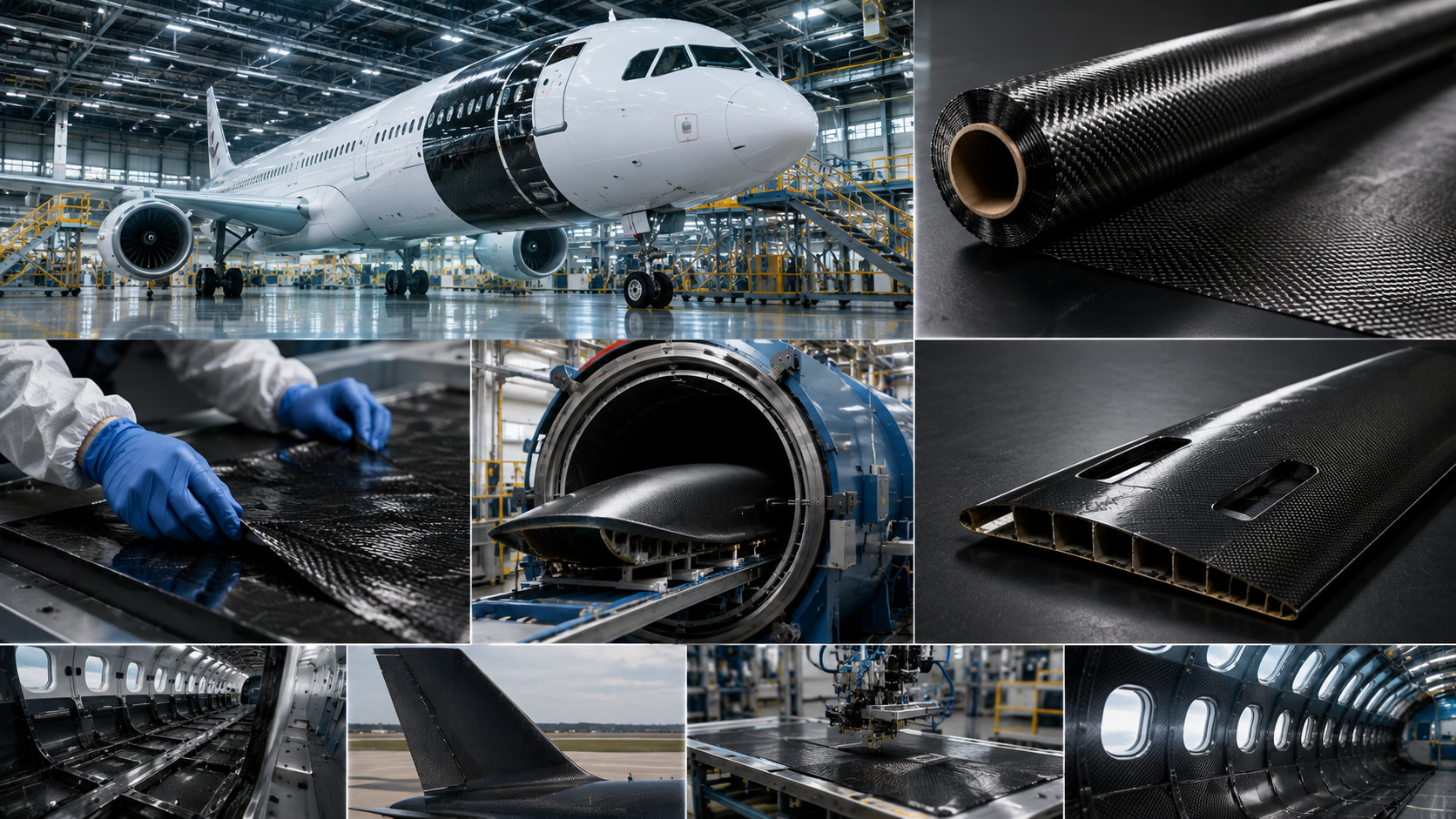
Application #2: Aerospace & Defense Structural Components — Precision Under Extreme Loads

Aerospace doesn’t forgive mistakes. A bracket fails at 40,000 feet, and the gap between a maintenance log entry and a catastrophe is zero. That’s why this sector sets the hardest material standards on earth — and why forged carbon fiber applications in aerospace and defense demand a different level of engineering discipline entirely.
The market shows how seriously the industry takes this material. Aerospace and defense composites were valued at USD 33.28 billion in 2024. By 2032, that number reaches USD 53.85 billion — a steady 6.2% annual growth rate driven by real structural demand, not marketing cycles.
Built to Survive What Other Materials Can’t
Carbon fiber reinforced polymer in aerospace isn’t chosen for looks. It’s chosen because it holds — under conditions that would destroy most other materials.
Structural components on aircraft, UAVs, and spacecraft face load profiles that break conventional assemblies:
- Temperature swings from -50°C in stratospheric cold to over 1,000°C near propulsion systems
- Ongoing exposure to wet, dry, abrasive, and gamma radiation environments
- Ascent loads calculated against combined safety factors that leave zero room for material variability
Engineers rely on probabilistic failure modeling here. High-consequence structural components must hold annual failure probabilities as low as 10⁻⁶ — a reliability index of 4.75. That’s not a target. That’s the floor.
Compression molded carbon fiber meets these demands because the manufacturing process spreads chopped fiber in all directions throughout the part. There are no weak-axis orientations. No seam lines under directional stress. The forged composite material performs at the same level in every direction — and that’s what aerospace structures need when load paths shift mid-flight.
Real-time fiber optic sensing now tracks structural integrity across aircraft frames, spacecraft panels, and UAV components during operation. It catches impact damage and load anomalies before they spread. High strength lightweight material you can also monitor in real time is what makes carbon fiber aerospace components viable at the full systems level — not just the individual part.
Application #3: Luxury Consumer Goods & Automotive Interiors — Where Aesthetics Meets Engineering

Here’s what sets this sector apart from aerospace or EV lightweighting: buyers don’t just want performance — they want to see it. The random, flowing texture of forged composite material delivers something traditional woven carbon fiber can’t match. You get organic complexity that looks handcrafted — even when precision engineering produced it.
Why Forged Carbon Fiber Fits the Luxury Brief Premium automotive manufacturers face three competing pressures right now:
- Personalization demand is surging — custom options have become a top purchase driver among high-income buyers
- Sustainability requirements are tightening — environmental compliance is reshaping material choices across every tier
- Weight matters more than ever — EV interiors need lighter trim without losing tactile quality
Compression molded carbon fiber solves all three at once. Complex three-dimensional shapes — instrument panels, center consoles, door inserts — come out of a single mold cycle. No hand-layup labor. No seam lines. The forged carbon fiber manufacturing process produces geometry that leather wrapping and aluminum facing simply can’t achieve.
Lamborghini proved it with its Forged Carbon interior program. The aesthetic became a signature — not just a trim option. Carbon fiber luxury goods now carry that same logic into high-end watch cases, pen barrels, and audio equipment housings. In each case, high strength lightweight material earns a premium that decorative finishes alone never could justify. The same premium forged texture works beautifully on smaller luxury items — explore it in forged carbon fiber wallets or forged carbon fiber watches.
Asia-Pacific is pushing this trend the hardest, the same premium forged texture works beautifully on smaller luxury items — explore it in forged carbon fiber rings, forged carbon fiber keyboards, and forged carbon phone cases. China’s growing affluent class is driving premium vehicle demand at a pace European and North American markets aren’t matching. For manufacturers looking at forged carbon fiber applications in consumer goods, that’s the growth signal worth tracking heading into 2026.
Application #4: Medical Implants & Orthopedic Devices — Biocompatibility at Scale

Seven million Brånemark implants placed worldwide by 2012. One million spinal rods by 2000. These aren’t prototype numbers. Advanced composite medical devices have lived inside human bodies for decades. The material demands they face are unlike anything in automotive or aerospace.
The human body is an unforgiving host. It corrodes. It rejects. It loads implants with cyclic stress, day after day, for years. Three failure modes send patients back to the operating table:
- Mechanical failure
- Poor osteointegration
- Corrosion-driven degradation
Every material choice is a bet against all three of those outcomes at once.
Compression molded carbon fiber reinforced polymer brings a clear structural advantage here. Its Young’s modulus can be tuned to match cortical bone in the 10–30 GPa range. That matters more than raw strength. An implant stiffer than the surrounding bone stress-shields the tissue. That triggers resorption, loosening, and eventual failure. Forged composite material avoids that mismatch in ways titanium and cobalt-chromium alloys simply can’t match — not by design, not by structure.
Meeting the Biocompatibility Threshold
ISO 10993 sets the floor. Materials must clear cytocompatibility, genotoxicity, hemocompatibility, sensitization, and degradation testing before getting anywhere near a surgical suite. The viability benchmark: ≥70% viable cells on MTT assay at 570 nm absorbance. Anything below that doesn’t proceed. Full stop.
Carbon fiber reinforced polymer clears these thresholds. But composite engineering still matters after that. Fiber-reinforced polymers carry documented risks around particle exposure and biomechanical mismatch. The carbon fiber manufacturing process behind forged composites uses random chopped-fiber distribution. This reduces directional stress concentration. Less stress concentration means less wear debris. And wear debris is a direct contributor to osteolysis in joint replacements.
Spinal rods are a strong example. Titanium fatigue fractures and pseudarthrosis are persistent clinical problems in that space. High strength lightweight material that spreads load evenly across directions — rather than concentrating it along one axis — is a real engineering improvement, not a marginal one. That’s the clinical case building behind forged carbon fiber applications in orthopedics heading into 2026.
Application #5: High-Performance Sporting Equipment — Beyond the Marketing Hype

The sporting goods industry has a carbon fiber problem — not a shortage, but a credibility gap. Too many products slap a woven carbon fiber aesthetic on components that don’t need it. Forged carbon fiber applications in sports equipment are different. The performance case here is structural, not cosmetic.
The global sports equipment market hits $266.7 billion in 2026, on track for $431.5 billion by 2033. The high-tech segment sits at $3.62 billion in 2026, growing at 10.7% per year through 2033. That’s where compression molded carbon fiber earns its place. That’s the segment worth watching.
Where the Material Earns Its Place Bicycle frames, tennis racket cores, lacrosse shafts, and hockey stick blades all share one core requirement. Each needs a high strength lightweight material that absorbs vibration across irregular impact loads — not just along a single axis. Forged composite material outperforms woven layups here. The reason is fiber orientation. Random fiber distribution spreads stress in every direction at once. Woven layups can’t match that — see the full forged carbon fiber vs traditional woven carbon fiber comparison for the technical breakdown.
Amateur athletes now make up 40% of the market. They’re funding precision-grade equipment that used to be reserved for professionals. Carbon fiber sporting equipment built through compression molding hits those performance thresholds. Plus, it scales to production volumes that handcrafted woven parts never could. Asia-Pacific is driving this shift at 7% CAGR, with China and Japan leading adoption. For similar lightweight gains in other high-performance gear, check out forged carbon fiber motorcycle parts, forged carbon fiber knives, and forged carbon fiber helmets.
The marketing hype is real. But so is the engineering advantage — as long as the application fits the material.
🗂️ Framework Summary Card
Five industries. One material. Here’s the full map at a glance.
| Sector | Key Application | Primary Value Driver |
|---|---|---|
| Electric Vehicles | Battery enclosures, crash structures | Weight reduction, regulatory compliance |
| Aerospace & Defense | UAV frames, structural brackets | Reliability under extreme loads |
| Luxury Goods & Interiors | Trim panels, watch cases | Aesthetic differentiation + premium margins |
| Medical Devices | Spinal rods, orthopedic implants | Biocompatibility, modulus matching |
| Sporting Equipment | Frames, shafts, racket cores | Multidirectional impact absorption |
| Renewable Energy | Turbine blade roots, nacelle housings | Fatigue resistance at scale |
| Pressure Vessels & Energy | Hydrogen tanks, downhole components | Weight-to-pressure ratio |
| Robotics & Automation | Arm linkages, end-effectors | Stiffness-to-mass ratio |
Every sector in this table shares three core needs:
- Shapes too complex for woven layups to fill
- Performance levels that traditional metals simply can’t reach
- Market pressure that makes high strength lightweight material a must, not a choice
That’s the common thread. Forged carbon fiber applications don’t win because they’re new. They win because the engineering numbers keep pointing to the same answer.
Conclusion
Forged carbon fiber isn’t a niche curiosity anymore. It’s changing how engineers and designers think about what a material can be.
The proof is in the applications. EV chassis shed critical kilograms without losing structural integrity. Luxury timepieces use the swirling random-fiber pattern as the main visual feature — not a detail, but the whole point. The pattern holds: compression molded carbon fiber performs where conventional materials hit their limits. Geometry freedom alone opens up design possibilities that didn’t exist before.
Stop treating forged composite material as a premium upgrade. It’s a platform decision. The companies pulling ahead in 2026 aren’t waiting for the perfect use case. They’re already prototyping, testing, and learning.
Your next move:
– Request a sample
– Run your own mechanical benchmarks
– Stress-test the aesthetics against your target market
The data will tell you what no article can.
The lightest structure isn’t always the weakest one. Sometimes it’s the smartest.
Contact HyperX Carbon – Your Trusted Chinese Carbon Fiber Partner
Ready to source high-performance carbon fiber materials or custom forged carbon fiber parts from China?
HyperX Carbon is a leading manufacturer with 20+ years of expertise, specializing in aerospace-grade forged carbon fiber, prepreg, tubes, sheets, and lightweight automotive/drone/medical components. We offer:
- Stable supply chain with premium raw materials (Toray, Mitsubishi, Hengshen)
- AS9100D certified production for aerospace & UAV applications
- Rapid prototyping (5-8 weeks) and monthly capacity exceeding 180,000 parts
- Competitive pricing with 15-18% cost savings on forged carbon solutions
- Full customization: from T700/T1100G to ultra-high modulus grades
Whether you’re an eVTOL developer, automotive OEM, drone manufacturer, or medical device engineer, HyperX delivers consistent quality, batch-to-batch reliability, and reliable delivery.
Get in touch today for a free consultation, custom quote, or material sample.
📧 Email: [email protected]
🌐 Website: https://www.hyperxcarbon.com/
📞 Phone/WhatsApp: +86 15623270276 (English support available)
Let’s build your next lightweight innovation together – contact HyperX Carbon now and stay ahead in the low-altitude and advanced composites market.