Buying carbon fiber seems simple until the first real decision appears.
Should you buy a finished carbon fiber part that is ready to install?
Should you buy prepreg, dry fabric, tow, sheet, plate, tube, or rod and process it yourself?
Should you buy semi-finished stock and CNC machine it?
Or should you ask a carbon fiber factory to manufacture the finished part for your project?
This is not only a technical question.
It is a procurement strategy question.
The wrong choice can create two very different problems. You may overpay for finished parts when your team already has the equipment and production volume to process materials efficiently. Or you may buy raw carbon fiber materials because the unit price looks cheaper, then lose money through tooling, scrap, rework, storage problems, cure failures, inspection gaps, and missed deadlines.
The lowest material price is not always the lowest project cost.
This guide explains how buyers should compare finished carbon fiber parts, carbon fiber materials, semi-finished stock, and custom manufacturing. It focuses on total cost, in-house capability, tooling, quality control, inspection responsibility, material storage, production volume, and risk transfer.
At HyperX Carbon, we review this decision before quotation when a project involves custom carbon fiber parts, CNC-cut carbon fiber sheets, molded components, tubes, plates, prepreg-based manufacturing, visible carbon surfaces, structural load, or repeat production.
This article is not about standard products versus custom parts. It is about whether the buyer should purchase a finished carbon fiber component or take responsibility for materials, processing, tooling, inspection, and production risk.
Finished Carbon Fiber Parts vs Carbon Fiber Materials: What This Guide Covers
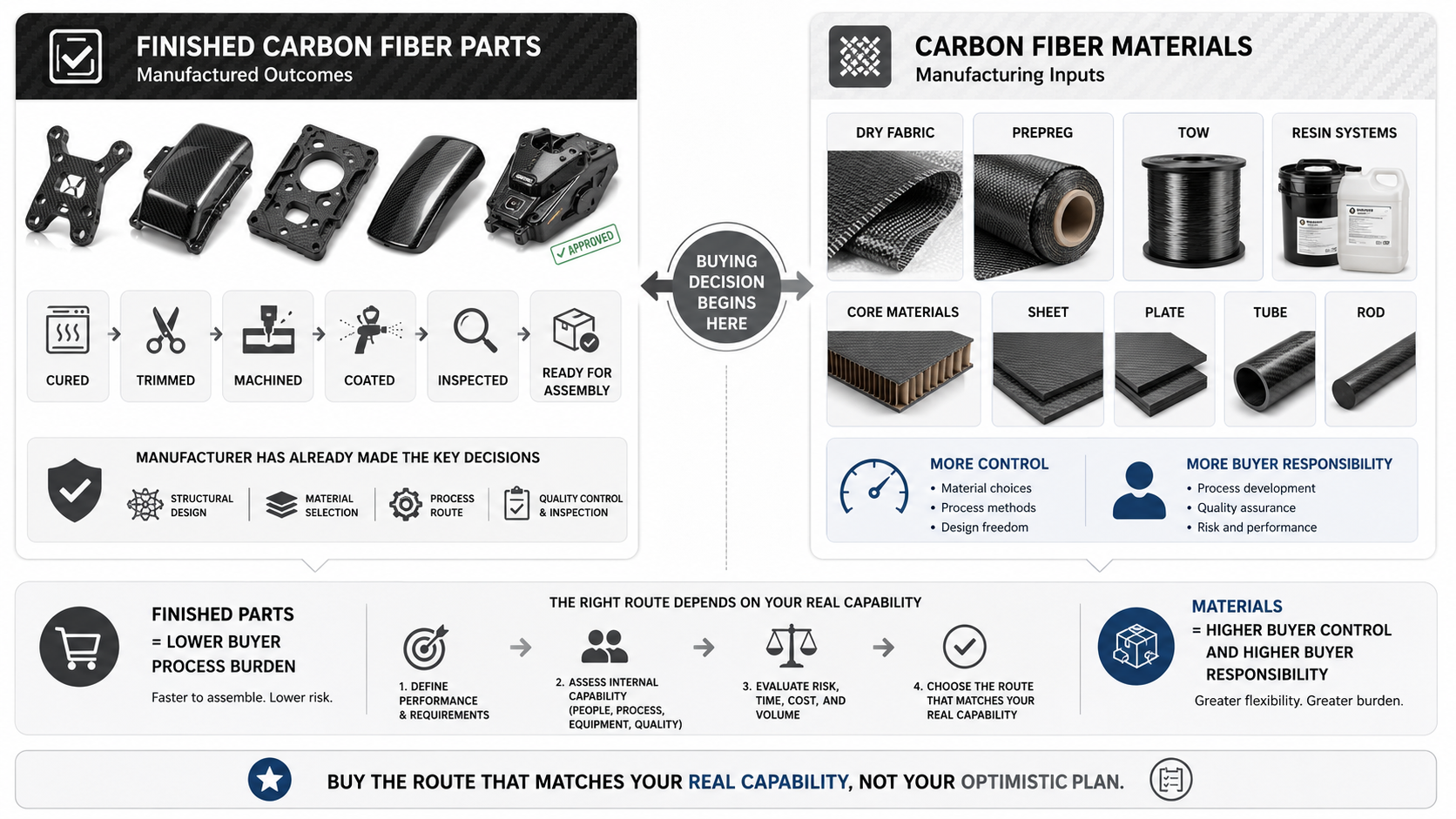
The buying decision starts with one fundamental split:
Finished carbon fiber parts are manufactured outcomes.
Carbon fiber materials are manufacturing inputs.
Finished parts arrive cured, trimmed, machined, coated, inspected, and ready for installation or assembly. The manufacturer has already made the structural, material, process, and quality-control decisions.
Carbon fiber materials are different. They may include dry fabric, prepreg, tow, resin systems, core materials, or semi-finished stock such as sheet, plate, tube, and rod. They give the buyer more control, but they also move more responsibility to the buyer’s side.
This guide covers the practical decision points:
-
What counts as a finished carbon fiber part
-
What counts as carbon fiber materials and semi-finished stock
-
The real difference between a finished outcome and a manufacturing input
-
Unit price vs total cost of ownership
-
In-house manufacturing capability
-
Tooling and equipment requirements
-
Material storage and process discipline
-
Layup, cure, inspection, and quality-control responsibility
-
Finished parts, CNC stock, and full custom manufacturing routes
-
Common misconceptions that increase purchasing risk
-
A quick decision checklist for buyers
The goal is simple:
Buy the route that matches your real capability, not your optimistic plan.
What Counts as a Finished Carbon Fiber Part?
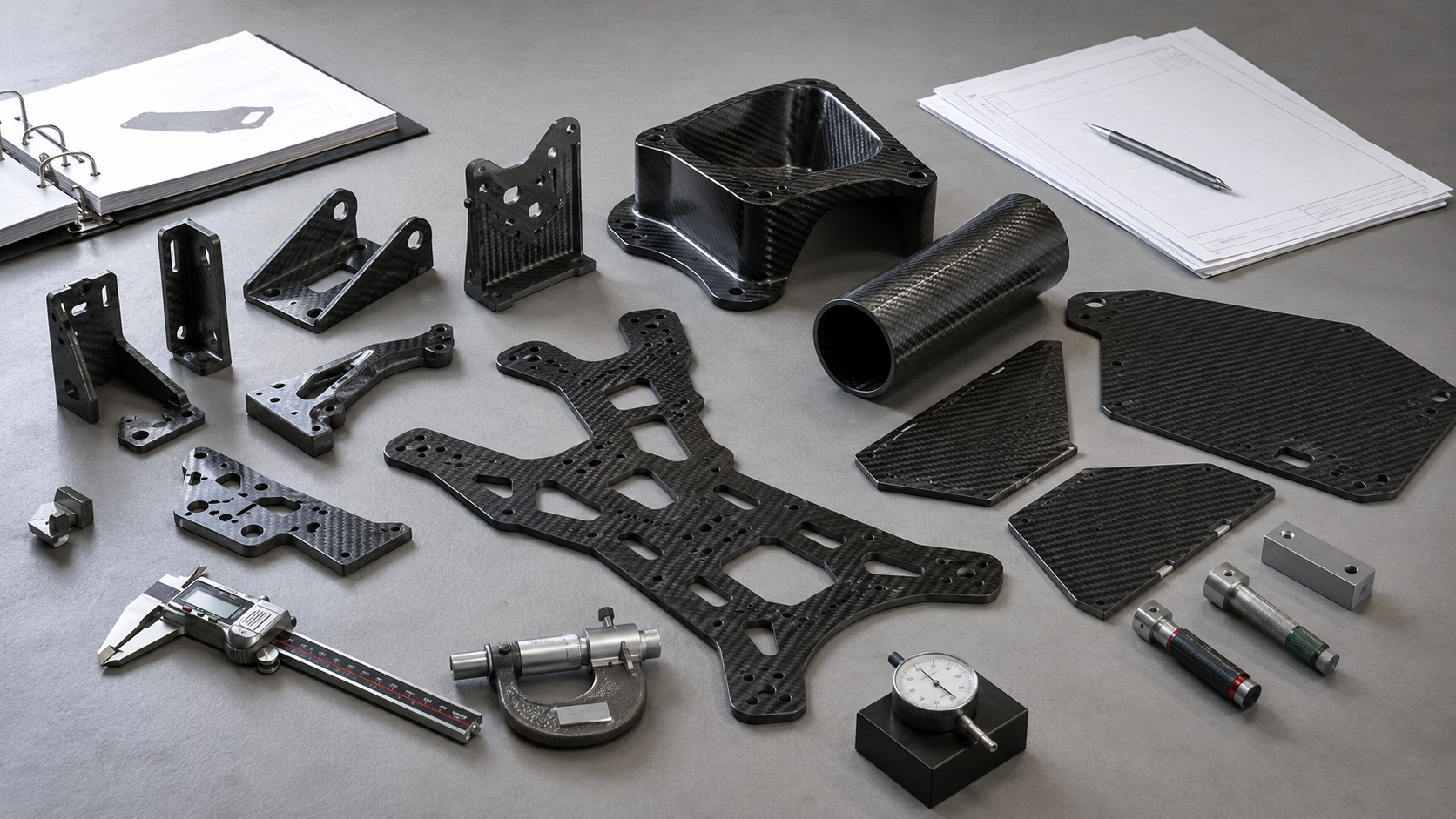
A finished carbon fiber part is a completed component.
It is not just carbon fiber shaped by someone else. It is the result of material selection, layup design, tooling, curing, trimming, finishing, inspection, and release.
Examples include:
-
Carbon fiber hood panels
-
Carbon fiber brackets
-
UAV frame plates
-
Carbon fiber wing elements
-
Carbon fiber interior trim
-
Carbon fiber robotic arms
-
Carbon fiber covers
-
Carbon fiber bike frames
-
Carbon fiber tubes cut and finished to specification
-
Molded carbon fiber structural components
A typical finished carbon fiber part may go through several manufacturing stages:
|
Stage |
What Happens |
Why It Matters |
|---|---|---|
|
Layup design |
Fiber orientation, ply count, and local reinforcement are defined |
Controls stiffness, strength, weight, and load path |
|
Tooling |
Mold or fixture is prepared |
Controls geometry, surface quality, and repeatability |
|
Fiber placement and resin control |
Wet layup, infusion, prepreg, compression molding, or other route is selected |
Controls fiber volume fraction and void risk |
|
Cure cycle |
Heat, pressure, vacuum, and time are controlled |
Controls resin crosslinking and laminate quality |
|
Trimming and machining |
Edges, holes, slots, and interfaces are cut |
Controls fitment and assembly accuracy |
|
Surface finishing |
Sanding, clear coat, paint, or surface treatment is applied |
Controls visible quality and protection |
|
Quality control |
Dimensional, visual, and sometimes NDT inspection is completed |
Controls release confidence |
Typical finished-part manufacturing data may include:
-
Wall thickness around 1.0–3.0 mm for many molded shells and panels, depending on design
-
Wet layup fiber volume fraction around 40–55%
-
Prepreg carbon fiber fiber volume fraction around 55–65%
-
Cure cycles around 120–180°C, 3–7 bar, and 1–3 hours, depending on resin and process
-
CNC trimming tolerance around ±0.5–1.0 mm for many finished parts
-
Autoclave prepreg porosity often under 1–2% when process control is strong
By the time the part ships, the major structural decisions are already made.
For buyers, that means less process risk.
You are not only buying carbon fiber material. You are buying the outcome of design, process control, tooling, cure validation, trimming, finishing, and inspection.
Structural Parts vs Cosmetic Covers
Finished carbon fiber parts are not all the same.
Cosmetic carbon fiber covers focus mainly on appearance, fit, surface quality, and basic dimensional stability. They may use a visible 3K twill face layer, clear coat, and a surface-driven layup. Fiber orientation is often chosen for visual effect rather than load path.
Structural carbon fiber parts are different.
They should be designed around load case, ply schedule, fiber direction, resin system, cure process, void content, and inspection requirement.
Structural parts may require:
-
Documented ply schedule
-
Fiber volume fraction target
-
Stated resin system
-
Cure record
-
Void content control
-
Mechanical test data
-
Dimensional inspection
-
NDT for critical zones
-
Batch traceability where required
A supplier that cannot provide a layup specification or curing record may have made a carbon-looking part, not a qualified structural component.
For cosmetic parts, surface quality and fitment may be enough.
For load-bearing parts, they are not.
What Counts as Carbon Fiber Materials and Semi-Finished Stock?
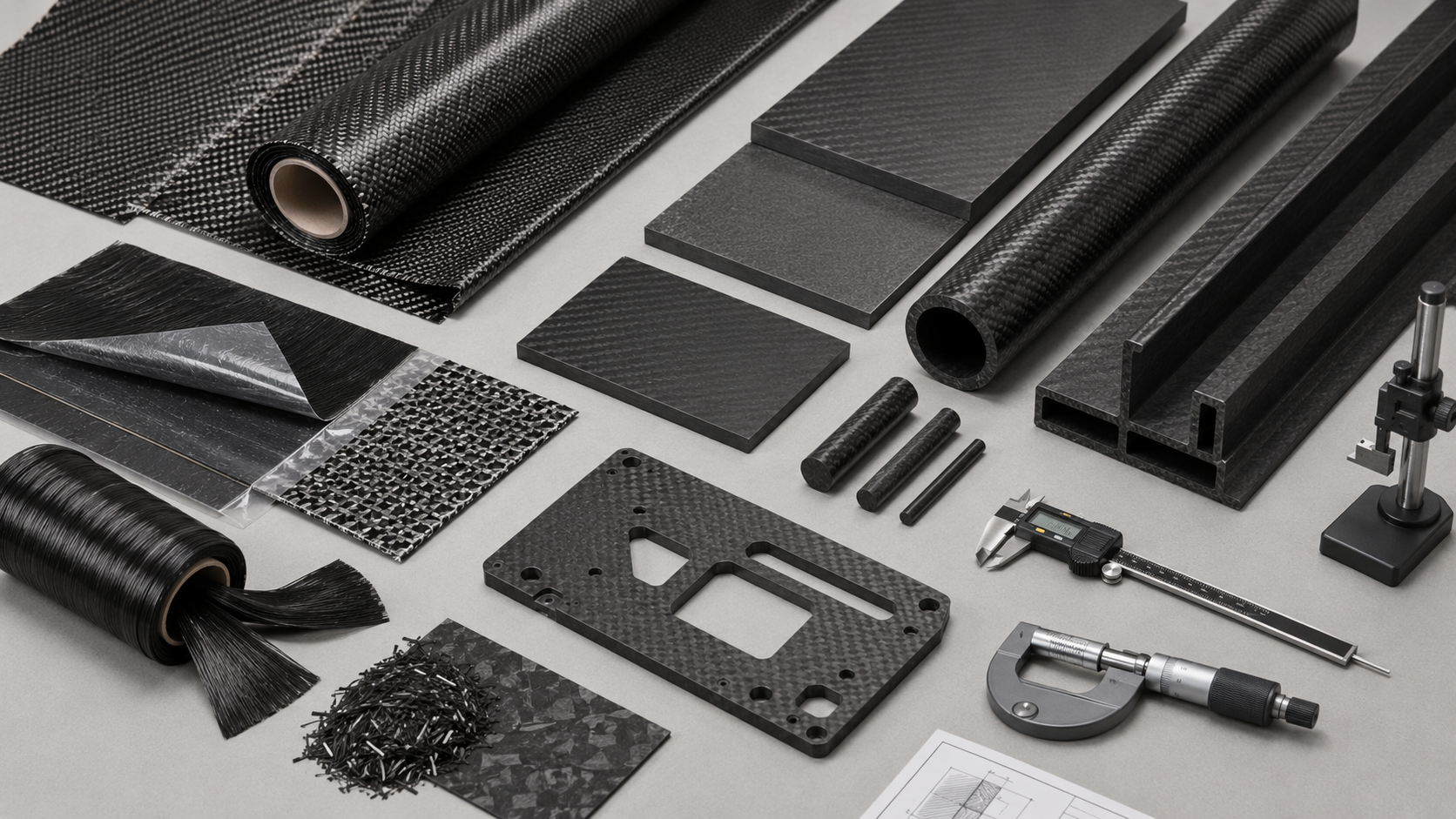
Carbon fiber materials are inputs used to manufacture or modify parts.
They are not ready-to-install outcomes.
For procurement decisions, it helps to separate raw or process materials from semi-finished stock.
Carbon Fiber Materials
Carbon fiber materials may include:
-
Dry carbon fiber fabric
-
Unidirectional reinforcement
-
Multiaxial fabric
-
Carbon fiber prepreg
-
Carbon fiber tow
-
Chopped carbon fiber
-
Forged carbon fiber material
-
Resin systems
-
Core materials
-
Adhesives and auxiliary materials
These materials require process control. Someone still needs to laminate, wet out, consolidate, cure, trim, inspect, and release the part.
Dry fabric has zero resin inside. The resin is added through wet layup, vacuum infusion, RTM, or another molding process.
Prepreg already contains resin, often around 30–40 wt% by weight, but it requires controlled storage, layup, vacuum bagging, and cure.
Tow can be used in filament winding, pultrusion, braiding, weaving, or automated fiber placement. It offers flexibility and efficiency, but it requires appropriate equipment and process control.
Semi-Finished Carbon Fiber Stock
Semi-finished stock includes carbon fiber products that are already cured into a basic shape but not yet finished for your exact application.
Examples include:
-
Carbon fiber sheet
-
Carbon fiber plate
-
Carbon fiber tube
-
Carbon fiber rod
-
Pultruded carbon fiber profiles
-
CNC-ready carbon fiber panels
These are not raw materials in the strict manufacturing sense. The composite layup and cure process are already complete.
The buyer usually performs:
-
Cutting
-
CNC machining
-
Drilling
-
Slotting
-
Bonding
-
Assembly
-
Secondary finishing
-
Inspection
This route is often the practical middle ground.
For example, a buyer may not have the capability to laminate prepreg or run infusion, but may still be able to buy cured carbon fiber plate and CNC machine custom profiles, holes, and interface features.
That is why this article separates three routes:
|
Route |
What You Buy |
What You Still Own |
|---|---|---|
|
Finished part |
Completed carbon fiber component |
Installation, assembly, and incoming inspection |
|
Carbon fiber materials |
Fabric, prepreg, tow, resin, or reinforcement |
Laminate design, process control, cure, inspection, scrap risk |
|
Semi-finished stock |
Sheet, plate, tube, rod, cured panel |
CNC machining, cutting, drilling, bonding, fitment, edge quality |
The farther you move from finished parts toward raw materials, the more responsibility moves to your team.
The Real Buying Difference: Finished Outcome vs Manufacturing Input
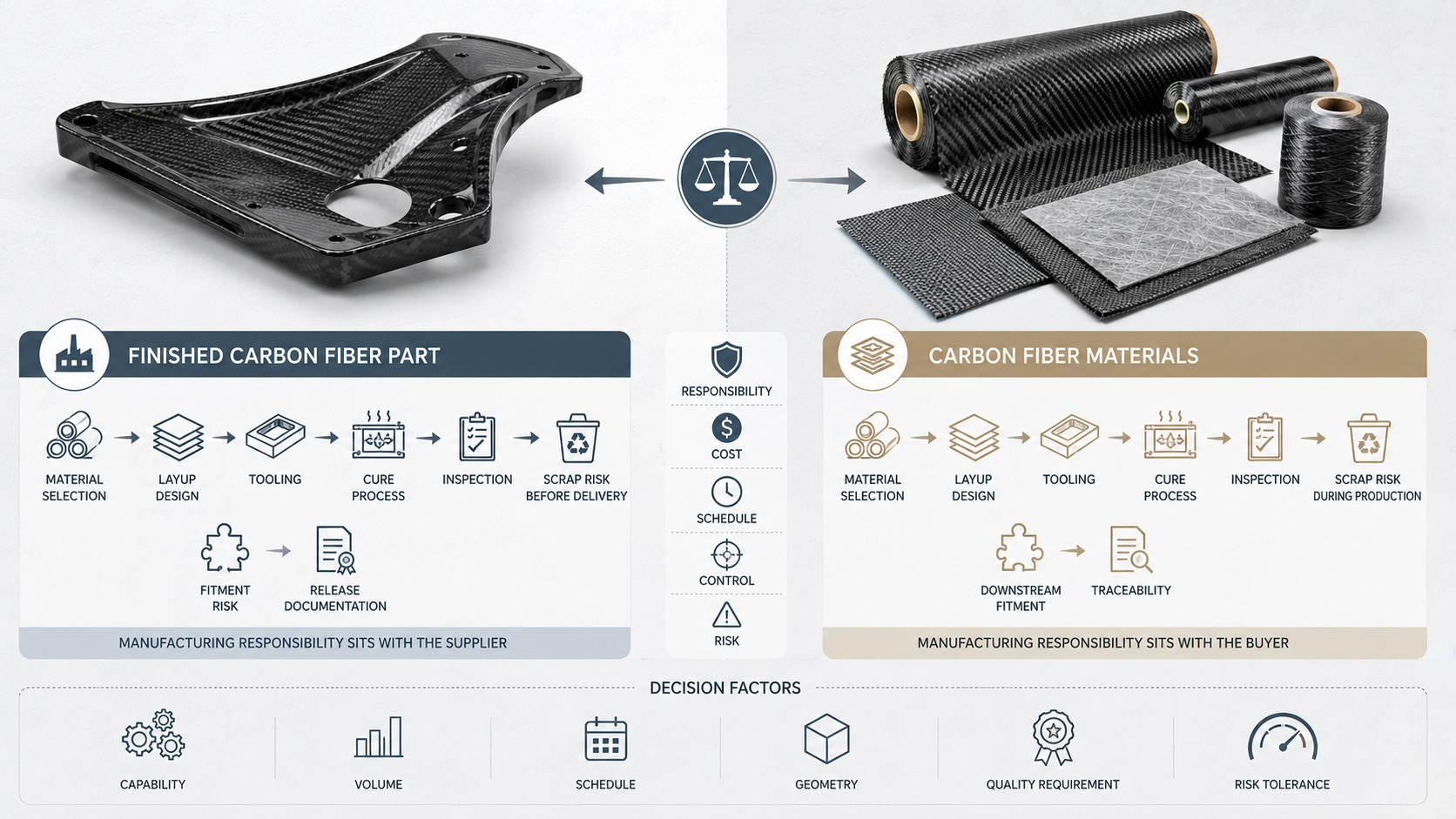
The real difference is not “part vs material.”
The real difference is where the responsibility sits.
A finished part transfers much of the manufacturing responsibility to the supplier. A raw material purchase keeps that responsibility with the buyer or the buyer’s production team.
|
Decision Area |
Finished Carbon Fiber Part |
Carbon Fiber Materials |
|---|---|---|
|
Material selection |
Mostly supplier responsibility |
Buyer or engineering team responsibility |
|
Layup design |
Built into part design |
Must be designed before production |
|
Tooling |
Supplier provides or manages |
Buyer must provide or develop |
|
Cure process |
Supplier controls |
Buyer must control |
|
Inspection |
Supplier performs before shipment |
Buyer must plan and perform |
|
Scrap risk |
Mostly supplier-side before delivery |
Buyer-side during production |
|
Fitment risk |
Controlled by part drawing and machining |
Depends on downstream processing |
|
Traceability |
Supplier should provide where required |
Buyer must maintain records if processing in-house |
|
Flexibility |
Lower after part design is fixed |
Higher before process is locked |
|
Skill required |
Lower for installation |
Higher for manufacturing |
A finished part is not always better.
Carbon fiber materials are not always cheaper.
The better route depends on capability, volume, schedule, geometry, quality requirement, and risk tolerance.
A simple rule helps:
More capability and more volume can justify materials. Less capability and less volume usually favors finished parts. Mixed capability often points to semi-finished stock and CNC machining.
At HyperX Carbon, many projects fall into this middle ground. Buyers may not need full material supply. They may need CNC-cut carbon fiber plates, cut-to-length tubes, molded carbon fiber parts, or a custom finished component based on their CAD and application.
Cost Comparison: Unit Price vs Total Cost of Ownership
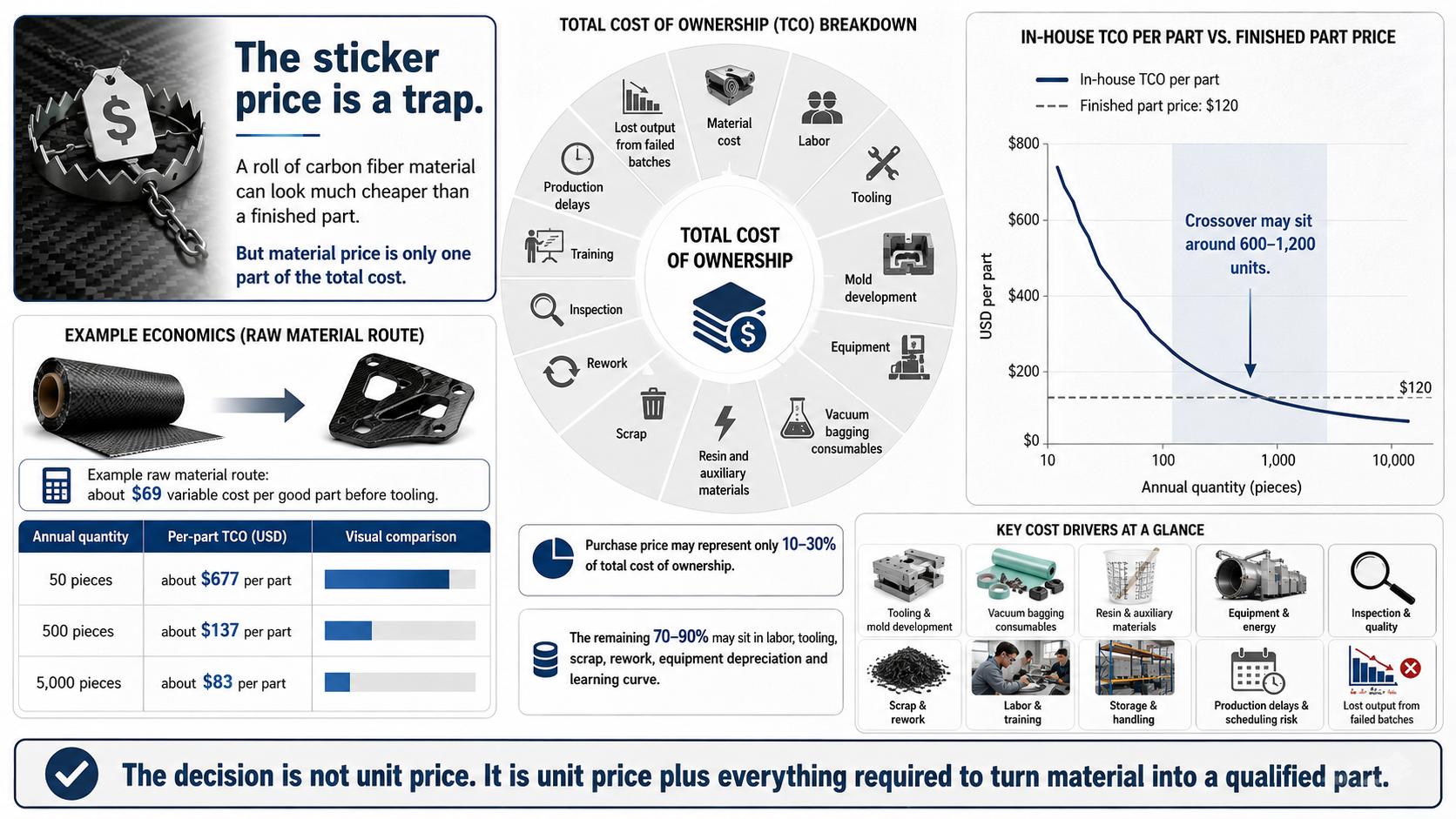
The sticker price is a trap.
A roll of carbon fiber material can look much cheaper than a finished part. But material price is only one part of the total cost.
A realistic total cost of ownership includes:
-
Material cost
-
Labor
-
Tooling
-
Mold development
-
Equipment
-
Vacuum bagging consumables
-
Resin and auxiliary materials
-
Energy
-
Scrap
-
Rework
-
Inspection
-
Storage
-
Training
-
Production delays
-
Lost output from failed batches
For many in-house composite projects, purchase price may represent only 10–30% of total cost of ownership. The remaining 70–90% may sit in labor, tooling, scrap, rework, equipment depreciation, and learning curve.
Example TCO Model
Consider a simple 1 kg carbon fiber part.
An in-house material route might look like this:
|
Cost Item |
Example Cost |
|---|---|
|
Material |
$20 / part |
|
Direct labor, 1 hour × $30/hour |
$30 / part |
|
Energy and consumables |
$12 / part |
|
Scrap adjustment at 10% rate |
About $7 / part |
|
Variable cost per good part |
About $69 |
Then fixed costs must be added.
|
Volume |
Tooling and Setup per Part |
Approximate TCO per Part |
|---|---|---|
|
50 pcs |
$600 |
~$677 |
|
500 pcs |
$68 |
~$137 |
|
5,000 pcs |
$14 |
~$83 |
If a finished part price is $120 in this example, the crossover point may sit around 600–1,200 units, depending on scrap rate, tooling cost, labor productivity, and equipment already available.
Below that range, the raw material route may not save money.
It may only move risk to the buyer.
Hidden Costs Buyers Often Miss
Learning curve: New composite processes may run at only 60–80% of target productivity for the first 3–6 months. A planned 1.0 hour per part can become 1.3–1.7 hours in early production.
Scrap and rework: A 10% rework rate or 5% full scrap rate can raise real cost per good part even when the material price looks low.
Tooling: Quality molds can cost thousands to tens of thousands of dollars. Matched tools, autoclave tooling, and high-temperature tooling raise the entry cost further.
Storage: Prepreg may require frozen storage around −18°C. If your team cannot manage cold chain and out-life, material waste becomes part of the cost.
Schedule risk: One day of line stoppage may cost $5,000–20,000 in lost output. Spread across a small batch, that can destroy the apparent savings from buying cheaper materials.
Volume-Based Rule
A practical TCO rule looks like this:
|
Production Situation |
Likely Better Route |
|---|---|
|
Under 50 units |
Finished parts usually win by 5–20× true TCO |
|
50–500 units |
Finished parts or CNC stock usually reduce risk |
|
500–5,000 units |
Case-by-case; depends on tooling, scrap, labor, and schedule |
|
Above 5,000 units |
In-house or dedicated contract manufacturing may reduce TCO if demand is stable |
The decision is not unit price.
It is unit price plus everything required to turn material into a qualified part.
Capability Check: Can Your Team Manufacture Carbon Fiber In-House?
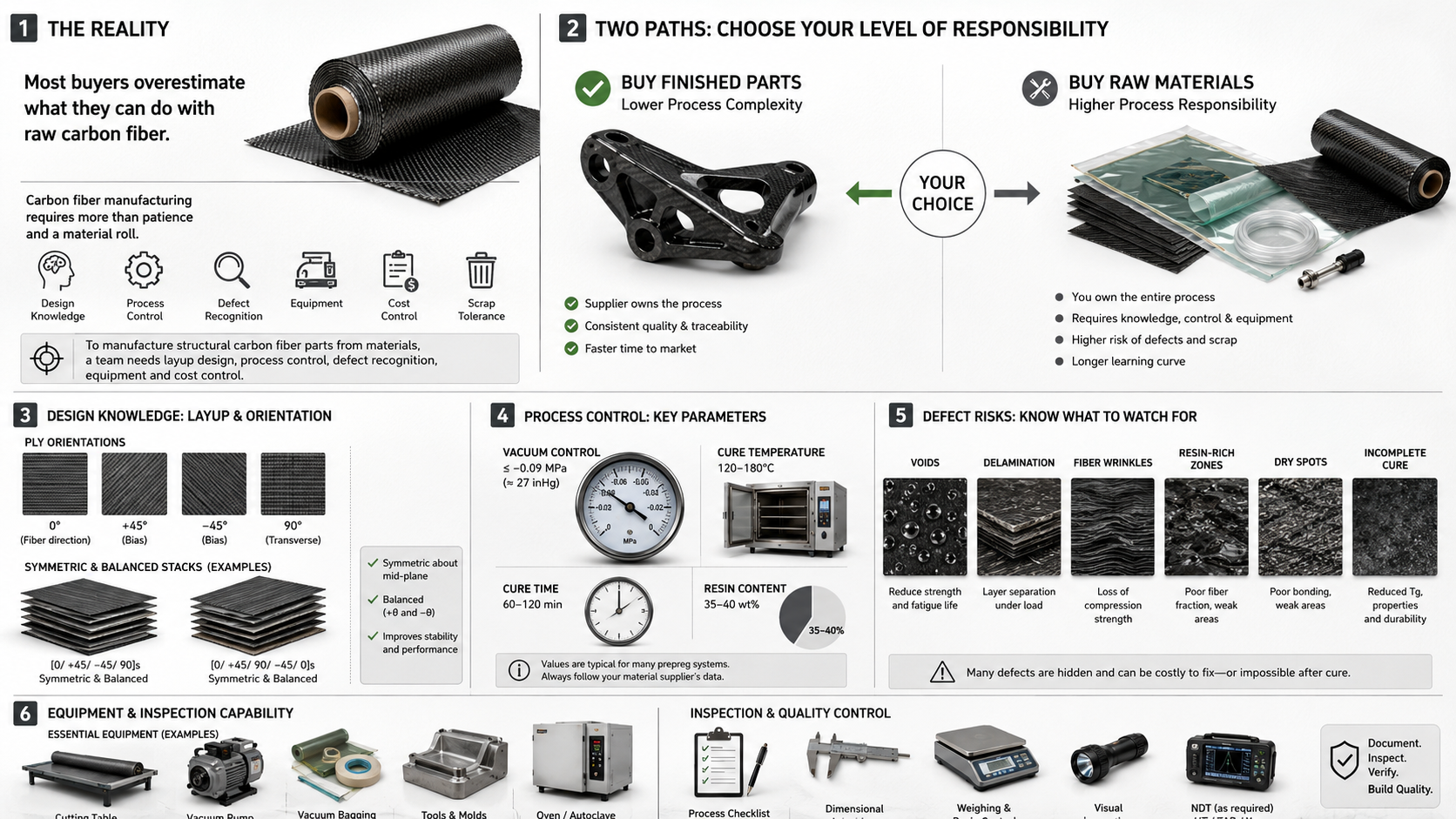
Most buyers overestimate what they can do with raw carbon fiber.
Carbon fiber manufacturing requires more than patience and a material roll. It requires design knowledge, process control, equipment, inspection capability, and tolerance for scrap during learning.
To manufacture structural carbon fiber parts from materials, your team needs capability in at least five areas.
1. Layup Design
A team working from raw materials must define the ply schedule.
Typical prepreg single-ply thickness may run around 0.125–0.25 mm, depending on material.
Common carbon fiber layup orientations include:
-
0°
-
±45°
-
90°
A typical structural stack may include:
-
0° plies for axial tension and compression
-
±45° plies for shear and torsion
-
90° plies for transverse stability and geometry support
Some structural laminates may use rough distribution ranges such as:
-
0° plies: 40–60%
-
±45° plies: 20–40%
-
90° plies: 10–20%
The stack should often be symmetric and balanced around the midplane. Asymmetric stacks can warp after cure.
If your team cannot explain why each fiber angle is present, buying raw material may be risky.
2. Process Control
Prepreg and dry fabric both require process control.
Prepreg may require:
-
Cold storage
-
Thaw control
-
Out-life tracking
-
Vacuum bagging
-
Cure temperature control
-
Pressure or vacuum control
-
Cure record documentation
Dry fabric may require:
-
Resin mixing
-
Resin viscosity control
-
Infusion path design
-
Wet-out control
-
Vacuum integrity
-
Debulking
-
Cure control
A prepreg process may need sustained vacuum around ≤ −0.09 MPa and cure conditions around 120–180°C for 60–120 minutes, depending on material data sheet.
Resin content may need to remain around 35–40 wt% in many prepreg systems.
Too much resin can create resin-rich zones and fatigue cracking. Too little resin can create dry spots, weak interfaces, and tensile failure.
You need to read a material datasheet and build a cure card from it.
Copying someone else’s cure cycle is not a process plan.
3. Defect Recognition
Carbon fiber defects are not always visible.
Your team should know how to identify and control:
-
Voids
-
Delamination
-
Fiber wrinkles
-
Resin-rich zones
-
Dry spots
-
Fiber shifting
-
Incomplete cure
-
Edge delamination
-
Drilling damage
Void content above 2–3% can reduce tensile, compressive, and fatigue performance in measurable ways.
Freehand wet layup may produce porosity above 5% if process control is weak.
Autoclave prepreg parts can reach under 1–2% porosity when process control is strong.
If your team cannot identify and quantify defects, it cannot validate structural parts.
4. Equipment
In-house processing may require:
-
Vacuum pump
-
Vacuum bagging consumables
-
Cure oven
-
Autoclave or press for some processes
-
Accurate scales
-
Temperature monitoring
-
Pressure monitoring
-
CNC cutting or trimming equipment
-
Dust control for carbon fiber machining
-
Inspection tools
-
Storage environment control
-
Cold storage for prepreg
Finished-part installation needs much less.
For many installations, the basic tool set may include:
-
Torque wrench in the 5–50 N·m range
-
Drill capable of holding ±0.1 mm hole tolerance
-
Calipers accurate to 0.02 mm
-
Fitment fixtures or assembly gauges where needed
That difference matters.
Buying finished parts reduces process complexity. Buying materials increases process responsibility.
5. Cost Control
A team should be able to calculate scrap-adjusted cost per good part.
Ask:
-
What is the realistic yield in the first 50 parts?
-
How many parts can be made before tooling changes?
-
How much labor is required per good part?
-
What is the rework rate?
-
What is the cost of a failed batch?
-
Can the timeline absorb a design revision cycle?
-
Is inspection included in the cost model?
If your team cannot answer these, finished parts or semi-finished stock may be the safer route.
A simple self-assessment:
|
Question |
Why It Matters |
|---|---|
|
Can you write a symmetric ply sequence and explain each fiber angle? |
Tests layup design capability |
|
Do you own vacuum, cure, storage, and inspection equipment? |
Tests process readiness |
|
Can you calculate scrap-adjusted cost across a 50-unit run? |
Tests TCO discipline |
|
Can you identify voids, dry spots, delamination, and fiber wrinkles? |
Tests quality capability |
|
Can you absorb a failed batch without missing delivery? |
Tests schedule risk tolerance |
Answer “not yet” to several of these, and finished parts are not a compromise.
They may be the correct buying route.
Performance and Quality Risk: Who Controls Layup, Cure and Inspection?
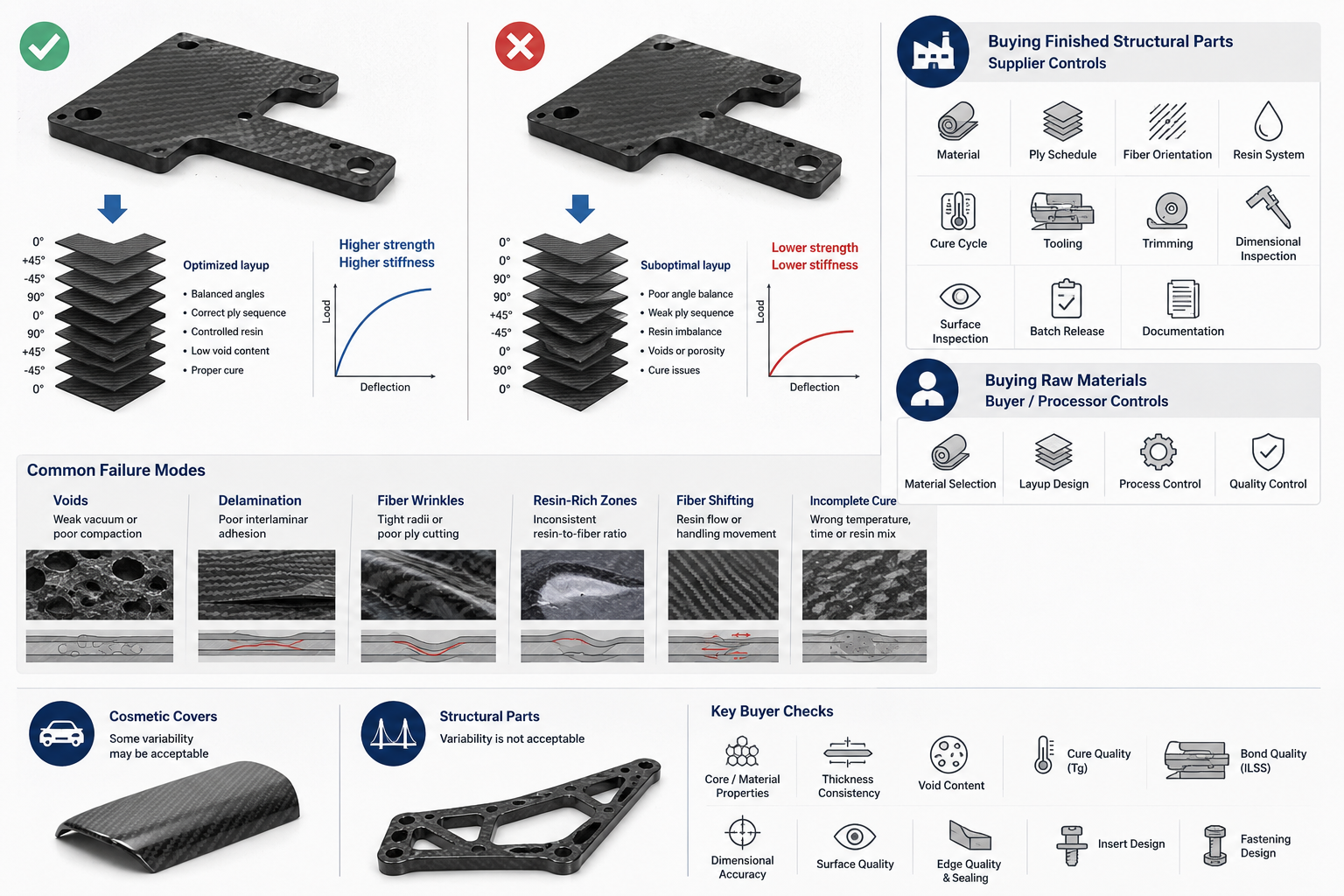
The fiber does not determine performance by itself.
The arrangement does.
Two parts can use the same carbon fiber material and look nearly identical, but one may fail at a much lower load because of fiber angle, ply sequence, resin control, void content, or cure quality.
That is why finished parts and materials create different quality responsibilities.
Finished Parts Transfer Process Risk
When buying a finished structural carbon fiber part from a qualified manufacturer, the supplier should control:
-
Material selection
-
Ply schedule
-
Fiber orientation
-
Resin system
-
Cure cycle
-
Tooling
-
Trimming
-
Dimensional inspection
-
Surface inspection
-
Batch release
-
Documentation where required
Controlled production can hold important variables more tightly.
Examples include:
-
Fiber angle tolerance around ±1–2° in controlled production
-
Fiber volume fraction around 55–60% using prepreg and controlled cure pressure
-
Void content under 1–2% for well-controlled autoclave prepreg parts
-
Batch-to-batch structural properties within ±10% where process and material control are stable
-
Hole and edge profiles around ±0.5–1.0 mm for many CNC-trimmed finished parts
The buyer still needs incoming inspection and fitment verification, but the main process responsibility stays with the manufacturer.
Materials Transfer Process Risk to the Buyer
When buying raw materials, the buyer or processor controls the key variables.
Common failure modes include:
|
Defect |
Root Cause |
Result |
|---|---|---|
|
Voids |
Weak vacuum, poor compaction, trapped air |
Strength loss and fatigue risk |
|
Delamination |
Poor interlaminar adhesion or contamination |
Failure below design load |
|
Fiber wrinkles |
Tight radii, poor ply cutting, poor debulking |
Local compressive strength reduction |
|
Resin-rich zones |
Inconsistent resin-to-fiber ratio |
Weight gain and cracking risk |
|
Fiber shifting |
Resin flow or handling movement |
Load direction misalignment |
|
Incomplete cure |
Wrong temperature, time, or resin mix |
Low Tg and weak mechanical properties |
For cosmetic covers, some variability may be acceptable.
For structural parts, it is not.
Structural parts should ask for:
-
Ply schedule
-
Fiber volume fraction
-
Void content target
-
Resin system
-
Cure record
-
Mechanical test data
-
Inspection report
-
NDT report where required
-
Batch traceability when required
Cosmetic parts may only need:
-
Surface quality
-
Fitment
-
Clear coat or paint quality
-
Basic thermal resistance
-
Dimensional check
Mixing these two categories causes purchasing mistakes.
Buyers may overpay for decorative covers or under-specify structural parts.
Both are avoidable.
Customization Options: Finished Parts, CNC Stock or Full Custom Manufacturing

Not every project fits a catalog.
A standard finished part may be enough when geometry, hole pattern, surface class, and loading are already close to your requirement.
But once the design needs custom wheelbase, special mounting holes, unusual sensor layout, integrated inserts, local reinforcement, or non-standard geometry, the buying route changes.
There are three practical options.
Option 1: Finished Carbon Fiber Parts
Finished parts are best when:
-
Existing geometry fits the application
-
Tolerance and surface quality are already acceptable
-
Production timeline is short
-
Buyer lacks composite manufacturing capability
-
Volume is low or medium
-
Process risk should stay with the manufacturer
This route is common for:
-
Automotive panels
-
UAV frames
-
Sports components
-
Covers
-
Brackets
-
Simple structural parts
-
Repeatable custom molded parts
The limitation is design freedom.
If the part does not match the application, forcing it to fit can create secondary machining, adapter plates, tolerance stack-up, and structural compromise.
Option 2: Semi-Finished Stock + CNC Machining
This is often the practical middle route.
Buyers can start with cured carbon fiber sheet, plate, tube, or rod, then machine it to match their design.
Common stock materials include:
-
1.0 mm carbon fiber plate
-
1.5 mm carbon fiber plate
-
2.0 mm carbon fiber plate
-
3.0 mm carbon fiber plate
-
5.0 mm carbon fiber plate
-
Carbon fiber tube
-
Carbon fiber rod
-
Pultruded profiles
CNC machining can create:
-
Custom hole patterns
-
Slots
-
Interface features
-
Brackets
-
UAV plates
-
Robot mounting plates
-
Equipment panels
-
Fixtures
-
Lightweight structural inserts
Typical CNC positional accuracy for custom stock machining may reach around ±0.05–0.1 mm, depending on equipment, part geometry, material thickness, and drawing requirements.
Lead time may be around 1–2 weeks for many simple CNC stock projects, compared with 4–8 weeks for full custom tooling and molded composite fabrication.
This route works well when the part is mostly flat or tube-based and does not require a new mold.
It gives more design freedom than finished catalog parts and less process risk than manufacturing from dry fabric or prepreg.
Option 3: Full Custom Carbon Fiber Manufacturing
Full custom manufacturing is the right route when geometry or performance cannot be achieved from standard stock.
Use this route when the project requires:
-
Compound-curved shells
-
Integrated structures
-
Local thickness changes
-
Custom layup design
-
Molded surfaces
-
High visible carbon quality
-
Special load paths
-
Complex inserts
-
Integrated battery bays
-
Sensor mounting structures
-
Bonded core structures
-
Repeat production from dedicated tooling
Full custom fabrication may use prepreg, dry fabric, infusion, compression molding, core materials, CNC trimming, bonding, and finishing.
It offers the highest design freedom, but it also requires tooling, engineering review, longer lead time, and a clearer production plan.
A practical rule:
|
Situation |
Better Route |
|---|---|
|
Standard part fits 85–90% of need |
Finished part with minor modification |
|
Flat plate or tube geometry with custom holes |
Semi-finished stock + CNC machining |
|
Geometry itself is custom |
Full custom carbon fiber manufacturing |
|
Buyer wants material control and has equipment |
Carbon fiber materials |
|
Buyer wants finished performance and lower process risk |
Finished parts or custom manufacturing |
At HyperX Carbon, this route decision is part of the early review. We look at whether the buyer needs material supply, CNC stock, molded parts, or a complete finished component.
Application Scenarios: When Each Buying Route Makes Sense
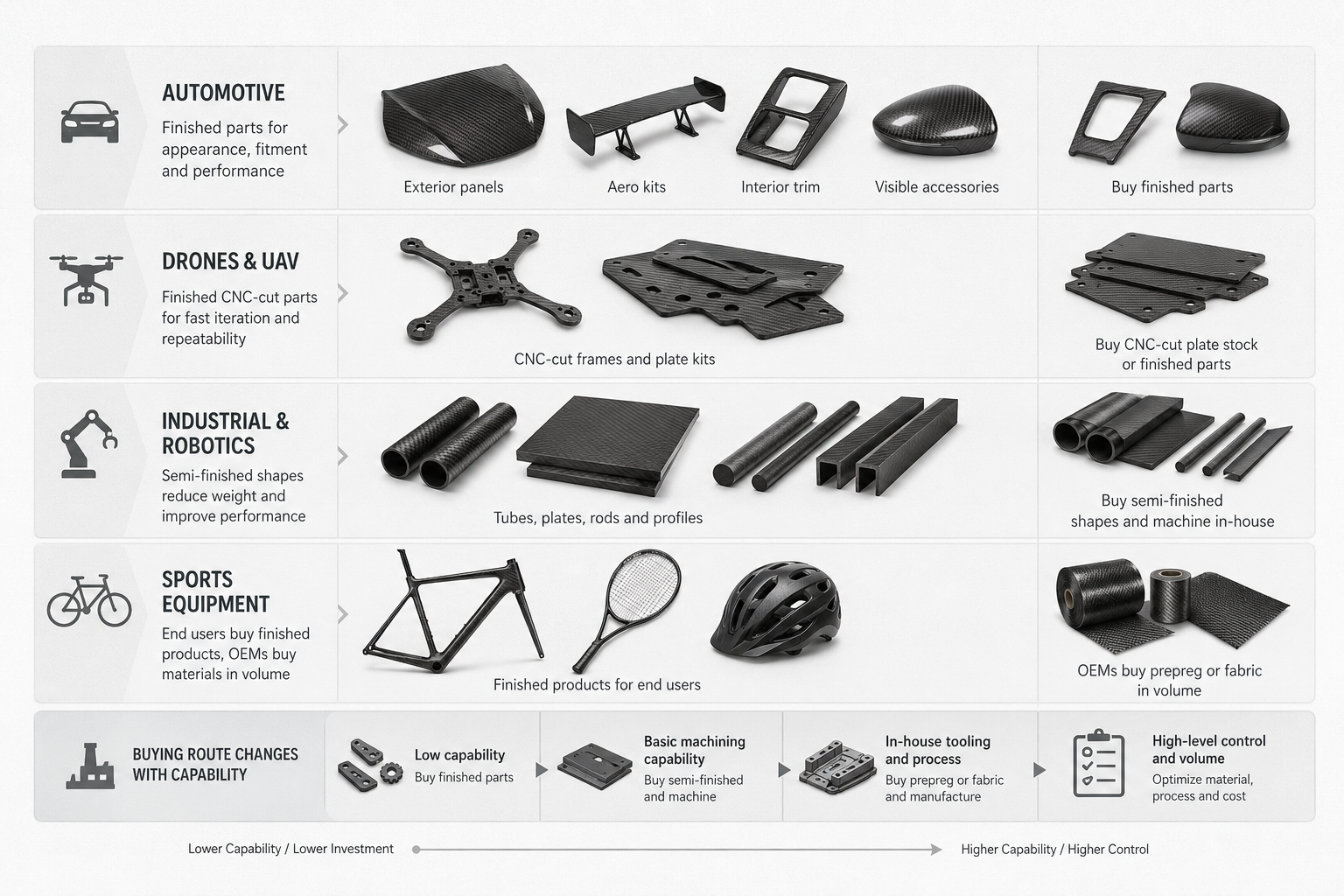
Different industries make different choices because performance, cost, and production reality are different.
Automotive
Finished parts often make sense for automotive exterior panels, aero kits, interior trim, and visible carbon accessories.
A track aero kit may replace 15–25 kg of OE parts with under 10 kg of CFRP, depending on design. Carbon fiber can reduce mass by 30–50% versus equivalent aluminum or steel panels.
Finished parts are attractive when:
-
Fitment matters
-
Surface quality matters
-
Buyer does not want tooling risk
-
Volume is low to mid
-
Installation speed matters
Raw prepreg or custom molding makes sense for full monocoque shells, motorsport structures, or highly integrated aerodynamic forms.
Drones and UAV
Finished CNC-cut carbon fiber frames are often best for racing drones, commercial UAV plates, landing gear, and repeatable frame systems.
A 250 mm racing quad frame may weigh 60–120 g and handle thrust loads above 5–8 kg, depending on design and material.
Material-based custom development makes sense for:
-
Non-standard fuselage shapes
-
Blended wing-body structures
-
Integrated payload bays
-
Experimental airframes
-
Prototype programs with several design cycles
For many UAV teams, CNC-cut carbon fiber plate is the fastest middle route.
Industrial and Robotics
Industrial buyers often use semi-finished stock.
Carbon fiber tubes, plates, rods, and profiles can reduce weight and improve motion response in robot arms, fixtures, machine frames, and pick-and-place beams.
Compared with steel, carbon fiber structures may reduce weight by 30–60% in suitable applications and improve acceleration or dynamic response where stiffness-to-weight ratio matters.
Semi-finished stock is often better than raw material when:
-
Geometry is simple
-
Flat or tubular structures are acceptable
-
Fast lead time matters
-
CNC accuracy is enough
-
No new composite mold is needed
Raw materials may be used by R&D teams testing multiple layups, but serial production often moves toward standard stock, custom molded parts, or contract manufacturing.
Sports Equipment
End users usually buy finished products.
Bike frames, golf shafts, rackets, paddles, and protective components are engineered through layup design and process control. The athlete does not need to handle prepreg, cure cycles, or fiber orientation.
OEMs may buy prepreg or fabric in volume because they own the tooling, design process, test plan, and manufacturing control.
This is the right split:
|
Buyer Type |
Better Route |
|---|---|
|
End user |
Finished product |
|
Product brand |
Contract manufacturing or material supply with production partner |
|
OEM with composite factory |
Prepreg, fabric, or tow |
|
Prototype builder |
CNC stock or custom manufacturing |
The buying route changes with capability.
Not with enthusiasm.
Common Misconceptions That Increase Carbon Fiber Purchasing Risk

Three beliefs cause many carbon fiber purchasing mistakes.
Misconception 1: Carbon Fiber Is Inherently Strong
The fiber is strong.
The part may not be.
Carbon fiber performance depends on fiber direction, ply schedule, resin system, consolidation, void content, cure quality, and inspection.
The same material can create a strong structural part or an expensive weak plastic-like panel.
A proper structural layup maps load paths:
-
0° plies carry axial tension and compression
-
±45° plies resist shear and torsion
-
90° plies stabilize transverse direction and support local geometry
If the load path is wrong, the resin matrix may carry loads it was never meant to carry.
Poorly designed CFRP can also fail differently from metal. Metal may yield and deform before failure. Carbon fiber can hold load until the critical point, then fracture suddenly.
Before buying a structural carbon fiber part, ask for:
-
Ply sequence
-
Ply thickness
-
Fiber volume fraction
-
Static strength data
-
Fatigue data where required
-
Resin system confirmation
-
Cure record where required
If the supplier cannot provide structural evidence, treat the part as cosmetic until proven otherwise.
Misconception 2: Raw Materials Are Always Cheaper
Material is cheaper than a finished part.
A finished qualified part may not be.
Fabric and resin may represent only 20–40% of a finished part’s total cost. The rest may include tooling, labor, equipment, quality control, scrap, finishing, inspection, and process development.
Early in-house composite production can face 20–30% scrap rate if the process is not mature.
The unit economics often shift only above a certain production volume. In many cases, the crossover may sit around 600–1,200 units, depending on tooling, labor, scrap, and equipment.
A fast TCO check:
-
Estimate annual production volume.
-
Amortize tooling and equipment over 3–5 years.
-
Use a conservative 70–80% yield rate for early production.
-
Add labor, consumables, inspection, storage, and rework.
-
Compare real per-unit cost with finished part or contract manufacturing quotes.
If self-manufacturing lands close to the buy price while adding higher process risk, it is not automatically a savings strategy.
Misconception 3: Any Fabricator Can Make Structural Carbon Fiber Parts
Surface finish is not structural competence.
Cosmetic carbon fiber fabrication needs clean layup and surface preparation.
Structural carbon fiber manufacturing needs:
-
Load analysis
-
Ply optimization
-
Cure control
-
Defect control
-
Damage tolerance
-
Inspection discipline
-
Traceability where required
Many structural defects are not visible on the surface.
Examples include:
-
Internal porosity above 2–3%
-
Fiber waviness
-
Incomplete cure
-
Delamination around holes
-
Resin-rich zones
-
Dry spots
-
Poor bonding
A qualified structural composite supplier should be able to provide:
-
Defined cure cycles
-
Batch records where required
-
Mechanical test data
-
Dimensional inspection
-
NDT capability for critical parts
-
ISO 9001 minimum for general quality systems
-
AS9100 where aerospace-grade work requires it
A lower unit price can be attractive.
But one structural failure can cost many times the original purchase amount.
Quick Decision Checklist: Which Option Should You Buy?
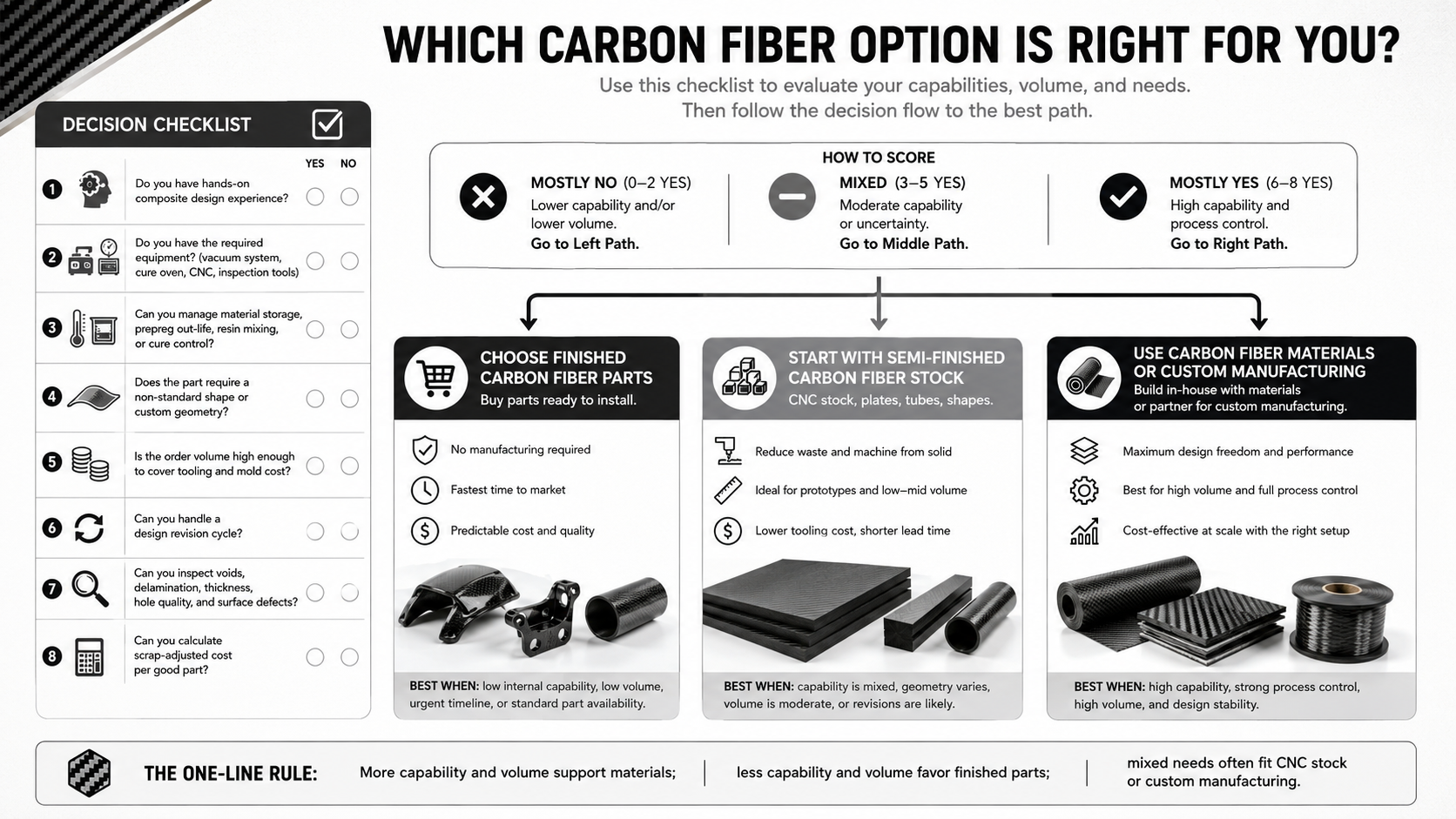
Use this checklist before choosing finished parts, materials, semi-finished stock, or custom manufacturing.
|
# |
Question |
Yes / No |
|---|---|---|
|
1 |
Do you have hands-on composite design experience? |
Yes / No |
|
2 |
Do you own the required equipment, such as vacuum system, cure oven, CNC, or inspection tools? |
Yes / No |
|
3 |
Can your team manage material storage, prepreg out-life, resin mixing, or cure control? |
Yes / No |
|
4 |
Does your part require a non-standard shape or custom geometry? |
Yes / No |
|
5 |
Is your order volume high enough to cover tooling and mold cost? |
Yes / No |
|
6 |
Can you handle a design revision cycle without breaking the timeline? |
Yes / No |
|
7 |
Can you inspect voids, delamination, thickness, hole quality, and surface defects? |
Yes / No |
|
8 |
Can you calculate scrap-adjusted cost per good part? |
Yes / No |
If Most Answers Are No
Buy finished carbon fiber parts or ask for custom manufacturing.
This route reduces process risk and gives you a production-ready outcome.
If Most Answers Are Yes
Carbon fiber materials may make sense.
This is especially true when you already have layup knowledge, tooling, storage, cure equipment, inspection control, and enough volume to justify the process.
If the Answers Are Mixed
Start with semi-finished carbon fiber stock.
CNC-cut sheet, plate, tube, or rod can give you custom geometry without full laminate manufacturing responsibility.
This is often the safest route for UAV frames, robot brackets, equipment plates, fixtures, and low-to-mid-volume industrial parts.
A simple decision map:
|
Your Situation |
Recommended Buying Route |
|---|---|
|
Need ready-to-install part |
Finished carbon fiber part |
|
Need custom flat plate geometry |
CNC-cut carbon fiber sheet or plate |
|
Need tube frame or structural member |
Cut and bonded carbon fiber tube or rod |
|
Need molded custom geometry |
Full custom carbon fiber manufacturing |
|
Need to control material and have equipment |
Carbon fiber material supply |
|
Need performance but lack process capability |
Finished part or contract manufacturing |
|
Need prototype with fast revision |
CNC stock or custom low-volume manufacturing |
The one-line rule:
More capability and volume support materials. Less capability and volume favor finished parts. Mixed needs often fit CNC stock or custom manufacturing.
What to Send HyperX Carbon for Material Route Review
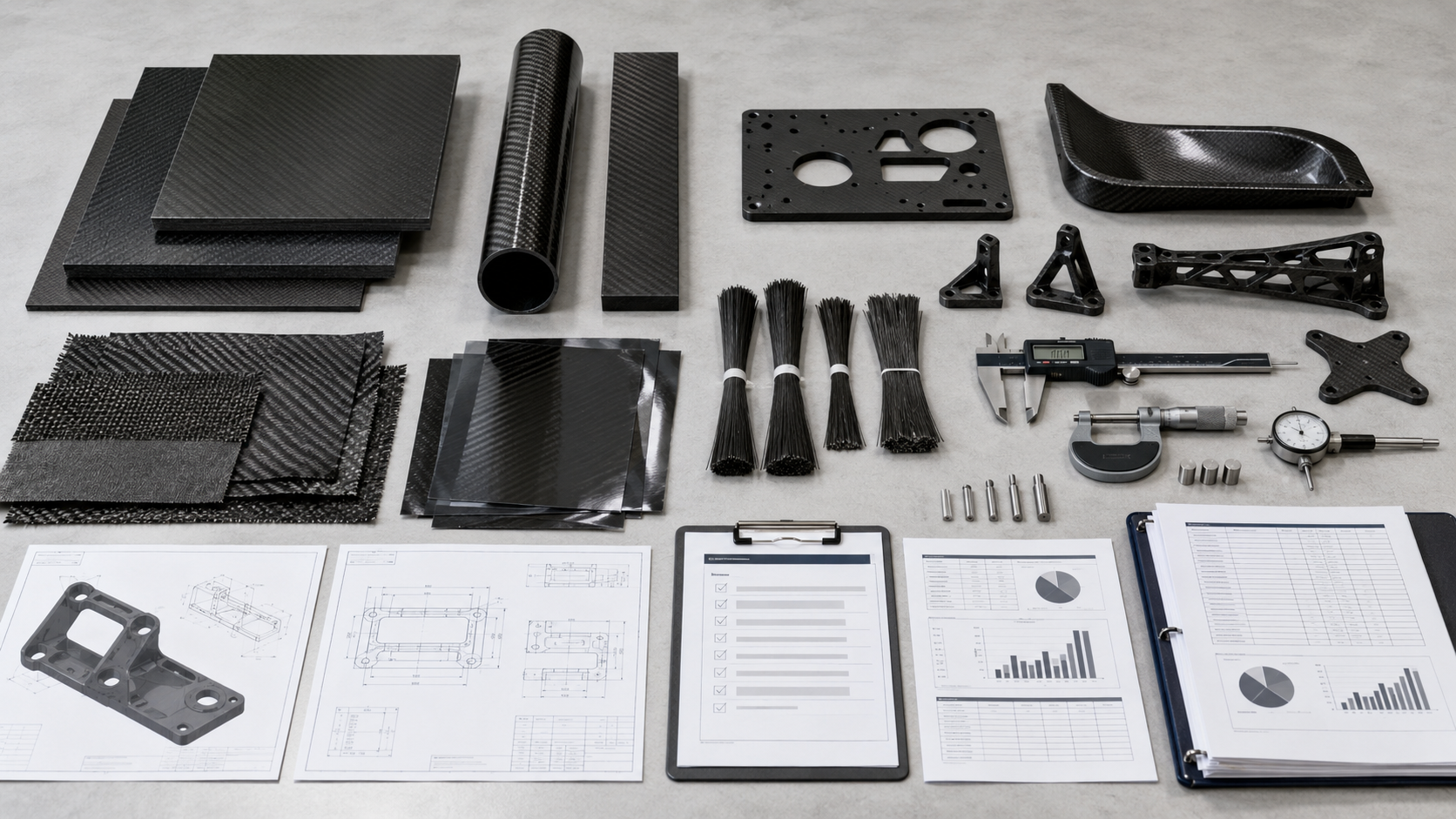
A strong buying decision starts with clear project information.
Before asking for a quote, send:
-
3D CAD file
-
2D drawing
-
Part size
-
Quantity target
-
Application
-
Load direction
-
Surface requirement
-
Weight target
-
Tolerance requirement
-
Visible or hidden surface class
-
Material preference, if any
-
Required production method, if any
-
Inspection requirement
-
Documentation requirement
-
Timeline
For the parts-versus-materials decision, also tell us:
-
Whether you want finished parts or material supply
-
Whether your team has in-house composite manufacturing capability
-
Whether you have tooling already
-
Whether you can handle prepreg cold storage
-
Whether you can manage resin mixing, vacuum, and cure control
-
Whether CNC machining from stock material is acceptable
-
Whether the geometry requires a mold
-
Whether traceability or batch records are required
-
Whether first article approval is required
-
Whether production volume is prototype, low-volume, mid-volume, or high-volume
At HyperX Carbon, we can review whether your project is better suited for finished carbon fiber parts, carbon fiber materials, semi-finished stock, CNC machining, or full custom manufacturing.
For some projects, buying materials makes sense.
For others, it only moves cost and risk to the buyer.
The smarter route is the one that matches capability, quantity, timeline, quality requirement, and total cost.
A good carbon fiber purchase does not start with the lowest material price.
It starts with choosing the right responsibility boundary.