Carbon fiber parts do not blow procurement budgets only because the material is expensive.
They blow budgets because most teams miss where the real money gets lost: the decisions made before production starts.
A misaligned specification here. A vague RFQ there. A tooling strategy copied from metal fabrication. Before you know it, your per-part cost runs 30% higher than it should, lead times double, and you are stuck in a supplier relationship that is hard to exit.
These are not rare cases.
This is the standard experience for engineering and sourcing teams entering carbon fiber procurement for the first time — or even the fifth.
Below are the seven most common procurement mistakes that increase carbon fiber part cost, plus the specific fixes that help cut them out.
At HyperX Carbon, we see the same pattern across many RFQs: buyers often ask for a carbon fiber part price before the performance target, tooling strategy, validation path, surface grade, tolerance level, and annual volume are clear. That is where cost risk begins.
Quick Answer: Why Carbon Fiber Part Cost Increases

Carbon fiber part cost usually increases because the project is not specified, quoted, tooled, validated, or sourced in the right sequence.
The seven mistakes are:
- Treating carbon fiber sourcing like metal procurement
- Over-specifying materials and processes for the wrong application
- Ignoring tooling strategy and its per-part cost impact
- Chasing the lowest unit price while ignoring total cost of ownership
- Sending vague RFQs with incomplete specifications
- Single-sourcing critical parts without supply risk assessment
- Skipping validation stages to save time
Each mistake is preventable.
Together, they drive up the majority of inflated carbon fiber part costs across industries from aerospace and automotive to robotics, UAVs, industrial machinery, and consumer products.
Carbon fiber raw material already runs $15–60/kg, compared with steel at around $2.20/kg. Every procurement error pushes that cost gap even wider.
The correct procurement logic is not:
“Find the cheapest carbon fiber supplier.”
The correct logic is:
“Define the performance requirement, choose the right material and process level, match tooling to volume, validate before production, and compare suppliers by total cost and risk — not unit price alone.”
Why Carbon Fiber Procurement Is Different — And Why Mistakes Are So Costly
Steel is forgiving.
Make a bad call on geometry, swap the tooling, absorb a modest rework bill, and move on.
Carbon fiber does not work that way.
The numbers explain why. Industrial-grade PAN-based carbon fiber runs $15–$60/kg. Structural steel sits around $2/kg. That is not just a pricing premium. It is a different risk category.
On a 100 kg component, a 10% scrap event costs about $20 in steel.
The same mistake in carbon fiber costs about $300.
Add a geometry change that forces tooling rework, and you may be looking at an extra $10,000–$50,000. Equivalent metal tooling revisions may run $2,000–$10,000 — a fraction of that.
The cost multiplier does not stop at raw material.
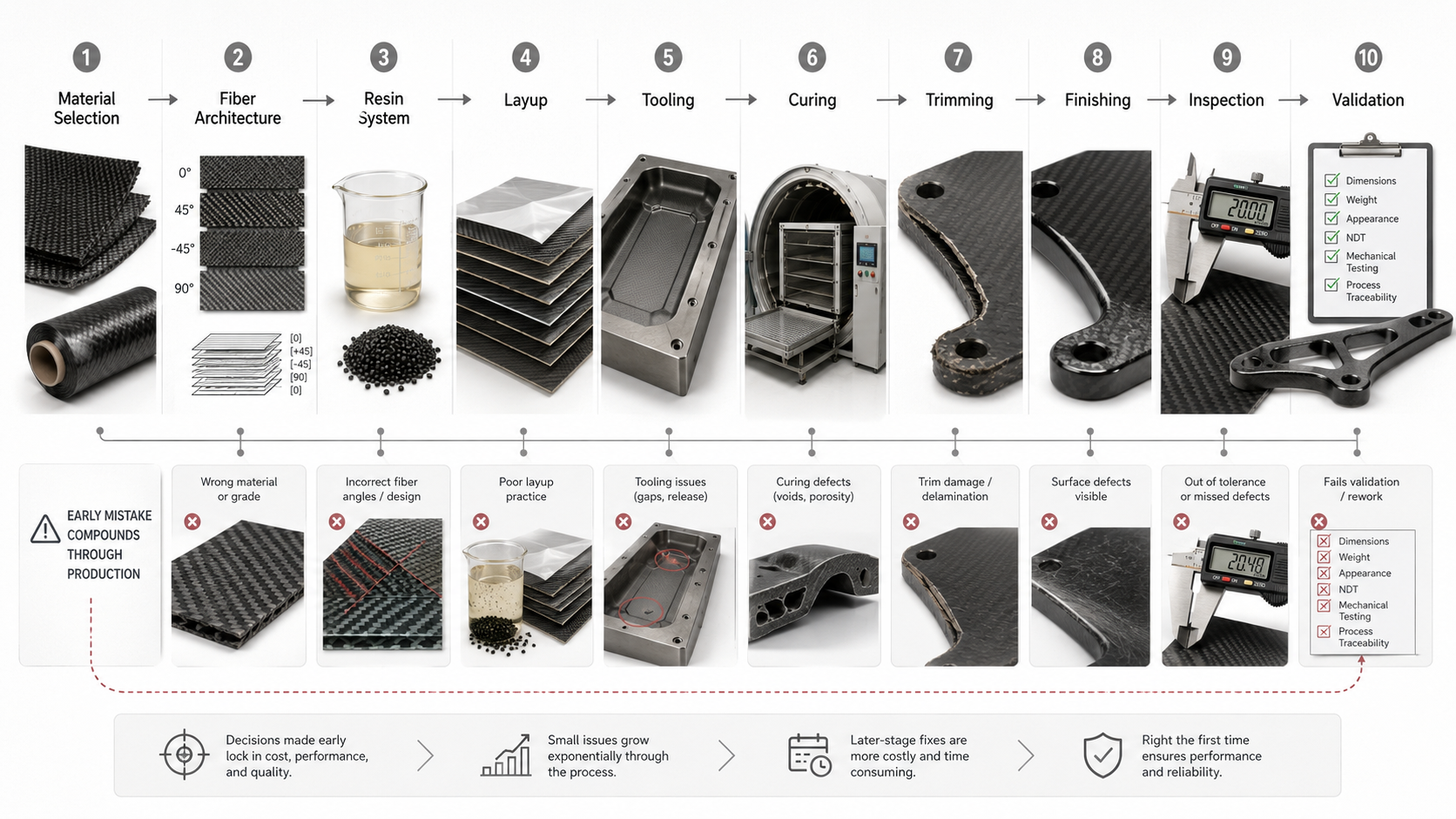
Carbon fiber composite manufacturing can include precursor processing, fiber spinning, carbonization, surface treatment, prepreg handling, layup, autoclave or oven cure cycles, trimming, inspection, and QA validation. Each step is capital-intensive. Each step is sensitive to deviation.
Overall part manufacturing cost can run 5–10× comparable metal solutions at the same structural performance level.
This is the core procurement reality:
In a cost structure this amplified, process errors do not add cost in a straight line. They compound it.
You may be comparing CFRP quotes against metal alternatives. Or you may be trying to understand why two carbon fiber suppliers priced the same part with a 3× difference.
Either way, the stakes are real:
- Material grade misjudgment alone can push cost up by 20–80%.
- Supplier capability mismatch can drive unit cost up 10–25% and extend lead times 2–8 weeks past milestone.
- Incomplete total cost analysis can lead teams to reject CFRP even where weight-driven operating savings could offset 20–50% of its own price premium.
- Structured procurement decisions across fiber selection, supplier fit, tooling planning, and quality control can improve lifecycle cost by 15–40% versus unstructured sourcing.
From HyperX Carbon’s factory perspective, carbon fiber procurement should not begin with “what is the cheapest price?” It should begin with: what is the application, what is the load, what is the volume, what process level is justified, and what validation is required before production?
The seven mistakes below are where that cost gap is won or lost.
Mistake #1: Treating Carbon Fiber Sourcing Like Metal Procurement
Metal procurement has a simple grammar:
Pick a grade. Fix a thickness. Get a price.
That logic works when the material forgives you.
Carbon fiber does not.
Sourcing teams often carry metal-buying habits into composite procurement. The biggest failure is not always picking the wrong supplier. It is writing the wrong RFQ.
A buyer locks in a nominal thickness — for example, 2.0 mm — and sends out a frozen drawing. The supplier quotes what was asked for. No one questions the layup, weave, resin system, fiber direction, or whether the specification actually maps to what the part needs to do.
The result is over-specification.
Extra plies add weight and cost. Material choices end up optimized for nothing in particular.
What This Mistake Looks Like
A metal-style RFQ says:
“2.0 mm carbon fiber plate, 1,000 pcs.”
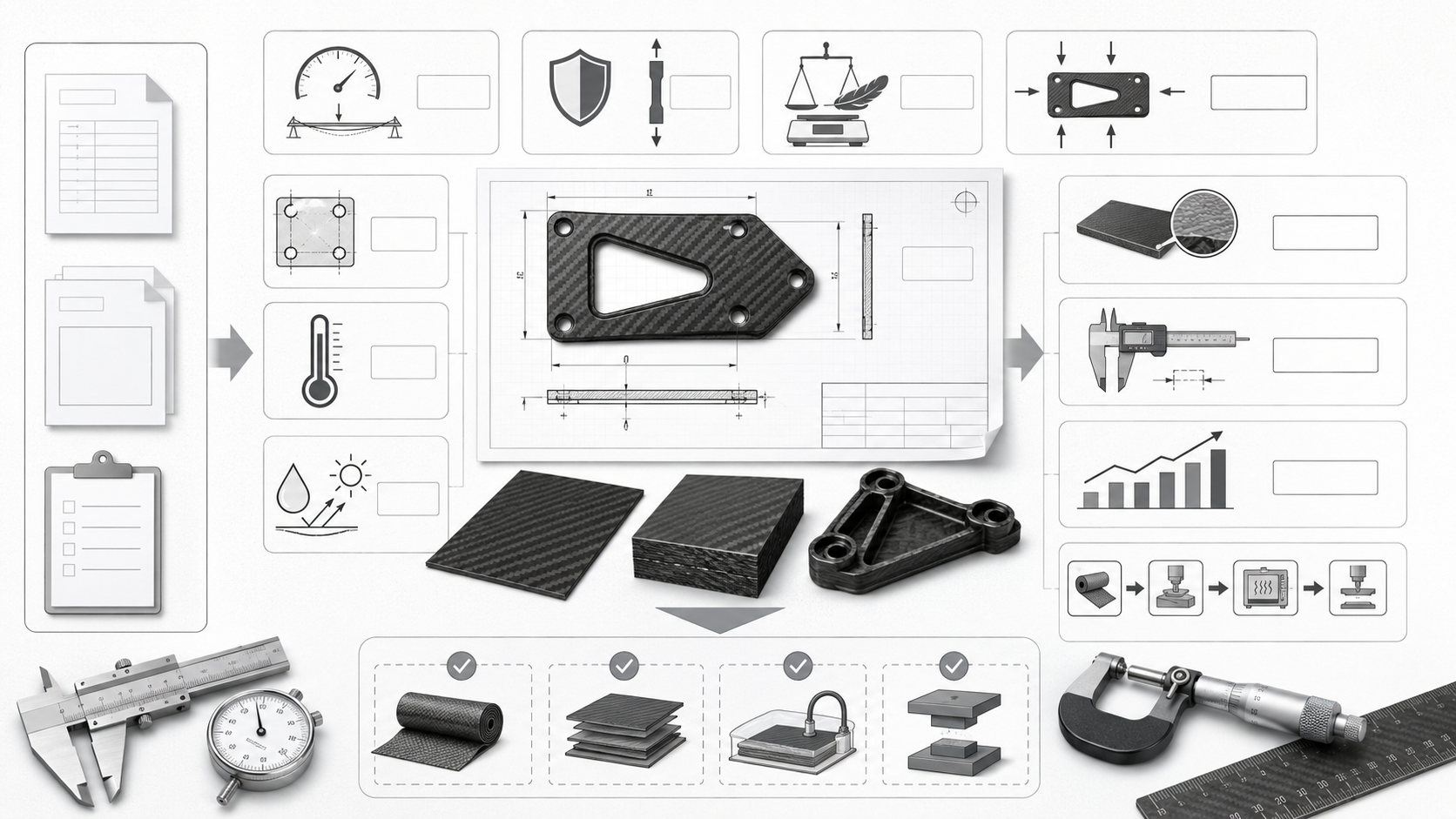
A carbon-fiber-ready RFQ should say:
- Target stiffness
- Target strength
- Target mass
- Load direction
- Service temperature
- Moisture or chemical exposure
- Surface requirement
- Tolerance requirement
- Acceptable process route
- Annual volume
- Prototype or production stage
That is not a minor rewrite.
It is a completely different conversation with the supplier.
Why It Increases Cost
When a supplier receives only geometry and thickness, they must protect themselves. They quote conservatively. That often means more plies, a safer process, wider assumptions, more inspection allowance, and more risk built into the price.
The buyer thinks the supplier is expensive.
The supplier is actually pricing uncertainty.
How to Fix It
Specify performance first.
Then let the supplier help find the material path to reach it.
Bring the supplier in at the concept stage, before tooling is locked. Carbon fiber suppliers work with layup, reinforcement architecture, resin systems, tooling, and process selection every day. They can optimize these in ways a frozen metal-style drawing never will.
Skip this step, and you risk qualification delays, redesign cycles, rework, and tooling changes at the point when drawings are most expensive to revise.
The rule: specify performance. Let the supplier find the material and process route to get there.
At HyperX Carbon, early RFQ review usually starts with drawing, application, load direction, surface grade, tolerance, volume, and process openness. A quote based only on “carbon fiber part + thickness + quantity” is rarely enough for cost control.
Mistake #2: Over-Specifying Materials and Processes for the Wrong Application
Aerospace-grade prepreg on an industrial bracket.
Autoclave cure cycles on a part that will never see 50,000 flight hours.
Class A surface finish on a panel nobody will ever look at.
This is over-specification — and it is one of the most expensive habits in carbon fiber procurement.
Material Over-Specification
The cost math is clear.
Industrial-grade carbon fiber prepreg runs about $20–30/kg.
Aerospace-grade high-modulus prepreg can run $60–100/kg.
That is a 200–300% material cost premium before adding cold-chain logistics, batch certification, AMS traceability requirements, and quality audits.
Those extras come attached to every aerospace material system.
All in, over-specifying the material grade alone can push total part cost up by 30–70%.
Process Over-Specification
Process mismatches hit just as hard.
Defaulting to autoclave cure when the part does not need it can add 20–40% to manufacturing cost per cycle.
For industrial parts with moderate mechanical requirements, OOA vacuum bagging or resin infusion can cut that back by 30–50% without high-pressure equipment.
Autoclave curing is valuable for the right application. It is not automatically the correct process for every carbon fiber part.
Tolerance Over-Specification
Applying ±0.1 mm tolerances across an entire drawing — instead of isolating them to functional features — can drive machining and inspection cost up by 30–100%.
Tighten to ±0.05 mm part-wide, and unit cost may double.
Most carbon fiber parts do not need high precision everywhere. They need precision where fit, sealing, bearing, bonding, or assembly requires it.
Surface Over-Specification
Specifying Class A surface finish on B-side or hidden geometry adds 1–2 extra process steps.
Finishing labor can go up by 50–100% — for surfaces no end user will ever see.
How to Fix It
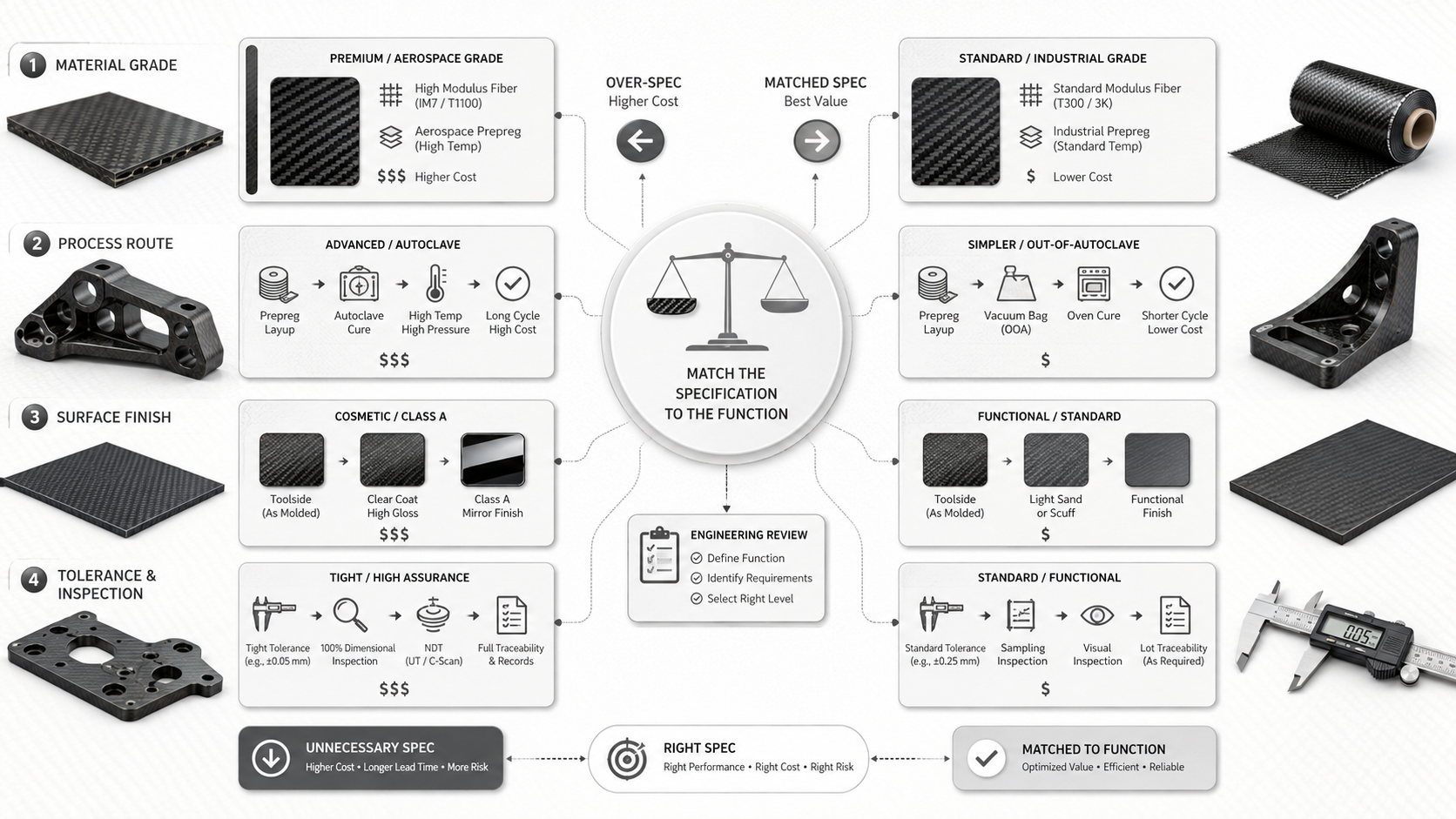
Match the specification to the function.
- Use aerospace materials for aerospace loads and aerospace documentation requirements.
- Use autoclave cure for fatigue-critical or high-reliability structures where it is justified.
- Use OOA, vacuum bagging, resin infusion, or compression molding when the performance requirement allows it.
- Tighten tolerances only where fit, seal, bearing, contact, or assembly requires them.
- Separate A/B/C surfaces and define cosmetic acceptance criteria clearly.
Not every carbon fiber part needs to be built like a wing spar.
The ones that do not — but get specified like one anyway — are exactly where procurement budgets disappear.
At HyperX Carbon, we often help buyers reduce cost by reviewing whether the material grade, process route, tolerance level, and visible surface requirement match the real application instead of the most expensive possible version of the part.
Mistake #3: Ignoring Tooling Strategy and Its Per-Part Cost Impact

Tooling decisions feel like a one-time capital expense.
They are not.
Every dollar spent on a mold gets divided across every part it produces.
Get that decision wrong, and the math hits every single unit.
The formula is simple:
Tooling cost per part = total mold cost ÷ total production volume
A $10,000 mold across 10,000 parts adds $1.00 per unit.
Spread that same mold across 500 parts, and it adds $20.00 per unit — before material, labor, cure time, trimming, finishing, inspection, or packaging.
That gap is where procurement teams lose control of per-part cost.
The Common Tooling Mismatch
The mismatch usually looks like one of these scenarios.
A low-volume prototype program gets quoted on a high-durability steel mold. That mold is built for 10,000+ parts. The capital outlay may make sense for mass production. For a 300-piece run, it makes no sense.
Or a scaling program locks in an aluminum soft tool — right for 1,000–5,000 parts — then pushes volume to 15,000. Tool wear speeds up. Dimensional drift creeps in. Rework climbs. The mold fails mid-program and gets replaced.
Now the buyer is paying for a second mold on top of the first.
Both scenarios end the same way:
Per-part cost rises 10–30% above what the right tooling choice would have cost.
Tooling Selection by Production Volume
| Volume Range | Recommended Tool Type | Typical Cost |
|---|---|---|
| Prototype / <500 parts | 3D-printed or epoxy soft mold | <$1,000 |
| Low-mid volume, 1,000–5,000 parts | Aluminum mold | $2,000–$5,000 |
| High volume, >10,000 parts | Multi-cavity steel mold | $5,000–$100,000+ |
The cost differences are real.
But the risk is not only the upfront number. It is the amortization logic.
A $50,000 steel mold that does not fit the program costs more than $50,000. Add the sunk cost of the wrong mold it replaced. Add the disruption of switching mid-production. Add the inspection and requalification cost.
The total damage is far higher than the sticker price.
What to Lock Into the Supplier Contract
Tooling strategy is not only technical. It is commercial.
The supplier contract should define:
- Mold ownership — if the supplier owns the tooling, they control your production flexibility. Switching suppliers may mean paying to rebuild the mold from scratch.
- Modification rights — design changes are common in early-stage programs. Without explicit terms, every change can trigger renegotiation.
- Maintenance responsibility — worn ejector pins, surface degradation, cavity damage, and dimensional drift happen over time. Spell out who pays.
- Life expectancy and target volume — mold lifespan, expected shot count, acceptable scrap rate, and maintenance interval should be written down.
The clearest sign you have ignored tooling strategy is this:
Your RFQ shows a total mold price with no amortization breakdown, no ownership clause, and no production volume tied to it.
At that point, you do not have a tooling cost.
You have a surprise sitting somewhere in your production schedule.
At HyperX Carbon, tooling recommendations are tied to geometry, expected quantity, surface requirement, tolerance, production ramp, and whether the project is still in prototype, pilot, or repeat production. A mold should fit the program, not just the part shape.
Mistake #4: Chasing the Lowest Unit Price While Ignoring Total Cost of Ownership
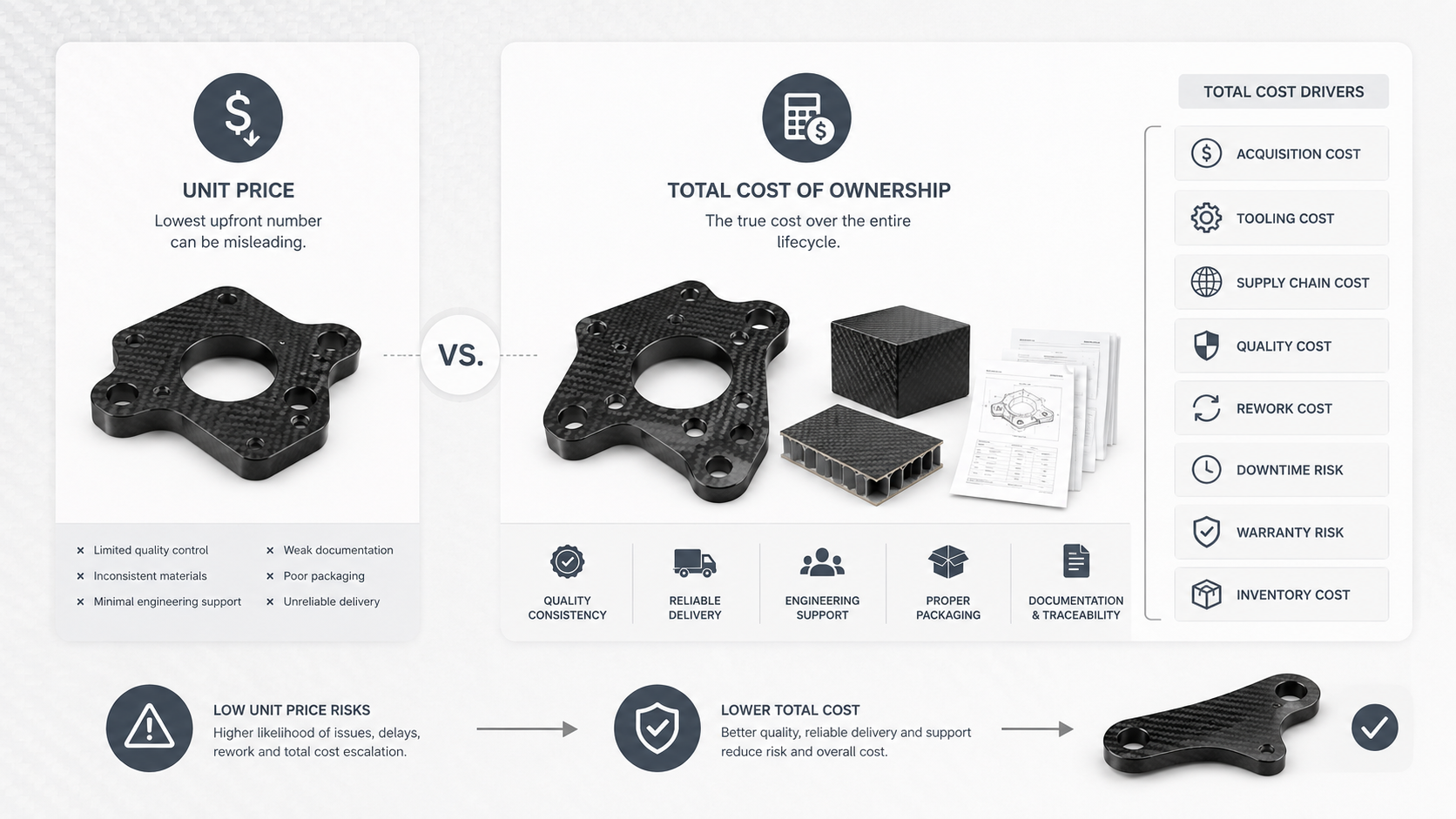
The lowest quote wins the PO.
Then the problems start.
This mistake shows up in carbon fiber procurement more than almost any other — and it is the hardest one to explain after the damage is done.
A supplier prices the part at $0.90/unit.
A competitor quotes $1.00/unit.
Procurement picks the $0.90 option.
It looks right.
The math is wrong.
Unit price is one number. Total Cost of Ownership is a completely different calculation:
TCO = Acquisition Cost + Supply Chain Cost + Quality & Warranty Cost + Operational Risk Cost
Run the full numbers, and the cheaper supplier can stop looking cheap very fast.
What One Quality Failure Actually Costs
A supplier running at 1,000 PPM defect rate may look acceptable on paper.
Then one batch goes wrong — process drift, a bad cure cycle, a material lot issue, or a handling error. Defect rate spikes to 5%.
On a 100,000-unit order, that means 5,000 bad parts.
The cost event can look like this:
- Rework and sorting: 5,000 × $1.50 = $7,500
- Scrapped material: 5,000 × $0.90 = $4,500
- Line stoppage and overtime recovery: $10,000
- Customer escalation and quality team response: $3,000
- Total event cost: about $25,000
The savings from choosing the $0.90 supplier over the $1.00 supplier?
$10,000 for the month.
One quality event erases the savings and adds about $15,000 net cost.
Effective unit cost jumps from $0.90 to $1.05.
Delivery Risk Also Changes the Real Cost
Downtime makes the problem worse.
A single day of stoppage in automotive or electronics manufacturing can run $5,000–$50,000.
A supplier at 92% on-time delivery versus a competitor at 98% may look like a small difference. But once you map disruption probability, recovery time, and stoppage cost per day, the 92% supplier may cost more per part even with a lower quote.
Volume Discounts Can Hide Cost Too
A supplier offers $0.90/unit if you commit to 50,000 pieces instead of your usual 10,000.
The unit saving is $5,000.
But the excess inventory is:
40,000 units × $0.90 = $36,000 in tied-up capital
At a standard 25% annual holding cost, that is $9,000/year in carrying cost.
Over a six-month cycle, that already eats most of what you saved.
How to Fix It
Use a supplier scorecard, not just a price sheet.
A practical supplier scorecard can include:
| Dimension | Weight |
| Technical / process capability | 30% |
| Quality performance, PPM and OTD | 30% |
| Price and TCO | 25% |
| Service and engineering support | 15% |
Take two suppliers.
One scores high on unit price but weak on quality and delivery. The other is slightly more expensive but stronger on process control, documentation, response speed, and on-time delivery.
The second supplier often wins once you do the full math.
Then lock the TCO logic into your contracts.
Tie supplier agreements to:
- PPM targets
- OTIF / OTD rates
- Escalation protocols
- Quality failure credits
- Late-delivery remedies
- Engineering support expectations
- Change-control procedures
The unit price on your quote sheet is the starting point.
TCO is the number that tells you whether you made a smart procurement decision or an expensive one.
Mistake #5: Sending Vague RFQs With Incomplete Specifications
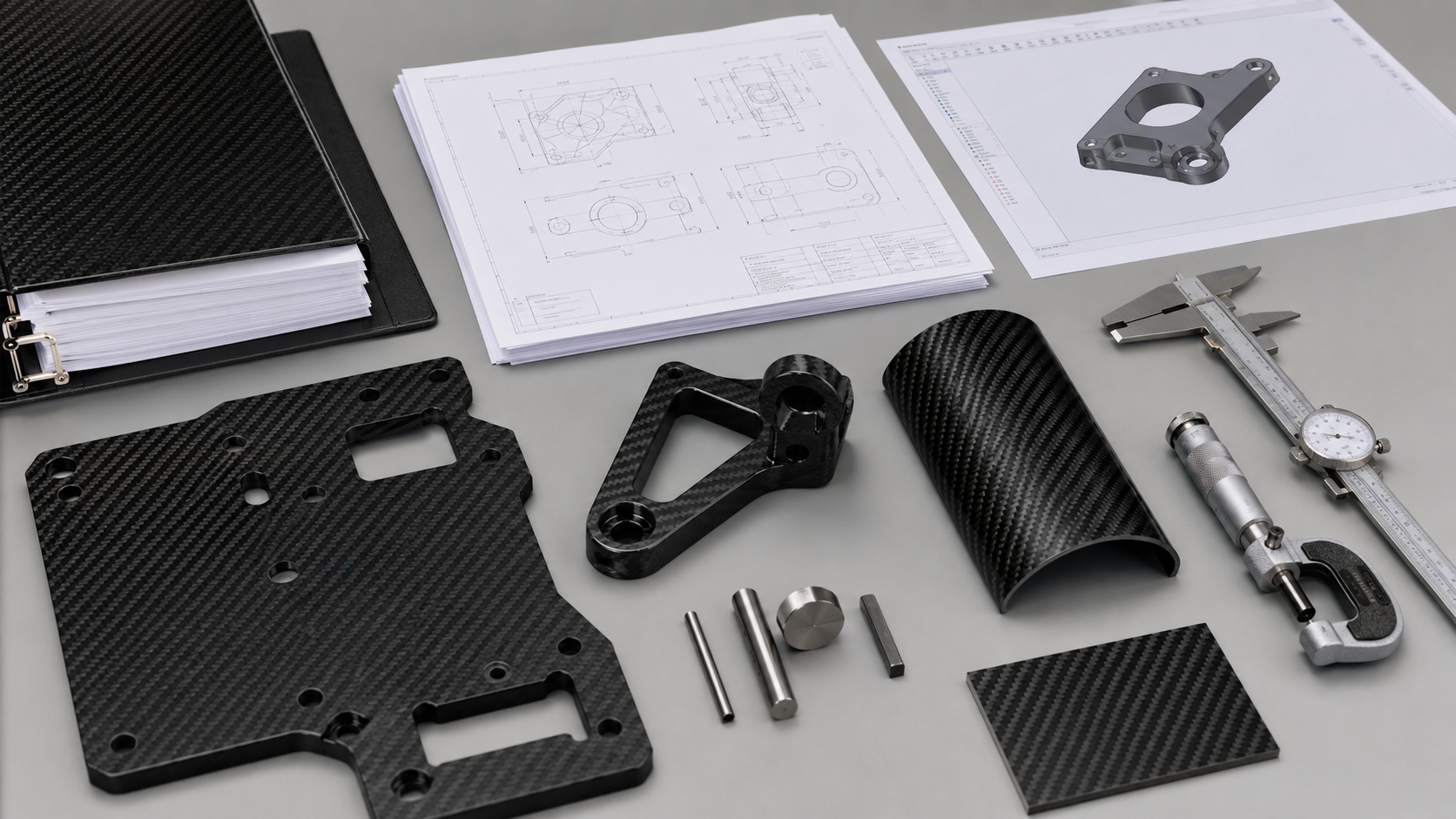
Suppliers price what they can see.
Everything they cannot see, they charge you for anyway — buried inside a risk premium.
An RFQ without complete GD&T tolerances, NDT requirements, or surface grade definitions does not always prompt questions. Suppliers may not ask. They assume.
And they assume on the safe side.
That assumption lands as a 10–20% risk adder on unit cost — protection against scrap and rework they can already see coming.
That happens before production even starts.
The Cost Path of an Incomplete RFQ
At the RFQ stage, missing tolerances push suppliers to default to standard shop practice — for example, ±0.1 mm instead of ±0.02 mm. Generic process assumptions get baked into the quote. The risk premium slips in without a separate line item.
At first article, tighter requirements show up after the PO. Scrap rates can jump from a normal 2–3% to 10–15% on tight-tolerance features. Add 1–3 machine-hours and 1–2 inspection-hours of rework per part. Direct manufacturing cost for that lot climbs 5–10%, almost always through a change order.
At PPAP or FAI, incomplete acceptance criteria cause rejection. Each rejection adds 8–24 man-hours of re-measurement and 1–2 weeks of schedule slip. In automotive or aerospace launch phases, downstream line-start penalties can run $10,000–$100,000 per week.
Add it up:
Risk premium + rework + delay penalty can push total effective cost 25–40% above what a clean RFQ would have cost.
The original quoted price gap between suppliers may have been only 3–5%.
What a Complete Carbon Fiber RFQ Should Include
The fix is a complete specification package — released before the RFQ, not after the PO.
Every carbon fiber part RFQ should include:
- Approved 3D CAD model with revision level locked
- 2D engineering drawing with full GD&T and datum scheme
- Complete BOM with part numbers, materials, quantities, and finish specifications
- Clear surface grade definitions — A/B/C surfaces with cosmetic acceptance criteria
- NDT requirements — method, acceptance standard, sampling plan, and report format
- Required certifications such as AS9100, IATF 16949, NADCAP, or other project-specific requirements
- Expected PPAP or FAI level
- Annual volume and ramp plan
- Prototype, pilot, and production timing
- Allowed process alternatives or prohibited substitutions
One more step separates clean programs from problem programs:
Run a specification review workshop with two or three shortlisted suppliers before the RFQ goes final.
Walk the drawings together. Clarify tolerances. Flag high-risk features. Log every question into a requirements document.
It may take two to four hours.
That time can save two to four weeks and cut the risk premium before it is priced into the quote.
Vague specs do not just produce bad quotes.
They produce bad parts, late programs, and renegotiation conversations nobody wanted.
At HyperX Carbon, RFQ readiness review is often the fastest way to prevent cost escalation. When buyers send the drawing, annual volume, target surface grade, inspection requirements, and process openness early, the quote becomes clearer and the production risk becomes easier to control.
Mistake #6: Single-Sourcing Critical Parts Without Supply Risk Assessment
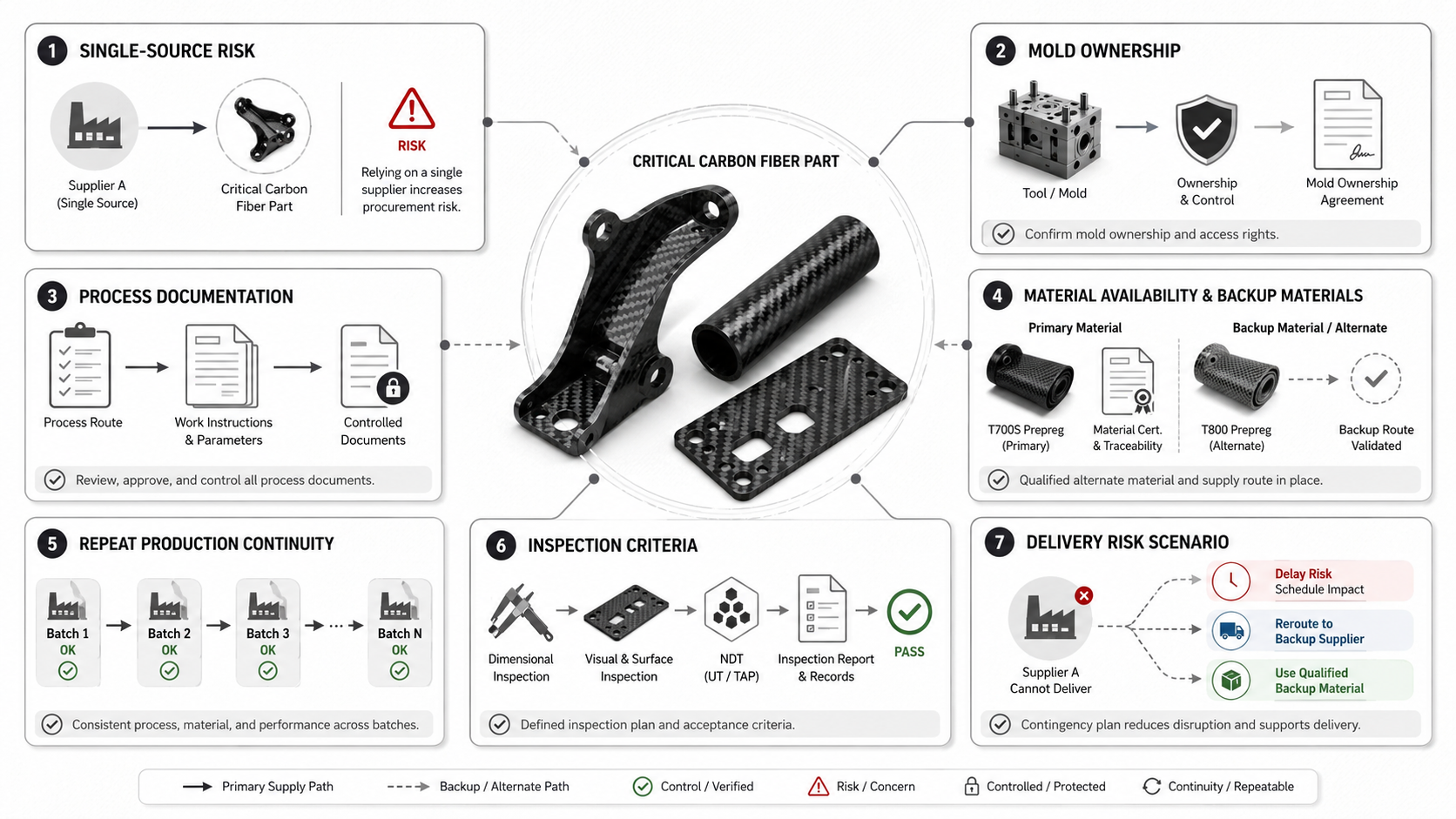
Single-sourcing a critical carbon fiber part does not always feel like a risk decision.
It feels like a procurement decision: you found a supplier who can do the work, the price held, and the program moved on.
The risk appears later — usually at the worst possible time.
The structural problem is simple:
The moment you have no qualified backup, the supplier knows it too.
Price leverage shifts. Lead times stretch. MOQ requirements creep up at renewal. You are no longer negotiating from strength.
And that is the scenario where nothing goes wrong.
Something eventually does go wrong.
A quality event. A regional logistics disruption. A capacity crunch. Resin shortage. Fiber supply issue. Autoclave availability problem. Sub-tier contractor delay.
Any one of these can stop production cold.
You have one source.
It is down.
You wait.
Why Tier-1 Review Is Not Enough
Most procurement teams miss this:
85% of supply disruptions start below Tier 1.
Your direct supplier may be running fine. But their resin supplier, fiber source, autoclave subcontractor, tooling partner, or logistics provider can cause the same stoppage.
Stop your supply-risk assessment at Tier 1, and you are not assessing risk.
You are ignoring it.
Build the Risk Register Before You Need It
The fix is not complicated.
It has to happen before a disruption hits — not during one.
Start with a sole-source database:
- Critical-path carbon fiber part
- Direct supplier
- Resin source
- Fiber source
- Tooling dependency
- Process dependency
- Inspection dependency
- Logistics dependency
- Backup source status
Then rate each item using a simple traffic-light register:
- Green — sole source in place, no current supply concern
- Yellow — potential exposure in quality, delivery, cost, capacity, or lead time
- Red — immediate risk requiring action and management sign-off
Any yellow or red part needs a qualified backup.
Not a theoretical backup.
A real supplier who has cleared your quality requirements, understands the tolerance stack, and can meet lead time within an acceptable window.
Most programs miss the timing benchmark:
Run backup qualification at the design stage, before launch, before demand ramps.
The worst time to start qualifying a second supplier is the week your primary source goes dark.
For high-criticality parts — long lead times, revenue-critical assemblies, tight tolerances, or safety-critical applications — one qualified backup is the floor.
Two verified alternate sources should be the standard for anything you cannot afford to lose.
Lock Continuity Into the Contract
A multi-year supply agreement does more than stabilize price.
Structured correctly, it becomes a risk-management tool.
A durable contract separates base manufacturing margin — fixed or capped — from variable inputs such as resin, fiber, energy, and freight. Those variable inputs can move against an external index.
This structure removes pressure to reprice everything at renewal. The supplier does not need to inflate margin to cover input swings. The buyer does not face a surprise 20% increase because raw material costs shifted.
Critical-part contracts should also include:
- Named backup capacity — a specific alternate source identified and acknowledged in the contract
- Allocation priority during shortages — your program’s position in the queue when supply tightens
- Notice period for supply interruption — minimum lead time before shutdown so you can activate contingency
- Requalification trigger — automatic review if the supplier misses service levels or shows signs of financial stress
Run annual reviews for critical vendors. For anything rated red, add real-time monitoring and scenario planning.
These are not administrative exercises.
They are the difference between a disruption that costs two weeks and one that costs a program.
Single-sourcing is sometimes unavoidable. Specialized carbon fiber geometries, proprietary layup processes, niche material systems, or supplier-owned tooling can make one source difficult to replace.
That is not the mistake.
The mistake is treating that constraint as stable, skipping risk mapping, and carrying the exposure until it breaks.
Mistake #7: Skipping Validation Stages to Save Time
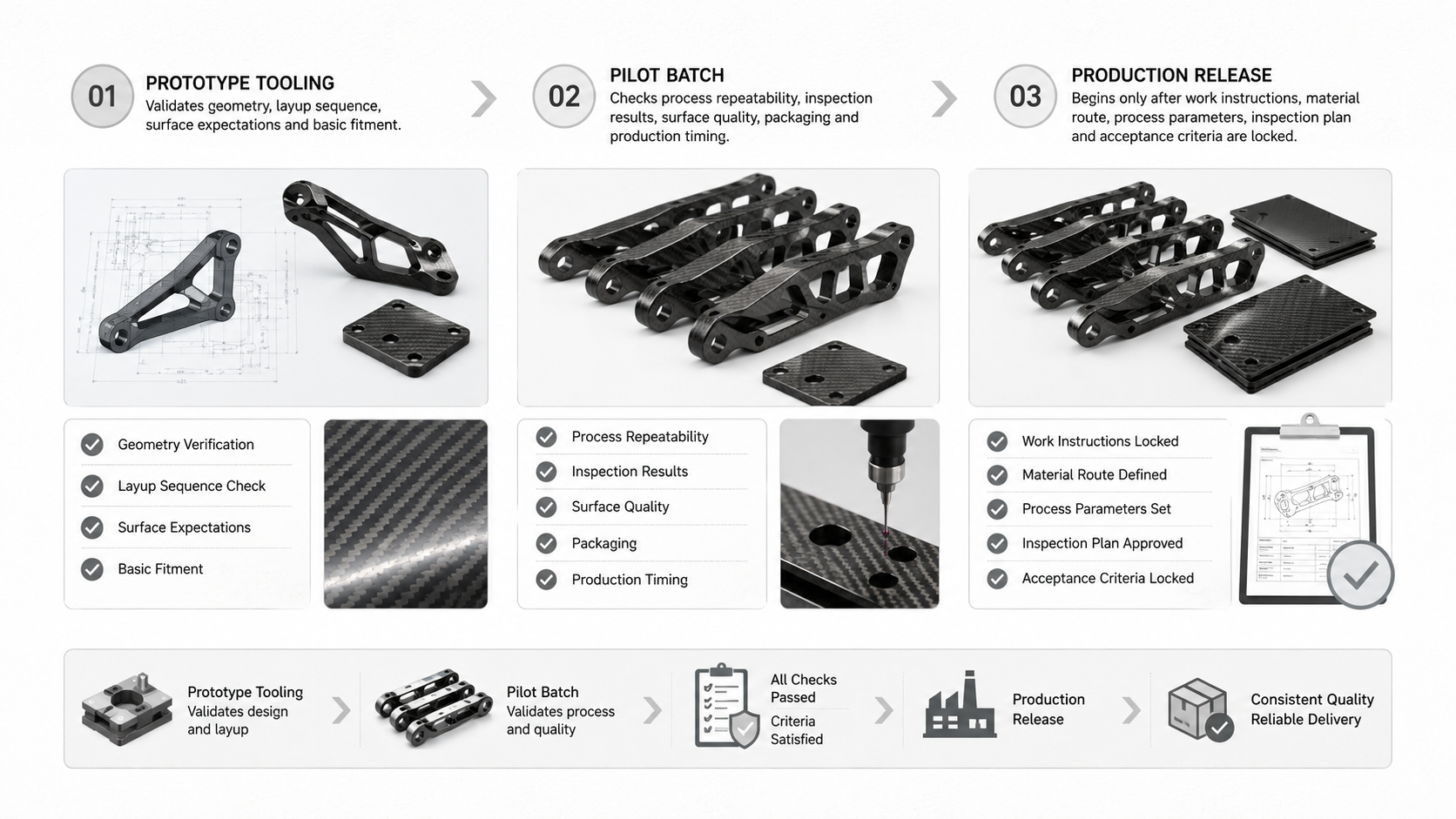
The math here is brutal — and almost nobody runs it until after the damage is done.
Skipping prototype and pilot validation to speed up production feels like a fair trade.
Compress the schedule. Save a few weeks. Hit volume faster.
That logic works right up until it does not.
Then it falls apart in the first production run, when a geometry defect, layup issue, resin problem, cure failure, or process variation scraps the batch.
What One Skipped Validation Stage Can Cost
Take a 20-piece structural trial batch.
Unit material cost: $300.
Process, labor, inspection, and tooling amortization: another $500.
Total per-part cost: $800.
One full-batch scrap event:
20 × $800 = $16,000
Of that, material is $6,000. The other $10,000+ goes to labor, process time, equipment, and inspection — costs that never appear in the original material quote.
That is the first-order loss.
The compounding starts next.
Failure often traces back to an unvalidated mold. Production tooling rework runs 15–30% of the original mold cost. On a mid-size structural mold priced at $80,000, that means $12,000–$24,000 in rework.
If the geometry cannot be salvaged, the mold may need to be rebuilt from scratch: another $80,000.
Add:
- Process redesign: $10,000–$30,000 in engineering time
- Repeat certification and mechanical testing: $20,000–$50,000
- Schedule penalties during program delay
- Three to six months of delay
- Carrying cost and opportunity losses: $15,000–$120,000
Total exposure from one skipped validation stage can move well past $100,000.
The original material cost is only a small fraction of that number.
The Three-Stage Validation Sequence
Run this sequence before production tooling and volume release.
Stage 1: Prototype Tooling
Use a low-cost aluminum or soft mold.
Build one to five parts.
Validate:
- Geometry
- Layup sequence
- Cure cycle
- Fiber orientation per layer
- Corner radius handling
- Vacuum and pressure parameters
- Basic dimensional fit
Dimensional problems caught here cost almost nothing compared with production-stage rework.
Stage 2: Pilot Batch
Scale to 5–10% of planned production volume.
Run statistical process control.
Use NDT on 10–20% of parts.
Calculate Cpk and target Cpk ≥ 1.33 before moving forward.
Version-control and document every parameter that matters:
- Material batch
- Layup schedule
- Cure profile
- Vacuum level
- Trim program
- Inspection method
- Acceptance criteria
Stage 3: Production
Use locked work instructions only.
No unapproved process changes.
SPC monitoring should stay active on critical dimensions throughout the run.
In-process quality cost at Stages 1 and 2 usually runs 1–3% of total program cost.
The production-stage failure those stages prevent can run 5–15× that figure, even in a conservative failure scenario.
Skipping validation does not save time. It moves time, cost, and risk to the worst possible moment in the program — after tooling is expensive, schedules are locked, and every day of delay carries a real dollar figure.
Your supplier should have a structured validation protocol. They should also explain the pilot-to-production qualification process clearly.
No protocol?
No clear answer?
That is a red flag.
At HyperX Carbon, validation sequencing is built into project review before tooling and production release. For custom carbon fiber parts, prototype, pilot, and production validation should be planned as part of the cost-control strategy — not treated as optional paperwork.
Carbon Fiber Procurement Checklist: What Your Next RFQ Should Include
Every inflated carbon fiber quote has a paper trail.
It almost always starts with a weak RFQ.
Before sending anything out, lock these five areas:
- Performance requirements
- Annual volume
- Project timeline
- Process openness
- Surface grade and NDT requirements
Miss any one of them, and suppliers fill the gap with assumptions.
Assumptions cost money.
What Belongs in Every Carbon Fiber RFQ Package
Your RFQ should include:
- Material definition — fiber type, resin system, prepreg vs. dry fiber, tow size, weave, cure system
- Performance targets — tensile strength, modulus, temperature range, fatigue life, dimensional stability
- Volume and ramp — MOQ, annual forecast, pilot-to-production cadence
- Timeline — prototype date, first article, SOP, line-rate demand
- Process openness — whether alternative layup, cure cycle, resin substitution, or molding method is allowed
- Surface grade — Class A/B/C, porosity limits, weave print-through tolerance, edge quality, and clear acceptance criteria
- NDT requirements — ultrasonic C-scan, X-ray/CT, tap test, sampling plan, defect limits, and report format
- Quality and compliance requirements — FAI, PPAP, AS9100, IATF 16949, NADCAP, or customer-specific requirements where relevant
- Tooling expectations — target volume, mold ownership, mold life, maintenance responsibility, modification rights
- Commercial expectations — payment terms, warranty, late delivery remedies, quality credits, backup capacity, and change-control rules
Supplier Questions to Ask Before Final Quote
Before the RFQ goes final, ask suppliers direct questions:
- Which cost drivers move the price most — resin system, autoclave time, tooling, labor, scrap rate, or inspection?
- Which design changes would reduce production risk?
- Which tolerances are expensive, and which are easy to hold?
- Which surfaces truly need Class A finishing?
- Which NDT method is appropriate for this part?
- What validation steps are required before production release?
- What mold type fits the expected volume?
- Where could supply risk appear below Tier 1?
You want these answers early.
They shape the specification before it locks.
Supplier Scoring Model
A practical 100-point supplier scorecard can include:
| Dimension | Suggested Weight |
| Technical fit | 40 |
| Quality and compliance | 25 |
| Delivery and capacity | 20 |
| DFM support | 15 |
Price still matters, but it should not sit above technical fit, quality capability, delivery reliability, and engineering support.
For carbon fiber procurement, the cheapest supplier is not always the lowest-cost supplier.
The right supplier is the one that can protect performance, schedule, quality, and lifecycle cost.
Have a drawing ready but not sure whether your specification package is complete?
Send HyperX Carbon your part file, annual volume, target surface grade, tolerance requirements, NDT requirements, timeline, and expected process route. Our team can review RFQ readiness and identify where hidden cost may already be building before the project goes to market.
FAQ: Carbon Fiber Procurement Mistakes and Cost Control
Why do carbon fiber part quotes vary so much between suppliers?
Carbon fiber quotes vary because suppliers may assume different material grades, resin systems, layup structures, tooling routes, curing processes, surface finishes, tolerances, inspection levels, scrap rates, and packaging methods.
If your RFQ is incomplete, each supplier fills the gaps differently. That can create large price differences that are not always visible in the quote.
What information should I include in a carbon fiber RFQ?
A strong carbon fiber RFQ should include a CAD file, 2D drawing, tolerance requirements, material expectation, surface grade, load case, quantity target, timeline, inspection requirements, and application background.
For custom parts, include mounting conditions, deflection limits, safety factor, visible surfaces, hidden surfaces, and whether alternative process routes are allowed.
Can over-specifying carbon fiber increase cost?
Yes. Over-specifying is one of the most common reasons carbon fiber part cost increases.
Aerospace-grade prepreg, autoclave curing, Class A finish, full-part tight tolerance, unnecessary NDT, and excessive documentation can all raise cost when the application does not truly require them.
The goal is not to reduce quality. The goal is to match quality requirements to the actual function.
How does tooling affect carbon fiber part cost?
Tooling cost is spread across the production volume.
A mold that costs $10,000 adds $100 per part if only 100 parts are made. The same mold adds $10 per part if 1,000 parts are made.
That is why tooling strategy must match prototype stage, volume forecast, product lifespan, surface requirement, and repeat production plan.
Is the lowest carbon fiber part quote always the best option?
No.
The lowest quote may hide higher risk in scrap, late delivery, weak engineering support, poor surface control, inconsistent tolerance, unclear inspection, or limited repeat production capability.
Compare total cost of ownership, not only unit price.
Can HyperX Carbon review my RFQ before quoting?
Yes. Send your CAD file, 2D drawing, quantity target, material expectation, surface grade, tolerance requirements, NDT or inspection needs, validation requirement, and project timeline.
HyperX Carbon can review the RFQ package, identify hidden cost drivers, and recommend a practical material, tooling, process, and production route before quotation.
Conclusion
Carbon fiber parts usually become more expensive because the project is under-specified, over-specified, wrongly tooled, poorly validated, or sourced only by unit price.
The biggest cost drivers often appear before production:
- Wrong material grade
- Wrong process route
- Incomplete RFQ
- Wrong tooling strategy
- Excessive tolerances
- Unclear surface requirements
- Missing NDT requirements
- Supplier capability mismatch
- Skipped validation
Carbon fiber cost control starts before the quote, not after the PO.
Is Carbon Fiber Always More Expensive Than Metal?
Upfront, often yes.
Carbon fiber raw material can run $15–60/kg, while steel may sit around $2–2.20/kg.
But the final decision should not compare raw material only. Carbon fiber can reduce weight, maintenance, downtime, corrosion risk, and operating cost. In some programs, those gains can offset 20–50% of the price premium.
The right comparison is total cost of ownership, not material price alone.
How Much Can Over-Specification Increase Cost?
Over-specification can increase cost quickly.
Aerospace-grade prepreg can cost 200–300% more than industrial-grade prepreg. Autoclave cure can add 20–40% to manufacturing cost per cycle when it is not required. Part-wide tight tolerances can add 30–100% to machining and inspection cost.
Class A finish on hidden surfaces can add 1–2 extra process steps and raise finishing labor by 50–100%.
The fix is to match material, process, tolerance, and finish to the function of the part.
What Is the Biggest RFQ Mistake Buyers Make?
The biggest RFQ mistake is sending a drawing without enough engineering context.
A carbon fiber supplier needs more than geometry. They need to know:
- Load case
- Target stiffness
- Target strength
- Surface grade
- Tolerance requirement
- NDT requirement
- Annual volume
- Prototype or production stage
- Process openness
- Validation expectation
Without that information, suppliers price uncertainty.
That uncertainty becomes a risk premium.
Why Is the Lowest Unit Price Risky?
The lowest unit price can hide quality cost, downtime cost, warranty risk, delivery instability, inventory cost, and supplier capability gaps.
A $0.90 part can become more expensive than a $1.00 part if one defect event, late shipment, or rework cycle occurs.
In one example, a 5% defect spike on a 100,000-unit order creates about 5,000 bad parts and a quality event cost around $25,000. That can push effective unit cost from $0.90 to $1.05.
Unit price is the starting point. TCO is the real procurement number.
When Should I Invest in Custom Tooling?
Custom tooling makes sense when production volume, geometry, surface requirement, and repeatability justify the investment.
As a rough guide:
- <500 parts: soft mold or CNC-machined prototype route
- 1,000–5,000 parts: aluminum mold may fit
- >10,000 parts: steel or multi-cavity tooling may be justified
Always calculate tooling cost per part:
Tooling cost per part = total mold cost ÷ total production volume
Do not approve tooling without mold ownership, maintenance, modification rights, and target volume written into the agreement.
Why Is Validation So Important for Carbon Fiber Parts?
Carbon fiber validation catches geometry, layup, cure, bonding, trimming, and inspection issues before they become production failures.
Skipping validation may save a few weeks at first, but one production-stage scrap event can exceed $100,000 once tooling rework, process redesign, repeat testing, certification, delay, and opportunity cost are included.
A proper validation path includes:
- Prototype tooling
- Pilot batch
- NDT and SPC
- Cpk review
- Locked production work instructions
- Final production release
Validation is not a delay. It is cost protection.
How Can HyperX Carbon Help Reduce Procurement Cost Risk?
HyperX Carbon can help buyers review the project before production decisions become expensive.
Send us:
- CAD or 2D drawing
- Application background
- Load and performance targets
- Material or process preference
- Surface grade requirement
- Tolerance requirement
- NDT or inspection requirement
- Prototype quantity
- Annual volume
- Timeline
- Tooling expectation
- Supplier or sourcing constraints
Our engineering team can help review whether the cost risk is coming from material grade, process selection, tooling strategy, RFQ completeness, validation planning, or supplier capability.
Carbon fiber procurement does not punish ignorance gently.
It punishes it expensively — usually at the worst possible moment in the project timeline.
The seven mistakes covered here share one common thread: they all come from applying conventional sourcing logic to a material that operates by different rules.
Treating CFRP like metal, chasing unit price over TCO, skipping validation to hit a deadline, or single-sourcing critical parts without risk assessment may feel reasonable in isolation.
Together, they compound into budget overruns, delayed launches, and supplier relationships that fail under real production pressure.
The good news is simple:
Every one of these mistakes is avoidable if you identify the risk before sending the RFQ or cutting the tool.
Get a transparent quote. Ask the hard questions early. Build the specification around performance, process, validation, and lifecycle cost.
Your budget will thank you later.