Most carbon fiber RFQs fail before they ever reach a supplier’s engineering team.
Not because the part is too complex.
Because the specification package is incomplete.
A missing layup schedule here. An undefined surface finish requirement there. A tolerance that looks obvious to the buyer but is not marked on the drawing. That gap turns a “two-week quote turnaround” into a six-week clarification loop.
Your program gets delayed.
Your costs go up.
Procurement teams and engineers working with custom CFRP parts hit the same wall again and again: knowing what to specify, and in enough detail that a supplier can price it correctly on the first pass.
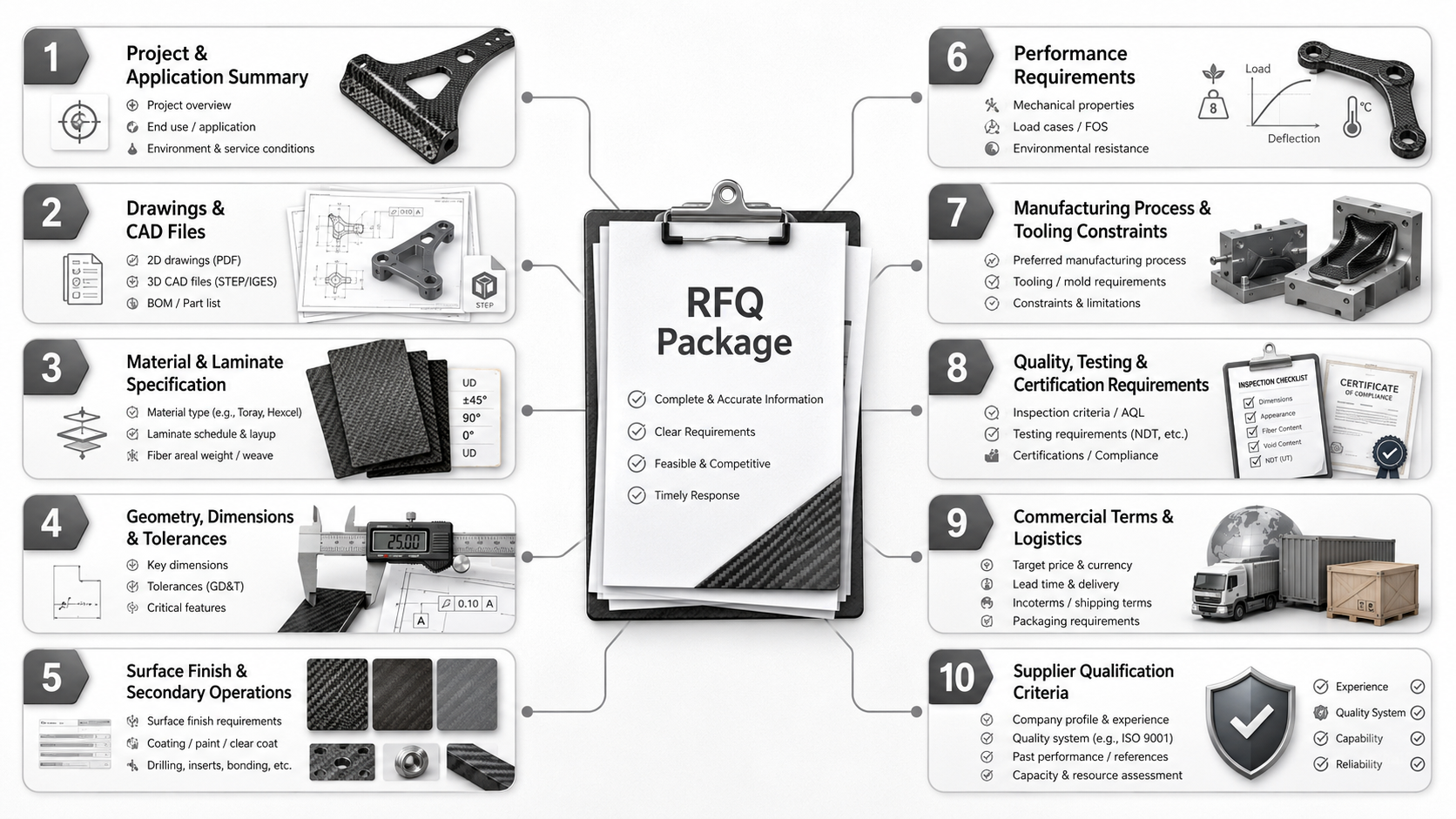
This guide gives you a complete custom carbon fiber product specification checklist built for RFQ submissions. It covers material grade, weave type selection, part tolerances, resin system, laminate structure, surface finish, testing, certification, supplier qualification, and commercial terms.
At HyperX Carbon, we review RFQ packages from a manufacturing and engineering perspective. A complete RFQ does not just help us quote faster. It helps us choose the right material, process route, tooling strategy, inspection plan, and production risk level before the project starts.
Quick Answer: Custom Carbon Fiber Product Specification Checklist:
Here is the honest reality:
Suppliers do not quote on intent. They quote on data.
A composite manufacturer’s engineering team runs through a mental checklist the moment your RFQ lands in their inbox. Every blank field becomes a forced assumption. Every assumption carries risk. And that risk gets priced into the quote — against you.
There are seven core data categories that drive every carbon fiber quote:
- Geometry and dimensions — thickness, panel size, part complexity, tolerance requirements, and critical features such as ±0.1 mm surfaces
- Fiber specification — tow size such as 3K, 6K, or 12K; weave type such as plain weave, 2×2 twill, or UD; and areal weight range
- Resin system — epoxy type, cure temperature, minimum Tg requirement, and environmental resistance
- Laminate design — ply orientation, target thickness, fiber volume fraction, and mechanical performance targets
- Surface and cosmetic grade — structural-only, B-side, or A-side visual finish; pinhole tolerance; gloss level; color tolerance
- Quantity and schedule — batch size, prototype quantity, annual volume forecast, production ramp, and required lead time
- Quality and certification — ISO 9001, AS9100, testing requirements, NDT method, FAI, and documentation level
Miss one, and you get a clarification email.
Miss three, and you can lose two weeks.
Project and Application Summary: The Context Suppliers Cannot Guess
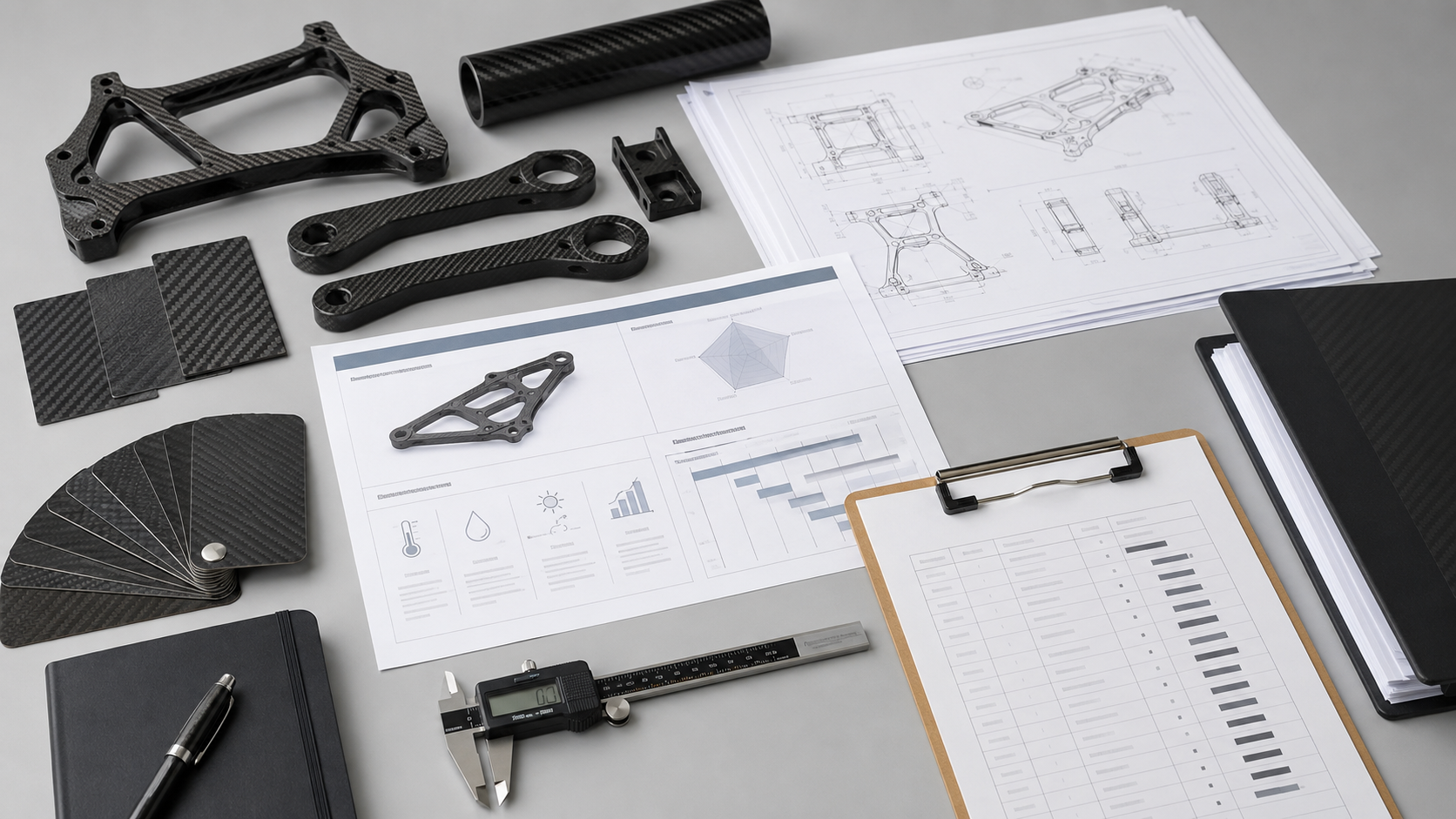
Suppliers quote what they know.
Everything else, they assume — and assumptions cost money.
Your supplier needs to understand why the part exists and where it lives before a single fiber spec or resin system enters the RFQ. Not in vague terms. In numbers.
A weak project objective says:
“Reduce weight.”
A useful project objective says:
“Replace an aluminum bracket to cut component weight by 40%, targeting a unit cost of ≤USD 4.50/pc FOB within 12 months.”
That one sentence can eliminate several clarification emails before they are written.
Add the context suppliers almost always need:
- Operating environment: temperature range, such as –10°C to +85°C, UV exposure, chemical contact, humidity, or moisture exposure
- Structural load conditions: static vs. cyclic loading, peak stress, safety factor, impact risk
- Volume and timing: prototype quantity, annual demand, production ramp schedule, hard go-live date
- Budget constraints: total project budget, maximum unit cost, acceptable payment terms, tooling budget limits
- Application background: industry, assembly location, functional role, replacement material, and failure consequence
This context drives material selection, process choice, qualification level, tooling strategy, and inspection requirements.
At HyperX Carbon, the best RFQs usually include both the drawing and the application story behind the drawing. A part file tells us the shape. The application tells us what the part must survive.
Section 2 — Drawings & CAD Files: Revision Control Is Non-Negotiable
A supplier quoted Rev B.
Your team had already moved to Rev D.
Nobody caught it.
The tooling was cut wrong, and three weeks disappeared.
This is one of the most expensive mistakes in CFRP procurement — and it is fully preventable.
Submit drawings with one rule in mind:
One current released revision exists at any time.
All superseded files go to archive. Lock them. Make them read-only. Do not let suppliers quote against a moving target.
What Your Drawing Package Must Include
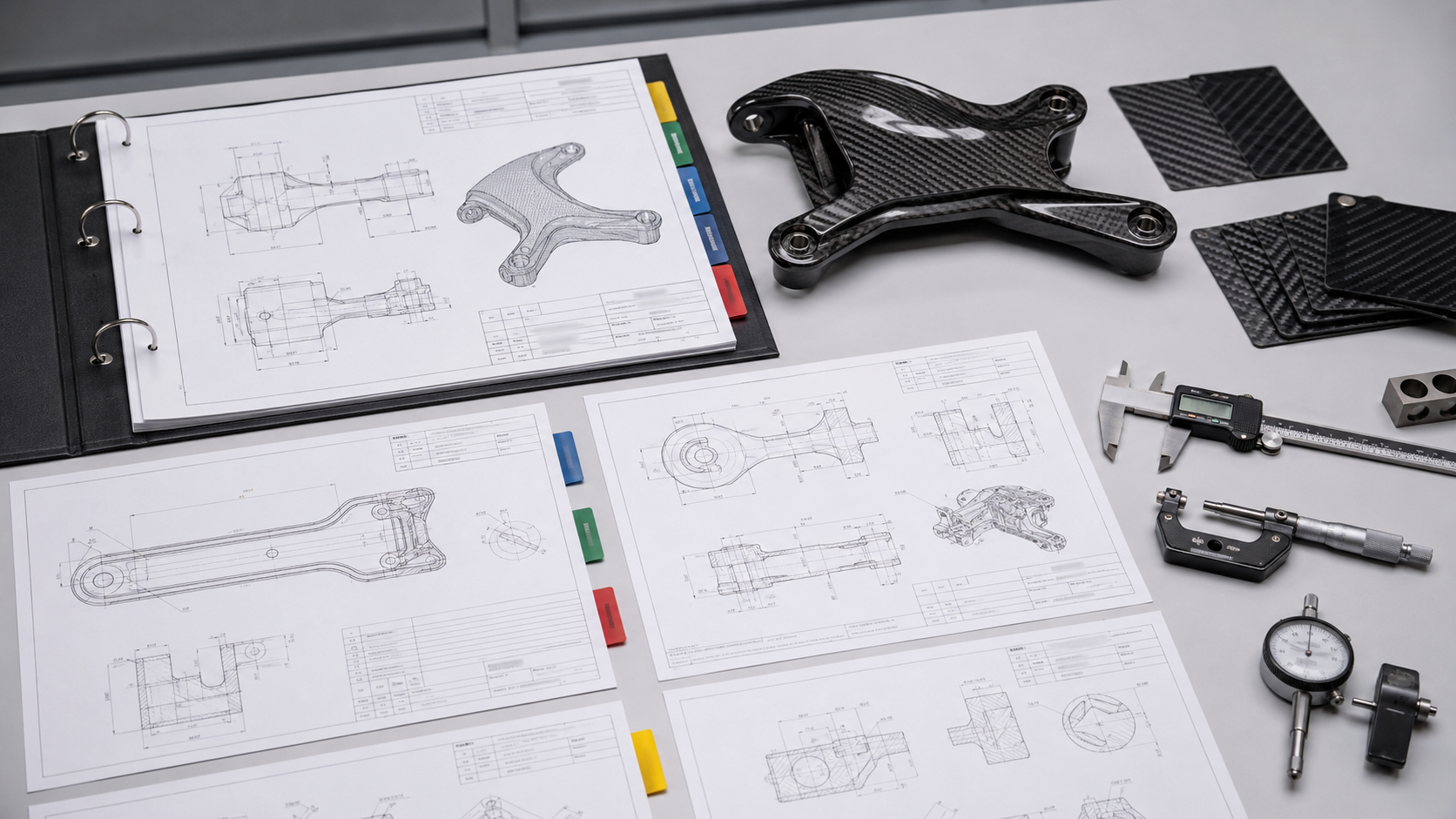
Your drawing package should include:
- Current revision marked in the title block — revision code, approval date in YYYY-MM-DD format, approver initials, and ECN number
- Revision history table — every change from first release to present, including what changed, where it changed, and why it changed
- Stable file naming — revision belongs in the title block and PDM metadata, not only in the base filename
- 3D CAD model — STEP, IGES, or native CAD file when possible
- 2D drawing — full dimensions, tolerances, datums, hole positions, material notes, surface requirements, and inspection callouts
- BOM — part number, material, quantity, finish, assembly relation, and revision alignment
CAD references can break when files are renamed. Do not rely only on filenames to control revision status.
Revision Coding Suppliers Recognize
Use revision logic suppliers can understand:
- Prototype phase: numeric revision, such as Rev 0, Rev 1, Rev 2
- Production release: alphabetic revision, such as Rev A, Rev B, Rev C
- Skip confusing letters: I, O, and Q
- Geometry or fit/function change: new major revision
- Note correction or typo fix: minor suffix, such as C to C1
Any change that voids parts already made — or breaks existing tooling — needs a new major revision and a reissued production release.
Document it every time.
Why Revision Control Matters More for Carbon Fiber
In metal fabrication, a late geometry correction may mean machining adjustment or a modest tooling change.
In carbon fiber production, a geometry revision can affect:
- Mold design
- Layup sequence
- Ply drop zones
- Trim path
- Hole reinforcement
- Cure shrinkage allowance
- Surface finish strategy
- Inspection fixture design
- First Article Inspection
A drawing revision error is not only a paperwork problem. It can become a tooling, layup, inspection, and production cost problem.
At HyperX Carbon, we treat revision control as part of RFQ readiness. If the CAD, 2D drawing, BOM, and technical brief do not match the same revision, the quote cannot be fully reliable.
Section 3 — Carbon Fiber Material & Laminate Specification: The Most Misunderstood Section
Two suppliers.
Same fiber.
Wildly different mechanical properties on their data sheets.
Both may be telling the truth.
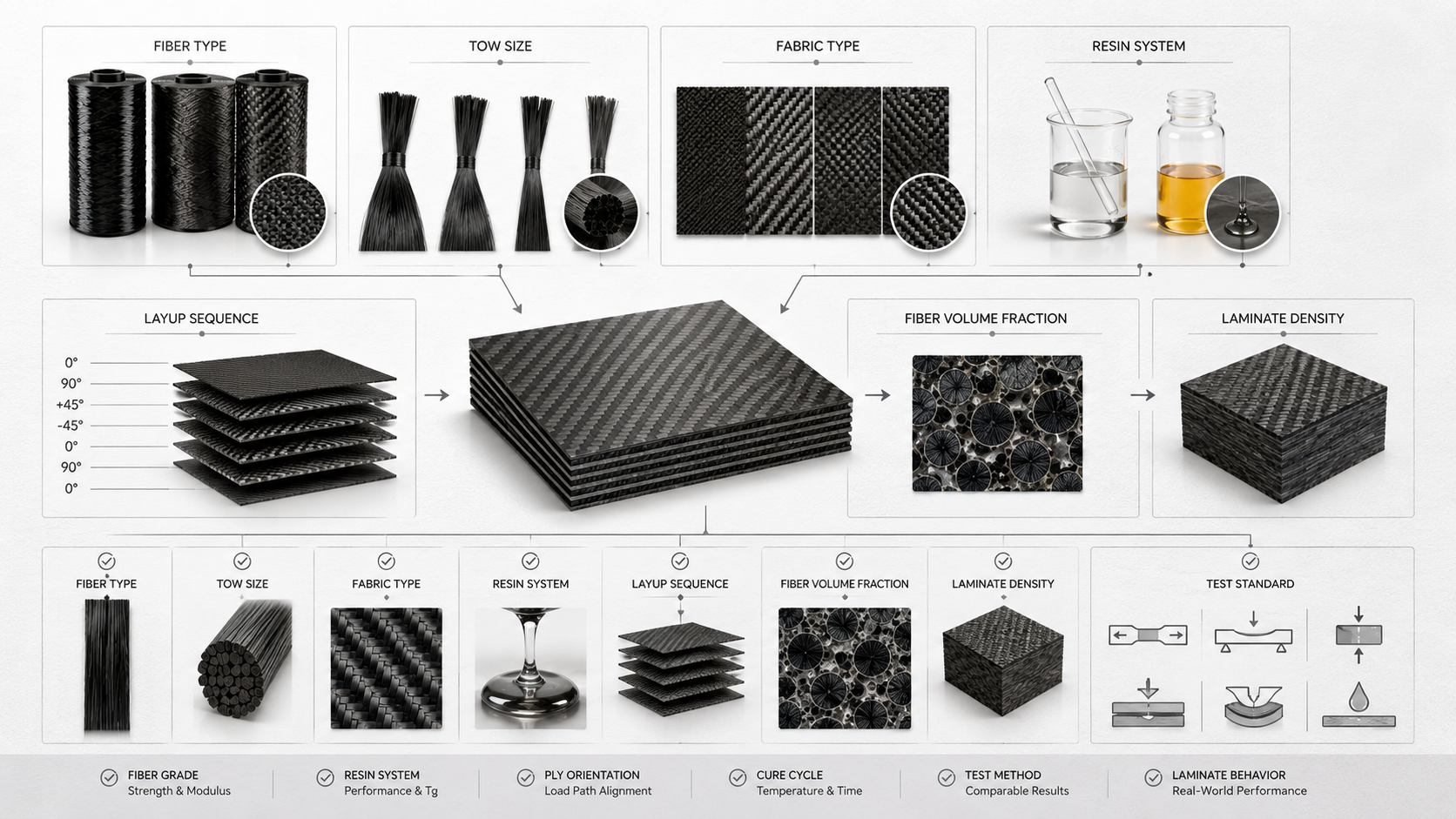
This is the trap that catches procurement teams again and again. Carbon fiber is not a commodity with fixed numbers.
The same fiber grade can produce a laminate with tensile modulus anywhere from 50 GPa to well above 100 GPa. That range depends on layup orientation, fiber volume fraction, resin system, cure cycle, and test standard.
“Carbon fiber” alone is not a specification.
It is only a starting point.
The Baseline Reference
A balanced, symmetrical 0/90° CFRP laminate — one of the most common configurations on supplier data sheets — may deliver:
- Tensile modulus: 70 GPa
- Tensile strength: 600 MPa
- Density: 1.5 g/cm³
That is a useful reference point.
A unidirectional 0° layup will be stiffer and stronger along the fiber axis. A quasi-isotropic layup will be more balanced. An undefined layup sequence gives you something in between — with no reliable way to compare it against another quote.
What Your Laminate Specification Must Define
| Parameter | What to Specify | Example |
|---|---|---|
| Layup sequence | Ply orientation stack | [0/90]s or [0/±45/90]s |
| Fiber volume fraction | Target Vf % | 55–60% |
| Laminate density | Acceptable range | 1.4–1.6 g/cm³ |
| Test standard | Standard per property | ASTM D3039 tensile, ASTM D7264 flexural |
The laminate specification should also clarify:
- Fiber grade
- Tow size
- Fabric type
- Resin system
- Prepreg vs. dry fiber
- Cure system
- Target thickness
- Local reinforcement
- Core material if sandwich construction is used
- Whether substitutions are allowed
Constraints First-Pass RFQs Often Miss
Procurement teams often miss the practical constraints that determine whether a laminate is manufacturable and durable.
Watch for these:
- Balance and symmetry — asymmetric laminates can warp during cure.
- Galvanic isolation — carbon fiber parts connected to aluminum or steel may need a glass ply or liquid shim barrier. Carbon fiber in direct contact with aluminum can create an electrochemical cell.
- Fastener rules — countersink depth should stay under 70% of laminate thickness.
- Minimum edge distance — use 3.0D in the primary load direction as a baseline.
- No interference-fit fasteners — clearance fit only.
- Compatible fastener materials — titanium, A286, or PH17-4 stainless are typical options.
One thing must be settled before this section is finalized:
Two suppliers quoting “T700 12K 2×2 twill epoxy laminate” can still deliver laminates with different properties.
Fiber volume fraction, cure cycle, resin chemistry, and ply schedule all shift the final numbers.
The fix is simple:
Require test data per named standard, not marketing spec sheets.
At HyperX Carbon, material selection and laminate design are reviewed together. A fiber grade without layup context is incomplete. A layup without process context is also incomplete. The RFQ should connect all three: fiber, resin, and laminate architecture.
Section 4 — Geometry, Dimensions & Tolerances: Where Most RFQs Fall Short
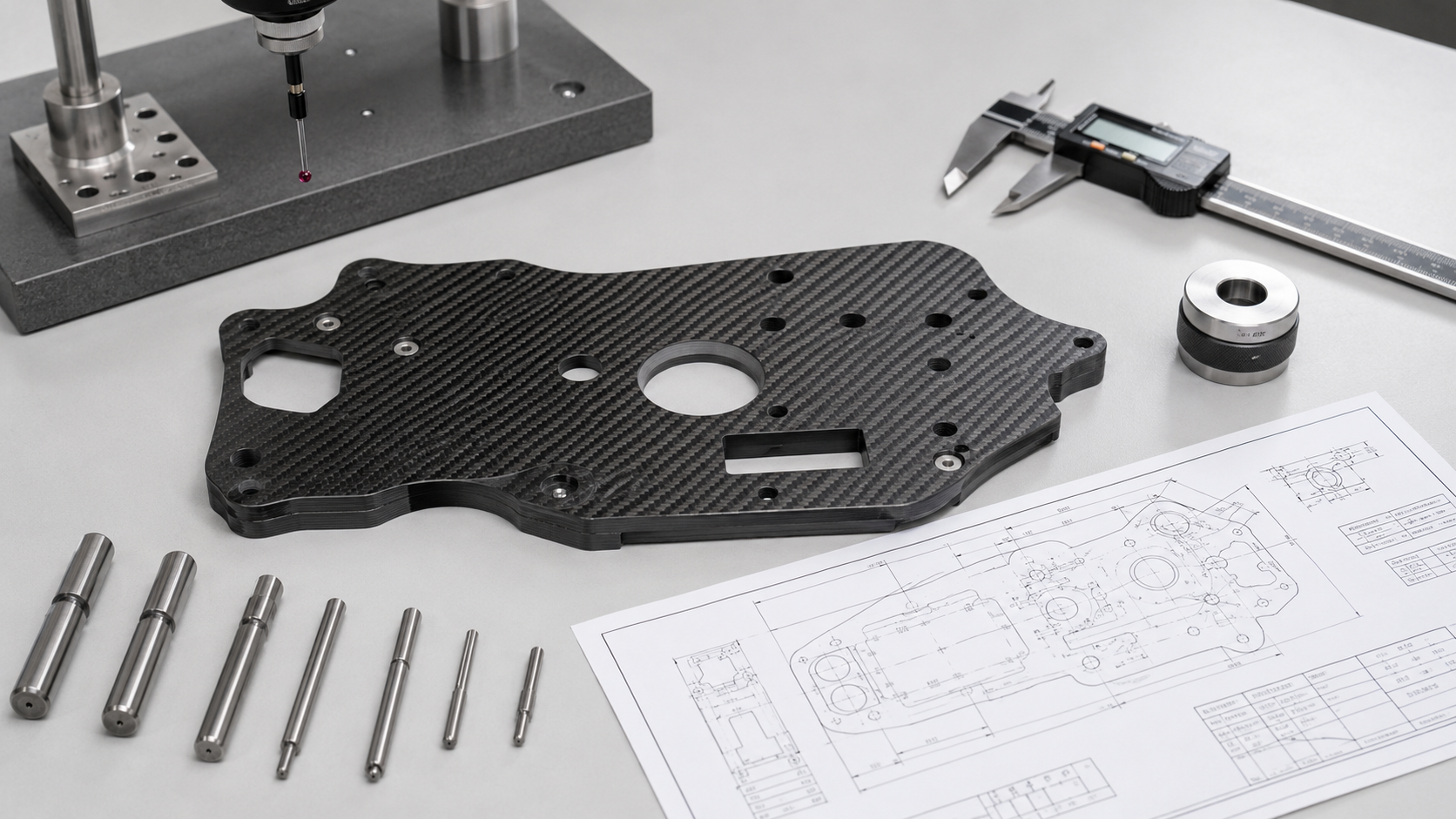
Tolerance errors do not announce themselves at RFQ stage.
They show up six weeks later, on a scrap pile, attached to an invoice you were not expecting.
Most procurement teams underestimate this section. It also generates many supplier clarification emails. Geometry looks simple. It is not.
Failure Pattern 1: Dimensions Without Tolerances
Every critical dimension needs an explicit tolerance on the drawing itself.
Not buried in a specification document nobody reads.
A nominal Ø25 mm callout with no ± value forces the shop to use its default tolerance, often ±0.1 mm. Your actual requirement may be ±0.03 mm.
At that point, the fit is already at risk before a single ply is laid.
Use limit dimensioning where precision matters:
25.00 / 24.97 mm
That is clear.
“Ø25 mm” is not.
Failure Pattern 2: GD&T and Coordinate Tolerances on the Same Feature
Pick one method.
A hole located by X/Y ±0.10 mm and a GD&T position frame of ⌀0.20 creates a direct conflict.
Each supplier may handle it differently. Some may ask. Some may not. None should be forced to guess.
Failure Pattern 3: No Inspection Protocol Attached to the Tolerance
A flatness specification of 0.05 mm on a 500 mm panel means little without a measurement rule.
Is it checked with a four-point method?
A 16-point 4×4 grid?
A CMM scan?
A fixture gauge?
That choice decides whether the part passes or fails.
Failure Pattern 4: No Remediation Path for Out-of-Tolerance Parts
Be direct:
- What is reworkable?
- What is scrap?
- What triggers concession review?
- What triggers a price adjustment?
- What must be reported before shipment?
Without this guidance, suppliers may scrap parts that could be saved — or ship parts that should not pass.
Geometry and Tolerance Checklist
Before RFQ release, confirm:
- All critical dimensions carry explicit limit tolerances or IT grades.
- GD&T and ± coordinate tolerances are not applied to the same feature.
- Measurement method is defined, such as CMM, gauge type, fixture check, or point count.
- Batch acceptance criteria are stated as numbers, such as 90% within limit per 10-sample lot.
- Out-of-tolerance remediation path is documented.
For carbon fiber parts, tolerances also affect the process route. A loose tolerance may be possible with molded finish. A tight tolerance may require CNC trimming, drilling, secondary machining, or inspection fixtures.
Tolerance is not just an inspection issue. It is a cost and process issue.
Section 5 — Surface Finish & Secondary Operations: Cosmetic Requirements Must Be Quantified

“Cosmetically acceptable.”
That phrase has killed more CFRP programs than bad fiber specifications ever will.
It means nothing.
Your supplier knows it means nothing.
So they ship what they think you want. You reject it. Now the project is three weeks behind on a timeline that had no slack.
Carbon fiber surface finish requirements should be written as numbers on a drawing — not adjectives in an email.
Define Your Surface Class First
Assign surface class to every exterior face.
A simple framework:
- Class A — primary visible surfaces
- Class B — secondary visible surfaces
- Class C — structural or hidden surfaces
For Class A surfaces, define inspection conditions and limits:
- Inspection distance: ≤300 mm
- Inspection time: 7 seconds per 12 in²
- Lighting: ≥1,000 lux
- Scratches: none beyond 0.25 mm × 3 mm
- Blisters: no blisters over 0.25 mm diameter, maximum 3
- Burrs: none
For Class B surfaces, use the same inspection distance but shorter inspection time, such as 5 seconds, with looser defect limits.
For Class C surfaces, inspection may be 3 seconds, with scratching and single gouges up to 0.75 mm allowed if they do not affect structure.
The point is not that every project must use these exact limits.
The point is that cosmetic acceptance must be quantified.
Lock Roughness to a Number
| Surface Type | Ra Target | Measurement Rule |
| A-side cosmetic | 0.4–0.8 µm | 5 profilometer readings, mean 83–112% of nominal |
| Structural B/C surfaces | 1.5–3.2 µm | Same measurement protocol |
A surface cannot be “smooth enough” unless smoothness has a number.
Define Color Matching Correctly
Color matching requires ∆E, not “match sample.”
Specify:
∆E < 1.0 in CIELAB color space
If color variance is visible within 30 seconds at inspection distance, define whether that is a reject.
Write the threshold into the drawing.
No exceptions.
Secondary Operations Checklist
Your RFQ should list all secondary operations clearly:
- Clear coat
- Painting
- Sanding
- Polishing
- Edge sealing
- Bonding
- Inserts
- Labels
- Holes
- Slotting
- CNC trimming
- Drilling
- Assembly preparation
- Packaging protection for visible surfaces
Include alignment tolerances and QA approval requirements for rework.
Before RFQ release, confirm:
- Surface class is assigned to every exterior face.
- Ra range is specified per class.
- Profilometer measurement protocol is defined.
- Defect limits are defined by type, count, and maximum dimension.
- Color acceptance is stated as ∆E < 1.0 or another defined project threshold.
- Secondary operations are listed with acceptance rules.
At HyperX Carbon, we separate structural requirements from cosmetic requirements early. A visible carbon fiber part and a hidden structural part should not be quoted with the same finishing assumptions.
Section 6 — Performance Requirements: Mechanical, Thermal & Electrical Specifications
Numbers do not lie.
Vague performance targets do.
A procurement team that submits CFRP mechanical properties without test method references is not submitting specifications. It is submitting suggestions.
“High stiffness required” gives a supplier nothing useful to work with.
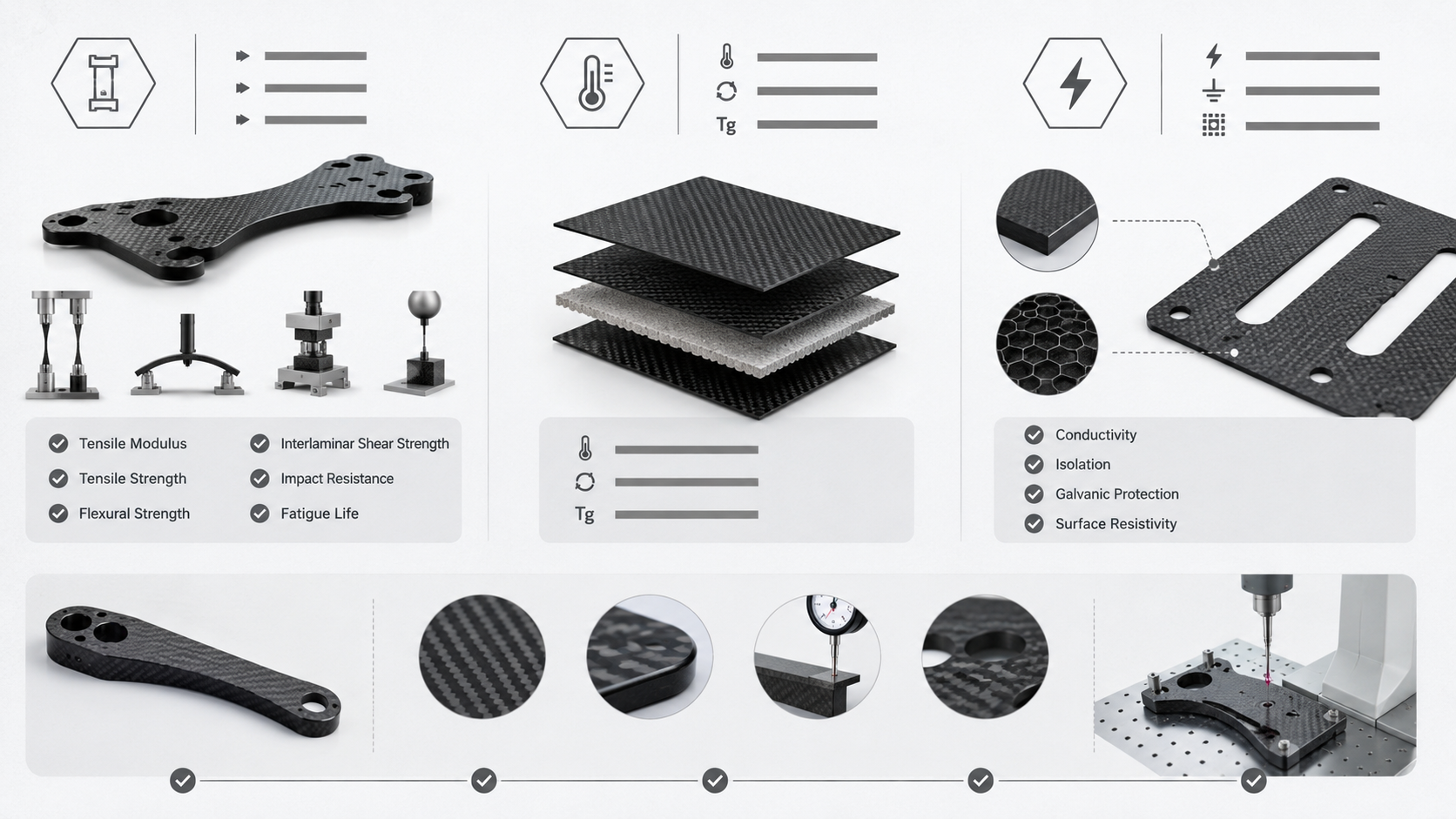
Custom carbon fiber parts usually need three performance requirement categories:
- Mechanical
- Thermal
- Electrical
Most RFQs mix them up or skip them.
Mechanical Performance: Specify the Test, Not Just the Target
Every mechanical property needs a paired test standard.
Tensile modulus without ASTM D3039 is incomplete.
Flexural strength without ASTM D7264 is not comparable across suppliers.
| Property | Target Value | Required Test Standard |
| Tensile modulus | ≥70 GPa, 0/90° baseline | ASTM D3039 |
| Tensile strength | ≥600 MPa | ASTM D3039 |
| Flexural strength | ≥800 MPa | ASTM D7264 |
| Interlaminar shear strength | ≥50 MPa | ASTM D2344 |
Use these values as a specification example, not a universal requirement for every part.
The correct targets depend on application, load case, fiber grade, layup, resin system, and process route.
Thermal Requirements: Define the Actual Use Condition
State the operating temperature range in full:
- Minimum temperature
- Maximum temperature
- Thermal cycling
- Short-term peak exposure
- Continuous exposure
- Hot-wet condition if relevant
A part running at 120°C needs a resin system with Tg well above that point.
Use this baseline:
Tg ≥ maximum operating temperature + 25°C
If the part sees cycling, moisture, UV, or chemical contact, say so clearly.
Electrical Conductivity or Isolation
Carbon fiber conducts electricity.
That can be an asset or a liability.
If the part interfaces with sensitive electronics, antennas, batteries, aluminum structures, or grounding paths, define the requirement.
Your RFQ should state whether the part needs:
- Electrical conductivity
- Electrical isolation
- Galvanic isolation
- EMI shielding
- Controlled surface resistivity
- Insulation layer
- Glass ply barrier
If conductivity is the goal, state the target surface resistivity in Ω/sq.
If isolation is required, identify the interface area and isolation method.
Before RFQ release, confirm:
- Mechanical properties are paired with named ASTM or ISO test standards.
- Tg requirement is stated relative to maximum operating temperature.
- Electrical conductivity or isolation requirement is declared.
- Performance targets are tied to the application, not copied from a generic datasheet.
At HyperX Carbon, we often see buyers request “strong carbon fiber” when the real need is fatigue resistance, heat resistance, isolation from aluminum, or stiffness under a specific load direction. Performance requirements should describe the job the part must do, not only the material name.
Section 7 — Manufacturing Process & Tooling Constraints

The process is the specification.
Most procurement teams treat manufacturing method as a supplier decision.
It is not.
Leave it undefined, and your quote reflects whatever process the supplier defaults to — not necessarily the one your part actually needs.
Three constraints drive every carbon fiber manufacturing quote:
- Process capability
- Tooling investment
- Minimum viable volume
Get clear on all three before sending the RFQ.
Process Capability: Match the Method to the Part
CFRP processes are not interchangeable. Each one has limits on geometry, tolerance, surface finish, cost, and throughput.
| Process | Typical Dimensional Tolerance | Surface Finish, Ra | Best-Fit Volume |
| Hand layup | ±0.3–0.5 mm | 1.6–3.2 µm, tool side | Prototype to low-volume |
| Autoclave prepreg | ±0.1–0.2 mm | 0.8–1.6 µm | Aerospace, low-to-mid volume |
| RTM / VARTM | ±0.2–0.3 mm | 0.8–1.6 µm, both sides | Mid-to-high volume |
| Compression molding | ±0.05–0.15 mm | 0.4–0.8 µm | High volume, simpler geometry |
Name the required process in the RFQ, or define the output requirements tightly enough that only suitable processes can meet them.
Both approaches work.
Leaving the process completely open does not.
Tooling Investment: Know What You Are Committing To
Hard production tooling reshapes program economics.
The thresholds are real:
- Prototype tooling: 3–6 week lead time. Good for geometry validation, not final production qualification.
- Production injection mold: 8–16 week lead time. Cost makes sense above 10,000–20,000 parts/year.
- Matched compression die: 10–20 week lead time. Needs firm volume commitment before start.
Under those volume thresholds, soft tooling or machined mandrels may be the better route.
Putting hard tooling on a 500-piece annual program is a budget error. It shows up directly in per-unit cost.
Physical Process Limits to Document
Your RFQ should also define physical constraints that may affect manufacturability:
- Maximum part envelope
- Autoclave bed size
- Press platen size
- Maximum cured ply thickness per cure cycle
- Minimum bend radius relative to laminate thickness
- Core material constraints
- Foam type and density if sandwich construction is involved
- Insert and bonding requirements
- Maximum part weight
- Required trim access
What Your RFQ Must State in This Section
Confirm the RFQ includes:
- Preferred or required manufacturing process
- Cure cycle requirements: temperature, pressure, hold time, ramp rate
- Tooling type acceptable: soft vs. hard, open vs. matched die
- Prototype quantity
- Annual volume
- Maximum part envelope dimensions and weight
- Process exclusions, such as “no wet layup — prepreg only”
- Whether supplier process alternatives are allowed
- Tool ownership expectation
- Tool life and maintenance responsibility
Keep this section vague and the supplier fills in the blanks based on their available equipment and utilization needs.
That choice may not match your quality targets, timeline, or unit cost model.
At HyperX Carbon, manufacturing route review is part of RFQ review. We look at geometry, tolerance, surface, quantity, tool cost, and validation requirement together before recommending prepreg layup, molding, infusion, CNC finishing, or another route.
Section 8 — Quality, Testing & Certification Requirements
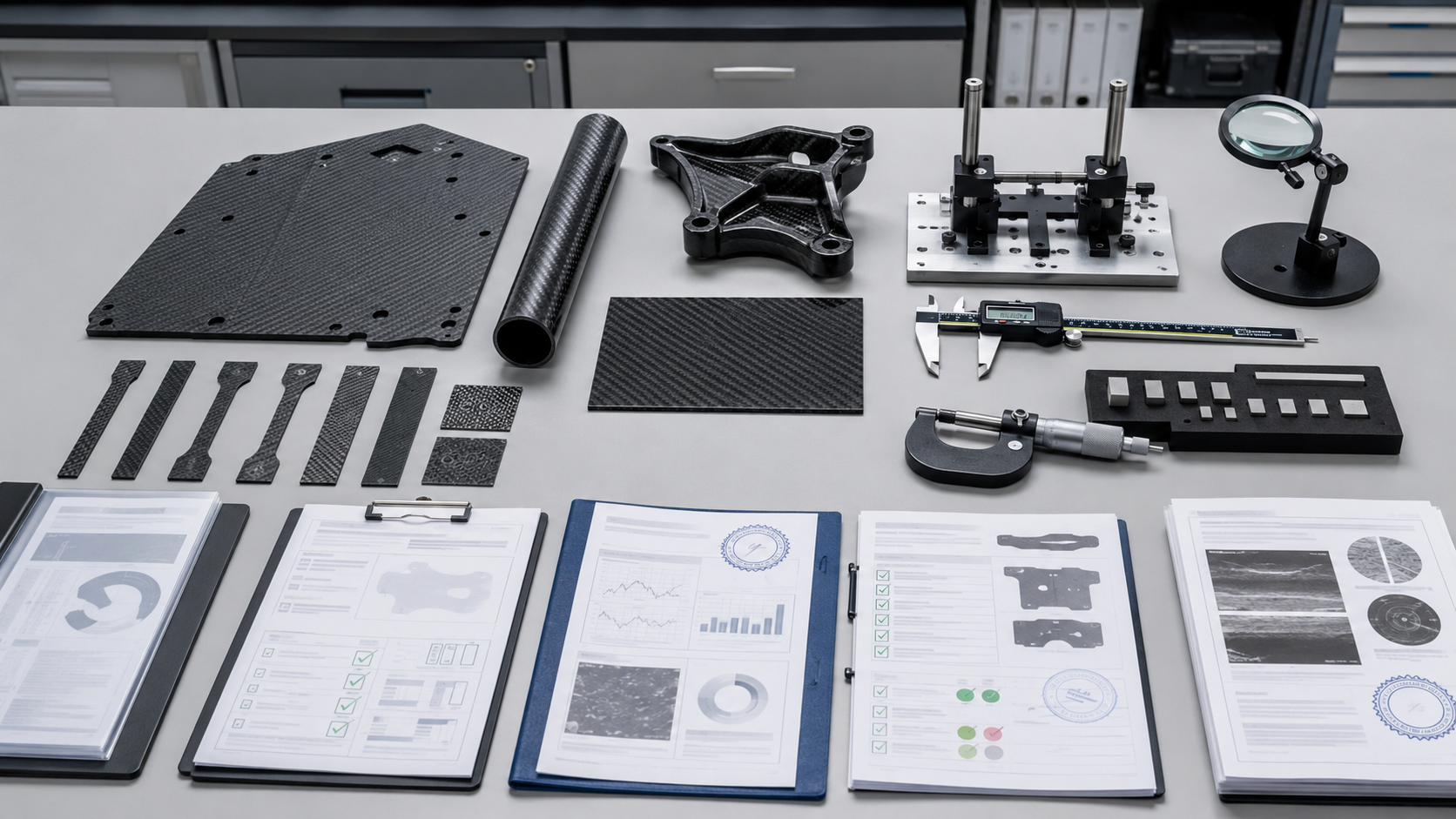
Certification requirements separate suppliers who can deliver from suppliers who say they can deliver.
The proof shows up in inspection records — not in a brochure.
Before a single part ships, lock down three things:
- What tests are required
- Who certifies the results
- What documentation travels with the order
Minimum Quality Requirements to Include
Your RFQ should define:
- Dimensional inspection — CMM report per drawing revision, with recorded measurements against every critical tolerance
- Mechanical property verification — coupon test data per ASTM D3039 tensile and ASTM D7264 flexural, from the same production lot if required
- Fiber volume fraction — burn-off or acid digestion test confirming Vf falls within the specified range, such as 55–60%
- Visual and cosmetic inspection — written pass/fail criteria tied to defined surface class
- NDT requirements — ultrasonic C-scan, X-ray/CT, tap test, thermography, or other project-specific method
- Sampling plan — percentage or lot size to inspect
- Acceptance criteria — defect limits, void limits, porosity rules, delamination limits, or customer-specific requirements
- Nonconformance process — reporting, containment, rework, concession, and rejection rules
Certification Levels to Specify
| Documentation Tier | What It Covers |
| Certificate of Conformance, C of C | Supplier declares part meets drawing requirements |
| First Article Inspection, FAI | Full dimensional and material verification on the first production lot |
| AS9100 / ISO 9001 | System-level quality management; required for aerospace or safety-critical parts where applicable |
For automotive projects, IATF 16949 or PPAP requirements may also apply.
For aerospace projects, AS9100, NADCAP process requirements, customer approvals, or long-term record retention may be required.
Quality Checklist
Before RFQ release, confirm:
- Inspection method is named per dimension type.
- Test standards are specified by property.
- Required certifications are listed with acceptable issuing bodies.
- FAI is required on first production release if applicable.
- Quality record retention period is stated.
- Structural parts should define record retention clearly; 10 years minimum is common for high-reliability programs.
- Nonconformance containment and corrective action expectations are written.
At HyperX Carbon, we prefer quality expectations to be defined before quotation. Inspection that appears after the PO becomes a cost change. Inspection defined before RFQ becomes part of the production plan.
Section 9 — Commercial Terms & Logistics: Details That Affect Lead Time and Price
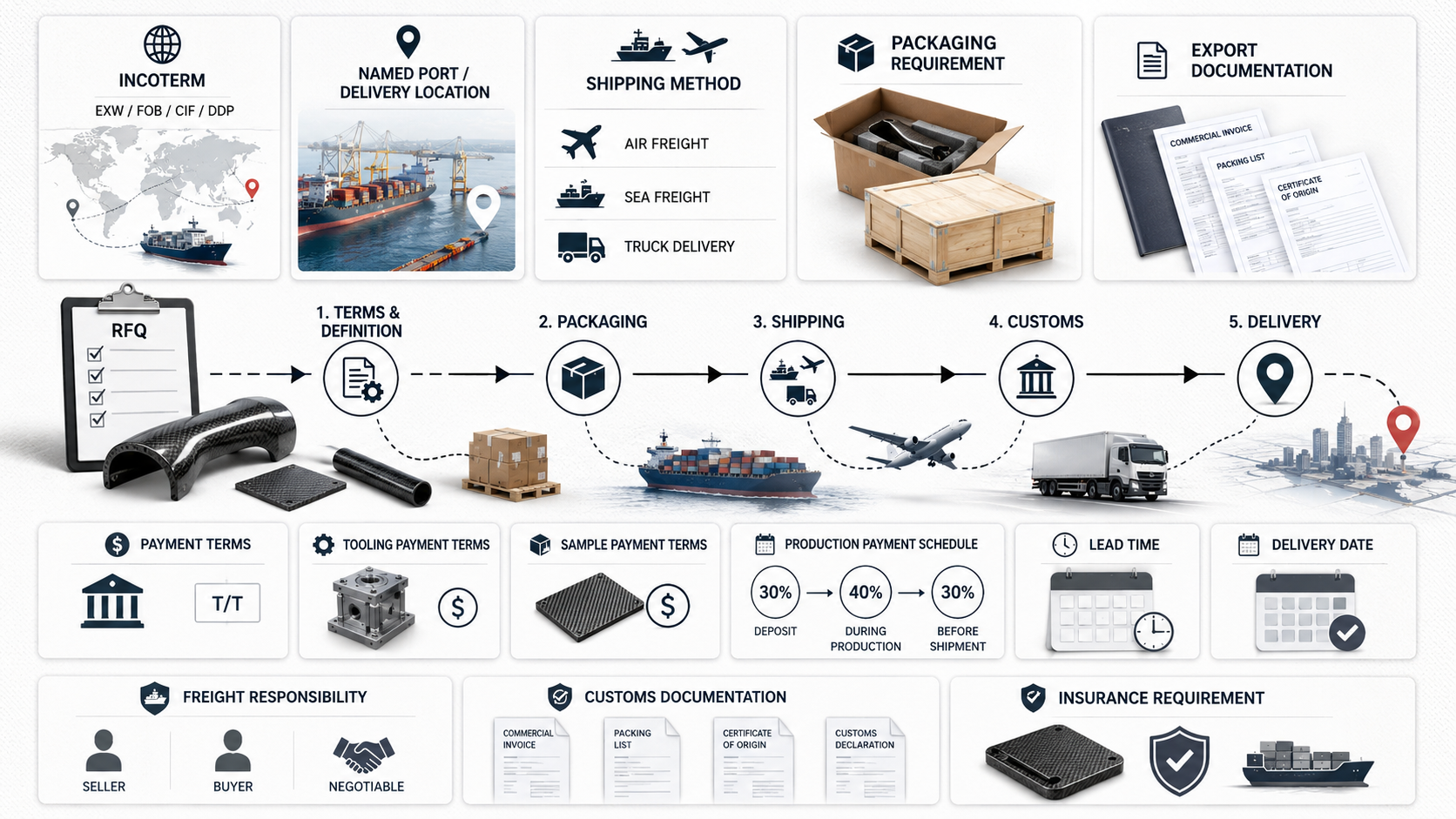
The commercial terms section of your RFQ is where good specifications often lose control.
You can define everything upstream — fiber grade, layup schedule, surface class, cure cycle — with precision.
Then the logistics fields get left blank.
Your 30-day program becomes a 60-day program.
Not because the parts were late.
Because nobody agreed on who books freight, who clears customs, who pays insurance, or what “on time” means.
Incoterm and Named Place
State the Incoterm plus named place.
Write:
FOB Shanghai
Do not write only:
“FOB”
This single field determines who pays pre-carriage, main freight, insurance, and customs clearance.
FOB vs. CIF on the same shipment can shift 5–15% of cargo value between buyer and supplier.
Total Lead Time Commitment
State the maximum acceptable order-to-delivery window.
Sea freight from Asia may run 15–35 days port-to-port, depending on destination.
Air freight can reduce that to 1–5 days, but it may cost 3–6× more per kg.
Your RFQ should state whether the supplier is quoting:
- Production lead time only
- Production plus export packing
- Production plus freight booking
- Door-to-door delivery
- Air freight
- Sea freight
- Express courier
Documentation Deadlines
VGM and export documents may be due 24–72 hours before vessel departure.
Miss the cutoff and your shipment moves to the next sailing — often a 7–10 day delay.
Demurrage can begin at USD 75–200/container/day once free time expires.
These details affect real landed cost.
They belong in the RFQ.
Service-Level KPIs
Define delivery expectations with consequences:
- Required on-time delivery percentage
- Acceptable delivery window, such as ±24 hours
- Late delivery notice period
- Expedite responsibility
- Air freight upgrade rules
- Price adjustment or credit for late delivery
- Backup shipment plan
- Packaging damage responsibility
No consequences means no accountability.
Commercial and Logistics Checklist
Before RFQ release, confirm:
- Incoterm with named port or named place is stated.
- Maximum total lead time is defined in calendar days.
- Documentation cutoff deadlines are included.
- Demurrage and detention free days are agreed in writing.
- Per-day demurrage or detention rates are known.
- Maximum total lead time is defined in calendarPriority vs. standard freight options and price premiums are documented.
- MOQ, payment terms, warranty, packaging, and export documentation are defined.
At HyperX Carbon, export packaging, documentation timing, Incoterms, and delivery terms are treated as part of RFQ review because they affect real project lead time and landed cost.
Section 10 — Supplier Qualification Criteria: How to Evaluate Carbon Fiber Manufacturers
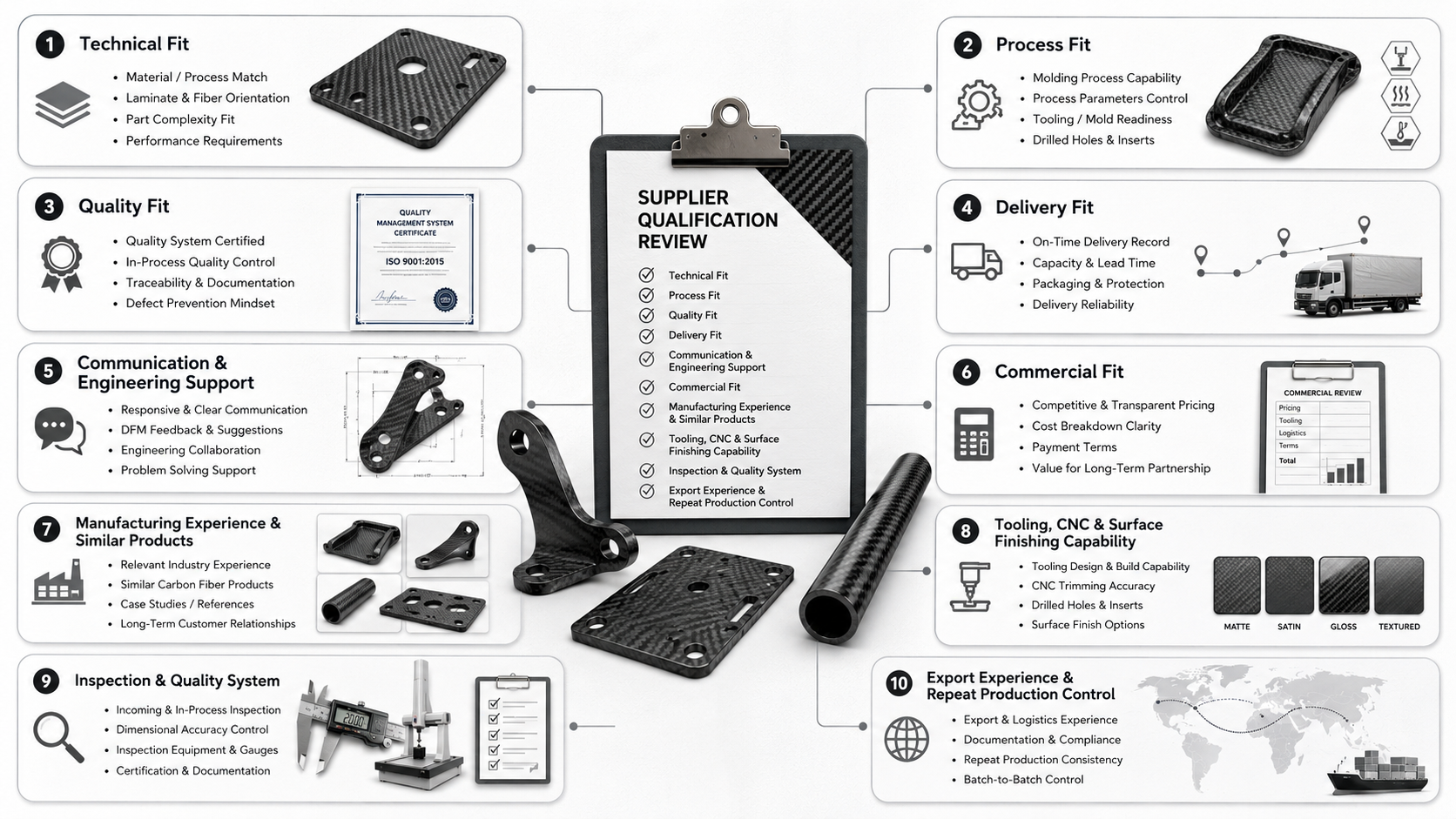
Certifications live on paper.
Capability shows up on your scrap report.
Qualifying a carbon fiber manufacturer is not a checkbox exercise. It is a structured risk assessment.
Two suppliers can look identical on a vendor questionnaire and deliver very different results once production starts.
Step 1: Pre-Screen on Hard Filters First
Before discussing price or lead time, verify non-negotiables:
- ISO 9001 minimum — no exceptions for serious production work
- AS9100 for aerospace applications
- IATF 16949 for automotive applications where required
- Documented Process Control Document, or PCD, per fiber grade
- Audit history — at least one successful second-party or third-party audit within the last 36 months
- Zero unresolved major nonconformities
Suppliers without these are not just unqualified candidates.
For critical programs, they are disqualified ones.
Step 2: Request Technical Data That Matters
Ask for qualification test reports, not marketing datasheets.
Request:
- Mechanical allowables per fiber grade — tensile modulus, tensile strength, ILSS
- Test standard per property
- Specimen count — at least 30–50 specimens per orientation across multiple lots is a useful baseline for serious qualification programs
- Lot-to-lot variability data
- Coefficient of variation, or CoV, for tensile strength and modulus
- Environmental conditioning datasets — RTD, ETW, CTD if the application runs above 80°C or sees moisture
- Processing window
- Storage conditions
- Traceability record example
For aerospace-grade fiber or high-reliability applications, CoV for tensile strength and modulus should typically stay below 5–8%.
A supplier who cannot produce multi-lot statistical property data may not be running a qualified process.
They may be running hope.
Step 3: Audit the Shop Floor, Not the Slide Deck
On-site audit targets should include:
- PCD implementation — confirm whether actual process parameters are monitored and recorded
- Carbonization temperature profile
- Line speed
- Sizing application rate
- Layup control
- Cure cycle records
- Vacuum and pressure records
- Nonconformance logs for the last 24 months
- Fiber breaks
- Diameter deviations
- Sizing failures
- Response speed
- Packaging and storage controls
- Lot and roll ID labeling
- FIFO practice
- Humidity and temperature control
For critical nonconformities, containment within 24–72 hours is a useful benchmark.
Step 4: Run Trial Lots Before You Commit
Procure 100–500 kg trial quantities if the program scale justifies it.
Produce qualification laminates in your own facility or through the agreed manufacturing process. Use the supplier’s recommended processing windows.
Measure laminate properties against the supplier’s published data.
Acceptable deviation may be around ±5–10% on key mechanical metrics.
Anything beyond that range is a process alignment problem.
Find it before production.
Not after.
Step 5: Set KPIs With Consequences
Conditional approval means little without clear performance targets attached.
| KPI | Minimum Acceptable Target |
| On-time delivery | ≥95% over preceding 12 months |
| Nonconforming lots | ≤1–2% of total shipments |
| CoV, tensile strength | Within agreed specification limits |
| Corrective action response | Critical nonconformities contained within 72 hours |
Schedule annual audits.
Require notification — and requalification data — for major process changes:
- New PAN source
- Modified carbonization temperature profile
- Updated sizing chemistry
- Resin change
- Prepreg storage change
- Layup process change
- Cure cycle modification
- Tooling change
Supplier Questionnaire Questions
Add these to your RFQ or qualification survey:
- Provide full lot traceability records linking fiber lots to PAN precursor lot and doff numbers. State your record retention period.
- State your on-time delivery percentage, scrap/rework rate, and customer complaint rate for the last 12 months.
- List all major process changes to carbonization, stabilization, or sizing in the last five years, and provide associated requalification test results.
- Confirm your annual production capacity per fiber grade in metric tons.
That last question has a benchmark built in.
Toray produces around 35,000 metric tons per year and holds 30–35% global market share — that is what tier-one scale and reliability looks like.
Suppliers serving serious aerospace or automotive programs often dedicate at least 20–30% of production to those sectors.
A manufacturer with 95% industrial output and a fresh AS9100 certificate carries a different risk profile than one with a decade of aerospace OEM approvals.
Know which one you are talking to before sending a purchase order.
At HyperX Carbon, supplier qualification logic also applies when buyers evaluate us. We expect serious buyers to ask about process capability, inspection, documentation, traceability, capacity, and quality control. A capable carbon fiber manufacturer should be able to answer those questions clearly.
Common RFQ Mistakes That Cause Delays and Inaccurate Quotes
Six weeks into a program, nobody wants to hear the quote was wrong because the RFQ was incomplete.
But that is how it happens — quietly, at cost, and on repeat.
These mistakes are common across procurement teams, industries, and supplier relationships.
The same patterns kill carbon fiber RFQ cycles again and again.
Mistake 1: Sending Incomplete Technical Data
A BOM without revision numbers, material grades, or finish specs forces every supplier to guess.
Each supplier guesses differently.
Your quotes come back different.
You cannot compare them because they are not pricing the same thing.
Mistake 2: Using Outdated Drawings
BOM at Rev R3.
Design already at Rev R5.
The supplier quotes parts that no longer exist.
Re-quoting cycles can eat 3–10 days per round.
Freeze the revision before the RFQ goes out.
Lock it.
Do not hand suppliers a moving target.
Mistake 3: Leaving Tolerances Undefined
The gap between ±0.01 mm and ±0.1 mm can shift machining cycle time by 20–40% and scrap rate by 5–15%.
No explicit callout?
Suppliers default to their own standard — not yours.
Mistake 4: Skipping Logistics Details
No Incoterm means no agreed freight cost split.
An MOQ that jumps post-PO from 500 to 1,000 units can push total cost 10–20% in a direction nobody planned for.
Mistake 5: Treating Surface Finish as a Description Instead of a Standard
“Glossy carbon finish” is not enough.
“Class A visible surface, Ra 0.4–0.8 µm, ∆E < 1.0, inspection at ≤300 mm under ≥1,000 lux” is a specification.
The second version can be quoted, inspected, and accepted.
Mistake 6: Asking for Price Before Defining Validation
Coupon tests, NDT, FAI, CMM reports, surface inspection, and documentation retention all affect cost.
If validation appears after the PO, it becomes a change order.
If it appears before RFQ, it becomes part of the quote.
Final Takeaway
All of these failures trace back to the same root cause:
The RFQ went out before the specification package was ready.
A complete RFQ is not paperwork.
It is leverage.
Your custom carbon fiber product specification checklist needs to cover every layer of the conversation:
- Project context
- Drawings and CAD files
- Revision control
- Material and laminate specification
- Geometry and tolerances
- Surface finish
- Secondary operations
- Mechanical, thermal, and electrical performance
- Manufacturing process
- Tooling constraints
- Quality and certification
- Commercial terms
- Logistics
- Supplier qualification
Cover these, and you stop being just another inquiry in a supplier’s inbox.
You become the procurement team that knows what it needs.
That clarity cuts quote cycles short, removes revision loops, and earns serious attention from capable manufacturers.
The ten sections in this guide serve one purpose:
Nothing should get lost between your engineering intent and the supplier’s workshop floor.
Pull your current project specs. Run them against this checklist, section by section. Spot what is missing before your supplier has to ask.
Then send HyperX Carbon your CAD file, 2D drawing, application background, material preference, surface requirement, tolerance requirement, performance target, quantity, timeline, quality requirement, and logistics terms.
Our engineering team can review whether your RFQ is complete enough for accurate quotation — and where hidden cost may already be building before production starts.
A complete specification does not slow procurement down. It prevents the delays, rework, and price changes that incomplete RFQs create.