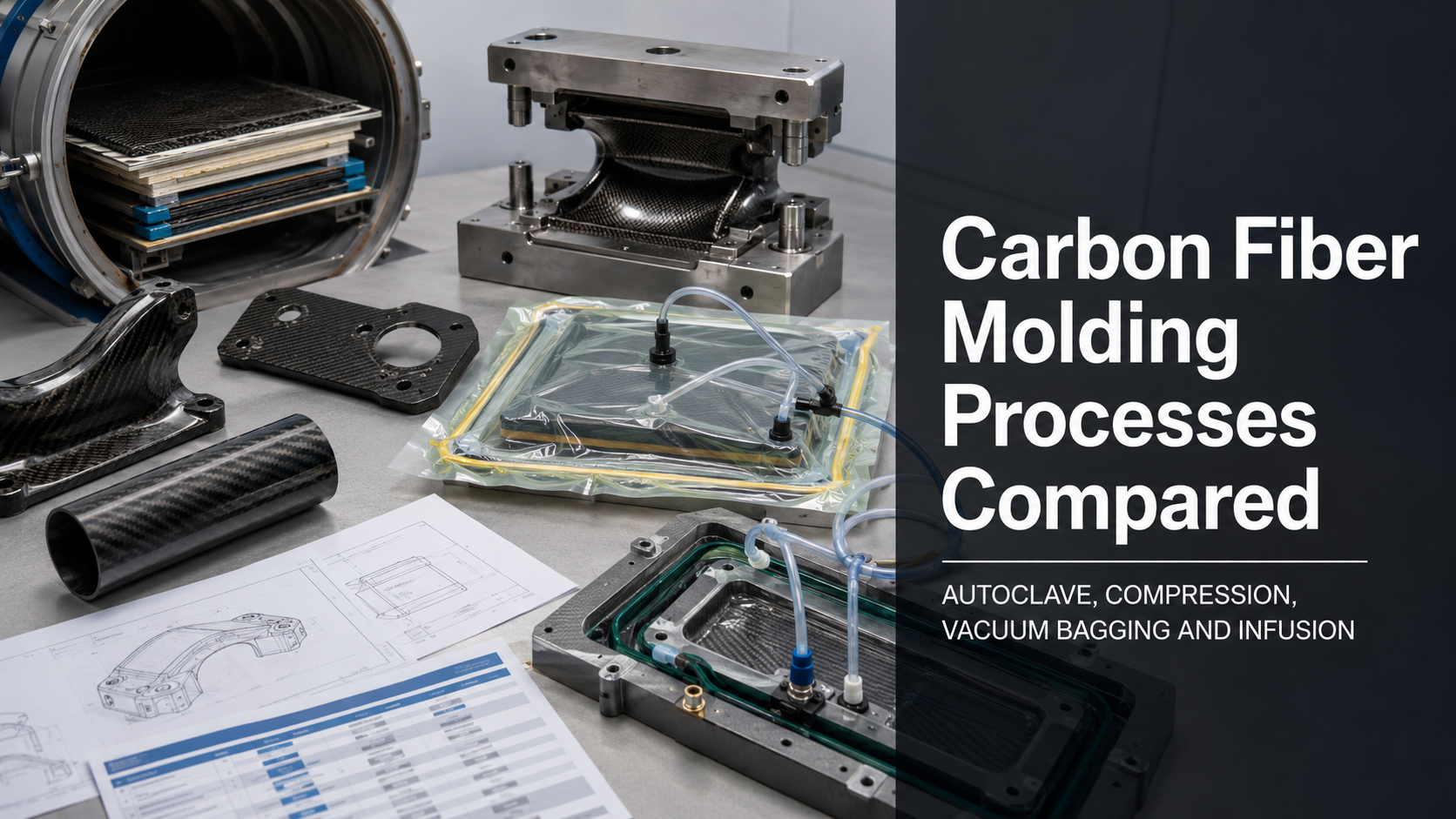
Choosing the wrong carbon fiber manufacturer does not just cost money.
It costs months.
A supplier failure at the prototype stage can collapse an entire product timeline. By the time quality issues show up, the RFQ is already old history, tooling may already be committed, and the project may be too far along to recover without serious cost.
Most buyers start supplier evaluation with little more than a capability deck and a price comparison.
That is a dangerous gap.
Carbon fiber manufacturing is not a commodity purchasing category. A supplier must control material storage, layup, cure, trimming, inspection, documentation, capacity, communication, and IP protection. If one of those systems is weak, the failure may not appear until the first article, pilot run, or production batch.
This guide gives procurement teams, engineers, and sourcing managers a structured framework to evaluate carbon fiber manufacturing services before sending an RFQ.
At HyperX Carbon, we believe the buyer should evaluate manufacturing capability before asking for a final quote. A quote is only useful when the supplier’s factory evidence, process records, quality system, capacity, and engineering support have already been checked.
Carbon Fiber Manufacturing Services: What This Evaluation Guide Covers
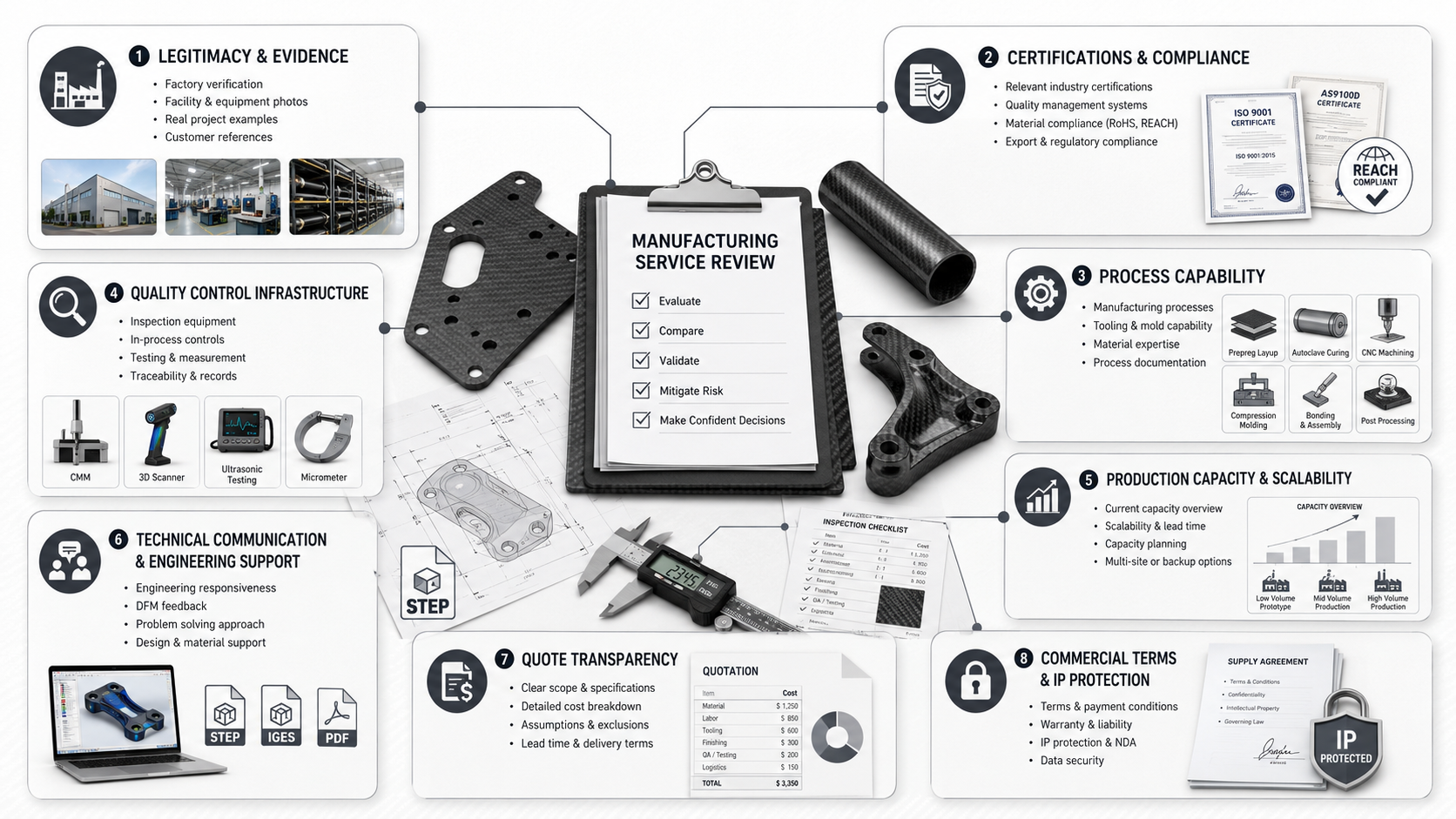
This guide covers the seven dimensions buyers should evaluate before sending an RFQ to a carbon fiber manufacturer.
The goal is simple:
Avoid wasting procurement cycles on suppliers who look capable on paper but cannot support the part in real production.
The seven evaluation dimensions are:
- Factory legitimacy and manufacturing evidence
- Certifications and compliance
- Manufacturing process capability and process records
- Quality control infrastructure
- Production capacity, lead time, and scalability
- Technical communication and engineering support
- Quote transparency, commercial terms, and IP protection
Each dimension connects directly to RFQ quality.
A strong manufacturer should be able to show:
- Real factory identity and production evidence
- Verified certifications matched to the application
- Process records, not only process names
- Incoming, in-process, final, and NDT inspection systems
- Capacity numbers backed by equipment, shift, and output records
- DFM feedback that identifies real manufacturing risks
- Transparent quotes with tooling, unit pricing, QA, secondary operations, payment terms, and IP boundaries separated clearly
The purpose of this evaluation is not to make supplier selection slower.
It is to prevent the expensive version of speed: sending an RFQ too early, receiving a quote based on assumptions, then discovering the supplier cannot support the real production requirement.
Why Manufacturing Service Evaluation Matters Before RFQ

Supplier selection in carbon fiber procurement is not a checkbox.
It is a structural decision that determines whether the project survives contact with reality.
The numbers are unforgiving.
A single wrinkle defect in the layup can reduce compressive strength by 40–60%. Fiber waviness across multiple plies can cut fatigue life by a factor of ten. These are not rare edge cases. They are predictable outcomes when process capability does not match the design requirement.
The risk appears across three main failure modes.
Performance Failure
Wrong process selection creates defects that material datasheets never warn you about.
A part may use the correct carbon fiber grade and resin system, but if the layup process, cure control, compaction, ply alignment, or inspection system is weak, the final part can still underperform.
Material selection does not compensate for poor manufacturing control.
Schedule and Cost Collapse
VARTM infusion failures can lock up tooling for weeks. Compression molding suppliers with undersized presses may deliver 30–50% less actual capacity than their RFQ response claimed.
When this happens, the issue is not only late delivery.
The buyer loses prototype timing, validation windows, launch confidence, and sometimes the chance to change supplier without restarting tooling.
Compliance Exposure
Certification fraud is documented in APAC sourcing chains. Some suppliers quote aerospace-grade prepreg without a single NADCAP or EN 9100 audit on record.
A certificate scan is not enough.
For regulated or high-reliability applications, the buyer must verify the issuing body, scope, facility address, expiry date, audit status, and test evidence.
Procurement research is clear across industries: delivery timing, product quality defects, and order processing time are among the highest-severity supplier risk factors.
Carbon fiber sourcing makes all three harder because every node — precursor, fiber, resin, prepreg, layup, cure, machining, inspection, packaging, and export — can become a failure point.
Pick the wrong manufacturer before RFQ, and you do not just lose money. You lose timeline you may not recover.
Dimension 1: Factory Legitimacy and Manufacturing Evidence

Shell companies exist in every supply chain.
Carbon fiber is no exception.
Before any technical discussion starts, confirm that the entity you are speaking with is a real manufacturer, not a trading company reselling capacity it does not own, and not a paper entity with no production floor.
Verify the Legal Entity
Request the supplier’s business license.
Cross-reference the 18-digit Unified Social Credit Code against China’s national public inquiry platform.
The registered company name, legal representative, and address must match — character for character — across:
- Business license
- Contract draft
- Invoice header
- Payment account
- Export documents
Any mismatch needs a written explanation.
No explanation means no negotiation.
Apply Hard Filters on Operating History and Capital
A legitimate carbon fiber manufacturer should normally have at least 3 years of operating history.
A supplier claiming large-scale CFRP production capacity but registered less than 36 months ago, with capital in the low millions, is a high-risk signal.
That does not automatically mean the supplier is fake.
But it means the buyer should require stronger evidence before sending drawings, paying deposits, or discussing production commitments.
Cross-Check the Factory Address
Pull up satellite imagery.
A registered address in a commercial office district with no industrial footprint nearby is a red flag. Real composite manufacturing facilities — autoclaves, cleanrooms, layup bays, curing equipment, CNC trimming areas, material storage rooms — leave a physical footprint.
If the registered address shows a residential building or office-only location, stop the conversation and request a third-party factory audit.
Confirm the Payment Account Before Funds Move
The bank account holder must match the registered company name.
No personal accounts.
No unrelated trading company.
No affiliated holding company redirects unless legal relationships are documented and the Social Credit Code supports the explanation.
Payment account mismatch is not a small accounting issue.
It is a commercial risk and potential fraud signal.
Factory Evidence to Request
Beyond legal registration, buyers should request real manufacturing evidence:
- Factory photos or video walkthrough
- Equipment list
- Layup area evidence
- Cure equipment evidence
- CNC trimming or machining evidence
- Inspection equipment evidence
- Material storage and prepreg cold-chain evidence
- Recent production examples
- Traceability sample
- Process record sample
- Quality report sample
- Export packaging evidence if international shipping is involved
At HyperX Carbon, we treat factory evidence as part of the first trust layer. A serious buyer should not evaluate carbon fiber manufacturing services from a brochure alone.
Threshold to Advance
Move into price and technical negotiations only when these conditions are met:
- Legal entity verified
- Operating history ≥3 years
- Factory address confirmed
- No major court judgment or blacklist record
- Payment account name matches registered entity
- Manufacturing evidence is consistent with claimed capability
Skip any one of these, and every technical evaluation that follows sits on an unverified foundation.
Dimension 2: Certifications and Compliance for Carbon Fiber Manufacturing
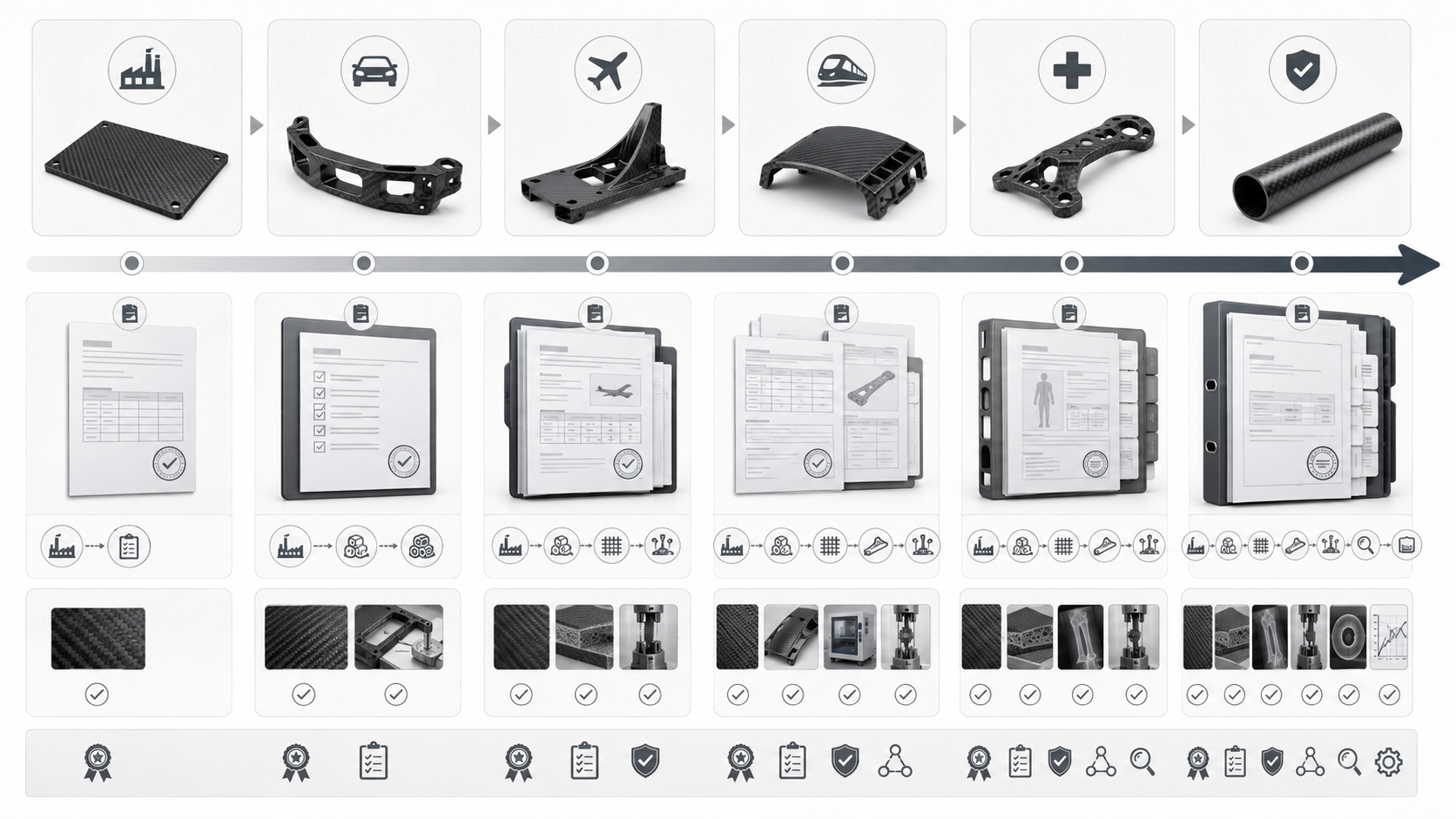
Certifications do not guarantee quality.
But missing the right ones is a hard stop.
The mistake many buyers make is treating ISO 9001 as a quality signal for all carbon fiber applications.
It is not.
ISO 9001 is a baseline. It may work for general industrial CFRP, consumer sporting goods, and non-regulated structural components.
If the application touches an automotive chassis, aerospace frame, rail interior panel, medical device, or safety-critical structure, ISO 9001 alone may not be enough.
Match certification to the application. No exceptions.
Application vs. Certification Requirements
| Application | Required Certification | What It Demands |
|---|---|---|
| General industrial CFRP | ISO 9001 | Batch traceability, documented process, inspection records |
| Automotive structural components | IATF 16949 | SPC, Cp/Cpk indices, APQP/PPAP, DFMEA/PFMEA, OEM customer-specific requirements |
| Aerospace CFRP structures | AS9100D | Full traceability from prepreg batch to part serial number, configuration management, counterfeit material controls, records retained for design life + 10 years |
For buyers, the certification question should not be:
“Do you have ISO?”
It should be:
“Does your certification scope match this part’s application, process, facility, and risk level?”
How to Verify Certificates
Do not accept a certificate scan at face value.
Run two checks.
First, verify through the issuing body. Enter the certificate number on the certifying body’s official portal. Check:
- Standard version
- Scope
- Facility address
- Expiry date
- Suspension or revocation status
Second, request the latest surveillance audit nonconformity summary. One to three pages is standard.
A supplier who refuses to share any audit summary is already telling you something.
For critical aerospace or automotive programs, go further and request a third-party confirmation letter from the certification body stating that no major open nonconformities exist.
FST and Material Performance Requirements
For interior components, compliance may shift from factory system certification to material-level performance.
This includes:
- Aircraft cabin panels
- Rail wall sections
- Seat structures
- Interior housings
- Visible or semi-structural interior composite parts
For aircraft interiors, require FAR 25.853 data:
- Vertical burn test results
- OSU heat release rate
- Smoke optical density
- Dmax ≤ 200–250
- Accredited lab report
- Material system documented
- Specimen thickness documented
- Cure cycle documented
For rail vehicles, EN 45545 may apply:
- LOI values
- Combustion rate
- Smoke toxicity index, CIT
- Test results mapped to HL1–HL3 classification
For mechanical performance verification on structural CFRP, require test data per named standards:
- ASTM D3039 for tensile testing
- ASTM D3410 for compression testing
- ASTM D790 for flexural testing
A useful structural test package should include at least n ≥5 specimens, mean values, standard deviation, test environment, and failure mode.
For critical structural programs, budget for independent re-testing of three to five batches. Acceptable statistical deviation may be around ±10–15% depending on the part and program.
Threshold to Advance
Advance to deeper technical review only when:
- Certification matches the actual application
- Certificate is verified through the issuing body
- Facility address and scope are consistent
- Surveillance audit summary is on file
- FST reports or ASTM/ISO mechanical data are available where applicable
- Accredited lab reports support high-risk or regulated claims
At HyperX Carbon, certification is not used as a decoration. It is used to decide whether the project needs general industrial quality control, automotive-level process discipline, aerospace-level traceability, or material-level FST testing.
Dimension 3: Manufacturing Process Capability and Process Records
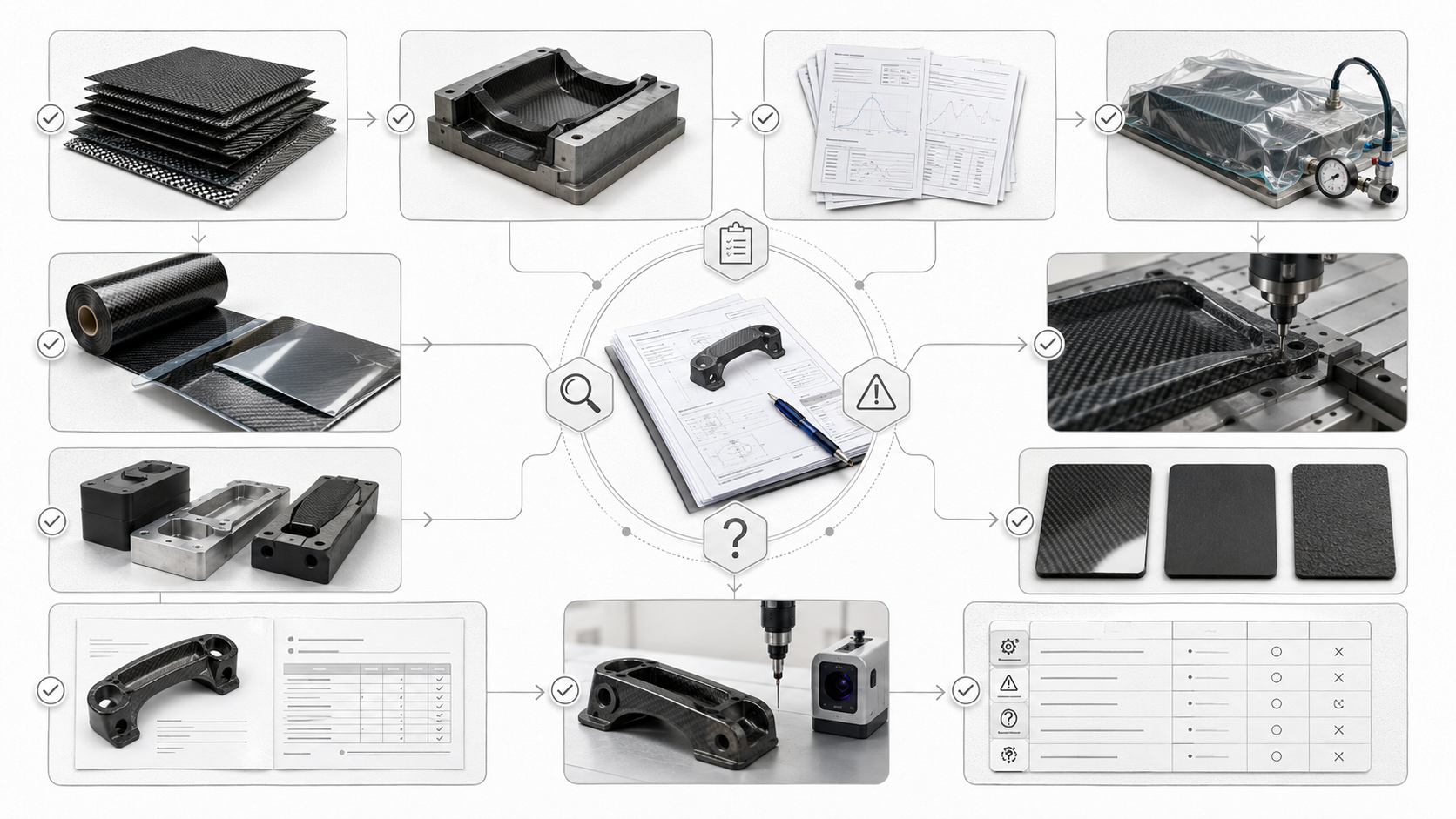
Process capability is where manufacturers reveal themselves.
Not in brochures.
Not in capability decks.
You see it in their answers to specific technical questions — and in the documents they either pull up quickly or struggle to find.
Ask Which Process Windows They Actually Run
Do not only ask what processes the supplier lists.
Ask which process windows they run in production.
Relevant carbon fiber manufacturing routes may include:
- Wet layup
- Vacuum bagging
- VARTM / RTM
- Prepreg layup with autoclave
- Oven-cured prepreg
- Pultrusion
- Compression molding
- Thermoplastic consolidation
- CNC trimming and finishing
For each process, ask for numbers:
- Maximum part dimensions
- Minimum part dimensions
- Thickness range
- Wall thickness range
- Typical defect rate
- Output per shift
- Minimum viable quantity
- Typical lead time
- Tooling type
- Process limitations
A supplier who responds with generalities such as “we can handle most geometries” is telling you they have not answered the hard parts yet.
Ask for Cure Parameter Traceability
Each cure cycle needs a documented record.
That record should include:
- Temperature ramp rate
- Dwell time
- Cure temperature
- Pressure level
- Vacuum level
- Humidity condition
- Oven or autoclave ID
- Fixture position
- Deviations
- Release sign-off
Ask for cure records from the last three comparable production batches.
If the supplier cannot produce them on request, batch-to-batch consistency is already a risk.
A claimed process capability without process records is not yet a manufacturing capability.
Ask How They Manage Prepreg Cold Chain
Prepreg cold chain control is not an administrative detail.
It affects laminate quality.
Ask for:
- Storage temperature
- Temperature log
- Thaw time
- Out-time tracking after opening
- Shelf-life control
- Scrap criteria
- Roll identification
- FIFO practice
Prepreg storage at −18°C is a common requirement. Shelf life may run 6–12 months, depending on the material system. Out-time must be recorded after thawing or opening.
If a supplier cannot control prepreg condition, the fiber volume fraction, tack, cure behavior, and final laminate quality may not land where the design expects.
Ask for a DFM Response to a Real Part
Hand the supplier a geometry with real manufacturing risk:
- Compound curves
- Local thickness transitions
- Tight-radius corners
- Inserts
- Deep cavities
- Secondary machining
- Critical cosmetic surfaces
Ask for:
- Minimum corner radius
- Ply accessibility assessment
- Bridging risk zones
- Wrinkle risk zones
- Ply drop sequence
- Insert strategy
- Trimming strategy
- Inspection concerns
“It is manufacturable” is not an answer.
A clear ply transition scheme is.
Three Questions That Expose Real Capability
Ask these three questions:
- “Send cure curves, vacuum / pressure logs, and deviation reports from your last three batches.”
- “Show a DFM feedback example involving thickness transitions, inserts, and secondary machining.”
- “Trace one sample part by lot number — fiber grade, CoC, prepreg cold storage, and out-time records.”
A capable manufacturer should be able to answer all three within 48 hours.
An unprepared one asks why you need them.
At HyperX Carbon, we consider process records part of supplier credibility. The manufacturing process must be visible in data, not only described in words.
Dimension 4: Quality Control Infrastructure for Carbon Fiber Parts
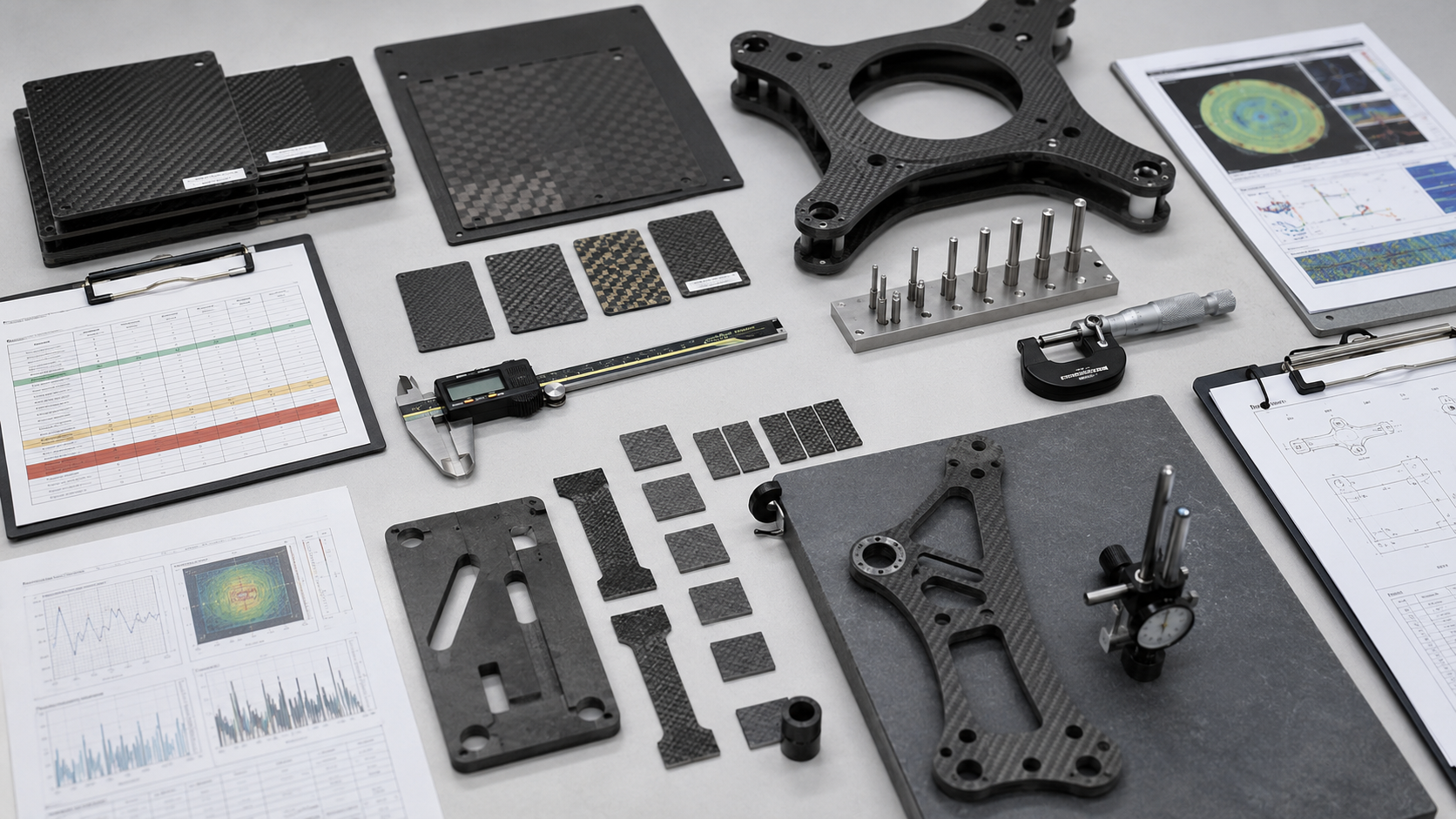
Quality control in carbon fiber manufacturing is not a final inspection step.
It is an end-to-end system.
A supplier can own the right equipment and hire skilled laminators. None of that matters if the quality system stops at ISO paperwork and a visual check before shipping.
What you are evaluating here is infrastructure: the live, documented, data-generating process that catches defects before they reach your production line.
Incoming Material Inspection
Every serious carbon fiber manufacturer should run batch-level inspection on incoming fiber and resin.
Not occasional spot checks.
Batch-level control.
For carbon fiber tow, ask for written confirmation that:
- Tensile strength hits ≥4,000 MPa
- Modulus lands within 230–240 GPa
- Moisture content stays below 0.5%
- Visible defects such as fuzz balls, filament breaks, and tangling are documented
For resin and prepreg, the numbers that matter include:
- Viscosity: 500–1,500 mPa·s at 25°C
- Volatile content: <1–2%
- Resin content: within ±2 wt% of specification
- Storage: −18°C for prepreg where required
- Shelf life: 6–12 months where applicable
- Temperature log: continuous
Sampling should follow recognized plans such as ANSI/ASQ Z1.4 or ISO 2859 Normal Inspection Level II.
For batch sizes in the 1,201–3,200 range, that means 80 specimens — accept on 3, reject on 4.
A-rated vendors may use reduced inspection. New or flagged suppliers should receive tighter sampling, such as 50% larger sample sizes.
In-Process Controls on the Layup Floor
The layup bay is where many structural defects begin.
Ask for written process controls.
Verbal assurances do not count.
Typical control targets include:
- Fiber orientation deviation: ±2°
- Ply-to-ply misalignment: <3 mm
- Layup environment: 18–25°C
- Relative humidity: below 65%
- Vacuum bag integrity: internal vacuum ≥−0.95 bar
- Leak rate: <2 mbar/min
Cure cycle documentation must cover every major variable:
- Temperature ramp rate: 1–3°C/min
- Dwell time and temperature, for example 120°C × 90 min
- Autoclave or oven ID
- Fixture position
- Deviations
- Sign-off
Temperature uniformity across the tool should stay within ≤±3°C gradient.
Thermal monitoring should use at least 3–5 thermocouples on critical parts.
Data capture should run at 1–5 second intervals.
Critical operations — layup, vacuum bagging, and cure — need 100% documentation.
No exceptions.
For SPC, resin content, fiber volume fraction, cure temperature, and vacuum level are all controlled characteristics. Suppliers should run X̄-R or X̄-S control charts on 5–10 specimens per batch. Defect rate tracking can use p-charts or np-charts.
A useful target defect rate is below 1%.
Final Inspection Standards
Finished part inspection starts with geometry.
Typical tolerances to check include:
- Structural component thickness: ±0.2–0.5 mm
- Hole position: ±0.1–0.3 mm
- Profile: 0.3–0.5 mm
Verification should use CMM, digital calipers, or dedicated inspection fixtures — not hand feel.
For appearance-grade components such as automotive trim or visible structural panels:
- Micro-defect area should stay below 0.5–1% of surface
- Individual defect depth should stay under 0.2 mm
For A-grade structural surfaces:
- Pore area should be <0.5% per unit
- Individual defect diameter should be <2 mm
NDT Coverage
Visual inspection comes first, but it is not enough for structural CFRP.
Tap testing can cover 100% of critical load-bearing zones in a 10–20 mm grid pattern. A dull thud instead of a clean ring can flag delamination or a void for follow-up.
Ultrasonic testing is the standard for internal defect detection.
Typical operating frequency: 5–10 MHz.
It is effective on laminates from 2–25 mm thick and can identify delaminations, porosity, and inclusions that surface methods cannot detect.
On aerospace structural components, ultrasonic coverage should be 100% of the part area, not selective scanning.
Pulse thermography works well on larger panels under 10 mm thick. A thermal pulse hits the surface, the temperature distribution is captured, and disbonds or subsurface delaminations show up as thermal anomalies.
Documentation threshold:
Any defect ≥0.5 mm in length should be recorded.
Visual inspections should follow standardized defect atlases with minimum visible sizes, not inspector judgment alone.
COA, COC, and Mechanical Test Reports
Every incoming material batch should arrive with a COA or COC.
It should include:
- Supplier name and address
- Material designation
- Batch number
- Production date
- Tensile strength
- Modulus
- Elongation
- Resin content
- Volatile content
- Density
- Test standard references
- Test dates
Mechanical test reports for CFRP parts should cover:
- Laminate stacking sequence
- Cure parameters
- Specimen dimensions
- Mean value
- Standard deviation
- Minimum value
- Failure mode
Acceptable coefficient of variation for tensile strength should normally be <5% for controlled structural programs.
Always record the failure mode:
- Fiber fracture
- Interlaminar peel
- Crushing
- Delamination
- Bond failure
COA/COC should ship per batch.
Mechanical performance summaries may be monthly or quarterly for general production, but critical structural programs may require per-batch tensile, flexural, or ILSS data.
Quality Escalation: The 8D Procedure Test
One question separates suppliers with real quality infrastructure from those running on paperwork:
“Walk me through your last 8D report.”
A working system looks like this:
- Problem logged within 24 hours of customer notification
- Containment measures completed within 24–48 hours
- Batch isolation
- Shipment hold
- Inventory quarantine
- Root cause analysis using fishbone diagram, 5-Why, and SPC data comparison
- Corrective action documented
- QMS version updated
A real 8D report includes:
- Batch number
- Part number
- Quantity
- Defect rate
- Specific deviation
- Root cause
- Corrective action
- Verification method
For example: 8% defect rate on batch X against a 1% target, traced to cure temperature running 10°C below specification due to process control failure.
Inspection records should stay on file for at least 5–10 years. For aerospace and automotive structural components, that is the floor, not a suggestion.
Quality Threshold to Advance
Move toward contract discussions only when the supplier can show:
- Batch-level incoming inspection
- Documented sampling standards
- In-process SPC
- Control charts on critical characteristics
- NDT coverage matched to part criticality
- COA/COC delivered per batch
- Working 8D escalation process
- Written response time commitments
A supplier who cannot produce process control records from the last three production runs is not a quality risk you can manage.
It is a quality risk you have already accepted.
Dimension 5: Production Capacity, Lead Time and Scalability
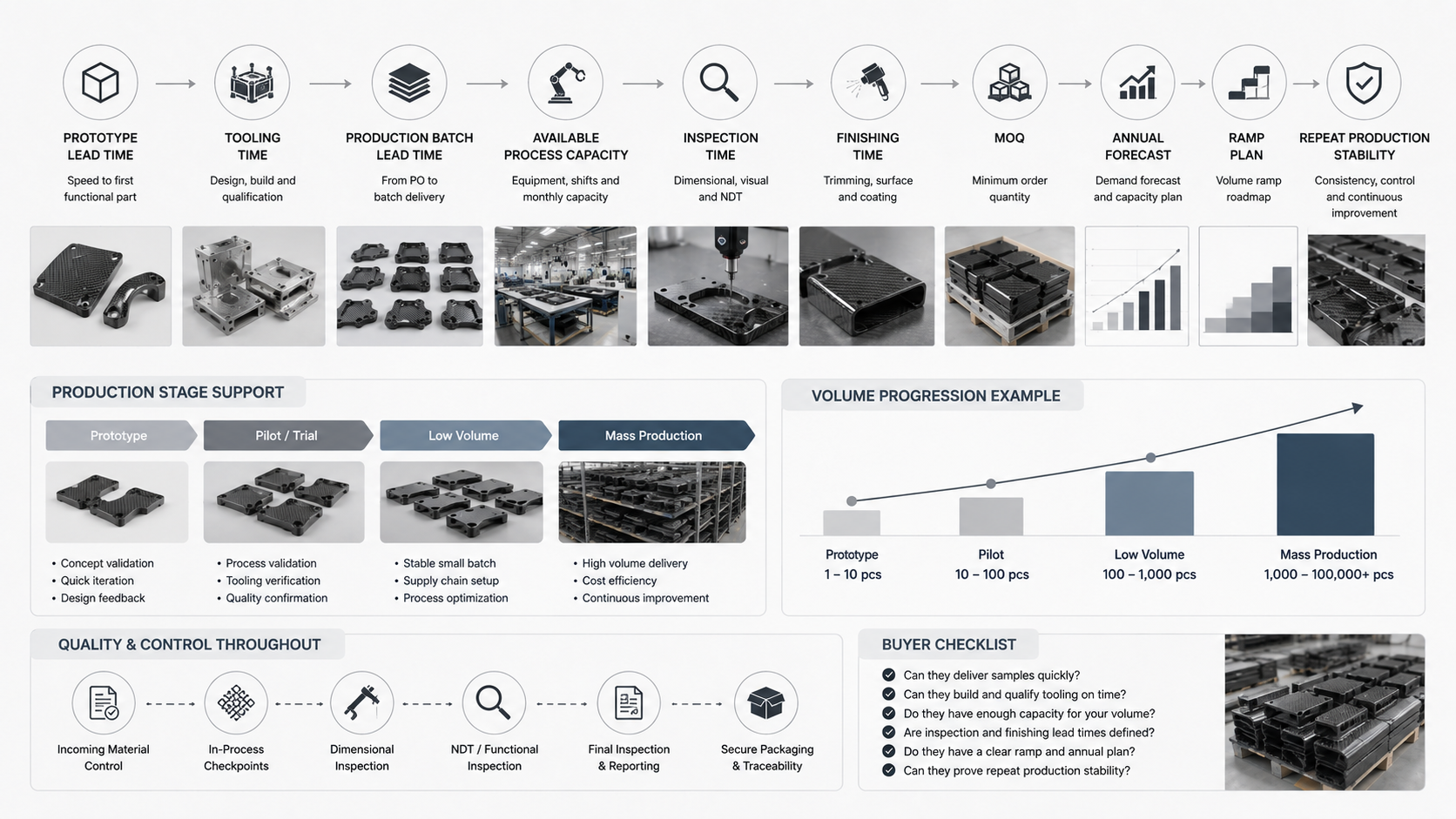
Capacity numbers lie.
Not always on purpose.
But they lie when buyers do not check the math.
A supplier quoting “600 parts per day per machine” on a compression molding press with a 180-second cycle is not giving a real number. They are giving a ceiling that physics will not allow.
Claimed Capacity vs. Verifiable Capacity
Run the math yourself.
A compression molding machine with a 180-second cycle — including forming, cooling, and mold opening — tops out at 440 cycles across 22 effective hours.
At 90% utilization, the verifiable ceiling is around 400 parts/day/machine.
A supplier claiming 600 may not be lying intentionally.
But the gap is real.
It belongs in the risk model.
Three documents close that gap:
- Equipment list with rated cycle times, machine count, and planned downtime rates of 5–10%
- Shift scheduling records from the last 3 months, including actual headcount per station
- Production output reports vs. planned schedule
A supplier may claim three-shift, 24-hour operations, but the night shift may run as a 4-hour standby crew.
In that case, cut the stated capacity by 50% before it enters your evaluation.
Claimed capacity that exceeds your calculated ceiling by more than 30% should be classified as high-risk.
Use a downgraded capacity figure in your model.
Lead Time Benchmarks Worth Keeping
| Stage | Industry Reference |
| Prototype, with tooling | 2–6 weeks |
| Small batch / validation run | 4–8 weeks |
| First production batch | 8–12 weeks |
| Ongoing production cycles | 2–4 week rolling |
Do not take these at face value.
Pull 20–30 historical orders from the supplier’s ERP:
- Confirmed date
- Promised delivery
- Actual ship date
- Quantity ordered
- Quantity shipped
- Delay reason
Calculate OTIF: On-Time In-Full.
Below 85% is a risk flag.
Below 95% means you need a written explanation before contract talks start.
One underused signal is the share of rush orders in the supplier’s active schedule.
Expedited orders above 10–15% of total volume are a warning sign. It means standard lead time commitments may already be fiction.
Scalability Check for High-Volume Programs
Targeting 200,000+ parts per year at automotive scale?
Check the full production line setup, not just machine count.
Two compression molding machines at 180 seconds/cycle produce around 760 verified parts/day across 250 working days.
That may hit an 800-parts/day target, but only if shift coverage, tooling changeover, mold life, and downtime are factored in.
Tooling changeover may take 30–90 minutes per changeover and reduce capacity by 5–10%.
Leave that out, and the number falls short.
MOQ alignment matters too.
If monthly demand is around 8,300 units and the supplier’s production MOQ is 20,000 per batch, the buyer carries 2.5 months of inventory risk per order.
Keep the MOQ-to-periodic-demand ratio at ≤1.5×.
Anything higher turns the supplier relationship into an inventory financing problem — not a manufacturing partnership.
Capacity Threshold to Advance
Move toward contract only when:
- Verifiable daily output is within 15% of claimed figures
- OTIF is ≥95% across sampled historical orders
- MOQ aligns with actual demand cycles
- Rush-order ratio is below 15%
- Shift, equipment, tooling, and downtime records support the claimed capacity
At HyperX Carbon, capacity review must connect to real equipment, real shifts, real lead time, and real production records. A capacity number without verification is not a production plan.
Dimension 6: Technical Communication and Engineering Support
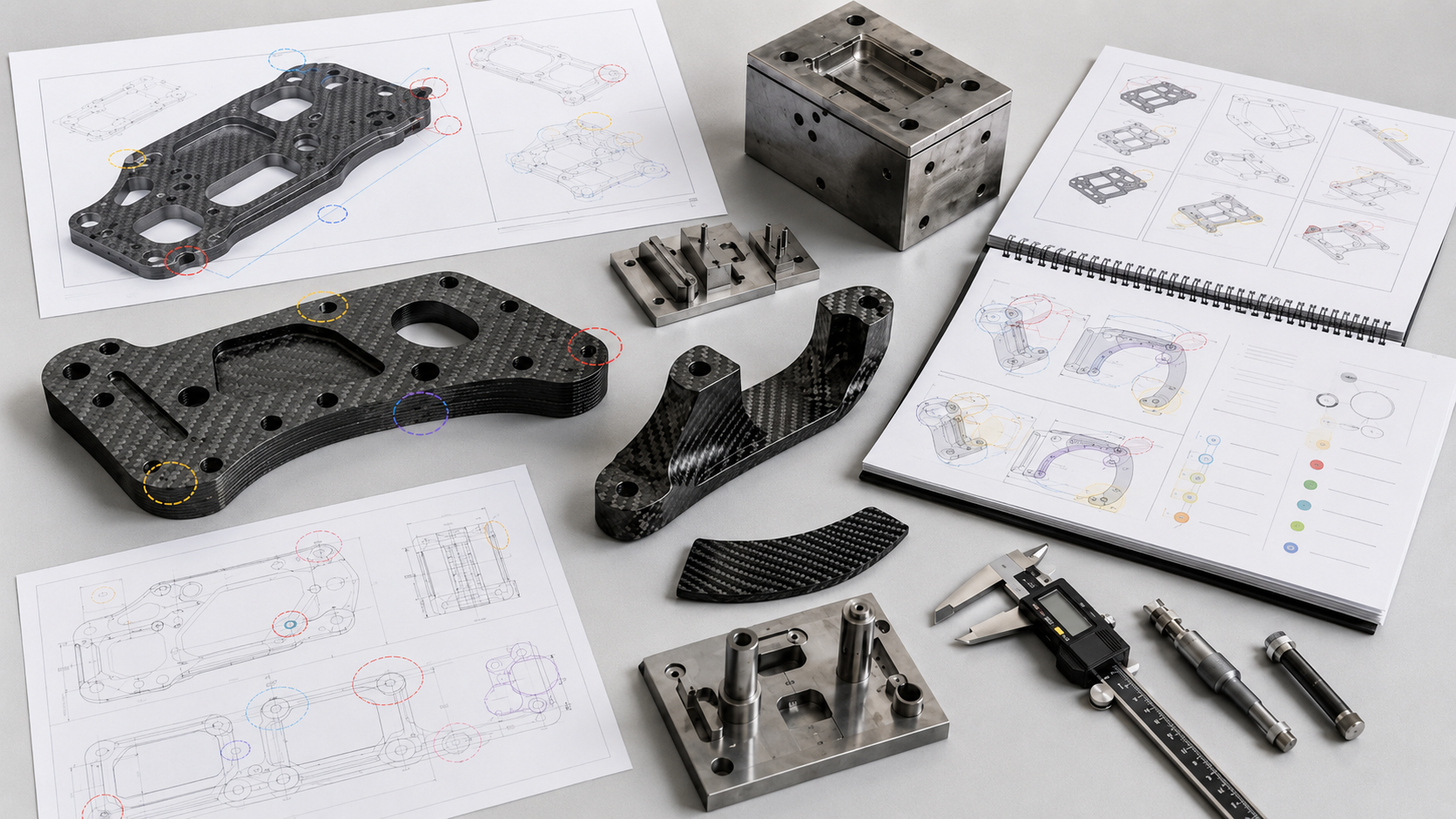
Engineering support quality separates manufacturers from fabrication shops.
A shop cuts fiber and cures resin.
A manufacturer catches problems in the design before a single ply is laid.
The fastest way to test this is simple:
Send a drawing with embedded risk.
DFM Response Test
Submit a design PDF with 3–5 known manufacturing vulnerabilities, such as:
- Wall thickness under 1.5 mm
- Deep cavity ratios above 4:1
- Undercuts
- Tight radii
- Local thickness transitions
- Complex inserts
- Difficult trim zones
- Cosmetic surfaces near structural transitions
Request a DFM review within 48 hours.
Score what comes back.
A useful DFM response should identify:
- Problem
- Mechanism
- Impact
- Recommended fix
Risk identification rate should be ≥80%.
Below 60% is disqualifying.
Technical Fluency Check
Look for accurate use of industry terms such as:
- Draft angle
- Springback
- Fiber waviness
- Autoclave cure cycle
- Anisotropy
- Ply drop
- Bridging
- Resin-rich zone
- Porosity
- Delamination
- Tool-side surface
Error rate should be below 10%.
If the supplier cannot speak precisely about composite-specific manufacturing risks, they may not be ready to support a custom CFRP program.
GD&T Interpretation Test
Give the supplier a drawing with 7–10 geometric tolerance symbols.
A qualified technical contact should explain each control in writing:
- Datum reference
- Tolerance zone geometry
- Inspection implication
- Process risk
- Suggested relaxation if over-constrained
Interpretation accuracy should be ≥85%.
They should also flag over-constrained tolerances and propose relaxations backed by functional justification.
Process Alternative Comparison
Ask for a structured comparison across at least two viable routes.
For each route, request:
- Cycle time
- Porosity target
- Achievable wall thickness
- Achievable dimensional tolerance
- Tooling cost
- Surface finish expectation
- Risk areas
- Best-fit volume
Numbers only.
No generalities.
Technical Support Threshold to Advance
Move forward only when the supplier shows:
- DFM risk identification ≥80%
- GD&T interpretation accuracy ≥85%
- Process comparison with quantified trade-offs
- Engineering change response within 5 business days
- Clear technical contact ownership
- Ability to explain manufacturing limitations before quoting
At HyperX Carbon, technical review is not a sales step. It is part of manufacturing risk control. A qualified carbon fiber manufacturer should help the buyer find design, tolerance, layup, process, and inspection risks before RFQ becomes a purchase order.
Dimension 7: Quote Transparency, Commercial Terms and IP Protection
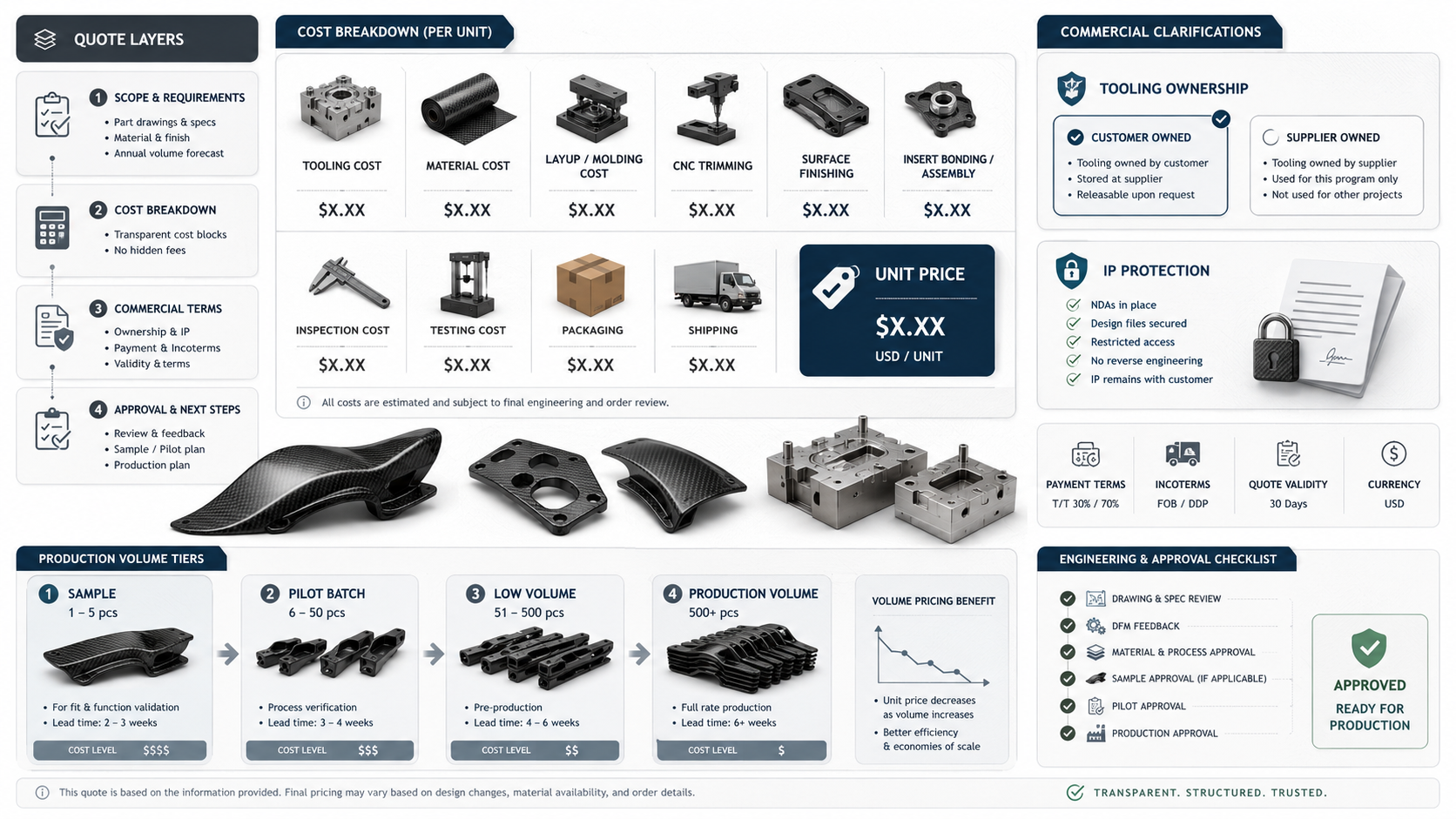
Price transparency is a supply chain discipline.
A supplier who bundles tooling, labor, secondary processing, QA testing, and packaging into one line item is not being efficient.
They are hiding the variables you need to control.
Require itemized quotes.
Every time.
What a Transparent Quote Must Include
A proper custom carbon fiber manufacturing quote should break into five cost categories:
- Tooling
- Unit production
- Secondary operations
- QA and testing
- Packaging and logistics
Tooling costs carry the most variability.
Aluminum or sheet metal molds for mid-volume runs may cost USD 5,000–25,000.
Carbon fiber RTM or hot-press molds scale by surface area:
- Parts under 0.5 m²: USD 8,000–20,000 per mold
- Large exterior panels, such as body shells or roof sections: USD 20,000–60,000
The tooling quote should show:
- Design, about 5–10%
- Fabrication, about 80–90%
- Trial and rework, about 5–15%
A supplier who rolls these into one number leaves room to renegotiate later.
Do not accept it.
Unit Pricing by Volume Tier
Unit pricing should cover at least three volume tiers:
- 100 pieces
- 1,000 pieces
- 10,000 pieces
Typical benchmark ranges:
- 100 units/year: USD 80–120/piece
- 1,000 units/year: USD 55–90/piece, around 20–35% reduction
- 10,000 units/year: USD 40–70/piece, further 15–25% reduction
Material cost, including fiber and resin, may run 40–60% of unit cost.
Secondary processing may add 15–30%.
QA and packaging may close at 5–10%.
Secondary Operations and QA Fees
Secondary operations need their own quote line:
- CNC trimming
- Drilling
- Painting
- Clear coat
- Polishing
- Bonding
- Inserts
- Assembly preparation
- Packaging protection
CNC precision work at ±0.02–0.05 mm can run USD 30–100/hour, depending on complexity.
Surface treatments can add USD 10–50/piece.
Reject any bundled “finishing” line that does not explain what is included.
QA testing fees should also be separate:
- Dimensional inspection + visual: USD 2–5/piece at volumes above 1,000/year
- Batch mechanical testing, 5–10 specimens: USD 200–800/batch
- NDT, ultrasonic or CT: USD 5–20/piece
- First Article Inspection: one-time USD 500–2,000
Payment Terms and Prototype Policy
Established CFRP manufacturers use consistent payment structures.
For production orders, a common structure is:
30% on contract execution, 70% before shipment
T/T wire is common for new relationships, with 0–30 day terms. Qualified OEM programs may extend to 60–90 days.
Export orders above USD 100,000 may use letters of credit. Push for irrevocable L/C with documentary conditions tied to shipment proof.
Prototype pricing carries a real premium.
Plan for:
- Single-piece prototype unit cost at 1.5–3.0× production price
- Small validation run of 10–50 parts at +15–30%
- Soft tooling adding 4–8 weeks before first article delivery
Tooling ownership needs its own contract clause.
Two standard models exist:
- Client pays 100% and holds physical ownership, with the mold stored at the supplier facility and dedicated to the program
- 50/50 cost share, with clear restrictions on supplier reuse
Both can work.
Ambiguity does not.
IP Protection: Clauses That Count
NDA willingness is a baseline filter.
Tier-1 and Tier-2 CFRP OEM suppliers usually sign bilateral NDAs before receiving 3D data or structural designs.
Standard terms often run 5–10 years, covering:
- Technical data
- Process parameters
- Cost structures
- Prototype pricing
- Drawings
- CAD files
- Material specifications
- Production know-how
The NDA is only the starting document.
The contract clauses that carry real weight are:
- IP ownership on client-supplied geometry — drawings, 3D models, and client design changes belong to the client. The supplier cannot reproduce them for third parties.
- Supplier-developed process IP — fixture design, internal tooling, and proprietary layup sequences may remain supplier trade secrets. The contract must define that boundary clearly.
- Physical mold vs. design copyright — these are different rights. The client can own the physical mold while the supplier retains rights to process methods they contributed, or the contract can assign broader rights. The split must be written.
- Post-termination obligations — define data return, destruction, mold storage, mold disposal, and production stop conditions. A 12-month post-production window before mold disposal is common.
Ask every supplier this question:
“What prevents you from making a similar part for a competitor using our mold geometry?”
A supplier with real IP controls answers in writing.
One without controls changes the subject.
Commercial Threshold to Advance
Advance to contract only when the supplier provides:
- Itemized quote
- Tooling broken out
- Unit pricing at three or more volume tiers
- Secondary operations separated
- QA and testing listed separately
- Payment terms aligned with standard OEM structures
- NDA signed before data sharing
- Written IP ownership clauses
- Physical mold rights clarified
- Post-termination data and mold handling defined
At HyperX Carbon, quote transparency is part of trust. A buyer should know what is being paid for: tooling, material, labor, finishing, inspection, packaging, logistics, and engineering support.
Pre-RFQ Evaluation Checklist for Carbon Fiber Manufacturing Services
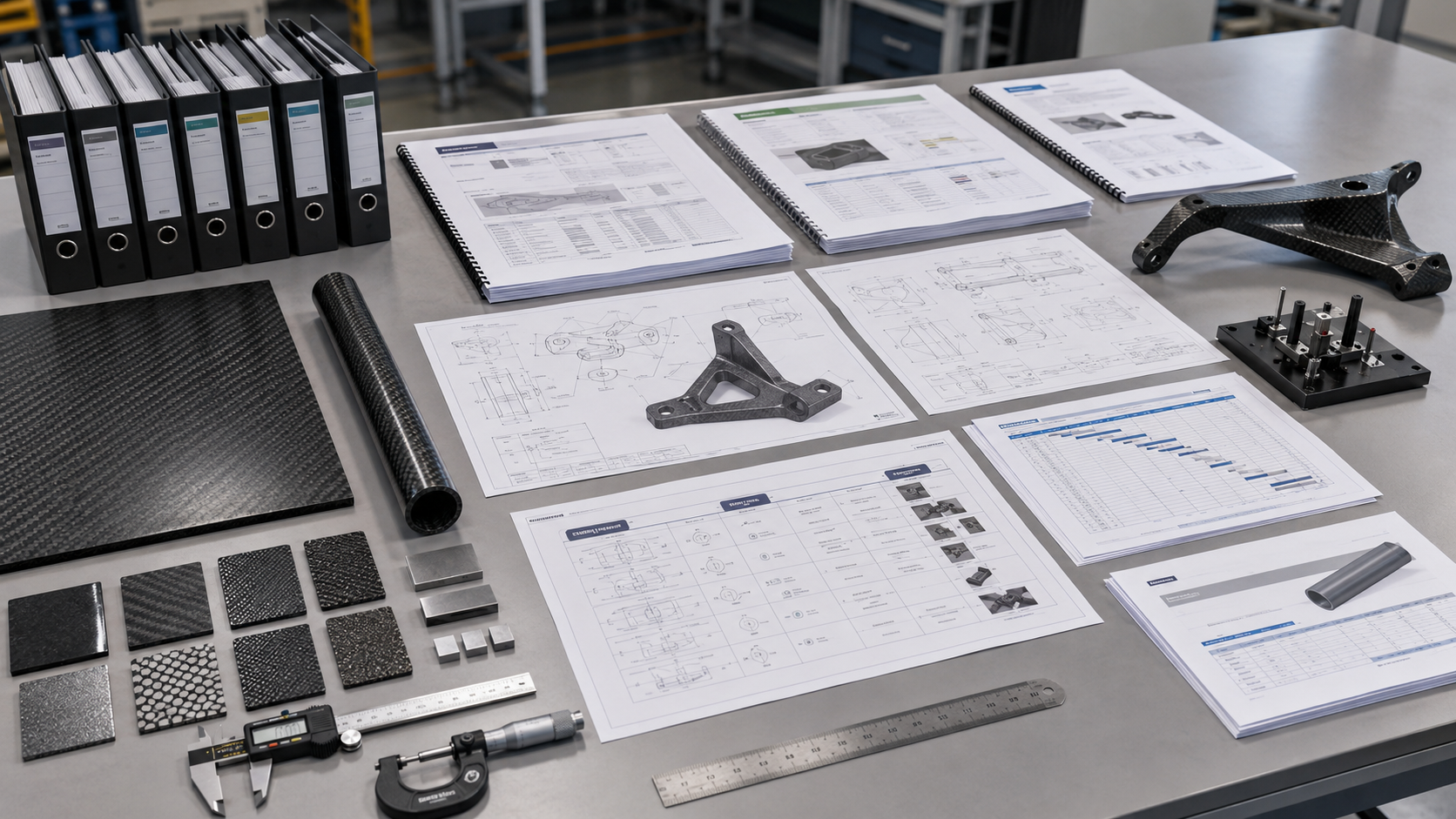
Seven dimensions.
One scorecard.
One red flag failure cuts the supplier — no matter how well they score elsewhere.
Run this scorecard before the RFQ goes out.
| Dimension | Weight | Scoring Method |
| Legality & Traceability | 20% | Pass / Fail + 1–5 |
| Certifications & Compliance | 15% | Pass / Fail + 1–5 |
| Process Capability | 20% | 1–5 |
| Quality System | 15% | Pass / Fail + 1–5 |
| Capacity & Delivery | 10% | 1–5 |
| Technical Communication | 10% | 1–5 |
| Commercial Terms & Risk | 10% | 1–5 |
Minimum threshold to advance:
Weighted average ≥3.5/5, with zero red flag failures.
Dimension Scoring
For legality and traceability:
- Operating history ≥3 years: score ≥3
- Under 36 months: score ≤2
- Business license, tax ID, and Unified Social Credit Code: Pass / Fail
- Factory address verified on map and registry: Pass / Fail
- Factory verification completed: score 1–5
- Legal disputes or regulatory penalties in past 3 years: deduction or fail
For certifications and compliance:
- ISO 9001: no certificate = fail; verified certificate = score 3–5
- AS9100D for aerospace supply: absent = maximum score ≤2
- IATF 16949 for automotive structural parts: confirmed = bonus points
- Third-party mechanical test reports from last 12–24 months: Pass / Fail + completeness score
- RoHS / REACH declaration: present = Pass; absent = Fail where applicable
For process capability:
- Fiber tensile strength ≥ 3,500 MPa proven by COA data: score ≥4
- Elastic modulus ≥ 230 GPa
- Porosity control < 2–3%
- Product form coverage: fabric, prepreg, plate, tube, molded parts — at least 2–3 types
- Equipment list with machine age <10 years and annual maintenance schedule
- Full process flow documented from precursor, carbonization, sizing, layup, cure, and post-processing
For quality system:
- Written quality manual, work instructions, and inspection procedures
- Batch traceability to raw material, equipment, and operator level
- Defect rate past 12 months: ≤0.5% = score 5; 0.5–1% = score 3–4; >1% = score ≤2
- Customer complaints per 100 batches: ≤2 is excellent; >5 is high risk
- Internal lab capability for tensile, flexural, ILSS, and porosity testing
For capacity and delivery:
- Annual output ≥ 1,000 metric tons or ≥ 100,000 m² of composite panel: score ≥4
- On-time delivery rate past 12 months: ≥95% = score 5; 90–95% = score 3–4; <90% = score ≤2
- Peak demand surge capability ≥20–30% above baseline
- Top-5 customer concentration: single customer >40% of revenue = risk flag and score reduction
For technical communication:
- Minimum 2 named technical contacts
- Average technical response time ≤24 hours = score 5; 24–48 hours = score 3–4; >72 hours = score ≤2
- TDS, processing guides, and layup design recommendations available
- Engineering team able to handle co-development and prototype optimization, with at least 3 engineers
For commercial terms and risk:
- Tiered pricing by weight, thickness, modulus, and surface finish
- Payment terms aligned with industry standard, such as 30% upfront / 70% pre-shipment
- Delay penalty clause accepted, such as 0.5–1% per week capped at 5–10%
- Price lock for 6–12 months with raw material escalation mechanism
Red Flag Conditions: Automatic Disqualification
Any one of these ends the evaluation:
- Factory address unverifiable
- No certifications and no quality system explanation
- Refusal to provide test reports or COA
- Payment account name mismatch
- Refusal of any factory audit
- Falsified or altered documentation
- No verifiable production history
- No capacity, equipment, or real customer evidence
Do not negotiate around these.
Do not spend engineering time trying to fix them.
How to Calculate the Final Score
Use the weighted formula:
Final Score = Σ Dimension Score × Weight
Example:
- Process capability score: 4.2 × 20% = 0.84
- Quality system score: 3.8 × 15% = 0.57
Together, those two dimensions contribute 1.41 toward the final total.
Suppliers scoring 3.5–4.0 may move forward with conditions. Specific gaps must be fixed before contract signature.
Suppliers above 4.0 with no red flags can move directly into RFQ.
Anything below 3.5, or with even one red flag, comes off the shortlist.
Do not spend another hour of engineering time on them.
How to Structure Your RFQ Package After Manufacturing Evaluation
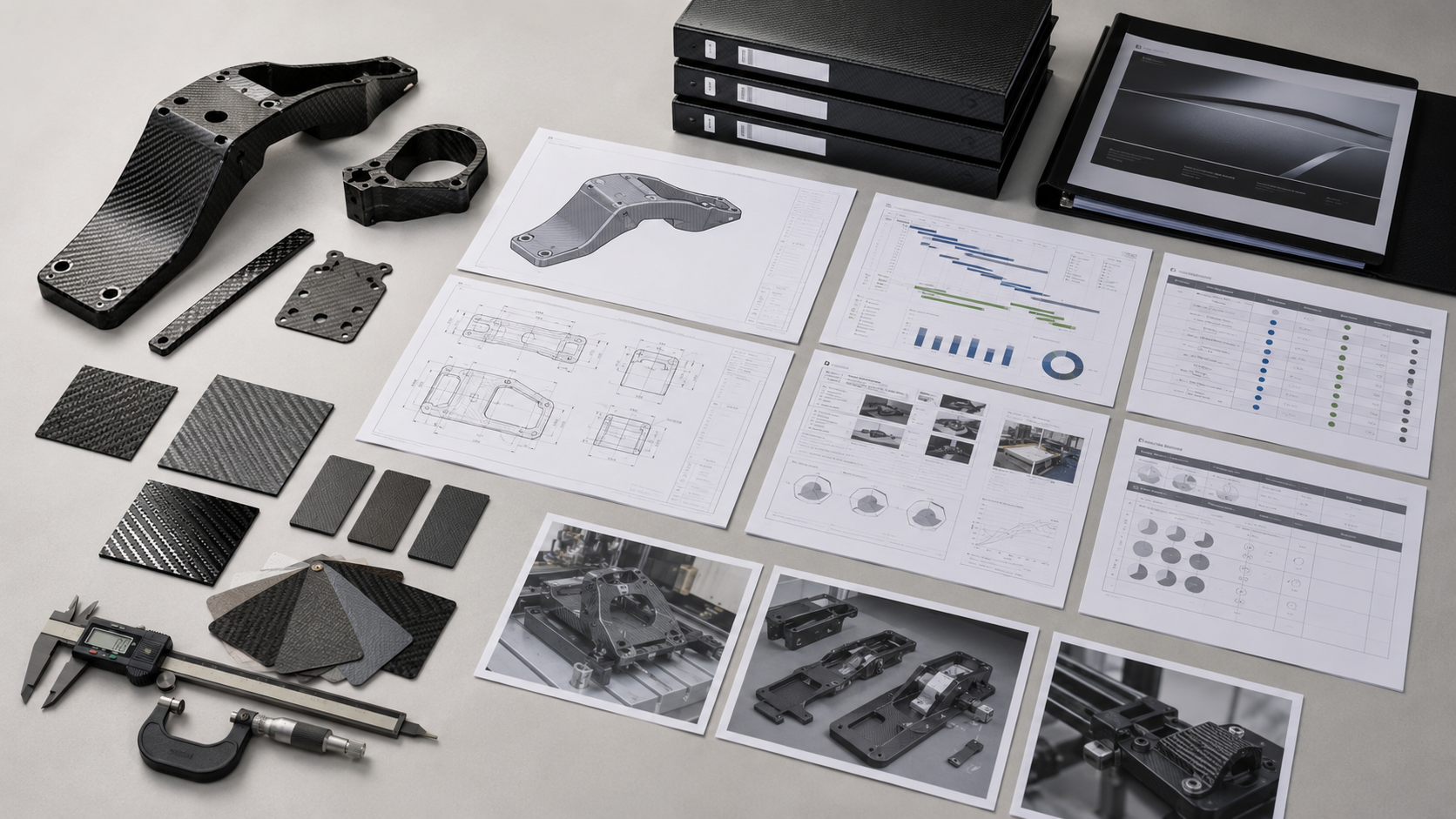
A supplier who clears your scorecard has earned one thing:
The right to receive a well-built RFQ.
Send a weak RFQ package to a strong manufacturer and you still get quotes that cannot be compared. You also create clarification loops that could have been avoided.
The RFQ document is not a formality.
It is the technical and commercial foundation that governs everything before a contract exists.
Minimum Document Set
Every RFQ leaving your desk after supplier evaluation needs four locked components.
Engineering Definition
Include:
- 2D manufacturing drawing in PDF
- 3D CAD in STEP or IGES
- Part number
- Revision level
- Tolerance class, such as ISO 2768-mK
- Surface finish Ra in µm
- Complete BOM
- Material designation
- Weight per part in kg
- 3-year demand forecast broken down by quarter
Performance and Load Case Specification
Do not ask suppliers to assume your loads.
State them clearly:
- Design loads per direction: Fx, Fy, Fz in kN
- Moments: Mx, My, Mz in kNm
- Safety factor: SF ≥1.5 static, ≥2.0 fatigue
- Stiffness and deflection limits in mm at a defined load condition
- Allowable strain in critical regions
- Test standard references, such as ASTM D3039 for tension and ASTM D7264 for flexure
Environmental and Regulatory Requirements
List requirements with clause numbers, not only category names:
- Operating temperature range, for example −40°C to +85°C continuous and +120°C short-term
- Humidity requirement
- Chemical exposure list
- REACH SVHC
- RoHS limits
- FAR 25.853
- EN 45545 hazard level
- UL94 class
- OEM-specific specifications
Material System Specification
Use a standard material system table.
| Parameter | Required Field |
| Fiber grade | Type, such as T700 12K; fabric style; UD / 0-90 / ±45; areal weight; fiber volume fraction target |
| Resin system | Epoxy / phenolic / thermoplastic; Tg; viscosity; cure cycle; ramp rate; dwell time; pressure |
| FST / UV requirements | Specific standard and threshold, such as UL94 V-0 at 1.5 mm, EN 45545 R22 HL3, OSU HRR <65 kW/m², QUV 1000h with strength retention >90% |
Mark each field as mandatory or preferred.
A supplier who does not know which fiber grade can be substituted may quote too safely — or simply quote incorrectly.
Commercial Terms for Apples-to-Apples Comparison
Use a standard pricing template.
Ask for separate line items:
- Unit price at 500 / 1,000 / 5,000 pieces per year
- Raw material percentage
- Direct labor hours × rate
- Overhead
- Finishing or coating
- Testing
- Packaging
- Logistics
- Duties
- Tooling design
- Tooling fabrication
- Modification allowance
- Spare inserts
- Tool lifetime in cycles
- Payment milestones, such as 40/40/20
- Lead time in weeks
- Price validity, such as 90–180 days
- Incoterms, such as EXW, FOB, or DDP
What Suppliers Must Return
Ask for structured sections, not open-ended capability statements.
Supplier responses should include:
- Process route and risk declaration — raw material prep, layup, cure, post-processing, NDT, packaging
- Key parameter ranges — pressure, temperature, cycle time, vacuum level, wall thickness, tolerance
- Primary equipment — press tonnage, autoclave size, cavity count, CNC capacity, NDT equipment
- Risk mitigation — porosity, warpage, FST failure, delamination, surface defects
- Capacity and lead time commitments — output per line each month, MOQ, standard production cycle time, prototype delivery, production batch lead time, surge capacity
- Certification summary — ISO 9001, AS9100D, IATF 16949, issuing body, audit scope, nonconformity count over the past 3 years
- Average scrap and rework rate
Prototype delivery may be 4–6 weeks. Production batch lead time may be 6–8 weeks, depending on process, tooling, and capacity.
Run a Pre-RFQ Feasibility Review First
Before the formal RFQ goes out, run a structured DFM session with your top one to three shortlisted suppliers.
Review:
- Wall thickness transitions
- Rib geometry
- Corner radii
- Material system fit
- FST requirements
- Mechanical targets
- Tooling assumptions
- Inspection needs
The returns are measurable.
A well-structured RFQ paired with a pre-RFQ review can cut clarification rounds by 30–50%.
It can also bring formal quotation cycles down from 3–4 weeks to 2–3 weeks on complex CFRP components.
Risk fields spotted during the review feed into the RFQ scoring matrix. That turns supplier-specific weak points into weighted evaluation criteria — not post-award surprises.
Send the RFQ only to suppliers who cleared the evaluation scorecard.
Lock the drawing revision, material system, and test requirements before distribution.
Any supplier who receives a different version cannot be evaluated against the others.
Work with a Qualified Carbon Fiber Manufacturer: Start with a Technical Review
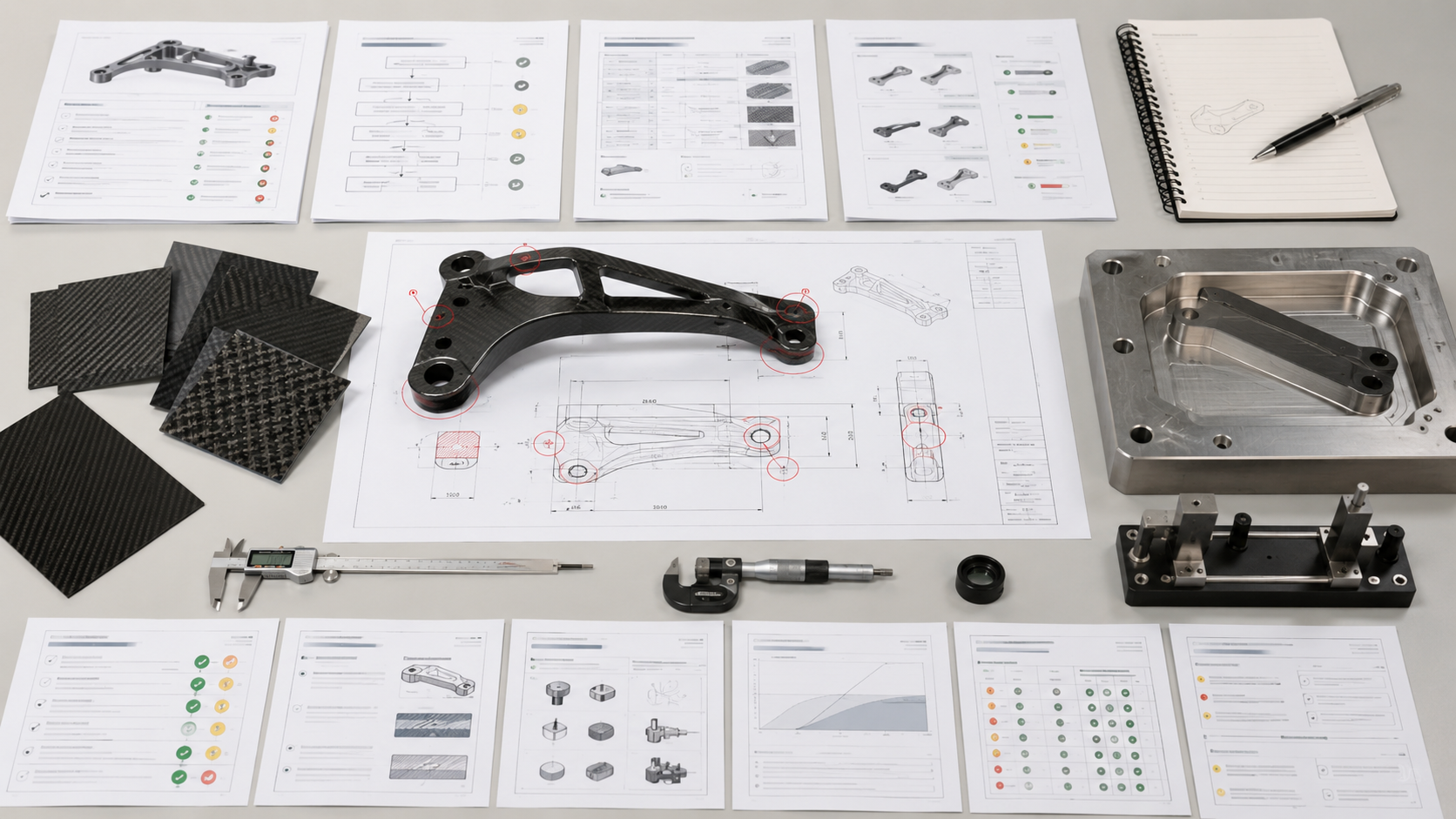
The scorecard is complete.
The shortlist is set.
Now the question becomes both simpler and harder:
Which supplier can actually build your part?
A technical review answers that before the RFQ goes out — not after the first rejected batch comes back.
Start with five checkpoints.
1. Certifications Matched to Application
ISO 9001:2015 is the baseline.
AS9100D applies for aerospace.
IATF 16949 applies for automotive structural programs when required.
ISO 14001 may matter if environmental compliance is in scope.
Check directly with the issuing body.
A certificate scan proves nothing by itself.
2. Machining Capability
Complex CFRP geometries need more than basic machining.
Ask whether the supplier has 5-axis CNC, not only 3-axis equipment.
A 3-axis setup leaves too many constraints for complex parts, multi-surface trimming, precise holes, and critical fitment surfaces.
3. NDT Infrastructure
Ultrasonic scanning and industrial CT are common standards for serious structural work.
Visual inspection alone misses too much.
Internal delaminations may stay hidden until they cause a field failure.
4. Batch-Level Traceability
Traceability should include:
- Fiber type
- Tensile strength ≥3,500 MPa where applicable
- Batch number
- Raw material origin
- Resin batch
- Prepreg storage record
- Layup operator
- Cure cycle
- Inspection record
No trace means no control.
It is that straightforward.
5. DFM Response Speed
A qualified manufacturer gives feasibility feedback quickly.
The target is hours or a few working days, not silence.
No response at the pre-RFQ stage signals a process maturity gap, not only a busy schedule.
Start with a Pre-RFQ Review
There is a simple way to test all five checkpoints at once.
Submit your drawing for a pre-RFQ feasibility review.
Ask for:
- DFM assessment
- Process route suggestion
- Material and layup risk review
- Tooling direction
- Quality and inspection requirements
- Lead time and cost driver notes
Then watch what comes back — and how fast.
At HyperX Carbon, this is where many useful conversations start. Send your drawing, application, target load, material preference, quantity, tolerance requirement, surface expectation, and timeline. Our engineering team can review whether the project fits our process capability and where the RFQ needs more information before quotation.
Conclusion: Evaluate Manufacturing Capability Before You Request a Quote
Picking a carbon fiber manufacturer is more than a procurement step.
It is an engineering decision with long-term structural consequences.
Some suppliers look credible on the surface. But looking credible and being credible are two different things.
Not every supplier can hold tolerances at scale.
Not every supplier can control prepreg out-time.
Not every supplier can run NDT correctly.
Not every supplier can handle an NCR without blame-shifting.
Not every supplier can protect your IP after the contract ends.
That gap between appearing capable and being capable is where most sourcing mistakes happen.
This framework is built to close that gap.
Before sending a single RFQ, be clear on what you are buying.
It is not just parts.
You are buying:
- Process discipline
- Quality infrastructure
- Engineering communication
- Capacity reliability
- Traceability
- Commercial transparency
- IP protection
- A partner who speaks like an engineer, not only a salesperson
Worked through the checklist and ready to move forward?
HyperX Carbon offers a technical review before formal quotation.
Bring your drawings, questions, requirements, standards, and target timeline.
We will tell you what we can do.
And where we cannot — we will say that too.
Evaluate manufacturing capability before you request a quote. It is the fastest way to avoid slow, expensive mistakes later.