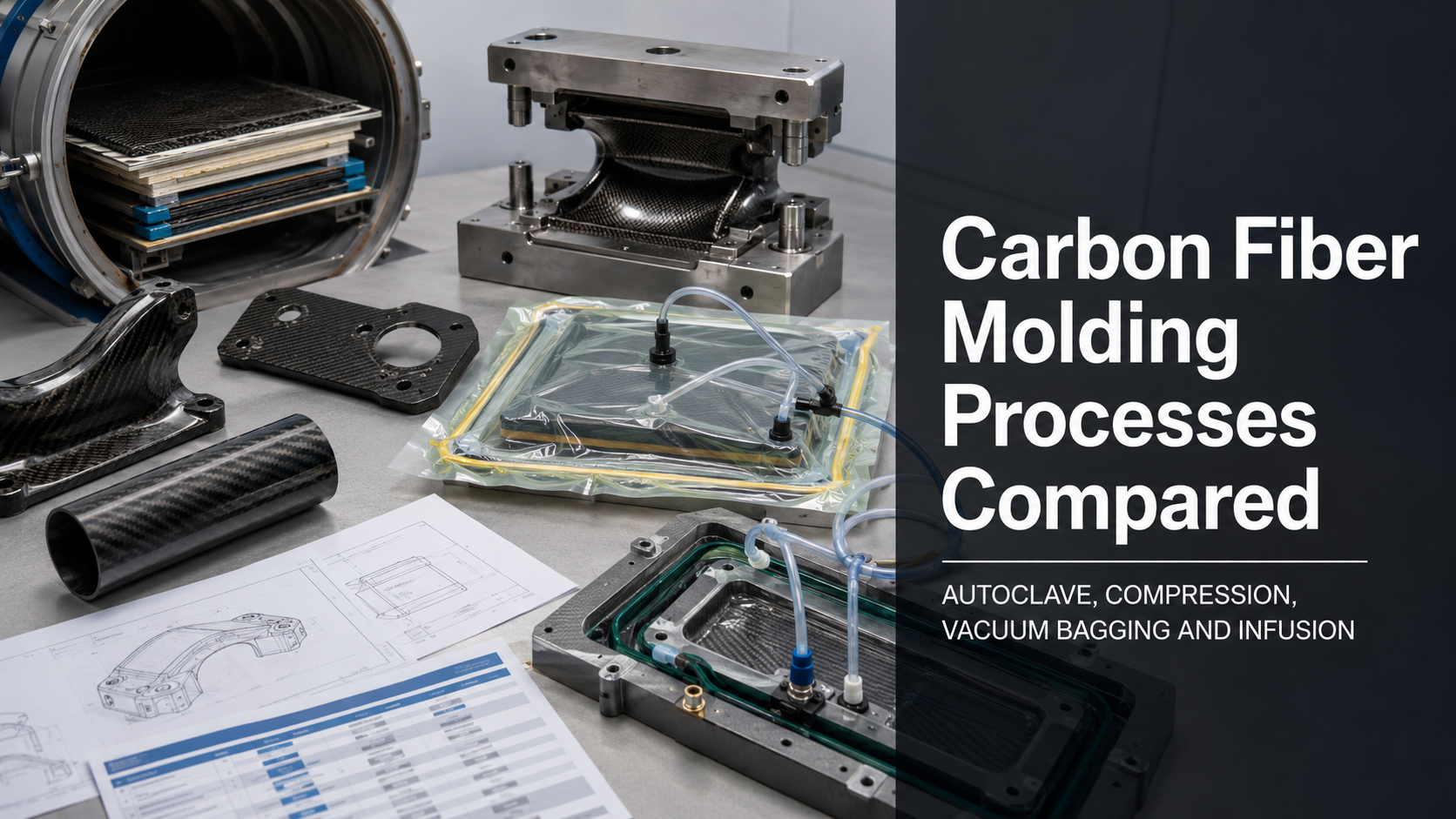
Sourcing carbon fiber parts without understanding how they are made leaves procurement teams exposed.
Inflated quotes, missed lead times, quality disputes, tooling surprises, and unclear supplier claims usually start from the same problem: the buyer is evaluating a carbon fiber quote without knowing which fabrication process is driving the price, timeline, and quality risk.
The fabrication process is not just a manufacturing detail.
It affects every cost figure, every delivery promise, and every structural guarantee a supplier puts in front of you.
A wet layup quote, a prepreg autoclave quote, an RTM quote, and a compression molding quote may all describe “carbon fiber parts.” But they do not describe the same cost structure, quality ceiling, tooling requirement, or production logic.
This guide explains carbon fiber fabrication from a procurement perspective. It covers material selection, mold tooling, cure routes, fiber volume fraction, process comparison, cost drivers, supplier evaluation, and the technical questions buyers should ask before awarding a project.
At HyperX Carbon, we review carbon fiber fabrication projects by connecting material system, geometry, process route, tooling strategy, inspection requirement, quantity, and RFQ readiness before quotation. That is the fastest way to avoid paying for the wrong process — or trusting a supplier who cannot control it.
Carbon Fiber Fabrication Process: What This Guide Covers
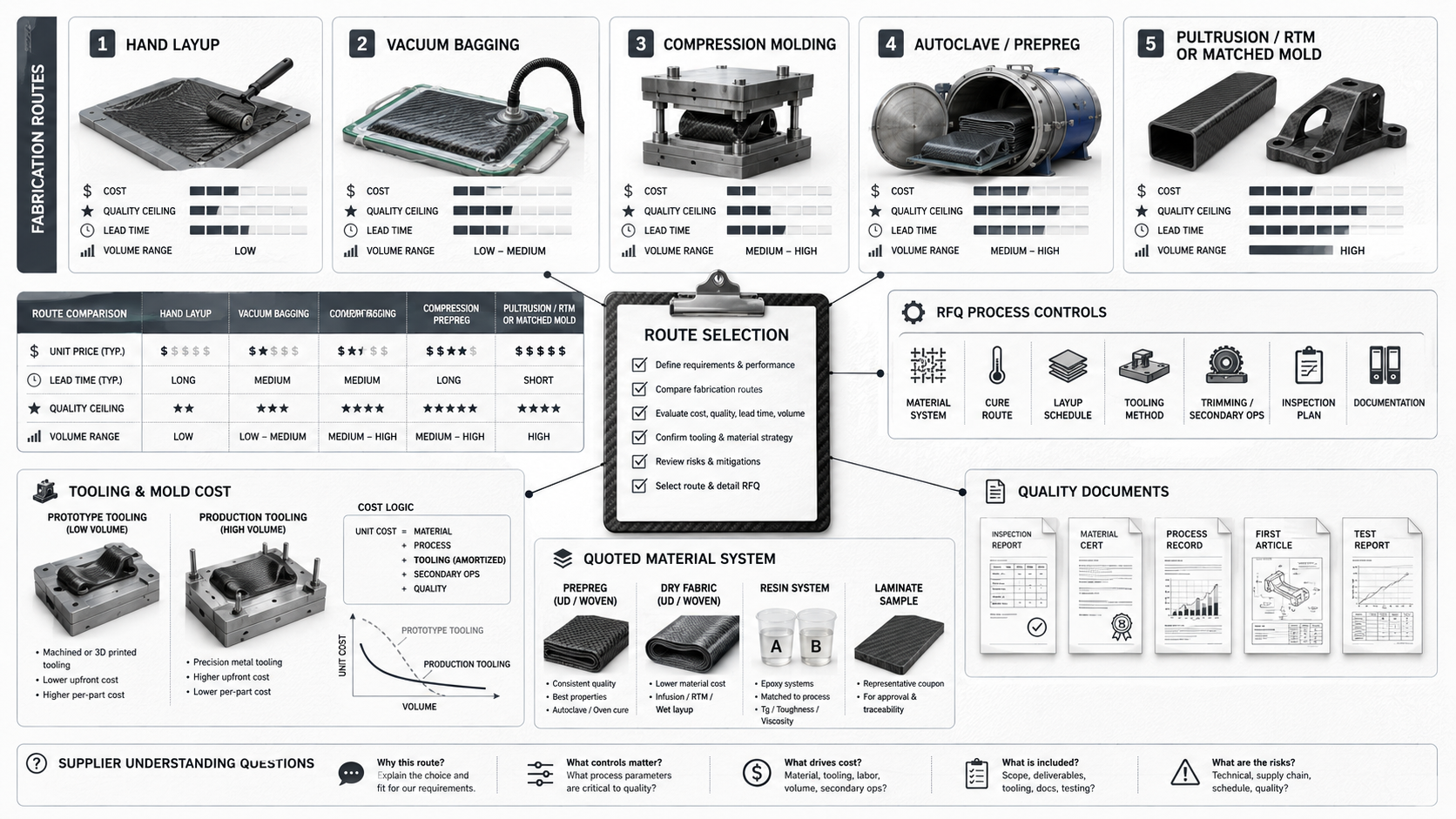
Carbon fiber fabrication is not one process.
It is a group of manufacturing routes, each with different cost, quality, tooling, lead time, and volume logic.
This guide focuses on the decisions that matter most to procurement teams:
- Which fabrication route is the supplier using, and why does it change unit price, lead time, and quality expectations?
- What process controls should be written into the specification before a dispute forces the conversation?
- How should a buyer read supplier quality documentation and spot missing evidence?
- Which material system, resin, fabric form, and tooling route fits the project volume and performance target?
- What supplier questions expose real process capability before RFQ closure?
The core message is simple:
Carbon fiber cost is not only material cost. It is material + process + tooling + labor + cure time + yield + inspection + supplier capability.
A procurement team that understands this structure can negotiate with facts.
A procurement team that does not understand it is forced to compare quotes by unit price alone — and that is where sourcing mistakes begin.
What Procurement Teams Need to Know About Carbon Fiber Fabrication

Most procurement teams treat carbon fiber as a material category.
Suppliers treat it as a process decision.
That gap is where budget overruns, quotation mismatches, and timeline disputes start.
Carbon fiber fabrication includes at least seven major routes:
- Wet layup
- Prepreg layup with autoclave curing
- RTM
- VARTM
- Compression molding
- Filament winding
- Pultrusion
Each route has a different cost structure, lead time, tooling requirement, defect risk, and quality ceiling.
Process Drives Price
Material costs make up 35–60% of a finished composite part.
The rest depends on the process:
- Tooling amortization
- Cure cycle hours
- Labor intensity
- Scrap rate
- Inspection burden
- Secondary machining
- Surface finishing
- Cold-chain handling if prepreg is used
That means two suppliers can quote the same drawing with very different prices and still both be “reasonable” — if they are assuming different processes.
A carbon fiber RFQ that does not define process requirements gives the supplier room to choose the process that fits their shop, not necessarily your project.
Volume Determines the Right Process
Volume is one of the fastest filters.
Under 100 parts per year, prepreg layup or wet layup may be practical.
Above 10,000 parts per year, compression molding or pultrusion may make more sense.
The wrong process does not only increase cost. It tells suppliers your specification is not technically grounded.
A low-volume custom part quoted with a high-volume production mold may look expensive.
A high-volume program quoted with a manual layup route may look cheap at first, then fail on labor cost, cycle time, and repeatability.
Structural vs. Cosmetic Is a Procurement Decision Too
Structural and cosmetic carbon fiber parts do not carry the same requirements.
A structural part may require:
- Higher fiber volume fraction
- Tighter porosity control
- Mechanical test data
- NDT
- Traceability
- Cure record documentation
- Process qualification
A cosmetic part may prioritize:
- Weave alignment
- Gloss level
- Clear coat quality
- Surface defect limits
- Visual consistency
- Lower structural documentation burden
Procurement should classify the part before the quote comes back.
A visible trim part, a load-bearing bracket, a UAV arm, a medical device housing, and a motorsport monocoque do not belong in the same fabrication category.
End-to-End Carbon Fiber Fabrication Process: A Procurement-Stage Breakdown
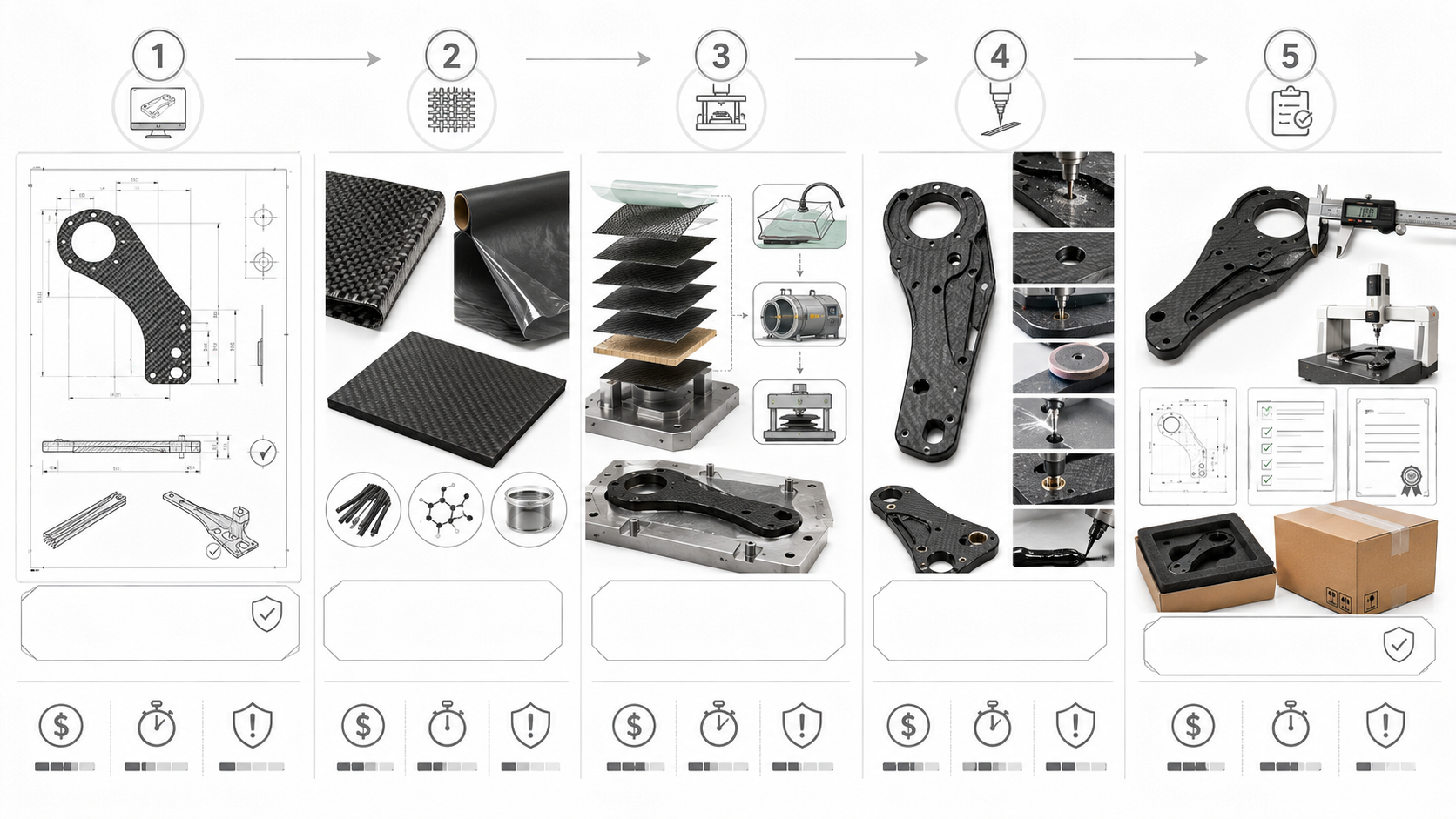
Carbon fiber fabrication has five major procurement-stage steps.
Each step carries a cost lever and a lead-time exposure.
| Stage | Cost Share | Lead Time Impact |
|---|---|---|
| Design confirmation | 5–10% | 2–6 weeks if frozen late |
| Material selection | 30–50% | 4–12 weeks, up to 16+ for specialty grades |
| Process manufacturing | 20–35% | Variable; autoclave backlog can add 2–4 weeks |
| Post-processing | 5–15% | 1–5 days per batch for standard CNC + coating |
| QC and delivery | 5–10% | NDT + documentation = 5–15% of total project cycle |
The key point for buyers:
Material selection usually carries the heaviest cost, not the manufacturing step.
Aerospace-grade prepreg can run USD 60–120/kg. Industrial carbon fiber grades may land between USD 20–60/kg. That gap appears directly in the unit price even if the RFQ never calls it out clearly.
Design Confirmation
Design confirmation is where the buyer and supplier lock geometry, performance targets, tolerances, surface requirements, material assumptions, and process route.
Late design freeze is expensive.
One engineering revision after tooling starts can add 1–3 weeks.
Two revisions can cost a full month before a single part is made.
At HyperX Carbon, this is why we ask buyers to confirm CAD revision, drawing revision, application, load case, tolerance, quantity, and surface requirement before tooling starts.
A design change after tooling is no longer just an engineering change. It becomes a cost, schedule, and requalification event.
Material Selection
Material selection drives fiber grade, resin system, fabric form, prepreg or dry fiber choice, cure requirement, and certification level.
This stage can carry 30–50% of total cost exposure.
Specialty grades may add 4–12 weeks, or even 16+ weeks, depending on availability.
The procurement mistake is assuming material is only an engineering decision.
It is also a sourcing decision because it controls availability, MOQ, storage, shelf life, certification, and unit cost.
Process Manufacturing
The fabrication route determines cycle time, labor content, tooling requirement, defect risk, and inspection burden.
Autoclave capacity, press availability, RTM tool schedule, or VARTM setup can all create queue risk.
An autoclave backlog alone may add 2–4 weeks.
Post-Processing
Post-processing includes:
- CNC trimming
- Drilling
- Edge finishing
- Coating
- Painting
- Sanding
- Bonding preparation
- Insert installation
- Surface repair
- Final dimensional adjustment
This stage may only look like 5–15% of cost, but it often controls fitment and final acceptance.
A molded part is rarely “finished” just because the cure cycle is complete.
QC and Delivery
Quality control can include dimensional inspection, NDT, visual inspection, mechanical coupon testing, documentation, packaging review, and export preparation.
NDT and documentation may represent 5–15% of the total project cycle.
If those requirements appear after quotation, they become cost changes.
If they are written into the RFQ, they become part of the production plan.
Carbon Fiber Material Systems: Fiber, Resin and Fabric Form Selection
Most procurement errors start with material selection.
They are silent, early, and costly.
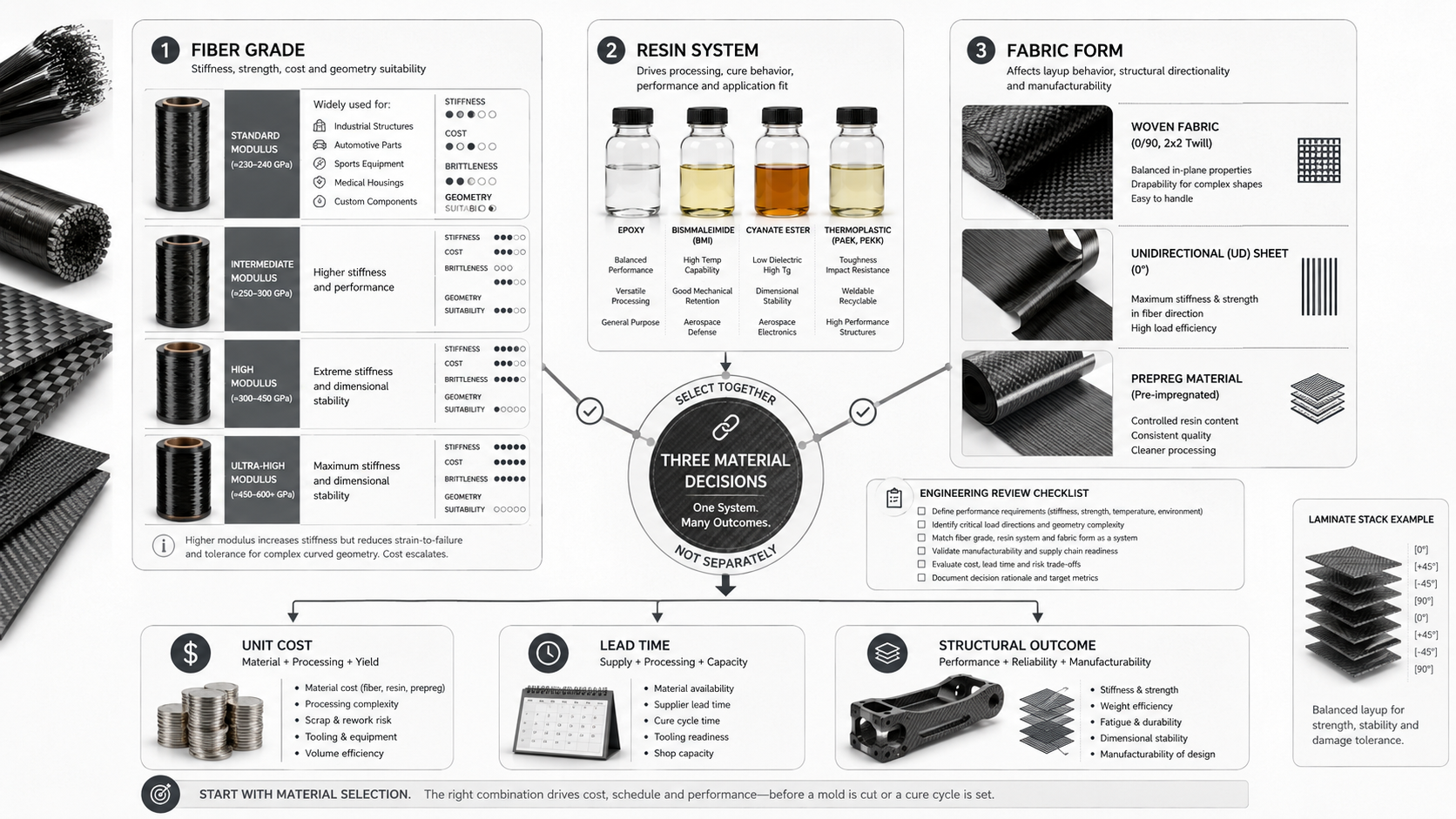
Three material decisions shape unit cost, lead time, and structural outcome before a mold is cut:
- Fiber grade
- Resin system
- Fabric form
Get any one wrong, and the supplier either quotes what you asked for — not what you need — or sends back clarification questions that delay the project.
Fiber Grade: Modulus vs. Cost vs. Processability
Carbon fiber is not a single material. It is a spectrum defined largely by stiffness, or modulus.
That stiffness choice has direct cost and manufacturing consequences.
Standard Modulus Carbon Fiber
Representative grades include Toray T300 and T700.
Typical properties:
- Modulus: 230–250 GPa
- Tensile strength: 3.5–4.5 GPa
- Cost index: 1.0× baseline
- Process compatibility: RTM, VARTM, prepreg layup, pultrusion, AFP
Best-fit applications include:
- Industrial structures
- Automotive general structures
- Sports equipment
- Medical device housings
- General structural parts where cost and processability matter
Standard modulus fiber is often the most practical choice. It gives broad availability and strong process compatibility without unnecessary stiffness premium.
Intermediate Modulus Carbon Fiber
Representative grades include T800 and T1000.
Typical benchmark:
- Modulus: 290–320 GPa
- Modulus improvement: about 20–30% over standard modulus
- Cost premium: +20–50% over standard modulus
- Conservative RFQ planning: budget around +30%
Best-fit applications include:
- High-end sports equipment
- Aerospace secondary structures
- High-performance automotive components
- Stiffness-sensitive but not ultra-high-modulus structures
Intermediate modulus is useful when stiffness gain justifies the cost premium.
High Modulus and Ultra-High Modulus Carbon Fiber
Representative high-modulus grade:
- M40J: around 393 GPa modulus and around 4.4 GPa tensile strength
Typical ranges:
- High modulus: 350–450+ GPa
- Ultra-high modulus: above 450 GPa
- Cost premium: 2–3× standard modulus for HM, 3–5× for UHM
The trade-off is important:
Stiffness increases, but impact toughness decreases.
HM and UHM fibers are more brittle. They can fracture under tight bend radii, high-shear layup, and automated fiber placement on complex curves.
Use them on straight load paths:
- Beams
- Trusses
- Antenna booms
- Dimensional-stability members
- Linear structural paths
Do not specify them casually for compound-curve shells.
Fiber Grade Selection Rule
| If the part requires… | Select… |
| High strength + impact resistance + cost control | Standard modulus or intermediate modulus |
| Extreme stiffness + dimensional stability | High modulus or ultra-high modulus |
| Complex curved geometry | Standard modulus or intermediate modulus only |
| Linear load paths such as beams or tubes | High modulus may be viable with supplier process confirmation |
RFQ action:
Specify modulus grade and minimum layup bend radius.
Requesting high-modulus fiber on a compound-curve shell can become an unmanufacturable specification. A capable supplier should flag that immediately.
Resin System: Temperature, Certification, and Application Match
The fiber carries the load.
The resin transfers it and protects it from the environment.
In regulated industries, the resin also determines whether the part can pass fire, smoke, toxicity, thermal, or durability requirements.
Epoxy Resin
Epoxy is the most common resin system.
Typical profile:
- Service temperature: Tg 120–180°C
- Toughened aerospace grades: above 180°C
- Strength and fatigue resistance: strong
- Bonding interface quality: strong
For aerospace applications, epoxy systems may require:
- AS9100 or EN9100 quality system
- NCAMP, CMH-17, or OEM-specific allowables
- B-basis design allowables for tension, compression, and interlaminar shear
For automotive and industrial applications, ISO 9001 or IATF 16949 may be sufficient, with stronger focus on cycle time, cost, and repeatability.
BMI Resin
BMI, or bismaleimide, supports higher sustained temperature.
Typical profile:
- Service temperature: 200–250°C sustained
- Applications: wing leading edges, engine nacelles, structures near propulsion systems
- Processing demand: narrow cure window, elevated cure temperature, strict process qualification
Use BMI only when the application truly needs high-temperature performance and the supplier has documented history with the process.
Phenolic Resin
Phenolic is not primarily a structural resin.
It is a fire-safety resin.
Common applications include:
- Aircraft interiors
- Rail transit components
- Industrial fire-barrier parts
Relevant standards may include:
- FAR 25.853
- EN 45545
- UL 94 V-0
The mechanical trade-off is lower strength and toughness than epoxy.
Use phenolic for non-primary-load structures where fire performance matters more than peak structural performance.
Resin System RFQ Fields
Your RFQ should include:
- Resin family: epoxy, BMI, phenolic, or thermoplastic
- Minimum Tg or service temperature: for example, ≥150°C
- Required certification: AS9100, IATF 16949, FAR 25.853, EN 45545, UL 94
- Supplier deliverables: material datasheet, design allowables summary, quality certificate, cure profile, and relevant test data
Fabric Form: Matching Fiber Architecture to Process
The same fiber grade behaves differently in different fabric forms.
Fabric form affects structural behavior, drape, process compatibility, surface appearance, and cost.
Unidirectional Tape
UD tape gives maximum stiffness in the load direction.
It can realize near-full fiber modulus depending on grade, typically in the 230–400+ GPa range.
Process match:
- AFP / ATL automated layup
- Manual prepreg layup
- Pultrusion
- Directional RTM
Applications:
- Aerospace spars
- Fuselage skin primary load plies
- Pultruded structural profiles
- Directional beams
RFQ specification should state:
- UD tape
- Tape width, such as 6 in or 12 in
- Fiber modulus grade
- Layup orientation requirements
Woven Fabrics
Woven fabrics include plain, twill, and satin weaves.
Common tow sizes include 3K and 12K.
Benefits:
- Bidirectional load capacity
- Good drape
- Strong visual surface potential
- Better conformability over complex geometry
Process match:
- Hand layup
- Vacuum bagging
- Compression molding
- RTM / VARTM
Applications:
- Complex-curve shells
- Visible surface panels
- General industrial housings
- Cosmetic carbon fiber parts
RFQ specification should state:
- Fabric type
- Tow count
- Areal weight in g/m²
- Target process
- Permeability confirmation for VARTM if relevant
Multiaxial Non-Crimp Fabrics
NCF uses stitched fiber layers in multiple orientations, such as 0° / ±45° / 90°, without weave crimp.
Benefits:
- Higher structural efficiency than woven fabric at the same weight
- Straighter fibers
- More direct load transfer
Process match:
- VARTM
- RTM
- Prepreg infusion
- High-volume structural panels
Applications:
- Wind turbine blades
- Automotive structural panels
- Aerospace secondary structures at volume
Fabric Form Summary
| Fabric Form | Best For | Process Match | Caution |
| UD tape | Maximum directional stiffness | AFP, pultrusion, prepreg layup | Poor off-axis load capacity without multi-ply design |
| Woven fabric | Complex geometry, visual surfaces | Wet layup, RTM, VARTM | Crimp reduces peak stiffness vs. UD |
| NCF | Structural panels, high-Vf laminates | VARTM, RTM | Requires supplier NCF handling experience |
One procurement rule matters most:
Fiber grade, resin system, and fabric form are not separate choices. They must be selected together.
A high-modulus fiber in a woven architecture on a complex-curve shell is not just an expensive material choice. It can become a quality problem.
7 Carbon Fiber Fabrication Processes Compared by Cost, Quality and Volume
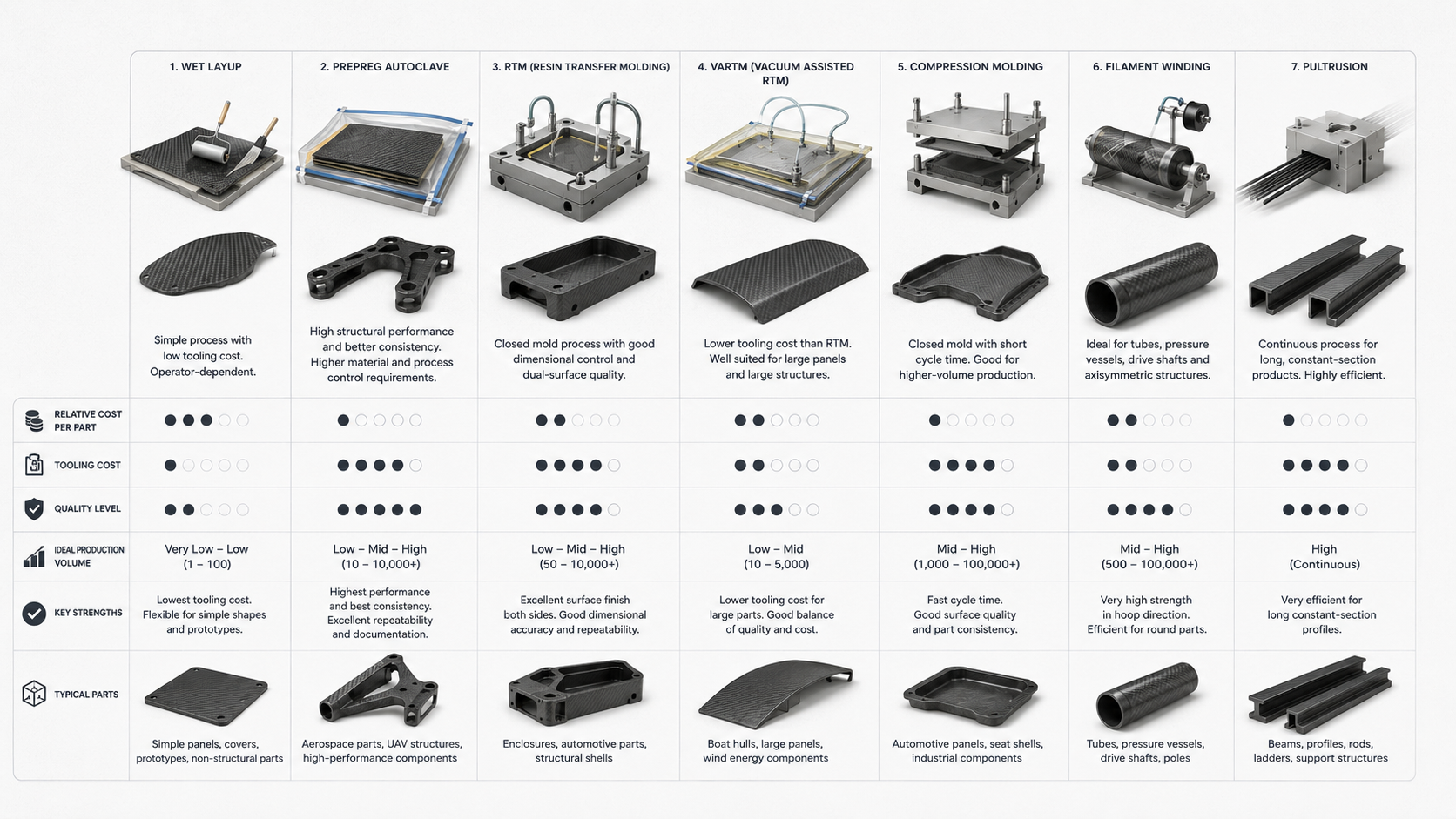
Six suppliers may quote the same part using six different processes.
The unit prices can look drastically different, but the quote may not explain why.
That is where procurement teams lose leverage.
Seven fabrication routes dominate CFRP manufacturing. Each route has a different cost structure, quality ceiling, tolerance capability, and volume range.
Wet Layup
Wet layup is the lowest-cost entry point.
It is also the highest-risk route for structural applications.
Tooling for a small cosmetic shell can run around USD 1,500 per set. At one-off quantities, total cost per part can exceed USD 1,650 once tooling and labor are counted.
Scale to 100 parts, and the cost may drop to about USD 161/part — but usually for cosmetic-grade work.
Structural reality:
- Fiber volume fraction usually stays below 45%
- Thickness tolerance often runs ±0.3–0.5 mm or worse
- Porosity varies by operator and batch
- Repeatability is limited
Procurement risk:
A supplier quoting wet layup for structural applications may be quoting what is easy, not what is safe.
Prepreg Layup + Autoclave Curing
Prepreg layup with autoclave curing is the benchmark route for structural performance.
Typical capability:
- Fiber volume fraction: 55–65%
- Porosity: below 1–2%
- Thickness tolerance: ±0.1–0.2 mm
- Quality level: aerospace/Class-A structural potential
Material costs are real.
Non-aerospace PAN carbon fiber can run about USD 21.50/kg at around 50% conversion efficiency.
Aerospace-grade prepreg may run USD 60–120/kg.
Procurement teams often miss one distinction:
Prepreg + oven cure is not the same as prepreg + autoclave.
Oven cure without autoclave pressure produces higher porosity and weaker interlaminar strength.
If your specification requires autoclave-cured prepreg, confirm that the supplier has:
- Actual autoclave equipment
- Qualified cure cycles
- Pressure records
- Temperature logs
- Batch traceability
- Cure-cycle documentation
RTM
Resin Transfer Molding is a closed-mold process for dimensional control at production volumes.
Best-fit range:
Thousands to tens of thousands of parts per year.
RTM can produce near-net-shape parts with cycle times measured in minutes. It gives dual-surface control, meaning both faces come out dimensionally consistent.
Typical capability:
- Thickness tolerance around ±0.2 mm
- Fiber volume fraction around 50–60%
- Porosity below 2–3% under solid process control
- Good dimensional repeatability
- Higher tooling cost than open-mold processes
Procurement risk:
Low-price RTM quotes may hide reduced fiber volume fraction below 50% or underspecified resin systems.
Write minimum Vf and porosity limits into the specification before contract award.
VARTM
Vacuum-Assisted Resin Transfer Molding sits between wet layup and RTM on cost and quality.
Advantages:
- Single-sided tooling
- Mold costs 20–50% lower than RTM closed tools
- Practical for large-format parts
- Good for wind blades, marine hulls, and large structural panels
Trade-offs:
- Thickness tolerance on large parts may run ±0.3–0.7 mm
- Resin flow path variability can cause dry spots
- Vacuum distribution affects quality
- Mold-side surface can be acceptable
- Bag-side surface is not a finished surface
Procurement risk:
Do not substitute VARTM for RTM on high-precision structural parts without proper process validation.
If a supplier proposes VARTM for a toleranced structural application, require ultrasonic or CT inspection sampling before accepting the qualification lot.
Compression Molding
Compression molding, including CF-SMC, is built for high-volume automotive and industrial production.
Typical profile:
- Volume: 10,000–500,000 parts/year
- Cycle time: minutes
- Thickness tolerance: ±0.1–0.2 mm
- Class-A surface: achievable on both sides
- Tooling: high investment
- Fiber type: chopped/random orientation in CF-SMC
The structural caveat is important:
CF-SMC uses chopped fiber with random orientation. It gives more isotropic behavior but lower directional performance than continuous-fiber laminates.
It is suited to distributed load paths.
It is not suitable for strongly unidirectional structural members.
Procurement risk:
Specifying CF-SMC for a component with a strong uniaxial load path can pass qualification visually but underperform in service.
Filament Winding
Filament winding is purpose-built for axisymmetric geometry.
Applications include:
- Pressure vessels
- Tubes
- Drive shafts
- Hydrogen tanks
- Torque tubes
Typical capability:
- Material utilization above 95%
- Thickness consistency around ±0.1–0.2 mm
- Strong scalability after mandrel tooling is paid off
- Fiber orientation controlled by winding angle
Hard constraint:
The geometry must support a continuous winding path.
Complex openings, non-axisymmetric cross-sections, and abrupt contour changes can create fiber misalignment and stress concentration.
Procurement risk:
Do not accept filament winding for non-axisymmetric or heavily perforated parts unless the supplier proves the winding path and structural assumptions.
Pultrusion
Pultrusion is a continuous process for constant cross-section profiles.
Applications include:
- Structural angles
- I-beams
- Rod stock
- Flat stock
- Straight profiles
- Constant-section tubes or bars
Typical capability:
- Pull speeds can exceed 1 m/min
- Annual output in tens of thousands of meters is common
- Cross-section tolerance around ±0.1 mm
- Fiber volume fraction around 55–65%
- Low unit cost for suitable shapes
Hard constraint:
Pultrusion only produces straight, constant cross-sections.
No curves. No bends. No variable sections.
Pultruded profiles may also perform poorly under high-cycle bending, a failure mode that may not appear in supplier datasheets.
Procurement risk:
Do not specify pultruded profiles for curved geometry or high-cycle bending applications.
Quick-Reference Comparison: All 7 Processes
| Process | Optimal Volume Range | Tooling Cost | Thickness Tolerance | Fiber Vf | Surface Quality | Best Application |
| Wet layup | 1–500 parts/year | Low, around USD 1,500 | ±0.3–0.5 mm | <45% | Cosmetic with polishing | Prototypes, custom cosmetic parts |
| Prepreg + autoclave | 10–5,000 parts/year | Medium–high | ±0.1–0.2 mm | 55–65% | Aerospace/Class-A | Primary structures, motorsport monocoques |
| RTM | 1,000–50,000 parts/year | High | ±0.2 mm | 50–60% | Dual-surface controlled | Automotive structural, aerospace secondary |
| VARTM | 50–3,000 parts/year | Medium | ±0.3–0.7 mm | 45–55% | Mold-side only | Wind blades, marine hulls, large panels |
| Compression molding | 10,000–500,000 parts/year | High | ±0.1–0.2 mm | 35–50%, random | Class-A both sides | Automotive panels, structural covers |
| Filament winding | 500–50,000 parts/year | Low–medium | ±0.1–0.2 mm | 55–70% | Functional, not visual | Pressure vessels, tubes, drive shafts |
| Pultrusion | 5,000+ meters/year | Medium | ±0.1 mm | 55–65% | Good structural, not cosmetic | Structural profiles, rods, flat stock |
One important point:
Process capability is not the same as process availability.
A supplier may own an autoclave but reserve capacity for anchor customers. They may list RTM but lack comparable production records. They may offer compression molding but have a press queue that makes lead time unrealistic.
Evaluate process fit and supplier queue depth together.
Tooling and Mold Costs in Carbon Fiber Fabrication

Tooling can consume the budget before a single part is made.
The cost is usually visible in the quote as “mold fee” or “tooling charge.”
What buyers often miss is what sits underneath that number:
- Tool material
- Machining complexity
- Design work
- Trial runs
- Rework allowance
- Expected tool life
- Production volume
- Ownership rights
- Lead time risk
What Tooling Cost Is Really Made Of
A mold quote is not one number. It is usually five categories bundled together.
| Tooling Cost Category | Typical Share |
| Materials, mold base, steel or aluminum cavity inserts | 15–30% |
| Machining, CNC, EDM, grinding | 20–30% |
| Design, DFM review, 3D/2D drawings | 10–15% |
| Testing and trial runs | ≤3–5%, depending on complexity |
| Overhead, tax, logistics, supplier margin | 20–40% |
When challenging a tooling quote, this is the cost structure to request.
A supplier who cannot break tooling into these categories either does not know their cost structure clearly — or does not want you to know it.
Mold Material vs. Volume
Not every part needs hardened steel tooling.
The right mold material depends on production volume and project stage.
| Mold Type | Upfront Cost vs. Steel | Expected Life | Best Fit |
| Aluminum soft tool | 30–60% of steel | 3,000–20,000 cycles | <10k–30k parts, development phase |
| Steel, P20/H13 | 100% baseline | 200,000–1,000,000+ cycles | 50k+ parts, long-run production |
| Composite tooling, CFRP/GRP | 50–80% of steel | Thousands of cure cycles | Large aerospace/automotive structures |
| 3D printed polymer or metal | 20–40% below aluminum for small tools | Hundreds to a few thousand cycles | Prototypes, <1k–5k parts |
The common procurement mistake is comparing the initial mold quote without modeling total cost per part at real production volume.
An aluminum tool at half the price may look attractive.
But at 50,000 parts, that tool may already be at end of life, forcing a second tooling investment.
Breakeven Math Suppliers May Not Show
Every tooling negotiation has a breakeven point.
Example:
- Option A: tooling = RMB 200,000; unit price = RMB 20
- Option B: tooling = RMB 80,000; unit price = RMB 28
Breakeven:
200,000 + 20Q = 80,000 + 28Q
Q = 15,000 parts
Below 15,000 parts, Option B has lower total cost.
Above 15,000 parts, Option A wins.
RFQ action:
Ask every supplier for tiered unit pricing at 1k / 5k / 10k / 50k quantities alongside tooling cost.
Then run the breakeven math.
That moves the negotiation from “which quote is lower?” to “which cost structure fits our real volume?”
Tooling Lead Time
Mold cost is visible.
Mold lead time is where many schedules fail.
Typical tooling lead times:
- Simple single-cavity aluminum tool: 4–6 weeks
- Multi-cavity production steel tool: 8–12 weeks
- Large composite or high-precision metal tool for structural CFRP: 10–16 weeks
Carbon fiber projects are especially exposed because tooling can take 40–60% of total development cycle time.
Design, machining, trial cure, refinement, and first article sign-off all add up.
Contract Terms That Protect Tooling Timeline
Your sourcing agreement should:
- Tie the tooling start date to a design freeze milestone, not only PO receipt
- Define phased acceptance: design review, rough machining, finish machining, trial run, first article
- Set lead-time targets by complexity tier
- Add delay clauses for critical-path tooling on structural components
- Define tool ownership
- Define maintenance responsibility
- Define tool life
- Define modification rights
- Define mold storage and handover conditions
Tooling owned by the supplier is tooling controlled by the supplier.
For high-volume or long-term programs, ownership terms should be written into the contract from day one.
What Drives Carbon Fiber Fabrication Cost? A Procurement Cost-Down Framework

Carbon fiber parts do not become expensive by accident.
Every cost layer has a name, a percentage, and a lever procurement can pull — if the team knows where to look.
Most buyers negotiate at the surface:
- Unit price
- Tooling fee
- Lead time
The real cost structure sits deeper.
The Carbon Fiber Cost Stack
At raw material level, PAN precursor dominates carbon fiber production cost.
At small tow sizes such as 3K, precursor alone can account for about 77% of carbon fiber production cost.
At 100K tow, that share drops to around 50%, but labor, depreciation, and energy fill more of the gap.
Average industrial breakdown:
| Cost Driver | Share of Carbon Fiber Production Cost |
| PAN precursor | ~53% |
| Labour | ~15% |
| Natural gas | ~11% |
| Depreciation | ~10% |
| Other energy | ~7% |
This structure points to three procurement levers.
Lever 1: Precursor Grade and Tow Size Strategy
Precursor grade and tow size can control 50–77% of material cost.
For high-volume, non-critical parts, moving toward ≥50K tow can be a high-impact cost-down lever.
Above 50K tow, precursor cost share begins to flatten. Further increases bring diminishing returns.
Procurement action:
Ask whether the part truly needs small-tow fiber or whether a larger tow can meet performance and appearance requirements.
Lever 2: Energy Contracts
Natural gas plus electricity can account for 18–20% of cost.
Some suppliers operate in low-energy-cost regions or hold long-term fuel contracts.
Ask whether the supplier’s quote reflects energy cost advantage, or whether that margin is simply retained by the supplier.
Lever 3: Labor and Automation
At large tow sizes, labor can climb toward 18% of cost.
A supplier quoting manual layup on a 10,000-part program is pricing labor into every unit.
Cycle time, cavity count, automation level, and shift structure matter.
Procurement action:
Ask for cycle time per part, cavity count, labor hours per part, and expected output per shift.
Process Choice as a Cost Multiplier
The fabrication route can amplify or compress every cost layer.
Autoclave-cured parts can cost 30–60% more than vacuum-infused equivalents at the same geometry and grade.
For aerospace-grade programs, cost per kg can exceed USD 1,000.
For high-volume simple profiles such as pultrusion or compression molding, cost can fall below USD 5–10/kg.
That gap is not only about quality.
It is about process selection.
Yield, Scrap and Hidden Cost
Scrap rate is one of the most underpriced risks in carbon fiber sourcing.
The math is direct:
- At 90% yield on USD 50/kg material, effective cost per good kg = USD 55.60
- At 80% yield on the same material, effective cost per good kg = USD 62.50
That is a 25% real-cost increase over the nominal rate.
NDT requirements can also raise rejection rate and inspection time.
Procurement clauses should require suppliers to declare:
- Expected yield %
- Scrap allocation method
- NDT method
- NDT coverage percentage
- Per-part inspection time
- Standalone inspection cost
Prepreg Cold Chain
Prepreg costs more than dry fiber and resin.
It also carries cold-chain cost.
Refrigerated transport at 2–8°C can carry a 10–20% logistics premium over ambient shipping on small-to-medium loads.
Freezer storage at −18°C adds energy and space cost.
Shelf life may run 6–12 months frozen and 30–45 days at ambient, depending on material system.
Poorly managed programs can run 10%+ expiry scrap.
Well-managed programs may hold expiry scrap below 3–5%.
Procurement should ask suppliers to separate:
- Prepreg ex-works price
- Cold-chain logistics surcharge
- Frozen storage or inventory carrying cost
- Annual expiry scrap rate
- Who owns expiry scrap cost
Design Changes and Non-Linear Cost
A 50% increase in layup complexity does not always create a 50% cost increase.
More plies or local reinforcements can push the job past a shift boundary, autoclave capacity threshold, or labor allocation limit.
Scheduling inefficiency alone can raise effective per-part cost by 50–70%.
Tooling rework on a large aerospace autoclave mold can run USD 10,000–100,000+ per change.
If a tool is amortized over 10,000 parts and gets redesigned at 5,000 parts, tooling cost per unit effectively doubles.
Contract terms should include:
- Design freeze milestone before tool PO
- Change cost table after freeze
- Requalification cost rules
- Tooling rework fee rules
- Price escalation clauses tied to late engineering changes
The goal is not to prevent engineering changes.
The goal is to make their cost visible.
RFQ Transparency Checklist
A complete cost breakdown should include:
- Material cost: fiber grade, tow size, prepreg vs. dry, resin system
- Labor: rate basis and hours per part at stated volume
- Energy: electricity and natural gas listed separately
- Tooling amortization: tool cost divided by planned volume
- NDT and inspection: method, coverage %, time and cost
- Cold-chain logistics and storage for prepreg programs
- Expected yield %
- Scrap cost allocation method
- Cure cycle duration
- Batch size
Regional fabricated sheet benchmarks can also help evaluate quotes:
- North America: USD 160–320/m²
- Europe: USD 150–300/m²
- China: USD 95–190/m²
- India: USD 75–170/m²
The suppliers who can answer every line understand their own cost structure.
The ones who cannot — or will not — are already pricing uncertainty into your quote.
Supplier Evaluation Checklist for Carbon Fiber Fabrication Capability
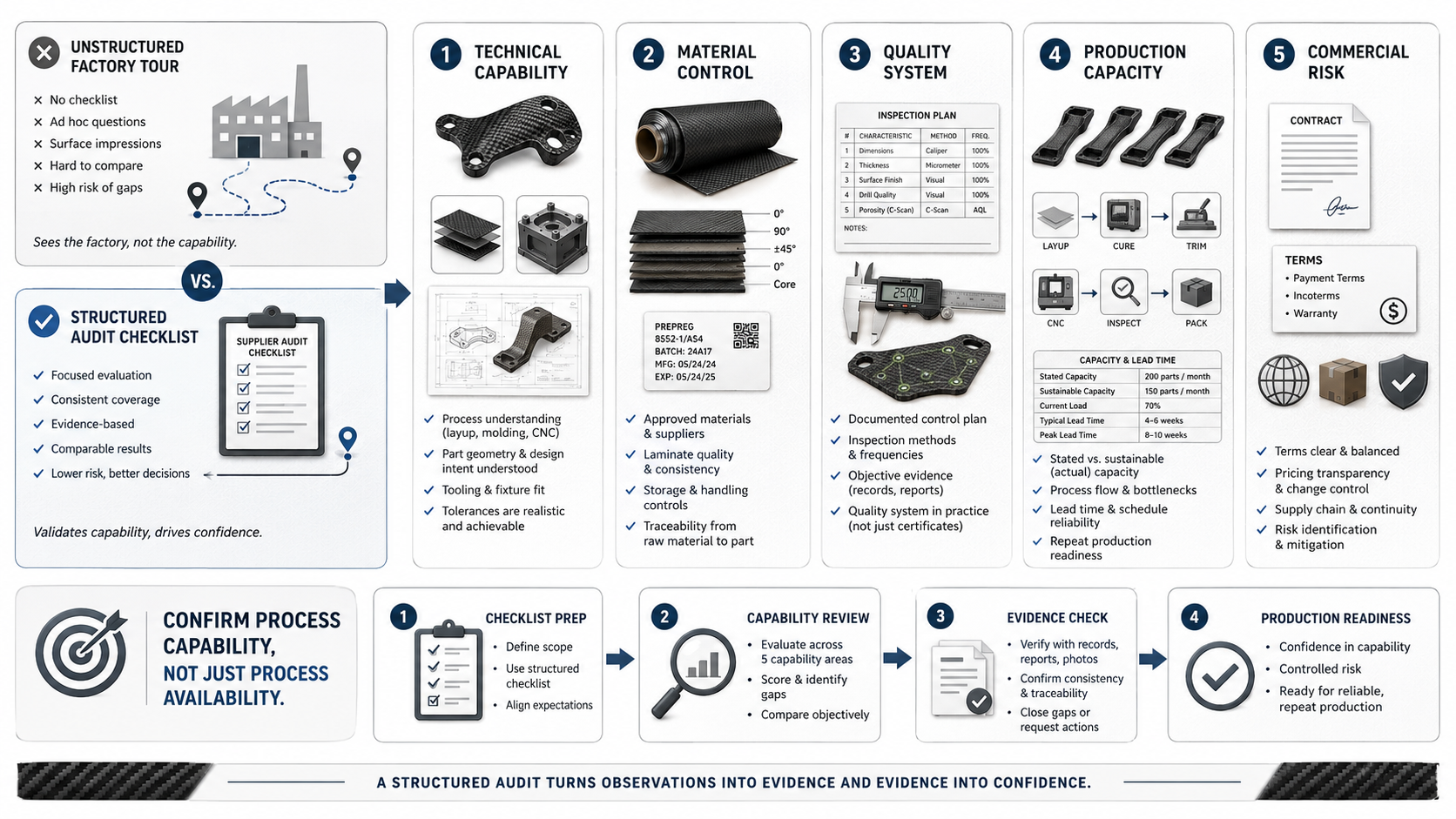
A supplier audit without a structured checklist is just a factory tour.
You see what the supplier wants you to see.
The checklist below targets five dimensions that expose real capability.
Technical Capability
Start with materials.
Ask to see:
- Material datasheet
- Batch COA
- Incoming inspection record
- Fiber grade labels
- Resin system labels
- Last three production batch records
Cross-check physical labels against the documentation.
Discrepancies are a yellow flag.
Repeated discrepancies are a red one.
Then verify process capability — not just process availability.
A supplier who owns an autoclave and a supplier who runs comparable autoclave parts are not the same.
Request:
- Equipment list
- Process window documentation
- Production photos or work orders from the last 12 months
- Cpk/Ppk data
- First Article Inspection reports
- Tensile, flexural, and ILSS test results
The real question is not whether the supplier can hit tolerance on a sample.
It is whether they can hit it batch after batch at your volume.
Material Control
Traceability shows whether documentation discipline is real.
Pick one finished part serial number and ask the supplier to trace it back to:
- Fiber lot
- Resin batch
- Cure cycle record
- Operator ID
- Equipment number
- Environmental log
Give them 30 minutes.
If they cannot close the loop, the traceability system may live on paper, not in practice.
Check the storage area.
Prepreg and adhesives need:
- Temperature logs
- Humidity logs
- Controlled thawing procedures
- Expiration labels
- Out-of-date disposal rules
- FIFO practice
Unlabeled materials and missing expiration dates are not housekeeping issues.
They are material integrity risks.
Quality System
Match the certification to the application.
- Aerospace: AS9100
- Automotive: IATF 16949
- General industrial structural work: ISO 9001:2015 minimum
Then look past the certificate.
Ask for:
- Customer complaint rate
- Rework rate
- Scrap rate
- CAPA closure timeline
- 8D report sample
- Quality manual
- Work instructions
- Control plans
- Calibration records
A supplier who files reports but cannot show verified corrective action is managing appearances, not quality.
Check the lab.
Look for:
- Thickness gauges
- Ultrasonic inspection equipment
- CT inspection if claimed
- Tensile testing machine
- Flexural test capability
- Porosity testing capability
- Current calibration certificates
Production Capacity
Stated capacity and real capacity are rarely the same number.
Ask for:
- Monthly output by process
- OEE
- Bottleneck cycle time
- Changeover time
- Peak-season utilization
- Last three months of delivery records
- Production schedule records for critical workstations
Then walk the floor.
A supplier who can quote capacity but will not show production data is giving a sales number, not an operations number.
Check equipment redundancy:
- Autoclave
- Curing oven
- Cutting machine
- Fabric cutter
- Vacuum system
- CNC trimming machine
- NDT equipment
No backup unit?
Ask for the recovery time objective if the primary asset goes down.
Compare the sample build area to the production line.
New equipment in a sample area and weak production equipment on the floor is paper capability.
It looks strong in presentations and fails at scale.
Commercial Risk
Audit the business, not only the factory.
Ask for:
- Two years of financial statements or revenue trend data
- Customer concentration
- Delivery performance history
- Insurance certificates
- Export control compliance
- REACH/RoHS records
- Change notification procedure
- Raw material backup plan
If one customer accounts for more than 40% of revenue, priorities can shift fast.
Late delivery above 5% on existing programs is a leading indicator, not a lagging one.
Ask what happens if the primary raw material supplier goes down.
Do they have:
- Qualified second source?
- Alternate resin or fiber grade?
- Contingency plan for single-point-of-failure tooling?
No answers mean the risk lands on you.
On-Site Audit Sequence
Do not start in the conference room.
Start in the warehouse.
Recommended sequence:
- Check material storage and labeling.
- Walk critical equipment and production line.
- Pull one in-process batch and trace it forward and backward.
- Review quality records.
- Run two finished-goods serial number traceback exercises.
- Ask the same core questions to sales, process engineering, quality, and production.
Answers that do not match signal a management system gap.
The most reliable signal of real capability is how fast and how thoroughly a supplier answers questions they were not expecting.
10 Technical Questions Procurement Should Ask Carbon Fiber Suppliers
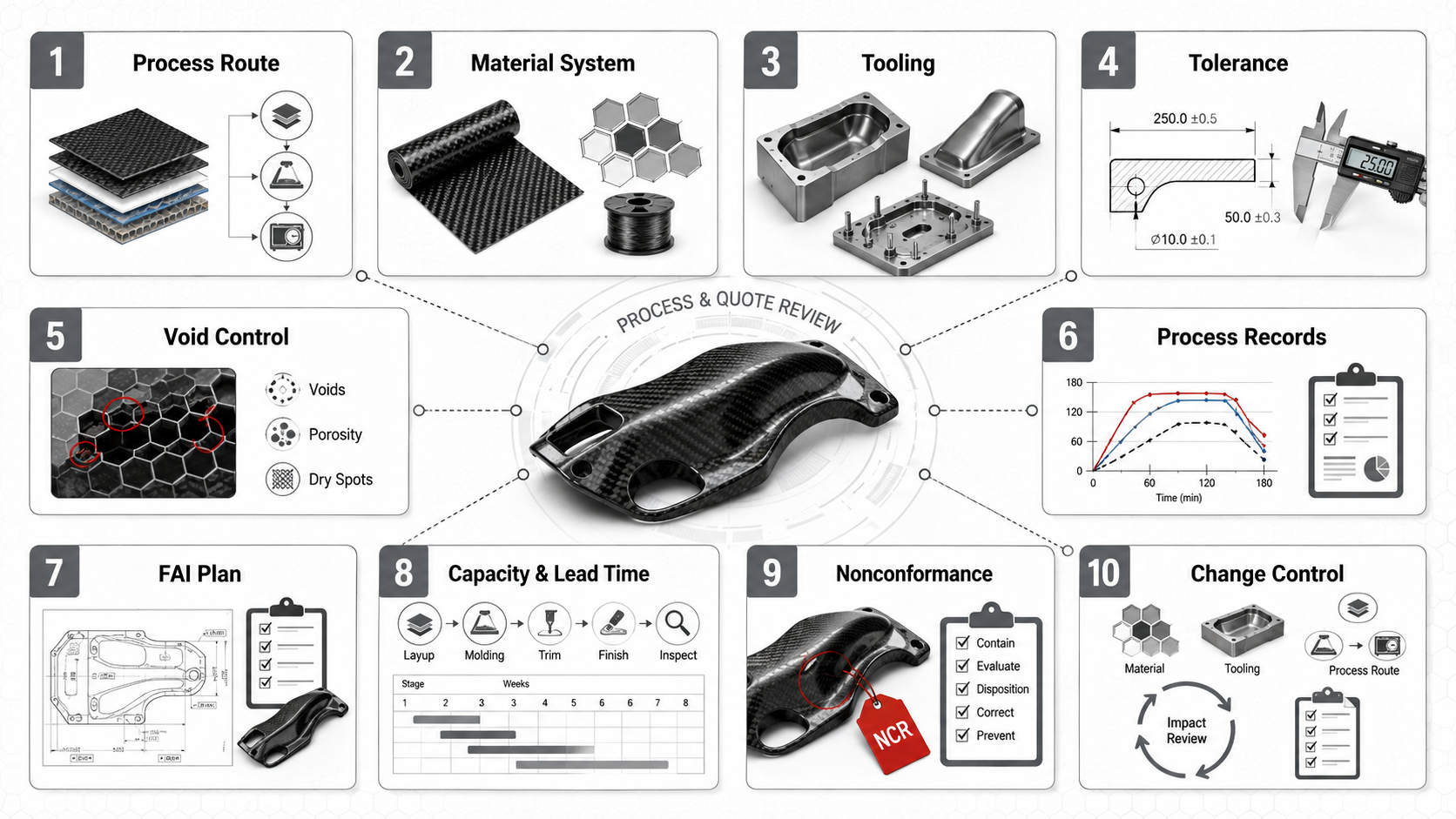
These ten questions separate a sourcing decision you can defend from one you may need to explain six months later.
Ask them before RFQ closes.
Ask them during the factory audit.
Ask them again when the first production lot ships.
1. What Fabrication Process Do You Use for This Part — and Why?
Push past the process label.
“Advanced composites” is marketing.
You need a specific route with real parameters.
Ask for:
- Autoclave pressure range, such as 0.6–0.7 MPa
- Cure temperature, such as 180–190°C
- Ramp rate, such as 1–2°C/min
- RTM injection pressure, such as 5–15 bar
- Mold temperature, such as 130–160°C
- Compression molding cycle time, such as 5–20 min
- Press pressure, such as 50–120 bar
A supplier who answers in numbers understands the process.
One who answers in adjectives is guessing.
2. What Is Your Maximum Allowable Porosity, and How Do You Measure It?
Aerospace standards often sit around:
- ≤1–2% total porosity
- ≤3% local porosity
Porosity above 2–3% can cut tensile and fatigue performance by 10–30%.
Ask for:
- NDT method
- Ultrasonic C-scan, CT, or density test
- Equipment model
- Minimum detectable defect size
- Sampling frequency
- 12-month porosity trend report
- Batch rejection rate
A credible answer should include a batch rejection rate below 0.5% for controlled programs.
3. Can You Provide a Complete Cure Cycle Record for Every Batch?
Temperature deviation should stay within ±3°C from setpoint.
Pressure stability should hold within ±0.05 MPa through the soak phase.
Records should be electronic, not handwritten.
Retention expectation:
- Aerospace programs: ≥10 years
- Automotive structural programs: ≥5 years
Ask for a sample cure record from a recent production batch.
If no record can be produced within 24 hours, traceability may exist only on paper.
4. What Dimensional Tolerances Can You Hold — and What Is Your Cpk?
Standard autoclave and compression-molded parts may hold ±0.1–0.3 mm per 100 mm on linear dimensions.
Flatness often runs 0.3–0.5 mm.
Precision mating surfaces after machining may reach ±0.05–0.1 mm.
Ask for:
- Cpk ≥ 1.33 on critical dimensions
- CMM or laser scan data
- As-molded tolerance
- Post-machining tolerance
- Which feature uses which process
Separate as-molded tolerance from post-machined tolerance.
Both matter.
5. What Is the Design Life of the Production Tooling, and What Is the Maintenance Schedule?
Automotive-grade compression tools may be built for 20,000–50,000 cycles.
Preventive maintenance should run every 1,000–2,000 cycles.
Maintenance may include:
- Surface polishing
- Coating inspection
- Locating pin replacement
- Tool cleaning
- Wear inspection
Ask to see the mold ledger:
- Cumulative cycle count
- Maintenance history
- Defect correlation
- Repair history
- Ownership status
Supplier-owned tooling is supplier-controlled tooling.
Write ownership into the contract.
6. What Does Your First Article Inspection Plan Include?
A complete FAI should cover:
- 100% dimensional inspection of critical features
- Mechanical coupon testing
- Tension, flexure, and shear data
- Minimum 5 specimens per condition
- NDT for porosity and delamination
- Environmental durability if required
- Material certifications
- Cure records
- Control plan
- Capability study
The deliverable should look like a PPAP Level 3 package when the application requires that level of control.
Everything should link to the same part serial number.
7. What Is Your Current Capacity Utilization and Peak Surge Capability?
Utilization above 90% means your project is competing for queue position.
Ask for:
- Monthly output by process
- OEE on critical equipment
- Autoclave or press utilization
- CNC utilization
- Actual vs. planned run rates from the last three months
- Demand surge plan for ±30%
- Delivery performance penalty clause
On-time delivery above 95% should be the floor, not the target.
8. How Do You Handle Nonconforming Parts?
Target rejection rate:
- <1% per batch
- <0.1% for structural defects
Ask for the full disposition flow:
- Containment
- Root cause analysis
- Corrective action
- Recurrence prevention
- Customer notification
- Rework approval
- Scrap decision
- CAPA closure
Then ask for closure timelines on the last five CAPAs.
Open CAPAs older than 90 days suggest a quality system that files reports but does not close the loop.
9. What Fiber Grade and Resin System Are You Quoting — and Can You Trace the Material Lot?
This question reveals a lot.
Pick a finished part from the last production run and ask the supplier to trace it back to:
- Fiber lot
- Fiber grade, such as T700 or T800
- Tow size
- Areal weight
- Resin batch
- Epoxy Tg
- Cure specification
- Incoming inspection record
Give them 30 minutes.
A supplier with real traceability closes the loop quickly.
One without it delivers many words and few serial numbers.
10. Who Are Your Tier-2 Material Suppliers — and What Is Your Contingency if One Goes Down?
Single-source prepreg or fiber creates supply risk.
Ask whether the supplier has:
- Qualified alternate fiber grade
- Backup resin supplier
- Alternate prepreg source
- Tooling failure contingency
- Single-point-of-failure plan
- Safety stock policy
- Raw material lead-time buffer
No answer means the exposure lands on your program schedule.
No procurement team should accept that without a mitigation plan written into the contract.