
Choosing between carbon fiber prepreg, dry fabric, and tow is not a small material decision.
It can decide the whole manufacturing route.
A part planned for autoclave prepreg may actually fit filament winding. A large panel planned with prepreg may be more practical with dry fabric and infusion. A low-volume prototype may not justify cold-chain prepreg storage. A pressure vessel planned with woven fabric may need continuous tow and controlled winding angle instead.
The fiber may be similar.
The material form is not.
Carbon fiber prepreg, dry fabric, and tow differ in resin content, fiber volume fraction, void control, storage requirements, process compatibility, equipment cost, production volume, and quality risk.
For buyers, engineers, and procurement teams, the right question is not only:
Which carbon fiber material is strongest?
The better question is:
Which carbon fiber material form matches the process, equipment, storage condition, part geometry, performance requirement, production volume, and cost target?
At HyperX Carbon, we review material form together with application, part geometry, load direction, surface requirement, quantity target, process route, inspection requirement, and buyer capability. A UAV frame plate, a visible automotive panel, a filament-wound tube, a pressure vessel, and a large infused panel do not need the same material form.
This guide compares carbon fiber prepreg, dry carbon fiber fabric, and carbon fiber tow from a practical manufacturing and procurement angle.
Carbon Fiber Prepreg vs Fabric vs Tow: What This Guide Covers

This guide focuses on the three purchasable carbon fiber reinforcement forms buyers most often compare:
-
Carbon fiber prepreg
-
Dry carbon fiber fabric
-
Carbon fiber tow
These are not interchangeable.
Each material form answers a different production question.
Prepreg is carbon fiber with resin already added under controlled factory conditions. It is used when resin content, laminate repeatability, and controlled curing matter.
Dry fabric is carbon fiber reinforcement without resin. It is used when the manufacturer wants resin-selection flexibility, infusion compatibility, room-temperature storage, or lower material handling complexity.
Tow is a continuous bundle of carbon filaments. It is used when the process needs direct fiber feeding, controlled tension, winding, pultrusion, braiding, weaving, or automated placement.
This article compares the three forms across the decision areas that matter most:
|
Decision Area |
Why It Matters |
|---|---|
|
Resin state |
Determines whether resin is factory-controlled or added during processing |
|
Fiber volume fraction |
Affects strength, stiffness, weight, and repeatability |
|
Void content |
Affects compression strength, fatigue, ILSS, and structural reliability |
|
Manufacturing process |
Determines whether the material fits autoclave, infusion, winding, pultrusion, or molding |
|
Storage and handling |
Determines whether cold chain, out-time, or ambient warehouse storage is required |
|
Cost structure |
Determines whether cost sits in material, labor, equipment, storage, or scrap |
|
Application fit |
Determines whether the form works for panels, shells, tubes, vessels, profiles, or visible surfaces |
This article goes deeper into the three reinforcement forms introduced in the broader carbon fiber materials overview. It does not replace the carbon fiber prepreg product page, the fabric and tow product page, the resin systems guide, the molding processes article, or the material traceability guide.
The boundary is simple:
This guide helps buyers choose between prepreg, dry fabric, and tow before locking the manufacturing route.
The Core Difference: Resin-Included vs Resin-Free Material Forms

The simplest way to compare prepreg, fabric, and tow is to start with resin.
Either the resin is already in the material when it ships, or it is added during manufacturing.
That difference changes almost everything.
|
Material Form |
Resin State |
Practical Meaning |
|---|---|---|
|
Carbon fiber prepreg |
Resin already added at factory |
Resin content is controlled before layup |
|
Dry carbon fiber fabric |
No resin |
Resin is added during wet layup, infusion, RTM, or similar process |
|
Carbon fiber tow |
Usually no resin unless supplied as prepreg tow |
Resin is added during winding, pultrusion, infusion, impregnation, or automated processing |
Prepreg gives more resin-content control, but it requires storage discipline, cure control, and suitable equipment.
Dry fabric gives more process flexibility, but it requires resin selection, resin flow control, vacuum control, and good operator discipline.
Tow gives strong directional efficiency and scale potential, but it requires equipment that can control fiber path, tension, resin metering, and cure.
This is why a material form should never be chosen from a catalog alone.
The buyer should first ask:
-
What process will be used?
-
What equipment is available?
-
Does the project need resin-content control?
-
Is cold storage available?
-
Is the geometry flat, curved, axisymmetric, or continuous?
-
What fiber volume fraction and void level are acceptable?
-
Is the project low-volume, mid-volume, or high-volume?
-
Who owns the quality risk?
The right material form is the one that matches the whole production system.
Carbon Fiber Tow: When Continuous Fiber Bundles Fit the Process

Carbon fiber tow is the starting point for many reinforcement forms.
A tow is a bundle of continuous carbon filaments wound onto a spool. It is not woven into a fabric and normally does not include resin unless supplied as prepreg tow.
Tow size is described by K-count. K means one thousand filaments.
|
Tow Size |
Filament Count |
Typical Use Direction |
|---|---|---|
|
3K |
3,000 filaments |
Fine fabric, visible surfaces, small parts |
|
6K |
6,000 filaments |
Structural fabric, moderate reinforcement |
|
12K |
12,000 filaments |
General structural reinforcement and industrial use |
|
24K |
24,000 filaments |
Winding, pultrusion, large structures |
|
48K+ |
48,000+ filaments |
Heavy industrial, infrastructure, high-throughput processes |
K-count is not a quality grade.
A 3K and a 12K tow made from the same fiber grade can have similar tensile strength per fiber cross-section. The difference is bundle size, handling behavior, surface detail, drapability, deposition rate, and process suitability.
Smaller tows such as 3K and 6K can create finer surface patterns and better drape over curved geometry.
Larger tows such as 12K, 24K, and 48K can deposit more fiber faster and reduce cost in high-volume or continuous processes, but they are less suitable for fine cosmetic surfaces and tight-radius layups.
Tow is usually selected when the process needs continuous fiber feeding.
Common tow-based processes include:
|
Process |
Why Tow Fits |
|---|---|
|
Filament winding |
Tow can be wound at controlled angles around a mandrel |
|
Pultrusion |
Tow or roving can be pulled continuously through resin and a heated die |
|
Braiding |
Tow can form tubular or complex preforms |
|
Weaving |
Tow becomes the yarn used to make woven fabric |
|
Automated fiber placement |
Tow or slit tape can be placed along programmed paths |
|
Tow prepreg winding |
Pre-impregnated tow can support controlled winding applications |
Tow performs especially well when the part has a clear fiber path.
Examples include:
-
Tubes
-
Drive shafts
-
Pressure vessels
-
Hydrogen storage tanks
-
CNG cylinders
-
Pultruded profiles
-
Rods
-
Spar caps
-
Reinforcement strips
-
Axisymmetric parts
In well-controlled winding, pultrusion, or automated placement processes, tow-based parts can reach high fiber volume fractions, often around 60–75%, depending on fiber, resin, process, pressure, geometry, and quality control.
Void content can be competitive with prepreg when tension, resin metering, compaction, and cure are controlled. In good winding or pultrusion processes, void content may reach ≤1–2%.
The advantage is directional efficiency.
The limitation is geometry.
Tow is excellent when the fiber path is controlled and repeatable. It is not the easiest choice for freeform shells, complex hand layups, or cosmetic weave surfaces.
Dry Carbon Fiber Fabric: When Flexibility and Infusion Matter
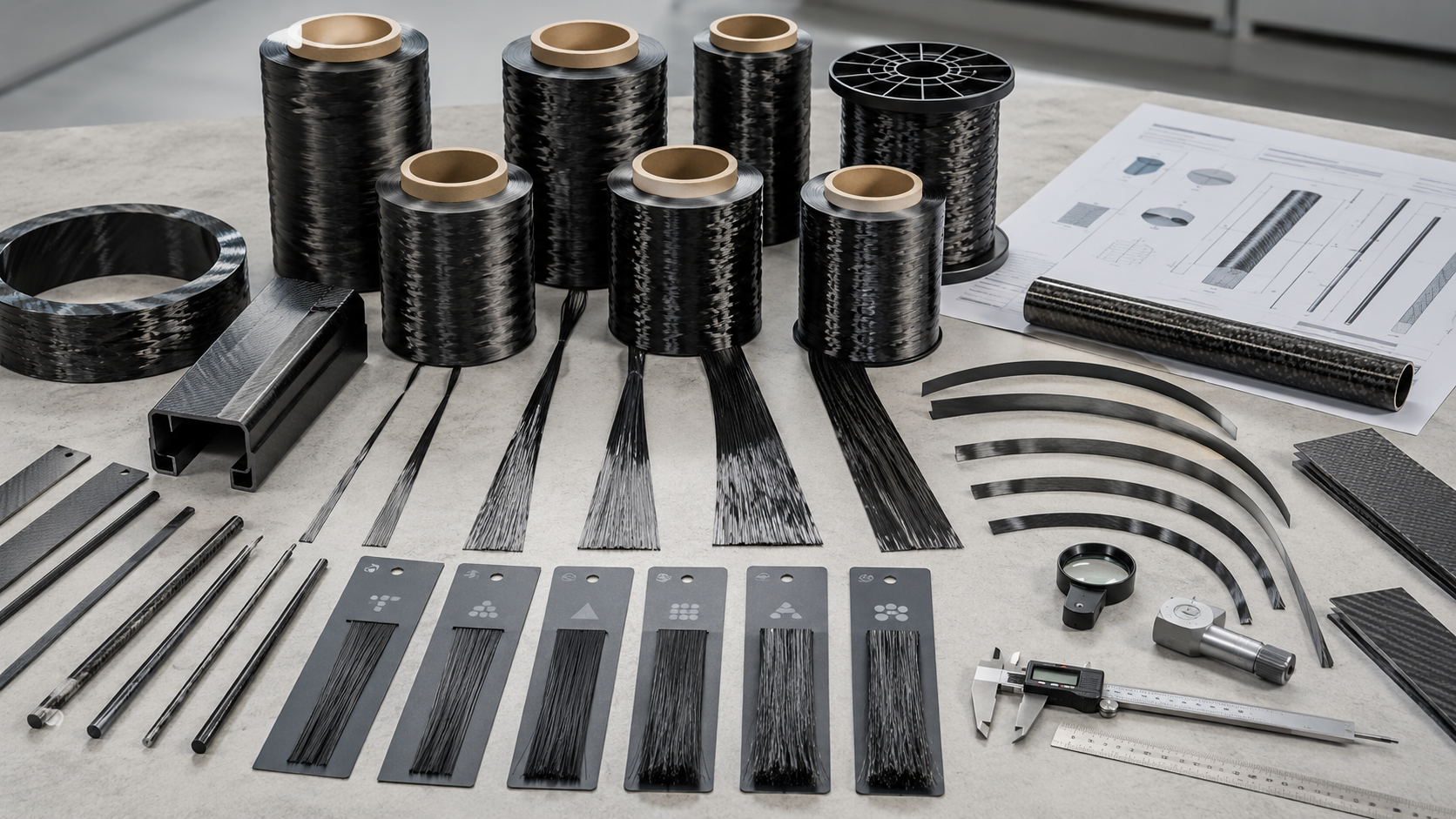
Dry carbon fiber fabric is carbon fiber reinforcement with no resin inside.
It is made by weaving, stitching, or spreading carbon fiber tow into sheet-like reinforcement. The resin is added later during wet layup, vacuum infusion, RTM, VARTM, or another process.
Dry fabric is often selected when buyers or manufacturers need:
-
Room-temperature storage
-
Lower cold-chain complexity
-
Resin-selection flexibility
-
Compatibility with wet layup or infusion
-
Large-panel manufacturing
-
Lower material entry cost
-
Easier handling for low-to-mid-volume projects
-
Good surface appearance with woven fabric
-
Custom resin system selection
Common dry carbon fiber fabric forms include:
|
Fabric Type |
Main Benefit |
Main Consideration |
|---|---|---|
|
Plain weave |
Stable, tight pattern |
More crimp, less drape |
|
2×2 twill |
Better drape and visible pattern |
Common for visible carbon surfaces |
|
Satin weave |
Lower crimp and smoother surface |
Less stable, more process-sensitive |
|
Unidirectional fabric |
Strong in one main direction |
Needs careful layup design |
|
Multiaxial fabric |
Multiple fiber directions stitched together |
Useful for large infused structures |
|
Non-crimp fabric |
Straight fibers with minimal crimp |
Better structural efficiency than woven fabric |
|
Spread-tow fabric |
Thin, flat, low-crimp reinforcement |
Sensitive to air entrapment and surface waviness |
Areal weight, or GSM, is one of the most important purchasing details.
|
Fabric Weight |
Typical Meaning |
|---|---|
|
80–200 g/m² |
Thin layers, spread-tow surfaces, lightweight skins |
|
200–245 g/m² |
Common visible twill or plain weave surface layers |
|
300–430 g/m² |
Heavier structural UD or woven reinforcement |
|
600–650 g/m² |
Structural buildup layers |
|
800–1,200 g/m² |
Heavy multiaxial or NCF reinforcement for larger structures |
A lower GSM fabric is easier to conform and may give better visible surface control, but it requires more plies to build thickness.
A higher GSM fabric builds thickness faster, but it may be harder to drape and may need better resin-flow planning.
Dry fabric is commonly used in:
-
Marine panels
-
Industrial covers
-
Automotive visible parts
-
Wind blade structures
-
UAV panels
-
Prototype parts
-
Large shells
-
Infused panels
-
RTM or VARTM parts
-
Cost-sensitive composite structures
The main risk with dry fabric is not the carbon fiber itself.
The main risk is process control.
Because resin is added later, the final laminate depends heavily on:
-
Resin viscosity
-
Wet-out quality
-
Vacuum integrity
-
Infusion path
-
Debulking
-
Tooling
-
Operator skill
-
Cure control
-
Fabric architecture
-
Fiber orientation
Dry fabric laminates made by vacuum infusion often reach around 45–55% fiber volume fraction. Wet hand layup may fall lower, especially without strong consolidation control.
Void content can vary. Well-executed infusion may perform well, but uncontrolled wet layup can create resin-rich zones, trapped air, dry spots, and inconsistent thickness.
Dry fabric is not a lower-quality material form by default.
It is the right material form when the part size, process route, resin choice, cost target, and production environment match dry reinforcement.
Carbon Fiber Prepreg: When Controlled Resin Content and Repeatability Matter

Carbon fiber prepreg is carbon fiber reinforcement that already contains resin.
The resin is applied under factory-controlled conditions and partially advanced into a B-stage state. That means the material is tacky enough for layup, stable enough to handle under defined conditions, and designed to complete cure under heat and pressure.
Prepreg can be supplied as:
|
Prepreg Form |
Typical Use |
|---|---|
|
Woven prepreg |
Curved shells, visible panels, quasi-isotropic laminates |
|
UD prepreg tape |
High-stiffness structures and directional reinforcement |
|
Prepreg tow |
Filament winding, automated placement, braided or wound structures |
|
Prepreg charge |
Compression molding and high-volume closed-tool parts |
Prepreg is often chosen when the project needs:
-
Controlled resin content
-
Repeatable laminate quality
-
High fiber volume fraction
-
Lower void risk
-
Cleaner layup
-
Better batch consistency
-
Stronger structural documentation
-
High-performance laminates
-
Lower manual resin variability
Many prepreg systems contain resin around 30–40 wt%, depending on material form, resin system, and application.
Under controlled processing, prepreg laminates commonly reach around 55–65% fiber volume fraction. Higher values may be possible in specialized systems, but 55–65% is a practical working range for many carbon fiber prepreg projects.
Autoclave prepreg processing can reach very low void content, often below 1% when the material, tool, vacuum bagging, pressure, and cure cycle are well controlled.
Out-of-autoclave prepreg can reduce equipment demands, but void content and mechanical performance depend strongly on the specific material system, breather design, venting, vacuum quality, part geometry, and cure discipline.
Prepreg is commonly used in:
-
Aerospace structures
-
Motorsport monocoques
-
High-end bicycle frames
-
UAV structures
-
High-performance sporting goods
-
Appearance-critical carbon fiber parts
-
Compression-molded parts
-
Structural brackets
-
Precision panels
The main limitation is operational discipline.
Prepreg usually requires:
-
Frozen storage around −18°C
-
Controlled thawing
-
Cumulative out-life tracking
-
Vacuum bagging or matched-tool molding
-
Oven, autoclave, or press cure
-
Cure cycle control
-
Batch record discipline
Prepreg is not automatically the best choice.
It is the best choice when the project can use its advantages: resin-content control, laminate repeatability, low void risk, and strong structural performance.
If the buyer cannot manage storage, out-life, tooling, or cure control, prepreg’s theoretical advantage may not appear in the finished part.
Mechanical Performance Comparison: FVF, Void Content and Strength

Mechanical performance depends on the fiber, resin, laminate design, consolidation, cure, and inspection.
But material form strongly affects the range of performance that a process can realistically achieve.
The key metric is fiber volume fraction, or FVF.
Higher FVF generally means more load-carrying carbon fiber in the laminate. But FVF alone is not enough. Fiber orientation, void content, resin quality, and process control still matter.
A practical comparison looks like this:
|
Material Form and Process |
Typical FVF |
Typical Void Content |
Performance Direction |
|---|---|---|---|
|
Prepreg with controlled autoclave or press cure |
55–65% commonly; higher possible in specialized systems |
<1% possible in well-controlled systems |
Strong repeatability, high structural performance |
|
Dry fabric with vacuum infusion |
45–55% |
1–3% in strong processes; 2–5% in less controlled systems |
Good balance of cost, scale, and performance |
|
Dry fabric with wet layup |
35–50% |
Often higher if hand process is weak |
Accessible but more variable |
|
Tow with winding or pultrusion |
60–75% in controlled processes |
≤1–2% possible in good systems |
Excellent directional efficiency |
|
Tow in poorly controlled processing |
Variable |
Variable |
Performance depends heavily on tension and resin control |
Prepreg often leads in structural consistency because resin content and reinforcement are prepared before layup. When compared with similar fiber and resin systems under controlled test conditions, autoclave prepreg laminates may outperform vacuum infusion laminates by roughly 15–35% in tensile strength and 15–30% in compressive strength.
Void control explains part of that difference.
Reducing void content from 3–5% to below 1% can help recover roughly 5–15% tensile strength and 10–20% compressive strength, depending on laminate, load direction, resin system, and test condition.
Tow-based processes can close the performance gap in the right geometry.
Filament winding and pultrusion can place fibers in controlled paths under tension. Because tow can avoid woven crimp, it can deliver strong load transfer along the fiber direction.
Crimp matters.
In woven fabrics, fiber waviness and crimp can reduce axial stiffness by 10–30% at the same fiber volume fraction, depending on weave architecture and load direction.
Pultruded unidirectional profiles may show 20–40% higher axial tensile strength than lower-FVF infusion laminates when the comparison is along the primary fiber direction.
The practical interpretation:
|
Requirement |
Stronger Starting Point |
|---|---|
|
Highest structural consistency |
Prepreg |
|
Large infused panel with balanced cost |
Dry fabric |
|
Axisymmetric part with hoop or axial load |
Tow |
|
High visible weave surface |
Twill fabric or woven prepreg |
|
Continuous profile |
Tow / roving |
|
Prototype without cold chain |
Dry fabric |
|
Low void structural part with strong cure control |
Prepreg |
The best material form is not the one with the highest spec sheet number.
It is the one that your process can actually turn into a qualified laminate.
Manufacturing Compatibility: Match Material Form to Process Route

Your equipment makes the first decision.
Material form must match process route. If the material and process do not match, the result may be resin-rich zones, incomplete wet-out, dry spots, poor fiber path control, weak consolidation, or unpredictable void content.
A practical compatibility table:
|
Manufacturing Process |
Best-Fit Material Form |
Primary Risk if Mismatched |
|---|---|---|
|
Autoclave cure |
Prepreg |
Dry reinforcement does not provide factory resin control |
|
Oven cure |
Prepreg or selected OOA prepreg |
Void control depends on material and vacuum design |
|
Wet layup |
Dry fabric |
Resin-rich zones, inconsistent FVF, trapped air |
|
Vacuum infusion |
Dry fabric or dry preform |
Dry spots, race tracking, incomplete fill |
|
RTM / VARTM |
Dry fabric or preform |
Flow imbalance, incomplete impregnation |
|
Filament winding |
Tow or prepreg tow |
Poor fiber path control if material form is wrong |
|
Pultrusion |
Tow / roving |
Dimensional inconsistency or weak impregnation if process is uncontrolled |
|
Compression molding |
Prepreg charge, SMC-like charge, or suitable preform |
Incomplete consolidation or surface defects |
|
Braiding |
Tow |
Fiber angle and tension control required |
|
AFP / ATL |
Prepreg tape, slit tape, or tow-based systems |
Equipment/material mismatch causes placement defects |
The fastest selection logic is:
-
Have an autoclave, controlled oven, AFP, or ATL system? Start with prepreg.
-
Have vacuum infusion, RTM, VARTM, or wet layup equipment? Start with dry fabric.
-
Have filament winding, pultrusion, or braiding equipment? Start with tow.
-
Have matched metal tooling and press molding capability? Consider prepreg charge or suitable molding material.
-
Have no process equipment? Consider finished parts, CNC stock, or custom manufacturing instead of raw materials.
This is where many projects go wrong.
Buyers first choose the material they like, then try to force the process to fit.
The better order is:
-
Confirm part geometry.
-
Confirm process route.
-
Confirm available equipment.
-
Confirm storage and handling capability.
-
Confirm required performance.
-
Choose the material form.
A material form that performs well in one process may fail in another.
Prepreg does not become low-risk if there is no cure discipline.
Dry fabric does not become economical if the infusion process creates scrap.
Tow does not become efficient if the geometry cannot support controlled fiber paths.
Material selection and process selection must be made together.
Storage and Handling: Cold Chain, Out-Time and Room-Temperature Materials

Storage is one of the biggest differences between prepreg, dry fabric, and tow.
Prepreg arrives with a time limit.
Dry fabric and dry tow are much easier to store.
Prepreg Storage and Out-Life
Most carbon/epoxy prepregs require frozen storage around −18°C to slow resin advancement.
Unopened frozen shelf life often falls around 6–12 months, depending on resin system and supplier specification. Some systems may offer longer storage life, but buyers should not assume this without checking the datasheet.
Once prepreg is removed from frozen storage, cumulative room-temperature exposure begins.
This is often called out-life or out-time.
Out-life varies by resin system. Many epoxy prepregs may allow several days to about two weeks at room temperature. Some extended-out-life systems allow longer. The supplier datasheet is the authority.
The practical buyer rule:
If you use prepreg, you must track cumulative out-life.
Thawing also matters.
A safe workflow usually includes:
-
Remove the sealed prepreg from frozen storage.
-
Allow it to warm while still sealed.
-
Do not open packaging until condensation risk has passed.
-
Avoid oven or heat-gun thawing.
-
Track exposure time after removal from storage.
-
Follow supplier limits for out-life and freeze-thaw handling.
If prepreg exceeds its allowed out-life, the risk is not always visible. The material may still look usable but can produce lower tack, poor flow, incomplete cure, weak bonding, or reduced mechanical performance.
For structural applications, expired or uncontrolled prepreg should not be treated as acceptable without technical review.
Detailed storage records, out-life logs, COA/COC checks, and traceability procedures belong in a separate material traceability guide. For this article, the point is simpler:
Prepreg requires cold-chain and time-control discipline.
Dry Fabric and Tow Storage
Dry carbon fiber fabric and dry tow do not need frozen storage.
Typical storage conditions include:
-
Clean, dry warehouse
-
Room temperature around 20–25°C
-
Relative humidity below 60% RH where possible
-
Sealed packaging
-
Protection from dust, moisture, crushing, oil, and contamination
With proper packaging and humidity control, dry carbon fiber fabric and tow can remain usable for years under normal inventory practice.
This creates important operational advantages:
|
Storage Factor |
Prepreg |
Dry Fabric |
Dry Tow |
|---|---|---|---|
|
Frozen storage |
Usually required |
Not required |
Not required |
|
Out-life tracking |
Required |
Not required in the same way |
Not required in the same way |
|
Handling clock |
Yes |
No resin clock |
No resin clock |
|
Condensation risk |
Important during thaw |
Lower |
Lower |
|
Inventory flexibility |
Lower |
Higher |
Higher |
|
Small-shop burden |
Higher |
Lower |
Lower |
Dry fabric and tow are not risk-free. They still require clean handling, protection from contamination, and proper packaging.
But operationally, they are easier for small shops, low-volume programs, and variable production schedules.
This is why the best material form is not always the one with the highest performance ceiling.
Sometimes the best material is the one your operation can store, handle, process, and repeat without losing control.
Cost Comparison: Material Price, Labor, Equipment and Scrap Risk

Prepreg, dry fabric, and tow do not only differ in price.
They move cost into different places.
Prepreg front-loads cost into material, resin control, cold chain, freezer infrastructure, and out-time scrap risk.
Dry fabric reduces cold-chain cost but shifts cost into resin selection, consumables, labor, infusion control, wet-out quality, and inspection.
Tow may reduce material cost per unit at scale, but it shifts cost into winding, pultrusion, braiding, or automated placement equipment.
A useful cost map:
|
Material Form |
Cost Concentration |
Best Economic Fit |
|---|---|---|
|
Prepreg |
Material premium, cold chain, cure equipment, scrap risk from out-life |
High-performance, repeatable, low-defect programs |
|
Dry fabric |
Labor, resin, consumables, infusion setup, wet-out control |
Large panels, prototypes, low-to-mid-volume structures |
|
Tow |
Equipment, automation, tension control, resin metering |
Continuous profiles, vessels, tubes, high-volume axisymmetric parts |
Prepreg Cost Reality
Prepreg can cost more per square meter or kilogram because the resin is already applied under controlled conditions.
It may also require:
-
Frozen shipping
-
Freezer storage
-
Out-life tracking
-
Controlled thawing
-
Cure equipment
-
Vacuum bagging consumables
-
Higher process documentation
In one small-shop example, a shop processing 500 m² of prepreg per year may add cold-chain overhead such as freezer amortization, special shipping, and expired-material scrap.
A simple model may show around US$16/m² in cold-chain-related overhead. At a base material cost of US$60/m², that is about 27% extra cost.
The number will vary by country, freezer size, resin system, logistics, and material grade, but the lesson is stable:
Prepreg cost is not only material price. Cold chain and out-life discipline are part of the real cost.
Dry Fabric Cost Reality
Dry fabric can look cheaper because it does not include resin and does not require frozen storage.
But the final cost includes:
-
Resin
-
Mixing labor
-
Vacuum bagging materials
-
Flow media
-
Peel ply
-
Release film
-
Breather or bleeder
-
Infusion consumables
-
Tool preparation
-
Process labor
-
Scrap and rework
-
Inspection
Dry fabric can save material cost, but weak processing can erase the savings.
Wet layup is the common trap.
The material price may be lower, but if scrap rises to 10–20%, rework and waste can consume the savings quickly. A program with dry fabric may save 30–50% on material cost but lose that advantage if resin control, wet-out, vacuum, and cure discipline are poor.
Tow Cost Reality
Tow can be efficient at scale.
For filament winding, pultrusion, and automated fiber placement, tow can support high material utilization and fast deposition.
But the equipment cost is higher.
Tow-based processes may require:
-
Filament winding machine
-
Pultrusion line
-
Braiding equipment
-
AFP / ATL system
-
Resin bath or impregnation unit
-
Tension control
-
Mandrels or dies
-
Automated cure or heated tooling
-
Dimensional control
-
Process monitoring
Tow is often the best total-cost route when geometry is stable and production volume is high enough to spread equipment cost.
It is rarely the easiest route for one-off manual production.
Cost Decision Summary
|
Project Situation |
Likely Cost-Fit Material Form |
|---|---|
|
Highest performance with low defect tolerance |
Prepreg |
|
Large panel with moderate structural requirement |
Dry fabric with infusion |
|
Low-volume prototype without cold chain |
Dry fabric |
|
Axisymmetric tube or vessel at scale |
Tow |
|
Continuous profile |
Tow / pultrusion |
|
Appearance-critical panel |
Prepreg or high-quality fabric infusion |
|
Small team without storage or cure control |
Dry fabric or finished/custom manufacturing |
The right cost comparison is not material price alone.
It is material price plus labor, equipment, storage, scrap, inspection, and schedule risk.
Application Scenarios: Where Prepreg, Fabric and Tow Make Sense

Different applications point toward different material forms.
Aerospace and Motorsport Structures
Prepreg is usually the strongest starting point when structural consistency, low void content, and documentation matter.
Common examples include:
-
Aerospace brackets
-
UAV structural shells
-
Motorsport monocoques
-
F1-style safety cells
-
High-performance bicycle frames
-
High-stiffness panels
-
Precision structural parts
The reason is repeatability.
Prepreg offers controlled resin content, strong fiber volume fraction, and low void potential under controlled cure.
For aerospace and motorsport, the cost of process failure is high. Prepreg often earns its price by reducing variability and supporting documentation.
Marine and Industrial Panels
Dry fabric with infusion is often practical for large structures.
Examples include:
-
Marine hull panels
-
Deck panels
-
Industrial covers
-
Large molded shells
-
Wind blade sections
-
Architectural carbon fiber panels
Large parts may not fit autoclave equipment or may not justify prepreg cold-chain and layup cost.
Dry fabric with vacuum infusion can support large-area manufacturing with lower storage burden and more flexible resin selection.
The key checks are resin flow, vacuum integrity, fabric permeability, fill time, and cure control.
Pressure Vessels, Tubes and Drive Shafts
Tow is usually the best form when the part is axisymmetric or continuous.
Examples include:
-
Pressure vessels
-
Hydrogen tanks
-
CNG cylinders
-
Drive shafts
-
Tubes
-
Rods
-
Pultruded profiles
-
Spar caps
-
Reinforcement strips
Filament winding can place tow at controlled angles for hoop strength, axial stiffness, torsion, or burst-pressure requirements.
Pultrusion can pull tow continuously through resin and a heated die to make constant-section profiles.
Tow works because the fiber path is controlled and repeatable.
UAV Structures
UAV projects may use prepreg, dry fabric, or tow depending on geometry.
|
UAV Component |
Likely Material Direction |
|---|---|
|
CNC-cut frame plates |
Prepreg laminate or cured carbon fiber plate |
|
Lightweight shells |
Prepreg or dry fabric infusion |
|
Booms and arms |
Carbon fiber tube, roll-wrapped tube, pultruded tube, or tow-wound structure |
|
Experimental fuselage |
Dry fabric or prepreg depending tooling and performance |
|
High-performance load frames |
Prepreg or controlled laminate stock |
Weight-critical UAV structures often benefit from prepreg or controlled cured plate. Cost-sensitive prototypes may begin with dry fabric or CNC-cut stock.
Automotive Panels
Visible automotive carbon fiber parts often use:
-
2×2 twill fabric
-
Woven prepreg
-
Spread-tow fabric
-
Clear-coated visible carbon layers
-
High-quality infusion where cost matters
Class-A visible surfaces need surface control, weave consistency, low pinholes, low waviness, and stable geometry.
Prepreg can help with appearance repeatability, but high-quality infusion may also work when cycle cost and tooling strategy fit the project.
Sports Equipment
Sports equipment may use prepreg, fabric, or RTM depending on volume and performance target.
High-end bicycle frames, rackets, paddles, and shafts often rely on prepreg because layup tuning and repeatability matter.
Volume products may use RTM with fabric where mold cycle, appearance yield, and repeatability matter more than peak single-part performance.
The pattern is consistent:
Prepreg wins where performance and repeatability dominate. Dry fabric wins where flexibility and large-format processing matter. Tow wins where fiber path, scale, and continuous production dominate.
Decision Framework: How Buyers Should Choose the Right Material Form
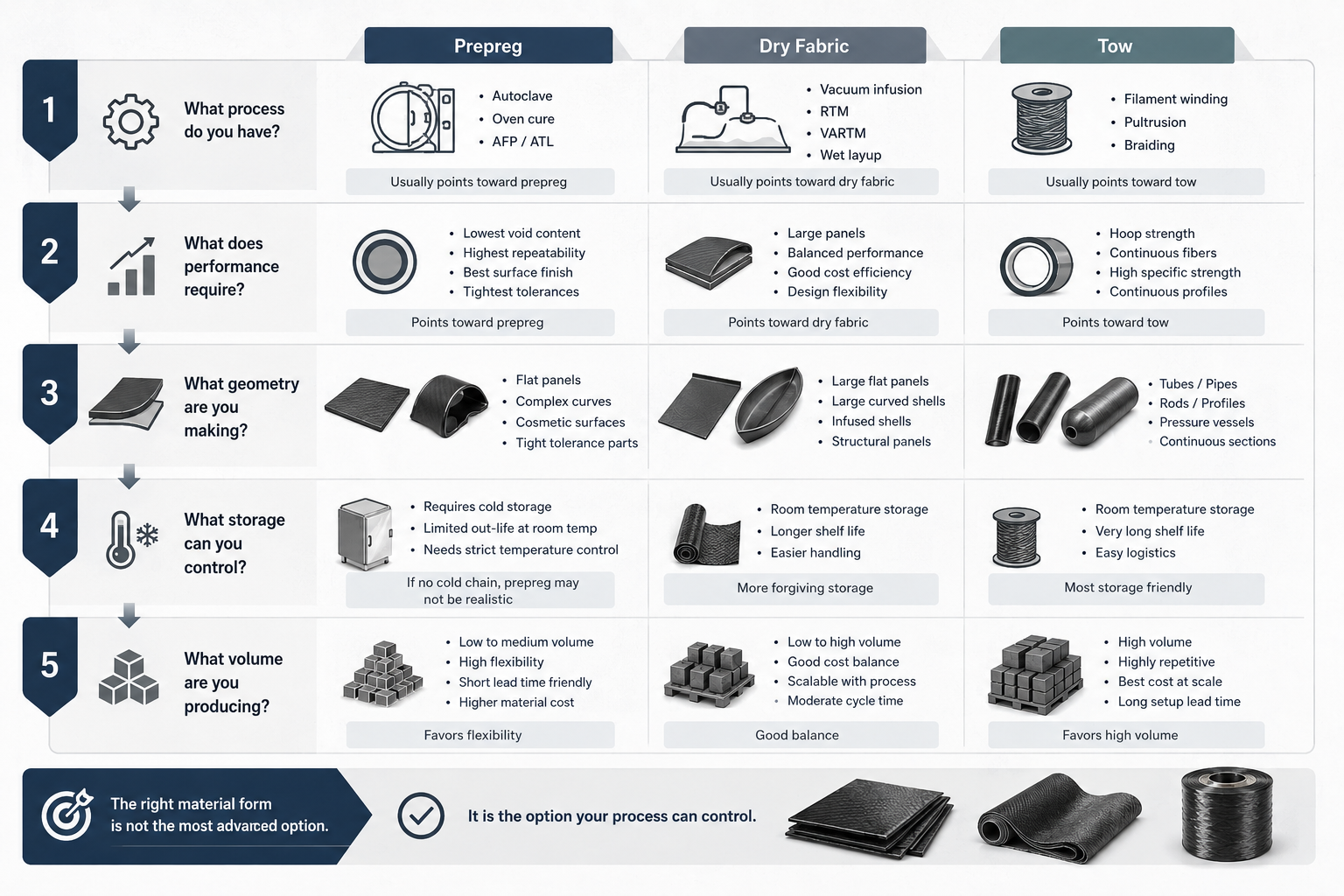
Use this sequence before selecting prepreg, dry fabric, or tow.
Do not start with material preference.
Start with the project reality.
Step 1: What Process Do You Have?
|
Existing Process or Equipment |
Best Starting Material Form |
|---|---|
|
Autoclave |
Prepreg |
|
Controlled oven cure |
Prepreg or OOA prepreg |
|
AFP / ATL |
Prepreg tape or tow-based system |
|
Vacuum infusion |
Dry fabric or dry preform |
|
RTM / VARTM |
Dry fabric or preform |
|
Wet layup |
Dry fabric |
|
Filament winding |
Tow or prepreg tow |
|
Pultrusion |
Tow / roving |
|
Braiding |
Tow |
|
Compression molding |
Prepreg charge or suitable molding material |
If the process is fixed, the material choice narrows quickly.
Step 2: What Does Performance Require?
|
Requirement |
Better Starting Point |
|---|---|
|
Lowest void content |
Prepreg with controlled cure |
|
Highest repeatability |
Prepreg |
|
Large panel with balanced cost |
Dry fabric and infusion |
|
Hoop strength |
Tow and filament winding |
|
Continuous profile |
Tow and pultrusion |
|
Visible woven surface |
Twill fabric or woven prepreg |
|
Ultra-thin appearance layer |
Spread-tow fabric |
|
Prototype without cold chain |
Dry fabric |
|
High-volume automation |
Tow, prepreg tape, or automated process-specific materials |
Performance should be tied to real part requirements, not generic material rankings.
Step 3: What Geometry Are You Making?
|
Geometry |
Practical Material Direction |
|---|---|
|
Flat panel |
Dry fabric, prepreg, or cured laminate stock |
|
Compound curved shell |
Prepreg or drapable fabric |
|
Large infused shell |
Dry fabric / NCF / infusion preform |
|
Tube |
Tow winding, roll-wrapped prepreg, or pultrusion |
|
Rod |
Tow / pultrusion |
|
Pressure vessel |
Tow / filament winding |
|
Constant-section profile |
Tow / pultrusion |
|
Cosmetic visible surface |
Twill fabric, spread-tow fabric, or woven prepreg |
Geometry often eliminates unsuitable options before cost is considered.
Step 4: What Storage Can You Control?
|
Storage Capability |
Better Material Direction |
|---|---|
|
−18°C freezer, FIFO and out-life tracking |
Prepreg is available |
|
Limited refrigeration only |
Check extended-out-life systems or avoid standard prepreg |
|
No cold chain |
Dry fabric, dry tow, or finished/custom manufacturing |
|
Variable production schedule |
Dry fabric or tow may be safer |
|
Stable production schedule |
Prepreg can be easier to control |
Prepreg’s performance advantage means little if the storage system cannot protect the material.
Step 5: What Volume Are You Producing?
|
Annual Volume |
Practical Direction |
|---|---|
|
Prototype / very low volume |
Dry fabric, cured stock, or selected prepreg if capability exists |
|
Under 1,000 parts/year |
Dry fabric, infusion, CNC stock, or low-volume prepreg |
|
1,000–10,000 parts/year |
Prepreg, RTM, high-speed infusion, or multiaxial fabric |
|
Above 10,000 parts/year |
Automated prepreg placement, compression molding, winding, pultrusion, or tow-based automation |
Volume changes the economics.
Low volume favors flexibility.
High volume favors controlled, repeatable, automated processes.
Final Decision Matrix
|
If You Need… |
Choose… |
|---|---|
|
Highest FVF and lowest voids |
Prepreg with controlled cure |
|
Best accessible material form for infusion |
Dry fabric |
|
Lowest cold-chain burden |
Dry fabric or tow |
|
Axisymmetric geometry and hoop strength |
Tow with filament winding |
|
Constant profile |
Tow with pultrusion |
|
Appearance-grade woven surface |
Twill fabric or woven prepreg |
|
High repeatability and documentation |
Prepreg |
|
Low-volume trial without freezer |
Dry fabric |
|
High-volume automated production |
Tow, prepreg tape, or process-specific prepreg |
The right material form is not the most advanced option.
It is the option your process can control.
Common Mistakes When Choosing Prepreg, Fabric or Tow

Most material-form mistakes come from choosing too early.
The buyer selects a material before confirming process, geometry, storage, and quality target.
Mistake 1: Choosing Prepreg Without Cold-Chain Control
Prepreg can be excellent, but only when storage and cure control are real.
If a buyer cannot manage frozen storage, thawing, out-life, vacuum bagging, and cure cycle, prepreg becomes a risk instead of an advantage.
Mistake 2: Choosing Dry Fabric Because It Looks Cheaper
Dry fabric has lower entry cost, but it still needs resin, consumables, labor, vacuum, tooling, cure control, and inspection.
If resin distribution is poor, dry fabric can produce heavier and weaker laminates than expected.
Mistake 3: Choosing Tow for Geometry That Needs Drapability
Tow is efficient when fiber paths are controlled.
It is not a simple replacement for fabric in hand layup or complex freeform surfaces. Using large tow where drape is needed can create bridging, wrinkles, voids, and poor surface quality.
Mistake 4: Comparing Material Price Instead of Finished Part Cost
Prepreg may cost more but reduce rework.
Dry fabric may cost less but increase labor.
Tow may lower unit cost at scale but require expensive equipment.
The correct comparison is total project cost, not raw material price.
Mistake 5: Ignoring Resin Control
Prepreg includes resin.
Dry fabric and tow need resin added later.
That means viscosity, wet-out, cure cycle, resin content, and matrix compatibility become process responsibilities. These topics should be reviewed before production, not after the first failed batch.
Mistake 6: Using One Material Form for Every Project
There is no universal best material form.
Prepreg, dry fabric, and tow each win in different conditions.
The best supplier does not force one route.
It reviews the project and recommends the material form that matches the real manufacturing path.
FAQ: Practical Questions About Prepreg, Fabric and Tow
Does carbon fiber prepreg require refrigeration?
In most carbon/epoxy prepreg systems, yes.
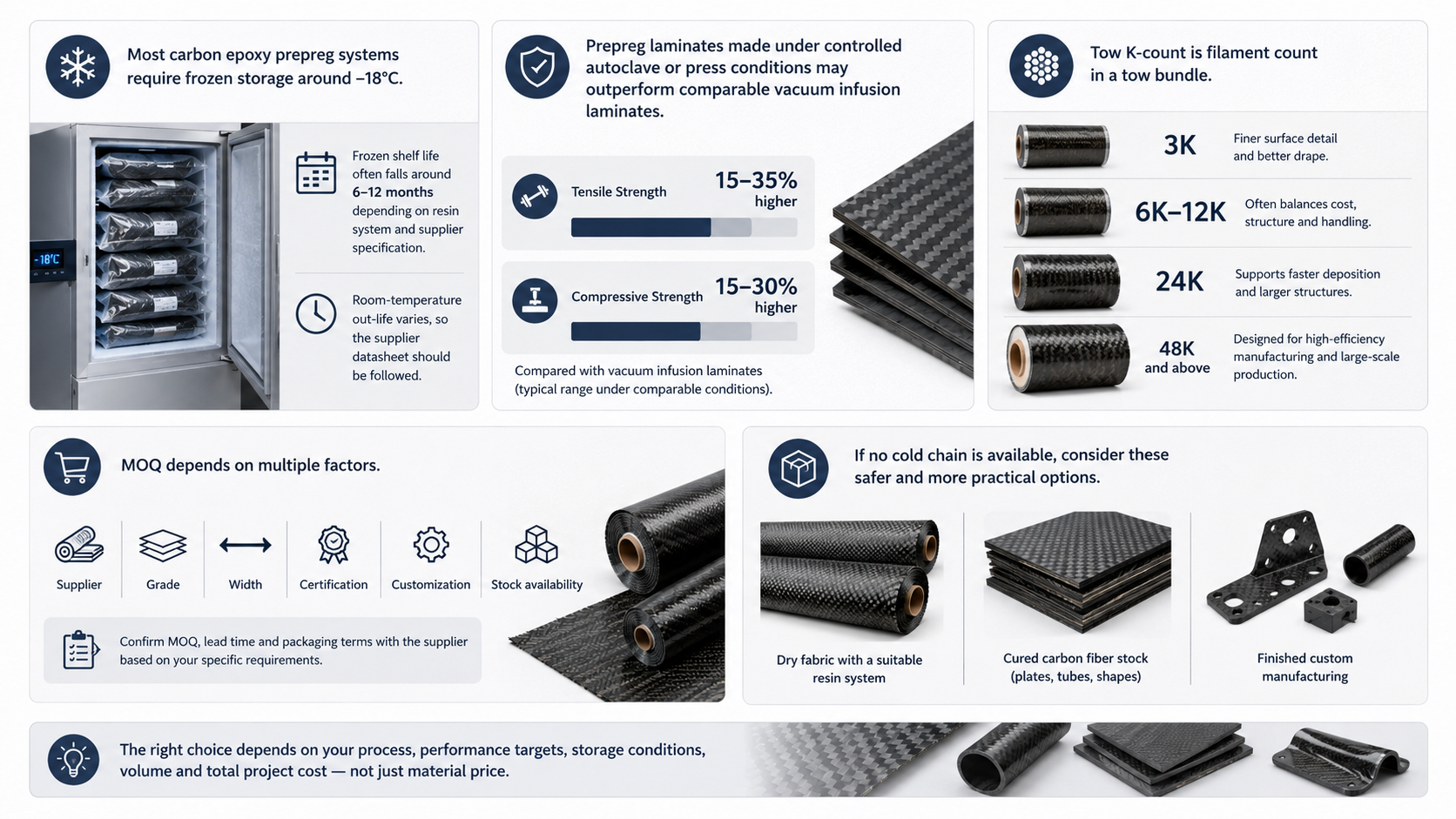
Standard prepreg usually requires frozen storage around −18°C. Frozen shelf life often falls around 6–12 months, depending on resin system and supplier specification.
Room-temperature out-life varies. Many systems allow several days to about two weeks. Some extended-out-life systems allow longer.
Always follow the supplier datasheet and track cumulative out-life.
How much stronger is prepreg than vacuum infusion?
There is no single universal number because fiber grade, resin system, layup design, process quality, and test method all matter.
As a practical comparison, prepreg laminates made under controlled autoclave or press conditions may outperform comparable vacuum infusion laminates by roughly 15–35% in tensile strength and 15–30% in compressive strength.
The main reasons are higher fiber volume fraction, lower void content, controlled resin content, and better consolidation.
Vacuum infusion can still be the better choice for large panels, cost-driven projects, and applications where ultra-low void content is not required.
How does tow K-count affect material choice?
K-count is the filament count in a tow bundle.
-
3K gives finer surface detail and better drape.
-
6K–12K often balances cost, structure, and handling.
-
24K and above supports faster deposition and larger structures but is less flexible on tight curves.
Higher K-count does not automatically mean higher quality.
It means larger fiber bundle size.
Choose K-count based on surface requirement, geometry, process equipment, deposition rate, and cost target.
What are typical minimum order quantities for prepreg, fabric and tow?
MOQ depends on supplier, grade, width, certification, customization, and stock availability.
General planning ranges may look like this:
|
Material Form |
Typical Planning MOQ Direction |
|---|---|
|
Woven fabric |
One roll may be possible for standard stock; industrial orders may require larger quantities |
|
UD prepreg tape |
One roll or more; aerospace-grade material can require higher MOQ |
|
Woven prepreg |
Often quoted by roll, square meter, or kilogram |
|
Tow |
Often supplied by box, spool, or kilogram |
|
Custom width / custom weave |
Higher MOQ |
|
Certified aerospace material |
Higher MOQ and longer lead time |
For exact MOQ, buyers should confirm fiber grade, width, resin system, certification requirement, packaging, and destination.
Can prepreg be used without cold-chain infrastructure?
For structural production, usually no.
Some specialty systems may offer extended out-life or room-temperature stability, but buyers should not assume this applies to standard prepreg.
Without proper storage and out-life control, prepreg quality can degrade in ways that visual inspection may not catch.
If no cold chain is available, dry fabric with a suitable resin system, cured carbon fiber stock, or finished/custom manufacturing may be the safer route.
Is dry fabric lower quality than prepreg?
No.
Dry fabric is a different material route.
It can produce strong parts when resin selection, vacuum, infusion, wet-out, tooling, and cure are controlled.
Prepreg usually offers stronger resin-content control and repeatability. Dry fabric offers flexibility, easier storage, and better fit for large or cost-sensitive parts.
The correct choice depends on process capability and application requirement.
Is tow only for large industrial parts?
No.
Tow is the starting point for many carbon fiber materials. It can be used in weaving, braiding, winding, pultrusion, and automated placement.
Tow is especially useful when the process needs continuous fiber feeding, controlled angle, and repeatable deposition.
It becomes more attractive when part geometry and production volume support automation.
What to Send HyperX Carbon for Material Form Recommendation

A good material-form decision starts with the right project information.
Before asking whether prepreg, dry fabric, or tow is the best choice, send:
-
3D CAD file
-
2D drawing
-
Part size
-
Target thickness
-
Quantity target
-
Application
-
Load direction
-
Surface requirement
-
Weight target
-
Temperature environment
-
Tolerance requirement
-
Visible or hidden surface class
-
Preferred manufacturing process, if any
-
Existing equipment, if any
-
Storage capability, especially cold storage
-
Resin preference, if already known
-
Inspection requirement
-
Documentation requirement
-
Timeline
For material-form selection, also tell us:
-
Whether you want material supply or finished parts
-
Whether you can process prepreg
-
Whether you can manage frozen storage and out-life
-
Whether you plan to use wet layup, infusion, RTM, autoclave, oven cure, winding, pultrusion, or CNC machining
-
Whether the part is flat, curved, tubular, axisymmetric, or complex
-
Whether visible carbon appearance matters
-
Whether the project is prototype, low-volume, mid-volume, or high-volume
-
Whether traceability or batch records are required
At HyperX Carbon, we can review your project and recommend whether prepreg, dry fabric, tow, cured stock, or finished custom manufacturing is the better route.
Prepreg wins on control and repeatability.
Dry fabric wins on flexibility and accessibility.
Tow wins on scale and directional efficiency.
The best choice is the one your project can process, inspect, and repeat.
Send your drawings, process route, equipment condition, storage ability, quantity target, and performance requirement.
We can help match the carbon fiber material form before production begins.