Every gram you strip from your motorcycle makes a real difference — shorter braking distances, sharper corner entry, a bike that responds instead of reacts. Not all lightweight upgrades deliver the same results, though. You’ve been researching forged carbon fiber motorcycle parts, and the market is packed with products making big claims but offering little proof.
Here’s what matters: forged carbon fiber and traditional carbon fiber are two different materials. They use different manufacturing processes. They fail in different ways. And they tell very different price-to-performance stories.
This guide cuts through the noise. It compares materials, breaks down real performance data by component category, and helps you figure out what’s worth buying in 2026 — and what’s just expensive cosmetic theater. See more applications at forged carbon fiber applications 2026 guide.
Forged Carbon Fiber vs Traditional Carbon Fiber vs Aluminum: Which One Wins for Motorcycles?

Three materials. Dozens of claims. One answer that depends on what you’re building and what you’re willing to spend.
Here’s the honest breakdown.
The Numbers Don’t Lie
Put the test data side by side. The picture gets clear fast:
|
Dimension |
Forged Carbon Fiber |
Traditional Carbon Fiber |
Aluminum |
|---|---|---|---|
|
Weight |
~24.7g (lever component) |
~20g |
~46.7g |
|
Flexural Yield |
220kg (optimized: 268kg) |
Lower |
120kg |
|
Tensile Strength |
588kg / 192MPa (optimized: 875MPa) |
960kg / 314MPa |
930kg / 304MPa |
|
Impact Resistance |
High — random fibers resist delamination |
Prone to impact cracking |
Moderate |
|
Production Cost |
90% faster molding than autoclave |
High waste, slow layering |
Cheapest |
The optimized forged carbon fiber variant stands out. It delivers 2x the flexural yield of aluminum, 3x the tensile strength, and identical deflection at 0.35mm. No other material in this comparison comes close on those combined metrics.
Where Each Material Wins
Forged carbon fiber owns complex geometry. Fairings, exhaust covers, irregular frame sections — the chopped fiber composite fits tight curves cleanly. No waste. No weak spots. Superbike manufacturers use it on high-heat, high-impact parts for a reason.
Traditional carbon fiber holds a raw tensile strength edge on flat panels. It works well for simple, straight-line structural pieces. Keep delamination risk low, and it performs. Push it into impact-heavy or curved applications, and it starts to crack — sometimes without warning.
Aluminum makes solid sense for commuter builds and budget-conscious riders. It matches forged carbon’s deflection performance at a much lower cost. Not every motorcycle needs race-spec components. Aluminum fills that gap without cutting corners on basic function.
The Bottom Line
Chasing performance and safety on a track or premium street build? Forged carbon fiber wins on strength-to-weight ratio, impact resistance, and long-term durability. Running a tighter budget on a daily rider? Aluminum still does the job well.
Traditional carbon fiber sits in an uncomfortable middle ground. It costs more to produce than aluminum. It’s more fragile under impact than forged composites. For most motorcycle applications, that trade-off is hard to justify.
The same premium forged texture works beautifully on smaller items — explore it in forged carbon fiber phone cases or forged carbon fiber wallets.
5 Proven Performance Gains of Forged Carbon Fiber Motorcycle Parts

The numbers behind forged carbon fiber aren’t marketing copy. They’re test bench results that hold up under real riding conditions. Here’s what changes when you swap aluminum and fiberglass for forged composite.
1. Weight Drops 30–50% — And You Feel It Right Away
Forged carbon fiber runs 30–50% lighter than aluminum and fiberglass parts. That’s not abstract. A Yamaha R6 full fairing kit saves 9 lbs. Those 9 lbs translate into faster lap transitions and sharper throttle response. Wheels carry the benefit even further. Drop 10 lbs of unsprung and rotational mass, and turn-in gets more precise. BST Rapid TEK carbon wheels at Willow Springs: 1 full second faster per lap. One material change. That’s it.
2. Aerodynamic Drag Cuts 15–20%
Contoured forged carbon fairings don’t just look fast — they cut aerodynamic drag by 15–20% compared to fiberglass or aluminum bodywork. On the R6, you get better airflow management, less front-end lift under hard acceleration, and cooler operating temperatures. You’ll notice the difference at corner entry — more stability, more confidence, and less wind fatigue on long runs.
3. Heat Resistance to 250°C — No Warping, No Deformation
Near engine covers and exhaust systems, material failure isn’t a performance issue — it’s a safety issue. Forged carbon holds up to sustained temperatures of 250°C without deforming. Aluminum struggles at that range. Fiberglass gives up long before that point.
4. Less Unsprung Weight Means Better Suspension Response
Every part below the suspension affects how the bike reads the road. Lighter wheels and hubs give you faster direction changes, better braking grip, and suspension that tracks surface bumps instead of bouncing over them. Agility isn’t just about power — it’s about what the chassis does with it.
5. Strength-to-Weight Ratio That Beats Aluminum Under Load
Flexural yield tests put forged carbon at 220–268kg — more than double aluminum’s 120kg limit. The optimized composite version reaches a modulus of 61.1 GPa. It’s 5x stronger than steel, 2x stiffer, and 70% lighter than aluminum. The random fiber layout also absorbs vibration well. You get less rider fatigue on longer rides, with no loss in structural strength where it matters.
For real structural performance gains in cars, see our guide to best forged carbon fiber automotive parts.
Complete Guide to Forged Carbon Fiber Motorcycle Parts by Category
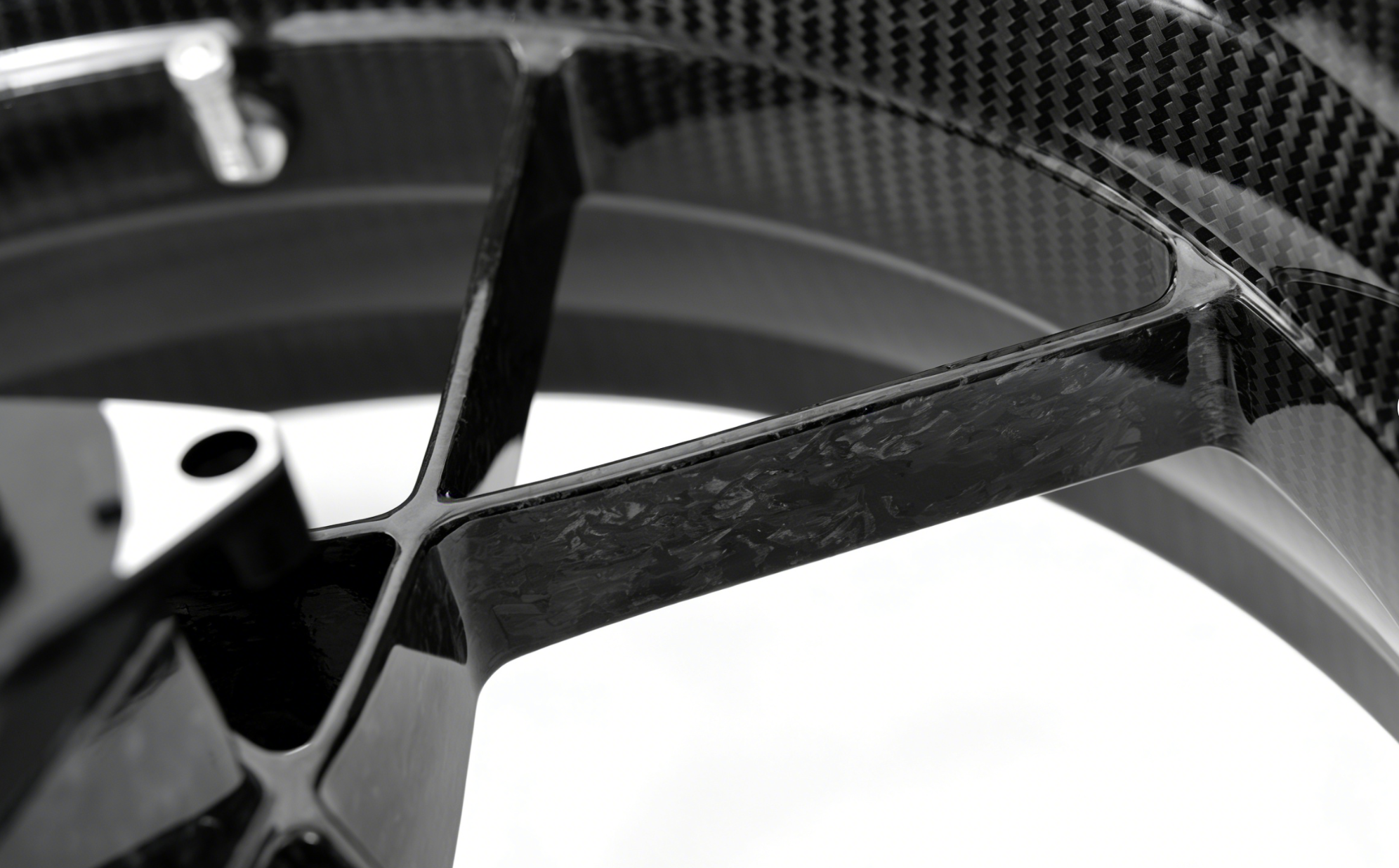
Forged carbon fiber behaves in distinct ways across every zone of a motorcycle. Knowing what it does in each category separates a smart upgrade from an expensive mistake.
Fairings & Body Panels
Stock ABS plastic fairings are low-hanging fruit. Swap them for forged carbon and you get 40–60% weight reduction — not projected savings, actual measured results. You feel that number in the parts of riding that matter most: how fast the bike changes direction, how light it feels mid-corner, how little it fights you on a technical track section.
Two entry strategies here:
-
Full fairing kits cut weight across the entire front and side structure in one go.
-
Add-on panels — chin spoilers, mirror caps, seat cowls — cost less upfront. You upgrade in stages.
Both work. The right choice depends on your budget timeline, not your ambition.
One detail most buyers miss: UV-resistant clear coat. Without it, carbon panels yellow within six months of outdoor exposure. Confirm it’s applied before you buy. Also check the finish — matt or gloss — and the weave type: twill, plain, or forged. Twill is BMW’s OEM standard on the M1000RR line. Forged suits complex shapes. Plain works for flat panels.
Confirmed bolt-on fitment covers the BMW S1000RR 2020+, M1000RR, S1000XR 2021+, and S1000R 2021+. Premium aftermarket brands like Akrapovič and SW-MOTECH include OEM bolts in the box — no hunting for hardware on the side.
Price range: Add-on panels run $50–$300. Full fairing kits start around $500 and climb past $2,000 for track-grade dry carbon construction.
Forged Carbon Fiber Motorcycle Helmets
Woven carbon fiber helmets carry one structural weakness: directional vulnerability. The layup process creates stronger and weaker axes. Take a hit at the wrong angle and the weaker axis absorbs the energy — not ideal.
Forged carbon fixes that problem at the source. The chopped fibers sit in random orientations, which gives you isotropic impact resistance — consistent strength in every direction, no weak axis exposed. The shell can also follow complex compound curves without resin-rich zones or uneven wall thickness. That’s exactly where woven prepreg helmets build up structural inconsistencies.
On weight: forged carbon shells run slightly heavier than dry woven carbon per unit volume. That sounds like a trade-off. Factor in the even thickness distribution forged construction allows, though, and the final weight stays competitive — with better structural reliability at compound-curve impact zones.
Certification is non-negotiable. Check for an ECE 22.06 (Europe) or DOT FMVSS 218 (USA) stamp before you buy. Both cover carbon fiber shells. The spec sheet must state shell construction type. No mention of it? Ask. No clear answer? Walk away.
Price range: $600–$1,500 for forged carbon shell helmets.
Carbon Fiber Wheels
No other component gives you a faster, more measurable performance return. The physics are simple: every 1 kg removed from wheels equals about 7 kg removed from sprung mass in handling response terms. That’s why serious track riders put wheels at the top of their upgrade list.
Carbon wheels run 40–60% lighter than OEM aluminum, with a typical saving of 3–5 kg per set. The effects reach every dynamic system on the bike:
-
Acceleration response sharpens
-
Braking deceleration improves
-
Suspension compliance increases
-
Steering precision tightens
These aren’t small, incremental gains. One component swap changes how the whole bike behaves.
Forged carbon wheels also carry a real advantage over woven carbon for road riding: better fatigue crack resistance under repeated impact loading. The even fiber distribution spreads stress across the structure instead of concentrating it along fiber axes. Split your time between track days and street miles? That durability gap adds up over a full season.
Price range: $2,000–$5,000+ per set. Track use ROI is straightforward — measurable lap time reduction. Street use ROI is real too, just more subtle: the handling feel on every ride becomes sharper and more responsive.
Swingarms & Frame Components
Structural carbon is a different category. This isn’t bodywork. It’s load-bearing, torsion-critical hardware. The construction standard matters — both for performance and legal compliance.
Autoclave-cured dry carbon only. Wet carbon can’t hit the fiber-to-resin ratio or the void-free consolidation that structural parts demand. A forged carbon swingarm built to raise torsional rigidity under corner-exit acceleration is a precision engineering component. A wet-layup swingarm is a safety risk.
Here’s the real-world performance case: a stiffer swingarm holds a more consistent tire contact patch as power builds mid-corner. That gives you earlier, more confident throttle application — and that’s where lap times actually get made.
Weight savings over aluminum swingarms: 1.5–3 kg. Not dramatic on its own. Stack it on top of wheel and fairing savings, though, and the combined reduction becomes significant.
One maintenance point that’s easy to overlook: structural carbon parts need regular delamination checks. Impact damage often doesn’t show on the surface. Build inspection intervals into your maintenance schedule. For safety-critical parts, this step isn’t optional.
Price range: $1,500–$4,000+.
Accessories: Exhaust Covers, Tank Caps, Mirrors & Handlebars
The accessories category is where forged carbon’s material properties show up in practical, day-to-day ways.
Exhaust heat shields get a direct benefit from the random fiber layout. Repeated heat cycles create uneven thermal stress across the part. Isotropic fiber distribution handles that stress more evenly than directional woven carbon. Carbon fiber’s thermal conductivity sits at ~5 W/m·K, versus steel’s ~50 W/m·K. That makes it a genuinely effective heat barrier for rider leg protection — not just a cosmetic cover.
Carbon mirror stalks solve a specific high-speed problem: vibration reaching the mirror glass. At highway speeds, aluminum stalks pass enough vibration to blur the mirror image. Carbon’s damping coefficient — 0.1–1.0% critical damping versus aluminum’s 0.01% — makes a clear, measurable difference. Sharper mirror visibility at speed is a real safety gain, not a spec sheet claim.
Carbon handlebars work on the same damping principle. High-frequency road buzz travels straight into your hands on aluminum bars. Carbon absorbs it before it gets there. Over a four-hour ride, that adds up to less hand fatigue — and you stay sharper for longer in the saddle.
Tank caps and filler covers are straightforward: aesthetic upgrades with a solid, rigid feel over OEM plastic. No performance claim needed here. They look good and feel better.
Price range: $50–$300 for most accessories.
Quick-Reference Buying Checklist
|
Category |
What to Verify First |
|---|---|
|
Fairings |
OEM fitment accuracy + UV coat confirmed + dry carbon for track |
|
Helmets |
ECE 22.06 or DOT stamp + shell construction type in spec sheet |
|
Wheels |
Load rating + spoke pattern + brake rotor bolt pattern compatibility |
|
Swingarms |
Autoclave-cured certification only — request test documentation |
|
Accessories |
Fitment compatibility → finish preference → weave type |
The price gap is real — but real forged carbon fiber delivers long-term value. Compare it to traditional carbon fiber in our forged vs traditional woven carbon fiber guide.
How to Verify You’re Buying Genuine Forged Carbon Fiber (Not a Cheap Imitation)

Counterfeit carbon fiber parts are good enough to fool experienced riders. Before you hand over $500 or more, know what to look for. There’s no room for guesswork here.
Start With Your Eyes
Genuine forged carbon fiber has a marbled, random texture with subtle 3D depth. Light hits it at a different angle every time you move it. The pattern shifts around curves — that’s the chopped composite structure at work.
Watch out for these red flags:
– Flat, glossy surfaces with no depth
– Repeating tile patterns
– Anything that looks like a sticker over plastic
Hydro-dips and vinyl wraps copy the look for much less money. The structural strength? Also much less.
Flip the part over. Real forged carbon stays smooth on both sides — that’s what the molding process produces. Fakes give themselves away on the back: rough surfaces, injection ribs, white fiberglass, or primer gray. The underside tells the truth.
Use Your Hands and a Multimeter
Run your fingers across the surface. Genuine FCF has small contours from the fibers and resin underneath. Fakes feel like plastic film — too uniform, too smooth.
Tap it. Real forged carbon makes a crisp, high-pitched sound. A dull, hollow, or metallic tone means you’re holding something else.
Grab a multimeter next. Carbon fiber carries an electrical current. Test for continuity — genuine parts pass. Fakes made from ABS, fiberglass, or vinyl don’t.
Check the Numbers
Genuine forged carbon fiber has a density of 1.6 g/cm³ — about 40% lighter than aluminum. Pick it up. A part that feels heavier than its size suggests is a red flag. That extra weight usually means fillers, a metal base, or too much resin.
Demand Documentation
Trusted suppliers back their products with:
– Material test reports (MTRs)
– Certificates of conformity
– ISO 9001 or AS9100 certification
No datasheet? No fiber orientation specs? Walk away.
For helmets, check the ECE 22.06 e-mark or DOT FMVSS 218 label against official registries. Then look up the serial number on the manufacturer’s site to confirm it’s real.
Quick Verification Reference
|
Test |
Genuine Forged CF |
Fake Imitation |
|---|---|---|
|
Pattern |
Marbled, 3D depth |
Flat, tiled, repeating |
|
Weight |
~1.6 g/cm³, light |
Heavier — fillers or metal |
|
Tap sound |
Crisp, high-pitched |
Dull, hollow, metallic |
|
Conductivity |
Yes — multimeter confirms |
No |
|
Heat resistance |
Stable to 400°C |
Melts or deforms |
|
Back surface |
Clean, smooth, fiber-visible |
Rough, fiberglass, ABS ribs |
A seller who can’t answer basic questions about fiber orientation or resin specs? That’s your answer right there.
2026 Forged Carbon Fiber Motorcycle Parts Buying Guide: Budget, Brands & Fitment

Budget determines your entry point. Brand determines your outcome. Fitment determines whether any of it works.
What Your Money Gets You
Entry-level ($400–$800) covers functional accessories — chain guards, heel plates, sprocket covers. Carbon2Race’s sprocket cover runs ~$175. Their water pump cover sits around $88. You get 20–30% weight reduction over plastic and a clean marbled finish. The trade-off: simpler shapes and less geometric detail.
Mid-range ($800–$2,000) is where the real upgrade happens. Fairings, fenders, engine covers — parts that change how the bike feels. Carbon2Race’s four-piece Yamaha R9 engine set runs ~$470. Ilmberger fairings and fenders land around $630–$700, with periodic discounts. You can expect 10–15% better heat and fatigue resistance over traditional carbon. Plus, F1-grade pre-preg construction delivers real handling gains you can measure.
Flagship ($2,000+) means custom aero kits and full bodywork systems. Forged composites mold more efficiently than woven carbon. At mid-volume, that cuts per-unit cost by 10–20%. So the price premium is often smaller than most buyers expect.
Brand Breakdown
|
Brand |
Strength |
Fitment |
|---|---|---|
|
Ilmberger |
German handcraft, OEM tolerances, bolts on with no trimming |
Broad performance platforms |
|
Carbon2Race |
20+ years, track variants, Yamaha specialist |
R1 2020–2025, R9 2025+ |
|
Supreem Carbon |
1,000+ stock parts, 500+ custom, ISO QC |
BMW, Ducati, Honda, Yamaha, KTM |
|
CSMFG/Synergy |
Aerospace molding, handles complex shapes |
Custom aftermarket |
Before You Buy: Fitment Checklist
Start by confirming your exact model and year. Carbon2Race R9 parts do not cross to the R1. Next, check OEM-level tolerances. Ilmberger parts ship bolt-on — no fabrication needed. Also request CAD files or dimensional photos to verify pre-drilled mounting points. Check compatibility with any existing exhaust or suspension mods. US stock on popular fitments ships in 3–7 days.
The Long-Term Math
The upfront premium runs 20–50% over aluminum or plastic, depending on tier. Over five years, durability alone saves an estimated $200–$500 in repairs. Resale value stays 10–15% higher on premium-fitted bikes. A 10-year model built with Ilmberger-grade parts shows a net ROI of +15–25%. That’s the 10% performance efficiency gain working against the initial 30% cost premium over time. The break-even point is real — you just need to stay on the bike long enough to reach it.
Want genuine forged carbon fiber instead of wrap? Explore more in our full best forged carbon fiber applications in 2026.
FAQs: Real Questions Riders Ask Before Buying Forged Carbon Fiber Parts
Riders don’t ask vague questions. They ask specific ones — and they deserve straight answers.
Will forged carbon fiber hold up on daily street rides?
Yes. The random fiber orientation spreads stress in every direction. You get better fatigue resistance, better impact absorption, and zero rust — ever. Aluminum corrodes. Steel rusts. Forged carbon just rides.
How does it compare to aluminum on strength?
Strength is similar or higher. Weight is far lower. You also get better UV resistance, chemical resistance, and corrosion resistance. The strength-to-weight gap isn’t even close.
Can I repair it after a crash?
Surface scratches? Sand it carefully and reapply clear coat. That works fine as a DIY fix. Cracks, delamination, or impact voids? Stop there. Those need professional NDT ultrasonic inspection. Add epoxy resin injection and autoclave curing to that list too. Skip those steps and you risk hidden structural failure — the kind you won’t see until it’s too late.
How do I maintain it?
Keep it simple: mild soap, water, and a microfiber cloth. Reapply UV clear coat every 1–2 years on exposed parts. Store below 25°C, away from moisture and direct light. Check for micro-cracks once a year — catch small issues before they grow.
Will it bolt on without modification?
Check fitment before you order. Even OEM carbon parts — Ducati’s included — sometimes need minor adjustments. Carbon doesn’t flex like plastic. Precision fit matters more here than with standard bodywork, so verify your specs first.
Conclusion
Forged carbon fiber isn’t a trend. It’s a materials revolution — one that’s reshaping what motorcycles can be: lighter, stronger, and built for riders who won’t settle.
The gap between forged carbon fiber and traditional carbon fiber isn’t small. You see it in lap times, cornering confidence, and the long-term math of durability versus replacement cost. Upgrading a helmet, fairings, or a tank cover? Every gram you cut with high-strength forged composite components shows up as real, felt performance on the road.
The technology is here. The products exist. The question left is which parts move your build forward.
Pick the category that matters most to your riding:
-
Safety — helmets and protective components
-
Aerodynamics — fairings and body panels
-
Weight reduction — tank covers and structural parts
Contact HyperX Carbon – Your Trusted Chinese Carbon Fiber Partner
Ready to source high-performance carbon fiber materials or custom forged carbon fiber parts from China?
HyperX Carbon is a leading manufacturer with 20+ years of expertise, specializing in aerospace-grade forged carbon fiber, prepreg, tubes, sheets, and lightweight automotive/drone/medical components. We offer:
-
Stable supply chain with premium raw materials (Toray, Mitsubishi, Hengshen)
-
AS9100D certified production for aerospace & UAV applications
-
Rapid prototyping (5-8 weeks) and monthly capacity exceeding 180,000 parts
-
Competitive pricing with 15-18% cost savings on forged carbon solutions
-
Full customization: from T700/T1100G to ultra-high modulus grades
Whether you’re an eVTOL developer, automotive OEM, drone manufacturer, or medical device engineer, HyperX delivers consistent quality, batch-to-batch reliability, and reliable delivery.
Get in touch today for a free consultation, custom quote, or material sample.
📧 Email: [email protected]
🌐 Website: https://www.hyperxcarbon.com/
📞 Phone/WhatsApp: +86 15623270276 (English support available)
Let’s build your next lightweight innovation together – contact HyperX Carbon now and stay ahead in the low-altitude and advanced composites market.