Most automotive composites force a choice: stiffness or toughness. Carbon fiber gives you rigidity to shave lap times and cut weight. Push it too hard, though, and it shatters. Kevlar absorbs the kind of punishment that would destroy carbon. But it flexes in spots where you need it to hold shape.
That’s why the carbon fiber Kevlar hybrid exists. Neither material tells the full story on its own. Stack them together — alternating plies, purpose-built weave patterns, thermosetting resin systems that bond two different fibers — and you get something neither can deliver alone.
This guide covers the real science, the real applications, and the real trade-offs. Use it to make a smarter material decision, whether you’re sourcing parts for a race build, a street car, or a full production run.
Carbon Fiber + Kevlar Hybrid Materials For Automotive Protection

Here’s what this guide covers — and what it won’t waste your time on.
This is a technical guide built around the decisions real builders, engineers, and procurement teams face. Not a glossy overview. A working framework.
The sections break down like this:
-
Material science — how carbon fiber and Kevlar behave on their own, and what changes once you bond them into a hybrid laminate using thermosetting resin composite systems
-
Performance data — tensile strength, stiffness, impact resistance, and energy absorption figures, all compared side-by-side
-
Real automotive applications — underbody armor, wheel well liners, rally panels, and track-day components where aramid fiber composite layups outperform pure carbon
-
Manufacturing and curing — why autoclave-cured epoxy carbon fiber layup produces results that wet-lay alternatives simply can’t match
-
Decision framework — the right situations for a carbon fiber Kevlar hybrid, and the ones where it isn’t the right call
Each section answers a specific question. Evaluating hybrid laminate construction against pure carbon or aluminum for a production run? Start at the comparison tables. Troubleshooting delamination or UV degradation on existing parts? Skip straight to manufacturing.
One principle runs through everything: the best material choice isn’t always the lightest. It’s the one that holds up when it matters most.
What Makes Carbon Fiber + Kevlar Hybrid Different From Single-Material Composites

The numbers make the case before the engineering does. Hybrid carbon-Kevlar laminates deliver 27.40% higher tensile strength than single-material basalt configurations. Their impact strength hits 136.25 kJ/m² — a 24.4% jump. No pure-carbon or pure-Kevlar stack reaches that on its own.
That gap exists because the two materials don’t just sit side by side in a hybrid laminate. They fill each other’s structural weak points.
Here’s what each material can’t do alone:
-
Carbon fiber is rigid and fatigue-resistant. It holds over 95% of tensile strength under cyclic loading. But under sharp impact, it breaks without warning. No deformation. Just fracture.
-
Kevlar bends without breaking. The friction between its fibers turns kinetic energy into heat instead of cracks. But its compressive strength maxes out at 125–185 MPa. It also soaks up more than 10% of its own weight in moisture — a real long-term risk without something to shield it.
Bond them together, and those weak points cancel each other out.
The mechanics of the gain:
|
Failure Mode |
Single Material |
Hybrid Result |
|---|---|---|
|
Impact fracture |
Brittle (carbon) |
Managed delamination |
|
Compressive collapse |
Low resistance (Kevlar) |
Carbon layers hold load |
|
Moisture ingress |
High risk (Kevlar exposed) |
Carbon outer plies seal and protect |
|
Energy absorption |
3-axis limitation |
3.1 J absorbed — 29.17% above carbon-only |
The KCCK ply order — Kevlar-Carbon-Carbon-Kevlar — turns material mixing into structural strategy. Fiber damage drops from 80% to 60% compared to single-material stacks. No added weight. You get a design-level safety gain built directly into the layup sequence.
At a 50% hybrid ratio, the stiffness gap between KCCK and CCKK setups stays under 2.22%. That means you get the full impact protection benefit with almost no loss in rigidity. Push the Kevlar fraction past that point, and peak load capacity can drop by up to 46.03%. The balance point is real, and it’s precise.
That precision is what sets a hybrid laminate apart from a trade-off. It’s a calculated result — not a guess.
The Science Behind Hybrid Construction: How Layers, Weaves & Resin Systems Work Together
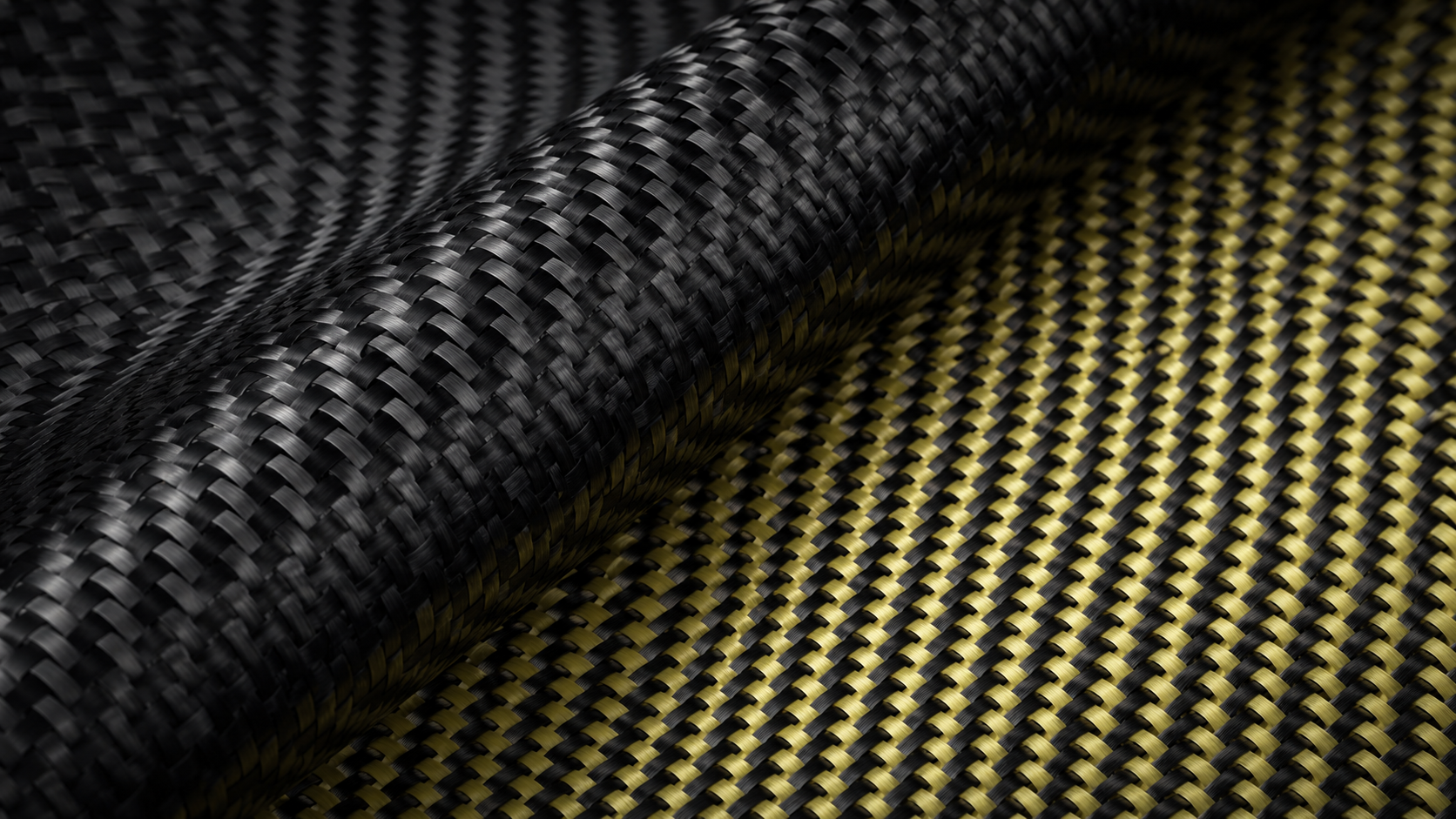
Three variables decide whether a hybrid laminate holds up or breaks down:
-
How the plies are stacked
-
How the fibers are woven
-
How the resin system bonds everything into one solid unit
Get all three right, and the material performs like it was built at a molecular level. Miss one, and you’re just gluing two expensive fabrics together.
Ply Stacking: Where the Structural Logic Begins
Each layer in a carbon fiber Kevlar hybrid carries a specific load job. Carbon plies handle stiffness and compressive load. Aramid fiber composite plies catch impact energy before it reaches the carbon. The sequence isn’t random — it’s calculated.
Individual layers stay at or below 1.5 mm. This gives the resin time to fully cure and lets internal stress settle. Go past that limit, and micro-voids start forming. Those voids sit right at the joint where carbon and Kevlar meet — and that’s a problem.
Weave Architecture: Alignment Is Performance
Warp knitted weave structures deliver 10–20% better fiber alignment than standard plain weaves. That alignment gap has a real effect on load distribution. A well-aligned woven carbon Kevlar fabric spreads force across multiple fiber bundles on impact. A misaligned one piles stress into one spot — and that’s where cracks begin.
Resin Systems: The Bond That Makes It One Material
The epoxy carbon fiber layup stage is where separate plies fuse into one structure. Dual-cure resin systems — UV pre-cure first, then thermal co-cure — produce bonds with void content below 5%. That near-void-free interface gives thermosetting resin composite laminates consistent mechanical performance across every production run.
Resin infiltration goes 5–10 μm deep into the fiber architecture. It creates micromechanical interlocking — not just surface adhesion. So the final product isn’t a stack of layers. You get a single load-bearing material, with two fibers acting as one.
Real Automotive Applications: Where Hybrid Carbon-Kevlar Gets Used
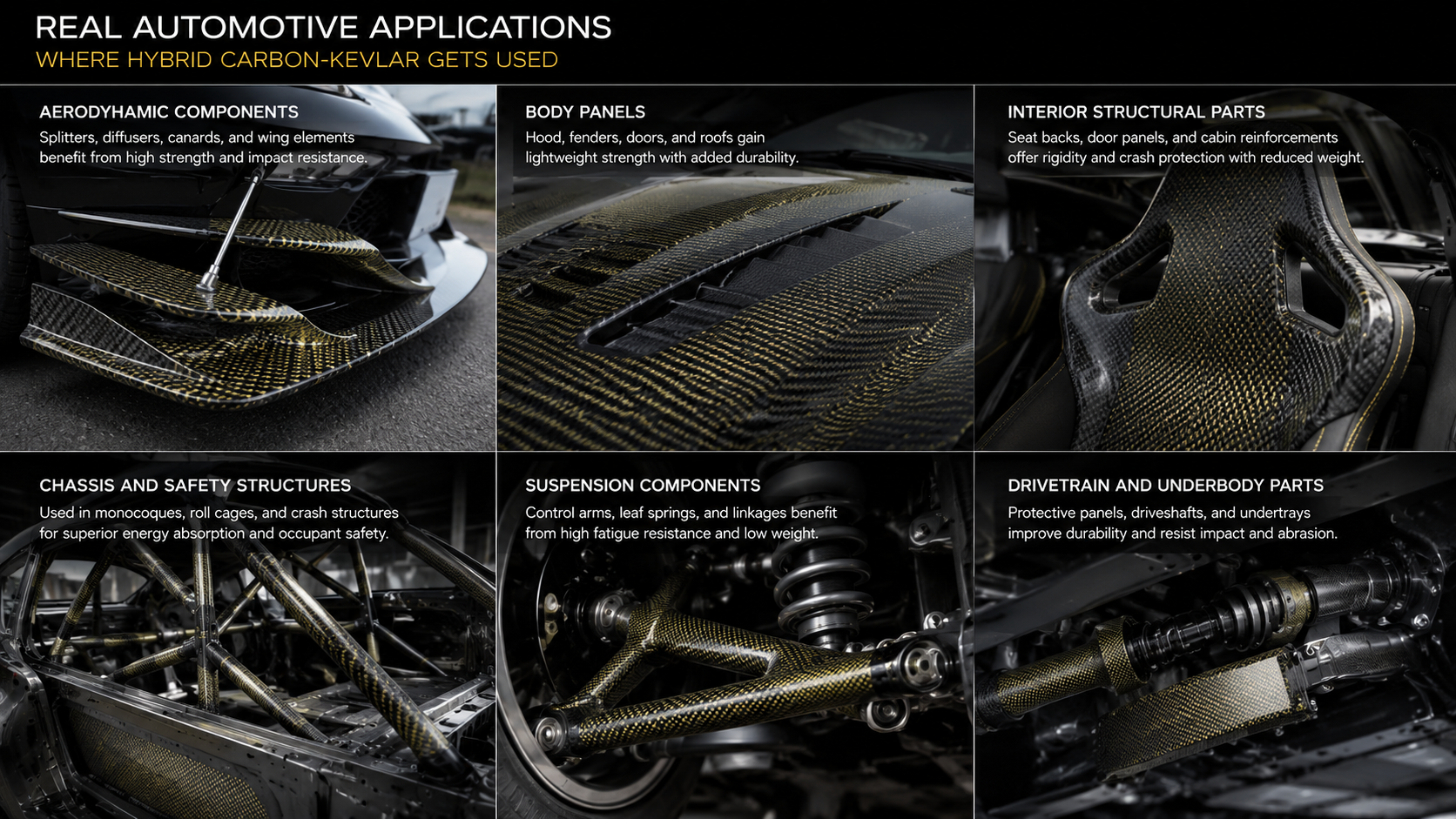
Carbon fiber and Kevlar have been sharing space inside serious production vehicles for longer than most people think. The Lexus LFA — still one of the most engineered road cars ever built — used a body structure that was 65% carbon fiber. Kevlar didn’t make the headlines. But it was doing quiet, critical work: timing belts, radiator hoses, clutch linings. These are components that live under sustained heat and torque. A pure carbon part would break down under that kind of stress. Kevlar friction linings in the clutch extended service life under the loading a high-revving V10 delivers. That’s not marketing. That’s materials engineering solving a real problem.
Where the Hybrid Shows Up in Real Builds
Body panels and chassis structures are the most common application. Racing teams run outer Kevlar skins to absorb impact energy — stone strikes, debris, kerb contact. The inner carbon plies keep the panel from flexing under aero load. Together, you get 15–20% weight reduction compared to steel construction. Fuel efficiency gains land in the range of 15%, based on aerospace benchmarks carried into motorsport use.
Structural reinforcements tell the same story at a different scale. Roof panels, floor sections, pillars, and trunk lids built from carbon-Kevlar hybrid laminate reach four times the tensile strength of high-grade steel. They do it at a fraction of the mass. That’s not a theoretical number. It’s the reason OEM procurement teams keep coming back to this material class as fuel efficiency targets get tighter.
Underbody protection is where the ballistic-grade fiber logic applies with full force. Race car floors and underbody armor take hits that no pure carbon panel survives intact. Kevlar absorbs that kinetic energy and converts it to heat. Structural damage stays out of the picture. High-speed drivetrain components stay protected underneath.
Hypercar and hybrid-electric platforms are pushing this further. Mass-optimized designs use carbon-Kevlar composites for parts consolidation — one component doing the structural job of three. You also get better NVH characteristics and zero corrosion risk. Two problems solved with the same material choice.
The application range is wide. The performance logic behind every single one of them is the same.
Carbon Kevlar Hybrid vs. Pure Carbon Fiber vs. Pure Kevlar
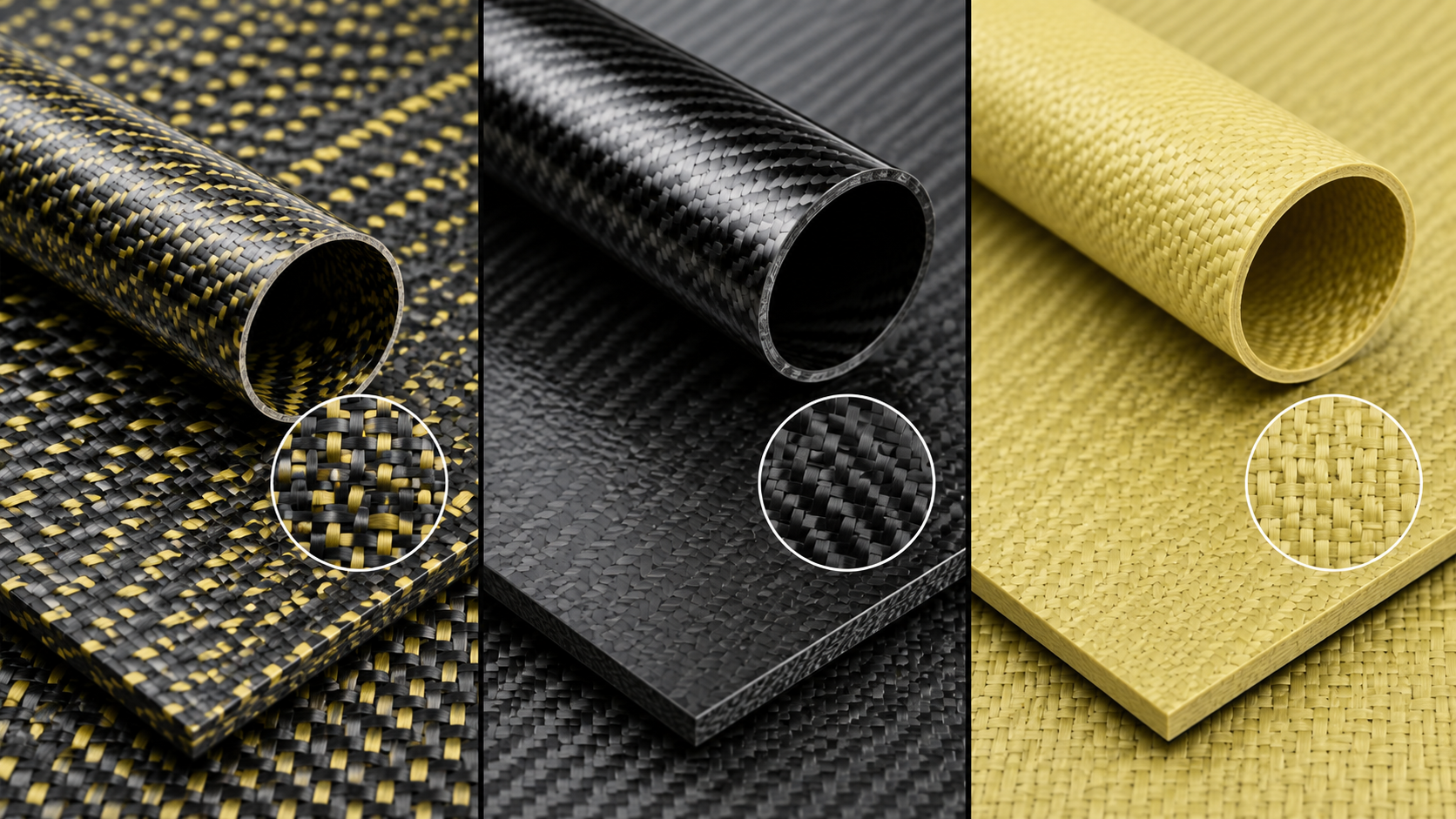
Three materials. Three different failure modes. Only one fits what you’re building.
The numbers make this clear before any debate starts.
|
Property |
Carbon Fiber |
Kevlar |
Hybrid |
|---|---|---|---|
|
Tensile Strength |
3,500–7,000 MPa |
2,800–3,600 MPa |
+27.40% vs. basalt baseline |
|
Impact Strength |
Low — brittle fracture |
8× steel per unit weight |
136.25 kJ/m² |
|
Compressive Strength |
700–1,000 MPa |
125–185 MPa |
Carbon plies carry the load |
|
Moisture Absorption |
<0.1% |
>10% by weight |
Carbon outer plies seal Kevlar in |
|
Flexural Strength |
Baseline |
Lower |
+30.87% improvement |
Each column tells a different story. Where each material wins — and where it falls short.
Pure Carbon Fiber: Stiffness Above Everything Else
Rigidity is the deciding factor here. Carbon fiber is the right call when nothing else comes close to mattering as much. Fatigue resistance holds above 95% under cyclic loading. Specific strength reaches 400 Pa·m³/kg. Steady-state aero components, hoods built for downforce, structural panels that never take a direct hit — pure carbon earns its place in all of them.
The trade-off is real, though. Impact loads produce brittle fracture. No deformation. No warning. Just a clean break at the worst possible moment.
Pure Kevlar: Built for Taking Hits
Kevlar’s job is absorbing punishment. It takes 4,500N to cut through a single layer. Energy absorption runs 8× that of steel per unit weight. Ballistic protection, impact-zone liners, parts where dynamic force is the main load — Kevlar justifies its cost in those roles.
Compressive strength maxes out at 125–185 MPa. That’s the ceiling. Rigid load-bearing is where Kevlar loses ground fast.
Hybrid: You Need Both Properties to Hold
The hybrid removes the forced trade-off. Carbon exterior takes the stiffness demands. Kevlar interior catches impact before it ever reaches the carbon. A 50/50 ratio keeps stiffness loss under 2.22% and delivers full impact protection at the same time.
Push Kevlar past that balance point, and peak load capacity drops up to 46.03%. Hold the 50/50 split, and both properties stay fully in play.
The decision breaks down like this:
– Maximum rigidity, no impact risk → Pure carbon
– Pure impact absorption, weight-tolerant → Pure Kevlar
– Both — because your build can’t take a failure mode → Hybrid
Key Benefits of Carbon Fiber Kevlar Hybrid for Automotive Protection (Data-Backed)
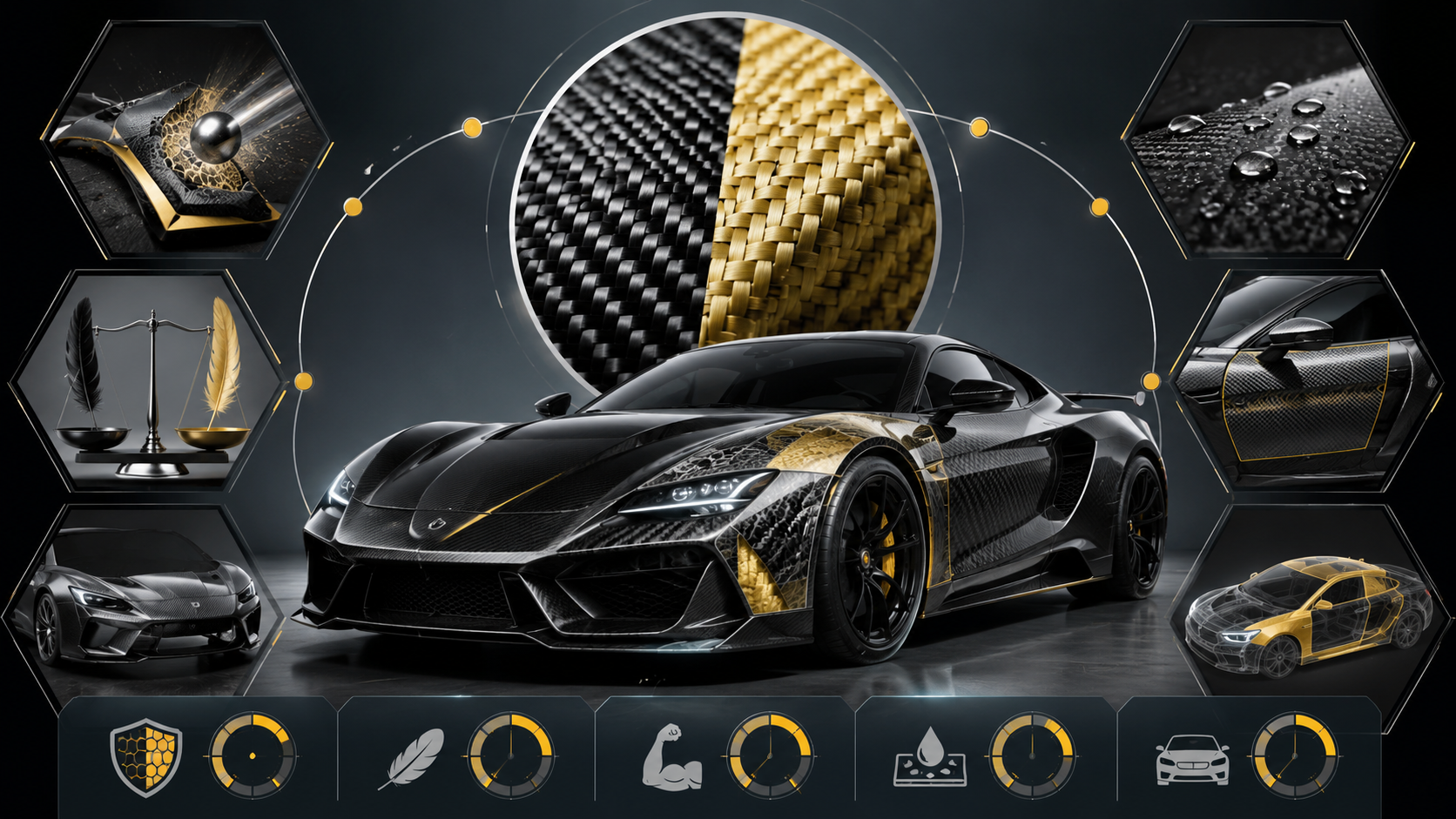
Five properties. One material. None of them available from carbon or Kevlar alone.
That’s the short version. Here’s the longer one — with the numbers to back it up.
Rigidity Meets Impact Resistance
Carbon fiber delivers specific rigidity 5× that of aviation aluminum. Kevlar delivers energy absorption 8× that of steel per unit weight. Stack them in a hybrid laminate, and you keep both properties. Neither one gives up ground for the other.
Cutting through a single Kevlar layer takes 4,500N of force. That’s not a marketing figure. It’s a structural baseline. In underbody armor, wheel well liners, and reinforced door panels, that penetration resistance is what shields the parts underneath from damage.
Performance Gains That Show Up in Real Builds
Racing chassis built with carbon main beams and Kevlar fabric skins are not an experiment. They’re a proven result: +40% overall performance improvement compared to single-material builds. That gain covers impact resistance, structural durability, and weight efficiency — all at once.
Off-road platforms, motorsport builds, and high-impact track applications all follow the same pattern:
– Abrasion resistance improves
– Part lifespan extends
– Pure carbon and forged carbon variants both fall short of what the hybrid delivers
Weight Reduction Without the Structural Trade-Off
Kevlar composites cut vehicle weight by up to 25% while improving crash performance. The hybrid format holds that mass advantage in place. Plus, it adds rigidity in areas where pure Kevlar can’t get the job done.
For EV platforms, crash structures, and sensor housings — low weight and impact protection carry equal priority. The hybrid handles both. That’s the core engineering case for using it.
The Benefit Breakdown
|
Property |
Performance Data |
|---|---|
|
Specific Rigidity |
5× aviation aluminum (carbon component) |
|
Energy Absorption |
8× steel per unit weight (Kevlar component) |
|
Cutting Resistance |
4,500N per single Kevlar layer |
|
Chassis Performance Gain |
+40% vs. single-material builds |
|
Vehicle Weight Reduction |
Up to 25% with maintained crash performance |
Every number here points to a structural decision made simpler. Your build needs to handle impact. It also needs to hold its shape under load. The hybrid covers both — no trade-off required.
How to Identify Quality Carbon Kevlar Hybrid Parts: What to Look for Before You Buy
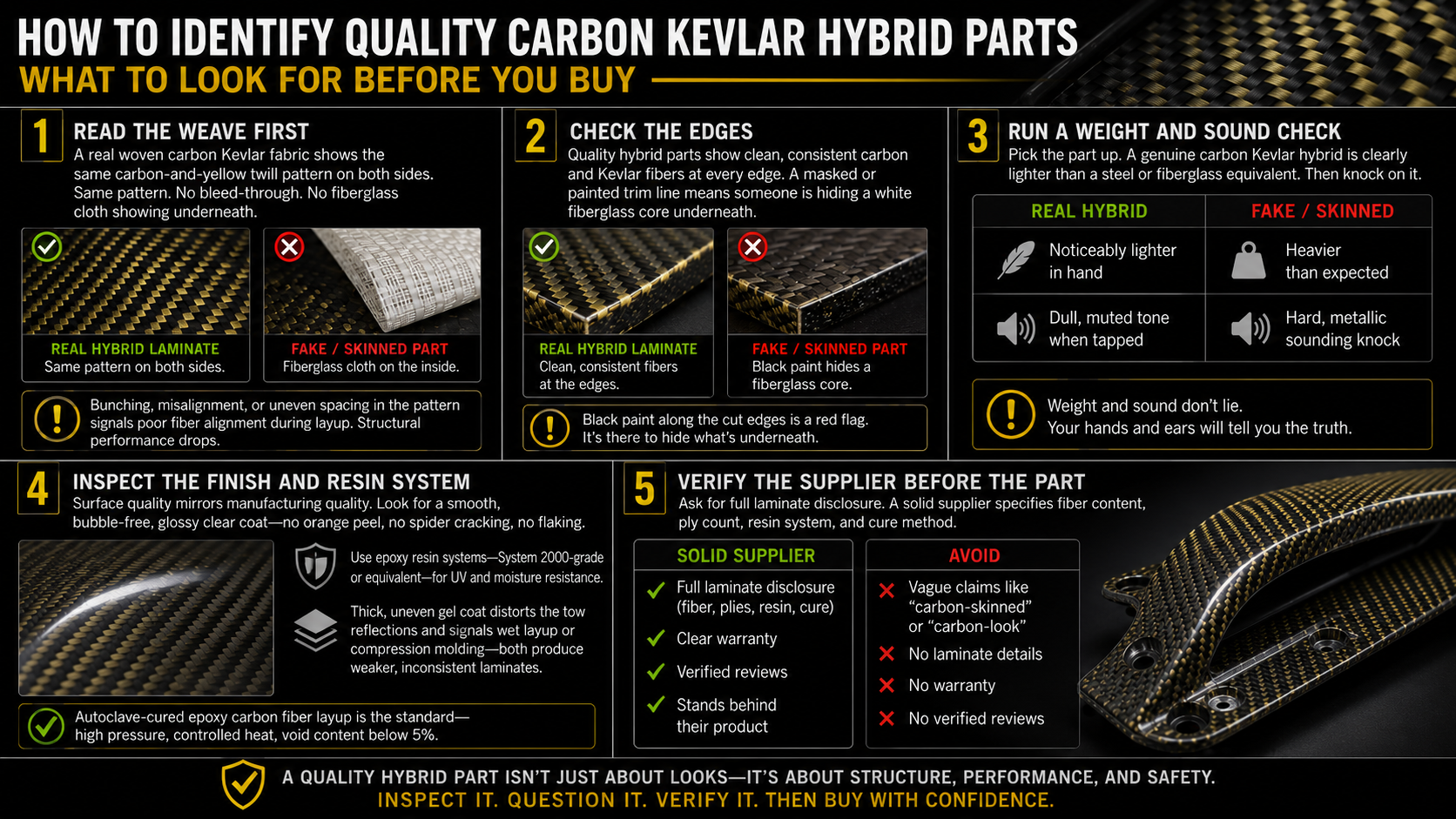
The counterfeit composite market is well-funded and convincing — until you know what to look for.
A genuine carbon fiber Kevlar hybrid isn’t just a surface treatment. It’s a full laminate structure where both fibers run through every layer. Fakes cut costs by laying a single hybrid skin over a fiberglass core — chopped strand mat, 1708 biaxial, the cheap stuff — then hoping the exterior finish sells the part. It often does.
Here’s how to spot the difference before you spend money on something that won’t hold up.
Read the Weave First
Flip the part over. A real woven carbon Kevlar fabric shows the same carbon-and-yellow twill pattern on both sides. Same pattern. No bleed-through. No fiberglass cloth showing underneath. An interior face that looks white, translucent, or cloth-textured — while the exterior doesn’t — means you’re holding a skinned fiberglass part. That’s not a true hybrid laminate.
The weave pattern tells you more. Black warp threads carry the tensile load. Yellow Kevlar fill threads handle impact. Bunching, misalignment, or uneven spacing in that pattern signals poor fiber alignment during layup. Structural performance drops before the part ever touches a vehicle.
Check the Edges
Black paint along the cut edges is a red flag — not a finish detail. Quality hybrid parts show clean, consistent carbon and Kevlar fibers at every edge. A masked or painted trim line means someone is hiding a white fiberglass core underneath. That’s the tell.
Run a Weight and Sound Check
Pick the part up. A genuine carbon Kevlar hybrid is clearly lighter than a steel or fiberglass equivalent — not by a small amount, but by a noticeable difference you’ll feel right away. Then knock on it. A dull, muted tone points to real composite construction. A harder, metallic-sounding knock means filler material inside.
Inspect the Finish and Resin System
Surface quality mirrors manufacturing quality. Look for a smooth, bubble-free, glossy clear coat — no orange peel, no spider cracking, no flaking. Premium hybrid parts use epoxy resin systems — System 2000-grade or equivalent — for UV and moisture resistance. A thick, uneven gel coat distorts the tow reflections underneath. It also signals a wet layup or compression-molded part. Both methods produce weaker, inconsistent laminates. Autoclave-cured epoxy carbon fiber layup is the standard — high pressure, controlled heat, void content below 5%.
Verify the Supplier Before the Part
Ask for full laminate disclosure. A solid supplier specifies fiber content, ply count, resin system, and cure method. Vague claims like “carbon-skinned” or “carbon-look” with no laminate details are the sales equivalent of a painted fiberglass core — nothing behind the finish. Warranties and verified reviews matter here. They’re the paper trail that separates manufacturers who stand behind their fiber reinforced plastic (FRP) from ones counting on you never putting it to the test.
FAQ: Carbon Fiber Kevlar Hybrid Automotive Parts
Builders ask the same questions. Here are the answers that matter most.
What is a carbon fiber Kevlar hybrid?
It’s alternating plies of carbon fiber and Kevlar. Sometimes woven into a single fabric. Sometimes stacked in sequence. Carbon handles rigidity. Kevlar handles impact and abrasion. One laminate. Both jobs done.
Where does it get used on a vehicle?
|
Application |
Why Hybrid Wins Here |
|---|---|
|
Underbody skid plates |
Absorbs impact and abrasion through constant punishment |
|
Wheel well liners |
Handles high-impact hits from repeated stone strikes |
|
Rally and off-road panels |
Durability matters more than shaving the last gram |
|
Endurance race components |
Load-bearing parts that cannot fail mid-event |
|
Track-day impact zones |
Resists abrasion during hard kerb contact |
How does it compare to 2×2 twill carbon or forged carbon?
-
vs. 2×2 twill — Hybrid wins on impact protection. Twill wins on weight and ease of installation. Cutting and drilling hybrid material takes specialized tools. Kevlar fibers push back against blades in ways standard carbon does not.
-
vs. forged carbon — Forged carbon is a cosmetic material. Hybrid is a structural one. It carries real tensile strength, genuine durability, and functional load-bearing capacity. Forged carbon belongs on show builds. Hybrid belongs on working vehicles.
Does curing method change performance?
Yes — and the gap is large. Autoclave-cured parts outperform vacuum-bagged and wet-lay alternatives. There is no close comparison. Resin spreads evenly throughout the part, which stops delamination from forming. Void content stays below 5%. That consistency makes performance numbers repeat reliably across every production run.
What about long-term durability concerns?
Two real risks — both manageable.
-
UV degradation — Carbon and Kevlar both weaken under long-term UV exposure without protection. A UV-resistant clear coat is not optional. It is routine maintenance.
-
Galvanic corrosion — Carbon fiber conducts electricity. Direct contact with metal creates a corrosion risk at the joint. Add insulation and a protective coating at every metal-to-composite junction. That stops the problem before it starts.
Is this a DIY-friendly material?
No. The same abrasion resistance that protects your vehicle also fights back against standard cutting tools. Pre-fabricated hybrid parts skip most of the fabrication headaches. Custom work needs the right tooling and hands-on experience. Professional installation gets better results.
Choose hybrid — or skip it?
Choose it when:
– Your vehicle takes real punishment — off-road, rally, track, endurance
– Underbody or wheel well protection is a hard requirement
– Durability ranks above cutting maximum weight
– Your budget covers premium composite pricing
Skip it when:
– Maximum weight reduction is the sole goal — 2×2 twill is the better pick
– The upgrade is cosmetic — forged carbon handles that job
– Budget is tight — wet-lay alternatives exist, though durability drops with them
Conclusion
The case for Carbon Fiber Kevlar Hybrid materials is straightforward. Carbon delivers rigidity. Kevlar absorbs impact. The epoxy carbon fiber layup binds them together and produces something neither material can do on its own. That’s physics — not marketing.
Evaluating materials for a motorsport build, OEM component upgrade, or vehicle protection project? The real question was never whether hybrid composites beat single-material options. You already know they do. The question is who you’re buying from. Do your suppliers understand fiber orientation, resin saturation, and laminate sequencing — or are they just selling you something that looks right?
Don’t let aesthetics drive a structural decision.
Browse HyperX Carbon’s full range of custom hybrid composite components. Request material spec sheets. Or reach out to discuss custom laminate configurations built around your specific load requirements. The right material choice starts with the right conversation.
Contact HyperX Carbon – Your Trusted Chinese Carbon Fiber Customization Partner
Ready to develop high-performance carbon fiber materials or custom forged carbon fiber parts tailored specifically for your project?
HyperX Carbon is your long-term strategic partner with over 20 years of expertise in advanced composites. We specialize in delivering aerospace-grade forged carbon fiber custom solutions, along with fully personalized prepreg, tubes, sheets, and lightweight carbon fiber structural components for automotive, drone, eVTOL, and medical applications.
We don’t just supply materials — we provide end-to-end customization support:
-
Stable premium supply chain using Toray, Mitsubishi, and Hengshen raw materials
-
AS9100D certified production tailored for aerospace and UAV requirements
-
Rapid prototyping carbon fiber component in just 5-8 weeks, with monthly capacity over 180,000 parts
-
Competitive pricing with 15-18% cost savings on forged carbon solutions
-
Full customization flexibility: from T700 and T1100G to ultra-high modulus grades, with tailored layups, finishes, and performance specifications
Whether you’re an eVTOL developer, automotive OEM, drone manufacturer, or medical device engineer, HyperX Carbon delivers bespoke material selection, structural optimization, and manufacturing solutions that match your exact technical and performance needs — with consistent batch-to-batch quality and reliable delivery.
Get in touch today for a free technical consultation, personalized quote, or custom material samples.
📧 Email: [email protected] 🌐 Website: https://www.hyperxcarbon.com/ 📞 Phone/WhatsApp: +86 15623270276 (English support available)