Most engineers searching for carbon fiber grades already know the basic story: higher modulus means stiffer fiber. But datasheets won’t tell you when that’s the wrong property to optimize for. Pick the wrong grade and you don’t just waste budget — you risk failure modes your design never accounted for.
The gap between standard modulus and high modulus carbon fiber is not just a number on a spec sheet. These are materials with different behavior, different manufacturing origins, and different application logic.
This guide cuts through the naming confusion. It maps every major grade against real mechanical properties and typical use cases. You’ll walk away with a clear decision framework — and know which carbon fiber modulus grade your application needs.
What Is Carbon Fiber Modulus — And Why It’s the Wrong First Question Engineers Ask

Tensile modulus measures how much a fiber resists elastic deformation. Expressed in GPa or MSI, it shows how much a material deflects under a given load. Standard modulus sits around 230–250 GPa. Ultra-high modulus pushes past 600 GPa. The number is real. The problem is treating it as the whole story.
Here’s what that number doesn’t capture:
Carbon fiber is anisotropic. Stiffness runs with the fiber, not across it. In-line modulus can exceed 250 GPa. Transverse modulus drops to 5–10 GPa in an epoxy matrix. Get your layup direction wrong and you forfeit 50–80% of the performance you paid for — regardless of grade.
Higher modulus trades away strength. Moving from standard to ultra-high modulus cuts tensile strength by 40% and multiplies cost by 5–10x. Stiffness goes up. Brittleness follows. You’re not getting a free upgrade — you’re making a trade.
The fiber isn’t the composite. Your part’s modulus depends on matrix choice, not just fiber grade. Switch from standard epoxy to PEEK and you can boost effective composite modulus 2–3x. The fiber grade stays the same. The performance shifts dramatically.
So before you reach for a datasheet, ask the questions that drive real material selection:
-
What direction is the load?
-
What strength-to-weight ratio do you need?
-
What failure mode matters most — impact or buckling?
Modulus is a starting point. It’s seldom the answer.
The Four Carbon Fiber Modulus Grades Explained: Definitions, Data & Material Science
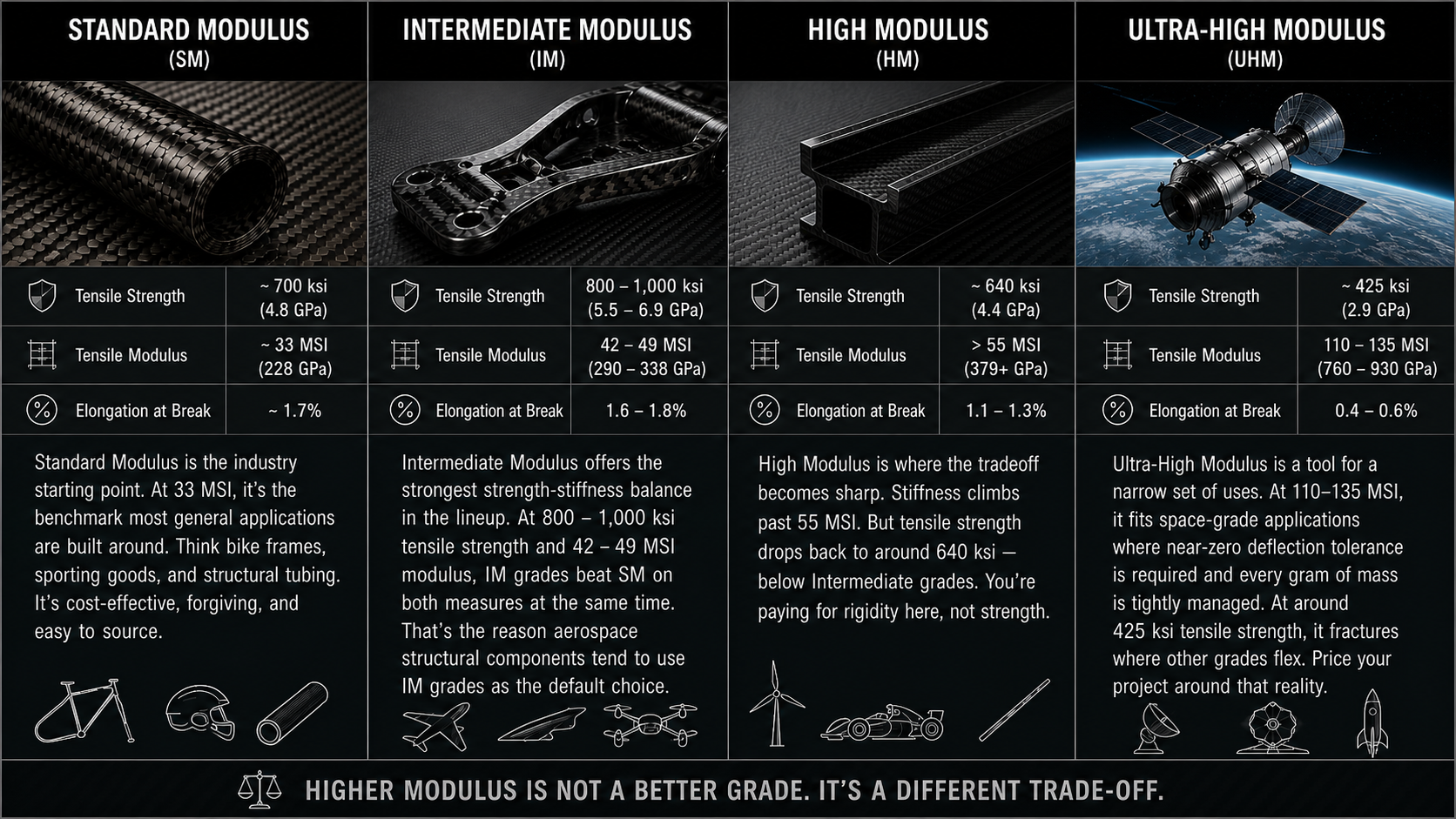
Four grades. One inverse relationship most buyers ignore until it costs them: as modulus goes up, tensile strength drops — and price climbs fast.
Each grade falls into a clear category based on precursor chemistry and processing temperature. Standard and Intermediate Modulus fibers use PAN-based precursors. High and Ultra-High Modulus fibers use pitch-based precursors instead. These are processed at temperatures above 2000°C to push graphitization further. More graphitization makes the fiber stiffer. It also makes the fiber more brittle. That’s not a manufacturing defect — it’s basic physics.
|
Grade |
Modulus (MSI) |
Tensile Strength (ksi) |
Cost |
Brittleness |
|---|---|---|---|---|
|
Standard (SM) |
33–36 |
500–700 |
Low |
Low |
|
Intermediate (IM) |
42–49 |
800–1,000 |
Moderate |
Moderate |
|
High (HM) |
55–65 |
~640 |
High |
High |
|
Ultra-High (UHM) |
110–135 |
~425 |
Highest |
Highest |
Standard Modulus is the industry starting point. At 33 MSI, it’s the benchmark most general applications are built around. Think bike frames, sporting goods, and structural tubing. It’s cost-effective, forgiving, and easy to source.
Intermediate Modulus offers the strongest strength-stiffness balance in the lineup. At 800–1,000 ksi tensile strength and 42–49 MSI modulus, IM grades beat SM on both measures at the same time. That’s the reason aerospace structural components tend to use IM grades as the default choice.
High Modulus is where the tradeoff becomes sharp. Stiffness climbs past 55 MSI. But tensile strength drops back to around 640 ksi — below Intermediate grades. You’re paying for rigidity here, not strength.
Ultra-High Modulus is a tool for a narrow set of uses. At 110–135 MSI, it fits space-grade applications where near-zero deflection tolerance is required and every gram of mass is tightly managed. At around 425 ksi tensile strength, it fractures where other grades flex. Price your project around that reality.
Higher modulus is not a better grade. It’s a different trade-off.
Standard Modulus Carbon Fiber (SM): The Workhorse Grade Most Applications Need
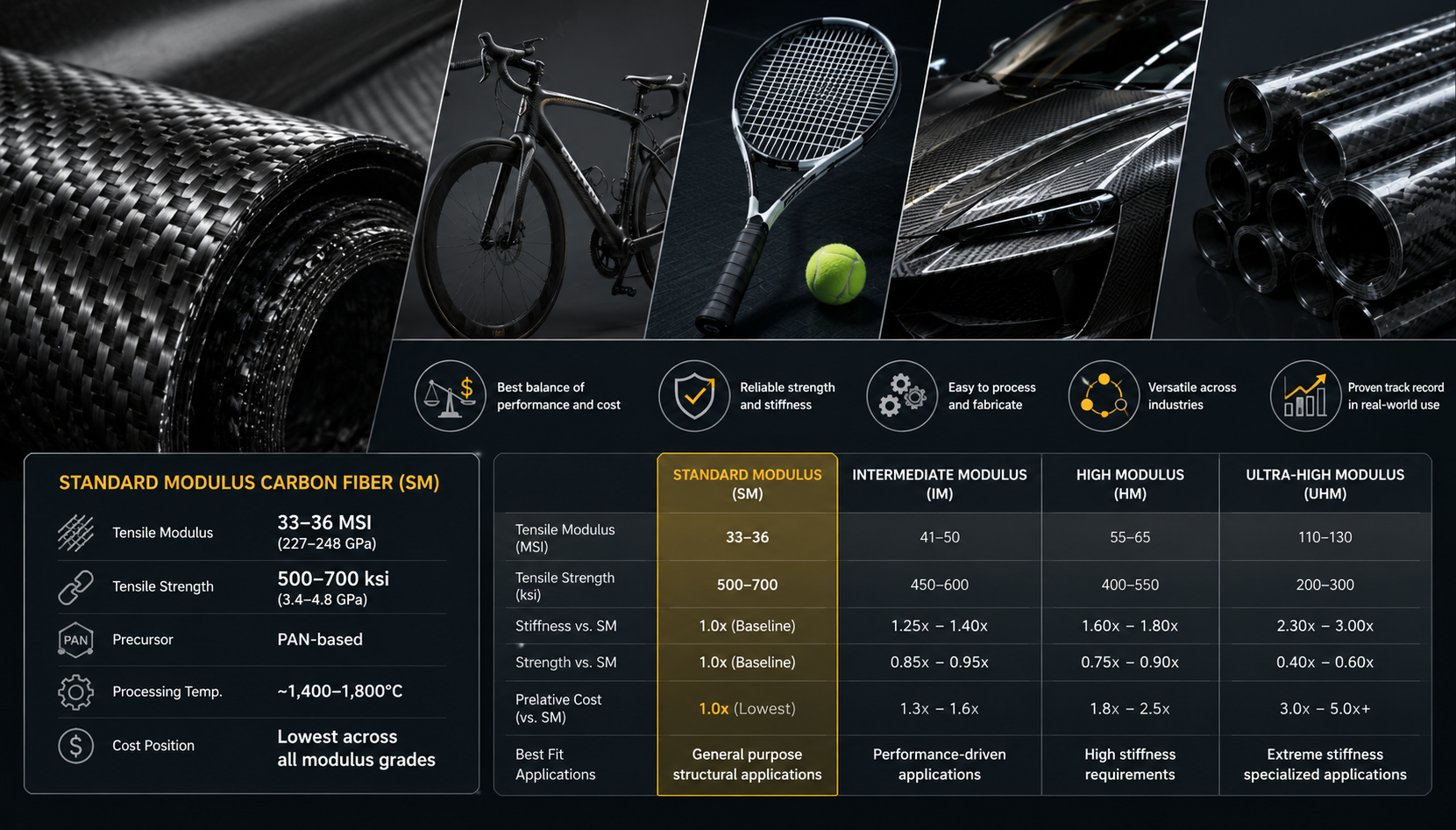
Standard modulus carbon fiber does one thing better than every other grade. It shows up everywhere, costs less than competing grades, and holds up when the application doesn’t push extreme limits.
At 33–36 MSI (227–248 GPa) tensile modulus and 500–700 ksi tensile strength, SM is the baseline the entire industry measures itself against. It’s PAN-based, easy to source, and works without the specialized tooling that higher grades require. Bicycle frames, tennis rackets, auto body panels, general industrial tubing — none of these need pitch-based precursors processed at 2000°C. They need reliable stiffness, solid strength, and a price point that keeps production costs in check.
That last factor matters more than most datasheets let on. SM sits at the lowest cost position across all modulus grades. Here’s how the other grades stack up:
-
Intermediate modulus gives you 25–40% more stiffness — but at a noticeably higher price
-
High modulus pushes past 55 MSI — but strength drops back below SM levels
-
Ultra-high modulus delivers 230–300% more stiffness than SM — and fractures where SM would flex
For most structural applications, SM isn’t a compromise. It’s the right call.
Your load case probably doesn’t demand elite rigidity or aerospace-grade strength-to-weight ratios. Going above SM means paying for properties your design will never use. That’s not an upgrade — it’s wasted spend.
Intermediate Modulus Carbon Fiber (IM): Why Aerospace Chose This Grade as Its Default Standard
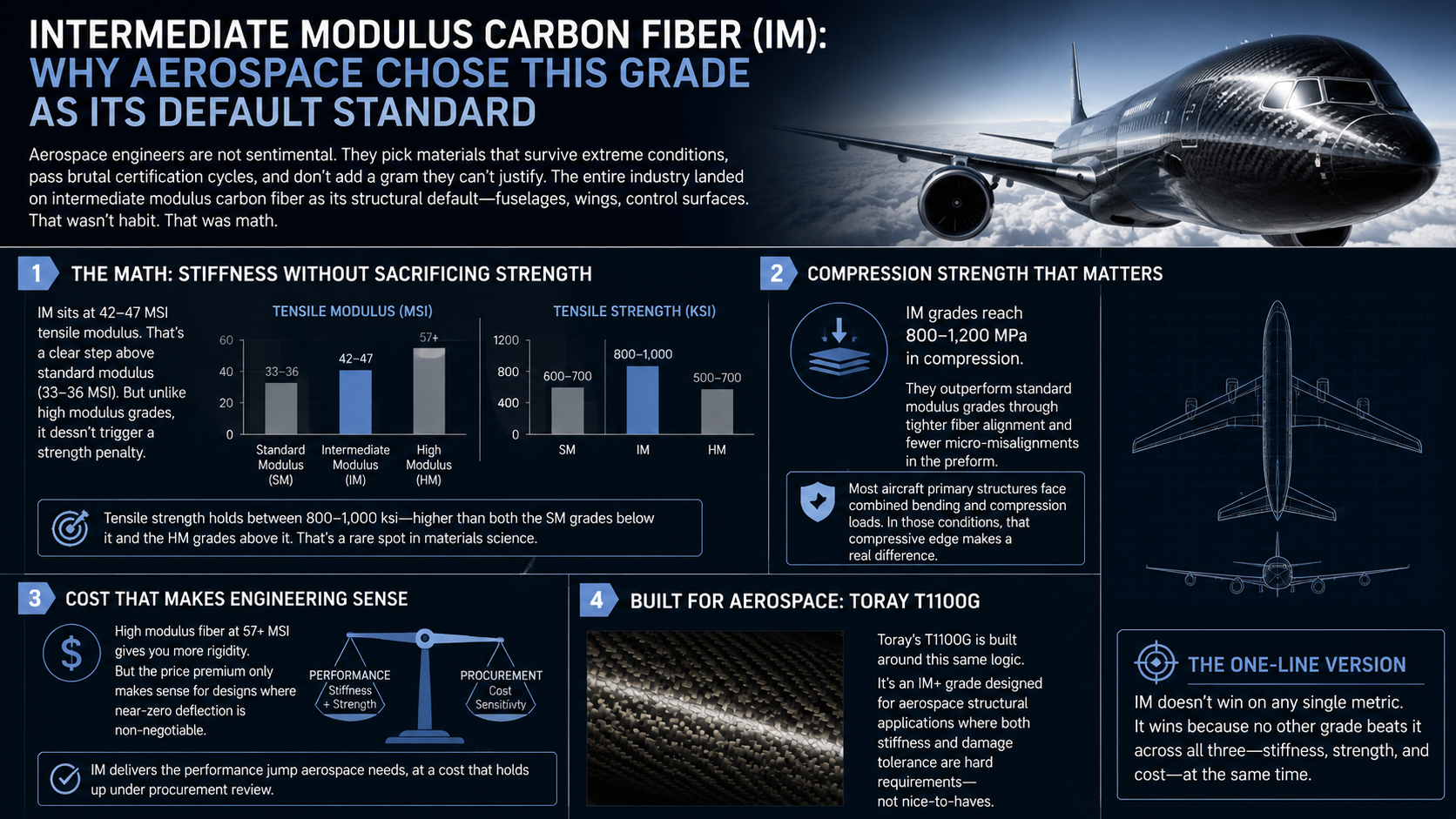
Aerospace engineers are not sentimental. They pick materials that survive extreme conditions, pass brutal certification cycles, and don’t add a gram they can’t justify. The entire industry landed on intermediate modulus carbon fiber as its structural default — fuselages, wings, control surfaces. That wasn’t habit. That was math.
The math works like this. IM sits at 42–47 MSI tensile modulus. That’s a clear step above standard modulus (33–36 MSI). But unlike high modulus grades, it doesn’t trigger a strength penalty. Tensile strength holds between 800–1,000 ksi — higher than both the SM grades below it and the HM grades above it. That’s a rare spot in materials science. You climb the stiffness ladder without giving back strength.
Compressive strength tells the same story. IM grades reach 800–1,200 MPa in compression. They outperform standard modulus grades through tighter fiber alignment and fewer micro-misalignments in the preform. Most aircraft primary structures face combined bending and compression loads. In those conditions, that compressive edge makes a real difference.
Cost closes the argument. High modulus fiber at 57+ MSI gives you more rigidity. But the price premium only makes sense for designs where near-zero deflection is non-negotiable. IM delivers the performance jump aerospace needs, at a cost that holds up under procurement review.
Toray’s T1100G is built around this same logic. It’s an IM+ grade designed for aerospace structural applications where both stiffness and damage tolerance are hard requirements — not nice-to-haves.
The one-line version: IM doesn’t win on any single metric. It wins because no other grade beats it across all three — stiffness, strength, and cost — at the same time.
High Modulus Carbon Fiber (HM): Maximum Stiffness at a Real Cost

Stiffness, taken far enough, becomes a liability.
High modulus carbon fiber starts at 42 MSI. Ultra-high modulus variants go past 65 MSI, reaching near 135 MSI at the top end. That’s about 2.5x stiffer than standard modulus fiber. Half the weight of aluminum, 50% more rigid. On a datasheet, those numbers look like a clear win.
They’re not. Here’s the trade hiding underneath them.
The brittleness problem is structural, not incidental. HM fiber is pitch-based. It gets processed at temperatures above 2000°C to push graphitization to its limits. More graphitization means more stiffness. It also means strain-to-failure drops below 1% — versus 1.5–2% for standard grades. Under impact or shear loading, HM doesn’t bend. It cracks. That’s not a manufacturing flaw. That’s the physics of the material you selected.
Tensile strength drops too. Check the table in the previous section: HM grades fall below intermediate modulus on tensile strength. You pay a premium for rigidity, but give back the strength metric most structural designs depend on. That’s a real trade, not a footnote.
The cost follows the same logic — upward and unforgiving. One DragonPlate HM sheet (24″×36″, 1/16″ thick) runs $676.89. Bulk fabric through Alibaba starts at $10–$12 per square meter, with a 100 square meter minimum. Standard carbon fiber costs $10–$20 per pound at normal volumes. The gap is real, and it shows up fast in any bill of materials.
Where HM earns its place: deflection-controlled designs where near-zero flex is a hard requirement. Think space structures, high-end aerospace panels, precision optical mounts. These are applications where the load stays steady, the direction stays predictable, and impact gets engineered out entirely.
Where it fails fast: anywhere impact is possible. Pure HM bike frames crack. Mixed layups — HM combined with standard modulus plies — handle the brittleness by spreading energy across grades. Your application sees dynamic or unpredictable loading? That hybrid approach isn’t a workaround. It’s the correct specification.
HM carbon fiber is not the top of the hierarchy. It’s the far end of a specific trade-off. Know which side of that trade your design lives on before you commit.
Ultra-High Modulus Carbon Fiber (UHM): Extreme Stiffness, Extreme Trade-Offs
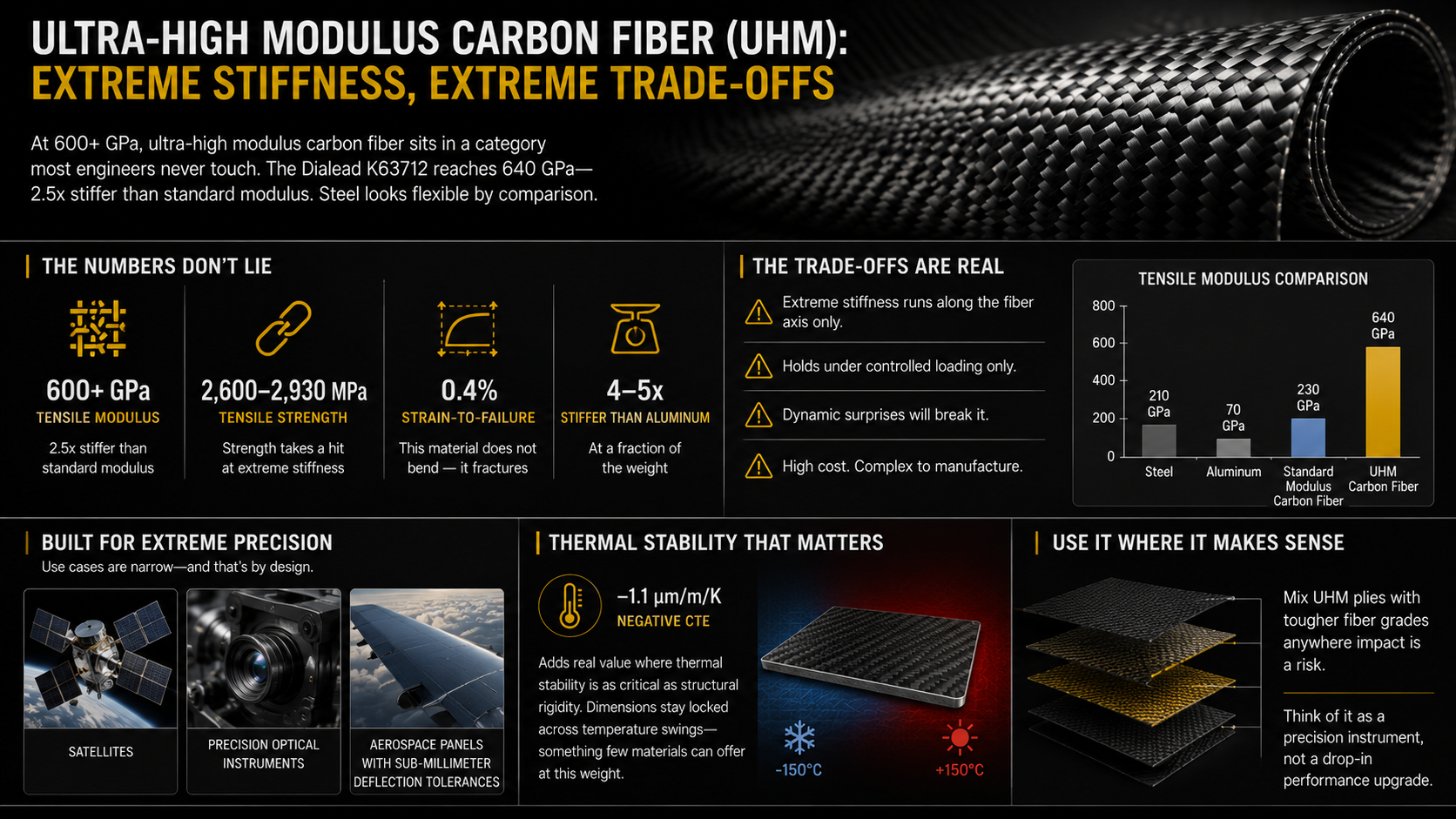
At 600+ GPa, ultra-high modulus carbon fiber sits in a category most engineers never touch. The Dialead K63712 reaches 640 GPa — 2.5x stiffer than standard modulus. Steel looks flexible by comparison.
That number comes at a price. And it’s not just about cost.
Tensile strength drops to 2,600–2,930 MPa. Strain-to-failure hits just 0.4%. This material does not bend under a bad load assumption. It fractures. You get 4–5x the stiffness of aluminum at a fraction of the weight. But that stiffness runs along the fiber axis only. It holds under controlled loading only. Dynamic surprises will break it.
The use cases are narrow — and that’s by design:
– Satellites
– Precision optical instruments
– Aerospace panels with sub-millimeter deflection tolerances as hard specifications
The negative CTE (−1.1 µm/m/K) adds real value where thermal stability is as critical as structural rigidity. Dimensions stay locked across temperature swings — something few materials can offer at this weight.
Mix UHM plies with tougher fiber grades anywhere impact is a risk. Think of it as a precision instrument, not a drop-in performance upgrade.
Carbon Fiber Grade Comparison Table: Full Mechanical Properties Side-by-Side

Numbers show what descriptions miss. Here’s every major grade, side by side.
|
Grade |
Tensile Modulus |
Tensile Strength |
Typical Designations |
|---|---|---|---|
|
Standard Modulus (SM) |
33–36 MSI |
500–700 ksi (3,400–4,800 MPa) |
T300, T700 |
|
Intermediate Modulus (IM) |
43–47 MSI |
800–1,000 ksi |
T800, T1100G |
|
High Modulus (HM) |
57–72 MSI |
~640 ksi |
M40, M46 |
|
Ultra-High Modulus (UHM) |
110–135 MSI |
~425 ksi |
M55, K63712 |
Two patterns are worth knowing before you move forward.
First: Strength peaks at IM, not UHM. Stiffer fiber does not mean stronger fiber. Engineers who treat stiffness and strength as the same thing end up picking the wrong grade for dynamic load applications.
Second: T700 beats T300 on tensile strength, yet both sit in the same SM modulus range. That tells you something important — grade category and individual fiber designation are not the same thing. You cannot use them as swappable labels.
How to Choose the Right Carbon Fiber Grade: A Decision Framework for Engineers & Buyers
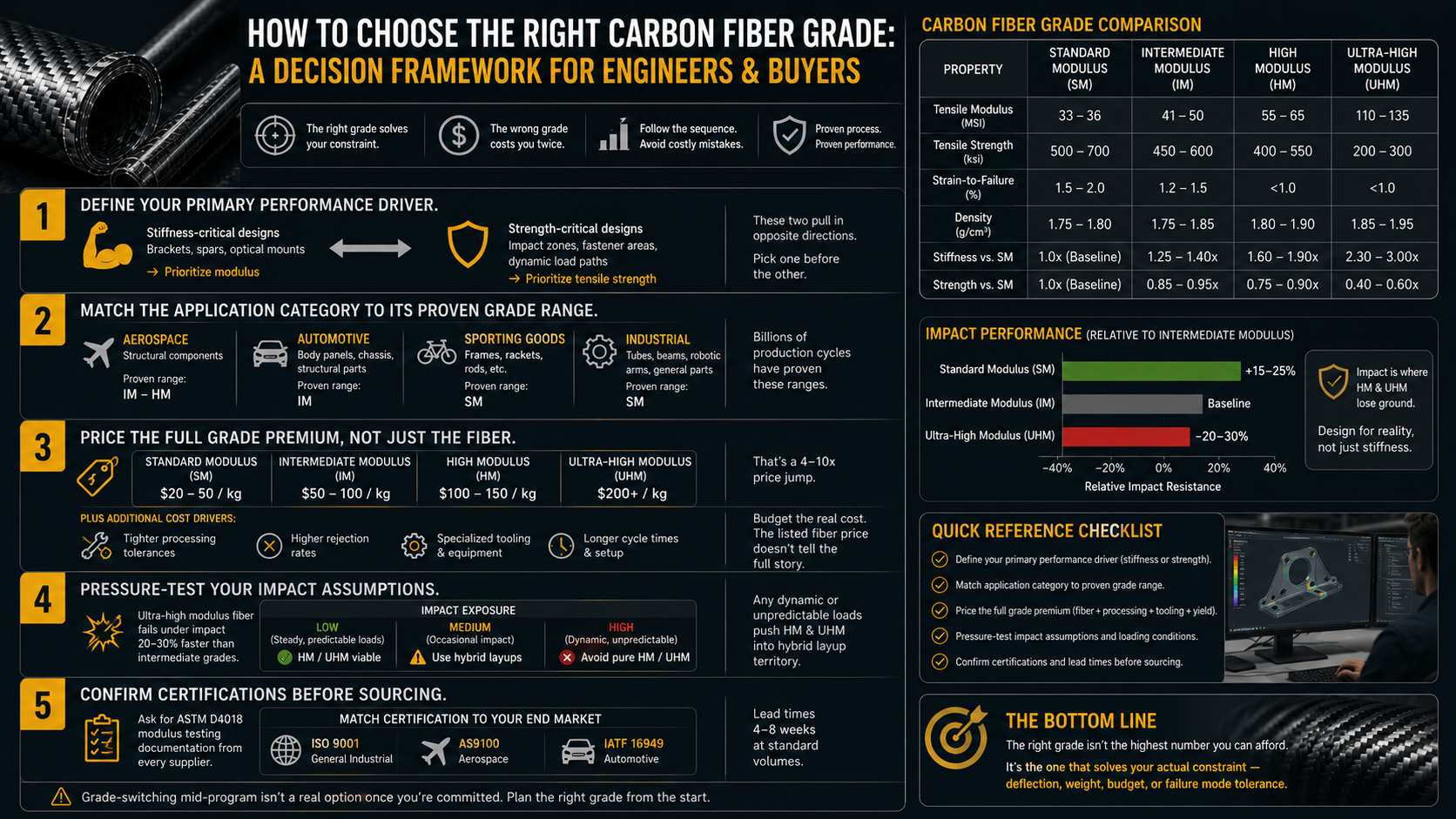
Grade selection isn’t a datasheet exercise. It’s a series of prioritization decisions. Get the sequence wrong, and it costs you twice — once in material spend, once in redesign.
Work through these five filters in order.
1. Define your primary performance driver.
Stiffness-critical designs — brackets, spars, optical mounts — need modulus first. Strength-critical designs — impact zones, fastener areas, dynamic load paths — need tensile strength first. These two pull in opposite directions. Pick one before the other. That’s how you avoid selecting a grade that solves the wrong problem.
2. Match the application category to its proven grade range.
Aerospace structural components default to IM and HM. Not because engineers there are overly cautious — but because certification cycles reward known performance envelopes. Automotive lands in the intermediate range. Crash tolerance and 20–30% weight savings over aluminum work well together there, without pushing into aerospace pricing. Sporting goods and general industrial applications sit at standard modulus — and that’s where they belong. These aren’t rough suggestions. Billions of production cycles have already proven them out.
3. Price the full grade premium, not just the fiber.
Standard modulus runs $20–50/kg. Ultra-high modulus crosses $200/kg. That’s a 4–10x price jump. On top of that, add tighter processing tolerances, higher rejection rates, and specialized tooling that some pitch-based grades demand. Budget the real cost. The listed fiber price doesn’t tell the full story.
4. Pressure-test your impact assumptions.
Ultra-high modulus fiber fails under impact 20–30% faster than intermediate grades. Any dynamic or unpredictable load inputs — even rare ones — push HM and UHM into hybrid layup territory. Pure high-modulus constructions in impact-exposed structures aren’t bold choices. They’re scheduled failure modes.
5. Confirm certifications before sourcing.
Ask for ASTM D4018 modulus testing documentation from every supplier. Match the certification scope to your end market:
– ISO 9001 for general industrial
– AS9100 for aerospace
– IATF 16949 for automotive
Lead times run 4–8 weeks at standard volumes. Build that into your project timeline. Grade-switching mid-program isn’t a real option once you’re committed.
The right grade isn’t the highest number you can afford. It’s the one that solves your actual constraint — deflection, weight, budget, or failure mode tolerance.
PAN-Based vs. Pitch-Based Carbon Fiber: The Manufacturing Difference That Changes Everything
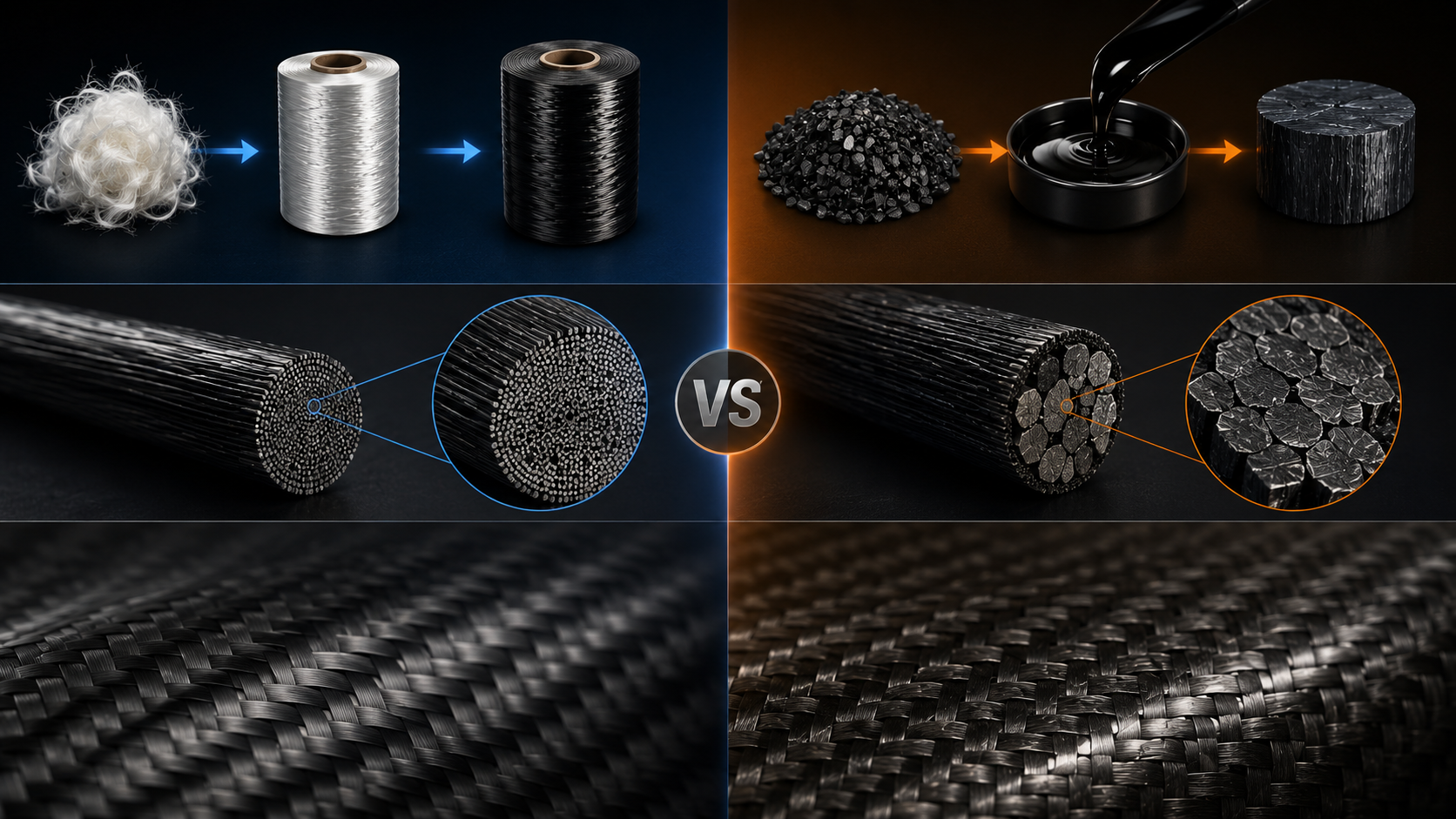
Two precursors. Two completely different sets of physics. The choice you make here sets your mechanical ceiling before you’ve wound a single tow.
Every carbon fiber grade traces back to one of two raw material families: polyacrylonitrile (PAN) or petroleum/coal tar pitch. The precursor decides how far graphitization can go. That single factor drives everything else downstream.
PAN fiber goes through oxidation at 200–300°C first. Then it gets carbonized between 1,000–1,500°C. Graphitization pushes past 2,300°C, but the crystal structure stays turbostratic — disordered, with layer plane spacing above 0.3354 nm. That disorder is not a flaw. It’s what gives PAN fiber its defect tolerance. Cracks can’t travel through irregular crystal boundaries without hitting a dead end. Filament diameter runs 5–7 μm. A tighter diameter pushes tensile strength higher. The process costs a lot to run, but scale, automation, and global supply chains keep it accessible. PAN accounts for 90%+ of all carbon fiber used worldwide — airframes, wind blades, automotive structures.
Pitch fiber works differently. Mesophase pitch spinning causes aromatic rings to align before carbonization starts. That early alignment gives graphitization a head start. At 1,600–2,800°C, pitch builds large, ordered graphite crystals with high coherent length (Lc). More crystal order means higher modulus — close to the theoretical stiffness of graphite itself. But those large crystals also let cracks travel fast. Tensile strength drops. Strain-to-failure falls below 1%.
Here’s the trade in a single table:
|
Property |
PAN-Based |
Pitch-Based |
|---|---|---|
|
Tensile Strength |
Higher; defect-tolerant |
Lower; crack-sensitive |
|
Tensile Modulus |
Moderate (up to ~294 GPa) |
Very high (600+ GPa possible) |
|
Strain-to-Failure |
Higher |
Lower |
|
Thermal Conductivity |
Baseline |
10x+ higher |
|
Electrical Conductivity |
Moderate |
Superior |
|
Processing Window |
Broad; extensive supplier base |
Narrow; fewer suppliers |
|
Market Share |
~90%+ |
Specialty/niche |
Thermal conductivity is where pitch pulls far ahead. Pitch-based fiber conducts heat at more than 10 times the rate of PAN fiber. That’s not a small gap. Spacecraft radiators, electronics housings, antenna reflectors, and optical benches specify pitch for exactly this reason. It’s not just about stiffness. Thermal management and dimensional stability both depend on the same material call — and pitch handles both.
Processing reality matters too. PAN works with a wide range of sizing chemistries — epoxy, BMI, thermoplastics — and handles normal shop conditions well. Pitch fiber carries enough electrical conductivity to create ESD risks in electronics environments. It runs on narrow processing windows. Supplier options are limited. Reject rates run higher.
The bottom line: PAN is the load-bearing workhorse. Pitch is the precision instrument.
Your design needs strength, damage tolerance, and manufacturing reliability? PAN is the default for good reason. Near-zero deflection and thermal performance are both non-negotiable? Pitch earns its place — as long as your team can manage tighter processing discipline.
Frequently Asked Questions: Carbon Fiber Modulus Grade Misconceptions Answered
Five misconceptions cost engineers real money every year. Here’s where things go wrong.
“Higher modulus means stronger fiber.”
It doesn’t. Modulus measures stiffness — how much the fiber resists bending under load. Strength measures how much load the fiber carries before it breaks. These two properties move in opposite directions. Ultra-high modulus fiber at 135 MSI has lower tensile strength than standard modulus fiber at 33 MSI. You’re not getting more of everything. You’re trading one property for another.
“The K number tells you the grade.”
No. 3K, 12K, 24K — these numbers count filaments per tow bundle. Nothing else. A 3K twill fabric can be standard modulus. A 3K plain weave can be high modulus. Tow size and modulus grade are two separate specs. Mix them up and sourcing errors follow.
“All carbon fiber frames use the same material.”
High-end bike frames blend grades on purpose. Builders use intermediate modulus through the main structure. High modulus goes only in spots that need targeted stiffness. The fiber changes by location, by load path, by design goal.
“High modulus belongs everywhere in a performance build.”
Standard modulus carries higher tensile strength and handles impact better. High and ultra-high grades run $150+/lb versus $10–20/lb for standard. Plus, they fracture where standard fiber flexes. Swapping everything to higher modulus won’t boost performance. It puts brittleness into zones that need toughness.
The right grade isn’t the highest number available. It’s the one your load case demands.
Conclusion
Picking the right carbon fiber grade isn’t about chasing the highest number on a spec sheet. It’s about matching mechanical properties to real-world demands.
Standard modulus covers most structural applications. The cost efficiency is hard to beat. Intermediate modulus is where aerospace settled — and for good reason. It hits the right balance of tensile strength and stiffness without the brittleness trade-off. High and ultra-high modulus grades have their place in precision-critical, weight-sensitive applications — but they come with real limitations you can’t ignore.
Engineers who get this wrong don’t fail from lack of data. They fail because they optimized for the wrong variable.
Don’t stop at carbon fiber tensile modulus values alone during material selection. Also factor in:
-
Your layup process
-
Failure mode tolerance
-
Long-term cost per performance unit
Ready to spec the right grade for your application? Contact the HyperX Carbon technical team for grade-specific recommendations backed by real project experience.
Contact HyperX Carbon – Your Trusted Chinese Carbon Fiber Customization Partner
Ready to develop high-performance carbon fiber materials or custom forged carbon fiber parts tailored specifically for your project?
HyperX Carbon is your long-term strategic partner with over 20 years of expertise in advanced composites. We specialize in delivering aerospace-grade forged carbon fiber custom solutions, along with fully personalized prepreg, tubes, sheets, and lightweight carbon fiber structural components for automotive, drone, eVTOL, and medical applications.
We don’t just supply materials — we provide end-to-end customization support:
-
Stable premium supply chain using Toray, Mitsubishi, and Hengshen raw materials
-
AS9100D certified production tailored for aerospace and UAV requirements
-
Rapid prototyping carbon fiber component in just 5-8 weeks, with monthly capacity over 180,000 parts
-
Competitive pricing with 15-18% cost savings on forged carbon solutions
-
Full customization flexibility: from T700 and T1100G to ultra-high modulus grades, with tailored layups, finishes, and performance specifications
Whether you’re an eVTOL developer, automotive OEM, drone manufacturer, or medical device engineer, HyperX Carbon delivers bespoke material selection, structural optimization, and manufacturing solutions that match your exact technical and performance needs — with consistent batch-to-batch quality and reliable delivery.
Get in touch today for a free technical consultation, personalized quote, or custom material samples.
📧 Email: [email protected] 🌐 Website: https://www.hyperxcarbon.com/ 📞 Phone/WhatsApp: +86 15623270276 (English support available)
Let’s co-create your next lightweight innovation together. Contact HyperX Carbon now and stay ahead in the low-altitude economy and advanced composites market.
HyperX Carbon – Not just a supplier, but your dedicated carbon fiber customization expert.