Forged carbon fiber and traditional carbon fiber are often confused—both called “carbon fiber,” yet they are fundamentally different materials with distinct purposes.
Traditional carbon fiber uses continuous, woven fibers laid in precise orientations to direct stress along engineered load paths—ideal for maximum strength and stiffness in demanding applications.
Forged carbon fiber uses chopped strands compressed randomly in a mold. This random distribution offers greater design freedom, faster production cycles, and a unique marbled, smoke-like appearance that woven carbon can’t match.
The mix-up matters: choosing the wrong one leads to over-engineered parts, mismatched aesthetics, or unnecessary costs.
This guide clears that up. It covers:
-
Strength data for both materials
-
How each one is made
-
Real-world applications where each one fits
-
The specific scenarios where each material earns its cost
By the end, you’ll know which one belongs in your project — and why.
Strength & Material Properties: The Numbers Behind the Debate
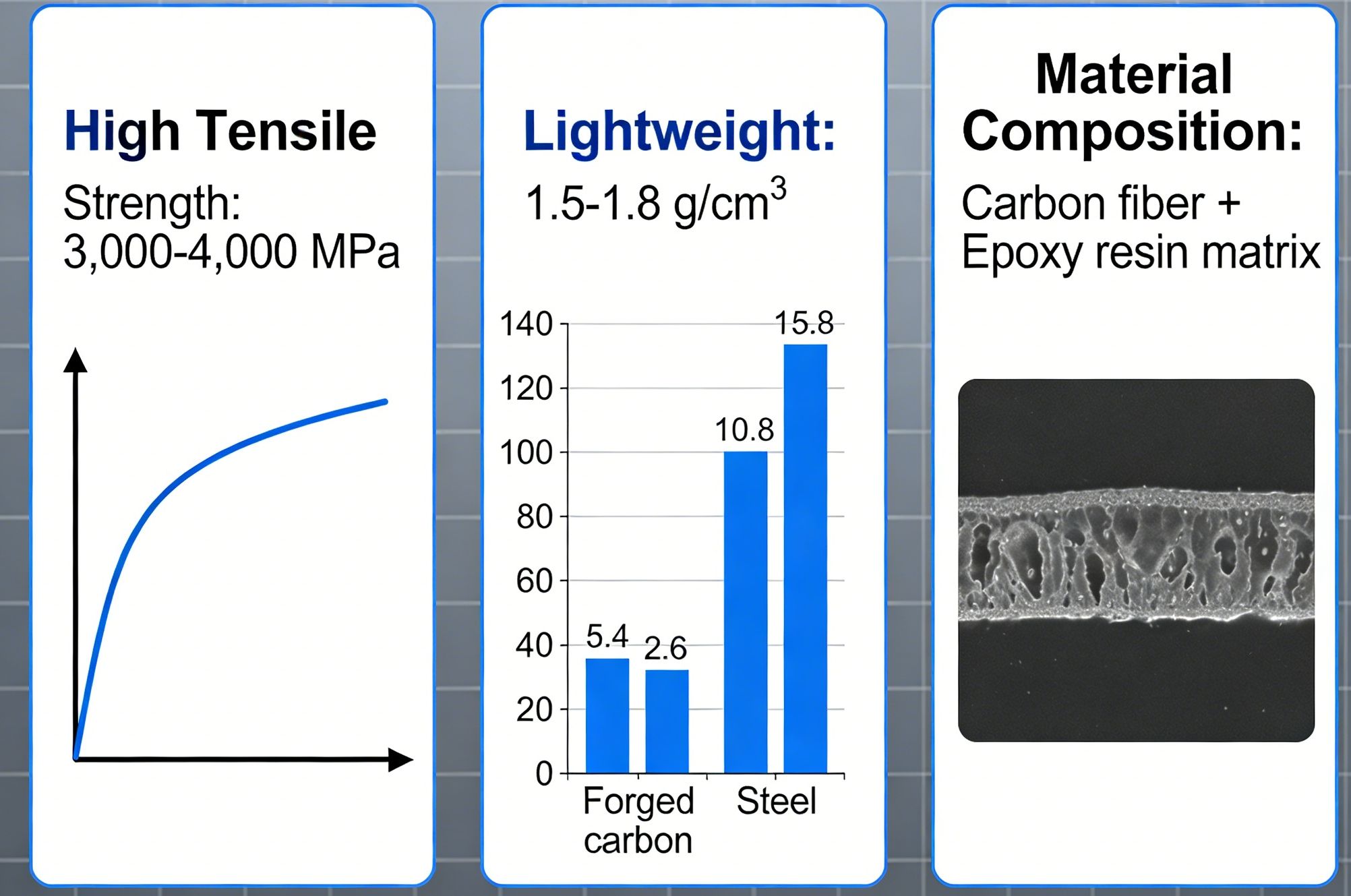
The numbers tell a story that marketing copy never will.
Traditional carbon fiber — the continuous-fiber, carefully-oriented kind — can reach tensile strengths approaching 6 GPa along its primary load axis. That’s not a rounding error. This material carries stress in one specific direction, and it does that job well. The continuous fiber layout channels force like a highway. Load moves from point to point with no interruption.
Forged carbon fiber works on a different principle. Measure it the same way, and it gives up ground.
Where Forged Carbon Gives Ground
Chopped strands land in random orientations. No single direction captures the full reinforcement effect. The result is a 20–30% reduction in tensile strength compared to equivalent traditional layups. That’s a real gap. It matters a great deal in structural aerospace components. In a shift knob or a laptop lid? It barely matters at all.
Fiber-to-resin ratio pushes things further. High-performance traditional laminates run 60%+ fiber content by volume. That ratio keeps weight low while pushing stiffness and strength up. Forged composites carry more resin by proportion. That shift softens the strength and modulus numbers. It also adds 5–10% more weight per unit volume and raises density by around 10–15%.
But that same resin-rich structure has an upside: it boosts impact toughness by about 25%. Forged carbon fiber doesn’t crack the way traditional laminates can. It absorbs energy in a different way — spreading impact load across the random fiber network rather than fracturing along a defined axis.
The Weight Question — A Straight Answer
Both materials beat aluminum by a wide margin. In panel applications, either carbon variant can cut weight by around 30% versus aluminum at comparable thickness. The density gap between forged and traditional carbon fiber is real. In practice, though, it’s narrow. Most non-structural applications won’t feel the difference.
Here’s the straight summary:
-
Traditional carbon fiber wins on directional strength
-
Forged carbon fiber wins on toughness and geometric complexity
Choosing between them isn’t about which one is stronger on paper. It’s about which properties your specific application needs to hold up in real use.
Appearance & Aesthetics: Marble Swirl vs Classic Weave

Walk into a room and you notice the surface before you notice the structure.
This is where forged carbon fiber and traditional carbon fiber split — and for many buyers, the visual difference is the deciding factor.
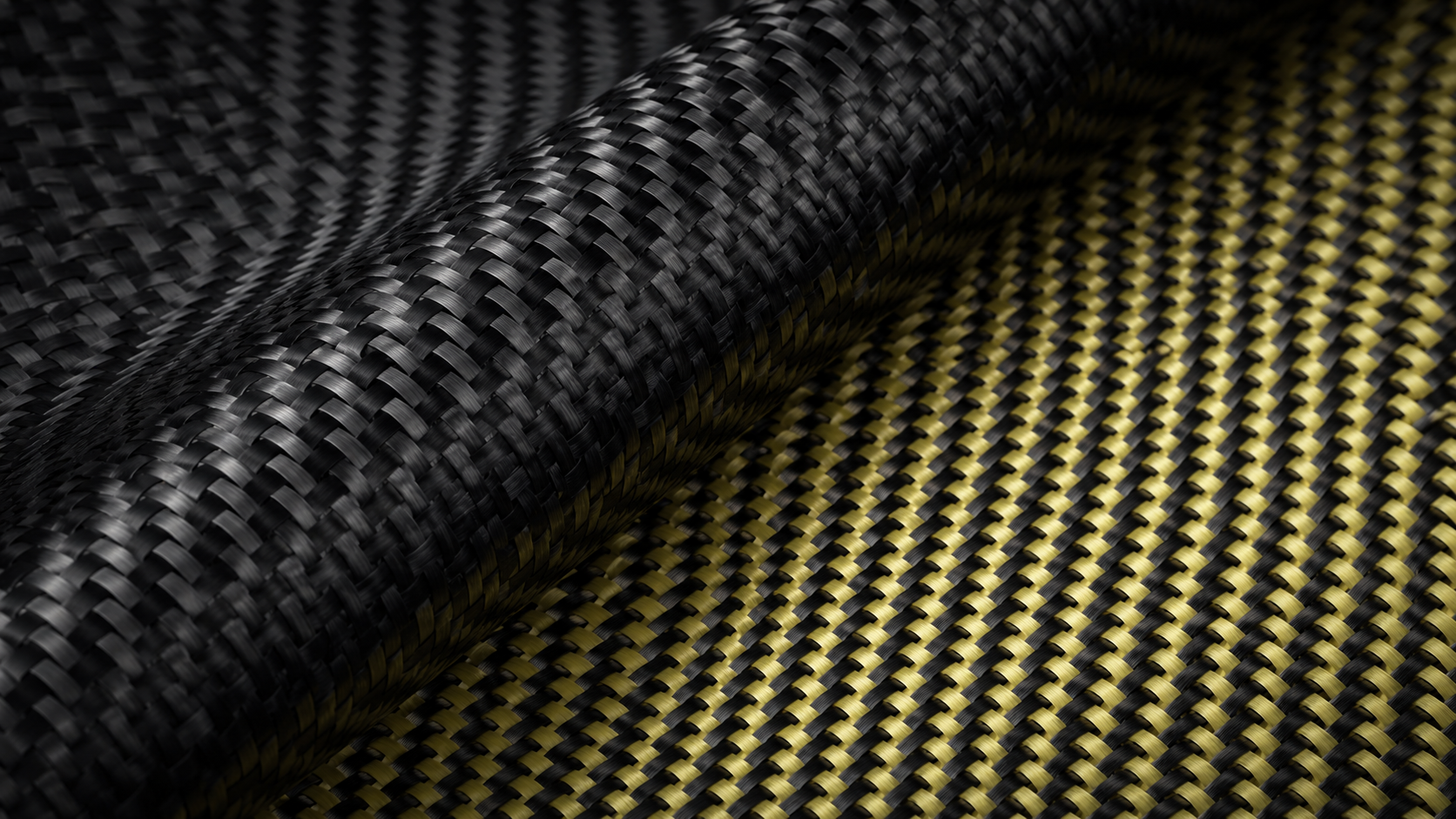
Traditional carbon fiber announces itself with geometry. The woven carbon fiber weave pattern is precise, repeating, architectural. Parallel tows cross at fixed angles. Light catches the edges and throws off that familiar checkered shimmer. It’s disciplined. Controlled. The kind of surface that signals engineering heritage.
Forged carbon fiber looks nothing like it.
The chopped strand process compresses short fibers at random into a mold. The result looks closer to marble than machinery. No two panels are identical. Strands swirl and stack wherever physics places them during the press cycle. This creates organic, smoke-like veining across the surface. Deep charcoal currents cut through lighter gray fields. Some panels pull blue. Others shift toward warm tones based on resin tint.
You can’t replicate that look with a traditional layup. The randomness isn’t a texture option — it’s a structural consequence.
The practical split comes down to this:
-
Pick traditional carbon fiber when precision visuals matter — motorsport trim, aerospace-adjacent consumer goods, anything where the weave itself communicates performance
-
Pick forged carbon fiber for a surface that reads premium without looking mass-produced — luxury automotive interiors, high-end consumer electronics, statement accessories
One looks engineered. The other looks grown. Neither is wrong — they’re just telling different stories.
Manufacturing Process Compared: Compression Molding vs Prepreg Layup

The real difference between these two materials comes down to time. We’re talking hours, not minor details.
Traditional carbon fiber uses the prepreg layup process. CNC equipment cuts fabric plies to spec. Technicians hand-place each ply onto a mold at precise angles. A vacuum bag seals the assembly. Then the waiting starts — oven curing under controlled heat and pressure takes 6 to 10 hours for standard cycles. Autoclave processing can push that past 24 hours in aerospace work. Every step needs skilled labor. Every edge gets CNC-trimmed at the end. The carbon fiber layup process is slow, strict, and leaves no room for error.
Forged composite material runs on a completely different production model.
Chopped prepreg strands go into an aluminum mold. Matched metal dies close under pressures up to 1,000 psi. Snap-cure epoxy systems take over — isothermal curing runs at 135°C and wraps up in 7 to 10 minutes. Some setups cut that down to 3 to 4 minutes per cycle. Traditional layup measures time in hours per part. Compression molding measures it in minutes per batch.
The labor gap adds up fast at scale:
-
Prepreg layup needs manual ply placement, vacuum bagging, post-cure CNC trimming, and cold-storage material handling
-
Compression molding automates material shaping, skips most edge-finishing steps, and produces near-zero prepreg waste
That efficiency gap has a cost. The carbon fiber manufacturing process for compression molding needs a big upfront tooling investment. You’re looking at aluminum molds with precision vacuum channels, plus development cycles that can stretch across years before tolerances stabilize on complex shapes.
Scalability: Where Each Process Earns Its Place
For high-volume runs — automotive trim panels, consumer electronics housings, propeller blades — compression molding makes strong financial sense. Its fast cycle time and high mold reuse rate spread the tooling cost thin across each unit produced.
For small-batch structural parts where continuous fiber strength is a must, prepreg layup holds its ground. It’s slower and costs more per labor hour. But it delivers 45% weight savings versus aluminum, compared to compression molding’s 25 to 35%. That gap matters on parts that carry real structural load.
5 Scenarios Where Forged Carbon Fiber Wins

Picking the right material isn’t about chasing the strongest spec sheet. It’s about matching the material’s nature to the problem in front of you.
Forged carbon fiber has a distinct nature. It flows under pressure, lands where physics takes it, and locks into shapes that continuous fiber cannot reach. Five specific scenarios reward that nature — and punish the engineer who ignores it.
1. Your Geometry Has Curves, Undercuts, or Integrated Features
Compression molding pushes forged composite material into every pocket of an aluminum tool at pressures up to 1,000 psi. The chopped strands flow like liquid, then freeze in place. Complex curves, undercuts, one-piece integrated structures — the mold fills all of them. A traditional carbon fiber layup can’t do that. Continuous fibers won’t bend around tight geometry. They bridge, wrinkle, or fail at the curve. Your part has the kind of shape that makes a laminator nervous? Forged carbon fiber is where you start.
2. Your Part Takes Hits From More Than One Direction
Woven carbon fiber is directional by design. Load it along the fiber axis and it performs. Load it off-axis and it delaminates. That’s not a defect — it’s physics.
Forged carbon fiber puts isotropic vs anisotropic carbon fiber thinking into real-world practice. The random fiber orientation — chopped strands ranging 5 to 50mm — spreads stress in every direction at once. Side impacts, vibration loads, lateral forces: the material absorbs them all. There’s no single failure plane. At a density of 1.5 to 1.58 g/cm³, it matches or beats cast aluminum in strength at about half the weight. Automotive body panels and consumer goods with complex load paths fit this scenario well.
3. You’re Running Volume and Watching Unit Cost
The economics shift at scale. The forged carbon fiber manufacturing process runs in minutes per part. Traditional prepreg layup runs in hours. That gap doesn’t stay theoretical — it shows up on your cost sheet.
Mass production with compression molding runs 20 to 40% lower cost than equivalent woven carbon layups. The global forged composite material market grew from USD 128M in 2024 to USD 134M in 2025. That’s a 4.9% annual expansion. The growth came from manufacturers who needed carbon fiber reinforced polymer performance without the long production timelines. Material waste stays low. Per-cycle labor stays low. Both push your unit cost down further. As order quantities climb, this process pays back its tooling investment fast.
4. Your Brand Needs a Surface Nobody Else Has
No two forged carbon fiber panels are identical. The chopped strand process creates a marbled, swirling texture that comes from physics, not a template. You can’t buy a roll of that pattern. You can’t copy it with a traditional carbon fiber weave.
Lamborghini saw this value early. Their Forged Composites® program — built with Callaway Golf — brought the process into high-visibility automotive components. The surface reads as rare. That’s the point. Richard Mille followed the same logic in watchmaking. Irregular cases in forged carbon fiber carry a visual weight that machined metal and woven fabric both fall short of. For luxury goods and high-margin accessories, the unrepeatable texture is the product.
5. You Need a Hybrid That Beats Metal Without Losing Moldability
Pure chopped fiber isn’t always the limit. Engineers can add targeted continuous fiber reinforcement into a forged carbon fiber layup — unidirectional tows placed in specific zones, embedded within the chopped matrix. Keep the ratio weighted toward chopped strands and the material still flows under pressure. The stiffness numbers climb. You get a part that outperforms cast aluminum in density-adjusted mechanical tests. It still holds the geometric freedom that makes compression molding worth choosing. Automotive structural brackets and performance sporting goods are already using this approach.
|
Feature |
Forged Carbon Fiber |
Traditional Carbon Fiber |
|---|---|---|
|
Fiber Orientation |
Random (isotropic) |
Controlled (anisotropic) |
|
Cycle Time |
Minutes per part |
Hours per part |
|
Cost at Volume |
20–40% lower |
Higher labor and layup cost |
|
Complex Geometry |
Undercuts, curves, integrated |
Flat and simple profiles |
|
Impact Resistance |
Multi-directional |
Axis-dependent |
4 Scenarios Where Traditional Carbon Fiber Is Irreplaceable

Forged carbon fiber works well in plenty of applications. But there are four situations where traditional carbon fiber doesn’t just compete — it wins. No amount of process innovation changes that.
1. Aerospace and Structural Components
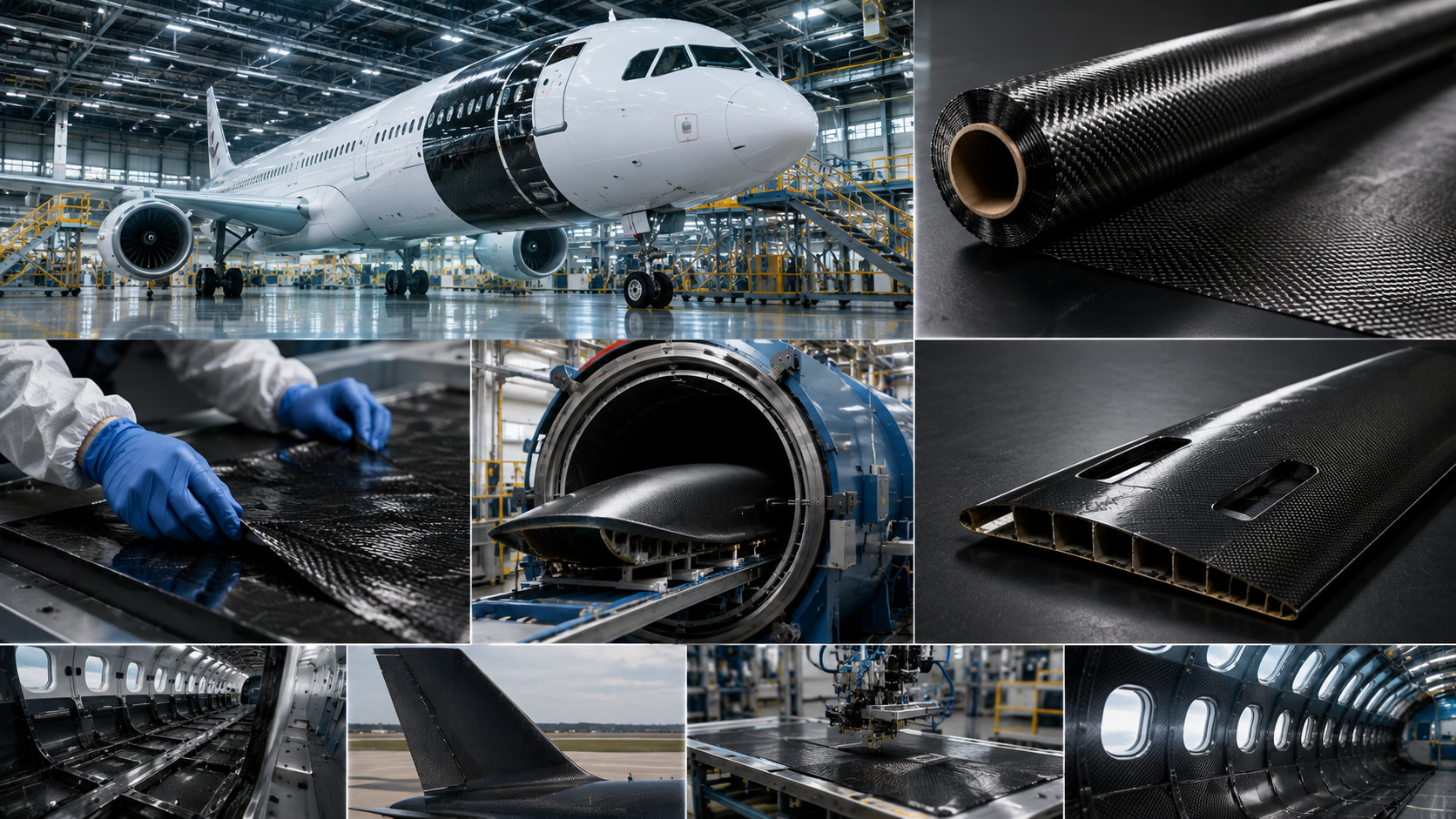
Certification bodies don’t accept “approximately aligned.” FAA and EASA qualification for primary aircraft structures demands verified fiber volume fractions — 60–70% — and directional modulus control. Prepreg layup is the process that delivers this. That precision is why aircraft fuselages and wing skins shed 20–30% weight versus aluminum without losing structural integrity. The carbon fiber layup process places fibers at the exact load paths required. Aerospace doesn’t forgive guessing.
2. Gram-Level Weight Sensitivity
Every gram shows up in fuel burn or race lap times. The specific strength numbers settle the argument fast. Traditional carbon fiber hits 3,500–7,000 MPa per g/cm³ — compared to steel’s 100 and aluminum’s 200. Here’s what that looks like in practice:
-
A highway bike frame drops from 1.5 kg in aluminum to 0.8 kg
-
A Tesla Model 3 front lip goes from 4.5 kg in steel to 1.4 kg — a 70% reduction
-
F1 bodywork cuts total vehicle weight up to 60% versus metal equivalents
Forged composite material closes some of that gap. It doesn’t close all of it.
3. Precision Tolerance Engineering
Autoclave-cured prepreg holds ±0.1 mm dimensional tolerances across production runs. Fiber volume fraction stays locked between 55–65%. Precision instrument housings, racing chassis components, and assemblies that must hold exact geometry across temperature and humidity shifts all depend on this repeatability. It’s not a feature — it’s a hard requirement. Compression molding produces excellent parts. It doesn’t reach this level of dimensional control.
4. Concentrated Directional Loads
Finite element analysis often reveals a dominant principal stress direction. A traditional carbon fiber weave pattern layup turns that data into material efficiency. Stack 70–80% of fibers at 0° along the primary tension axis, and tensile strength pushes past 3,500 MPa in that direction. That’s a 30–50% utilization gain over isotropic arrangements. Compared to metals, the gap widens further: 2–5× better load-specific performance per unit weight. Forged carbon fiber spreads strength across all directions. Traditional carbon fiber puts it where the stress actually lives.
Cost Comparison: What You’re Paying For
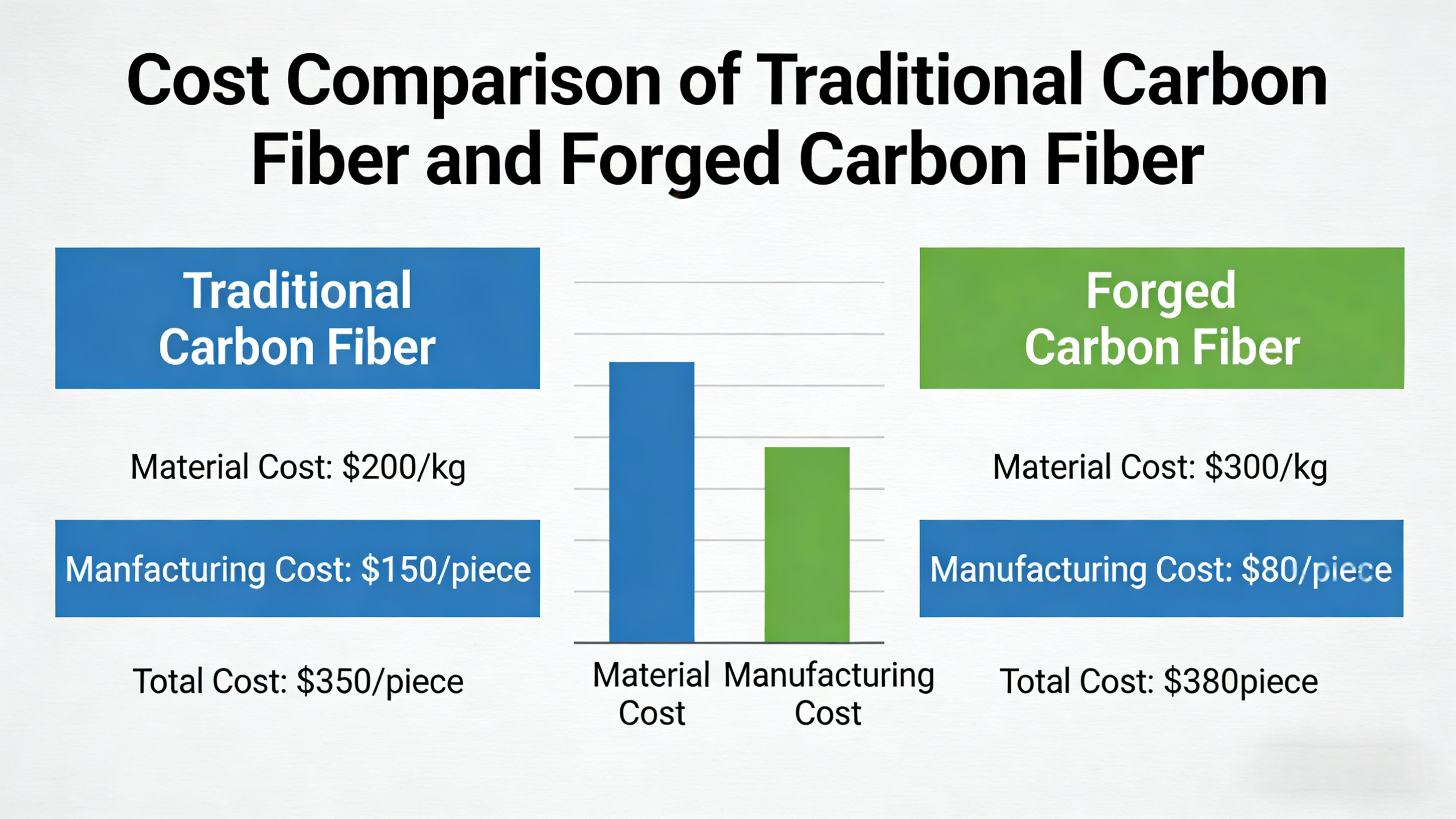
The price tag on carbon fiber parts doesn’t tell you what you’re buying. It tells you what someone charged. That’s a different thing.
Here’s where the real gap sits: traditional carbon fiber’s cost lives in labor. Skilled technicians handle cold-stored prepreg material. Autoclave time adds up. A single aerospace-grade panel can eat a full work shift before it reaches a trimming wheel.
Forged carbon fiber changes that equation. The cost goes into tooling upfront — precision aluminum molds, vacuum channels, development cycles. That investment is real. But once the tooling is done, each part takes minutes to produce, not hours.
-
Low-volume runs: Traditional carbon fiber often wins on per-unit tooling cost
-
High-volume production: Forged composite material runs 20–40% cheaper per unit than equivalent woven layups
-
Complex geometry: Compression molding cuts out post-cure CNC finishing on many shapes. That labor saving adds up fast at scale
Bottom line: you’re not choosing between cheap and expensive. You’re choosing where your money goes — into labor and precision, or into tooling and throughput.
Real-World Applications: Industry-by-Industry Breakdown

The best way to understand these two materials isn’t in a lab. You see the difference on a factory floor, a race circuit, or a watchmaker’s bench.
Automotive
Formula 1 teams don’t debate this. Traditional carbon fiber handles all structural work. McLaren and Ferrari chassis absorb 50g impacts with no problem. The carbon fiber layup process places every fiber at the exact position load analysis requires. Porsche’s 918 Spyder runs a traditional carbon driveshaft that cuts mass 30% compared to steel.
Forged carbon fills a different role — complex shapes. Bugatti Chiron wheels come out 15% lighter than comparable aluminum castings. Lamborghini’s Sian FKP 37 uses forged composite material for monocoque elements, cutting 20% off the weight of equivalent aluminum parts. Those part geometries can’t be hand-laminated. There’s no other way to produce them.
Luxury Goods & Consumer Electronics
Richard Mille built a whole product identity around forged carbon fiber strength paired with aesthetics. The RM 27-04 case runs 30% lighter than titanium. It also survives 12,000g impacts. No woven panel does both — the random fiber network absorbs shock from all directions.
Traditional carbon fiber leads in performance consumer goods. Trek Madone frames deliver 20–30% weight savings over aluminum, plus a 15% stiffness gain. Titleist’s TSR shaft series adds 2–3 mph to swing speed. These products need directional tensile strength above 3,500 MPa. Forged carbon doesn’t reach that level.
Aerospace & Industrial
Boeing’s 787 Dreamliner uses traditional carbon fiber reinforced polymer for 50% of its fuselage weight. That saves 20% in fuel costs over the aircraft’s full service life. The Airbus A350 goes further — 53% structural carbon content, with a 14% drop in operating costs. Aerospace certification requires verified fiber volume fractions. Compression molding can’t meet that standard.
Forged carbon is growing in industrial non-structural roles:
– Tool handles
– Equipment casings
– Robotics grips
In those uses, it cuts machining time by 70% and material waste by 50%. You also get 25% better impact resistance than the metal parts it replaces. Adoption sits around 10% for complex industrial molds right now, but it’s climbing steadily.
The pattern is consistent across every sector. Traditional carbon fiber carries the structural load. Forged carbon fiber handles the geometry, the volume, and the surfaces that make people stop and look.
Forged Carbon Fiber vs Traditional Carbon Fiber: Side-by-Side Comparison Table
The data below doesn’t favor either material. It just shows what each one is.
|
Dimension |
Forged Carbon Fiber |
Traditional Carbon Fiber |
|---|---|---|
|
Fiber Form |
Chopped strands (5–50mm) |
Continuous woven fabric |
|
Fiber Orientation |
Random — isotropic |
Controlled — anisotropic |
|
Strength Profile |
Equal in all directions |
Strongest along the weave axis |
|
Manufacturing Process |
Compression molding up to 1,000 psi |
Prepreg layup + autoclave curing |
|
Cycle Time |
Minutes per part |
Hours per part |
|
Production Speed Advantage |
Up to 90% faster |
— |
|
Mass Production Cost |
20–40% lower |
Higher baseline |
|
Density |
1.5–1.58 g/cm³ |
~1.15 g/cm³ |
|
Appearance |
Marbled, swirling — unique per piece |
Repeating geometric weave |
|
Complex Geometry |
Undercuts, curves, integrated features |
Limited to simpler profiles |
|
Impact Resistance |
Higher — load spreads across random fiber network |
Good, but axis-dependent |
|
vs. Aluminum |
Comparable to or better than cast aluminum |
Superior to aluminum |
One number stands out: the 90% reduction in cycle time. That single figure changes the whole cost picture at high volumes.
FAQ: Quick Answers to What Buyers Ask
These questions come up all the time. Here are straight answers.
Is forged carbon fiber weaker than traditional carbon fiber?
In one direction, yes. Forged carbon fiber loses 20–30% tensile strength compared to traditional continuous-fiber layups on a primary load axis. But it spreads that strength in all directions. For non-structural parts — trim panels, housings, accessories — that trade-off costs you nothing.
Why does forged carbon fiber look different?
The swirling marbled pattern isn’t a finish or a coating. It’s a direct result of how the material is made. Chopped strands press into a mold at random angles. No two panels come out the same. You can’t copy that texture with a traditional carbon fiber weave.
Is forged carbon fiber lighter?
Both materials are lighter than aluminum. The density gap between forged and traditional carbon fiber is real — around 10–15%. In most consumer and automotive applications, though, you won’t notice the difference.
Which one costs less?
Depends on volume. At low quantities, traditional carbon fiber can compete on per-unit cost. At scale, forged composite parts run 20–40% cheaper once tooling costs are spread across production.
Can forged carbon fiber be used in aerospace?
Not for primary structures. FAA and EASA certification demands verified fiber volume fractions. Compression molding can’t reliably hit those numbers. So traditional carbon fiber reinforced polymer stays the qualified choice for aerospace use.
Conclusion
Both materials share the “carbon fiber” name — but that’s where the similarities end.
Forged composite material shines with complex shapes, fast production, and that bold marble-swirl look. Traditional carbon fiber offers a continuous weave pattern and strong directional strength. It stays the top choice where structural performance cannot be compromised.
The real mistake isn’t picking the wrong one. It’s picking without knowing the difference. Now you do.
Still weighing options for your next project? Don’t guess. The right carbon fiber reinforced polymer comes down to your load requirements, production volume, and budget. Those details deserve a real conversation — not a coin flip.
Explore our forged carbon fiber components, or reach out to talk through your application. The best material for your project isn’t always the most expensive one. It’s the one built for what you need.
Contact HyperX Carbon – Your Trusted Chinese Carbon Fiber Partner
Ready to source high-performance carbon fiber materials or custom forged carbon fiber parts from China?
HyperX Carbon is a leading manufacturer with 20+ years of expertise, specializing in aerospace-grade forged carbon fiber, prepreg, tubes, sheets, and lightweight automotive/drone/medical components. We offer:
-
Stable supply chain with premium raw materials (Toray, Mitsubishi, Hengshen)
-
AS9100D certified production for aerospace & UAV applications
-
Rapid prototyping (5-8 weeks) and monthly capacity exceeding 180,000 parts
-
Competitive pricing with 15-18% cost savings on forged carbon solutions
-
Full customization: from T700/T1100G to ultra-high modulus grades
Whether you’re an eVTOL developer, automotive OEM, drone manufacturer, or medical device engineer, HyperX delivers consistent quality, batch-to-batch reliability, and reliable delivery.
Get in touch today for a free consultation, custom quote, or material sample.
📧 Email: [email protected]
🌐 Website: https://www.hyperxcarbon.com/
📞 Phone/WhatsApp: +86 15623270276 (English support available)
Let’s build your next lightweight innovation together – contact HyperX Carbon now and stay ahead in the low-altitude and advanced composites market.