Your forged carbon fiber wallet just arrived — sleek, feather-light, and carrying that unmistakable swirling pattern that screams premium. But here’s the uncomfortable question most people skip until it’s too late: is it genuine forged carbon fiber, or an elaborate fake riding on the material’s reputation?
The 2026 market is flooded with mislabeled composites, convincing knockoffs, and listings that abuse the term “forged carbon fiber” to slap luxury price tags on bargain-bin materials. Spotting the difference isn’t just about bragging rights. It’s about getting the durability, weight savings, and structural integrity you paid for.
This guide cuts through the noise. You’ll leave knowing:
-
How to authenticate a genuine forged carbon fiber wallet
-
Which specs matter before you buy
-
Which products are worth your money
See the full guide here about the best forged carbon fiber applications in 2026.
Forged Carbon Fiber vs Other Wallet Materials
Material choice determines everything — durability, weight, RFID protection, and whether your wallet looks like a collector’s piece or just another commodity.
Here’s the breakdown that matters.
Forged Carbon Fiber vs Leather
Leather loses on nearly every practical point for everyday carry:
-
Weight: Carbon fiber is much lighter
-
Profile: FCF wallets hold 1–12 cards at a fixed 6mm — leather stretches out and bulges over time
-
RFID: FCF blocks by nature; leather gives you zero protection on its own unless you add a separate layer
-
Durability: FCF holds up against scratches and daily wear; leather scuffs, stains, and breaks down
At-a-Glance Comparison
|
Forged CF |
Traditional CF |
Aluminum/Ti |
Leather |
|
|---|---|---|---|---|
|
Weight |
45g |
~45–55g |
+10g heavier |
Heaviest |
|
Thickness |
6mm, 1–12 cards |
6mm, 1–12 cards |
~6mm |
Thicker, stretches |
|
RFID Blocking |
Full (natural) |
Full |
Partial/added |
None |
|
Durability |
Extreme |
High tensile |
Scratches |
Wears fastest |
|
Price Range |
$100+ |
$75–100 |
$50–80 |
$20–50 |
|
Visual Appeal |
Marbled, unique per piece |
Uniform weave |
Plain metal |
Classic |
FCF carries a 50% price premium over aluminum wallets. Consider what you’re getting: lower weight, equal strength from every direction, built-in RFID blocking, and a pattern no other wallet shares. For anyone buying a wallet to last years — not months — that premium makes sense.
How to Tell a Real Forged Carbon Fiber Wallet From a Fake: 7 Definitive Tests
Seven tests. That’s all it takes to separate a genuine forged carbon fiber wallet from a convincing fake — no lab equipment, no materials science degree.
Run through these before you spend $150 on something that’s actually a $15 ABS shell with a printed pattern on top.
Test 1: The Magnifier Test (Your First Line of Defense)
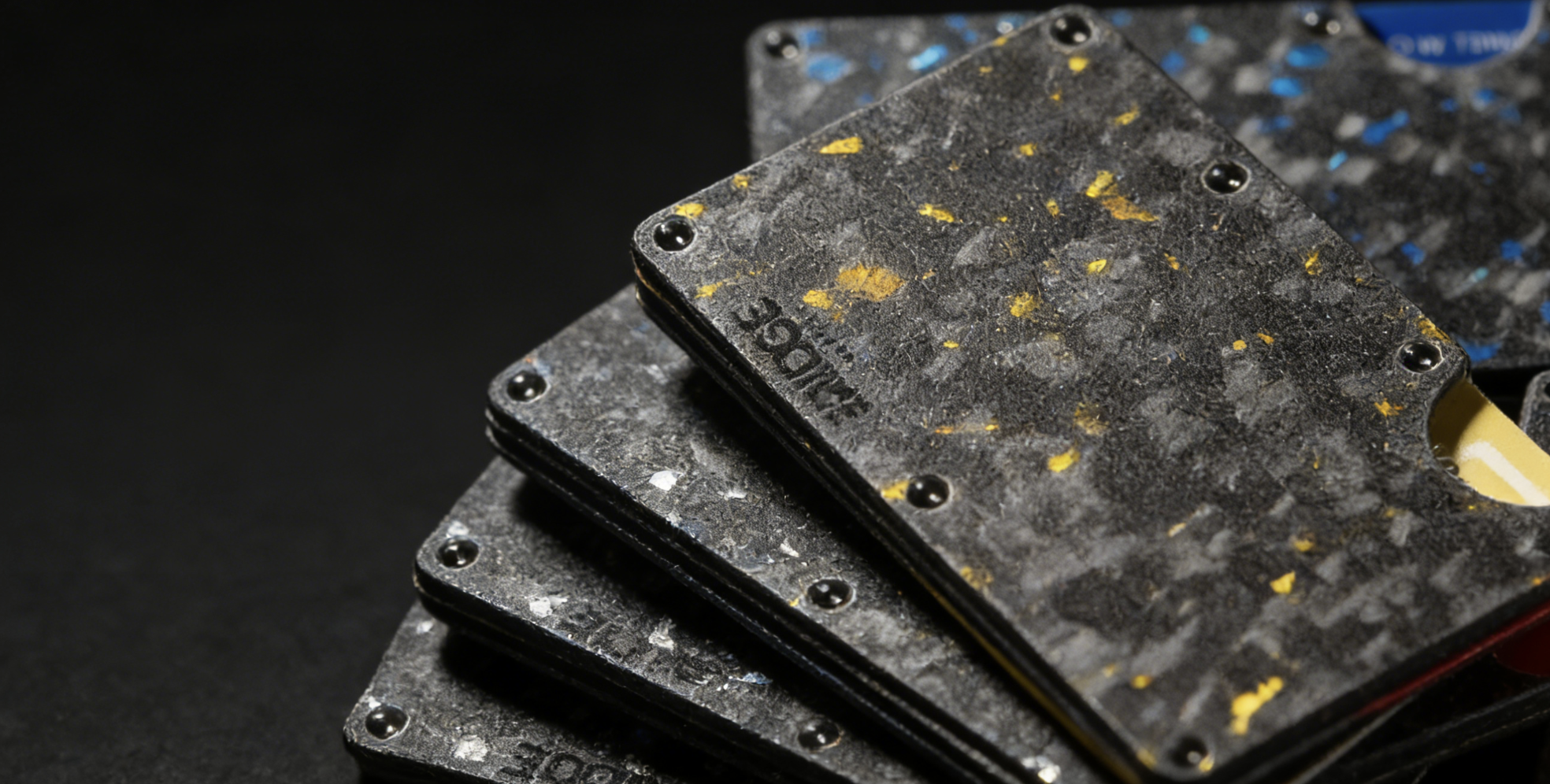
Grab a 10x magnifying glass and look at the surface up close. Genuine forged carbon fiber shows random, non-repeating fiber texture. You’re looking at chopped strands locked in an irregular resin matrix. No two sections look the same.
Fakes show the opposite: repeating printed grids, uniform lines, zero depth variation. It looks flat because it is flat.
Test 2: The Tap Test
Tap the surface with your fingernail. Real forged carbon fiber produces a high-pitched, crisp sound — think ceramic, not plastic. The surface also feels lightly textured where fibers meet resin.
A dull, hollow, or metallic tap? That’s a plastic or metal-backed fake.
Test 3: The Flex Test
Apply gentle bending pressure across the wallet plate. Authentic forged carbon fiber holds firm without cracking or deforming — it pushes back against the force and snaps right back into shape. Fakes crack, split apart, or flex unevenly. Vinyl and ABS materials simply can’t match that kind of structural strength.
Test 4: The Edge and Weight Check
Flip the wallet over and inspect the edges up close. Real FCF shows frayed fiber tows and a CNC-machined smooth finish — clean cuts, no rough burrs. Fakes reveal adhesive layers, fiberglass backing, or uneven cuts right away.
Weight matters here too. A genuine forged carbon fiber plate runs 3–4g per plate. Your wallet feels heavier than expected for its size? Something denser is sitting underneath.
Test 5: The Multimeter Continuity Test
Set a multimeter to continuity mode and touch both probes to the wallet’s surface. Genuine forged carbon fiber conducts electricity — you’ll hear the beep. Printed finishes and hydro-dipped fakes don’t conduct. No beep means no real carbon fiber.
Test 6: The Heat Test
This one is clear-cut. Hold a lighter flame near a hidden edge for a second or two. Real FCF chars the resin while the fibers stay intact — you’ll catch a faint composite odor, no melting. Fakes melt, deform, and release a sharp chemical or ABS plastic smell right away.
Go easy with this test. A seller who stands behind their product should have no problem with the material passing it.
Test 7: The Label and Certification Check
Read the product description word for word. Authentic forged carbon fiber products use the exact term “forged carbon fiber” — this refers to the compression-molding process that gives the material its signature random-fiber structure.
Watch out for phrases like: “carbon fiber look,” “carbon fiber style,” “carbon fiber pattern.” These are word choices that let sellers market a product with zero connection to real carbon fiber — and stay out of legal trouble doing it. Ask sellers for datasheets or laminate certifications. Real brands have them on hand.
Quick Reference: Pass/Fail Summary
|
Test |
Genuine FCF |
Fake |
|---|---|---|
|
Magnifier |
Random, irregular fibers |
Repeating printed grid |
|
Tap sound |
Crisp, high-pitched |
Dull or hollow |
|
Flex |
Rigid, no cracking |
Cracks or deforms |
|
Edge/Weight |
Frayed tows, 3–4g/plate |
Adhesive layers, heavier |
|
Multimeter |
Conducts (beeps) |
No continuity |
|
Heat |
Chars, faint odor |
Melts, chemical smell |
|
Label |
“Forged carbon fiber” + certs |
“Look,” “style,” “pattern” |
Run all seven before committing to any purchase. One failed test is a warning. Three failed tests is a clear answer.
Red Flags: Common Fake & Mislabeled Products You’ll Find Online in 2026

The data doesn’t lie. 41% of counterfeit accessories tested in recent safety audits failed U.S. and international standards. That’s not a fringe problem. That’s close to half of what you might be buying.
The forged carbon fiber wallet space is no exception.
Here’s what the 2026 fake market looks like — and how to avoid getting caught in it.
The Language Trap
Sellers know the law. That’s why you’ll rarely see an outright lie in a product listing. Instead, watch for word choices built to mislead without crossing a legal line:
-
“Carbon fiber style” — printed ABS plastic
-
“Carbon fiber look” — hydro-dipped film over a cheap shell
-
“Carbon fiber pattern” — laminate sticker on aluminum or resin
None of these phrases mean carbon fiber is present. They just mean the seller wants you to think it is.
The Platform Problem
Where you shop matters as much as what you shop for. Over 25% of hazardous counterfeit products traced in recent investigations came from Meta/Facebook ads. Shopee and Alibaba both land on the U.S. Notorious Markets List for counterfeits — year after year.
Right now, an estimated 30,000+ fake fashion and accessory e-commerce domains run across 80+ countries. They clone brand layouts, catalogs, and checkout flows pixel for pixel. Around 8,000 are active at any given moment. Fifty new ones launch every single day.
You clicked an ad to find a wallet? Check the domain yourself before entering any payment details.
The Scam Pattern Behind the Purchase
A product shipping doesn’t mean you’re safe. Online shopping scam reports averaged 2,550 per month in 2025 — double the 2023 rate. Here’s how those reports break down:
|
Red Flag |
% of Reports |
|---|---|
|
Unresponsive customer support |
46% |
|
Non-delivery |
35% |
|
Brand impersonation |
17% |
|
Fake tracking numbers |
10% |
Holiday periods push every one of these numbers higher. Fake tracking alone jumps +16% during peak shopping windows.
The Chemical Risk You’re Not Thinking About
This one catches most buyers off guard. Counterfeit composite products — including wallets sold as carbon fiber — have tested above regulatory limits for phthalates, lead, BPA, and formaldehyde. One tested product showed 327,000 ppm DEP. That’s 650 times the legal limit.
A wallet sits in your pocket against your body all day. Material safety isn’t a bonus feature. It’s a baseline requirement.
Legitimate forged carbon fiber brands carry RSL compliance documentation (Restricted Substances List). A seller who can’t produce it? Treat that product as unverified and move on.
Bottom line: Fake listings aren’t just disappointing — they can cause real harm. Check the domain, demand certifications, and run through the seven authentication tests above before any purchase clears your card.
The 2026 Forged Carbon Fiber Wallet Buying Guide: 6 Factors That Matter

Spotting a fake is half the job. The other half is knowing what separates a great forged carbon fiber wallet from an overpriced one.
Six factors. Nail these, and you won’t second-guess your purchase.
1. Manufacturing Method: Compression Molding vs. Everything Else
This one factor shapes everything else. Authentic forged carbon fiber uses compression molding — chopped fibers go into a mold, resin fills the gaps, then high pressure compresses the whole thing. You get a dense, isotropic structure with strength pulling from every direction.
Here’s what else you’ll find on the market:
-
Pre-preg overlays — pre-impregnated carbon sheets layered over cheaper base materials. Lower cost. Lower performance.
-
Dry fabric alternatives — non-woven carbon backing fused with chopped fibers. No cold storage needed, which says a lot about the process.
-
Hand-placed chopped fibers — the cheapest method. Labor variability is high. Output is inconsistent.
Ask the seller straight: how is this manufactured? A real brand answers that without hesitation.
2. Card Capacity and Mechanical Design
Most solid forged carbon fiber wallets hold 5–7 cards with no trouble. Some models — K2 Industries, for example — push that to 7 cards plus 20 bills with a built-in money clip. That range matters depending on how you carry.
Past raw capacity, check the access mechanism. GRIP6’s patented lever-squeeze design fans 5–6 cards into a cascading spread for one-handed access. That kind of detail shows a brand that has thought through real use — not just how the wallet looks on a shelf.
Skip wallets that cut corners on the mechanism to hit a cheaper price. A sticky card slot kills a $150 wallet just as fast as bad materials.
3. RFID Blocking: Verified Protection vs. Marketing Language
Every premium wallet in 2026 claims RFID blocking. Few tell you what that means.
The standard you need: 13.56 MHz blocking. That frequency covers modern credit cards, debit cards, and passports. A listing that says “RFID protection” without naming the frequency gives you nothing you can verify.
Forged carbon fiber does provide natural electrical insulation — but most wallet designs rely on an aluminum-infused layer inside the build for actual RFID blocking. Confirm that layer is there. Then confirm the frequency range it covers. A seller who can’t answer both is selling you a gap.
4. Surface Finish and Post-Processing Quality
Compression molding builds the structure. Post-processing determines how it feels and how long it holds up.
Real forged carbon fiber wallets go through trimming, sanding, and polishing to hit tight dimensional and surface standards. In practice, that means clean edges with zero adhesive bleed, a consistent matte or gloss finish across the full surface, and that signature marbled pattern — random, non-repeating, unique to every single piece.
No two genuine forged carbon wallets look the same. See a wallet with a uniform surface texture across the whole piece? That’s either a post-processing shortcut or a printed fake.
5. Price as a Signal, Not a Guarantee
Compression molds cost far more upfront than standard tooling. That investment only pays off at high production volume. That’s why real forged carbon fiber wallets carry a 50%+ price premium over aluminum alternatives — the manufacturing cost forces it.
What that means for you: a “forged carbon fiber” wallet under $40 is not what it claims. Genuine products start around $100 and go up from there, based on mechanism complexity, card capacity, and brand positioning.
Price alone won’t confirm quality. But a price that’s way too low is one of the clearest red flags in this space. Use it as a filter, not a final verdict.
6. Shape Capability and Design Complexity
Here’s a spec most buyers miss: forged carbon fiber can be molded into any shape the mold allows, including 90-degree corners — something woven carbon fiber fabric can’t do. It can also form solid three-dimensional parts that get machined further after molding.
So why does that matter for a wallet? It tells you whether the brand is using real forged carbon fiber or just coating another material with it. A wallet with sharp corners, complex geometry, and a one-piece structural shell came from a true compression mold. A flat plate with rounded edges that looks carbon fiber? That shape could come from almost any process.
Design complexity is authenticity evidence sitting right in front of you.
Top 5 Forged Carbon Fiber Wallets Worth Buying in 2026 (Specs-Based Selection)

Five wallets made the cut. Not because of branding or aesthetics — because the specs hold up under scrutiny.
Each pick below is measured against six buying factors: manufacturing method, card capacity, RFID verification, surface finish, price justification, and design complexity. Here’s what you get with each one.
1. Ridge Forged Carbon — Best for Modular Versatility
Specs at a glance:
– Weight: 1.6 oz (45g)
– Dimensions: 86 × 54 × 6mm
– Card capacity: 1–12 cards (patented dual-track system)
– RFID blocking: Yes
– Price range: $100+
The Ridge is the benchmark. That 1–12 card range beats most competitors, who cap out at 6–8. The patented dual-track mechanism is real engineering — not a marketing claim. The anodized 6061 aluminum embed adds scratch resistance to the forged carbon shell. AirTag compatibility and modular add-ons raise the long-term value further.
The lifetime warranty seals it. Best pick for business travelers who need flexible card capacity without carrying two wallets.
2. Simply Carbon Fiber Slim — Best Push-Deploy Under 3 oz
Specs at a glance:
– Weight: 2.8 oz (tested)
– Dimensions: 98.5 × 63 × 6.9mm
– Card capacity: Up to 7 cards + 20 bills
– RFID blocking: Certified
– Money clip: Built-in
The finger-push card lock and deploy mechanism sets this apart. One-handed card access is a usability detail most wallets skip. The built-in money clip handles 20 bills without a separate strap. That’s a cleaner, more integrated solution. Certified RFID blocking means the frequency claim is verifiable — not decorative. Best pick for minimalists who carry cash alongside cards on a regular basis.
3. Grip6 Forged Carbon Fiber — Best for EDC Enthusiasts
Specs at a glance:
– Card capacity: 5–7 internal + 6–8 external (expandable aluminum back plate)
– Profile: Under 6mm expanded
– RFID blocking: Yes
– Made in USA
– Lifetime warranty: Yes
Grip6 commits fully to solid forged carbon fiber construction. It’s USA-made, which matters for consistent quality. The patented lever-squeeze mechanism fans your cards into a spread so you can grab one with a single hand. The expandable anodized aluminum back plate adds external storage without pushing the profile wider. Best pick for tech-forward EDC users who want structural toughness with room to expand.
4. Ekster Forged Carbon Fiber — Best for High Card Volume
Specs at a glance:
– Weight: 59–87g (varies by configuration)
– Dimensions: 7.4 × 104 × 58mm
– Card capacity: Up to 15 cards (6 main + 9 backup)
– RFID blocking: Yes
– Cash strap: Included
Fifteen cards. That’s the headline. The 9-card backup compartment goes beyond Ridge’s 12-card limit. That gap matters for anyone managing loyalty cards, transit cards, or travel documents on top of daily-use cards. The weight range (59–87g) shifts based on how you configure it. Best pick for frequent travelers and business users who carry a high volume of cards every day.
5. Hu Mn Carbon — Thinnest Forged Carbon Profile Available
Specs at a glance:
– Construction: Single 3mm forged carbon fiber plate
– Card capacity: 6–10 cards (stacked)
– Weight: Under 2 oz (estimated)
– RFID blocking: Via material properties
– Cash: Elastic strap for folded bills
One plate. That’s the design philosophy. A single 3mm forged carbon slab with an elastic cash strap — nothing else. Your EDC maxes out at 10 cards and you want the slimmest possible profile? This is the logical endpoint. The RFID protection comes from the material itself, not an embedded layer. That’s consistent with authentic forged carbon fiber construction. Best pick for hardcore minimalists who treat every millimeter of pocket space as valuable.
Side-by-Side Specs Comparison
|
Wallet |
Weight |
Capacity |
RFID Verified |
Best For |
|---|---|---|---|---|
|
Ridge Forged Carbon |
45g |
1–12 cards |
Yes |
Modular versatility |
|
Simply CF Slim |
79g |
7 cards + 20 bills |
Certified |
Minimalist cash carry |
|
Grip6 Forged CF |
Ultra-light |
5–7 + 6–8 ext. |
Yes |
EDC enthusiasts |
|
Ekster Forged CF |
59–87g |
Up to 15 cards |
Yes |
High-volume carry |
|
Hu Mn Carbon |
<56g |
6–10 cards |
Via material |
Ultra-slim EDC |
One final note: none of these wallets are cheap — and that’s the point. Genuine forged carbon fiber manufacturing doesn’t support $30 price tags. A wallet claims forged carbon fiber but lands below $60? Run it through the seven authentication tests before trusting it.
FAQ: Forged Carbon Fiber Wallets — Real Questions, Direct Answers
Buyers ask the same questions. Here are the answers — no fluff.
Is forged carbon fiber stronger than regular carbon fiber?
Yes, but not in every way. Woven carbon fiber is stronger along its fibers. Hit it from an off-axis angle and you’ve found its weak point. Forged carbon fiber uses chopped strands packed in all directions. That removes the directional weak spot. Every angle carries the load. For a wallet that takes daily pocket abuse, that matters more than raw tensile strength numbers.
Why does every forged carbon fiber wallet look a little different?
That’s structural, not cosmetic. During compression, the chopped fibers settle in random positions inside the mold. No two pieces come out with the same swirl pattern. That marbled look isn’t a design choice — it’s what fibers spread in all directions look like in the finished piece.
Does RFID blocking work, or is it just marketing?
Real forged carbon fiber blocks electrical signals on its own. Most wallets add an aluminum-infused inner layer rated for 13.56 MHz — the frequency used by modern credit cards and passports. So you get two layers of protection, not just one. A listing that says “RFID protection” without naming a frequency gives you nothing to verify. Ask for the specific rating before you buy.
What’s the minimum I should spend to get genuine forged carbon fiber?
Under $60, you’re buying the label, not the material. Genuine compression-molded forged carbon fiber wallets start at $100. That price floor exists because the molds are expensive to make. The production cost doesn’t drop — so the price doesn’t either.
Can I fix a cracked forged carbon fiber wallet myself?
No. Compression-molded composites don’t bond well with adhesive repairs the way wood or metal does. A structural crack means the resin matrix has failed. Glue won’t fix that. Most reputable brands — GRIP6 included — cover this under a lifetime warranty. Use it.
Conclusion
You’ve now got everything you need to stop guessing and start buying smart.
Forged carbon fiber isn’t a marketing buzzword. It’s a superior material with a unique manufacturing process, solid structural integrity, and a visual identity that counterfeit products cannot replicate. Once you know what separates the real from the fake, the choice is clear.
Here’s the bottom line: carrying a wallet every single day means the material matters. A true forged carbon fiber wallet gives you aerospace-grade durability in something lighter than your phone. That’s not a luxury — that’s an upgrade that pays for itself.
Your next move? Run the seven tests before you buy anything. Cross-reference the specs. Want to skip the research? The wallets in our Top 5 list are the ones that passed every test.
Don’t settle for a fake just because it looks the part. The real thing lasts a lifetime. The imitation doesn’t.
Contact HyperX Carbon – Your Trusted Chinese Carbon Fiber Partner
Ready to source high-performance carbon fiber materials or custom forged carbon fiber parts from China?
HyperX Carbon is a leading manufacturer with 20+ years of expertise, specializing in aerospace-grade forged carbon fiber, prepreg, tubes, sheets, and lightweight automotive/drone/medical components. We offer:
-
Stable supply chain with premium raw materials (Toray, Mitsubishi, Hengshen)
-
AS9100D certified production for aerospace & UAV applications
-
Rapid prototyping (5-8 weeks) and monthly capacity exceeding 180,000 parts
-
Competitive pricing with 15-18% cost savings on forged carbon solutions
-
Full customization: from T700/T1100G to ultra-high modulus grades
Whether you’re an eVTOL developer, automotive OEM, drone manufacturer, or medical device engineer, HyperX delivers consistent quality, batch-to-batch reliability, and reliable delivery.
Get in touch today for a free consultation, custom quote, or material sample.
📧 Email: [email protected]
🌐 Website: https://www.hyperxcarbon.com/
📞 Phone/WhatsApp: +86 15623270276 (English support available)
Let’s build your next lightweight innovation together – contact HyperX Carbon now and stay ahead in the low-altitude and advanced composites market.