Getting a straight answer on carbon fiber wrap cost is harder than it sounds. One shop quotes $800, another says $3,500 — and both are wrapping the same car. That price gap isn’t random. It comes down to material grade, regional labor rates, and how much of the car you’re covering.
This guide cuts through that confusion. You’ll get real numbers: what 3M and Oracal films cost per square foot in 2026, what professional installation adds to the total, and whether partial wraps deliver the visual impact without the full-car price tag. No vague ranges. No outdated figures.
For a complete overview of all carbon fiber wrap types, benefits, and applications, start with our Ultimate Carbon Fiber Wrap Guide 2026. If you’re leaning toward a DIY approach, our DIY Carbon Fiber Wrap Tutorial: Step-by-Step for Beginners walks you through the full process with zero-fail tips and common pitfalls to avoid.
Carbon Fiber Wrap Cost Breakdown 2026

The automotive wrap film market hit $10.54 billion in 2026. That number shows where this industry is heading. Pricing is now more structured, more tiered, and more worth knowing before you spend a dollar.
Here’s the real breakdown. A standard car wrap starts at $2,500–$6,000. Add carbon fiber texture and that price jumps to $2,950–$7,200. Exotic builds? You’re looking at $6,650–$12,700+.
Vehicle size pushes cost up more than most people expect:
|
Vehicle Class |
Full Wrap Cost Range |
|---|---|
|
Compact Sedan |
$2,850–$5,000 |
|
Midsize SUV |
$3,550–$6,100 |
|
Full-Size SUV/Pickup |
$4,650–$8,000 |
|
Luxury Sedan/EV |
$5,050–$8,700 |
|
Exotic Sports |
$6,650–$12,700+ |
Labor dominates the bill — it takes up 80–90% of your total on a $4,000–$6,000 job. Carbon fiber texture is harder to apply than standard vinyl. That extra difficulty alone adds 15–25% to the installation cost.
How Much Does a Carbon Fiber Wrap Cost in 2026? (Quick Answer)

Most sedans fall between $2,500 and $3,500 for a full professional wrap. SUVs push that to $3,800–$5,000. Sports coupes land in the middle at $3,000–$4,500.
Three variables move your quote more than anything else:
-
Vehicle size — going from sedan to SUV adds 60–100% in material and labor costs alone
-
Location — urban shops charge 20–30% more than rural ones. Budget $50–$100/hr for skilled installation labor
-
Material grade — standard carbon vinyl costs $2,500–$4,000 installed. Premium 3D/5D patterns run $3,000–$5,000+
Just materials? A full sedan takes $500–$1,000 in vinyl. Premium carbon film sits at $20–$30 per square foot in 2026 — up from $18–$25 in 2025, but no big jump.
DIY partial wraps are a different story. Hood and mirrors can cost under $100 in materials.
Full Car Carbon Fiber Wrap Cost by Vehicle Type

Vehicle size is the single biggest variable most people overlook. A Honda Civic and a Toyota Highlander aren’t just different cars — they sit in completely different budget categories once you start pricing a carbon fiber wrap.
Here’s why: surface area drives everything. A compact sedan covers 55 square feet of wrappable surface. A mid-size sedan like a Model 3 or Accord adds another 5–10% on top of that. An SUV or pickup? You’re at 65+ square feet, counting taller doors, wheel wells, and cargo area. Those extra square feet add up fast — more material, more labor hours, more work overall.
Full Car Carbon Fiber Wrap: DIY Materials vs. Professional Total
|
Vehicle Type |
DIY Materials Only |
Professional Full Wrap |
Labor Share |
|---|---|---|---|
|
Compact Sedan (Civic, Corolla — ~55 sq ft) |
$550–$1,100 |
$2,500–$3,500 |
70–80% |
|
Mid-size Sedan (Accord, Model 3 — ~60 sq ft) |
$600–$1,200 |
$3,000–$4,500 |
75–85% |
|
SUV / Pickup (Highlander, F-150 — 65+ sq ft) |
$650–$1,300+ |
$3,800–$5,000 |
80–90% |
|
Sports Car / Coupe (GR86, M3 — 58–62 sq ft) |
$580–$1,240 |
$3,000–$4,500 |
75–85% |
Look at the sports car column. Square footage is close to a mid-size sedan — yet labor costs land in the same range. Tight curves, vented panels, and sharp body lines add 10% more installation hours. Shops charge for difficulty, not just size.
What the Labor Number Really Means
Labor runs $2,000–$5,000 on a professional full wrap. That’s not filler — it reflects real skill hours. Carbon fiber vinyl is less forgiving than standard film. Bubbles, misaligned seams, and stretch marks on a 3D/5D pattern show up in sunlight from 20 feet away. There’s no hiding sloppy work on this material.
Here’s how labor breaks down by vehicle:
-
Compact sedan — $1,800–$2,800
-
Mid-size sedan and sports car — $2,200–$3,800
-
SUV — $3,000–$4,500 in labor alone
Going with premium carbon fiber vinyl adds $500–$2,000 to your materials cost. That’s a 20–50% jump over entry-level carbon film. You get a deep, layered 5D finish that looks dimensional in real light — not a flat printed texture. The difference is obvious in person.
So here’s what the numbers mean for your vehicle. A Civic wrap runs $2,500–$3,500 with a professional install. A Highlander? That same full wrap jumps to $3,800–$5,000 — and that’s before any premium material upgrades hit the quote.
Partial Carbon Fiber Wrap Prices: Hood, Roof, Mirrors & More
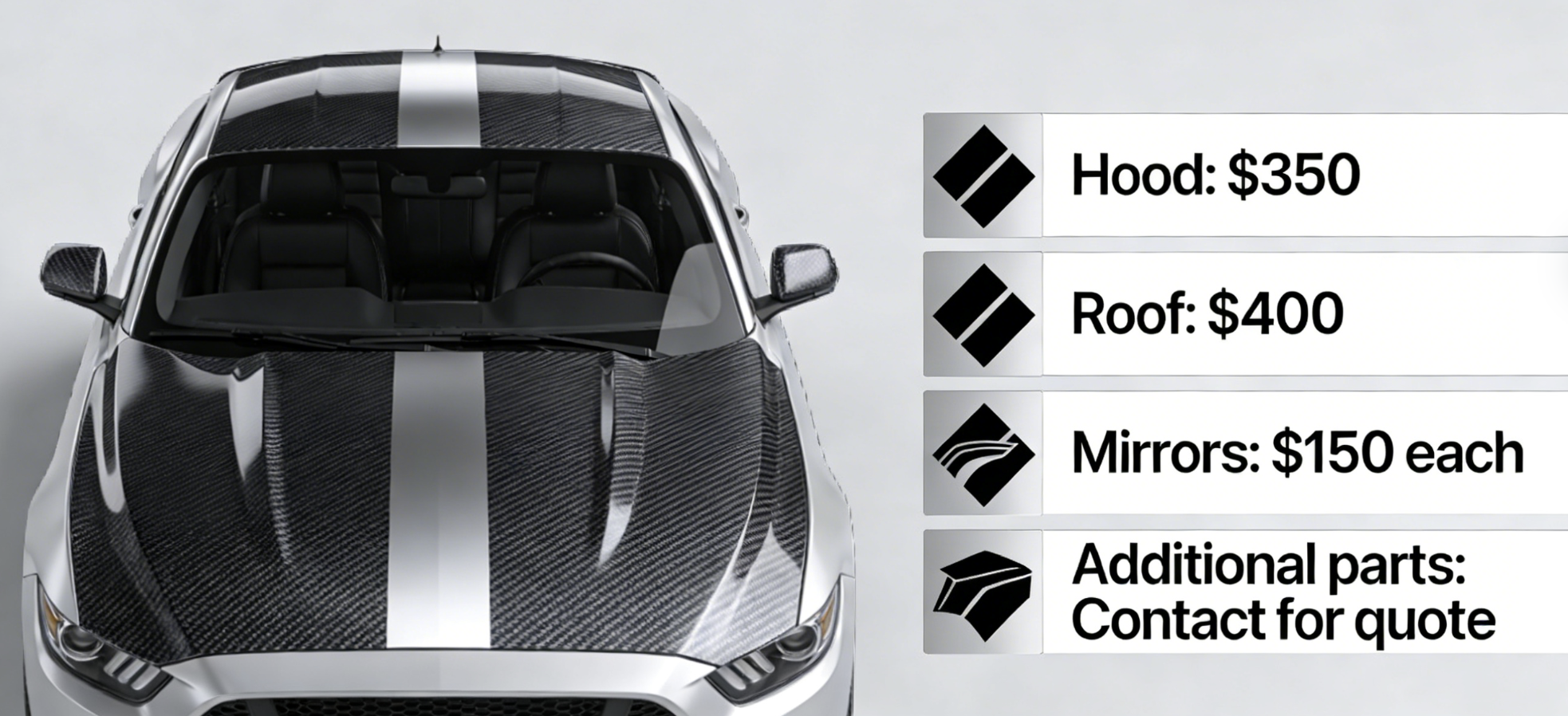
Not everyone needs a full wrap. For most builds, a few targeted panels do more visual work than a complete car transformation at three times the price.
That’s the real sell of partial carbon fiber wraps: 80% of the visual impact at 20% of the full-wrap cost. Here’s how the numbers break down by panel.
Price by Panel: DIY vs. Professional Install
|
Panel |
DIY Materials |
Professional Install |
|---|---|---|
|
Hood |
$15–$300 |
$250–$500 |
|
Roof |
$128–$300 |
$300–$600 |
|
Mirrors (pair) |
$30–$35 |
~$100 |
|
Spoiler/Wing |
$15–$300 |
$100–$500 |
|
Side Skirts |
~$300 (16-ft roll) |
$500–$1,500 |
Mirrors are the obvious entry point. The surface area is small. Complexity is low. Installation takes minimal time. Yet the side-profile change is immediate and noticeable. A shop charges around $100 per pair. DIY vinyl runs $30–$35. That’s a 66% saving for about 45 minutes of careful work.
The hood is where most people spend first, and for good reason. It’s the visual focal point of any build. Pro installation runs $250–$500 depending on panel curvature. DIY materials sit at $15–$300 depending on brand and grade. A hood-plus-roof combo at a professional shop lands around $350–$600 total — one of the better-value packages you’ll find.
Where to Start on a Budget
Prioritize in this order: mirrors → hood → spoiler → roof → side skirts.
Start with low-complexity panels first. That approach saves 50–70% compared to jumping straight to high-labor pieces before you’ve developed any technique.
Side skirts sit at the bottom of the list for a reason. Long curved panels leave no room for error. A botched install on a 16-foot rocker panel costs real money to fix — so build your skills first, then tackle them last.
Carbon Fiber Wrap Material Price Guide: Per Sq Ft, Per Roll & By Brand

Material cost is the one number most people get wrong before they ever call a shop.
Here’s the actual range: standard carbon fiber vinyl runs $4–$9 per square foot. General wrap film — including carbon texture variants — lands between $8–$12/sq ft. The deeper and more dimensional the carbon look, the higher you sit in that range. A flat printed texture sits at the bottom. A raised 3D/5D pattern with real depth sits at the top.
Here’s what that looks like in real numbers. A sedan needs about 60 square feet of material for a full wrap. At $6/sq ft average, that’s $360 in raw materials. Add professional installation at $2–$4/sq ft. Your total material-plus-labor cost runs $720–$840 — and that’s before shop overhead and regional markup.
Brand-by-Brand Price Breakdown
Not all carbon fiber film is priced the same. The gap between budget and premium is wider than most people expect.
|
Brand |
Price Per Sq Ft |
Key Notes |
|---|---|---|
|
3M IJ180CV3 Controltac |
$4.59–$5.19 |
Air-release channels, clean removability |
|
3M IJ180MC-114 |
$5.49–$6.09 |
Gloss, satin, and matte finish options |
|
3M IJ180MC-120 Metallic |
$5.49–$6.09 |
Slideable application, non-visible air release |
|
Avery Dennison MPI 1105 |
$4.29–$4.89 |
High durability, RS easy-apply liner |
|
Avery Dennison Chrome |
$16.99–$20.49 |
Premium chrome finish |
|
Vvivid Carbon 3D/True R |
~$20 (small cuts) to $546/full roll |
Raised 3D texture, UV resistant |
3M and Avery Dennison land in the $4–$6/sq ft range for standard carbon fiber film. You get better conformability, more consistent adhesive, and longer outdoor durability. That’s what separates them from generic brands — and why the extra cost holds up.
Vvivid is worth a closer look for budget-conscious builds. Their 3D carbon rolls start around $20 for small cuts and scale up to full rolls covering 546 sq ft. The raised texture pattern delivers real visual depth — not just a printed effect.
Roll Buying vs. Cutting to Size
Buying by the roll makes sense once you’re covering more than one or two panels. A 150 sq ft roll handles a full sedan wrap with material left over for mistakes and trim. Premium brands run 10–20% higher per roll than entry-level options. But cheap film wastes more and needs more rework. That gap closes faster than you’d think.
One number worth keeping in mind: the 50 sq ft comparison tells the real story. Standard black vinyl costs around $2/sq ft. Carbon fiber film in the same size jumps to $3.80/sq ft — a $90 premium for the texture upgrade. That’s your baseline cost for the carbon fiber look, before a single installation hour gets added to the bill. If you’re curious about the real differences between forged carbon fiber and traditional 3D/5D patterns, check out our detailed breakdown in Forged Carbon Fiber Wrap Explained.
Carbon Fiber Wrap vs Full Repaint: Cost & Value Comparison

The repaint shop wants $6,000. The wrap installer quotes $3,500. Same car, same goal — and a $2,500 gap sitting between them.
That gap is real. And it’s just the start of the cost story.
A professional carbon fiber wrap runs $2,000–$6,000 with installation included. A quality repaint starts at $3,000 and climbs fast. Custom colors, metallic finishes, and pearl coats push that number past $10,000–$20,000. Wraps come in 30–60% cheaper upfront, almost every time.
But upfront cost isn’t the whole picture. Here’s the full breakdown:
|
Aspect |
Carbon Fiber Wrap |
Full Repaint |
|---|---|---|
|
Upfront Cost |
$2,000–$6,000 |
$3,000–$20,000+ |
|
Installation Time |
1–3 days |
1–2 weeks |
|
Longevity |
5–10 years |
5–10 years |
|
Minor Repair Cost |
~$200 per panel |
$500+ touch-up |
|
Removal Cost |
$500–$1,000 |
Permanent |
Both options last 5–10 years with proper maintenance. The real difference shows up in what happens when things go wrong — and at some point, something always does.
Where Wraps Win on Long-Term Cost
Run the 5-year math. A wrap costs around $3,500 total — installation plus maintenance. A repaint lands closer to $8,000+ over the same period. That’s a 50–60% saving. Not a rounding error.
Repairs tell the same story. A damaged panel on a wrapped car costs $200 to patch or re-wrap. The same damage on a repainted surface? You’re looking at $500+ in sanding, color-matching, and finish work. The wider the coverage, the more expensive the fix.
Wraps also protect the original paint underneath. UV rays, stone chips, and minor abrasions hit the vinyl — not your factory finish. Pull the wrap off before selling, and the OEM paint underneath comes up clean. That protects your resale value — and can push it up by 5–10%.
When a Repaint Makes More Sense
For long-term keepers and collector builds, the math shifts. A premium repaint lasts 10+ years with proper care. It carries higher perceived quality among serious buyers. It also blends with the car’s original identity in a way vinyl can’t match.
The practical decision comes down to commitment:
-
Leasing or short-term ownership (2–3 years)? Go with a wrap. It’s removable, reversible, and protects the OEM finish for a clean return.
-
Daily driver with high mileage? Also a wrap. Cheaper to repair, easier to refresh every 5–7 years at close to half the repaint cost.
-
Long-term keeper or collector car? Repaint — but make sure the color choice is final and the shop is premium-grade.
Carbon fiber wrap isn’t a compromise. For most drivers, it’s the smarter financial move — and the numbers back that up at every stage of ownership.
Regional Price Differences: What You’ll Pay in 2026 by Location

Your ZIP code moves the final number more than most people realize.
Shop labor rates follow regional cost of living closely. California’s Regional Price Parity sits at 110.7 — meaning everything costs 10.7% above the national average before a single hour of installation begins. Arkansas lands at 86.9. That 24-point gap shows up in your wrap quote.
Here’s the breakdown:
|
Region |
RPP vs. National Avg |
Typical Install Premium |
|---|---|---|
|
CA, NY/NJ, New England |
+8–11% |
+20–30% over national baseline |
|
Southeast, Midwest |
Near average |
At or just below baseline |
|
Plains, AR, MS |
-12–13% |
15–20% below national baseline |
Northeast inflation ran 3.3% YoY through late 2025. The South held at 2.2%. That gap stacks on top of skilled labor costs — and wrap installation counts as skilled labor.
Is It Worth Driving for a Cheaper Quote?
It depends. LA and New York shops run 20–50% above mid-market rates. A $5,000 base job in those cities adds $1,000–$2,500 in regional premium. Drive 500 miles to a lower-cost market and you’re spending around $500 in gas plus $400 in time. The math works only if your net savings clear $900.
Pull at least three local quotes. Specify your vehicle, panel count, and material grade upfront. Then cross-check against the RPP-adjusted national average for your state.
Key Factors That Affect Your Carbon Fiber Wrap Price in 2026

Five variables move your carbon fiber wrap quote more than anything else. Know them before you walk into a shop. You’ll avoid overpaying.
1. Vehicle Size and Surface Complexity
Surface area is math. More square footage means more material and more labor hours. But complexity pushes the cost beyond just size. Tight curves, vented hoods, sharp body lines — these slow an installer down.
A sports coupe with 60 sq ft of surface can cost more in labor than an SUV with 70 sq ft. Every curve needs a heat gun, a squeegee, and time. That adds up fast.
2. Material Grade
Entry-level carbon vinyl and a true 5D raised-texture film are not in the same category. The difference shows up in your quote, not just in looks. Budget film sits at the low end of the $4–$9/sq ft range. Premium 3D/5D patterns push toward the top. That $3–$5/sq ft gap scales fast across a full vehicle.
3. Skilled Labor Availability
Carbon fiber vinyl leaves no room for error. Bubbles and misaligned seams are visible. Installers who handle this material well are scarce in many markets — and that scarcity costs you. In metro areas, demand outpaces the available talent pool. Shops there charge higher hourly rates as a result.
4. Supply Chain Conditions
Raw carbon fiber production stays volatile. Global growth is real — China at 15.3% CAGR, India at 14.1% — and total supply is rising. But regional distribution gaps still cause short-term price swings. Film inventory tightens, material costs rise. Shops pass that uncertainty straight into your quote.
5. Brand and Film Certification
3M, Avery Dennison, and Oracal charge a premium for good reason. You get consistent adhesive chemistry, verified outdoor durability ratings, and clean removability. Generic films undercut them on price — but often rack up more rework hours. Shops stocking certified film factor that sourcing cost into what they charge you.
Carbon Fiber Wrap FAQ: Durability, Maintenance & Removal Costs
Carbon fiber vinyl needs upkeep — and any installer who says otherwise is just trying to close a sale.
Here’s what lifespan data shows in 2026. A wrap installed with cast vinyl holds up for 5–7 years under normal conditions. Step up to premium film from 3M, Avery Dennison, or KPMF, park in a mild climate, and garage the car? Some wraps last 10–12 years with no major degradation. Go cheap on materials or installation, and you’ll see peeling edges and faded spots within 18 months.
Four things decide which outcome you get:
-
Film grade — Cast vinyl outlasts calendered vinyl by 2–5 years. That quality gap is built into the $4–$9/sq ft price range. You get what you pay for at both ends.
-
Installation quality — Poor application destroys a good film fast. Lifted edges trap moisture. Stretched sections crack early. A bad install can’t be fixed — you start over.
-
UV exposure — Sunlight breaks down vinyl at the chemical bond level. Parking in direct sun every day cuts the lifespan by a clear margin. A garaged car in the same climate lasts much longer between replacements.
-
Climate — Extreme heat and freeze-thaw cycles speed up wear. In hot climates, expect a lifespan of 5–8 years, even with premium film.
Maintenance: What Keeps It Looking Good
Hand wash with pH-neutral soap. Skip automated car washes — the brushes snag edges and create lift points. Keep the surface out of direct sunlight for long stretches where you can. That covers most of it.
Aging signs aren’t hard to spot. Look for dullness in the carbon texture pattern — this shows up first on flat horizontal panels like the hood and roof. Edge peeling starts at curves and door handles. See bubbling spreading across a panel? The adhesive has already failed. No maintenance fixes that.
Removal Costs
Professional removal runs $500–$1,000 for a full car. That price includes heat gun work, adhesive residue cleaning, and panel inspection — not just peeling film off. DIY removal is doable, but the risk is real. Rush it without heat and you pull paint. This is a bigger problem on older factory finishes or cars with prior bodywork.
One rule to keep in mind: stay within the film’s intended lifespan, and removal leaves the original paint clean underneath. That paint protection is part of what you paid for at installation.
Conclusion
You now have everything you need to stop guessing and start planning.
Carbon fiber wrap pricing in 2026 isn’t a mystery — it’s a spectrum. A hood wrap can transform your car’s look for under $300. A full professional installation on a luxury vehicle can climb past $5,000. That gap comes down to material grade, labor complexity, and the brand on the roll.
Here’s what matters most: know your budget before you walk into any shop. You have real per-square-foot costs, brand comparisons, and regional benchmarks. You’re not negotiating blind anymore.
Contact HyperX Carbon – Your Trusted Chinese Carbon Fiber Partner
Ready to source high-performance carbon fiber materials or custom forged carbon fiber parts from China?
HyperX Carbon is a leading manufacturer with 20+ years of expertise, specializing in aerospace-grade forged carbon fiber, prepreg, tubes, sheets, and lightweight automotive/drone/medical components. We offer:
-
Stable supply chain with premium raw materials (Toray, Mitsubishi, Hengshen)
-
AS9100D certified production for aerospace & UAV applications
-
Rapid prototyping (5-8 weeks) and monthly capacity exceeding 180,000 parts
-
Competitive pricing with 15-18% cost savings on forged carbon solutions
-
Full customization: from T700/T1100G to ultra-high modulus grades
Whether you’re an eVTOL developer, automotive OEM, drone manufacturer, or medical device engineer, HyperX delivers consistent quality, batch-to-batch reliability, and reliable delivery.
Get in touch today for a free consultation, custom quote, or material sample.
📧 Email: [email protected]
🌐 Website: https://www.hyperxcarbon.com/
📞 Phone/WhatsApp: +86 15623270276 (English support available)
Let’s build your next lightweight innovation together – contact HyperX Carbon now and stay ahead in the low-altitude and advanced composites market.