Carbon fiber sheets are easy to find. Finding the right one — at the right price, from a supplier you can trust — is the hard part. Most buyers waste hours on this.
Building a lightweight drone frame? Reinforcing an automotive part? Sourcing material for a high-load structural job? The supplier you pick matters just as much as the spec sheet. The wrong one gives you inconsistent fiber orientation, bad resin ratios, and a carbon fiber sheet price that doesn’t match what you’re getting.
This guide covers everything you need:
-
Every major purchasing channel
-
What separates a reliable carbon fiber composite sheet from a cheap imitation
-
What to check before you place an order
Key Factors to Consider Before You Buy Carbon Fiber Sheets

Spec sheets lie by omission. They tell you the tensile strength but not whether the fibers ran straight during layup. They list the thickness but skip the tolerance. Four variables separate a panel that performs from one that fails. None of them are obvious until you know what to look for.
Thickness: Match It to the Load
Thickness isn’t a preference. It’s an engineering decision.
-
0.2mm — veneer territory. Use it for decorative overlays and weight-critical skins where structural load isn’t the goal.
-
1–3mm — the workhorse range. Think automotive panels, drone frames, and moderate structural parts.
-
5mm and above — heavy-load territory. Aerospace supports, industrial fixtures, anything taking sustained mechanical stress.
Tolerances matter as much as the stated number. Good suppliers hold ±0.1mm. For imperial specs, expect ±0.010″ up to 0.124″ thick, and ±0.020″ from 0.125″ to 0.375″. A supplier who can’t state their tolerance has already given you the answer.
Weave Pattern: Strength vs. Appearance
|
Weave |
Strength Profile |
Best For |
|---|---|---|
|
3K Plain |
Moderate, balanced |
Decorative panels, clean finish |
|
2×2 Twill |
Higher flex + strength |
Automotive, consumer electronics, sports gear |
|
Unidirectional (UD) |
Maximum in one axis |
Structural beams, directional load paths |
|
Quasi-Isotropic |
Balanced across all axes |
Parts that need uniform stiffness in every direction |
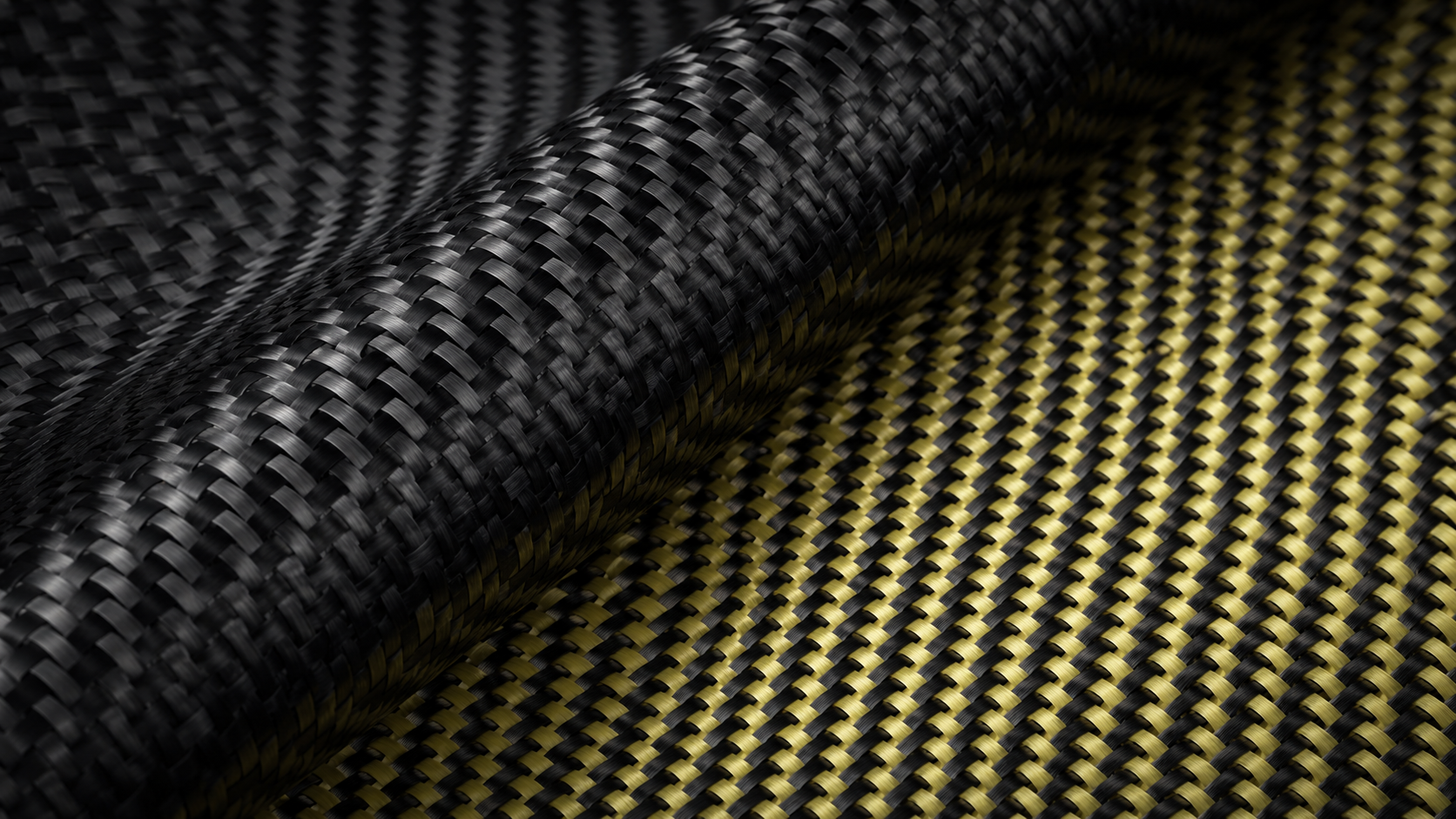
Twill weave carbon fiber handles better in complex curves. Plain weave carbon fiber gives a tighter, more uniform surface. Neither is better overall — your application decides.
Fiber orientation is its own factor. Standard twill plates run 0°/90° to stay flat and keep mechanical behavior predictable. Check fiber straightness before you commit to a large order. Crooked plies weaken the whole panel.
Surface Finish and Quality Baseline
Two finishes lead the market. Mirror gloss for visibility and aesthetics. Matte for functional, high-wear surfaces — it resists scratches better and holds up longer under friction.
On quality, reject any sheet that shows bubbles, ripples, or surface warps. A solid carbon fiber composite sheet runs at 1.45 g/cc (0.052 lb/in³). Cutting tolerances need to hold at ±0.125″ on length and width. Those aren’t guidelines — they’re your quality floor.
Where to Buy Carbon Fiber Sheets: 4 Main Purchasing Channels

The carbon fiber market is on track to exceed USD 10 billion by 2029, growing at a 9.2% CAGR. More suppliers and more options sound great. But more choices also mean more chances to buy a panel that fails. Know your channel before you buy.
Four channels dominate the market. Each one fits a different type of buyer.
Channel 1: Direct from Manufacturers
This is the shortest path between you and the material. No distributor margin. No middleman misreading your specs.
Manufacturers like hyperxcarbon.com offer sizes from 100×100mm up to 1000×2000mm. Need something larger? Request it. Thickness runs from 0.5mm to 6mm+. CNC cutting holds tolerances at ±0.005 inch. You choose plain weave, 3K twill, glossy, or matte — your call.
Pricing by thickness:
– 0.5–1mm: $30–$50
– 1–3mm: $50–$80
– 3–6mm: $80–$150
MOQ starts at 10 sheets for samples. Production lead time runs 15–30 days. Sample orders ship in 7 days.
Best for: Engineers, OEM buyers, and procurement teams with defined specs.
Watch for: You’ll need to vet the supplier first. Lead times run longer than retail.
Channel 2: Online Retailers and E-Commerce Platforms
The average spend on carbon fiber sheets through online retail sits at $41.88 per purchase. That number tells you a lot about who shops here — and what they need.
Amazon handles immediate needs well. You get multiple sellers, user reviews, fast shipping, and easy price comparison. eBay adds auction pricing for potential savings. Dedicated retailers — Rock West Composites, DragonPlate, Carbon Fiber Gear — go deeper. They carry multiple weave patterns, list full specs, and include selection guides.
Best for: DIY builders, rapid prototyping, and single-sheet purchases.
Watch for: Customization options are limited. Quality varies by seller. Check that you’re buying real prepreg-based carbon — not a fiberglass core with a thin carbon surface layer on top.
Channel 3: B2B Industrial Platforms
Alibaba, AliExpress, and Made-in-China give you direct access to global manufacturing prices. Unit costs drop at volume — and the gap is real. Some Chinese manufacturers also offer custom-colored carbon fiber with non-standard finishes beyond the typical black.
The tradeoff is clear: counterfeit and low-grade products exist on these platforms. Some sheets break under load conditions that a certified sheet handles without trouble.
To reduce that risk, check seller ratings. Request samples before placing bulk orders. For high-value orders, run a factory audit.
Best for: Large-volume procurement, cost-sensitive buyers, and OEM sourcing at scale.
Watch for: Quality inconsistency is the main risk here. Do not skip sample qualification.
Channel 4: Specialty Composites Distributors
Composites One, Fibre Glast, McMaster-Carr, and Grainger operate at a different level. These are not retail marketplaces. They are industrial supply chains built for compliance-driven applications — aerospace, medical, defense, and robotics.
You get detailed datasheets, verified certifications, technical consultation, and reliable lead times. McMaster-Carr works well as a one-stop shop for multi-component projects. Composites One pairs professional-grade materials with direct engineering support.
The price premium is real. You’re paying for documented quality and regulatory backing. That matters when your application has certification requirements your supplier must meet.
Best for: Aerospace, medical, and defense applications where material traceability is non-negotiable.
Watch for: Higher unit cost. Your location may limit which distributors are available to you.
Quick Comparison
|
Channel |
Price |
Lead Time |
MOQ |
Customization |
Best Use Case |
|---|---|---|---|---|---|
|
Direct Manufacturer |
Lowest (bulk) |
15–30 days |
~10 pcs |
Full |
OEM, engineers |
|
Online Retail |
Mid (~$41.88 avg) |
Days |
1 pc |
Minimal |
DIY, prototypes |
|
B2B Platforms |
Very low (bulk) |
Varies |
Negotiable |
High |
Large-volume |
|
Specialty Distributors |
Highest |
Fast–medium |
Varies |
Moderate |
Aerospace, medical |
Top Places to Buy Carbon Fiber Sheets Online (Supplier Comparison)

Eight suppliers. Very different strengths. Here’s what sets them apart.
|
Supplier |
Thickness Range |
Price (12×12″) |
MOQ |
Best For |
|---|---|---|---|---|
|
HyperXCarbon |
1mm–50mm |
~$25 |
1 sheet |
Custom specs, fast turnaround |
|
DragonPlate |
Up to 1.5″ |
$20–$35+ |
None |
Large sheets, DIY |
|
Easy Composites |
Variable |
From $20.83 |
None |
OEM, F1-validated quality |
|
Rock West Composites |
Up to 2″ |
$20–$35+ |
None |
Thick plates, machining |
|
Carbon Fiber Gear |
Multiple |
Competitive |
None |
Beginners, broad selection |
|
Toray |
Aerospace grade |
$35+ |
Bulk |
Aerospace, max tensile |
|
Mitsubishi Chemical |
Aerospace grade |
$35+ |
Bulk |
Extreme-load applications |
|
SGL Carbon |
Industrial |
$35+ |
Bulk |
Automotive, sustainability |
What Makes Each Supplier Different
HyperXCarbon.com carries the widest spec range on this list. Thickness runs from 1mm to 50mm. Sheets go up to 2×3m. Fiber is Toray/Hexcel-sourced and tests above 700 ksi. Prices run about 20% lower than comparable suppliers. A standard 12×12″ 3K twill sheet costs around $25. Volume discounts reach 15–30%. You also get free CAD files within 48 hours. Global delivery takes 3–7 days. US orders ship with a 24-hour turnaround.
DragonPlate offers the largest standard sheet size at 48×96″. That makes it a strong choice for big structural jobs.
Easy Composites produces 40sqm of material per day in-house. Each sheet comes with its own mechanical test data. F1 teams and medical OEMs rely on them — and that says a lot.
Rock West Composites goes the thickest — plates up to 2″. Machining services are built in. So it’s a solid pick for load-bearing parts that need post-processing.
Carbon Fiber Gear stocks the broadest range of finishes and thicknesses. You also get hands-on selection support. It’s a good starting point if you’re still working out your spec.
Toray (255 ksi tensile), Mitsubishi (640 ksi Tansome), and SGL Carbon (403 ksi, 33.6 Msi modulus) sit at the material-tier level. Bulk orders are required. Pricing is premium. For aerospace and defense work, the quality standards here are non-negotiable.
Bottom line: Need flexible specs, fast delivery, and competitive pricing? HyperXCarbon is the place most buyers should start.
Carbon Fiber Sheet Prices: What to Expect and What Affects Cost

Price breaks most procurement decisions. In carbon fiber, the range is brutal: USD 75 on the low end, USD 320+ at the top — for what looks like the same black panel.
Here’s what’s driving that gap.
The Four Variables That Set Your Price
Fiber grade moves the needle most. Standard Modulus fiber keeps costs low. It’s the workhorse behind industrial parts and EV components. Intermediate Modulus costs more. High Modulus — used in aerospace and defense — carries the highest prices and leaves little room for negotiation.
Thickness compounds everything. More layers mean more fiber, more resin, more cure time. A 5mm custom High Modulus sheet from a North American supplier can hit USD 250–320+ per square meter. A standard 1mm sheet from China or India? USD 75–120.
Manufacturing method builds in a 30–60% price gap from the start. Autoclave-cured panels consolidate better and trap fewer voids — you pay for that quality. Vacuum-infused panels cost less but carry higher porosity risk.
Customization adds a hard floor cost. Custom dimensions need tooling that runs USD 5,000–20,000 per setup. Standard 1×2m panels run 30–50% cheaper than equivalent custom-cut orders. Your application tolerates standard sizing? Use it. The savings are real.
What the Cheap Option Really Costs You
Sheets under USD 100 per square meter carry real risk:
– Void content above 5%
– Resin ratios that miss the mark
– Interlayer shear strength below 50 MPa
These panels fail 2–3× faster under load cycling. The upfront savings disappear inside the first maintenance cycle. Premium material adds 20–50% upfront — but cuts replacement costs by 40% across the panel’s full service life. That math works out fast.
Buying Smart at Volume
Orders above 500 square meters get you 15–30% discounts with most manufacturers. For high-volume procurement, India and China offer the best price-to-performance ratio — USD 75–170 per square meter. Run supplier qualification first. Don’t skip that step.
One more thing worth watching: Toray raised carbon fiber and prepreg prices 10–20% effective January 2026. That increase is already moving through the supply chain. Lock in pricing now — your project timeline may give you that window.
Carbon Fiber Sheets for Specific Applications: Which Type Do You Need

The wrong spec wastes money. The right one disappears into your build and never causes problems again.
Four application types drive most carbon fiber sheet purchases. Each one needs a different material decision.
Drones, Robots, and RC Builds
Thin and stiff. That’s the goal. Go with 0.5–2mm, balanced 0°/90° laminate or quasi-isotropic layup. Density runs 1.45–1.95 g/cc — about a quarter of steel. The strength-to-weight ratio beats titanium, aluminum, and steel. 3K twill (Toray T700 or Hexcel AS4) is the standard pick here. It’s lighter than 6K or 12K. You also get better elongation and a cleaner finish.
Automotive Exterior and Trim
2×2 twill weave carbon fiber owns this category for good reason. It curves well. It glosses up clean. It looks the way carbon fiber should look. For cosmetic panels, stick with 3K fine tow (198 g/1000m). For structural load-bearing parts, step up to 6K or 12K. Intermediate modulus fiber handles both stiffness and cost. It’s a solid fit for RTM or vacuum bagging processes.
Industrial and Aerospace Structural Parts
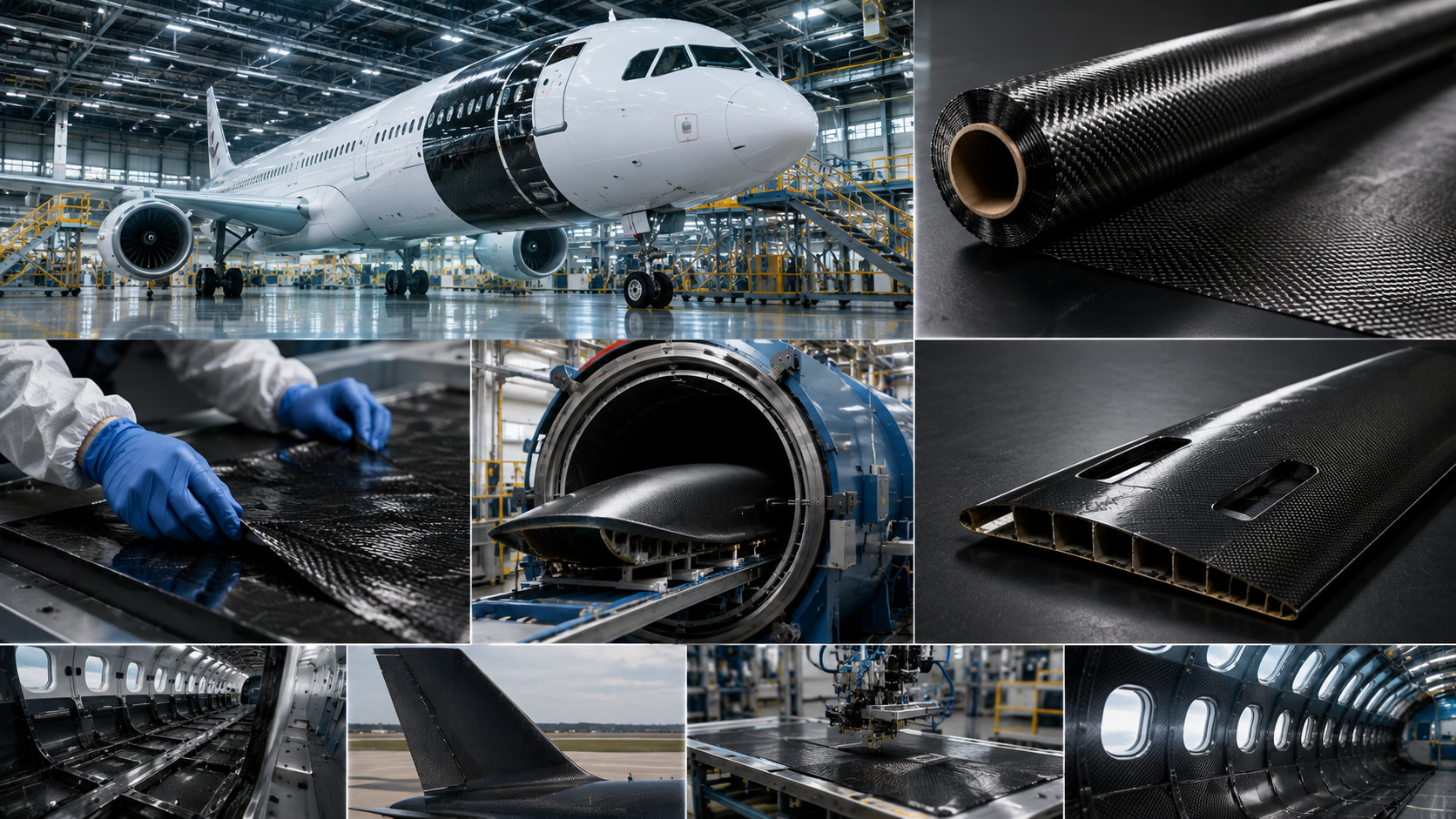
Go thick. Go unidirectional. 3mm+ prepreg-pressed panels with 55% fiber volume, 45% epoxy set the baseline. Void content must stay controlled — that’s not a preference, it’s a certification requirement. High-modulus fiber pushes above 600 GPa. Pitch-based fiber reaches thermal conductivity up to 1,000 W/m·K. That matters for heat-critical assemblies where standard fiber falls short.
DIY and Prototyping
Start with 3K plain or twill weave, 0.5–2mm thick, standard 48×96″ sheet. No exotic fiber needed. PAN-based standard modulus HT gives you balanced properties at the lowest cost. Check density at 1.45 g/cc and fiber volume at 55% before you buy. Low MOQ options are easy to find — most suppliers ship single sheets without a minimum order hassle.
How to Verify Carbon Fiber Sheet Quality Before Purchasing
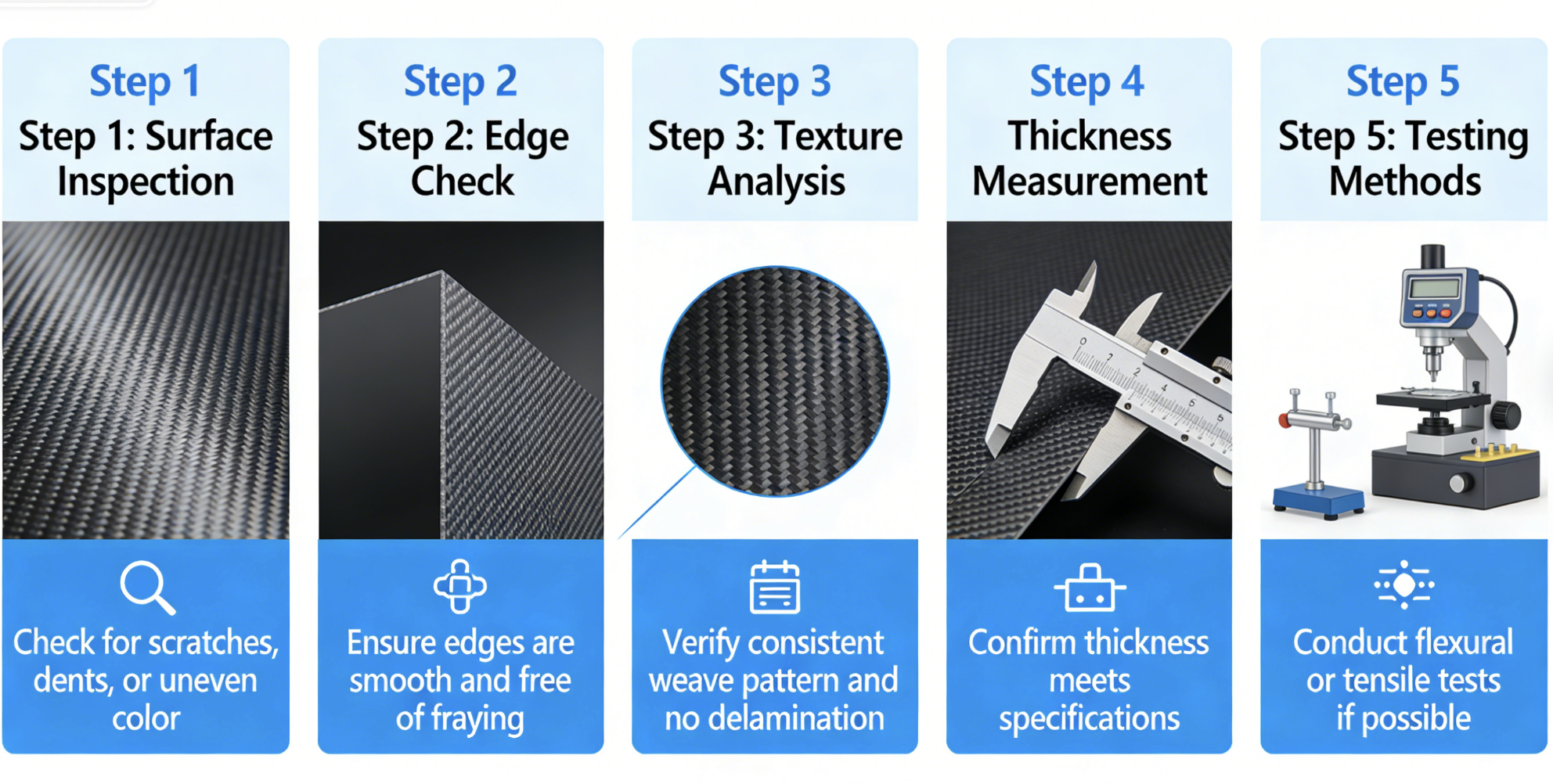
Bad carbon fiber doesn’t announce itself. It looks exactly like the real thing — same dark weave, same glossy surface. You won’t know it’s fake until it’s already inside your build.
Here’s how to catch it first.
Physical Tests You Can Run Right Now
Look at it. Real carbon fiber has a 3D depth to the weave — tight, uniform, with a slight optical shift as you rotate it under light. Fakes look flat. The pattern looks printed because it is.
Feel it. Run your finger across the surface. Genuine sheets have a subtle texture where fiber meets resin. Touch it and feel nothing but smooth? That’s a red flag.
Flip it over. Real edges show frayed fiber tows. Fakes expose adhesive, ABS backing, or a fiberglass core. That edge tells you what’s inside better than anything else.
Tap it. A knuckle tap on real carbon gives a crisp, high-pitched ring. Hollow or dull? Walk away.
Flex it. Press your thumb into the center. Real sheets push back. They hold firm under moderate hand pressure. A sheet that bends too easy has the wrong fiber volume.
Scratch it. Use a fingernail or plastic pick on a corner. Real carbon resists peeling — the surface may scratch, but the pattern stays intact. Fakes chip or flake. You’ll see a different material underneath.
Heat test on scrap. Hold a heat gun 2–3 inches away for a few seconds. Genuine carbon fiber holds up to 400°C (752°F) with no warping, bubbling, or melting. Fake panels deform fast. They also give off a plastic smell that removes all doubt.
What to Request from Your Supplier
Physical tests get you most of the way there. Documents fill the rest of the gap.
Ask for:
– Material Certificate with traceable raw material origin
– Tensile test reports — HTCF benchmark is 24 GPa; HMCF runs 36 GPa
– ISO certification and laminate quality datasheets
– Third-party lab results — microscopy, FTIR, or CT scanning if your application calls for it
A supplier who pushes back on any of these is already telling you something important about what they’re selling.
Instant Red Flags
|
Warning Sign |
What It Likely Means |
|---|---|
|
Price is way too low |
Fiberglass core + thin carbon surface, or hydro-dip vinyl |
|
No raw material documentation |
Unverified fiber grade, unknown void content |
|
Refuses sample orders |
No confidence in what they’re shipping |
|
Surface too perfect, zero texture |
Printed or laminated cosmetic film |
The rule is simple. A supplier who stands behind their material sends you a sample, hands over the datasheet, and doesn’t hesitate when you ask who made the fiber.
Frequently Asked Questions About Buying Carbon Fiber Sheets

Buyers ask the same questions every time. Here are straight answers.
What’s the minimum order quantity?
Most direct manufacturers start at 10 sheets for sample orders. Online retailers — Amazon, DragonPlate, Rock West Composites — sell single sheets with no minimum required. B2B platforms like Alibaba negotiate MOQ by volume.
Can I get custom sizes?
Yes. Suppliers like HyperXCarbon cut to order from 100×100mm up to 1000×2000mm. CNC tolerances hold at ±0.005 inch. Standard 1×2m panels cost 30–50% less than custom cuts. Your design works with a standard size? Go with it and save money.
What thickness should I order?
Match it to the load:
– 0.5–2mm — drones, RC frames, and lightweight panels
– 1–3mm — automotive parts and moderate structural work
– 3mm and above — parts that take sustained mechanical stress
What’s the difference between plain weave and twill weave carbon fiber?
Plain weave gives a tighter, more uniform checkerboard surface. Strength is moderate. It works well for decorative panels. Twill weave sits differently — it bends over curves more easily, offers higher flex strength, and is the go-to choice for automotive and sports applications.
How do I know the sheet is real carbon fiber?
Run a few quick checks:
– Tap it — real carbon rings crisp and high
– Flip it — genuine edges show frayed fiber tows, not adhesive or fiberglass backing
– Ask for a tensile test report — standard modulus fiber hits 600–700 KSI tensile strength
No documentation? Walk away.
What shipping method applies to large panels?
Panels under 100×100cm ship via courier. Larger orders move by freight. HyperXCarbon ships to destinations worldwide in 3–7 days. US orders get a 24-hour turnaround.
Conclusion
Buying carbon fiber sheets should be straightforward. No confusing specs, no sketchy suppliers, no guessing on price.
You now know what separates a structural-grade carbon fiber composite sheet from a decorative lookalike. Thickness, weave pattern, and fiber orientation each play a real role in performance. You also know which purchasing channels are worth your time — and which ones to skip.
So what’s left? Making the right call for your specific project.
Need a standard woven carbon fiber sheet for a drone frame? We’ve got you covered. Need a precision-cut panel for an aerospace component? HyperX Carbon delivers verified quality, transparent pricing, and custom sizing — with no minimum order headaches.
Contact HyperX Carbon – Your Trusted Chinese Carbon Fiber Partner
Ready to source high-performance carbon fiber materials or custom forged carbon fiber parts from China?
HyperX Carbon is a leading manufacturer with 20+ years of expertise, specializing in aerospace-grade forged carbon fiber, prepreg, tubes, sheets, and lightweight automotive/drone/medical components. We offer:
-
Stable supply chain with premium raw materials (Toray, Mitsubishi, Hengshen)
-
AS9100D certified production for aerospace & UAV applications
-
Rapid prototyping (5-8 weeks) and monthly capacity exceeding 180,000 parts
-
Competitive pricing with 15-18% cost savings on forged carbon solutions
-
Full customization: from T700/T1100G to ultra-high modulus grades
Whether you’re an eVTOL developer, automotive OEM, drone manufacturer, or medical device engineer, HyperX delivers consistent quality, batch-to-batch reliability, and reliable delivery.
Get in touch today for a free consultation, custom quote, or material sample.
📧 Email: [email protected]
🌐 Website: https://www.hyperxcarbon.com/
📞 Phone/WhatsApp: +86 15623270276 (English support available)
Let’s build your next lightweight innovation together – contact HyperX Carbon now and stay ahead in the low-altitude and advanced composites market.