
Carbon fiber has become the engineer’s go-to material — and telescoping applications show exactly why. Every gram of weight counts. Every millimeter of deflection matters.
You might be designing a UAV payload arm that retracts under a fuselage. Or sourcing a carbon fiber extension pole for high-reach window cleaning. Or spec’ing out a collapsible antenna mast for remote deployment. In each case, the material you choose upfront determines how your entire system holds up under load.
The problem? Most buyers get this wrong in one of two ways. Some overpay for specs they don’t need. Others underbuy — and find the failure point mid-project. Neither outcome is acceptable.
This guide helps you avoid both traps. You’ll get a full, technical breakdown of telescoping carbon fiber tubes: how they’re built, how they stack up against aluminum and fiberglass, where they’re being used across six demanding industries, and how to pick and source the right one for your specific application.
What Are Telescoping Carbon Fiber Tubes? Definition, Structure & How They Work
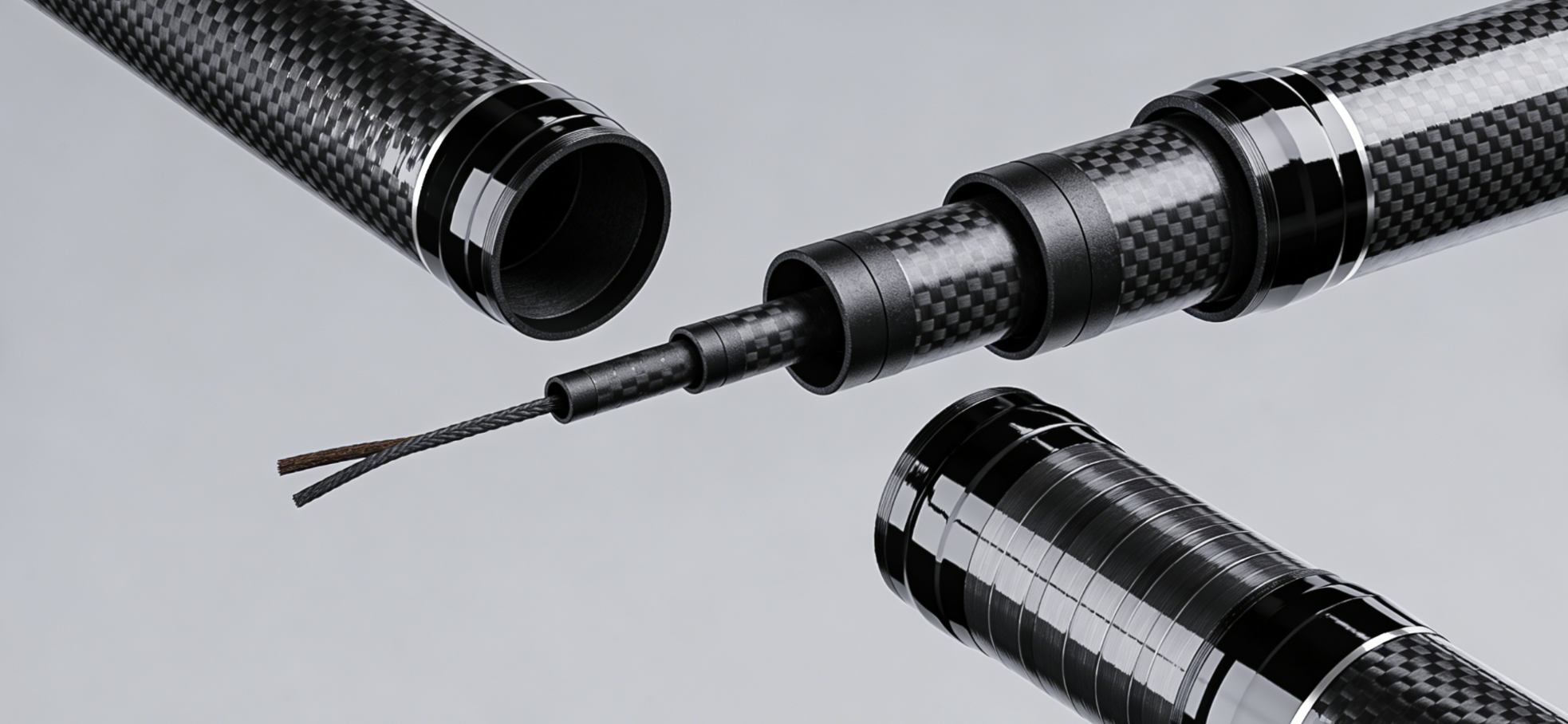
Precision is the whole game. A telescoping carbon fiber tube is a nested multi-section composite system. Inner tubes slide inside outer tubes. Each section holds tolerances tighter than 0.1mm. The result: the assembly extends and retracts with zero slop, zero wobble, zero compromise.
The definition is simple. The engineering behind it is not.
Structure: What’s Inside the Wall
Each tube section is a layered carbon fiber composite. High-strength fibers — Toray T300 or T700 are the common choices — are arranged in unidirectional and 3K or 12K woven patterns. Then they get locked into an epoxy resin matrix under heat and pressure.
That weave choice matters more than most buyers realize:
-
3K weave (3,000 filaments per tow) focuses on axial stiffness and torsional resistance — this is the configuration that holds straight under load at 10m+ extensions
-
12K weave builds hoop strength, so tube walls resist crushing and bending fatigue better
-
3K over unidirectional raises axial modulus by 20–30% — that gap separates a pole that stays rigid from one that creeps under a 100kg load
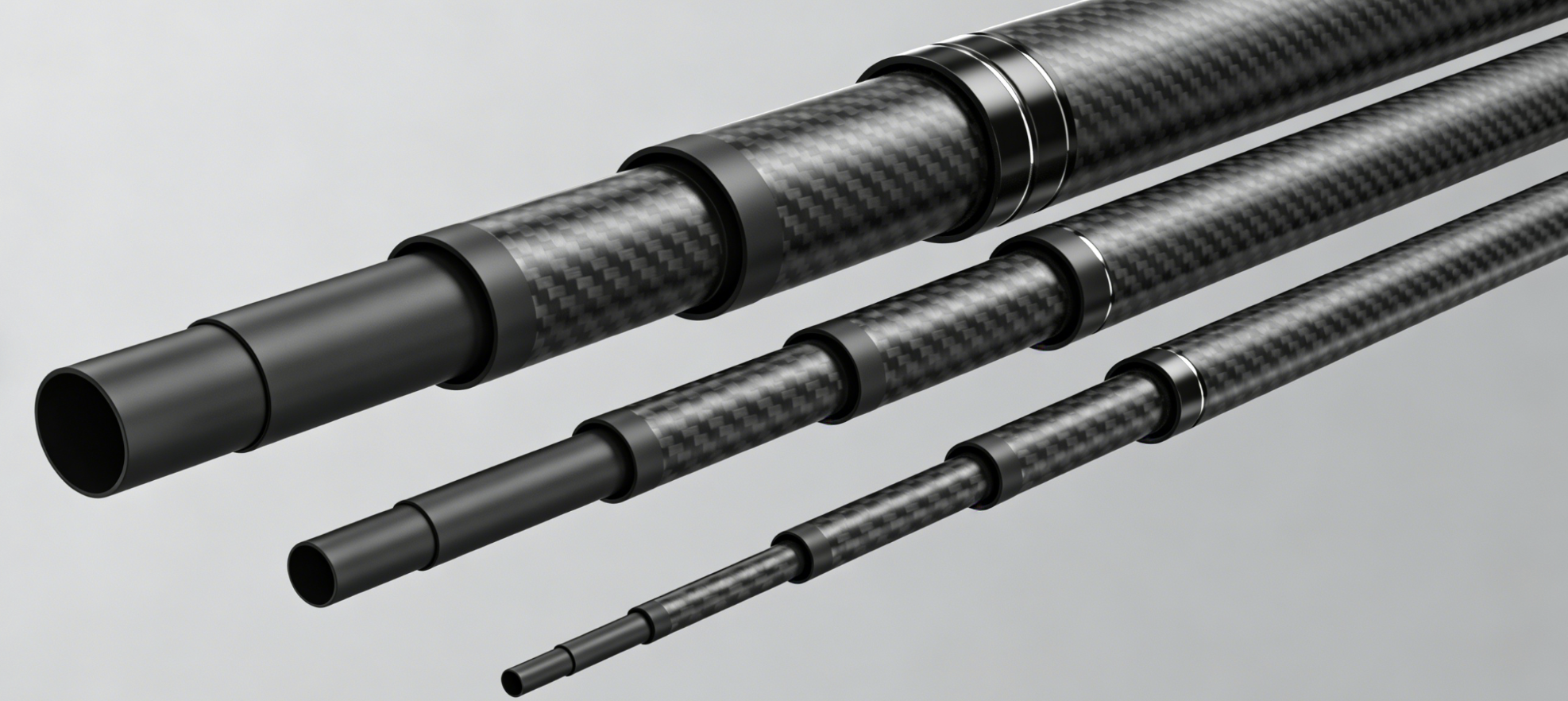
Standard outer diameters run 12mm to 50mm. Wall thicknesses sit around 0.045 inches on precision-wound sections. Take a single 2,000mm section at 40.5mm OD — nested across multiple stages, you get 10.75m of extended reach. That’s the Model T6PT2 configuration. It’s a solid benchmark for understanding what this geometry can deliver.
How the Telescoping Mechanism Works
The nesting principle is straightforward. Smaller-OD inner tubes slide into larger-ID outer tubes in sequence. Tolerances stay below 0.1mm — sometimes through custom bearings or precision-fitted bushings. So extension and retraction stay smooth even after repeated field cycles.
A well-designed system collapses to one-quarter to one-fifth of its extended length. A 25m pole folds down to about 5m. Transport volume drops 75–80%. One person can carry it.
Locking Mechanisms: Three Systems, Three Use Cases
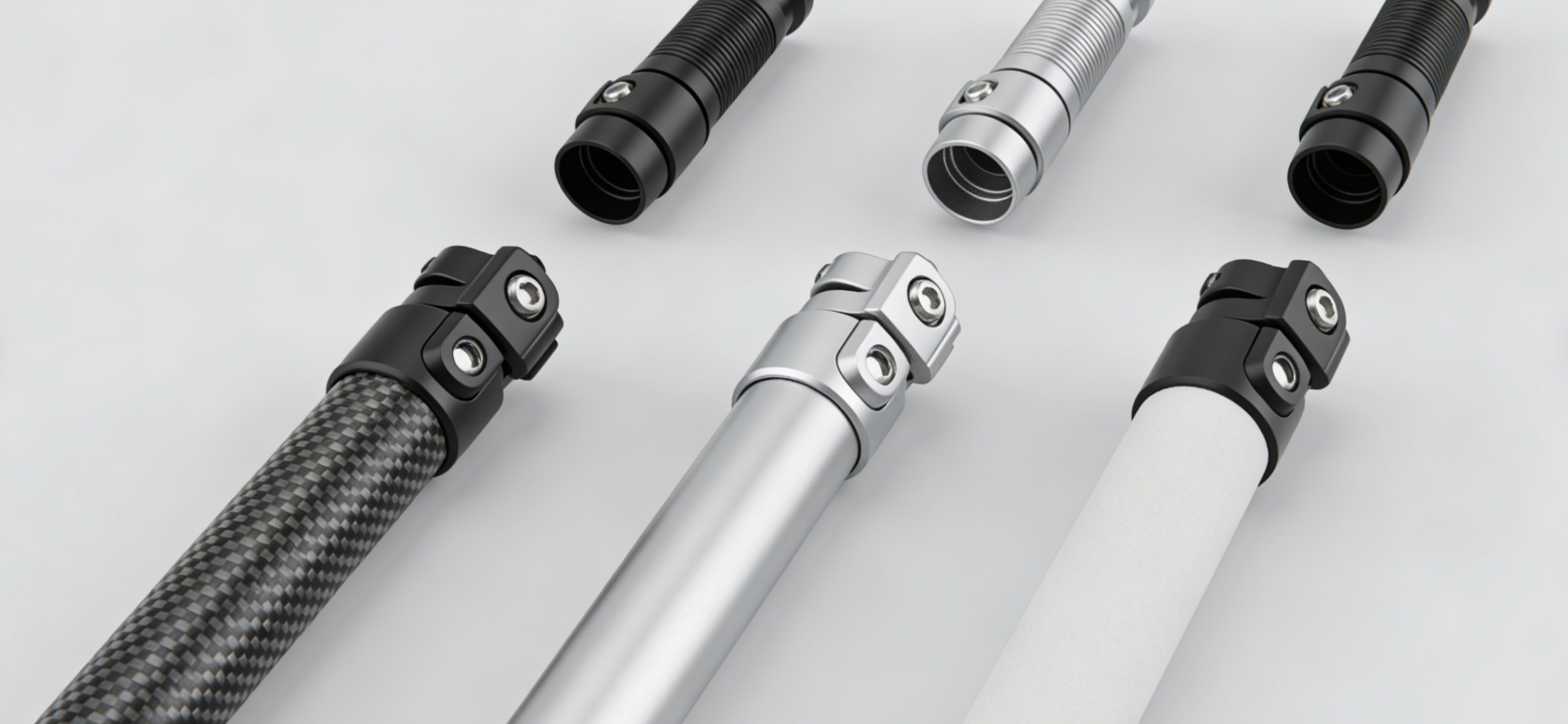
The locking system determines what a pole can handle in the field. There are three main mechanisms:
|
Mechanism |
How It Works |
Best For |
Load Capacity |
|---|---|---|---|
|
Friction Clamp |
Cam or bolt applies radial compression to squeeze sections |
Photography poles, static loads |
Up to 500kg shear; poor torsion resistance |
|
Twist Lock |
Helical groove rotates a collet outward against the inner tube |
Inspection tools, 10–20m poles, medium vibration |
1–2kN axial |
|
Lever Lock |
Eccentric cam pivots on a quick-release lever for instant grip |
Rescue ops, dynamic/high-impact loads |
5kN+ momentary; handles bending and torsion |
For collapsible carbon fiber poles in low-dynamic environments — a photography rig, a survey marker — a friction clamp does the job. For a carbon fiber antenna mast going up in wind-load conditions, or an adjustable carbon fiber tube arm on a deployment robot, go with a lever lock.
The locking mechanism isn’t an afterthought. It’s the structural connection between sections. Get it wrong, and all the material performance above that joint becomes irrelevant.
Carbon Fiber vs. Aluminum vs. Fiberglass Telescoping Poles: Full Performance Comparison
Three materials dominate the telescoping pole market. Each one makes promises. Not all of them hold up under real conditions.
Here’s what the numbers say.
Density & Weight: The Foundation of Every Calculation
Carbon fiber sits at 1.6 g/cm³. Aluminum lands at 2.7 g/cm³. Fiberglass comes in at 2.5 g/cm³.
That gap has real consequences in the field. A carbon fiber telescoping pole is about 40% lighter than an aluminum pole at the same diameter and wall thickness. On a 9-section pole extended to 18m, that weight difference is not abstract. It’s the difference between one operator deploying a carbon fiber telescoping pole alone and a two-person crew struggling with an aluminum mast.
For UAV arms, survey rigs, and long-reach carbon fiber extension poles, low weight is not a bonus feature. It’s a core load requirement.
Strength, Stiffness & Failure Mode: Where Material Character Shows
This is where the comparison gets more detailed — and where most buyers go wrong.
|
Property |
Carbon Fiber |
Aluminum |
Fiberglass |
|---|---|---|---|
|
Density |
1.6 g/cm³ |
2.7 g/cm³ |
~2.5 g/cm³ |
|
Tensile Strength |
~1,600 MPa |
~500 MPa |
Moderate |
|
Bending Modulus |
High — low deflection |
Moderate — prone to sag |
Low — high flex |
|
Failure Mode |
Brittle fracture |
Progressive denting |
Gradual flex/shatter |
|
Side Impact Risk |
Snaps without warning |
Dents and recovers |
Flexes, degrades over time |
Carbon fiber leads on tensile strength and axial stiffness — by a wide margin. That’s why telescoping carbon fiber tubes hold their shape at 10m+ extensions where aluminum poles sag under the same loads.
Carbon fiber’s failure mode needs a straight look, though. It gives no warning. Aluminum bends before it breaks. You see the dent, pull the pole, and check it over. Carbon fiber snaps under side impact or compression overload. A side hit on a drone arm or a lateral strike on an extended carbon fiber antenna mast — the failure is clean, total, and instant.
That’s not a reason to avoid it. It’s a design factor. Know how it fails. Build your system around that reality.
Corrosion Resistance: The Long Game
Outdoors, near water, or in coastal setups — this is where carbon fiber pulls ahead of everything else.
Carbon fiber does not react with its environment. No oxidation. No rust. No salt pitting. A carbon fiber telescopic tube on a marine vessel or coastal antenna installation shows no signs of wear after 10+ years of constant UV and salt exposure.
Aluminum corrodes. In coastal salt environments, oxidation speeds up replacement cycles by 2–5x compared to inland use. A pole that looks fine in the warehouse turns into a liability after eighteen months at sea.
Fiberglass holds up against moisture better than aluminum in wet conditions. Still, it does not match carbon fiber’s durability under long-term UV, chemical, and mechanical stress combined.
Cost vs. ROI: The Math That Changes the Decision
Carbon fiber costs 30–50% more upfront than comparable aluminum setups. That number gives many buyers pause. It shouldn’t.
Run the lifecycle math:
|
Scenario (10-Year, 5% Discount Rate) |
Aluminum |
Carbon Fiber |
|---|---|---|
|
Unit cost |
$100 |
$150 |
|
Service life |
~3 years |
~9 years |
|
Total 10-year replacement cost (100 units/yr) |
~$3,333 |
~$1,667 |
|
Break-even usage threshold |
— |
>50 units/year |
At moderate annual usage, carbon fiber cuts 10-year costs close to half. In marine or high-humidity setups — where aluminum wears out faster — the cost crossover comes sooner.
For high-cycle industrial use, the price premium pays off before year three.
The Verdict by Application
-
Choose carbon fiber where weight, stiffness, corrosion resistance, and long-term cost all matter. UAV frames, precision survey poles, antenna masts, high-reach cleaning systems, offshore deployments.
-
Choose aluminum where upfront budget is tight and side-impact risk is high. General construction, temporary structures, budget camera rigs.
-
Choose fiberglass where flex and wind absorption matter more than rigidity — or where electrical isolation is a firm requirement.
The extension pole market grows at a 5.4% CAGR through 2035. Carbon fiber is taking a bigger share of that growth than its price point would suggest. Engineers who’ve done the math already know why.
6 High-Performance Applications of Carbon Fiber Telescoping Poles (With Specs Per Use Case)
Six industries have rebuilt their field equipment around carbon fiber. Not because it’s trendy — the performance gap over aluminum and fiberglass is too wide to ignore once you’ve run the numbers.
Here’s where telescoping carbon fiber tubes do real work, with the specs that make each application tick.
1. High-Rise Window Cleaning (Poles Up to 40ft)
At 30ft of extension, aluminum poles sag. Carbon fiber doesn’t. Deflection runs 50–70% lower under equivalent loads. That rigidity is critical when a cleaning technician manages brush pressure against a curtain wall twelve stories up.
Key specs:
– 12-section configurations
– 25–30mm wall thickness
– 1.5 g/cm³ density
Tensile strength hits 70–150 ksi. That clears the 5–15lb dynamic load that high-rise work demands — with room to spare. The safety factor is built to 2x dynamic loads. Not because regulations require it. Because the alternative is unacceptable.
2. Portable Antenna Masts & Field Communications
Rapid deployment means one person, one pole, no crew needed. Carbon fiber antenna masts in 6–9 section configurations extend to 40–60ft (up to 20m). Diameters span 20–50mm. Weight stays at just 0.4–0.6 lbs/ft.
Payload capacity at full extension: 10–15kg. Non-rotating locking mechanisms keep cameras and sensors locked on target. That matters for recon, security surveillance, and portable comms setups where alignment drift creates real operational risk.
3. Drone Frames & Photography Booms
The camera is moving. Low deflection is non-negotiable. 3K woven carbon fiber holds angular deflection under 1° at 20ft with a 5kg load. You get stable imagery, clean footage, and zero vibration artifacts.
Dynamic load capacity reaches 9kg at 2x safety factor. That’s enough headroom for:
– Handheld gimbals
– Drone payload arms
– Lightweight robotic end-effectors
The 12–30ft non-rotating pole format covers aerial cinematography, machine vision systems, and everything in between.
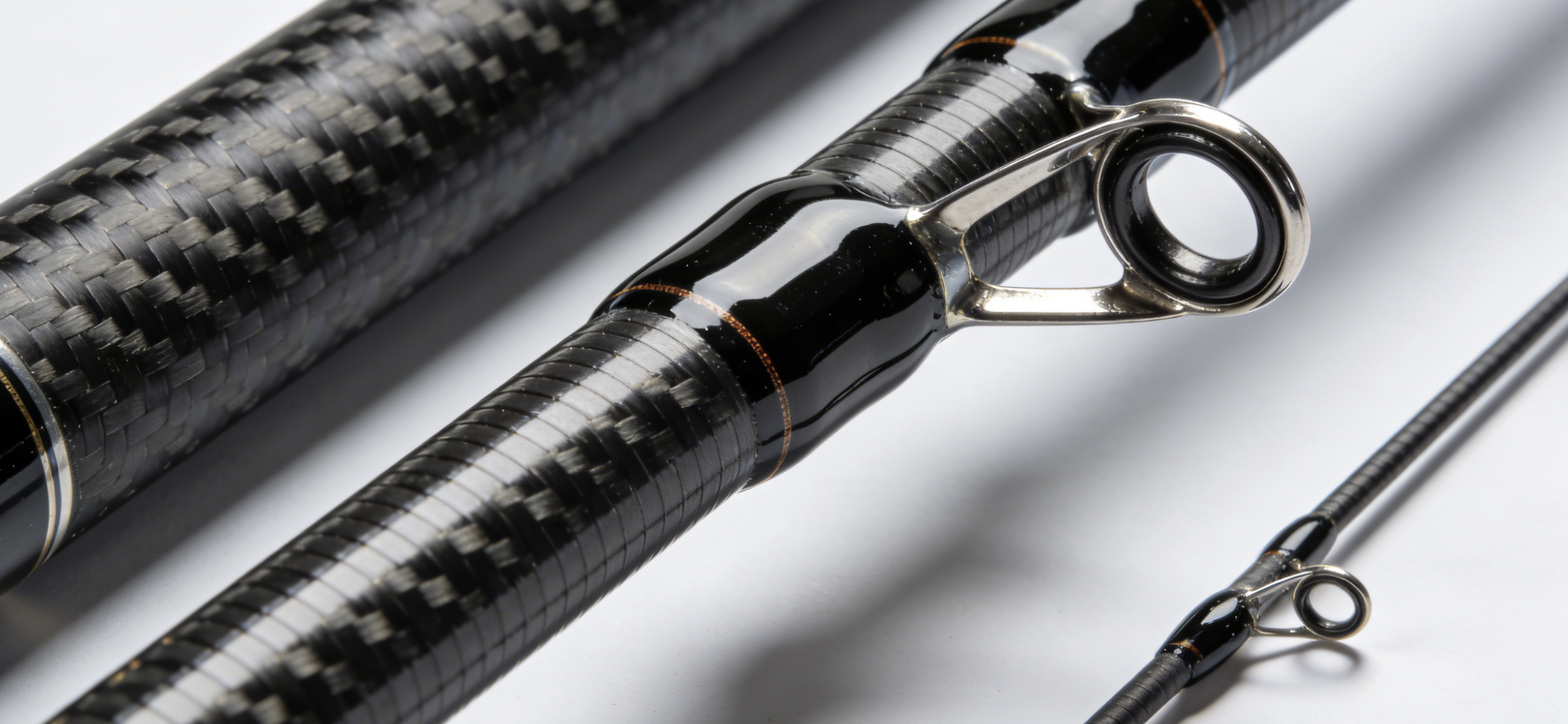
4. Fishing Rod Blanks & Trekking Poles
Weight separates a good day from a punishing one. Carbon fiber blanks weigh 0.4 lbs/ft. Fiberglass runs 1.0–1.5 lbs/ft. Over a full day on the water or a long trail, that gap cuts fatigue by 40–50%.
There’s a sensitivity edge too. Carbon fiber transmits vibration 30% faster than glass fiber. The angler feels the strike sooner. Plus:
– Fully corrosion-resistant
– Adjustable across different terrain profiles
– No maintenance beyond a rinse
5. Solar Panel & Pool Cleaning Systems
Solar installations need cleaning equipment that survives the same conditions the panels face. Carbon fiber outlasts aluminum in wet chemical environments by 5x or longer. No pitting. No oxidation. No dimensional creep under UV exposure.
50ft configurations handle brush and inspection tool loads in the 8–20lb range. Low thermal expansion keeps pole geometry stable across temperature swings that would warp an aluminum shaft.
6. Water Rescue & Hydrological Survey
Open water operations need light weight and structural strength at the same time. Hybrid carbon/glass configurations reach 18m maximum extension with a 10–20lb payload capacity. Total system weight sits at just 3.6–9kg — compare that to 4.5–11.3kg for equivalent fiberglass builds.
Corrosion and UV resistance keep these poles viable for years of marine and freshwater use. Fatigue resistance under repeated flex cycles holds the structure solid long after the survey season ends.
Technical Specifications Guide: Diameters, Wall Thickness, Sections & Load Ratings (2026 Standards)

Numbers don’t lie. In carbon fiber telescoping systems, the wrong number kills a project faster than a wrong decision.
Here’s the full 2026 specification matrix — diameters, wall thickness, section counts, and load ratings. Engineers can cross-reference each value against their application requirements in one place.
Outer Diameter Range
Standard telescoping carbon fiber tube configurations span 12mm to 50mm OD. The most-used range sits between 20mm and 40mm. That window covers antenna masts, photography booms, and mid-duty cleaning poles within a single product line.
-
12–20mm OD: Lightweight robotic arms, drone payload extensions, precision survey markers
-
20–32mm OD: Photography rigs, inspection poles, portable antenna masts
-
32–50mm OD: High-reach cleaning systems, structural antenna masts, solar support poles
Wall thickness across these ranges runs 1.0mm to 3.0mm. Sub-1.5mm thin-wall builds are now standard in 2026 for weight-critical UAV and aerial work. Every gram counts for flight time, and these configurations keep mass down without giving up structural integrity.
Section Counts & Extension Ratios
|
Sections |
Collapsed Length |
Extended Length |
Typical Application |
|---|---|---|---|
|
3–4 sections |
~1.2–1.5m |
4–6m |
Photography booms, inspection poles |
|
5–6 sections |
~1.5–2.0m |
8–12m |
Antenna masts, window cleaning |
|
7–9 sections |
~2.0–3.0m |
15–25m |
High-reach cleaning, field comms masts |
Collapse ratios stay between 1:4 and 1:5 across all section counts. A 20m pole folds down to 4–5m. That’s a practical number for transport and storage.
Load Ratings by Configuration
Carbon fiber tube wall thickness and fiber layup angle set the rated load capacity. Here’s how the numbers break down:
-
1.0–1.5mm wall, 3K woven: 50–80kg axial load — built for static photography and survey use
-
1.5–2.0mm wall, UD + 3K hybrid: 100–150kg axial — handles dynamic antenna payloads and mid-duty cleaning loads
-
2.0–3.0mm wall, UD + 12K woven: 150–200kg+ axial — structural mast builds, offshore deployment, rescue operations
Lateral (bending) load ratings scale with carbon fiber tube diameter and section count. Take a 40mm OD, 6-section pole at 10m extension. It carries 15–20kg lateral payload before deflection pushes past acceptable field limits. Know that number before you spec the configuration.
2026 Specification Trends
Three shifts are shaping the 2026 carbon fiber tube market:
-
Sub-1.5mm thin walls — High-modulus fiber grades like T700S and T800H now match stiffness at lower wall thickness. You get lighter poles with no drop in load ratings.
-
Modular carbon fiber tube systems — OD/ID tolerances hold below 0.05mm. Sections swap across product lines without custom fitting.
-
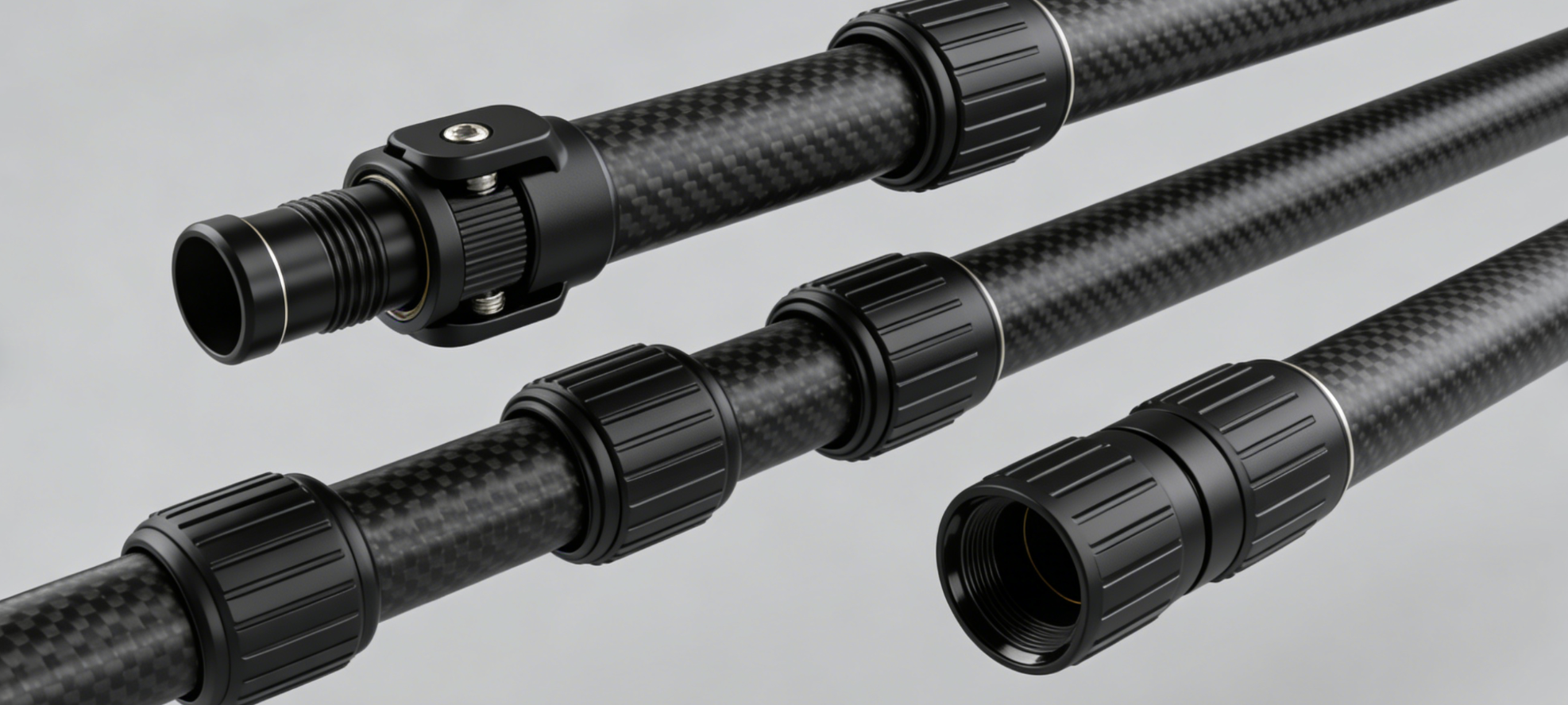
Integrated quick-lock mechanisms — Lever and twist-lock systems are now machined straight into carbon fiber tube sections. No aftermarket hardware. No tolerance stack. No play at the joints.
For precision work — robotics end-effectors, high-resolution aerial cameras, RF antenna alignment — that tolerance tightening is the detail that splits acceptable from exact.
How to Choose the Right Carbon Fiber Telescoping Pole: A Buyer’s Decision Framework
Most buyers narrow this decision down to price. That’s the wrong filter.
The right filter is application. Think about what your pole does under load — at full extension, in real conditions. That tells you whether a spec is good enough or a problem. Start there.
Match the Spec to the Job
Three application profiles cover most purchase decisions:
High-reach work (window cleaning, high-dusting, inspection): Stiffness is the number that matters. Carbon fiber runs 2–5x more rigid than aluminum at the same wall thickness. Standard carbon holds rigid out to 55–60ft. High-modulus carbon fiber extends that range to 70–80ft. A pole that flexes under brush load at full extension won’t get the job done right.
Portable carry work (hiking, survey, field deployment): Weight is the spec. Carbon fiber saves ~40% over aluminum. A 30ft pole with 5–8 sections can fold to under 4ft collapsed. Over a long field day, that weight difference cuts real fatigue — not a small amount, but enough to notice.
Antenna masts, drone arms, surveying rigs: Load-bearing is the priority. Go with wall thicknesses of 1.5–3mm and base diameters in the 25–50mm range. A high stiffness-to-weight ratio keeps your payload stable at full extension.
Budget Decision Path
|
Scenario |
Recommended Choice |
|---|---|
|
Under 3 stories, light occasional use |
Aluminum or hybrid — carbon is overkill |
|
3–4 stories, moderate frequency |
Standard full carbon (SLX grade) |
|
50ft+ daily use, precision work |
Hi-Mod carbon — the lifecycle ROI wins |
Skip carbon fiber if your budget is below $500 or you use the pole rarely. Aluminum with planned replacements handles that range better.
Standard vs. Custom: Where the Line Sits
Off-the-shelf options cover diameters from 20–60mm and lengths from 10–80ft. MOQ is one unit. That makes prototyping and testing straightforward — no minimum commitment required.
Custom builds — non-standard diameters, specialized locking systems, filament-wound heavy-duty sections — run 20–50% more than standard. The ROI crosses 2x in two situations. First, order volume exceeds 10 units. Second, the spec you need doesn’t exist in any catalog.
Quality Check Before You Commit
Before you buy, run one field test. Extend the pole to 75% of maximum length and hang a 5–10kg load off the end. Good carbon fiber deflects less than 1cm. A poor-grade tube shows 2–3cm or more of flex. That’s a stiffness failure waiting to happen mid-project.
Also check for surface delamination, brittle fracture patterns at cut ends, and locking slippage under light torque. These aren’t cosmetic issues. They’re structural warnings.
Custom Telescoping Carbon Fiber Tubes: Manufacturing Process, MOQ & Lead Time
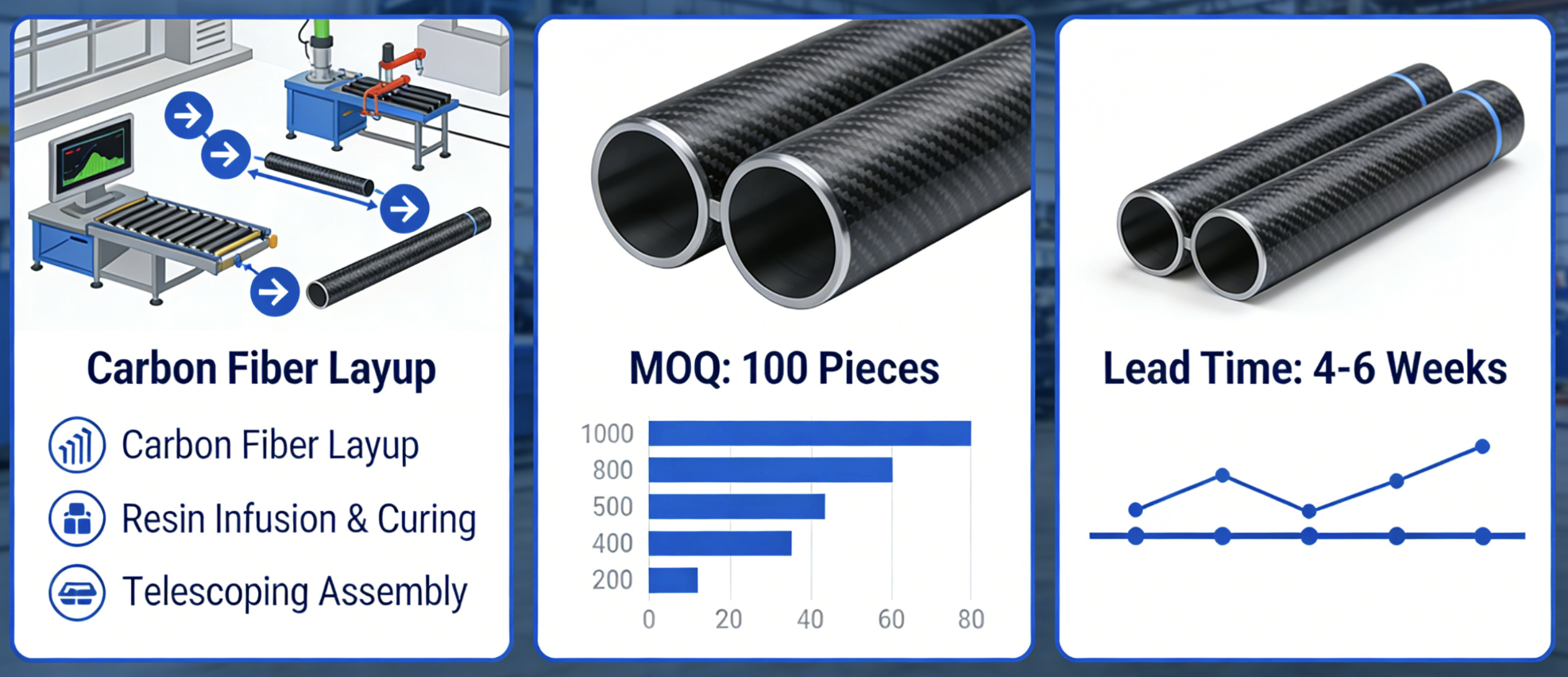
Getting a custom telescoping carbon fiber tube built right comes down to process discipline — and knowing what to ask for.
How Custom Tubes Get Made
Every precision telescoping tube starts with a CAD model. OD/ID tolerances are locked at ±0.008″ before a single fiber gets cut. Steel molds handle large-diameter sections. Mandrel OD matches the tube’s target ID. That dimensional relationship determines whether sections nest without friction or bind under load.
Next comes material selection. Standard layups combine 3K/6K/12K carbon prepreg in unidirectional and woven configurations. A typical structural build uses XC110 210g woven fabric (0°/90°) on inner and outer surfaces. The core uses XC130 300g unidirectional plies — that’s where axial stiffness is concentrated.
Workers cut, stack, and wrap layers onto the mandrel in sequence. Vacuum bagging pulls out trapped air. Autoclave curing at 120–180°C under 0.6–7 MPa consolidates the resin. This drives fiber volume above 60% and keeps void content below 1%. After demolding and trimming, the team applies surface coatings where the telescoping interface needs them.
MOQ, Lead Time & QC Documentation
|
Stage |
Typical Timeline |
|---|---|
|
Prototype (1–10 pcs) |
2–4 weeks |
|
Medium batch (50–100 pcs) |
Add 1–2 weeks for custom mandrels |
|
Surface treatment/post-cure |
+3–5 days |
Custom telescoping tubes almost always use non-standard diameters. That adds 1–2 weeks for mandrel fabrication. Thicker walls with multiple plies also extend cure cycles.
For B2B sourcing, request this documentation before approving production:
-
ASTM D3039 pull-test reports
-
Fatigue data to 10⁵–10⁶ cycles
-
Dimensional certificates at ±0.008″ OD
-
Full cure cycle logs
OEM services are available from prototype through full production runs. These include brand printing, embedded locking fittings, and custom packaging.
Carbon Fiber Telescoping Pole Price Guide: Cost Factors & Where to Buy in 2026
The price range on these poles is wider than most buyers expect — $65 for a trekking pair, $800 for a single 8m high-modulus mast. That spread isn’t random. Four variables drive it.
Carbon fiber grade hits hardest. Standard modulus handles 5kg loads. High-modulus 3K bumps that to 7kg and adds 30–50% to the invoice. Wall thickness is next — 1.4mm uniform walls maximize stiffness and wind resistance up to 8–10m/s. Thinner walls cut 20% of the weight but give up rigidity. Locking mechanisms matter too. Nylon clamps come standard — a 5.6m pole runs ~€159. Premium twist-locks add 15–25% on top. Volume closes the gap — batch orders pull 10–30% off.
Where you buy shapes what you get:
|
Channel |
Best For |
Price Signal |
|---|---|---|
|
Direct manufacturers (hyperxcarbon.com) |
Custom specs, 3m–84ft range |
Quote-based; strongest warranties |
|
E-commerce (Walmart, Dick’s) |
Stock sizes, fast ship |
Fixed — $215 for 5–9ft |
|
Traders/Alibaba |
Custom dims, high flexibility |
Negotiable; variable delivery |
Direct manufacturers like hyperxcarbon.com cover a wide range — from 3m up to 84ft — and back their products with the strongest warranties you’ll find. E-commerce platforms keep it simple with fixed pricing and fast shipping. Traders and Alibaba give you room to negotiate on dimensions and delivery terms.
On pricing trends: raw carbon fiber costs climbed 5–10% year-over-year through 2025. Solar panel production and CCTV cleaning equipment pushed that demand up. Finished poles followed, rising 8–15%. Locking in Q1 2026 pricing — on bulk direct orders — saves close to 20% compared to retail prices later in the year.
Conclusion
Every project has a breaking point. The wrong material costs you weight, rigidity, or credibility. Telescoping carbon fiber tubes remove that risk entirely.
You get a structure that’s lighter than aluminum and stiffer than fiberglass. Plus, it resists corrosion — the kind that destroys long-term builds over time.
Building a drone frame that needs to cut every gram? Mounting an antenna mast that faces years of harsh weather? Sourcing a carbon fiber extension pole for an industrial job? This guide covers the specs, the comparisons, and a clear decision framework. It exists to get you to the right choice faster.
Don’t let material selection slow down your next project.
Request a custom quote at hyperxcarbon.com — bring your dimensions, your load requirements, and your deadline. The right tube is ready to manufacture. You just need to ask.
Contact HyperX Carbon – Your Trusted Chinese Carbon Fiber Partner
Ready to source high-performance carbon fiber materials or custom forged carbon fiber parts from China?
HyperX Carbon is a leading manufacturer with 20+ years of expertise, specializing in aerospace-grade forged carbon fiber, prepreg, tubes, sheets, and lightweight automotive/drone/medical components. We offer:
-
Stable supply chain with premium raw materials (Toray, Mitsubishi, Hengshen)
-
AS9100D certified production for aerospace & UAV applications
-
Rapid prototyping (5-8 weeks) and monthly capacity exceeding 180,000 parts
-
Competitive pricing with 15-18% cost savings on forged carbon solutions
-
Full customization: from T700/T1100G to ultra-high modulus grades
Whether you’re an eVTOL developer, automotive OEM, drone manufacturer, or medical device engineer, HyperX delivers consistent quality, batch-to-batch reliability, and reliable delivery.
Get in touch today for a free consultation, custom quote, or material sample.
📧 Email: [email protected]
🌐 Website: https://www.hyperxcarbon.com/
📞 Phone/WhatsApp: +86 15623270276 (English support available)
Let’s build your next lightweight innovation together – contact HyperX Carbon now and stay ahead in the low-altitude and advanced composites market.




