T800 carbon fiber doesn’t just improve products — it changes what’s possible. With tensile strength exceeding 5,490 MPa and a stiffness-to-weight ratio that gets aerospace engineers excited, T800 sits in a performance tier that very few materials can reach.
Raw numbers, though, don’t tell the full story.
Maybe you’re choosing between T800 and T700 for a bike frame. Maybe you’re sourcing prepreg for a UAV structural component. Or you need to justify the cost premium to a procurement team. Either way, you need real clarity — on the properties, the tradeoffs, and the actual performance behind the spec sheet.
That’s what this guide covers:
-
A technical breakdown of T800 carbon fiber properties
-
A frank grade-by-grade comparison
-
Application-specific insights
-
Pricing context to help you make smarter material decisions
No fluff. Just the details that matter.
What Is T800 Carbon Fiber? (Material Definition & Grade Positioning)
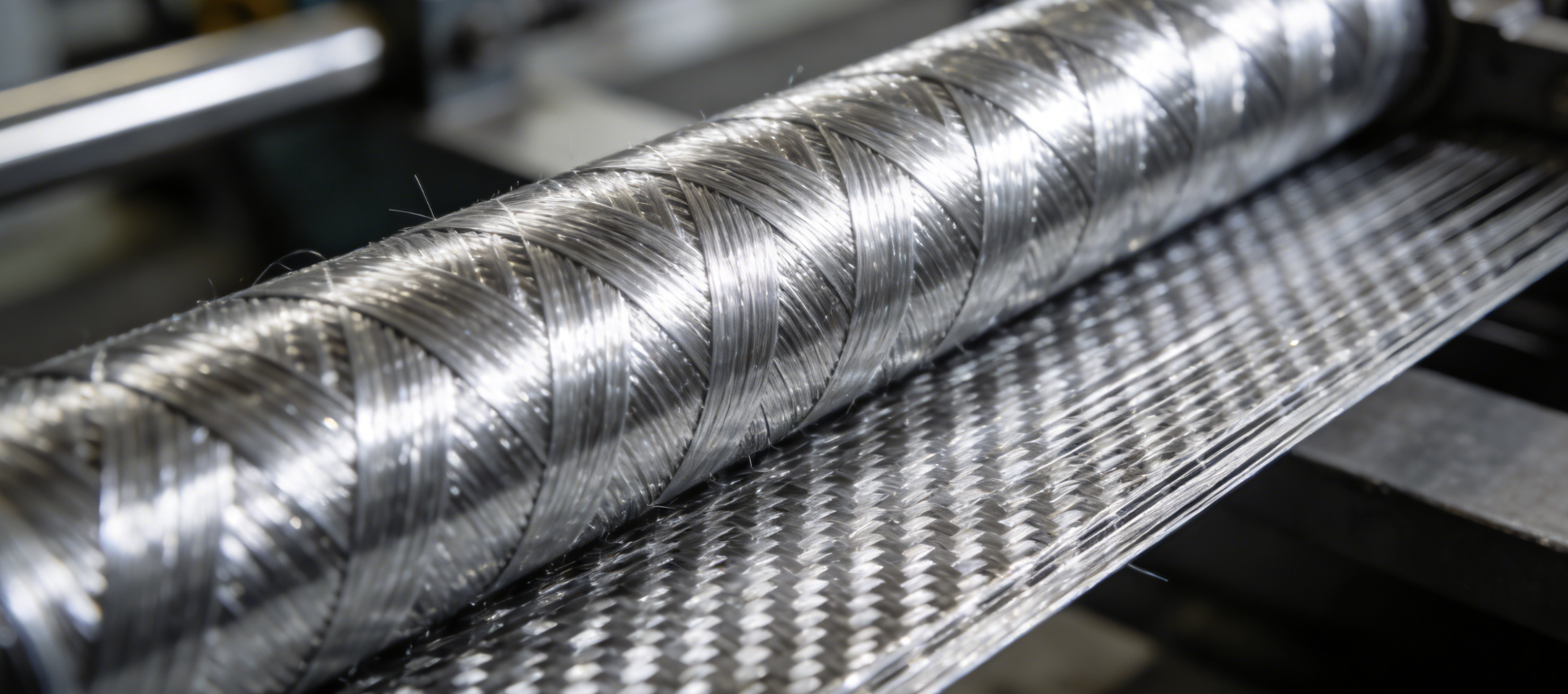
T800 is a PAN-based carbon fiber made by Toray — the Japanese materials company that shaped the modern carbon fiber industry. It falls into the intermediate modulus (IM) category. That puts it in the sweet spot between raw tensile strength and structural stiffness.
The core numbers: tensile strength of 5,490–5,880 MPa and a tensile modulus of 294 GPa. Filament diameter runs between 5–7 µm. Density sits at 1.8 g/cm³. These aren’t marketing figures. They’re the reason T800 became the go-to material for aerospace primary structures.
Where T800 Sits in the Toray Grade Hierarchy
Toray’s carbon fiber lineup follows a clear performance ladder:
|
Grade |
Tensile Strength |
Modulus |
Best Used For |
|---|---|---|---|
|
T300 |
~3,500 MPa |
~230 GPa |
Standard structural, cost-sensitive parts |
|
T700 |
~4,900 MPa |
~230–240 GPa |
High-volume, high-strength applications |
|
T800 |
5,490–5,880 MPa |
294 GPa |
Aerospace, primary structures, IM balance |
|
T1000 |
6,370+ MPa |
~294–590 GPa |
Extreme performance, premium applications |
T800 is 11–17% stronger than T700. Stiffness is noticeably higher too. T1000 beats it on both counts — but the cost premium is hard to justify for most programs.
T800H vs T800S: The Variant That Makes a Real Difference
Toray makes two main T800 variants. They are not interchangeable:
-
T800H — the high-performance variant. Tensile strength hits 6,000 MPa. Flexural modulus reaches 145 GPa. Interlaminar shear strength (ILSS) comes in at 110 MPa at 60% fiber volume. You’ll find this variant in aircraft components, motorsports structures, and ocean racing hulls. Toray produces it in both France and Japan.
-
T800S — the standard variant. It has a lower strength ceiling and a lower price. Manufacturers specify it for high-performance bicycles, sports equipment, and other uses where the full T800H performance range isn’t needed.
Someone quotes you “T800” without naming the variant? Ask which one. In load-critical designs, that distinction is real.
T800 Carbon Fiber Technical Properties: Full Datasheet Breakdown
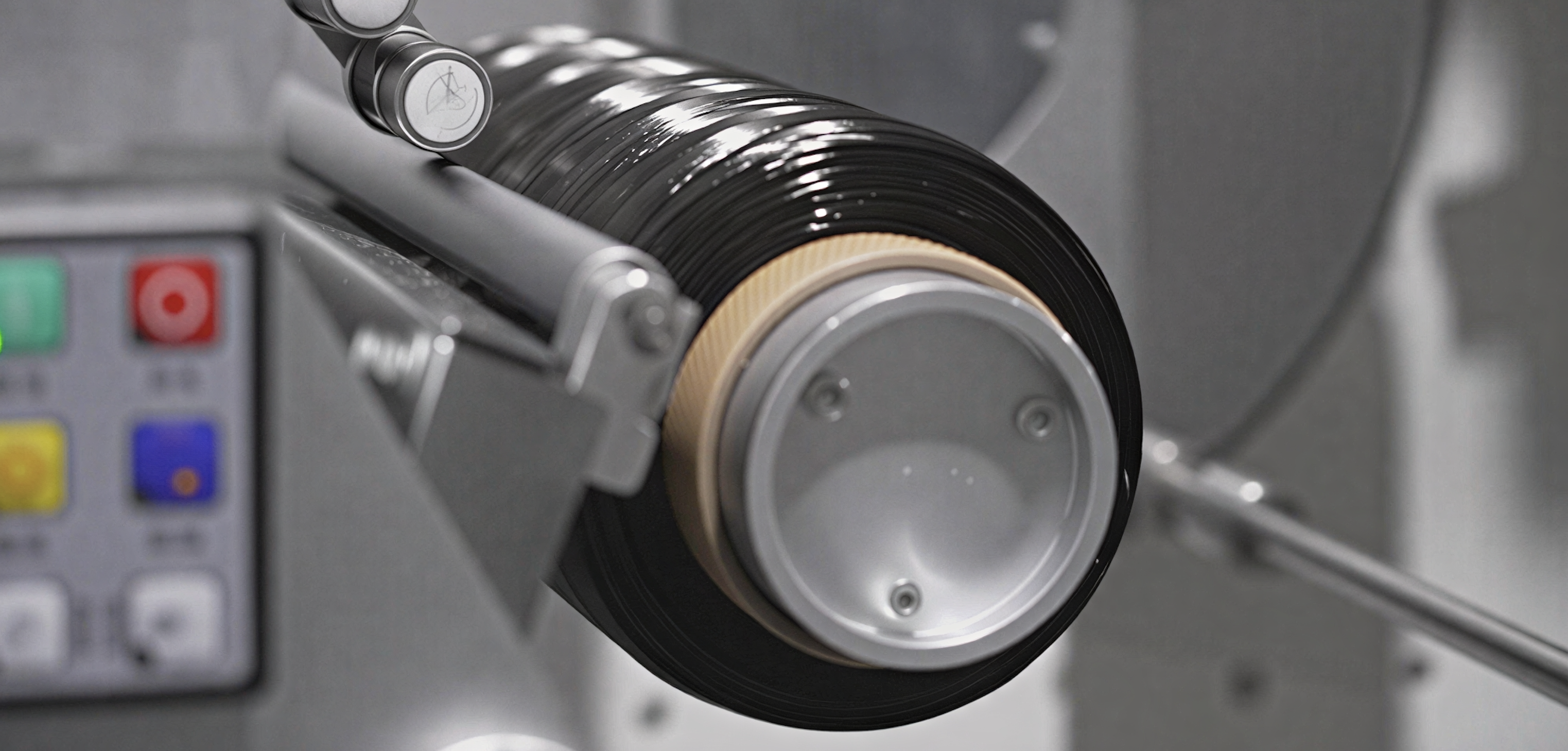
The T800 spec sheet earns its reputation fast. You’ll see why before you reach the second row.
Here’s what the fiber delivers — dry, before any resin enters the picture:
|
Property |
T800H |
T800S |
|---|---|---|
|
Tensile Strength |
5,490 MPa |
5,880 MPa |
|
Tensile Modulus |
294 GPa |
294 GPa |
|
Elongation |
1.9% |
2.0% |
|
Density |
1.81 g/cm³ |
1.80 g/cm³ |
|
Filament Diameter |
5 µm |
5 µm |
|
CTE |
-0.56 × 10⁻⁶/°C |
— |
|
Electric Resistivity |
1.4 × 10⁻³ Ω·cm |
— |
A few of those numbers are worth a closer look.
294 GPa modulus puts T800 at 15 times stiffer than steel, pound for pound. At peak operating loads, deflection stays below 0.1% strain in tensioned beam structures. That’s the kind of performance aircraft spar designers depend on.
Density at 1.81 g/cm³ makes T800 about 25% lighter than aluminum at equal stiffness. Run the specific strength calculation — 5,490 ÷ 1.81 — and you get 3,033 MPa per g/cm³. That number is why aerospace programs keep picking it.
The 5 µm filament diameter gives resin more surface area to bond to. That’s a real advantage. But it comes with a tradeoff — void formation risk goes up. Void content above 2% cuts composite strength by 20%. Tight processing control is not optional here.
CTE of -0.56 × 10⁻⁶/°C sits near zero. It lines up well with epoxy. That match stops delamination across a wide service temperature range — from -55°C to 180°C.
Fiber to Composite: What Happens When Resin Enters
Dry fiber strength and cured composite strength are two separate things. Don’t treat them as the same number.
At 60% fiber volume fraction with Toray 3631 epoxy, the numbers shift:
|
Property |
T800H Composite |
T800S Composite |
|---|---|---|
|
Tensile Strength |
2,840 MPa |
2,950 MPa |
|
Tensile Modulus |
160 GPa |
154 GPa |
|
Compressive Strength |
1,570 MPa |
291 MPa (OHTC) |
|
ILSS |
110 MPa |
85 MPa (CILS) |
|
CAI |
— |
300 MPa |
T800S comes in 7% higher in tensile strength than T800H at the fiber level. That’s enough to support 10% thinner laminates in pressure vessel design. T800H takes the lead in interlaminar shear strength, though — 110 MPa versus 85 MPa. If delamination onset is your design-limiting failure mode, that 25 MPa gap matters.
Resin choice reshapes the whole performance picture.
-
PEEK and other thermoplastic matrices push compressive strength up by 50%. You also get weldable joints that cut fastener weight by 20%. The tradeoff: tensile drops to 2,400 MPa, and processing gets much harder.
-
High-temperature systems — BMI, phenolic — extend service range beyond 200°C. The cost is about 10% less baseline strength.
One thing that catches engineers off guard: wet Tg degradation. Standard epoxy Tg drops 20°C under moisture absorption. That translates to a 30% drop in elevated-temperature strength. For hot-wet service conditions, build that constraint into your design from day one.
T800 vs T700 vs T300 vs T1000: Carbon Fiber Grade Comparison Chart
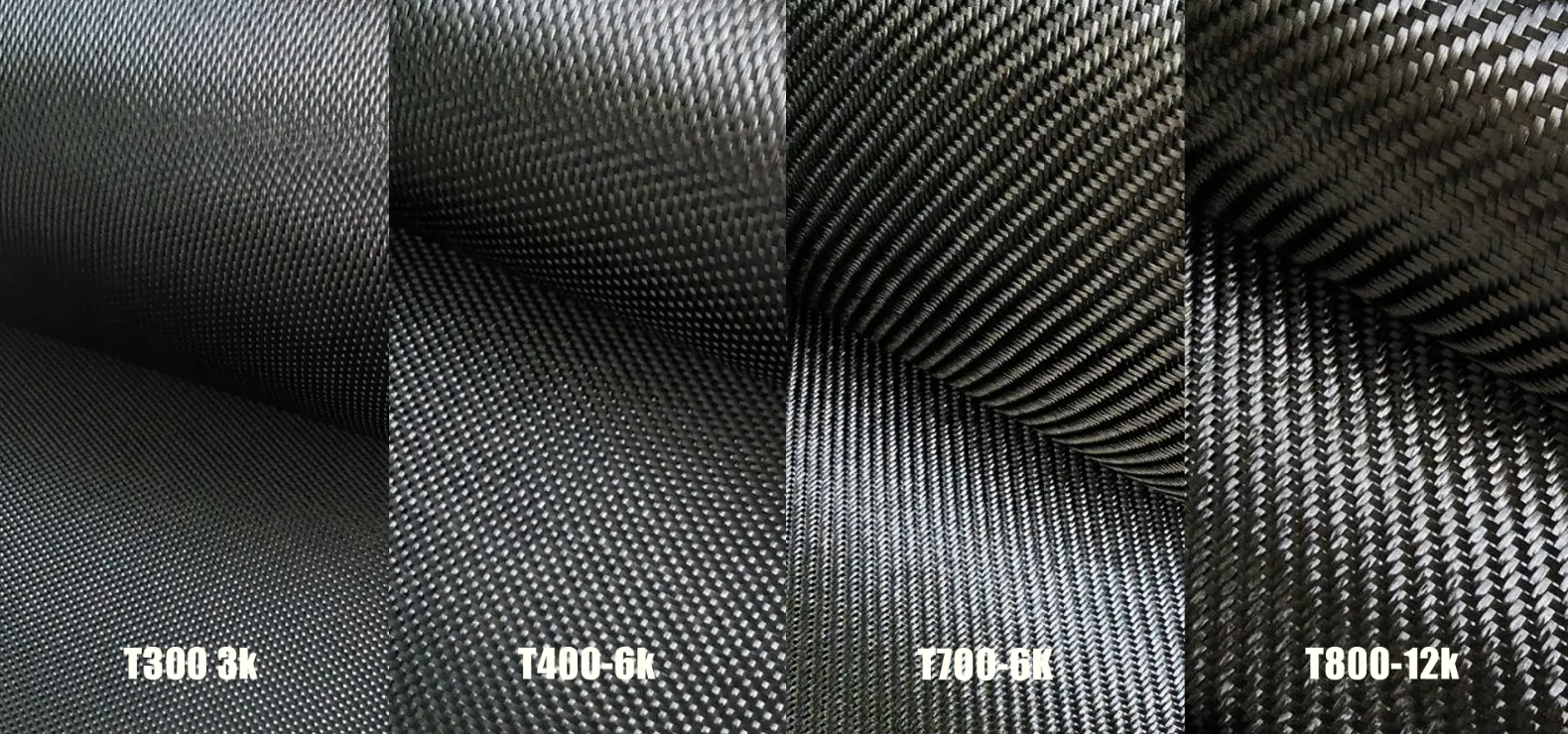
Four grades. One decision. The wrong choice costs you either money or performance — sometimes both.
Here’s the full picture, side by side:
|
Grade |
Tensile Strength |
Tensile Modulus |
Density |
Filament Dia. |
Elongation |
Carbon Content |
|---|---|---|---|---|---|---|
|
T300 |
3,530 MPa |
230 GPa |
1.76 g/cm³ |
7 µm |
1.3% |
92.5% |
|
T700 |
4,900 MPa |
230 GPa |
1.80 g/cm³ |
7 µm |
2.1% |
>93% |
|
T800 |
5,490–5,880 MPa |
294 GPa |
1.80 g/cm³ |
5 µm |
2.0% |
>96% |
|
T1000 |
6,370 MPa |
294 GPa |
— |
— |
— |
— |
The modulus column is where most people’s assumptions break. T700 and T300 both sit at 230 GPa. Same stiffness, different strength. T800 jumps to 294 GPa — a 27% modulus gain over both. That gap is structural, not cosmetic. Stiffer fiber deflects less under the same load. That’s what aircraft spar designers and high-performance frame builders are paying for.
Where Each Grade Belongs
T300 is the workhorse. Cheapest in the lineup, carbon content at 92.5%, standard 7 µm filaments. It handles commercial bike parts and general structural components well. Use it where cost drives the decision.
T700 is a big step up — 40% stronger than T300. Its elongation rate of 2.1% also gives it more give under impact. That makes it less prone to sudden failure. Drones, industrial components, and standard performance frames are right at home here. Good material. Excellent value.
T800 is where things shift. The 5 µm filament diameter increases resin bonding surface area. That lets you build thinner, lighter laminates. Carbon content climbs above 96%. Tensile strength beats T700 by 11–12%. The modulus advantage is also hard to match through layup geometry changes alone.
T1000 sits at the top: 6,370 MPa tensile strength, 16% above T800. Same modulus. Higher cost. More brittle. For most builds, that brittleness is the real problem. Stiffness in real structures comes more from tube geometry and layup design than raw fiber grade. T1000 makes sense when extreme lightness is a hard requirement — think pro-level MTB or competitive racing frames. There, a 16% tension boost can drive real sub-5% weight reductions.
The Selection Logic, Simplified
-
Load stays below 4.9 GPa + budget matters → T700 is your grade
-
Stiffness requirement exceeds 230 GPa or tension targets top 5 GPa → T800
-
Density-to-stiffness ratio is the primary constraint → T800 (thinner filaments, higher carbon purity)
-
Every gram counts and cost is secondary → T1000, but confirm your application truly needs it
T800 covers around 80% of high-performance applications. Not because it’s the strongest fiber on the market — it isn’t. It wins because it balances strength, stiffness, durability, and cost at a level the other grades can’t all match at once.
Real-World Applications of T800 Carbon Fiber: Where It Performs Best
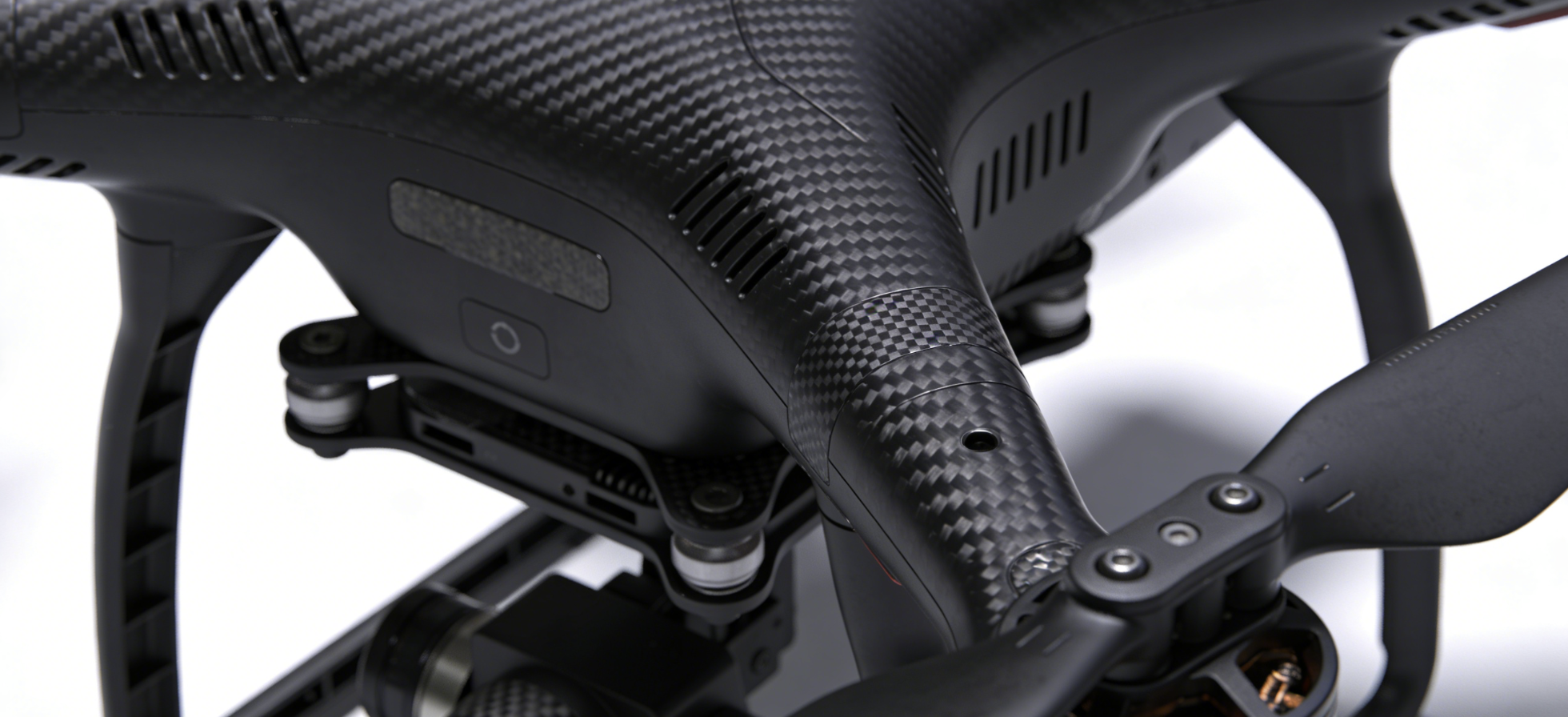
T800 doesn’t show up everywhere — it shows up where it counts.
Industries that rely on it aren’t chasing spec sheet prestige. They’re solving hard engineering problems. Failure isn’t recoverable. Weight is a real constraint. Here’s where T800 earns its place.
Aerospace & Defense
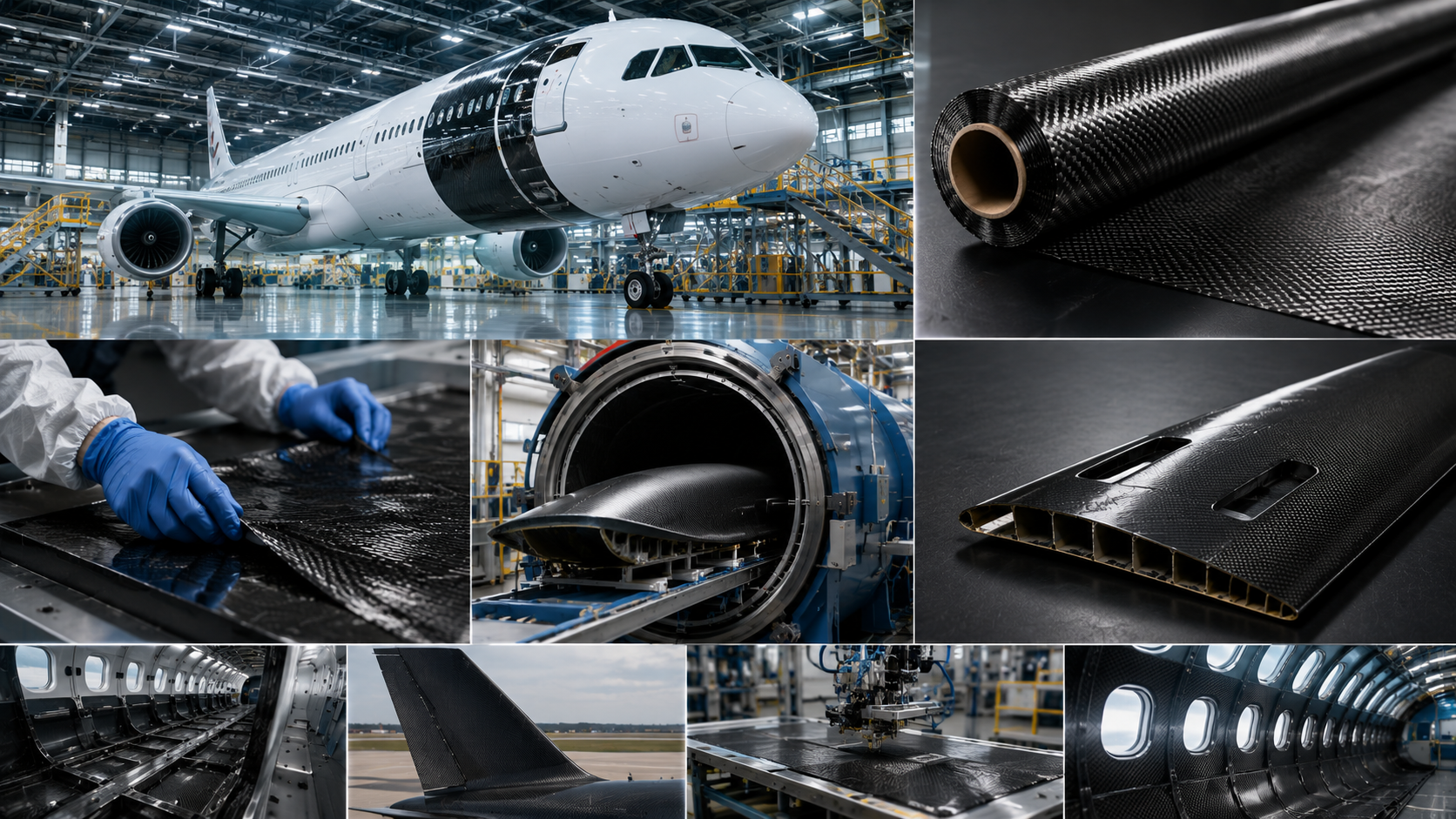
Boeing’s vertical fin structures. Helicopter rotor blades. Satellite frames. Missile casings. These applications built T800’s reputation. They all share one core requirement: sustained load-bearing under fatigue, across wide temperature cycles, with zero tolerance for progressive failure.
T800 delivers on all three. Its 294 GPa modulus and sub-5 µm filaments keep primary structures stiffer and bond surfaces cleaner. In aerospace, that’s not an advantage. It’s a baseline requirement.
UAVs and Flapping-Wing Micro Air Vehicles
A 1 mm T800 frame does something thicker, heavier composites can’t. It cuts vibration at high flapping frequencies while holding lift stability. Pair it with PET wing film, and T800 boosts lift output without adding structural mass.
For drone frames in general, T800 brings three things to the table:
– Low weight
– Flexibility under dynamic load
– Tensile resilience
That combination makes it a strong fit for airframes where resonance kills performance.
Cycling — Road, Track, BMX
This is where most end-users meet T800 in the real world. Seraph uses it for track frames that need high stiffness and aerodynamic efficiency. Winspace builds training and race frames around it for the strength-stiffness balance. Whistle’s e-bike line blends T800 with T1000 to hit elite stiffness-to-weight targets. Top-Fire’s BMX rims run T800 because it beats T700 on rim responsiveness and lateral stiffness under sprint loads.
One thing to know: pure T800 is brittle on its own. Most frame builders land on a 25% T800 / 75% T700 hybrid layup. That formula balances power transfer, impact tolerance, and vibration damping — without the brittleness penalty.
Know the Limits
T800 handles tension and dynamic fatigue well. Sustained compression is a different story. Fiber buckling drops effective compressive strength to around 30–60% of tensile values. It’s a strong material — but only in the right loading conditions. Design around that, and T800 delivers what the specs promise.
T800 Carbon Fiber Price Per Kg & Cost-Benefit Analysis

The price question is never just about price.
T800 costs more than T700. That’s the starting point. The premium makes sense — or doesn’t — based on what you’re building and how much each gram matters to your final product.
Here’s the market reality as of 2026:
|
Form |
Price Range |
Notes |
|---|---|---|
|
Dry fabric (12K twill, 300–670 gsm) |
$15–75/kg |
Bulk 5–100kg minimum |
|
Toray authentic 3K/12K fabric |
$20–60/kg |
Based on 300 gsm |
|
Prepreg (T800S UD, 37% resin) |
$50–115/kg |
Retail vs. bulk roll |
|
Alibaba OEM listings |
$40–60/kg |
100kg minimum, unverified |
Volume changes everything. At 100kg+, prices compress to $45–55/kg — about 25% below retail. Sourcing at scale? That number is your real baseline.
T800 vs T700: The Cost Premium, Quantified
T800 runs 20–30% more expensive than T700 on dry fiber. T700 lands around $40–50/kg. T800 sits at $50–65/kg. On paper, that gap looks straightforward.
In practice, it flows through your entire bill of materials. Here’s what it looks like in a real bike frame scenario — 1 kg of fiber, 500g finished frame, 37% resin prepreg:
|
Grade |
Fiber Cost/kg |
Total Material Cost |
Tensile Strength |
Weight Savings |
Total Cost Increase |
|---|---|---|---|---|---|
|
T700 |
$45 |
$72 |
5,490 MPa |
Baseline |
+0% |
|
T800 |
$58 (+29%) |
$92 (+28%) |
5,880 MPa (+7%) |
5–10% lighter |
+25–30% |
Seven percent more strength. Five to ten percent less weight. Twenty-five to thirty percent more total product cost. That’s the tradeoff on the table.
The right choice depends on your application. For aerodynamic frames where every gram of rotating mass matters, the math works. T800 carries a 294 GPa modulus — identical to T1000. That lets you build thinner laminates that T700 can’t match at the same wall thickness. In stiffness-critical designs, the performance-to-cost ratio runs 15–20% better.
For general structural components where loads stay below 4.9 GPa? T700 is the smarter spend.
Toray Certified vs. OEM: A Gap You Can’t Ignore
Toray-certified T800 carries a 20–50% premium over OEM alternatives. That premium isn’t brand loyalty — it’s documentation.
Certified material comes with a Toray Certificate of Analysis (COA). It confirms tensile strength at 5,880 MPa, modulus at 294 GPa, and density at 1.80 g/cm³. OEM suppliers skip that paper trail. Some deliver legitimate fiber. Others send T700-level material with T800 labeling. At $40/kg with no docs, the risk is real. A 15–30% hidden strength drop won’t show up until something fails.
Before you place any T800 order, run this checklist:
-
Request the Toray COA with batch serial numbers — tensile should read 5,880 MPa / 600 kgf/mm²
-
Require ISO 9001 certification and at least 10 years of supplier operating history
-
Run independent lab testing (ASTM D4018) on arrival — 12K fiber count, strain at break ≥3.0% (T700 runs 3.21%, T800 tighter)
-
Flag any price below $40/kg dry — legitimate T800 doesn’t live there
-
Reject “OEM Toray” claims that arrive without traceable serial numbers
Where the Premium Actually Pays Off
The break-even point is straightforward. Your project needs more than 5% weight reduction as a hard requirement? T800’s premium pays back across the product lifecycle. A $20 material cost increase per unit that delivers 10% performance gain works out to around 2x lifecycle value in performance-critical applications.
Below that threshold, the numbers don’t close. Buy T700, build smarter geometry, and put the savings somewhere useful.
How to Choose the Right T800 Carbon Fiber Product for Your Project
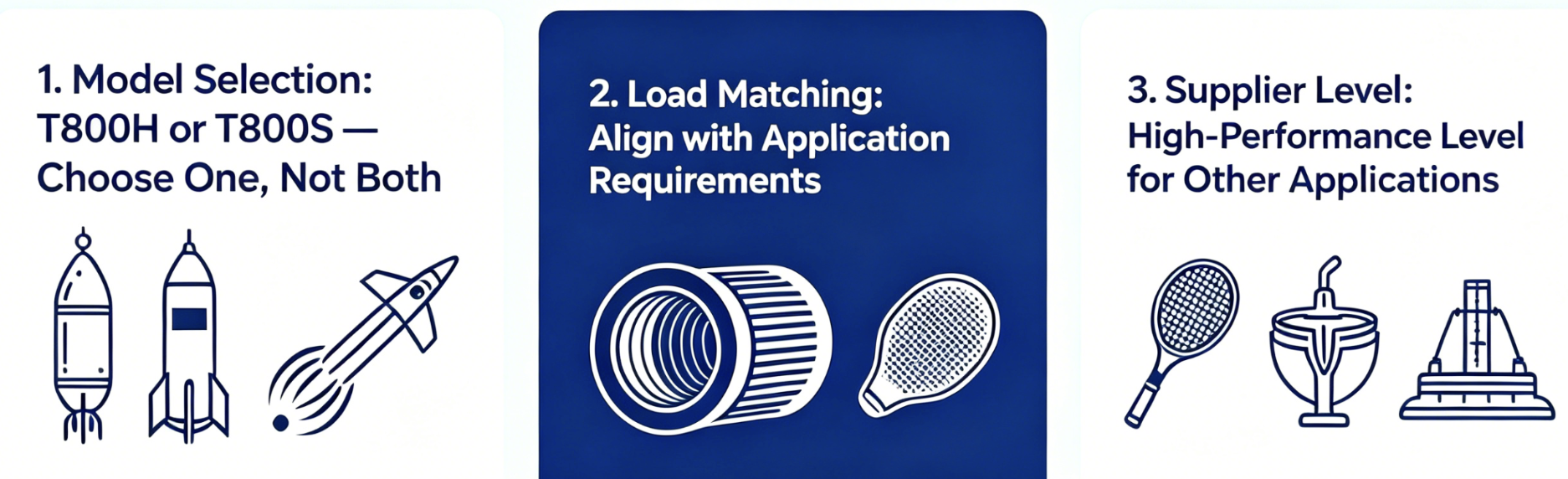
Three decisions stand between a smart T800 purchase and an expensive mistake: the right variant, the right load match, and the right supplier tier.
T800H or T800S — Pick One, Not “Either”
Start with the variant decision. Most buyers skip this step. That choice catches up with them later.
T800H is built for tension-dominant, load-critical applications. Think aerospace pressure vessels, rocket chambers, and filament-wound shells. These are builds where failure is catastrophic and the budget matches the stakes. Your design needs modulus above T700 and tensile strength in the 7–9x steel-multiplying range? T800H is the answer. There is no substitute here.
T800S covers everything else in the high-performance tier — sports equipment, industrial fatigue applications, compression-heavy structures. It sits in the T400–T700 strength range. Plus, it runs 40%+ cheaper than imported equivalents. Your load ceiling stays below 25 MPa adhesive equivalent? T800S closes the performance gap without the extra cost.
Match the Fiber to the Load
|
Scenario |
Load Type |
Recommended Variant |
|---|---|---|
|
Aerospace / rocket structures |
Tension-dominant |
T800H + optimized hoop layup |
|
Sports / industrial components |
Fatigue / compression |
T800S |
|
Defense / automotive |
Mixed fatigue |
T800 base grade |
Compression and fatigue loads suit T800S well. Its higher toughness profile handles cyclic stress more reliably. For tension-dominant designs, T800H performs differently. Its Hashin damage behavior under optimized layup sequences produces real, measurable results — up to 6.53% strength gain over non-optimized configurations.
Supplier Verification: The Step That Protects Everything Above
Toray-authorized suppliers provide SDS documentation and third-party test validation. That paperwork is not red tape. It is your proof that the fiber performs as labeled.
For OEM sources, run three checks before committing:
-
Burst coefficient modeling against declared specs
-
SDS compliance review
-
Documented application cases
Legitimate T800-grade material carries a 40%+ cost premium over commodity fiber. A price that does not reflect that gap is a signal. The fiber’s quality gap will show up eventually — usually at the worst time.
T800 Carbon Fiber FAQ: Engineer & Buyer Top Questions Answered
These questions come up all the time — from procurement desks, engineering teams, and builders trying to close a material decision. Here are straight answers.
Is T800 suitable for bicycle frames?
Yes. T800 runs at 294 GPa modulus and ~5,490 MPa tensile strength. That puts it ahead of T700 on dynamic load applications. You get better fatigue resistance and a better stiffness-to-weight ratio. Most frame builders go with a 25% T800 / 75% T700 hybrid. This keeps brittleness in check while holding onto the performance gains.
Can T800 handle deep-sea environments?
Yes. Service range runs from -70°C to 200°C+. Thermal expansion stays near zero. It resists micro-cracking under sustained pressure loads. For deep-sea pressure housings and structural members, T800 holds up better than most metal alternatives over long fatigue cycles.
T800H or T800S — which one?
Your load type decides this.
-
T800H is built for maximum rigidity. Think load brackets, stiffness-critical aerospace parts, and structures where deflection must stay minimal.
-
T800S suits dynamic, impact-prone applications. Flexibility and toughness matter more here than peak stiffness.
Also worth knowing: higher modulus means higher brittleness. Know your failure mode before you choose.
What does T800 cost per kilogram?
Expect $50–150/kg depending on form, tow count, and volume. Prepreg runs higher than dry fabric. High-modulus variants cost more. Tow count — 1K through 12K — affects both price and how easy the material is to process. Bulk orders above 100 kg can push pricing down into the $45–55/kg range.
How long does T800 last in service?
T800 can handle thousands of fatigue cycles with no measurable degradation. Under controlled conditions — no UV exposure, managed moisture — service life reaches 10–20+ years. For load-critical structures, plan for regular inspections regardless of material grade.
How do you store T800 prepreg?
Freeze it. Storage at -18°C extends shelf life to 6–12 months. Once you thaw it, B-stage cure starts — move fast. Keep it away from moisture and UV exposure. The resin-to-fiber ratio locks in at manufacture. Good storage conditions protect that ratio all the way to layup.
Conclusion
T800 carbon fiber isn’t a marketing buzzword — it’s a precise engineering decision.
Tensile strength at 5,490 MPa. Modulus at 294 GPa. You’re not just picking a material. You’re committing to a performance level T700 can’t reach — at a price that makes T1000 look expensive. T800 has held that sweet spot for decades. Aerospace cabins, championship bike frames, high-load structural composites — it shows up across all of them.
You’ve read this far. You know what your project needs. The real question is whether your supplier can deliver it. That means consistent fiber grade, verified mechanical properties, and documentation that holds up under engineering review.
That’s what HyperX Carbon is built for.
Ready to source T800 carbon fiber with full datasheet transparency? Request a technical consultation or material quote — and build with the grade that serious engineers trust.
Contact HyperX Carbon – Your Trusted Chinese Carbon Fiber Customization Partner
Ready to develop high-performance carbon fiber materials or custom forged carbon fiber parts tailored specifically for your project?
HyperX Carbon is your long-term strategic partner with over 20 years of expertise in advanced composites. We specialize in delivering aerospace-grade forged carbon fiber custom solutions, along with fully personalized prepreg, tubes, sheets, and lightweight carbon fiber structural components for automotive, drone, eVTOL, and medical applications.
We don’t just supply materials — we provide end-to-end customization support:
-
Stable premium supply chain using Toray, Mitsubishi, and Hengshen raw materials
-
AS9100D certified production tailored for aerospace and UAV requirements
-
Rapid prototyping carbon fiber component in just 5-8 weeks, with monthly capacity over 180,000 parts
-
Competitive pricing with 15-18% cost savings on forged carbon solutions
-
Full customization flexibility: from T700 and T1100G to ultra-high modulus grades, with tailored layups, finishes, and performance specifications
Whether you’re an eVTOL developer, automotive OEM, drone manufacturer, or medical device engineer, HyperX Carbon delivers bespoke material selection, structural optimization, and manufacturing solutions that match your exact technical and performance needs — with consistent batch-to-batch quality and reliable delivery.
Get in touch today for a free technical consultation, personalized quote, or custom material samples.
📧 Email: [email protected] 🌐 Website: https://www.hyperxcarbon.com/ 📞 Phone/WhatsApp: +86 15623270276 (English support available)
Let’s co-create your next lightweight innovation together. Contact HyperX Carbon now and stay ahead in the low-altitude economy and advanced composites market.
HyperX Carbon – Not just a supplier, but your dedicated carbon fiber customization expert.