
Choosing the wrong carbon fiber tube doesn’t just cost you money. It can compromise the structural integrity of everything built around it.
Pultruded carbon fiber tubes and roll wrapped tubes may look identical on a spec sheet. But their manufacturing processes produce different fiber architectures, mechanical behaviors, and performance profiles — and those differences are significant.
Are you an engineer optimizing for axial stiffness? A drone builder chasing the lightest possible frame? A procurement manager comparing suppliers? The distinction between these two tube types matters more than most people expect.
This guide breaks down how each process works, where the performance numbers diverge, and which one belongs in your next build.
Pultruded Carbon Fiber Tubes Vs Roll Wrapped
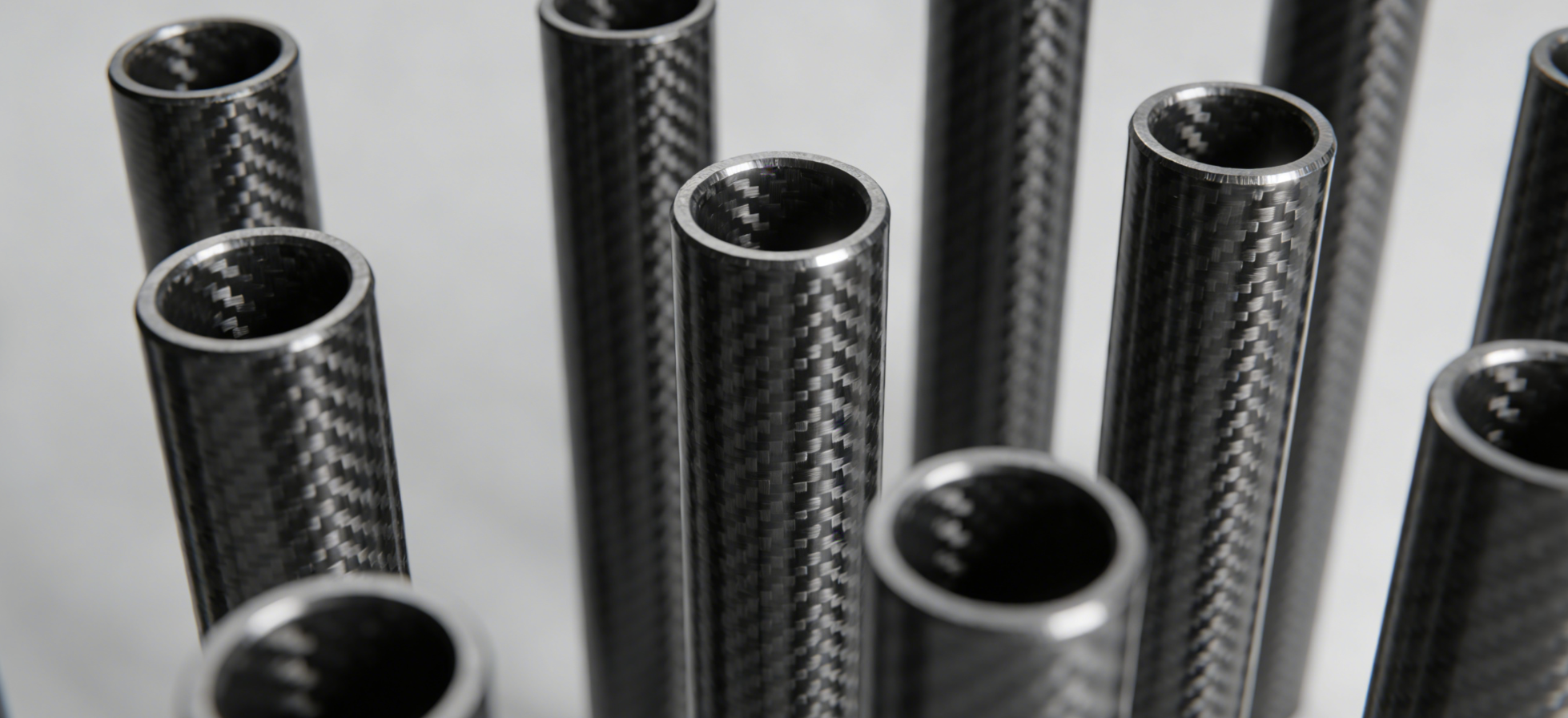
Two tubes. Same diameter. Two completely different animals.
This table breaks down what separates pultruded carbon fiber tubes from roll wrapped. Not vague claims — real properties that decide if your build works or falls short.
|
Property |
Pultruded Carbon Fiber Tube |
Roll Wrapped |
|---|---|---|
|
Fiber Orientation |
0° unidirectional (axial) |
0°, ±45°, 90° multi-axial |
|
Tensile Strength |
Excellent (axial) |
Very good (tunable) |
|
Bending Strength |
~140kg failure load |
~200kg failure load |
|
Torsional Strength |
Poor |
Excellent |
|
Weight |
Lighter |
A bit heavier |
|
Cost |
Lower |
Higher |
|
Design Flexibility |
Limited |
High |
The numbers tell a clear story:
-
Roll wrapped wins on bending, torsion, and complex loading
-
Pultruded wins on axial performance, weight efficiency, and cost at scale
Neither is the better option across the board. Each one is built for a different job. Pick based on what your build actually demands.
What Is Pultrusion? How Pultruded Carbon Fiber Tubes Are Made
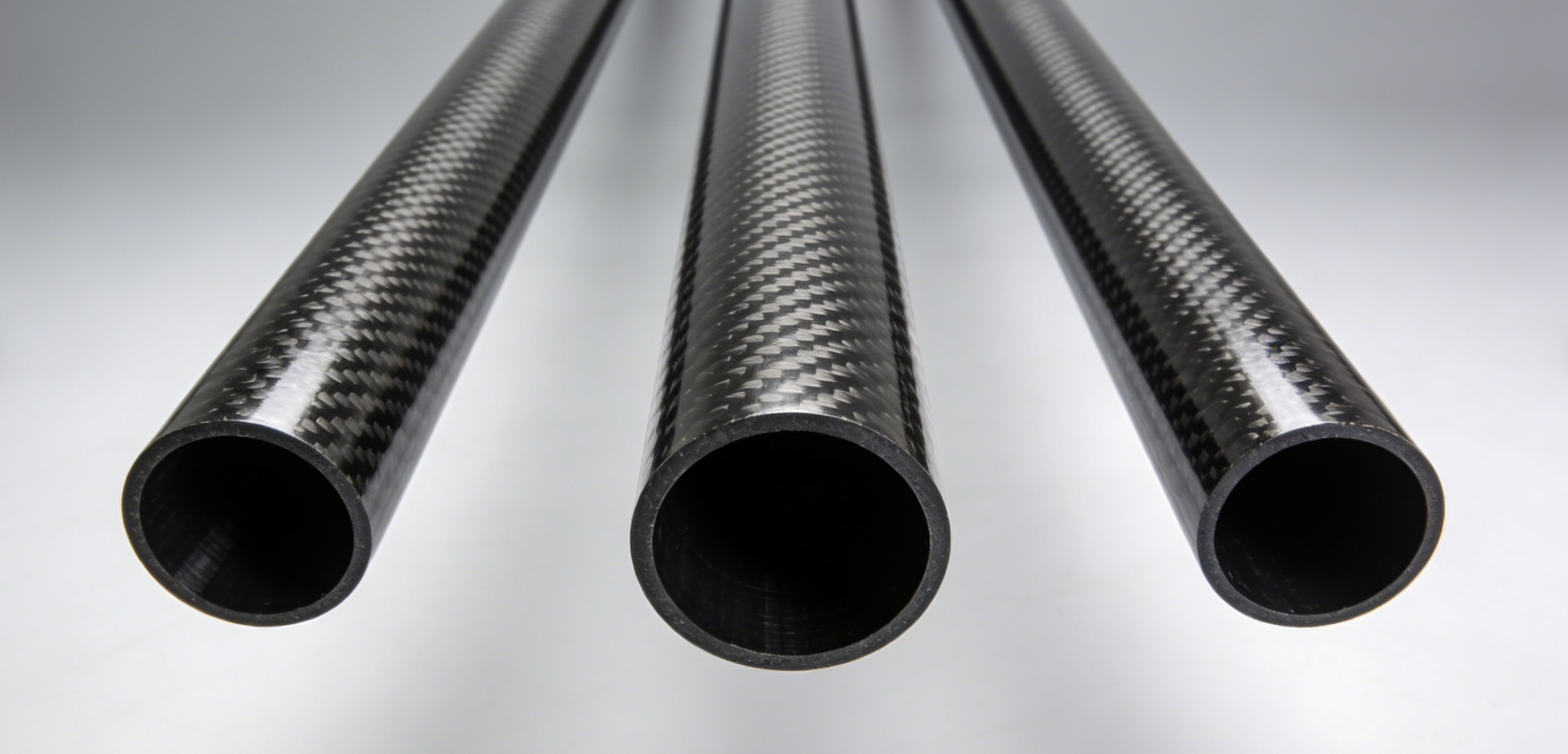
Pultrusion sounds complicated at first. Watch it in motion, and it clicks immediately.
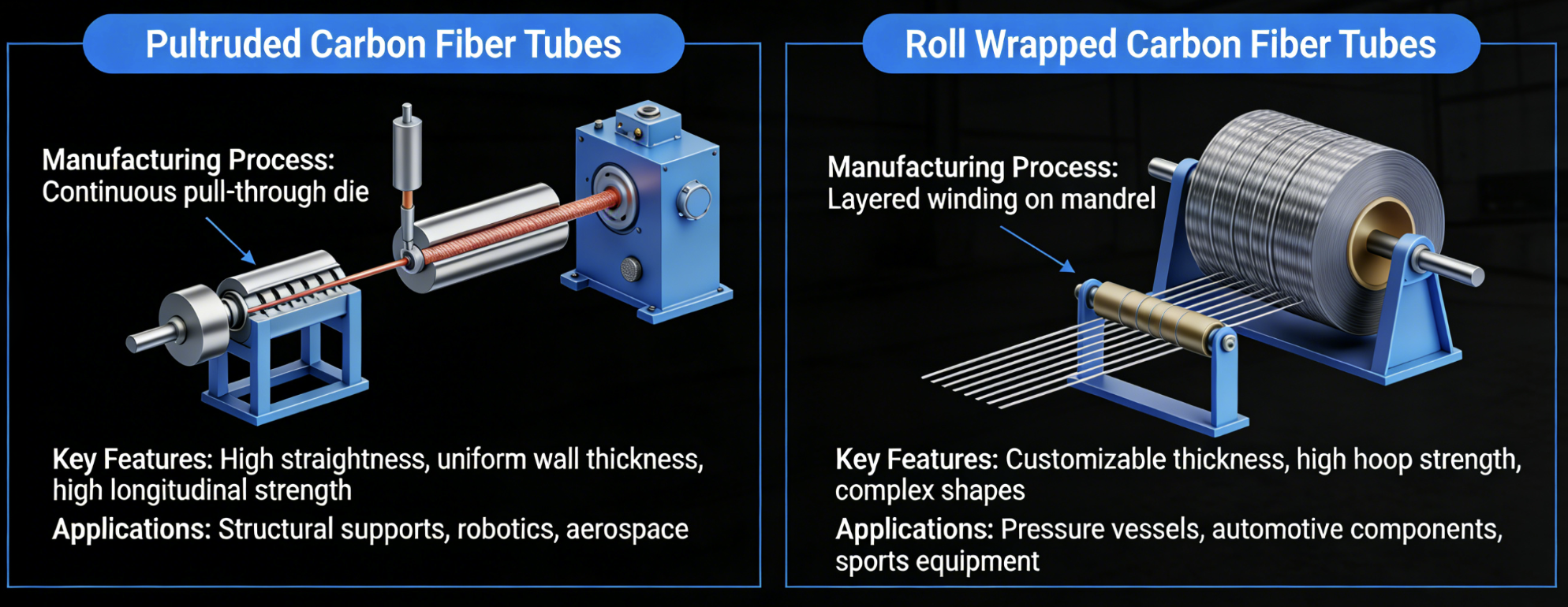
The core idea is straightforward. You pull continuous carbon fiber rovings through a resin bath, shape them through a heated die, cure everything under controlled heat, and cut to length. That’s the whole process. The word “pultrusion” describes the action directly — pulling material through extrusion tooling. The result is a unidirectional carbon fiber tube with fibers running along the tube’s axis.
The Step-by-Step Process
Here’s how a pultruded carbon fiber tube gets made:
-
Fiber Setup — Spools of 24K or 48K carbon fiber rovings mount on a creel rack. A guiding system aligns every strand in parallel along the length of the tube. All strands run the same direction before anything moves forward.
-
Resin Impregnation — Those aligned fibers pass through an epoxy resin bath. Two to four saturation layers coat the fibers. Rollers squeeze out excess resin to keep the fiber-to-resin ratio on target.
-
Preforming & Heated Die — Fibers enter a 900mm forming mold with three thermal zones — preheat, gel, and full cure — running at 120–180°C. Heat compacts the fibers and locks the resin in place.
-
Continuous Pulling — A tractor mechanism pulls the material at 0.2–0.5 meters per minute, without stopping. No pauses. No batch cycles.
-
Cutting — Automated saws cut finished tubes to exact lengths, up to 6 meters per piece.
What This Process Produces
The unidirectional fiber alignment is the defining characteristic — and the trade-off. 100% of fibers run along the tube’s length. This delivers exceptional axial tensile strength and dimensional consistency. You get tight tolerances, stable cross-sections, and high fiber volume with minimal porosity.
The flip side? Torsional resistance is close to zero. Twist loads are this tube’s weak point, by design.
For high-volume production needing consistent axial stiffness at controlled cost, the pultrusion manufacturing process is built for that job.
What Is Roll Wrapping? How Roll Wrapped Carbon Fiber Tubes Are Made
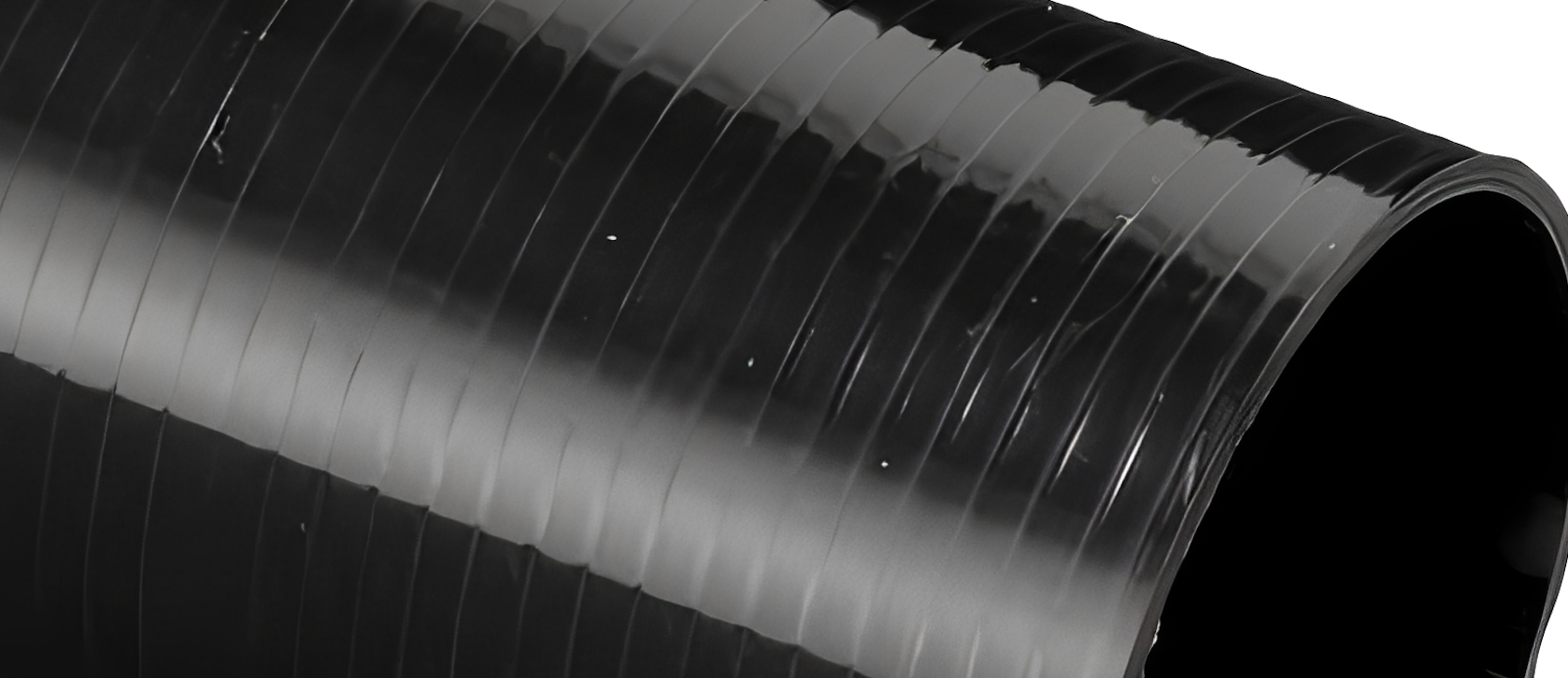
Roll wrapping starts with a metal mandrel — a precision-machined aluminum rod that sets the tube’s inner diameter. Everything builds around it, layer by layer, until you have a finished tube.
The material isn’t loose fiber pulled through resin. It’s prepreg — carbon fiber sheets pre-impregnated with epoxy at a controlled 30–40% resin content. Each sheet gets cut to specific dimensions and fiber angles before it ever touches the mandrel.
The Step-by-Step Process
-
Cut prepreg sheets to pattern — fiber angles are set by the design: 0°, 90°, ±45°, or combinations.
-
Layer onto the mandrel in sequence. A standard layup looks like this: inner woven prepreg (210g/m²), multiple unidirectional plies, then outer woven prepreg for a clean cosmetic finish.
-
Roll tight — by machine or by hand — pressing each layer flat against the one beneath it.
-
Apply shrink tape in a tight spiral with heavy overlap. This builds uniform compression across the tube during cure.
-
Cure in an oven — or an autoclave for higher-pressure void reduction. The tubes hang vertical the whole time.
-
Cool, then extract the mandrel using hydraulic force.
-
Trim ends to final length.
Why Fiber Angle Changes Everything
This is where roll wrapping pulls ahead. Each layer can run a different direction. A ±45° ply resists torsion. A 0° ply carries axial loads. Stack them with purpose, and you get a tube built for complex, multi-directional stress. Pultrusion can’t match that — its fixed unidirectional architecture gives you no room to vary the fiber path.
The trade-off is real, though. Mandrel length caps most tubes under 3 meters. The process also fits small custom runs far better than high-volume production.
Fiber Orientation & Structural Mechanics: The Root Cause of Every Performance Difference
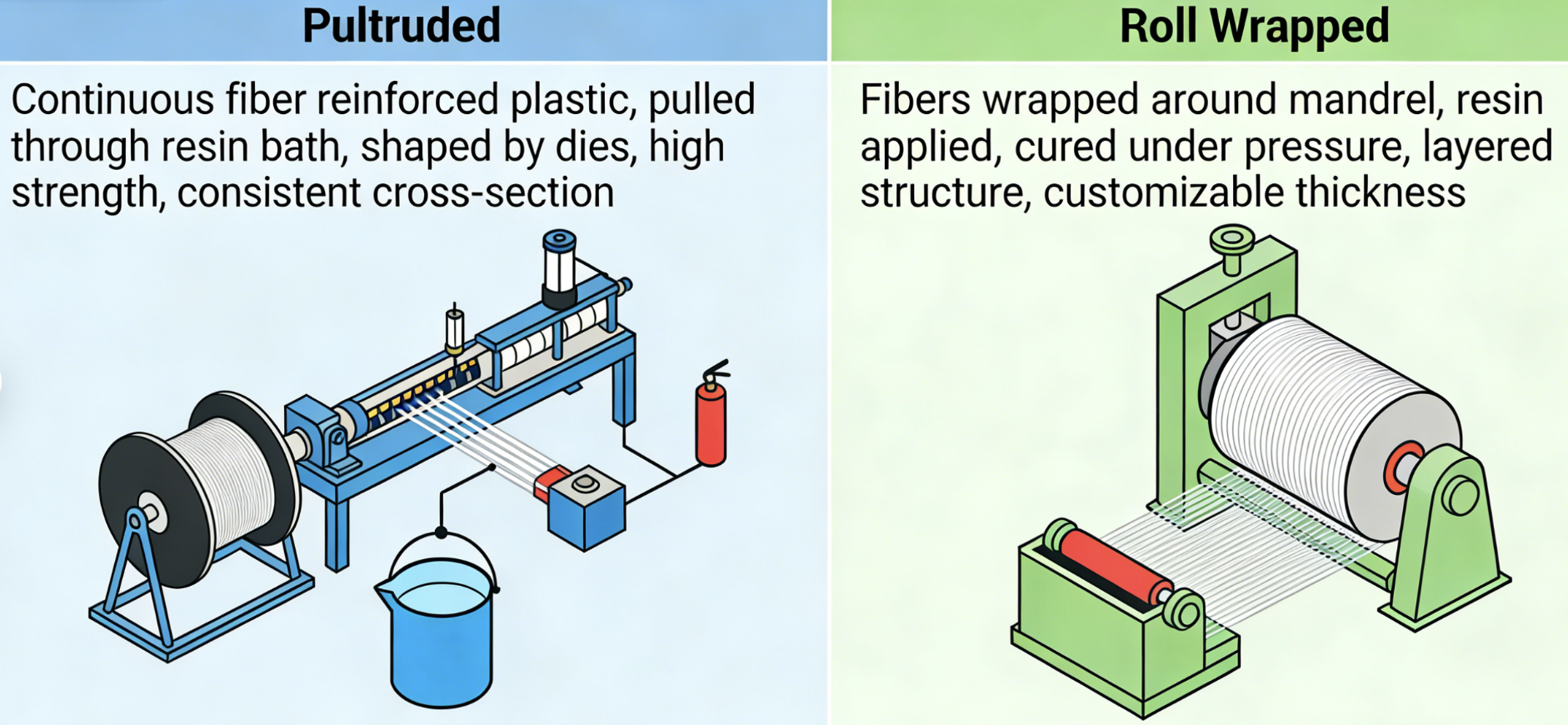
Fiber direction isn’t a detail. It’s the entire game.
Every mechanical difference between pultruded and roll wrapped carbon fiber tubes comes down to one variable: the angle at which fibers are locked into the matrix. We’re talking tensile strength, torsional resistance, bending modulus, hoop strength — all of it. Change the angle, and you change what the tube can do.
The Physics Behind the Numbers
In a pultruded carbon fiber tube, 100% of fibers run at 0° — aligned with the load axis. The orientation tensor (A11) approaches 1.0. No deviation. No wasted fiber. You get an axial modulus of 130–170 GPa. About 90% of the tube’s stiffness sits in the axial direction.
Roll wrapped tubes work on a different principle. A ±45° layup breaks that axial dominance. The bending modulus drops to 60–90 GPa — about half. But torsional stiffness jumps 3–5x. Hoop strength climbs from under 200 MPa to 800–1,200 MPa.
Neither result is a flaw. That’s Classical Laminate Theory doing its job.
What the Data Says
|
Property |
Pultruded (0° axial) |
Roll Wrapped (±45°) |
|---|---|---|
|
Axial Modulus |
130–170 GPa |
50–80 GPa |
|
Hoop Strength |
100–200 MPa |
800–1,200 MPa |
|
Torsion Stiffness |
0.1–0.2 Nm² |
0.5–1.0 Nm² |
|
Bend Modulus |
140–160 GPa |
60–90 GPa |
A single 30° fiber rotation cuts tensile strength by 30%. A 45° ply drops about 75% of its axial modulus contribution — that’s cos⁴(45°) applied to CLT. Fiber orientation drives 70–90% of total performance variance between tube types. That’s not a minor factor. It’s the dominant one.
The fiber angle doesn’t describe the tube. It is the tube.
Head-to-Head Performance Comparison: Strength, Stiffness, Weight & Dimensional Precision
The numbers don’t lie — they just need context.
Both tube types use the same raw material: carbon fiber. But the mechanical outcomes are worlds apart. Here’s the full breakdown across the five properties that drive material selection decisions.
|
Metric |
Pultruded Carbon Fiber Tube |
Roll Wrapped Tube |
|---|---|---|
|
Axial Tensile Strength |
1,200–2,000 MPa |
800–1,500 MPa |
|
Flexural/Bending Strength |
800–1,200 MPa |
1,000–1,800 MPa |
|
Torsional Strength |
200–400 MPa |
500–900 MPa |
|
Density |
1.5–1.6 g/cm³ |
1.6–1.8 g/cm³ |
|
Wall Thickness Tolerance |
±0.05–0.10 mm |
±0.10–0.20 mm |
|
Dimensional Tolerance |
±0.1–0.2% |
±0.2–0.5% |
Strength: Axial vs. Multi-Directional
On axial tensile strength, pultruded wins — and it’s not close. Standard modulus pultruded tubes hit 1,800 MPa. The same fiber wound at multi-angle orientation lands around 1,200 MPa. That’s a 50% gap. Fiber alignment explains it all.
Change the loading direction, and the result flips. Roll wrapped tubes deliver 1,000–1,800 MPa in bending. That’s 30–50% better than pultruded. Torsional shear strength tells an even clearer story. Wound tubes reach 700 MPa. Pultruded tubes manage around 350 MPa. A 100% difference. Pultruded tubes were never built for twist loads.
Weight & Density
A 1-meter, 50mm OD pultruded tube weighs 450g. The same-size roll wrapped tube comes in around 520g — 15% heavier. That extra weight comes from a higher resin-to-fiber ratio in the layup process. Pultruded tubes land in the 1.5–1.6 g/cm³ density range. Roll wrapped tubes run 1.6–1.8 g/cm³.
For weight-critical builds — lightweight frames, long spans, aerial platforms — that 15% gap adds up fast.
Dimensional Precision
Pultrusion uses a continuous, die-controlled process. It produces tighter tolerances that roll wrapping can’t match. Wall thickness holds to ±0.05–0.10 mm. Roll wrapped tubes run ±0.10–0.20 mm. Dimensional tolerances follow the same pattern. Pultruded holds ±0.1–0.2% on length and diameter. Roll wrapped runs ±0.2–0.5%.
For precision assemblies — robotics, aerospace brackets, optical mounting systems — that consistency cuts out the need for extra tolerance adjustments down the line.
The Bottom Line
Go with pultruded if axial loads dominate, weight margins are tight, and you need dimensional repeatability across large production runs.
Go with roll wrapped if your build involves combined bending and torsion — drone arms, shafts, structural tubes under dynamic loading. In those cases, pultruded tubes fail at about half the load capacity.
Same fiber. Completely different performance. Your application decides which tube belongs in the build.
Cost, Production Volume & Lead Time: The Business Side of the Decision
Your manufacturing method choice goes beyond structural performance. It hits your budget, your timeline, and your supplier relationships — and those effects build up fast.
Here’s the core cost gap: at low volumes (under 100 meters), pultruded carbon fiber tubes run $60–100/meter. Roll wrapped tubes come in at $150–300/meter. That’s a 2.5–3x price difference before you’ve touched shipping or safety stock. Scale up past 1,000 meters, and the gap narrows — but pultrusion still wins at $20–40/m versus $50–80/m for roll wrapped.
The reason comes down to process structure. Pultrusion runs continuously. Mold costs of $5,000–15,000 spread across 10,000+ meters per year. Roll wrapping runs in batches. It requires 4–8 hour cure cycles and autoclave equipment that starts at $100,000. Higher labor, higher overhead, smaller runs — the costs stack up quickly.
Volume, Lead Time & Length: Three Constraints That Shape the Decision
|
Factor |
Pultruded |
Roll Wrapped |
|---|---|---|
|
MOQ |
50–500m |
10–100 units |
|
Lead Time |
2–4 weeks (1,000m) |
4–12 weeks |
|
Max Length |
Unlimited (50m+ standard) |
10–20m (mandrel limit) |
|
Volume Discount |
20% at 1,000m; 30–40% at 5,000m |
Minimal scale benefit |
Lead time matters more than most procurement teams realize. Raw material timelines have stretched to 81 days on average — up 25% since the pandemic. Roll wrapped orders add batch curing delays on top of that. You get supply chain exposure that pultrusion’s continuous-pull model avoids entirely.
For tubes exceeding 20 meters, roll wrapping needs joints. That adds 15–25% to cost and weight. Pultrusion carries no such limitation.
The bottom line: ordering at scale, needing fast replenishment, or requiring long continuous sections — pultruded carbon fiber tubes are the lower-risk, lower-cost path. Small custom runs with complex fiber layups? The premium for roll wrapping makes sense there. Know your volume before you commit to either.
Pultruded Carbon Fiber Tubes: Best Applications & Use Cases
The market doesn’t lie. Pultruded carbon fiber tubes hold 65% of global market share. That number reflects decades of engineers pairing the right tube to the right job.
That job has a clear profile. Axial loads. Long linear spans. High-volume runs. Weight budgets that don’t forgive waste. Tick those boxes, and pultruded is your answer — before you finish reading the spec sheet.
Where Pultruded Tubes Do Their Best Work
Aerospace & Defense — Aircraft spars, UAV frames, and military structural components run on pultruded tubes. Weight reduction here isn’t cosmetic. It’s mission-critical. Aerospace holds the largest single application segment, and that lead is earned, not accidental.
Wind Energy — Turbine blades and structural supports need stiffness and corrosion resistance. They face decades of outdoor exposure. Global wind capacity is projected to grow 75% over the next ten years. Demand for pultruded components in this sector keeps climbing.
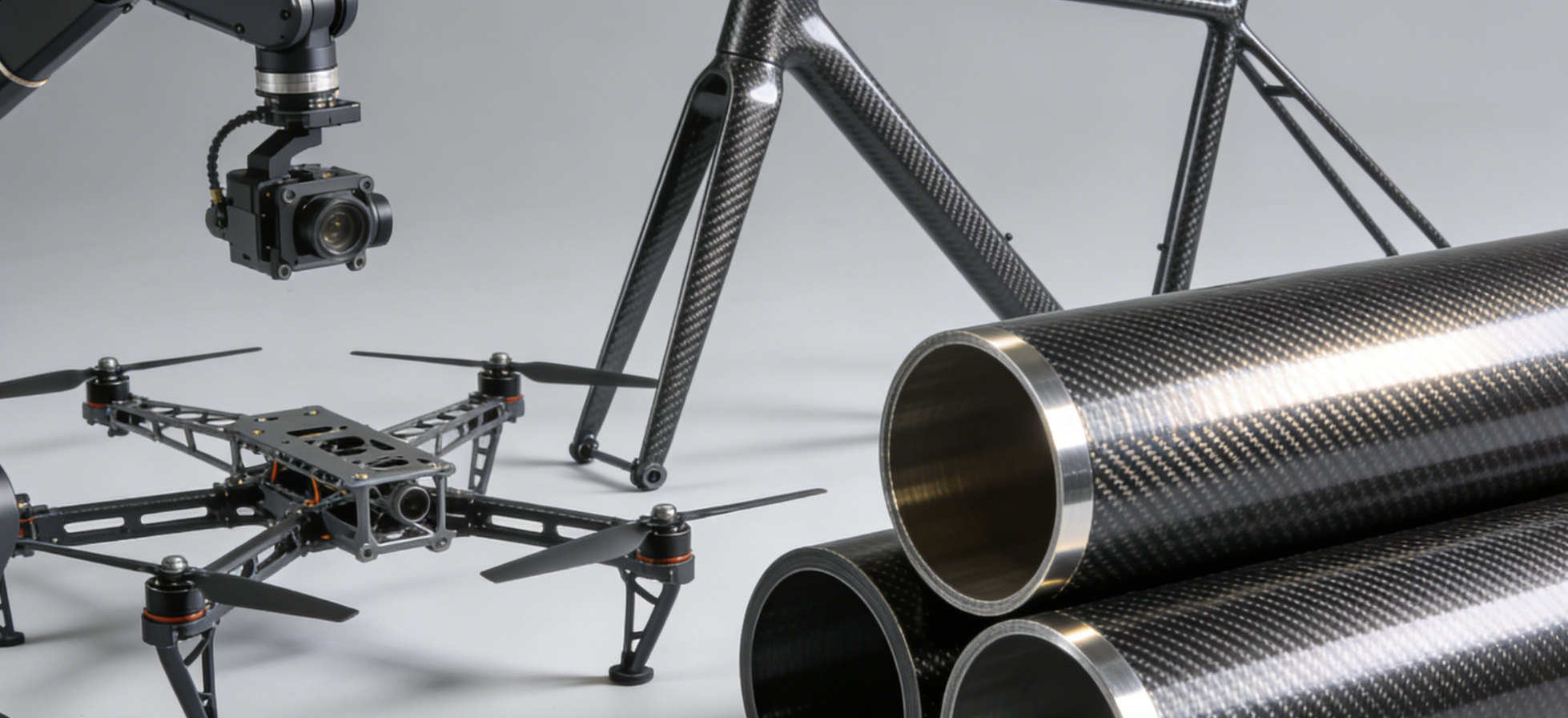
Robotics & Automation — Push-pull rods, linear actuator supports, and lightweight frames all load in one direction. That’s the job 100% unidirectional fiber alignment was made for. You get maximum stiffness along the axis that matters, with no wasted material in directions that don’t.
Sporting Goods & Consumer Products — Arrow shafts, fishing rods, tent poles, RC model frames. These products are high-volume, standardized, and weight-sensitive. Pultrusion’s continuous manufacturing process keeps unit costs low at scale. That’s a hard combination to beat.
Industrial Structures — Telescopic poles, trusses, construction reinforcements, offshore platforms. Straight geometry. Axial loads. Large quantities. Pultruded tubes fit this profile cleanly, and consistent output across long production runs is built into the process.
Where It Falls Short
Pultruded tubes are built around constant cross-sections and fixed unidirectional fiber alignment. That’s a real constraint — not a minor one. Complex geometries, multi-directional loading, or parts that need torsional resistance — those need roll wrapping instead. Forcing a pultruded tube into those scenarios doesn’t cut costs. It creates failure modes.
Match the tube to the load. That’s the whole framework.
Roll Wrapped Carbon Fiber Tubes: Best Applications & Use Cases
Roll wrapped tubes exist because some loads refuse to behave.
A structure can twist, bend, and compress all at once. Drone arms handle flight stress. Bicycle frames absorb road shock. Racing chassis take cornering loads. In all these cases, unidirectional fiber alignment falls short. Roll wrapped tubes are built for exactly that. Multi-axial laminates combine 0°, ±45°, and 90° plies. The result is what pultrusion can’t offer: bending stiffness, crush resistance, and hoop strength working together.
Where Roll Wrapped Tubes Belong
Aerospace & UAV — Drone booms, UAV fuselage tubes, and aircraft structural components face both bending and torsional loading at the same time. Roll wrapped tubes handle that combination. Pultruded tubes don’t.
High-Performance Vehicles & Cycling — Bicycle seat posts, frames, and racing chassis parts need strong strength-to-weight ratios under dynamic, multi-directional stress. Layup flexibility here isn’t a luxury. It’s how you manage load.
Precision Engineering — Camera booms, stabilization equipment, and high-precision shafts need tight ID/OD tolerances and clean surface finishes. Roll wrapping delivers both.
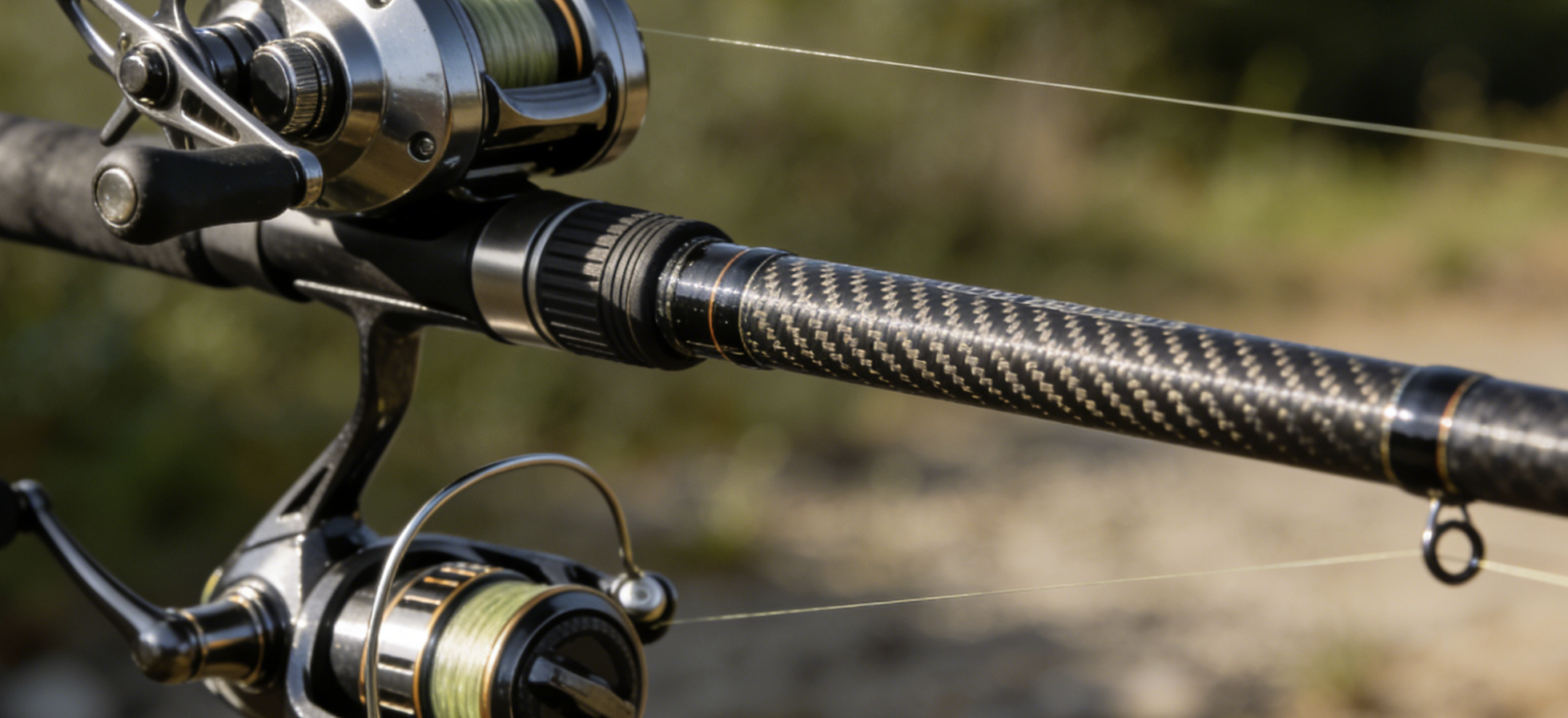
Sporting & Marine Applications — Fishing rods, high-performance bike parts, and marine structures exposed to corrosion all benefit from fatigue resistance and crush capacity. The ±45° hoop plies build that in.
Choose Roll Wrapped For These Needs
-
Bending stiffness per unit weight is your top requirement
-
Your application carries combined bending and torsional loads
-
Crush resistance matters — impact, compression, or external pressure
-
Tight dimensional tolerances or a finished surface are non-negotiable
-
You run small-to-medium production volumes where customization justifies the cost
Where Roll Wrapping Loses
Long continuous lengths. Pure axial loads. Hard cost-per-meter limits. Those are pultrusion’s territory. Roll wrapping has a mandrel-length ceiling — under 3 meters in most cases. Per-unit cost runs higher too. So for simple geometry at high volume, pultrusion is the better call.
One thing to check before you order: always request three-point bend test data, crush test results, and ID/OD tolerance specs from your supplier. Theoretical numbers and real coupon results can differ based on wall thickness and ply angles. Test data is the number that counts when the build is real.
Decision Guide: How to Choose Between Pultruded and Roll Wrapped Tubes
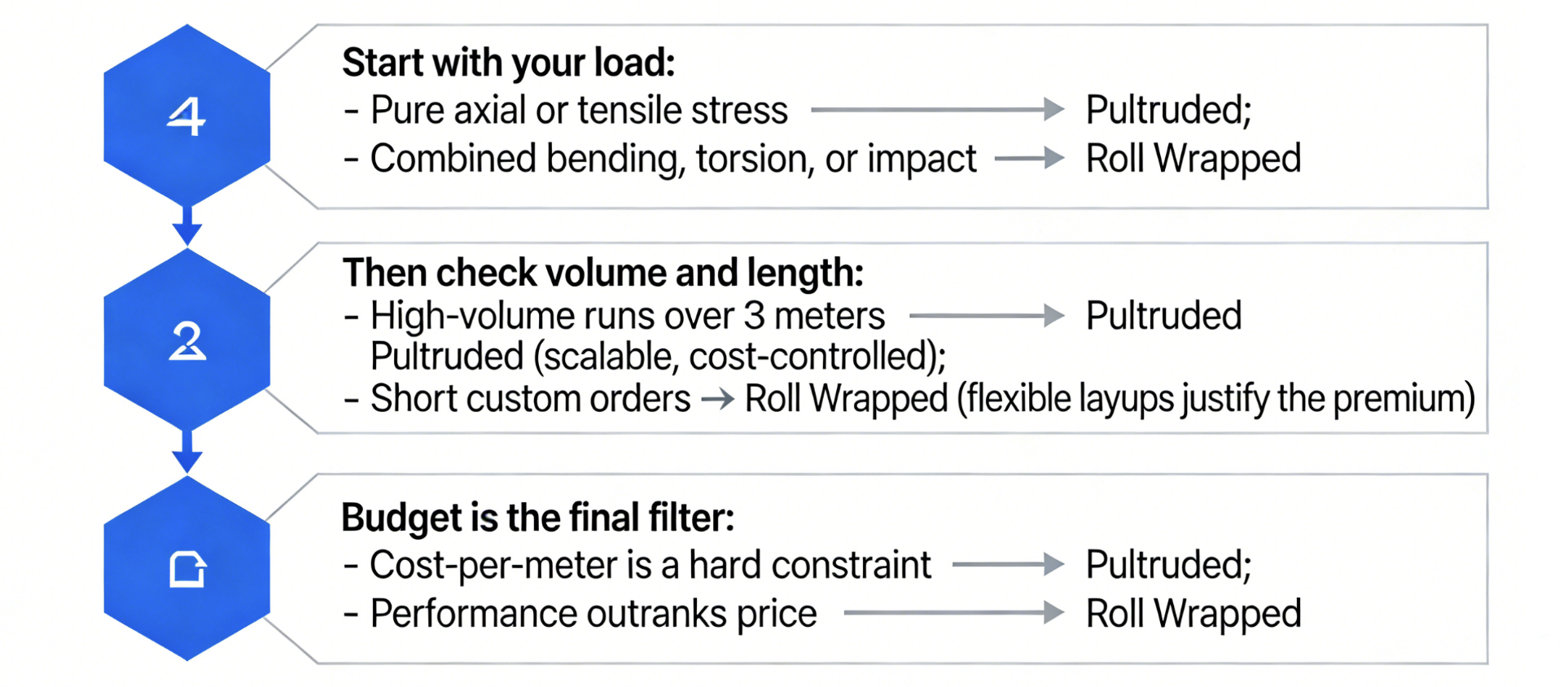
Five questions. That’s all it takes.
Work through this decision tree. You’ll land on the right tube fast — no second-guessing needed.
Start with your load:
– Pure axial or tensile stress → Pultruded
– Combined bending, torsion, or impact → Roll Wrapped
Then check volume and length:
– High-volume runs over 3 meters → Pultruded (scalable, cost-controlled)
– Short custom orders → Roll Wrapped (flexible layups justify the premium)
Budget is the final filter:
– Cost-per-meter is a hard constraint → Pultruded
– Performance outranks price → Roll Wrapped
Three Common Dilemmas, Answered
Drone arms? Roll wrapped. Hoop fibers stop the tube from splitting on impact. Pultruded tubes crack under side hits.
Structural tube over 3 meters? Pultruded. Long straight spans, axial stiffness, lower cost — that’s what it’s built for.
High-volume tension rods? Pultruded. It delivers top longitudinal strength, tight tolerances, and pricing that drops as volume grows.
The scorecard backs this up: pultruded scores 9/10 on volume, cost, and length. Roll wrapped scores 9/10 on complex loads. Neither one wins in every situation. Your application makes the final call.
Pultruded vs Roll Wrapped: Quick-Reference Comparison Table
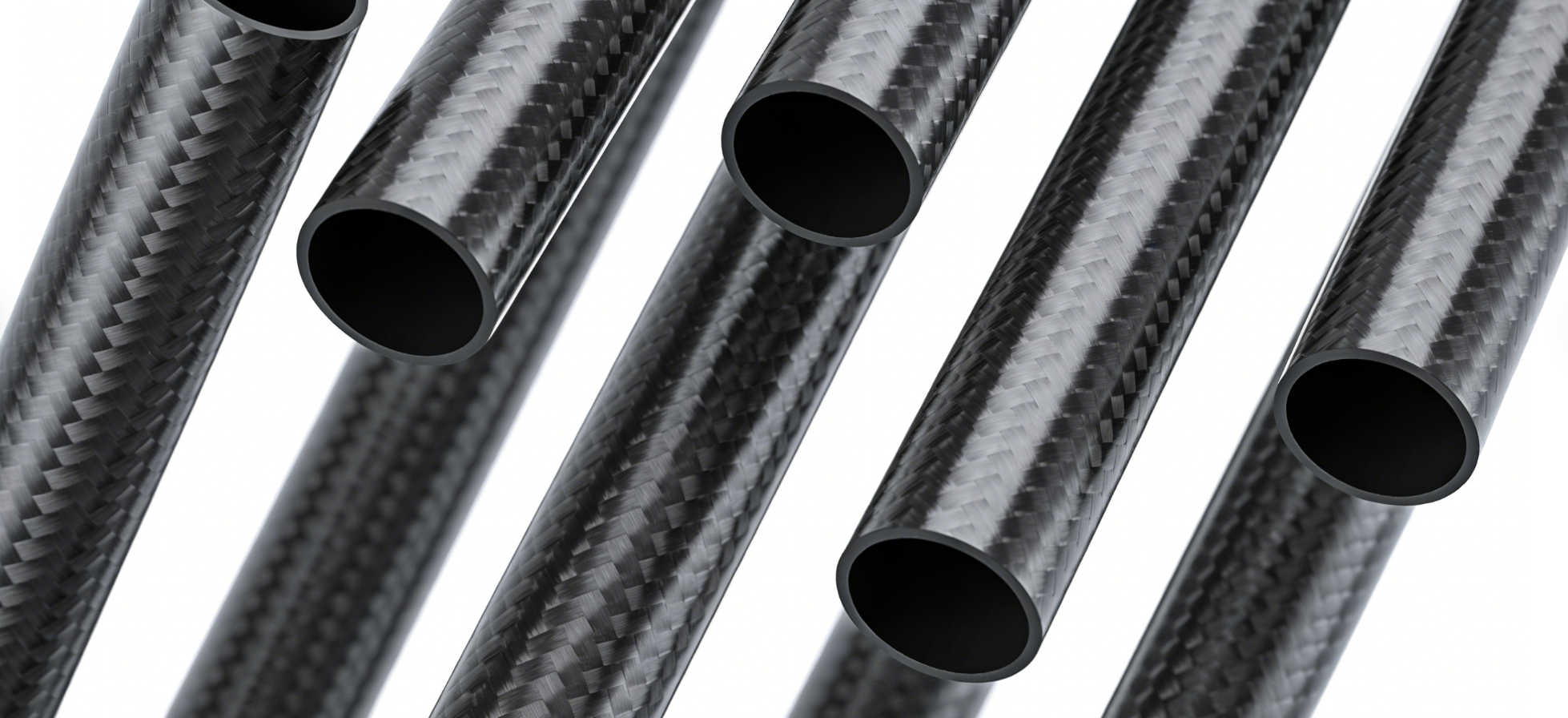
Six properties. Two tubes. One table that gets straight to what matters.
|
Aspect |
Pultruded Carbon Fiber Tube |
Roll Wrapped Tube |
|---|---|---|
|
Fiber Direction |
Axial (0°) — one direction |
0°, ±45°, 90° multi-directional |
|
Axial Tensile Strength |
Excellent |
Good |
|
Torsion / Bending |
Weak |
Strong |
|
3-Point Bend Failure Load |
~140kg |
~200kg |
|
Weight |
Lighter |
~15% heavier |
|
Cost |
Lower |
2.5–3× higher |
|
Design Flexibility |
Limited |
High |
|
Best For |
Long axial spans, high-volume runs |
UAV booms, shafts, complex-load structures |
The short version: Pultruded wins on tensile strength, weight, and cost. Roll wrapped takes the lead on anything that twists, bends, or takes a side hit. That 140kg vs 200kg bend failure gap is not a minor detail. It is the number that should drive your material decision.
Conclusion
Choosing between a pultruded carbon fiber tube and a roll wrapped one isn’t a debate. It’s a specification question. Pultruded tubes lead on axial stiffness, dimensional consistency, and cost at scale. Roll wrapped tubes take over when load paths run in multiple directions and geometry gets complex. Know your forces, know your budget — the answer follows from there.
Most engineers don’t struggle with understanding the difference. The real mistake is assuming one process beats the other across the board. It doesn’t. The right tube is the one built for your application. Not someone else’s.
Still weighing your options? Don’t guess. Browse HyperX Carbon’s full range of pultruded carbon fiber tubes — filter by OD, wall thickness, and length. Or reach out for a spec consultation. Getting the material decision right at the start cuts out redesign headaches down the road. That’s not a sales pitch. That’s just physics.
Contact HyperX Carbon – Your Trusted Chinese Carbon Fiber Partner
Ready to source high-performance carbon fiber materials or custom forged carbon fiber parts from China?
HyperX Carbon is a leading manufacturer with 20+ years of expertise, specializing in aerospace-grade forged carbon fiber, prepreg, tubes, sheets, and lightweight automotive/drone/medical components. We offer:
-
Stable supply chain with premium raw materials (Toray, Mitsubishi, Hengshen)
-
AS9100D certified production for aerospace & UAV applications
-
Rapid prototyping (5-8 weeks) and monthly capacity exceeding 180,000 parts
-
Competitive pricing with 15-18% cost savings on forged carbon solutions
-
Full customization: from T700/T1100G to ultra-high modulus grades
Whether you’re an eVTOL developer, automotive OEM, drone manufacturer, or medical device engineer, HyperX delivers consistent quality, batch-to-batch reliability, and reliable delivery.
Get in touch today for a free consultation, custom quote, or material sample.
📧 Email: [email protected]
🌐 Website: https://www.hyperxcarbon.com/
📞 Phone/WhatsApp: +86 15623270276 (English support available)
Let’s build your next lightweight innovation together – contact HyperX Carbon now and stay ahead in the low-altitude and advanced composites market.




