
Most carbon fiber tubes are round. But most engineering problems aren’t.
Your drone arm needs to curve around a battery housing. Your robotic linkage needs a tapered profile to shed weight at a specific point. Your mounting system needs flat faces that a round tube can’t provide. Standard stock won’t cut it.
Curved carbon fiber tubing, tapered profiles, octagonal hollow sections, hexagonal forms — none of these are exotic oddities reserved for aerospace black budgets. They’re practical, buildable solutions. More engineers are specifying them every day.
This guide breaks down each profile type:
-
What it is
-
How it’s made
-
Where it performs best
-
How to get one built to your exact specs
Curved, Tapered, Octagonal & Hexagonal Carbon Fiber Tubes
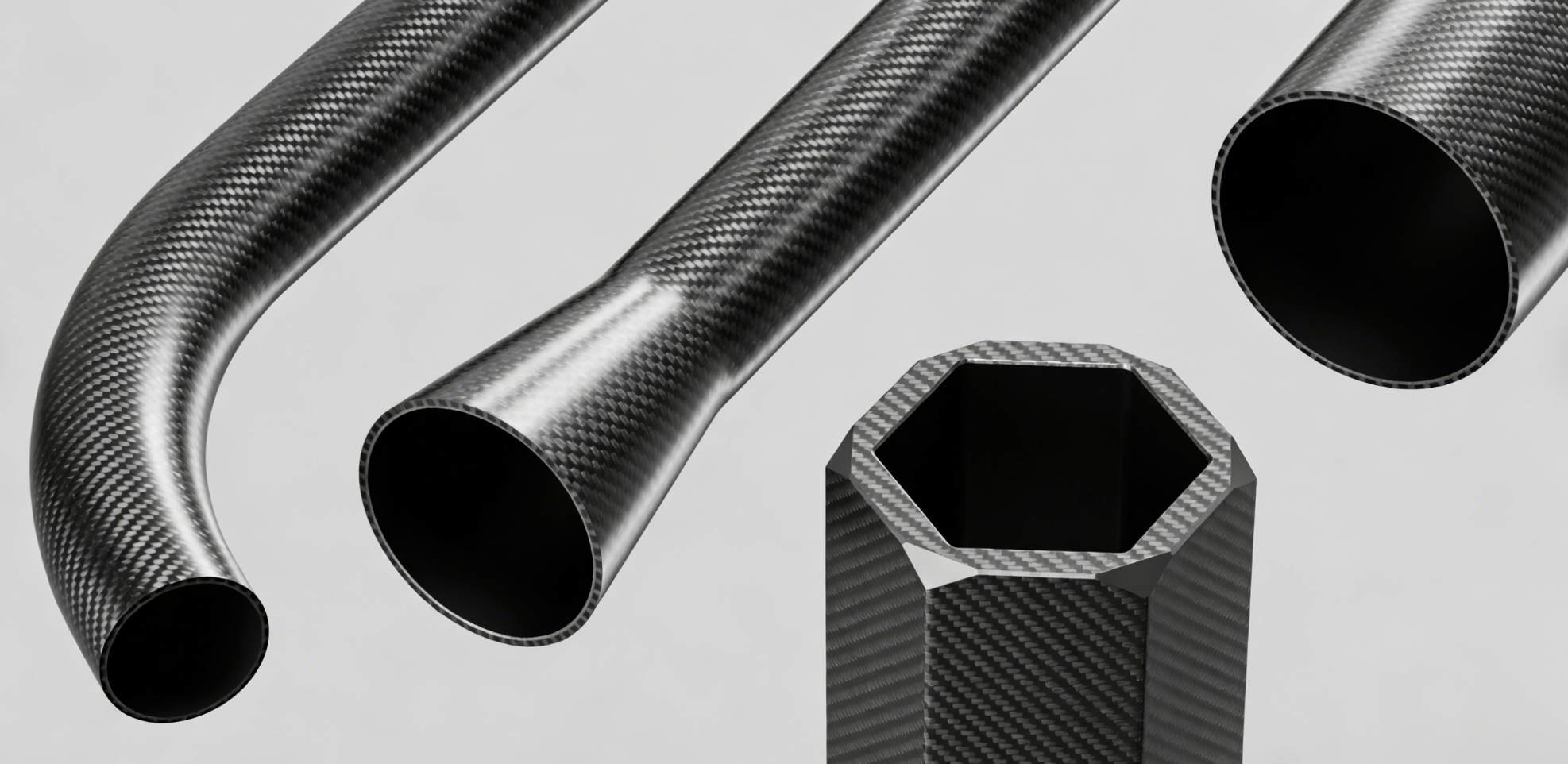
Four profile families. Each solves a different class of problem.
|
Profile |
Core Advantage |
Primary Use Case |
|---|---|---|
|
Curved |
Follows geometry, not fights it |
Drone arms, vehicle frames |
|
Tapered |
Sheds mass where strength isn’t needed |
Fishing rods, robotic limbs |
|
Octagonal |
Flat faces + rotational near-symmetry |
Camera rigs, structural rails |
|
Hexagonal |
Tool-free alignment, dense packing |
Modular frames, architectural grids |
Below, you’ll find full details on each profile — specs, how it’s made, real-world uses, and what to tell your supplier before placing an order.
These aren’t compromise solutions. A tapered carbon fiber tube beats a straight round tube in bending efficiency. A curved carbon fiber tube built to your bend radius cuts out brackets, adhesives, and the failure points they create.
The geometry is the engineering.
What Makes Non-Round Carbon Fiber Tubes Different — and Why Engineers Choose Them
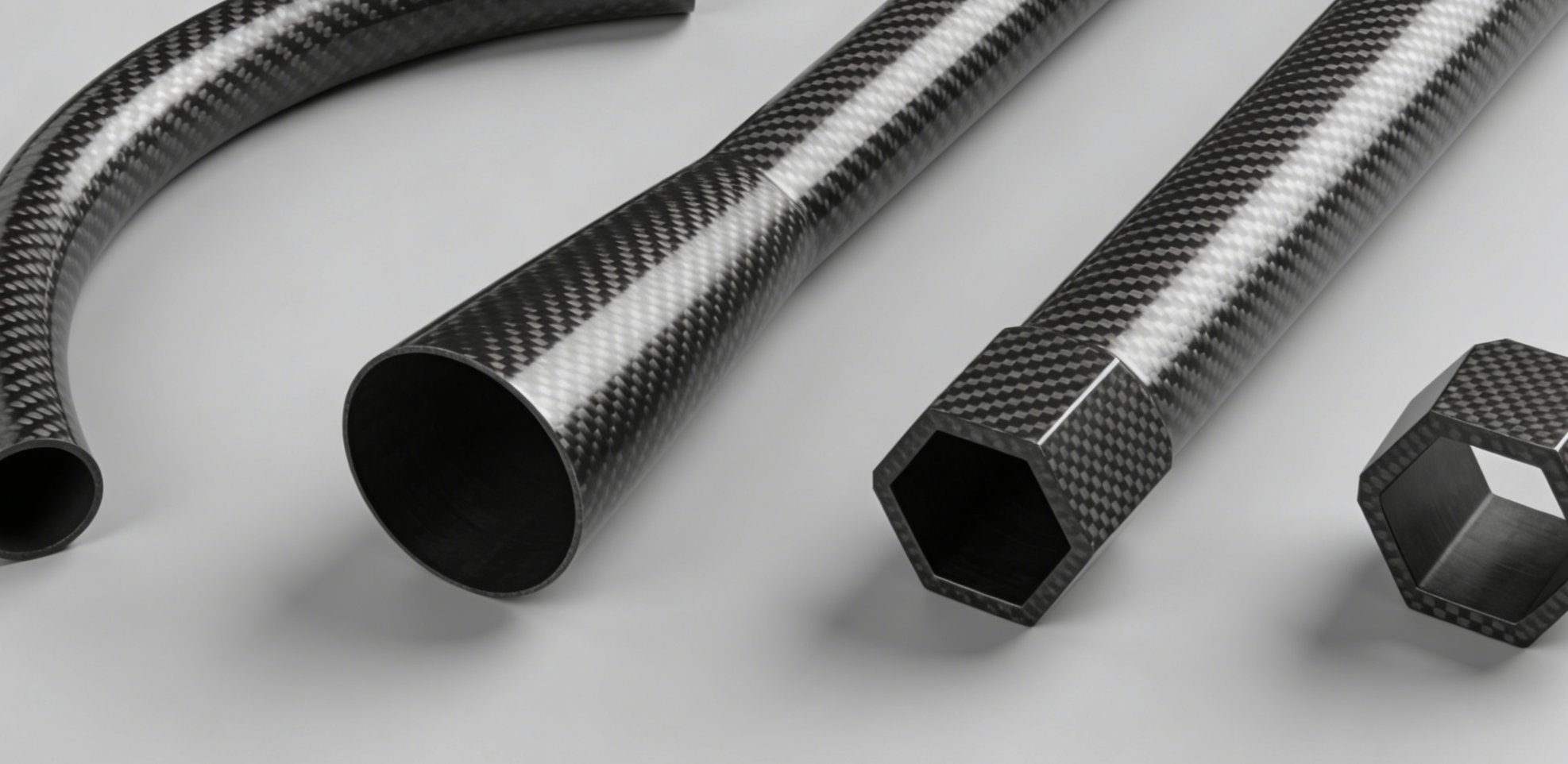
The shape of a tube isn’t aesthetic. It’s a load path decision.
Round tubes spread stiffness in every direction — useful when loads are unpredictable or multidirectional. But most structural applications don’t work that way. Loads have a primary axis. Assemblies have flat mounting faces. Frames have defined bending planes. Round stock is versatile, sure. But once your geometry stops being symmetric, it leaves performance on the table.
Non-round profiles fix this through anisotropic stiffness. They concentrate rigidity where bending loads hit hardest. Polygonal and shaped sections run 20–30% stiffer in their primary bending axes than round tubes of the same material and wall thickness. That’s not a rounding error. That’s a real structural advantage built right into the cross-section.
You see this play out in real applications:
-
Robotic arms using non-round profiles show a measured 26% improvement in positioning accuracy over round equivalents. No adapter plates, no shimming — just geometry doing the work.
-
UAV frames built with shaped carbon fiber tubing cut vibration transmission by ~15% through tighter load distribution.
-
CNC gantries get minimal in-frame deflection with non-round profiles. That delivers millimeter-level repeatability. Round tubes can’t match that.
Three situations make the switch from round to non-round a hard requirement:
-
Space-constrained installs — flat faces let you bolt directly, no custom adapters needed.
-
Torsional load concentration — square and polygonal sections resist torque up to 25% better in framed structures. The corners carry shear stress so the rest of the section doesn’t have to.
-
Modular precision assembly — flat surfaces self-register. Round tubes don’t.
Round carbon fiber tubing is still the right choice for rotating shafts, omnidirectional stress environments, and aerodynamic builds where symmetry matters. But once your design has a primary load axis, a flat mating surface, or a precision alignment requirement — the round tube is working against you.
Curved Carbon Fiber Tubes: Precision Bending Without Sacrificing Structural Integrity
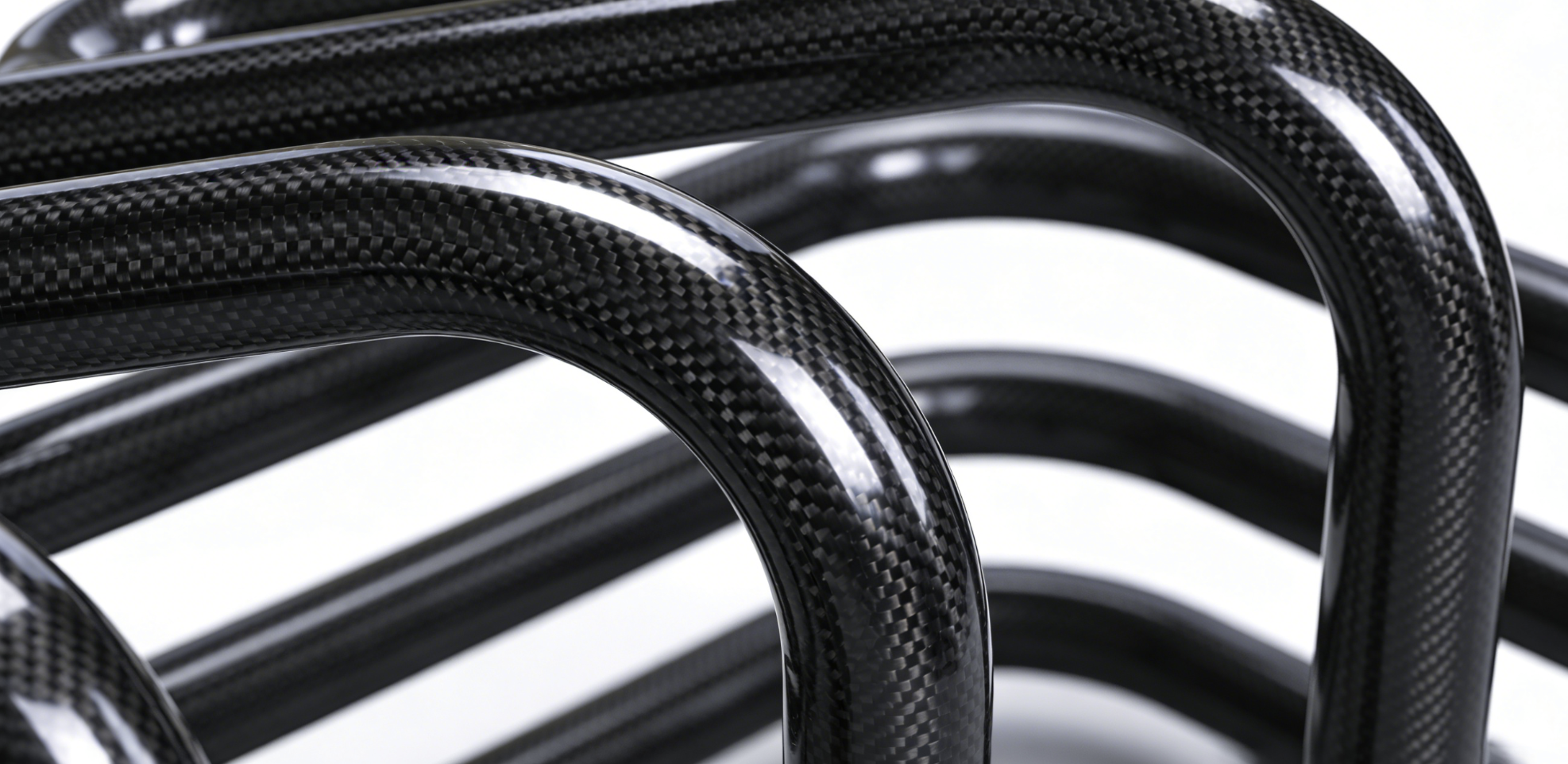
Bending carbon fiber isn’t the same as bending metal. With steel, you apply force and the material gives. With carbon fiber, you engineer the curve before the material cures — and that changes everything about the final result.
A curved carbon fiber tube isn’t a straight tube that’s been bent out of shape. It’s built curved from day one. Fiber orientation gets planned around that geometry before production even starts. That’s why bent carbon fiber tubing keeps its structural integrity where a post-processed metal part would develop stress concentrations, micro-cracks, and fatigue weak points.
How Curved Carbon Fiber Tubes Are Made
Two main processes drive production:
Split-mold prepreg layup places pre-impregnated carbon fiber sheets over a curved core inside a precision two-part mold. Tolerances reach ±0.1–0.5mm on bend radius. It’s labor-intensive. Best suited for tight radii under 100mm where dimensional precision has no room for error.
Filament winding with flexible mandrel feeds continuous carbon tow at controlled angles — 0°/±45° — around a curved form. It’s faster to produce and practical for radii above 200mm. Tolerances land around ±1mm. For prototype runs and longer curved sections up to 3 meters, this is the more cost-effective path.
Customizable Parameters That Matter
|
Parameter |
Typical Range |
Structural Impact |
|---|---|---|
|
Bend Radius |
20–500mm |
Smaller radii increase shear stress 20–50%; 0° fiber layup recovers ~30% of that drop |
|
Wall Thickness |
1–5mm |
5mm wall delivers 2× the torsional rigidity of 1mm |
|
Length |
Up to 3m |
Beyond 2m, add ±45° layers to offset 10–15% stiffness loss from buckling tendency |
|
Fiber Orientation |
0° / ±45° |
±45° layup adds 40% torsional strength over unidirectional |
One ratio to watch closely: resin-to-fiber at 33:67 is the performance sweet spot. Push resin content higher and torsional stiffness drops 20–30%. It’s a small variable with a big consequence.
Where Curved Carbon Fiber Tubing Gets Used
-
Drone arc arms: 1–2m curved tubes, 2mm wall, ~R150mm. Result: 70% weight reduction vs. aluminum with 3.5 GPa structural strength maintained.
-
Racing chassis struts: Filament-wound, ±45° layup, FEA-validated to match steel buckling modulus — at a fraction of the mass.
-
Medical brackets: 1mm wall, R50–100mm. Corrosion-free, with 2× the vibration damping of equivalent metal forms.
Curved Carbon Fiber vs. Bent Metal: The Honest Comparison
|
Metric |
Carbon Fiber |
Steel / Aluminum |
|---|---|---|
|
Density |
0.050 lb/in³ |
0.10–0.28 lb/in³ |
|
Weight Savings |
— |
60–80% lighter |
|
Fatigue Life |
>10⁶ cycles |
10⁵–10⁶ cycles |
|
Specific Strength |
4–4.8 GPa |
~125 KSI steel |
|
Torsion Stiffness |
10 MSI bending modulus |
30 MSI steel — but 3× heavier |
The processing cycle runs longer — 24–72 hours for cure and FEA validation versus 4–8 hours to bend and anneal metal. But material waste drops by 50%. The finished part needs no secondary straightening, no stress relieving, and no corrosion treatment. You get a cleaner production chain with less rework on the back end.
FEA validation isn’t optional on curved profiles. A proper bending and torsion analysis keeps post-bend integrity loss below 5%. Skip it and you’re guessing on a structural component — and that’s not a risk worth taking.
Tapered Carbon Fiber Tubes: Optimized Weight Distribution for High-Performance Profiles
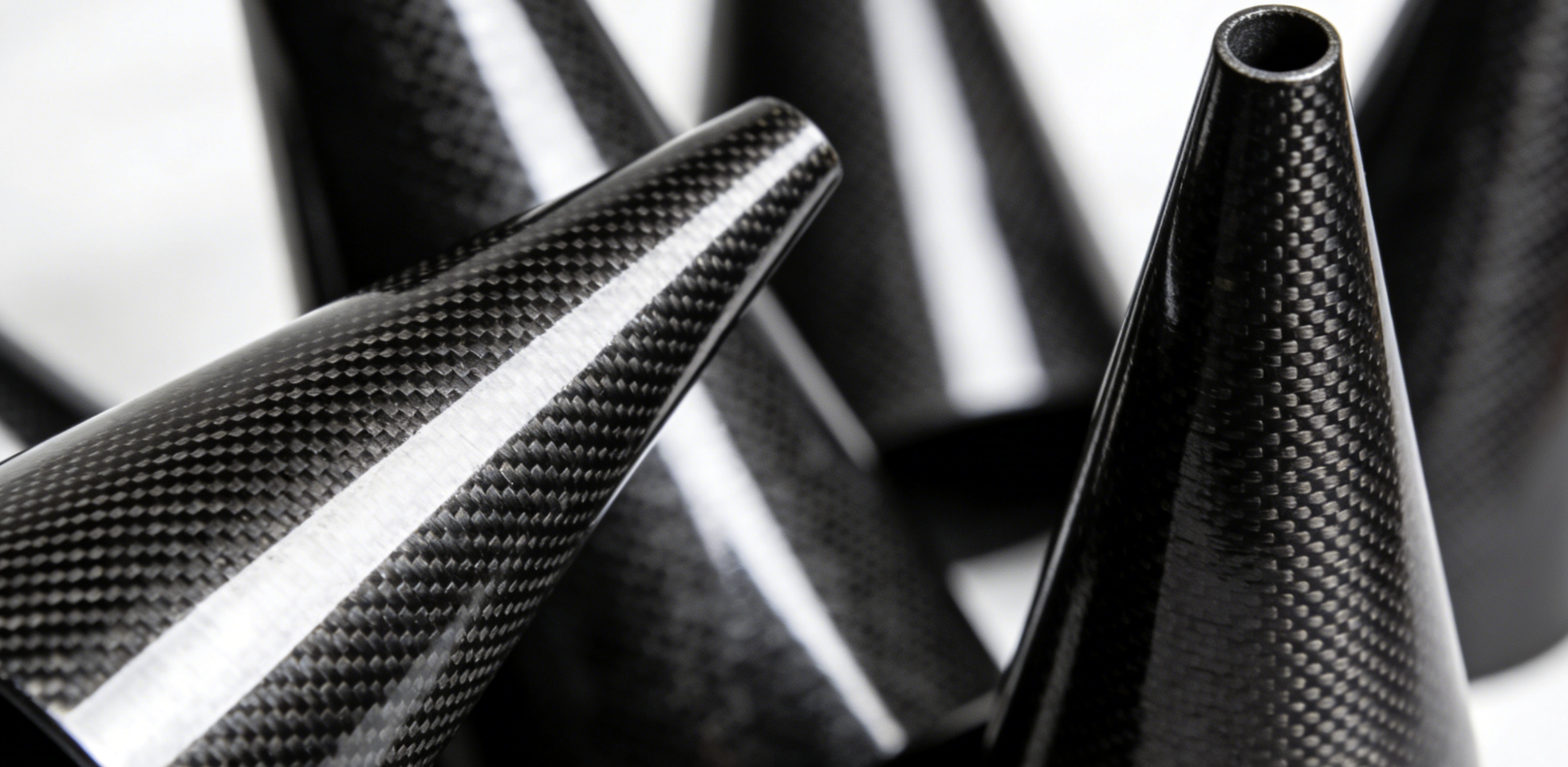
Tapering is one of the oldest tricks in structural engineering. Nature figured it out first — tree trunks, bird bones, insect legs. You put mass where loads are highest and shed it everywhere else. Tapered carbon fiber tubes apply that same logic with a precision nature can’t match.
The geometry is deliberate: a taper ratio of 1:10 to 1:100, with ODs ranging from 10–200mm and lengths from 300mm to 4m. The smaller tip reduces aerodynamic drag. The wider, heavier base anchors load without wasted material in between. That graduated profile cuts polar mass moment by 20–40% compared to a uniform tube of the same size. That translates to a better torsional stiffness-to-weight ratio — less mass, same structural output.
How Tapered Tubes Are Made
Two processes dominate:
-
Roll-wrapping on a tapered mandrel — handles taper ratios of 1:10 to 1:50, suits custom and low-to-medium volume runs. Fiber placement follows the profile precisely. Dimensional accuracy is high.
-
Compression molding — the better choice for steeper tapers beyond 1:50. It’s faster for high-volume production and delivers consistent wall thickness throughout.
Wall thickness runs 1–2mm. The gradient uniformity requirement is tighter than most buyers expect: variation must stay below 0.05mm per mm of taper. Go past 0.1mm deviation and you lose 10–20% of stiffness. Not from bad material — from uneven hoop stress distribution.
End processing matters just as much. Chamfer tolerances of 0.15–0.5mm prevent delamination at the cut face. The inner bore taper must sync with the OD taper at a 1:1 ratio. Drift past 1% and you introduce fiber waviness. That drops tensile strength by 15%.
Real Applications, Real Numbers
|
Application |
Taper Ratio |
Length |
Key Metric |
|---|---|---|---|
|
Drone propeller arms |
1:20–1:40 |
0.5–1.5m |
<50g/m; crash absorption 3× aluminum |
|
Fishing rod blanks |
1:30–1:50 |
Custom |
0.06–0.08 kg/m; 230 GPa progressive flex |
|
Architectural columns |
Custom |
2–4m |
Compressive load >50kg; buckling-resistant base |
Here’s a concrete example. A roll-wrapped tube at 914mm long — large end OD 16.9mm, small end ID 8.6mm — weighs just 17.4 grams. That’s Toray T300 epoxy at 60% fiber volume: tensile strength 512 ksi (3.53 GPa), modulus 33.4 Msi. You’re not giving up structural capability to hit that weight. You’re removing mass from places it was never doing any work.
Against aluminum, the density gap is clear: 1.5 g/cm³ versus 2.7 g/cm³. Against steel, it’s no contest — 1/5 the weight. The 60% mass reduction over equivalent alloy tubing isn’t a marketing claim. It’s what the material math produces.
Octagonal Carbon Fiber Tubes: Flat-Surface Precision for Mounting-Critical Applications
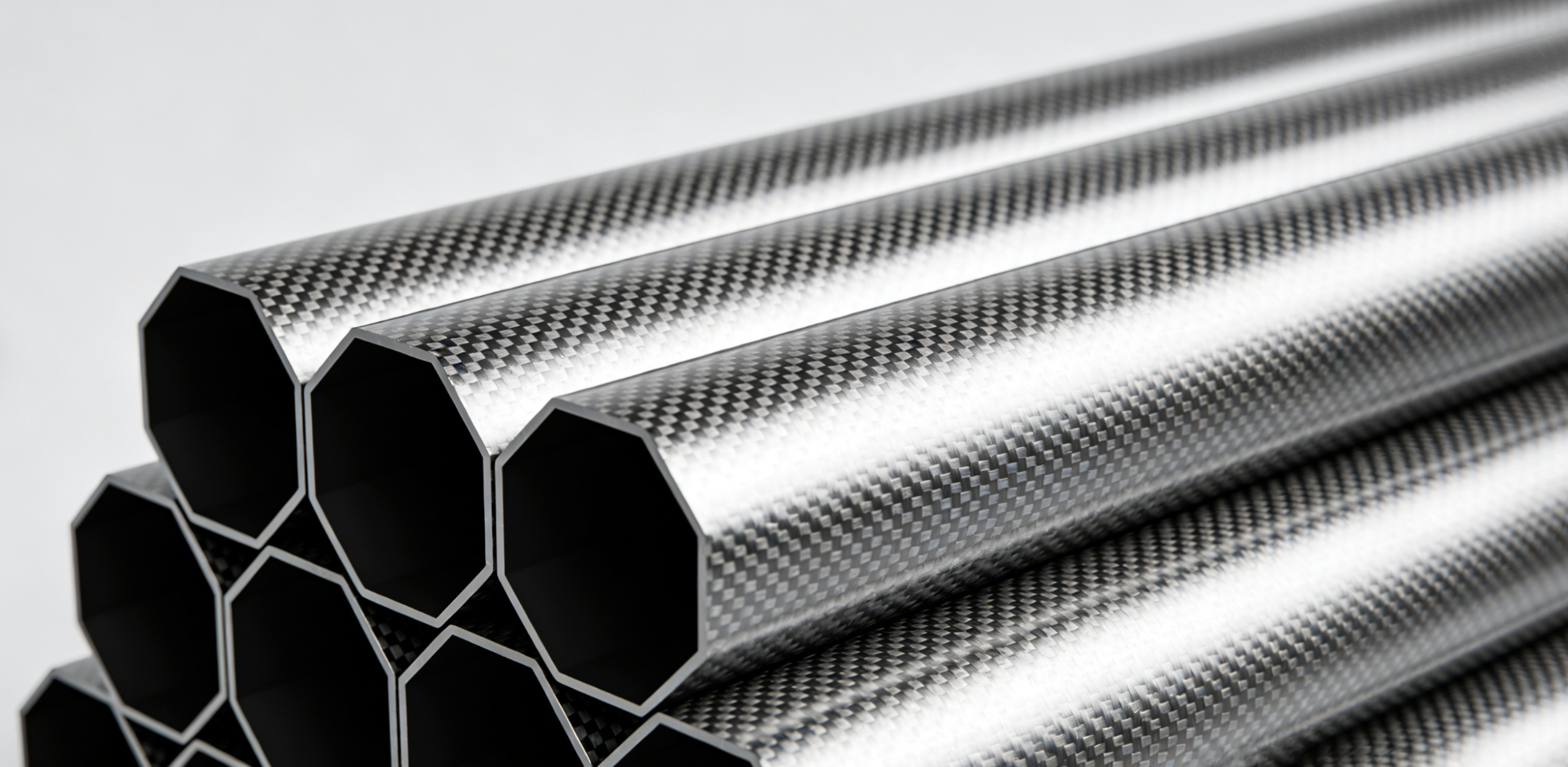
Eight sides. That’s all it takes to eliminate an entire category of mounting problems.
Round tubes slip in clamps. They rotate under torque. They need adapters, shims, and custom fixtures just to bolt down. An octagonal carbon fiber tube cuts through all of that — the flat faces do the work that hardware and workarounds used to handle.
The geometry is the connection system.
Why Eight Sides Beat Zero
The structural math is simple. Octagonal profiles run 20–30% stiffer in panel bending and torsion than round tubes at the same wall thickness. Two things drive that: the flat faces push back against panel-load deformation better, and the 0°/90° fiber orientation places strength right where the octagonal cross-section carries the most load. Axial plies handle tension. Hoop plies manage circumferential stress. Each layer does a specific job.
Performance numbers back this up:
|
Property |
Value |
Test Standard |
|---|---|---|
|
Tensile Strength |
≥600 MPa (up to 3,500 MPa) |
ASTM D3039 |
|
Tensile Modulus |
≥70 GPa |
ASTM D3039 |
|
Flexural Strength |
≥500 MPa |
— |
|
Fatigue Life |
>10⁷ cycles |
— |
|
Impact Resistance |
>20 J |
— |
Flat-to-flat outer width holds at ±0.1mm tolerance. That precision is what makes direct M3 bolting work — no adapter plate, no secondary machining.
Where Octagonal Profiles Get Specified
UAV booms and arms are the clearest use case. A 20×30mm octagonal tube at 1,000mm weighs 187 grams. At 1,250mm, 236 grams. Both sizes give you the torsional resistance a multi-rotor frame needs under full-throttle yaw loads — without the flex that hurts flight stability.
Industrial robot arms use octagonal profiles for a different reason: predictable bolt registration. Clamp hardware seats flush against the flat face. M3×45 screws and paired nuts lock the joint without the tube spinning under repeated load cycles. In high-torque joint applications, positioning drift is a failure mode — not just a minor issue. So a connection that stays put matters.
Sports equipment — racket frames, pole vault poles — gains from the stiffness-to-weight ratio. High axial modulus moves energy straight through the tube at impact or plant. The octagonal section keeps mass low while cutting out the torsional flex that costs you performance.
What to Specify When You Order
Production runs on roll-wrapping over an octagonal mandrel using T300/T700 unidirectional prepreg. The exterior gets a 3K 2×2 twill finish for surface consistency. The layup sequence matters: axial-dominant ply stacks build torque resistance. Too few hoop plies leave the flat panels undersupported. Get this right upfront.
Key parameters to define before ordering:
-
Flat-to-flat width (not OD — octagonal tubes are measured face-to-face)
-
Wall thickness (standard range: 1.5–3mm for structural applications)
-
Length and whether cut ends need chamfering
-
Mounting hole pattern, if direct-drilling is required
Put real thought into the clamp hardware connection. A well-specified octagonal tube clamp — flat Contact surface, M3 hardware, matched grip geometry — holds with no rotation, no slippage, and no need for adhesive backup. You get a clean, locked joint straight from the hardware.
That’s the advantage in a single sentence: the shape does the holding.
Hexagonal Carbon Fiber Tubes: Superior Crush Resistance and Torsional Strength
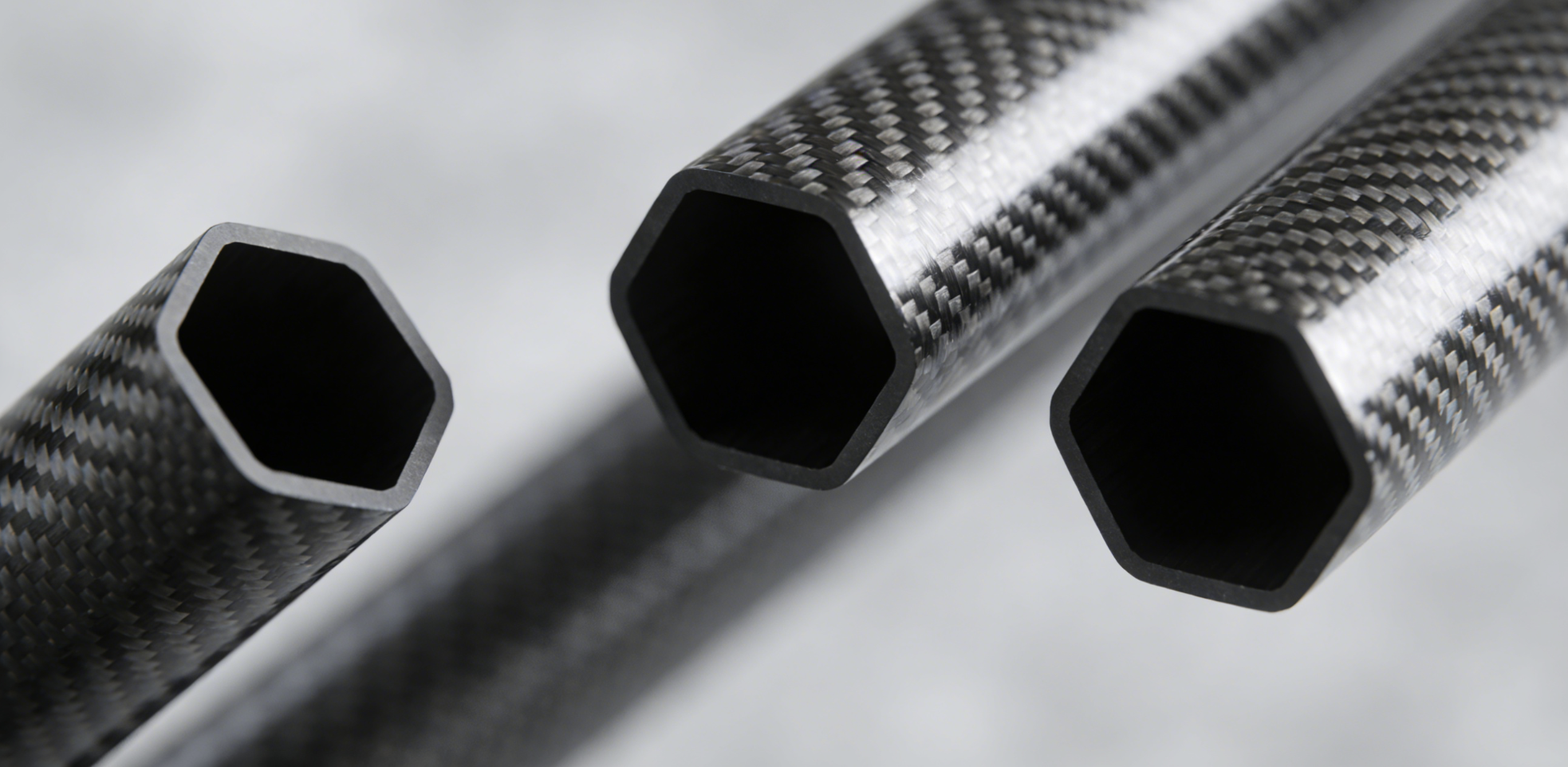
Six sides pack a structural argument that round tubes can’t make.
The hexagonal cross-section is more than a shape. It’s a crash management system, a torsion controller, and a precision alignment tool — all in one profile. Octagonal tubes solve mounting problems. Hexagonal carbon fiber tubes solve energy problems. What happens when your structure takes a hit it wasn’t built to survive? That’s exactly what this profile handles.
The Crashworthiness Data Is Clear
Uniaxial compression testing on plain weave/epoxy hexagonal tubes gives you the full picture. At a fiber angle of β=45° and aspect ratio L/t=70, the numbers are:
-
Average crushing load: 13.2 kN
-
Specific absorbed energy: 10.7 kJ/kg
-
Failure mode: progressive — not catastrophic
That progressive failure pattern matters just as much as the load numbers. The tube doesn’t shatter. It folds in sequence, absorbing energy step by step. This makes it a solid choice for automotive collision structures and infrastructure poles — places where uncontrolled fracture is a design failure, not just a broken part.
Fiber angle is the tuning knob:
|
Angle |
Avg Crush Load (kN) |
Specific Energy (kJ/kg) |
|---|---|---|
|
35° |
11.5 |
6.96 |
|
45° |
13.2 |
10.7 |
|
55° |
8.5 |
8.6 |
45° wins. The margin is large enough to justify calling out the layup by name in your order.
Mechanical Properties by Fiber Direction
The hexagonal form gives you three distinct structural modes. Each one depends on how the fibers run:
-
±45° layup → maximum torsional stiffness (driveshaft twist resistance)
-
90° hoop fibers → maximum crushing stiffness (step-load and impact durability)
-
0° axial fibers → maximum bending stiffness
A real-spec hex tube — 1.00 × 1.10 × 1.968 in, 0.055 in wall, TORAYCA™ fabric carbon fiber — delivers:
|
Property |
Value |
|---|---|
|
Young’s Modulus (X) |
8,301 ksi |
|
Young’s Modulus (Y) |
4,119 ksi |
|
Shear Modulus (XY) |
3,070 ksi |
|
Compressive Yield Strength (X) |
51,100 psi |
|
XY Shear Strength |
34,130 psi |
Base material: tensile strength 512 ksi (3.53 GPa), modulus 33.4 Msi (230 GPa). The layup sequence decides which of those numbers you get in real use. Pin down your primary load condition first. Then define your fiber orientation — not the other way around.
Performance Comparison: Custom Shaped Tubes vs Standard Round Carbon Fiber Tubes
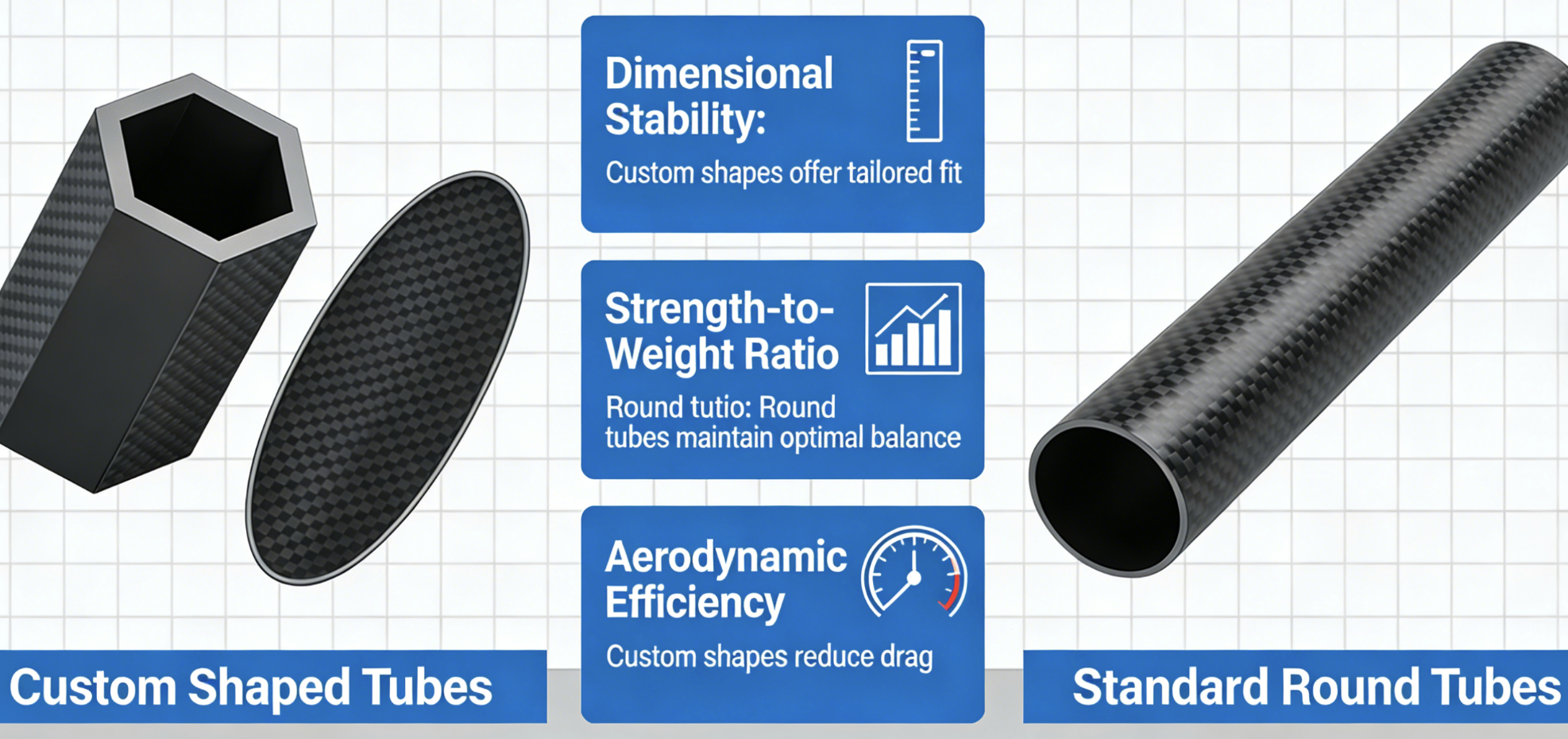
Round tubes are the default for good reasons. They distribute loads symmetrically. Connection interfaces stay simple. High-volume production keeps costs down. For rotating shafts or aerodynamic booms, round still makes sense.
But “right for some things” and “right for your thing” are two different claims.
Stiffness Is Where the Gap Shows Up
A 3-point bend test puts real numbers on the difference:
-
Roll-wrapped square carbon fiber tubes: 200kg load capacity
-
Pultruded round tubes: 140kg
-
Aluminum: 50kg
That’s not a small improvement. That’s a completely different structural tier.
The reason comes down to directional stiffness. Round profiles spread rigidity across every plane equally. That sounds useful — until your load has a primary axis. Custom-shaped profiles — octagonal, hexagonal, tapered, curved — put rigidity right where bending loads hit. The result is a 20–30% stiffness advantage over round tubes with the same wall thickness and material.
The weight comparison makes the case even stronger. Carbon fiber is 50% lighter than steel at the same diameter and wall thickness, and it holds comparable deflection performance. Steel is 5.5× denser. Aluminum is 2.7× denser. Changing the cross-section shape doesn’t close that density gap — it adds on top of the stiffness advantage you’re already getting.
Where Round Tubes Still Win
|
Use Case |
Round |
Custom Shaped |
|---|---|---|
|
Symmetric/rotating loads |
✓ Best |
Not ideal |
|
Primary-axis bending |
Adequate |
✓ Superior |
|
Flat mounting surfaces |
Needs adapters |
✓ Direct bolt |
|
Aerodynamic profiles |
✓ Best |
Situational |
|
Precision positioning |
Limited |
✓ 26% better accuracy |
|
Harsh environments |
✓ Good |
✓ Equal (zero corrosion, 6-month saltwater test) |
Material Quality Is the Multiplier
Shape choices mean nothing if the material underneath is inconsistent. Resin content is where most fabricators quietly bleed performance. The target is 38% resin content. At that level, density stabilizes at 1.03 g/cm³ and mechanical properties hold steady. Drift past ±3% and porosity creeps in. Push to 55% resin content and pore volume climbs high enough to seriously compromise mechanical properties — not because of bad fiber, but because of poor process control.
Theoretical versus measured values back this up:
-
Bending shear modulus: 8.54 GPa theoretical / 8.38 GPa measured
-
Shear strength: 112 MPa theoretical / 103 MPa measured
The gap is small. Keep your resin ratio disciplined and it stays small.
The short version: round tubes are a solid default. But your design has a primary load axis, a flat mating surface, or a precision alignment requirement? Custom-shaped carbon fiber profiles aren’t a premium upgrade at that point — they’re simply the more efficient answer.
Industry Applications: Where Curved, Tapered, Octagonal, and Hexagonal Tubes Are Used
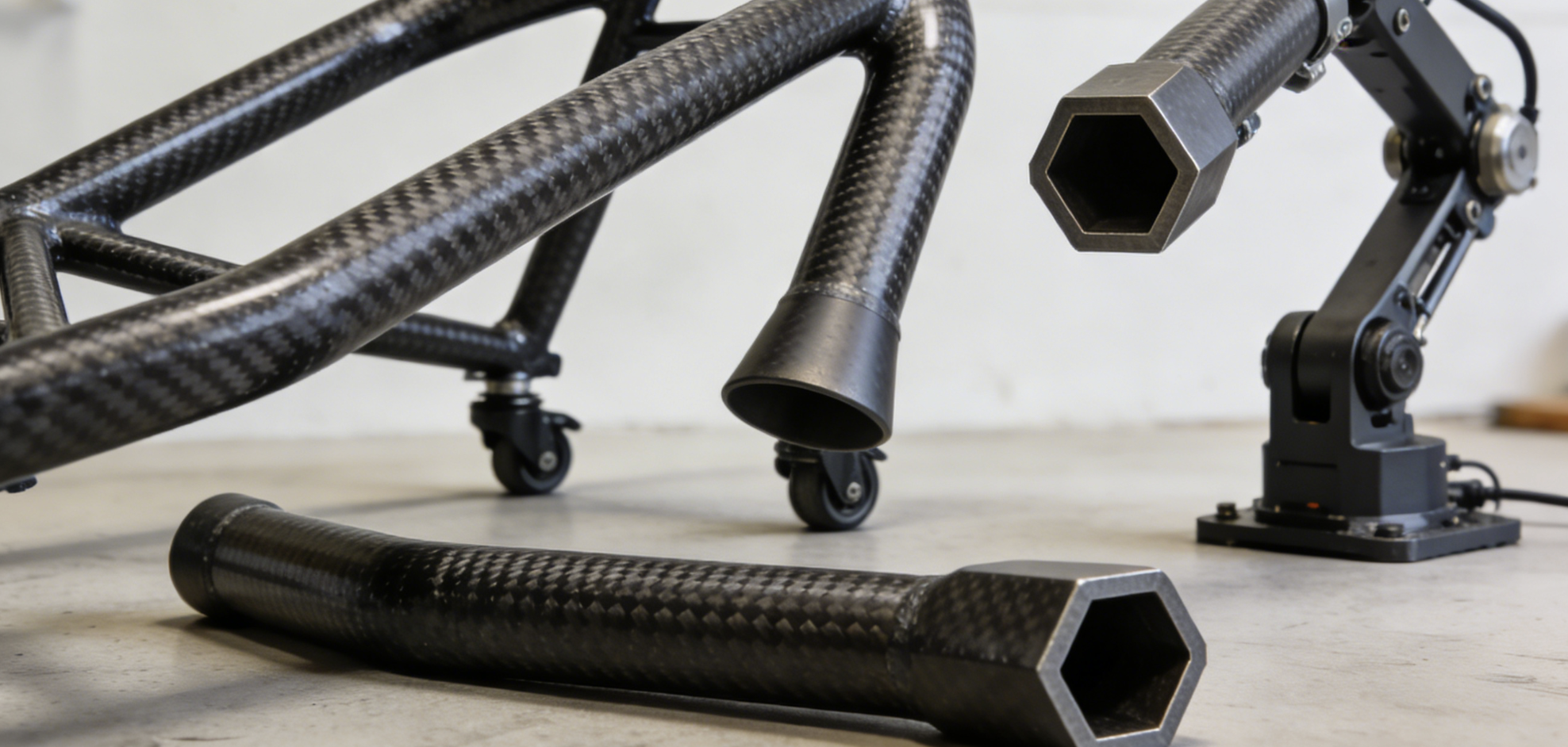
Every profile in this guide earned its place in real production hardware. Here’s where each one shows up — with actual specs to back it up.
Drones and Robotics
The DJI Matrice 300 RTK uses tapered CF arms — 20mm down to 10mm, 500mm long. These arms hold vibration damping below 0.5g. The Freefly Alta X goes a different route. It runs octagonal CF spars with 25mm sides and 2mm walls. That gives the hexacopter eight flat mounting planes for payload attachment. No custom adapters. No shimming needed.
Aerospace and Motorsport
Boeing 787 winglets use curved CF struts with bend radii of 2–5 meters. Each strut carries 50kN of compressive load. McLaren’s MCL38 F1 chassis uses 50×50mm hexagonal profiles rated to 150kN buckling load. That’s a 15% torsional rigidity gain over round tube equivalents, based on ASTM D3039 testing.
Sports Equipment
The Shimano Expride fishing rod blank tapers from a 2.5mm butt to a 0.5mm tip across 7 meters. It’s light enough to cast a 100g lure 120 meters with smooth, consistent flex along the full length. The Specialized Tarmac SL8 runs an oval-curved downtube at R300mm. That shape cuts aerodynamic drag by 12%.
Architecture
Tapered CF columns at Beijing Daxing Airport carry 100kN/m² compressive loads. They also serve as finished architectural elements — structural and decorative in one profile. The OMA Qatar Pavilion used 100mm hexagonal curtain wall tubes spanning 3 meters. Thermal expansion stayed under 0.1%.
The pattern is clear across every industry: profile shape isn’t decoration. Each shape does specific structural work that a round tube can’t do.
How to Order Custom Carbon Fiber Tubes: From Design Specs to Final Delivery
Getting a custom carbon fiber tube built isn’t complicated — but the sequence matters. Skip a step and you pay for it later, either in scrap rate or a part that fails to perform.
Five steps. Here’s how each one works:
-
Lock your design specs first. Start with cross-section drawings, OD/ID dimensions, wall thickness (±0.1mm tolerance), fiber orientation, length (up to 6m), and quantity (10pcs minimum for custom runs). Pick your process at this stage too. Roll-wrapping works best for custom layups and small batches. Filament winding fits high-pressure applications.
-
Match your process to your load. Each method does something different:
-
Roll-wrapping: handles adjustable 0–90° fiber orientations
-
Filament winding: builds burst and axial strength
-
Pultrusion: runs continuous straight profiles at a steady pace
-
Compression molding: suits medium-volume, repeatable production
-
Autoclave curing: produces void-free, precision parts
Target resin content: 30–40% by weight.
-
-
Run 1–5 prototype samples. Plan for one to two weeks. Check fiber consolidation. Keep voids below 1%. Confirm your layup — 4–8 layers covers most 1–2mm walls.
-
Cure and form. Use vacuum bag, oven, or autoclave at 120–180°C. Controlled cooling stops residual stress from building up. Then pull the mandrel.
-
Post-process and test. Trim, sand, and coat the tube. Bring dimensional tolerance to ±0.05mm. Strength testing targets >500 MPa. Full delivery takes 4–8 weeks.
Two pitfalls worth avoiding:
-
Fiber orientation — skip this and you lose 50–300% of torsional strength, depending on the angle.
-
Process mismatch — specifying pultrusion for a curved tube adds 20–50% to your cost. In some cases, it just won’t work at all.
Ready to quote? Submit your specs at hyperxcarbon.com/quote and get a response in under 24 hours.
Conclusion
The right tube shape isn’t a cosmetic detail. It’s an engineering decision that directly affects weight distribution, mounting precision, and torsional resistance. Get the shape wrong, and your design pays for it.
Curved, tapered, octagonal, and hexagonal carbon fiber profiles exist because round tubes can’t solve every problem. Your drone arm may need a cleaner airframe line. Your robotic joint may require a flat mounting face. Your structural component may need to shed grams without losing strength. These geometries handle all of that.
What you’ve seen here is what’s possible with custom carbon fiber tube manufacturing — not theory. Real, producible solutions. Defined tolerances. Verified fiber orientations. Scalable lead times. These aren’t promises — they’re built into how the manufacturing process works.
You’re past the “wondering if this is feasible” stage. The next step is simple — send your specs, get a quote, and let the material do its job.
Contact HyperX Carbon – Your Trusted Chinese Carbon Fiber Partner
Ready to source high-performance carbon fiber materials or custom forged carbon fiber parts from China?
HyperX Carbon is a leading manufacturer with 20+ years of expertise, specializing in aerospace-grade forged carbon fiber, prepreg, tubes, sheets, and lightweight automotive/drone/medical components. We offer:
-
Stable supply chain with premium raw materials (Toray, Mitsubishi, Hengshen)
-
AS9100D certified production for aerospace & UAV applications
-
Rapid prototyping (5-8 weeks) and monthly capacity exceeding 180,000 parts
-
Competitive pricing with 15-18% cost savings on forged carbon solutions
-
Full customization: from T700/T1100G to ultra-high modulus grades
Whether you’re an eVTOL developer, automotive OEM, drone manufacturer, or medical device engineer, HyperX delivers consistent quality, batch-to-batch reliability, and reliable delivery.
Get in touch today for a free consultation, custom quote, or material sample.
📧 Email: [email protected]
🌐 Website: https://www.hyperxcarbon.com/
📞 Phone/WhatsApp: +86 15623270276 (English support available)
Let’s build your next lightweight innovation together – contact HyperX Carbon now and stay ahead in the low-altitude and advanced composites market.




