Titanium sounds tougher. It’s the metal used in jet engines and surgical implants — the name alone carries weight. Carbon fiber, on the other hand, feels almost too light to take with any seriousness.
But run the numbers on tensile strength, specific strength, and weight-to-strength ratio, and the results flip assumptions upside down.
The real question isn’t which material sounds stronger. It’s which one performs better for your use case. That could be an aerospace frame, a trail bike, or an EDC tool you carry every day.
Here’s a clear breakdown of what the data shows.
The Direct Answer: Carbon Fiber vs Titanium Strength Explained

Strength isn’t one single number. It shifts based on material properties and real-world conditions.
Carbon fiber carries a tensile strength of 500–600 ksi. Titanium Grade 5 sits at 40–140 ksi. On that metric, carbon fiber wins by a clear margin. But titanium holds a higher absolute yield strength at 900 MPa. That means it resists permanent deformation under blunt force — something carbon fiber cannot do.
The number that changes the whole debate is specific strength — strength divided by density.
Carbon fiber weighs 1.6 g/cm³. Titanium weighs 4.5 g/cm³. That gap is significant. Carbon fiber delivers 1.85x more strength per gram than Grade 5 titanium, and 3.1x more than Grade 9.
Here’s one key detail to know: fiber orientation matters a lot. At aligned loads, carbon fiber dominates. Rotate stress to 45°, and titanium becomes nearly 3x stronger. The winning material comes down to one thing — how force travels through the part.
Head-to-Head Comparison: Carbon Fiber vs Titanium Across 7 Key Properties

Seven properties. Two materials. No hedging.
The table below covers the numbers straight — density, tensile strength, specific strength, stiffness, impact resistance, corrosion resistance, and thermal behavior. Each one changes the winner based on context. That context is what most comparisons leave out.
|
Property |
Carbon Fiber |
Titanium (Grade 5) |
Winner |
|---|---|---|---|
|
Density (g/cm³) |
1.6–1.8 |
4.5 |
CF — 2.5–2.8x lighter |
|
Tensile Strength (MPa) |
600 (aligned), 110 (45°) |
925 UTS |
CF aligned; Ti off-axis |
|
Specific Strength |
37 (aligned), 6.9 (45°) |
20 (Gr.5), 12 (Gr.9) |
CF — 1.85x > Grade 5 |
|
Stiffness (GPa) |
70 (aligned), 17 (45°) |
100 |
CF specific stiffness: 43.7 vs Ti 22.2 |
|
Impact Resistance |
Brittle, delamination risk |
Excellent fatigue resistance |
Ti — clear advantage |
|
Corrosion Resistance |
Excellent vs acids |
Excellent all environments |
Tie; CF edges in acids |
|
Thermal Resistance |
Decomposes ~2,400°C |
Melts at 1,668°C |
Situation-dependent |
What These Numbers Really Mean
Density is where carbon fiber pulls the biggest gap. At 1.6–1.8 g/cm³ versus titanium’s 4.5 g/cm³, you’re working with less than half the weight at the same volume. That weight difference adds up fast in aerospace panels, bike frames, and anything you wear or carry for hours.
Specific strength answers carbon fiber’s critics. Yes, titanium’s raw tensile UTS sits at 925 MPa. Divide strength by density, though, and carbon fiber scores 37 versus titanium’s 20 — with aligned fibers. Rotate that load to 45°, and the result flips hard. Carbon fiber drops to 6.9. Titanium stays steady.
Impact resistance is titanium’s clearest win. Carbon fiber delamination under side-on shock is not a theoretical risk. It is a real, documented failure mode. Titanium absorbs blunt force and keeps going. Surgical implants and prosthetics use titanium for exactly this reason.
Thermal conductivity tells a story most comparisons skip. Carbon fiber moves heat at 1.7 W/mK. Titanium runs at 21.9 W/mK — about 13x higher. In designs where heat must escape fast, that gap is a hard constraint. It shapes the whole design, not just a footnote.
No single property picks the winner. Load direction, temperature, and impact risk do.
Titanium vs. Carbon Fiber: Impact, Fatigue, and Real-World Durability

Drop a carbon fiber panel onto concrete. Then drop a titanium one. The difference is obvious.
Titanium dents. Carbon fiber shatters. That physical gap drives every buying decision where impact resistance matters more than saving weight.
Impact: Ductility Decides
Titanium needs 3x the force to fail compared to carbon fiber under blunt impact. Not because it’s stronger in tension — because it’s ductile. It bends. It deforms. It absorbs. Carbon fiber does none of that. Hit it from the side, and it cracks, splits, and fractures along the fiber planes.
Test data from hybrid laminate research backs this up. A titanium-carbon fiber metal laminate (TI-CF FML) handles 64.7–67.4 J of penetration energy at low-velocity impact. That’s more than double the 30 J a titanium-glass laminate can take. Peak force reaches 13.1 kN at 73.8 J impact. Maximum displacement holds at just 5.3 mm. So you get a material that eats serious energy and stays intact.
Pure carbon fiber under the same conditions? Delamination. Matrix cracking. Fiber fracture.
Fatigue and Long-Term Reliability
Titanium thrives under repeated stress. Watch cases, knife blades, mechanical fasteners — these parts face constant vibration, flex, and load cycling every day. Titanium holds up without breaking down.
Carbon fiber performs well under fatigue too, but the results vary. One surface scratch or a light impact can quietly compromise the structure. You won’t always see the damage — but it’s there.
Repairability: The Cost Most Buyers Miss
|
Property |
Titanium |
Carbon Fiber |
|---|---|---|
|
Impact Resistance |
Ductile, absorbs force |
Brittle, cracks |
|
Fatigue Resistance |
Excellent |
Good, but variable |
|
Repair Method |
Weld or machine on-site |
Specialist laminate repair |
|
Repair Cost |
Low |
High |
A damaged titanium part can be welded, re-machined, and put back into service with standard tools. Carbon fiber delamination needs expensive specialist repair — and sometimes the part is a write-off. No fix possible.
The bottom line: Your use case involves repeated impacts, high fatigue cycles, or field repairs? Titanium isn’t the heavier choice. It’s the smarter one.
Carbon Fiber vs Titanium by Application: Which Material Belongs Where

The right material depends on what you’re building — and what you’re building for.
Both carbon fiber and titanium are exceptional. Neither is the clear winner across the board. The gap between them shows up once you match each material to a real application and run the numbers.
Aerospace: Split the job
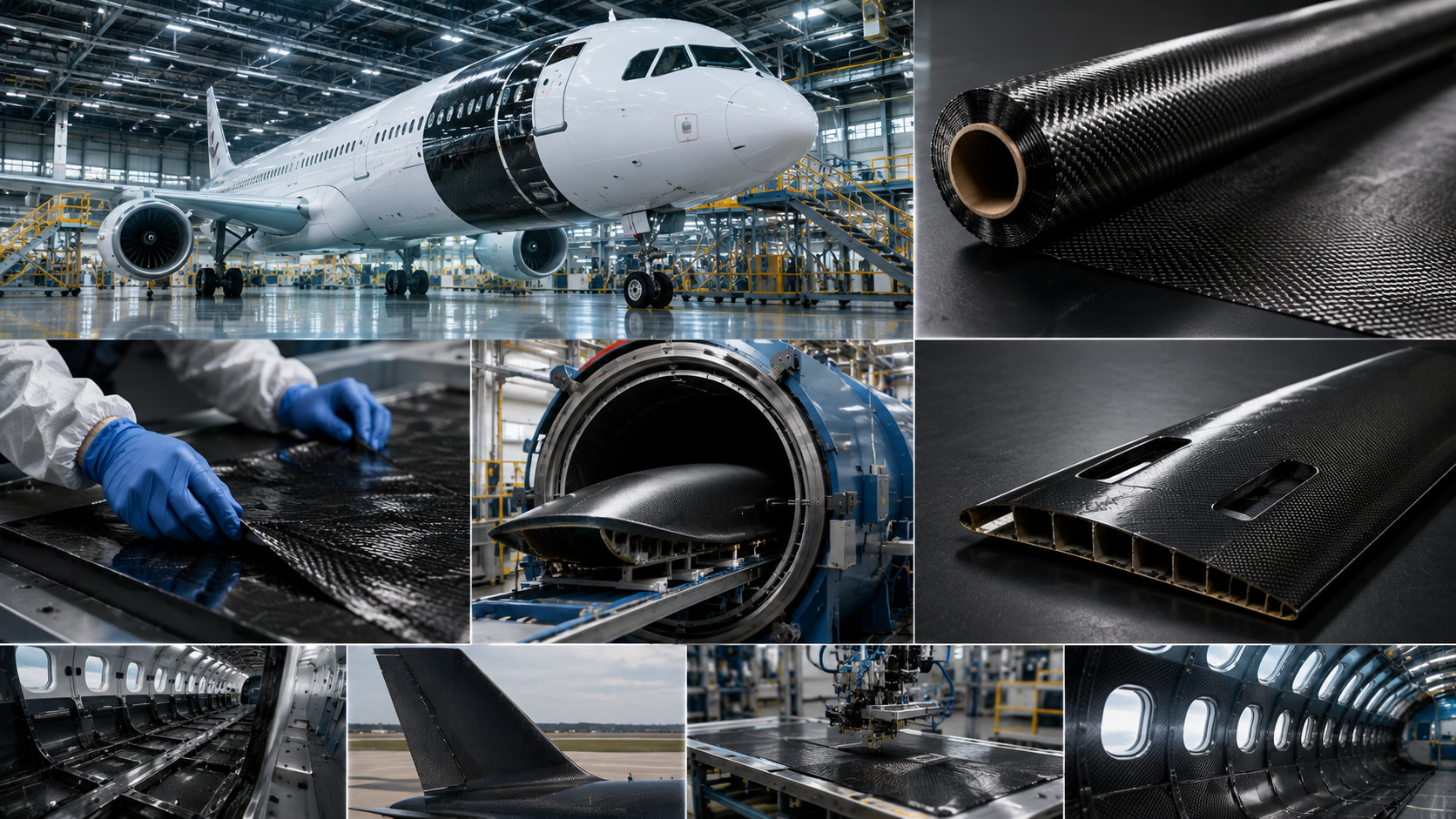
Boeing’s 787 uses CFRP for 53% of its fuselage by weight. That covers the structural skin, wings, and body panels. Bending stiffness and mass savings drive those design calls. Titanium takes over for fasteners, engine brackets, and high-stress joints. Heat and fatigue cycling rule out composites in those spots. One airframe. Two materials. Each doing what the other can’t.
EDC and consumer gear: Two different users
Carbon fiber wallets and watch bezels work at 1.75 g/cm³ — ultralight, corrosion-proof, and easy to mold into tight shapes. Titanium knives and tools work at 900 MPa yield strength — wear-resistant, polishable, built to take decades of hard use. The choice comes down to whether you want carry weight or working edge.
Sports equipment: Know your terrain
Road racers go with carbon fiber frames ($2,000–$8,000). You get a 43.7 stiffness-to-weight ratio and sub-900g builds — hard to beat on pavement. Mountain riders are shifting back to titanium. The reason is impact resilience. Lateral shock from off-road riding can drop carbon fiber’s effective strength by up to 80%. Titanium holds up where carbon fiber breaks down.
Medical and military: Titanium, no debate
Carbon fiber falls short in both categories. It’s brittle under transverse impact. That rules it out for orthopedic implants and ballistic protection. Titanium’s 100 GPa modulus lines up with cortical bone. It also absorbs unpredictable trauma loads without failing. There’s no real alternative here.
|
Application |
Carbon Fiber |
Titanium |
|---|---|---|
|
Aerospace fuselage |
✓ Weight, stiffness |
Fasteners, engine parts |
|
EDC wallets/bezels |
✓ Ultra-light, slim |
Knives, tools |
|
Road bikes |
✓ Stiff, fast, light |
— |
|
MTB/off-road |
— |
✓ Impact resilience |
|
Medical implants |
— |
✓ Biocompatibility |
|
Military armor |
— |
✓ Shock resistance |
Cost Comparison: Carbon Fiber vs Titanium — Which Is Worth the Investment

The price tag on carbon fiber isn’t simple. It never has been.
Industrial-grade carbon fiber runs $7–$14 per pound. Aerospace-grade jumps to $80–$120 per pound — about 10x more. Titanium often lands cheaper per kilogram than aerospace-grade CFRP. That catches most buyers off guard. They assume metal always costs more.
But raw material price is one part of the equation. The rest hides in production and ownership.
Where the real costs hide:
-
Carbon fiber demands high upfront tooling — molds, autoclave equipment, skilled layup labor. Small production runs carry a steep price. Scale up, and those fixed costs spread across volume. At that point, CFRP becomes cost-competitive.
-
Titanium costs more per unit to machine. Special tools, longer production time, and the energy-heavy Kroll extraction process all push costs up at every stage.
Long-term ownership shifts the math further. Carbon fiber needs close to zero maintenance. It resists corrosion across its full lifespan. But damage repairs need specialist technicians. Some parts aren’t worth fixing — the repair cost exceeds the part’s value. Titanium is easier to repair. Its recycling infrastructure is also far more developed and widely available.
The bottom line: For weight-critical, high-volume applications, carbon fiber’s full lifecycle cost is hard to beat. For low-volume production or parts that face unpredictable impact, titanium wins on total spend. Its lower per-unit complexity keeps the overall cost in check.
FAQ: Quick Answers to the Most Common Carbon Fiber vs Titanium Questions
Six questions keep coming up. Here are straight answers.
Is carbon fiber stronger than titanium?
On tensile strength per unit weight, yes. Carbon fiber hits up to 6,000 MPa. Titanium Grade 5 tops out at 900 MPa. But titanium handles fatigue and repeated impact far better. Carbon fiber can’t match that.
Which is lighter?
Carbon fiber — by a lot. Density runs 1.6–1.8 g/cm³ versus titanium’s 4.5 g/cm³. That’s 2.5–2.8x lighter at equal volume.
Which lasts longer?
Titanium. It takes shock, wear, and corrosion without breaking down. Carbon fiber is brittle under impact. You need to handle it with care to avoid cracking.
Which costs more?
Carbon fiber. Aerospace-grade CFRP runs $80–$120 per pound. The production process is complex, and that complexity pushes the price up.
Is carbon fiber stiffer?
At aligned loads, yes — modulus reaches 294 GPa versus titanium’s 110 GPa. Rotate the load angle, and that stiffness advantage drops off fast.
Carbon fiber vs titanium for watches and knives?
Watches: carbon fiber cuts weight. Titanium resists scratches and feels smooth against your skin. Knives: titanium edges hold up better under hard, everyday use. Carbon fiber wins on weight. Titanium wins on toughness.
Conclusion
“Stronger” was never the right question. The real question is stronger for what.
Carbon fiber wins where weight is a problem and every flex point matters: aerospace frames, performance cycling, precision EDC gear. Titanium holds its ground where impact, fatigue cycles, and raw toughness are what keep things intact. These two materials aren’t rivals. They’re specialized tools built for different jobs.
So what does that mean for you? Focus on weight-to-strength ratio. Want something that performs better because it’s lighter? Carbon fiber reinforced polymer isn’t just the modern pick — it’s the logical one. The numbers back it up.
Contact HyperX Carbon – Your Trusted Chinese Carbon Fiber Partner
Ready to source high-performance carbon fiber materials or custom forged carbon fiber parts from China?
HyperX Carbon is a leading manufacturer with 20+ years of expertise, specializing in aerospace-grade forged carbon fiber, prepreg, tubes, sheets, and lightweight automotive/drone/medical components. We offer:
-
Stable supply chain with premium raw materials (Toray, Mitsubishi, Hengshen)
-
AS9100D certified production for aerospace & UAV applications
-
Rapid prototyping (5-8 weeks) and monthly capacity exceeding 180,000 parts
-
Competitive pricing with 15-18% cost savings on forged carbon solutions
-
Full customization: from T700/T1100G to ultra-high modulus grades
Whether you’re an eVTOL developer, automotive OEM, drone manufacturer, or medical device engineer, HyperX delivers consistent quality, batch-to-batch reliability, and reliable delivery.
Get in touch today for a free consultation, custom quote, or material sample.
📧 Email: [email protected]
🌐 Website: https://www.hyperxcarbon.com/
📞 Phone/WhatsApp: +86 15623270276 (English support available)
Let’s build your next lightweight innovation together – contact HyperX Carbon now and stay ahead in the low-altitude and advanced composites market.