Steel built the modern world — bridges, skyscrapers, engines, warships. It’s proven, abundant, and trusted by engineers for over a century. Then carbon fiber started showing up in aerospace cabins, Formula 1 chassis, and high-performance bicycle frames. The claim? “Stronger than steel.” That raised a fair question: is it true — and does it matter for your application?
The carbon fiber vs steel strength comparison isn’t a simple yes or no. Tensile strength numbers don’t tell the whole story. Neither does weight.
What matters is understanding which strength properties favor each material — and under what real-world conditions that advantage holds or falls apart. That’s what this breakdown covers.
Carbon Fiber Vs Steel: Strength Comparison

The numbers make this clear before the debate even begins.
|
Material |
Tensile Strength |
Density |
Specific Strength |
Breaking Length |
|---|---|---|---|---|
|
Standard CFRP |
1,600–2,070 MPa |
1.6 g/cm³ |
1,335 MPa·cm³/g |
205 km |
|
High-Tenacity CFRP |
up to 5,400 MPa |
1.82 g/cm³ |
3,026 MPa·cm³/g |
396 km |
|
Mild Steel |
400–440 MPa |
7.8 g/cm³ |
~56 MPa·cm³/g |
6 km |
|
4130 Chromoly Steel |
670 MPa |
7.8 g/cm³ |
~85 MPa·cm³/g |
23 km |
Standard carbon fiber composite delivers 3–4× the tensile strength of chromoly steel. High-tenacity grades push that gap past 10×. Weight matters in most engineering decisions. On a per-weight basis, CFRP’s specific strength runs 15 to 23× higher than steel alloys.
Steel does hold its ground in some areas. It handles compression, impact, and bending without cracking. Those are real strengths — not small details. But for parts that carry tension loads and need to stay light, carbon fiber wins by a wide margin.
What Makes Carbon Fiber Stronger Than Steel (And When It Isn’t)

The answer comes down to load direction — and most people never think to ask that question.
Carbon fiber’s strength doesn’t spread out in all directions. It runs along the fibers. Line up your load with those fibers, and the material is extraordinary. Pull a carbon fiber tube straight along its length and it resists up to 7.06 GPa — about 4–10× what structural steel can handle in the same test. The stiffness-to-weight gap is just as striking: CFRP delivers 66.5 GPa·cm³/g against steel’s 24–26 GPa·cm³/g. That’s not a small edge. That puts carbon fiber in a completely different class of material performance.
Now shift that load off-axis. Add shear, compression, or sideways stress. Carbon fiber drops to 21–32% of its straight-line strength. Steel doesn’t work that way. Steel is isotropic — it takes force from any direction with the same steady, predictable resistance.
Where carbon fiber dominates:
– Tension-driven structures: aerospace frames, automotive monocoques, structural tubes
– Fatigue-critical uses: it can handle countless load cycles with no loss in strength
– Corrosive settings: zero electrochemical vulnerability, no maintenance needed
Where steel holds the advantage:
– Compressive and bending loads per unit volume
– Impact and toughness — steel bends before it breaks; carbon fiber gives no warning
– Any build that needs equal strength in every direction
The real design question isn’t which material is stronger. It’s which failure mode you can’t afford — and which material keeps you furthest from it.
Tensile Strength: Carbon Fiber vs Steel Side-by-Side Data
Raw numbers end arguments fast. Here’s what the data shows when you put these two materials in the same test environment.
|
Material Type |
Density (kg/m³) |
Tensile Strength (GPa) |
Elastic Modulus (GPa) |
Breaking Length (km) |
|---|---|---|---|---|
|
Carbon Fiber (Standard) |
1,760 |
3.53 |
230 |
205 |
|
Carbon Fiber (High Strength) |
1,820 |
7.06 |
294 |
396 |
|
Carbon Fiber (High Modulus) |
1,870 |
3.45 |
441 |
188 |
|
Steel (S355 Structural) |
7,850 |
0.50 |
210 |
6 |
|
Steel (High-Strength Wire) |
7,850 |
1.77 |
210 |
23 |
Breaking length deserves a closer look. It’s the theoretical length at which a hanging cable would snap under its own weight. Standard carbon fiber reaches 205 km. High-strength grade hits 396 km. Structural steel? 6 km. That one number tells you more about the weight-to-strength gap than almost any other metric.
What the MPa Numbers Mean
Tensile strength spans a wide range across these materials:
-
Carbon fiber filament: 600–6,000 MPa depending on grade
-
CFRP laminates and rods: 1,605–2,308 MPa in real fabricated parts
-
Structural steel: 400–500 MPa
-
High-strength steel wire: up to 1,770 MPa
The gap between filament strength and laminate strength is real. Individual carbon fiber tow can hit 7,060 MPa. Fabricated CFRP rods and plates land at 1,600–2,300 MPa — lower, but for clear reasons. Resin content, fiber volume fraction (~60%), minor voids, and fiber misalignment all cut into effective cross-sectional strength. Add more resin in a thicker laminate, and the absolute breaking force goes up. But MPa drops when you normalize by area. The fiber carries the load. The resin holds everything in place.
So even after that reduction, CFRP still delivers 4–10× the tensile strength of structural steel. It does that at one-fifth the density. Specific strength — the figure that drives aerospace and motorsport decisions — runs 10 to 50× higher than steel across comparable grades.
That’s not a marginal difference. That’s a completely different category of material.
Strength-to-Weight Ratio: Where Carbon Fiber Dominates

Density is the number most engineers forget to write down — and it’s the number that changes everything.
Steel’s tensile strength looks solid on paper. Structural grades hit 400–1,200 MPa. High-strength wire pushes past 2,000 MPa. But steel carries that strength at 7.8 g/cm³. Carbon fiber carries more strength at 1.6 g/cm³. That’s less than one-fifth the weight. Divide strength by density — that’s what specific strength measures. The gap doesn’t close. It explodes.
|
Material |
Tensile Strength (MPa) |
Density (g/cm³) |
Specific Strength (kN·m/kg) |
|---|---|---|---|
|
Carbon Fiber (standard) |
3,500 |
1.6 |
~2,200 |
|
Carbon Fiber (high grade) |
7,000 |
1.6–1.9 |
~3,500–4,400 |
|
Steel (structural) |
400–1,200 |
7.8 |
50–154 |
|
High-Strength Steel |
2,000–2,600 |
7.8 |
154–214 |
Standard carbon fiber puts out 2,200 kN·m/kg in specific strength. High-strength grades hit 4,400. Structural steel lands at 50–154. That’s not a performance gap — that’s a different physics class.
What That Ratio Looks Like in Practice
The numbers get real fast once you put them against actual parts.
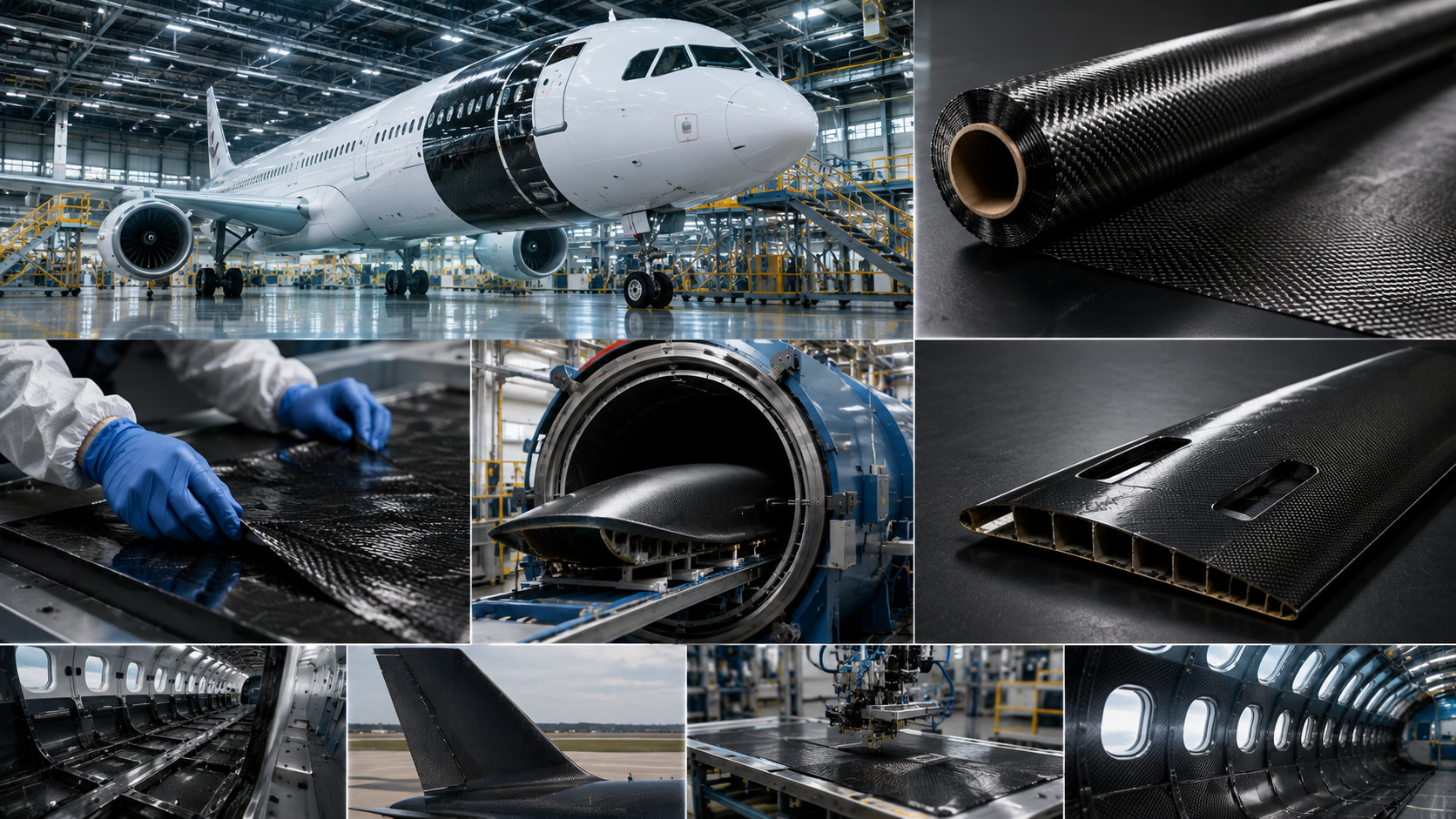
Aerospace is the clearest case. Carbon components come in 40–50% lighter than aluminum equivalents and 4–5× lighter than steel — with no loss in load-bearing capacity. On a commercial airframe, that weight reduction feeds straight into fuel savings at scale.
Bicycle frames tell the same story in a more hands-on format. A high-modulus carbon frame — 600 MPa tensile strength at 1.5 g/cm³ — goes up against steel’s 420 MPa at 7.9 g/cm³. The result: carbon comes in 4–5× lighter at equal strength. Riders feel that difference on every climb.
Racing chassis push the ratio further. A well-designed carbon monocoque delivers 400 kN·m/kg in specific strength. Steel sits at 53. That gap drives 20–30% total vehicle mass reduction. In motorsport, that means faster corner entry, shorter braking zones, and quicker lap times.
The pattern holds across all three applications. Tensile loads dominate. Mass is a constraint. Carbon fiber’s 20–50× specific strength advantage over steel turns into 40–75% part weight reductions. That’s not marketing language. That’s load calculations and weigh-in results.
Stiffness and Modulus of Elasticity: A Clearer Picture

Tensile strength gets the headlines. Stiffness is where the real engineering work happens.
Steel’s elastic modulus sits at a flat 200 GPa — the same number no matter which direction you load it. That consistency matters. Isotropic behavior gives you predictable deflection on every axis, every time.
Carbon fiber works differently. Its modulus ranges from 70 GPa to 600+ GPa — and that range isn’t a flaw. It’s a design tool.
Here’s what that looks like in practice:
|
Material |
Young’s Modulus (GPa) |
Behavior |
|---|---|---|
|
Steel |
200 |
Isotropic — constant in all directions |
|
Carbon Fiber (standard) |
230–300 (fiber axis) |
Anisotropic — direction-dependent |
|
Carbon Fiber (high-modulus) |
350–600 (fiber axis) |
Orientation-controlled |
|
Aluminum |
~70 |
Isotropic |
Layup Design Is the Lever
Ply orientation controls stiffness. A unidirectional 0° layup pushes axial modulus past 300–400 GPa — stiffer than steel in that direction. A quasi-isotropic [0/±45/90] stack lands around 70–140 GPa. It trades peak stiffness for resistance spread across multiple axes.
The relationship is straightforward: double the modulus, double the stiffness. At 100 MPa stress, a part with 100 GPa modulus deforms one-tenth as much as a 10 GPa part. You can dial in how much flex a component allows — and pinpoint where that flex occurs.
-
Tubes built for torsion use ±45° plies to boost shear stiffness
-
Beams designed for bending load 0° plies along the tension face
Steel gives you one fixed number. Carbon fiber gives you a tunable system.
That’s not a small detail. That’s a core structural advantage.
Impact Resistance and Ductility: Steel’s Real Advantage

Here’s what tensile strength tables won’t tell you: what happens in the half-second before a part fails.
Steel doesn’t just break. It warns you first. Under sudden impact, it yields — at 217 to 345 MPa for structural grades — then deforms and bends. Crystal defects shift and move inside the metal. The metal necks, stretches, and soaks up energy through that whole deformation process. Mild steel stretches up to 23% before it fractures. That’s not a weakness. That’s a built-in safety response at the atomic level.
Carbon fiber has none of that. No yield point. No plastic plateau. No warning. It holds load right up until it doesn’t. Then it shatters, splits apart, and separates — without releasing a single joule through controlled deformation. Stretch at failure stays below 2%. The gap between these two materials isn’t small. It’s a completely different category.
Impact Loads and Design Limits
Charpy V-notch testing gives real numbers to this gap. High-energy 4340 steel absorbs impact at HRC 30, σTS 952 MPa. T200 steel keeps ≥25% shear fracture area down to -198°C — a point where most materials go fully brittle. CFRP, by contrast, delaminates under low-speed impacts below 10 m/s. It doesn’t need a transition temperature. It starts brittle and stays there.
Structures that take collision loads, accidental drops, or sharp dynamic impacts — the difference here is critical. Steel bends. Carbon fiber breaks. Where the failure mode puts people at risk, that’s not just a performance spec. It’s a hard design boundary you can’t ignore.
Fatigue Resistance and Corrosion: Long-Term Performance Comparison

Long-term performance is where carbon fiber vs steel gets decided — not by sudden failure, but by slow, steady degradation that most spec sheets never mention.
Steel corrodes. That’s not a debate. What most people miss is this: corrosion and fatigue don’t just add together — they multiply each other. Corrosion pits form on the surface. Fatigue cracks start from those pits. Each stress cycle deepens the damage. This failure pattern holds across structural steel grades:
-
Surface film ruptures
-
Pitting forms at exposed sites
-
Cracks initiate from pit edges
-
Cracks grow under cyclic load
The fatigue strength data puts hard numbers to this:
|
Steel Grade |
Fatigue Strength Loss After Corrosion |
|---|---|
|
Q345 steel |
22.6% reduction (salt spray pre-corrosion) |
|
Q370qE steel |
44.29% reduction (30 corrosion cycles) |
|
Q370qENH steel |
25.97% reduction (30 corrosion cycles) |
Carbon fiber reinforced polymer (CFRP) sits outside this failure chain. It has no electrochemical vulnerability. There’s no oxide layer to break down, no pitting mechanism, no corrosion-fatigue interaction to worry about. In cyclic load environments — aerospace structures, marine components, structural tubes — CFRP holds its mechanical properties across millions of load cycles. No chemical degradation. No compounding damage.
That’s not a small maintenance win. For structural carbon fiber applications where access is limited or downtime is costly, the absence of corrosion-fatigue synergy is a core engineering argument — not a secondary selling point. You’re not just avoiding rust. You’re removing an entire class of failure from the equation.
Real-World Applications: Carbon Fiber vs. Steel

Material selection isn’t a philosophy debate — it’s a load case with a budget attached.
The data makes this clear. Map your performance requirements against real operating conditions, and the answers come into focus. Five application areas show this pattern best.
Aerospace and Weight-Critical Structures
Every kilogram removed from an airframe saves fuel across millions of flight cycles. CFRP delivers 5× the strength-to-weight ratio of steel. It cuts structural mass by 20–30% in wings and fuselage sections. That’s not optimization. That’s a completely different cost model.
Racing and High-Performance Cycling
A carbon monocoque or frame weighs less — and you can tune it. Fiber orientation controls where stiffness builds up and where vibration fades out. Steel gives you one fixed response. Carbon gives you a dialed-in one.
Industrial Heat Treatment Fixtures
CFC racks run 70% lighter than steel equivalents. They hold structural integrity past 1800°C — well beyond the 800°C point where steel starts to deform. The result: 20% productivity gains per cycle, lower thermal mass, and faster throughput.
Building Reinforcement
Carbon fiber strips for seismic retrofits deliver 4× the specific tensile strength of steel. They do it at a fraction of the profile depth — 2mm versus 10mm in comparable tension applications.
The Decision Filter
|
Condition |
Choose Carbon Fiber |
Choose Steel |
|---|---|---|
|
Tensile / fatigue loads |
✓ |
|
|
Impact / compression |
✓ |
|
|
Weight reduction >20% |
✓ |
|
|
High temperature >800°C |
✓ |
|
|
Tight upfront budget |
✓ |
Your load is tensile. Your environment is corrosive or hot. Weight drives the design. Carbon fiber isn’t the premium option here — it’s the logical one.
Cost Comparison: Is Carbon Fiber Worth the Premium Over Steel?

The price gap is stark: carbon fiber runs $15–38/kg. Steel sits at $0.80–0.95/kg. That’s a 30–40× raw material difference — and it stays wide in finished components too.
That premium has a clear cause. Carbon fiber production burns 30,000 kWh per ton — enough to power 300 households for a month. PAN precursor conversion yields just one ton of fiber per 2.5 tons of input. On top of that, you need multi-stage carbonization up to 3,000°C, specialized equipment, and tight handling controls. Those costs don’t go away.
But the right question isn’t the price tag — it’s the payback.
A commercial aircraft switching to CFRP components pays 40% more upfront ($1.2M vs. $850K equivalent). That gap closes in 2.1 years through fuel savings alone. Over 25 years, net savings reach $8.7M. The initial hit is real. So is the return.
The math shifts once weight stops being your main design driver. Compression-dominated structures need strength, not lightness. Impact-critical assemblies demand ductility. Cost-sensitive fabrication calls for speed and simplicity. In all three cases, steel wins — at 8× lower cost and with better ability to absorb impact without cracking.
Carbon fiber earns its premium when lifecycle savings exceed the initial gap. Steel wins when they don’t.
FAQ: Carbon Fiber vs Steel Strength — Top Questions Answered
Six questions come up every time this comparison surfaces. Here are straight answers.
Is carbon fiber stronger than steel?
In tension, yes — by a wide margin. Standard CFRP laminates reach 1,600 MPa. Mild steel tops out near 400 MPa. But steel holds its own under compression, bending, and impact. “Stronger” depends on which load you’re testing. There’s no single answer.
How much lighter is carbon fiber than steel?
About five times lighter. Both materials offer similar stiffness — carbon fiber’s modulus runs 230–441 GPa, while steel sits at a steady 200 GPa. The key difference is density. Carbon fiber delivers that same stiffness at one-fifth the weight. That’s where the strength-to-weight advantage really shows.
Will carbon fiber replace steel in construction?
Not across the board. Steel offers strong compression performance, predictable deformation, heat resistance, and lower cost. Those traits make it the go-to choice for load-bearing structures. Carbon fiber does better where tension is the main force and weight is a strict limit.
Does carbon fiber fail without warning?
Yes — and that matters a lot in safety-critical design. Steel bends and deforms visibly before it breaks. You can see it giving way. Carbon fiber holds its full load right up to the breaking point. Then it snaps — fast, with no bending or warning signs first.
Which handles heat better?
Carbon fiber keeps its shape across a wide temperature range. Its expansion rate is low, so parts stay dimensionally stable under heat. Steel handles extreme heat better without needing any protective coating or treatment. For high-temperature environments, steel has the edge.
Which resists corrosion better?
Carbon fiber wins here. It has no electrochemical reaction and no oxidation path. Rust and chemical corrosion simply don’t apply. Steel, on the other hand, needs alloying or a protective surface coating to hold up in corrosive conditions.
Conclusion
The numbers don’t lie — and neither does decades of engineering experience. Carbon fiber reinforced polymer outperforms steel on tensile strength and strength-to-weight ratio. The gap is often five times or more. Steel, though, holds its ground where ductility and impact absorption matter most.
The real question was never which material is stronger in absolute terms. It’s which material is stronger for your specific application. A suspension bridge needs steel’s graceful bend. A performance bicycle frame, a drone chassis, a precision industrial component? That’s where carbon fiber stops being a luxury and becomes the clear engineering choice.
You’ve read this far — that means you’re building something, not just browsing. Check out HyperX Carbon’s structural carbon fiber solutions and see how high-strength carbon fiber materials move from lab data into real-world performance.
Pick the material that matches the demand. Then build without compromise.
Contact HyperX Carbon – Your Trusted Chinese Carbon Fiber Partner
Ready to source high-performance carbon fiber materials or custom forged carbon fiber parts from China?
HyperX Carbon is a leading manufacturer with 20+ years of expertise, specializing in aerospace-grade forged carbon fiber, prepreg, tubes, sheets, and lightweight automotive/drone/medical components. We offer:
-
Stable supply chain with premium raw materials (Toray, Mitsubishi, Hengshen)
-
AS9100D certified production for aerospace & UAV applications
-
Rapid prototyping (5-8 weeks) and monthly capacity exceeding 180,000 parts
-
Competitive pricing with 15-18% cost savings on forged carbon solutions
-
Full customization: from T700/T1100G to ultra-high modulus grades
Whether you’re an eVTOL developer, automotive OEM, drone manufacturer, or medical device engineer, HyperX delivers consistent quality, batch-to-batch reliability, and reliable delivery.
Get in touch today for a free consultation, custom quote, or material sample.
📧 Email: [email protected]
🌐 Website: https://www.hyperxcarbon.com/
📞 Phone/WhatsApp: +86 15623270276 (English support available)
Let’s build your next lightweight innovation together – contact HyperX Carbon now and stay ahead in the low-altitude and advanced composites market.