Carbon fiber has a reputation that runs ahead of its explanation. Engineers specify it. Motorsport teams swear by it. Aerospace designers build entire structural systems around it. Yet the question — how strong is carbon fiber? — rarely gets a clear answer.
“Strong” has a precise meaning in materials science. Carbon fiber’s mechanical properties go far deeper than a single number.
Take tensile strength: high-performance grades can exceed 7,000 MPa. The strength-to-weight ratio puts steel to shame. But layup direction, resin selection, and fiber volume fraction can each pull those headline figures down fast — if you’re not paying attention.
Below is a data-driven breakdown of what carbon fiber’s strength means in practice:
-
Where it performs best
-
Where it falls short
-
How to use that knowledge to make real decisions
What Does “Carbon Fiber Strength” Mean? (Defining the Right Metrics)

Six numbers. That’s what separates a confident material decision from an expensive mistake.
Most talks about carbon fiber strength boil down to one flashy figure — “stronger than steel,” someone says, and everyone agrees. But that framing skips what matters to an engineer looking at a real load case. Carbon fiber strength isn’t a single value. It’s a profile — a set of distinct mechanical properties. Each one measures a different type of failure under a different type of load.
Here’s how that profile breaks down:
Tensile Strength (σ_uts) measures how much pulling force a material handles before it fractures. For raw carbon fiber, that number runs between 3,500 and 7,000 MPa — depending on grade. That’s the headline figure most people cite.
Compressive Strength (σ_ucs) is the pushing side of the equation. Carbon fiber laminates land between 700 and 1,000 MPa in compression. That’s lower than tensile strength, because fiber buckling becomes the limiting failure mode first.
Flexural Strength (σ_f) controls bending loads. A balanced 0/90° laminate plate delivers around 620 MPa. A unidirectional layup under pure bending can reach 2,070 MPa — same material, very different number.
Specific Strength — strength divided by density — is where carbon fiber leaves the competition behind. At 2,200–4,400 kN·m/kg, it far exceeds aluminum (110–200) and structural steel (50–150) by a full order of magnitude.
Stiffness Is Not Strength — And the Difference Matters
One distinction trips up more engineering decisions than any other: modulus versus strength.
Modulus (Young’s modulus, E) measures stiffness — how much a material resists deformation before it fails. Strength measures load capacity — how much force it takes to break it. These are not the same property. In carbon fiber, they trade off against each other directly.
|
Grade |
Tensile Modulus (GPa) |
Tensile Strength (MPa) |
|---|---|---|
|
Standard Modulus |
230–234 |
3,500–4,800 |
|
Intermediate Modulus |
~300 |
~5,500–6,900 |
|
High Modulus |
~390 |
~4,400 |
|
Ultra-High Modulus |
760–930 |
~2,900 |
The pattern is clear — and goes against what most people expect. Push the modulus higher, and tensile strength drops. Ultra-high modulus fiber at 930 GPa carries a strength rating about 60% lower than intermediate modulus grades. Your application needs minimal deflection — a long aerospace panel or a precision optical mount? Specify modulus. Need maximum load before fracture? Strength governs.
Pick the wrong one, and even the “strongest” fiber grade will fall short.
Why Fiber Strength ≠ Laminate Strength
This is where most comparisons go wrong — and they do it quietly.
Raw carbon fiber tests at 3,500–7,000 MPa in tension. A finished 0/90° balanced laminate — the kind you bolt onto a chassis or bond into a structure — tests at around 600 MPa. Same fiber. Same resin. That’s a 70–80% drop in headline tensile strength.
That gap isn’t a flaw. It’s just how composite materials work. Matrix properties, layup architecture, fiber volume fraction, void content, and fiber orientation all cut into the final number. A unidirectional laminate (all fibers running in one direction) can recover much of that strength — reaching 1,500–1,600 MPa along the fiber direction. But it gets far weaker at 90° to the fiber axis.
Knowing which strength metric applies to your geometry and load direction isn’t a bonus step. It’s the whole analysis.
Carbon Fiber Tensile Strength by Grade: From Standard to Ultra-High Modulus
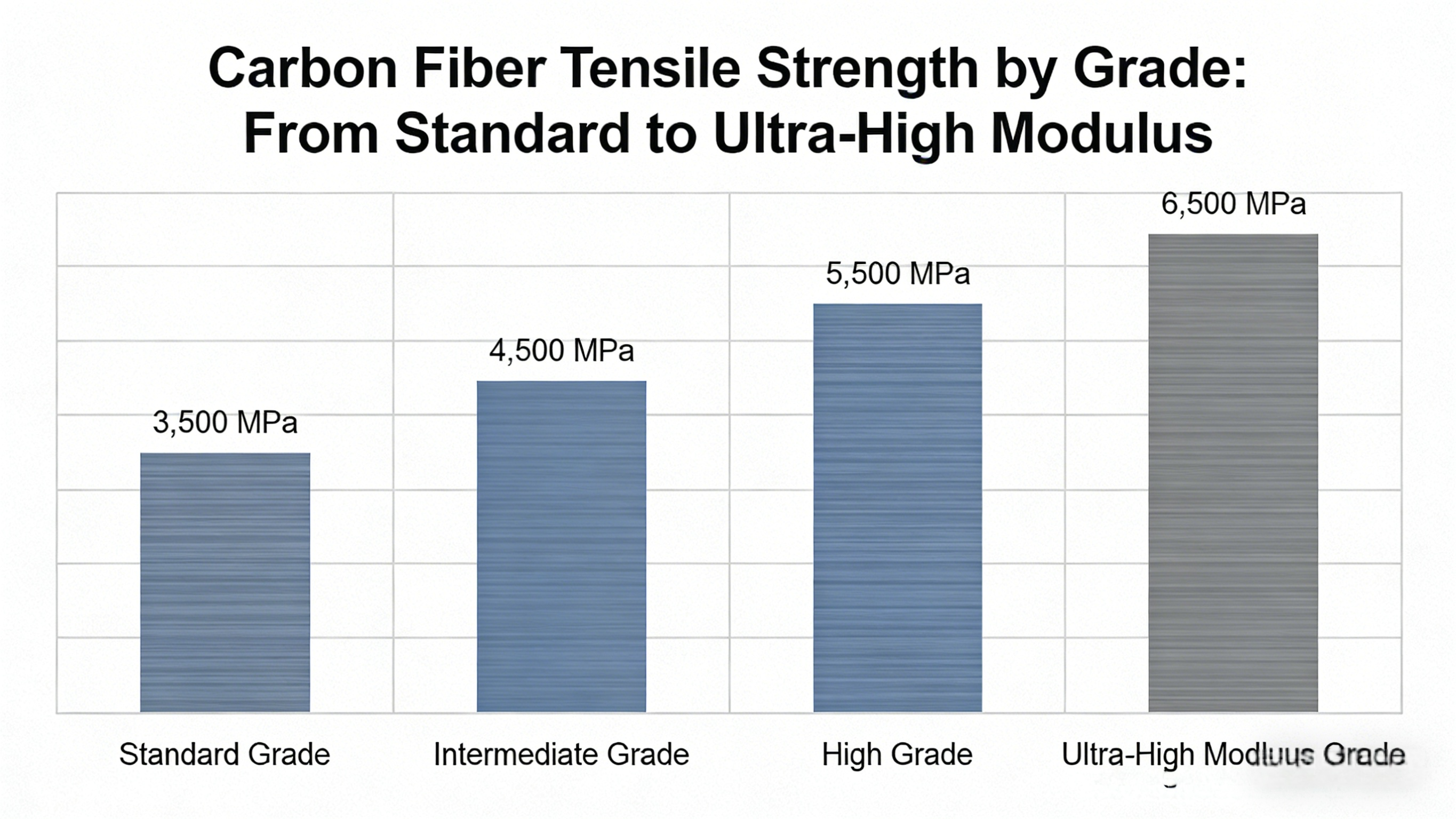
Four distinct grade families. Each built around a different engineering priority — and each carrying tensile strength numbers that tell a specific story.
The grade system isn’t marketing vocabulary. It’s a functional classification that maps to what the fiber can deliver under load. Knowing where each grade sits — and why it sits there — changes how you read a datasheet.
The Grade Breakdown
|
Grade |
Key Examples |
Tensile Modulus |
Tensile Strength |
Where It Gets Used |
|---|---|---|---|---|
|
Standard Modulus (SM/HS) |
T300, T700 |
230–240 GPa |
3,500–4,900 MPa |
Automotive panels, general structures |
|
Intermediate Modulus (IM) |
T800, T1100 |
290–320 GPa |
4,900–7,000 MPa |
Aerospace, performance components |
|
High Modulus (HM) |
M40, M55 |
380–570 GPa |
4,000–6,400 MPa |
Racing, stiffness-critical applications |
|
Ultra-High Modulus (UHM) |
M60J |
588–900 GPa |
2,500–4,500 MPa |
Precision aerospace structures |
Read that table top to bottom and a clear pattern shows up. Modulus climbs. Strength doesn’t follow. It peaks in the intermediate range, then drops as modulus keeps going up. A fiber at 900 GPa of stiffness — UHM territory — delivers tensile strength 40–50% lower than an intermediate modulus fiber.
That’s not a defect. That’s the trade-off, built into the physics.
The Strength-Stiffness Trade-Off in Practice
T700 is the workhorse. It hits 4,900 MPa tensile strength with a modulus of 230 GPa. That combination handles impact-heavy and load-bearing applications where energy absorption matters. Think crash structures, chassis components — parts that need to absorb a hit without breaking apart.
T800 and T1100 sit at the top of the strength curve. Intermediate modulus grades reach up to 7,000 MPa. That’s the highest raw tensile figure in the carbon fiber grade system. So aerospace designers lean on IM fibers for primary structures. The strength-to-stiffness ratio at this grade beats everything else in the lineup.
M60J shifts the priority. Its modulus reaches 588 GPa, and it’s built for parts where deflection — not fracture — drives the design. Satellite booms. Precision optical platforms. Structures where 0.1mm of flex under load is too much. Tensile strength drops at this grade, but that’s the cost of near-zero deformation — and for these applications, it’s worth it.
How Fiber Orientation Multiplies or Cuts These Numbers
Grade selection is half the equation. The other half is how you orient the fibers. That choice determines how much of the tensile strength reaches the load path.
A unidirectional 0° laminate in standard modulus fiber delivers ~2,070 MPa in bending along the fiber axis. Put that same material in a 0/90° cross-ply configuration and the longitudinal tensile contribution drops to 50–70% of that value. The transverse fibers add balance across directions, but they cut into peak directional strength.
The anisotropy gap is large: UD carbon fiber is 10–15× stronger along the 0° axis than at 90° to it. That ratio holds across all grades. So a UHM fiber in a misaligned layup can end up delivering less effective strength than a standard modulus fiber pointed straight at the load direction.
Grade matters. Orientation governs. Both decisions belong in the same conversation.
How Layup, Resin, and Fiber Volume Affect Real-World CFRP Strength
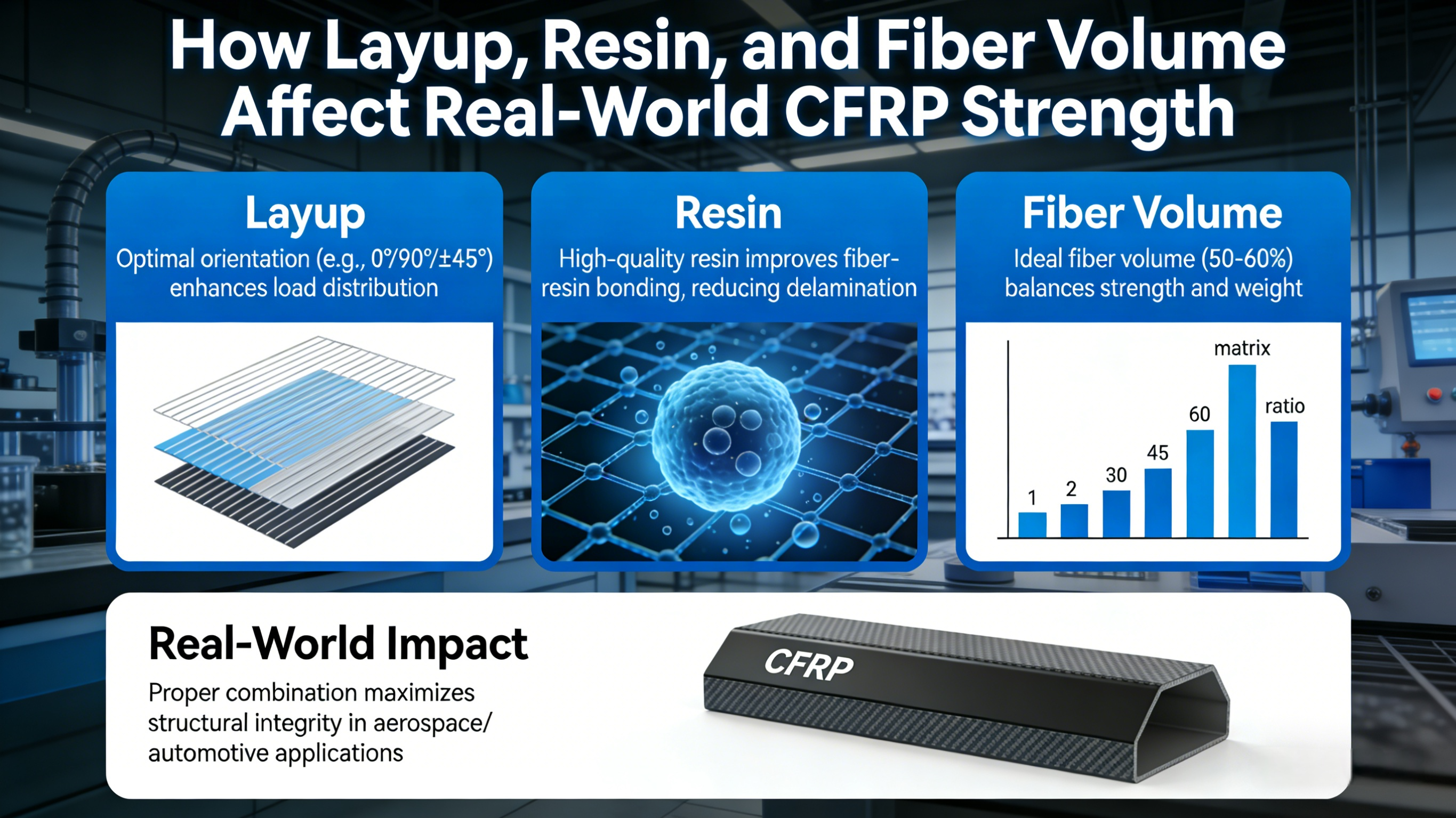
The fiber grade on a datasheet tells you what’s possible. What you get in the final part depends on three things: how the fibers are oriented, what resin binds them, and how much fiber is in the part.
Each variable is a multiplier. Get one wrong, and the others can’t save you.
Fiber Volume Fraction: The Number Most Buyers Never Check
Fiber volume fraction (Vf) is the ratio of fiber to total composite volume. It shapes the final mechanical result more than most buyers expect.
For thermoplastic-matrix composites, strength and impact resistance peak at Vf = 0.2–0.3 — about 40–50% fiber by weight. Push past that point, and fiber distribution starts to break down. Residual fiber length drops fast. In long-fiber injection systems, 20mm fibers process down to an average of just 4.17mm. Strength doesn’t keep climbing. It falls.
Epoxy systems work differently. Unidirectional CFRP laminates at Vf = 43.5% deliver compressive strength 50% higher than equivalent GFRP laminates at the same volume fraction. Shear strength and shear modulus also run higher. Same epoxy matrix — but stiffer carbon fibers carry more of the load.
The practical target for most structural applications: Vf = 0.4–0.6. Hybrid lattice structures combine a continuous-fiber lattice at Vf = 0.6–0.7 overmolded with long fiber at Vf = 0.2–0.4. This combination hits an overall Vf of 0.4–0.6 and produces flexural strength comparable to steel.
Layup Angle: The Variable That Can Cut Strength in Half
A 3° fiber misalignment in a unidirectional layup predicts compressive strength of 550.7 MPa — and experimental results confirm this. Three degrees is barely visible to the eye. Yet it’s enough to trigger kink-band failure, the dominant compressive failure mode in UD carbon laminates.
The directional sensitivity here is steep. Fibers aligned with the load path carry the structure. Fibers even a few degrees off that axis create an earlier failure point — every single time.
Resin Selection and Fiber Length: The Manufacturing Variables
For chopped carbon fiber (CCF) panels, fiber length and Vf interact in ways that aren’t obvious at first. At 50% Vf with 150gsm tow, 1-inch fiber length outperforms 2-inch on specific energy absorption. Shorter fibers create more fracture sites. This improves crush behavior. At 40% Vf, the relationship flips.
Key takeaways for procurement:
-
Smaller tow size (150gsm) maximizes tensile and flexural performance
-
Keep Vf at or below 0.3 in thermoplastic systems — going higher hurts fiber distribution
-
For epoxy prepreg or filament-wound structures targeting steel-level strength, aim for the 0.4–0.6 hybrid range
The fiber grade matters. So does everything that happens after you specify it.
Carbon Fiber Strength in Real Applications: Aerospace, Automotive & Sports

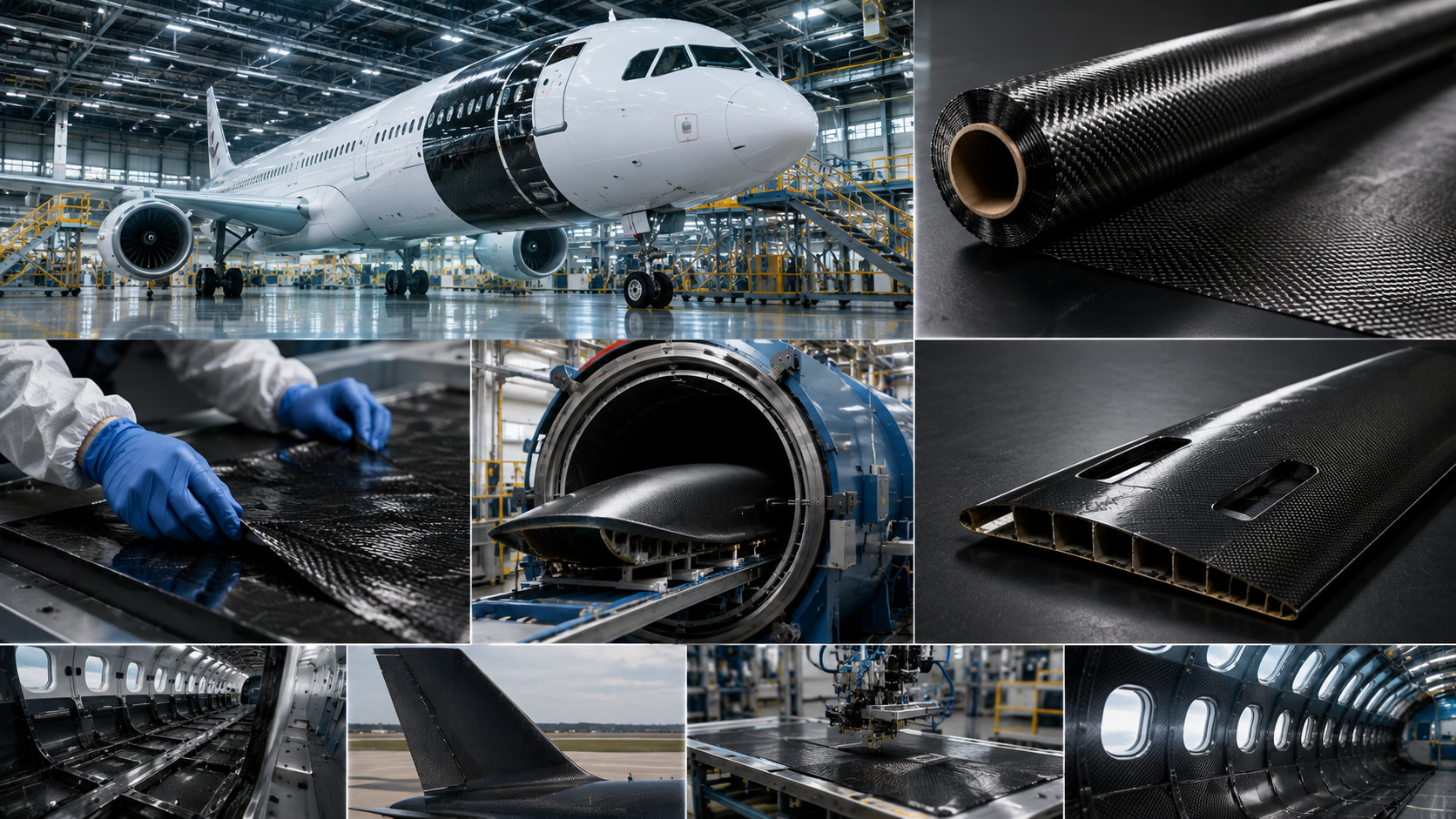
Numbers on a datasheet don’t build aircraft. Engineers do. Boeing’s team designed the 787 Dreamliner around one bold idea: carbon fiber could carry half an airplane by weight. It worked.
The 787 is 50% composite by weight. Carbon fiber runs through the fuselage, wing sections, and tail. That structure delivers a 20% weight reduction over aluminum construction. The weight savings don’t stop at engineering bragging rights — they cut fuel costs. Across a single aircraft’s lifespan, those efficiency gains add up to about $1 million in reduced operating costs. Swept wing designs using carbon fiber also trim aerodynamic drag, pulling fuel consumption down by up to 5%. Major manufacturers are now targeting 20% fleet-wide fuel efficiency improvements through composite adoption.
Aerospace leads carbon fiber demand. The sector accounts for 32.2% of total carbon fiber market revenue — a $2.58 billion share of a global aviation carbon fiber market on track to reach $6.55 billion by 2035. That growth is not guesswork. The numbers reflect real purchasing patterns. Aircraft manufacturing alone absorbs over 40% of current demand for fibers exceeding 6,300 MPa tensile strength — the ultra-high-strength grades used where failure is not an option.
Automotive and sports follow the same logic. Carbon fibers just 5–10 micrometers in diameter produce a strength-to-weight ratio that beats traditional metals by 50–70%. You get lighter vehicle structures, lower emissions, and performance gains aluminum cannot match at the same part weight.
One real trade-off worth knowing: maintenance costs for carbon fiber composites run much higher than for metals. Repairs need specialized tools and trained technicians. Long-term durability under real conditions — vibration, impact, thermal cycling — is still an open engineering question, not a settled one.
Strong in the right context. Demanding in others.
4 Common Misconceptions About Carbon Fiber Strength (What Most People Get Wrong)
Four beliefs about carbon fiber circulate through engineering forums, product listings, and buyer conversations — and all four are wrong in ways that cost people money.
Misconception 1: Carbon Fiber Is Stronger Than Steel
The claim sounds right. It isn’t accurate enough to be useful.
Per unit weight, carbon fiber wins. Per unit volume, steel hits harder. Carbon steel reaches 841 MPa tensile strength — close to double the 276–500 MPa you see in standard carbon fiber composites. The density gap explains the confusion. Steel sits at 7.85 g/cm³. Carbon fiber sits at 1.5–1.8 g/cm³. That’s four to five times denser. So carbon fiber carries more load per kilogram, not more load per cubic centimeter.
That one distinction changes every structural calculation you run.
Misconception 2: Carbon Fiber Is Equally Strong in All Directions
It isn’t. Not even close.
Carbon fiber composites are strongly anisotropic — meaning strength varies by direction. A unidirectional laminate delivers 600 MPa along the 0° fiber axis. At 90°, that drops to around 350 MPa. The resin fills the gaps but doesn’t erase the directional difference. Point a load perpendicular to the fibers, and you’re working with a much weaker material than the spec sheet shows. The fiber has to face the load. Otherwise, the datasheet rating doesn’t hold.
Misconception 3: Thicker Always Means Stronger
Stack more plies, get more strength. That’s the basic intuition. It breaks down at the laminate level.
Interlaminar shear strength (ILSS) limits how much each extra layer actually contributes. Past a certain point, more plies don’t add matching load capacity — they add delamination risk. Consider this comparison:
-
A well-designed forged carbon part at 1.5 g/cm³ resists 220 kg in three-point bending
-
An equivalent aluminum piece fails at 120 kg
That gap comes from geometry and layup design. Raw thickness alone doesn’t get you there.
Misconception 4: If It Looks Like Carbon Fiber, It Performs Like Carbon Fiber
The woven pattern is everywhere — phone cases, interior trim, cosmetic overlays. Most of it carries zero structural load.
Real structural CFRP needs fiber volume above 30% to build the continuous networks that produce actual mechanical performance. Drop below 10% volume fraction, and both strength and conductivity fall apart. High-end structural grades target 500+ MPa tensile strength with confirmed fiber-resin integration. A decorative carbon weave film delivers neither.
Before you spec or buy any carbon fiber component, check two things:
-
Fiber volume fraction — not just surface appearance
-
Tensile data — ask for the numbers, not just the finish
Surface looks mean nothing without the data to back it up.
FAQ: Quick Answers to Specific Carbon Fiber Strength Questions
Specific questions get specific numbers — no vague estimates here.
Is carbon fiber stronger than steel?
By weight, yes — and it’s not even close. Carbon fiber reaches 3,500–7,000 MPa tensile strength at a density of just 1.6–1.9 g/cm³. Steel lands at 400–600 MPa with a density of 7.8 g/cm³. That gives you 5–10× higher specific strength for carbon fiber. Per cubic centimeter, steel narrows the gap. Per kilogram carried, carbon fiber wins by a wide margin.
What is the tensile strength of carbon fiber in MPa?
The grade determines the number:
– T300/T700 (standard): 3,530–4,900 MPa
– T800/T1100 (intermediate modulus): up to 7,000 MPa
– M60J (high modulus): ~588 MPa at fiber level; ~365 MPa as composite
How strong is a carbon fiber tube?
A typical structural tube at 60% fiber volume using Toray 250°F epoxy delivers:
– Tensile strength: 1,860 MPa (270 ksi)
– Compressive strength: 1,480 MPa (215 ksi)
– Flexural strength: 1,810 MPa (260 ksi)
All tested per ASTM D3039/D790.
Which grade works best for structural applications?
– Standard Modulus (T300/T700): Best strength-per-dollar for general structures
– Intermediate Modulus (T1100G): Built for aerospace and high-load industrial use
– High Modulus (M60J+): Use this where deflection — not fracture — controls the design
Check the supplier’s Technical Data Sheet before you finalize any specification.
What testing standards apply to carbon fiber strength?
– ASTM D3039 — tensile strength and modulus
– ASTM D695 — compressive strength
– ASTM D790 — flexural strength
– ASTM D2344 — interlaminar shear strength (ILSS); typical values around 96 MPa
Conclusion
Carbon fiber doesn’t just outperform steel, aluminum, and titanium on paper — it changes what’s possible once weight stops being a limit you’re willing to accept.
The data is clear: carbon fiber tensile strength hits 3,500–7,000 MPa depending on grade. Its strength-to-weight ratio leaves metals far behind. The real variable between exceptional and mediocre results? How well the composite is engineered — layup orientation, fiber volume, resin selection.
That’s where most buyers get it wrong. They source the material. They underestimate the design.
Evaluating carbon fiber for a real application — aerospace bracket, automotive panel, structural component? Don’t stop at the datasheet. Look at the full system.
Browse our carbon fiber product range at HyperX Carbon, or reach out to our engineering team. We’ll match the right grade to your actual load requirements — no guesswork, no overselling.
The strongest material is the one specified for the right job.
Contact HyperX Carbon – Your Trusted Chinese Carbon Fiber Partner
Ready to source high-performance carbon fiber materials or custom forged carbon fiber parts from China?
HyperX Carbon is a leading manufacturer with 20+ years of expertise, specializing in aerospace-grade forged carbon fiber, prepreg, tubes, sheets, and lightweight automotive/drone/medical components. We offer:
-
Stable supply chain with premium raw materials (Toray, Mitsubishi, Hengshen)
-
AS9100D certified production for aerospace & UAV applications
-
Rapid prototyping (5-8 weeks) and monthly capacity exceeding 180,000 parts
-
Competitive pricing with 15-18% cost savings on forged carbon solutions
-
Full customization: from T700/T1100G to ultra-high modulus grades
Whether you’re an eVTOL developer, automotive OEM, drone manufacturer, or medical device engineer, HyperX delivers consistent quality, batch-to-batch reliability, and reliable delivery.
Get in touch today for a free consultation, custom quote, or material sample.
📧 Email: [email protected]
🌐 Website: https://www.hyperxcarbon.com/
📞 Phone/WhatsApp: +86 15623270276 (English support available)
Let’s build your next lightweight innovation together – contact HyperX Carbon now and stay ahead in the low-altitude and advanced composites market.