
You spent good money on that carbon fiber wrap. The last thing you want is to watch it bubble, peel, or fade into a chalky mess two years later.
Here’s the truth: carbon fiber wrap durability varies a lot. Most installers never mention the key factors at the point of sale. Some wraps hold strong for five-plus years. Others start breaking down before the first summer ends.
So what determines how long yours will last? And what can you do to stretch that lifespan as far as possible? This guide covers both — real numbers, straight answers, and the maintenance habits that separate a wrap that holds up from one that falls apart.
How Long Does Carbon Fiber Wrap Last in 2026?
The honest answer: it depends. But that’s not enough on its own, so here are the actual numbers.
Most carbon fiber wraps last between 3 and 7 years. That’s a wide range. Where your wrap lands comes down to three things: material quality, climate, and how well you maintain it.
Here’s how those ranges break down:
|
Wrap Type |
Expected Lifespan |
|---|---|
|
Budget calendared vinyl (carbon-look) |
3–5 years |
|
Standard carbon fiber texture wrap |
3–5 years |
|
High-end cast vinyl carbon wrap |
5–7 years |
|
Garage-kept + regular maintenance |
Up to 6–7 years |
|
Daily fleet / high UV exposure |
2–4 years |
Climate is the factor most people get wrong. Parking outdoors in Phoenix or Miami? UV exposure alone can cut your wrap’s lifespan by 30–40%. NIST data backs this up — polymer films degrade 25–35% faster without UV-protective coatings. That’s not a small gap.
Premium brands like 3M, Avery Dennison, and KPMF can push lifespan up to 12 years in mild climates. But those numbers need two things: quality material and consistent upkeep. The wrap won’t hold itself together. That part’s on you.
5 Key Factors That Determine Carbon Fiber Wrap Longevity
Five variables decide whether your wrap looks showroom-sharp at year six — or starts peeling before year three. None of them are random. All of them are knowable. Here’s what they are.
1. Material Quality and Film Thickness
Thickness isn’t just a spec on a data sheet. It’s the physical barrier between your wrap and everything trying to destroy it.
3M 2080 sits at 6 mil. That extra material cuts scratch penetration by 20–30% compared to thinner competitive films. Avery Dennison SC950 runs around 5.5 mil — solid UV and scratch protection, but about 10–15% less durable than 3M in high-abrasion testing.
Specialty carbon-texture films? Most run thinner still. That’s a core reason they land in the 2–4 year range rather than the 5–7 year window standard cast vinyl reaches.
The top benchmark: premium PPF-hybrid products like TERMINAX Carbon-X can push past 10 years. Budget films won’t come close.
2. Installation Quality
A flawless material with a sloppy install is still a liability.
Professional installers deliver a bubble rate under 5% and edge lift below 2% after three years. Real example: a 2019 BMW X5 wrapped with 3M 1080 by a certified shop showed 95% appearance retention at six years. The same wrap put on by an inexperienced installer on a similar vehicle? Significant lifting and fading by year three.
DIY installs tend to produce 15–25% bubble rates and 10–20% edge lift within three years. Three red flags that cut lifespan by 30–50%:
– Excessive film stretching
– Poor edge sealing
– Inadequate surface prep before application
3. Environmental Exposure
Climate compounds every other weakness.
|
Climate |
Expected Lifespan |
Primary Damage Mechanism |
|---|---|---|
|
Desert Southwest |
4–6 years |
Heat over 100°F + sand abrasion erodes topcoat |
|
Northern Cold |
3–5 years |
Freeze-thaw cycles crack resin bonds |
|
Southern California |
6–8 years |
Consistent heat/UV; no harsh cycles |
|
Coastal regions |
6–8 years |
Salt and humidity corrode edges |
UV index matters more than most people realize. At index 9–11 — a San Diego summer, a Phoenix afternoon — photochemical breakdown speeds up film degradation by 25–35% without protective coatings. Unprotected resin yellows and turns brittle in as little as 2–4 years.
4. Maintenance Practices
Maintenance isn’t optional upkeep. It’s active lifespan management.
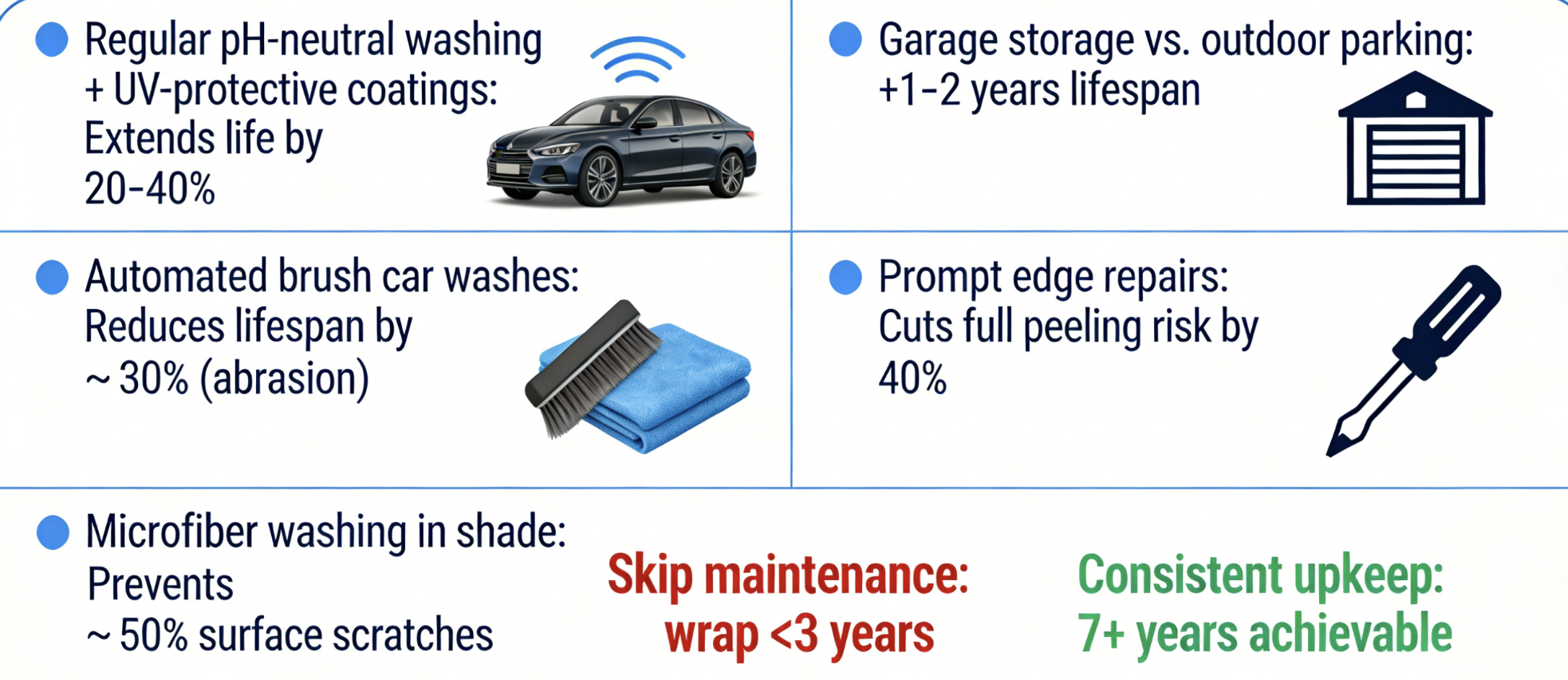
Regular pH-neutral washing combined with UV-protective coatings extends wrap life by 20–40%. Automated brush car washes do the opposite — they cut lifespan by about 30% through repeated abrasion. Washing with microfiber in the shade stops around 50% of avoidable surface scratches.
Two other habits that pay off big:
– Garage storage adds 1–2 years compared to outdoor parking, no matter the climate
– Prompt edge repairs — catching a small lift before it spreads — cut full peeling risk by 40%
Skip maintenance, and even a premium wrap struggles past three years. Stay on top of it, and seven-plus years is within reach.
5. Surface Position on the Vehicle
Your wrap doesn’t age at the same rate across the car. Where it sits changes everything.
Horizontal surfaces — hood, roof, trunk lid — absorb direct overhead sun and run 20–30°F hotter than vertical panels under the same conditions. That heat speeds up topcoat failure and causes fading at about twice the rate of doors and fenders.
A real example: in desert climates, hood wraps often show edge lift within 2–3 years. The side panels on the same vehicle? Still holding at five-plus years. Same material. Same install. Different physics.
Ceramic coatings on horizontal panels can recover 1–2 years of lost lifespan. They do this by cutting UV absorption and heat retention directly at the surface.
The Full Picture
|
Factor |
Low-End Outcome |
High-End Outcome |
|---|---|---|
|
Material quality |
2–4 years (thin specialty film) |
10–12 years (premium PPF hybrid) |
|
Installation |
DIY: up to 50% lifespan lost |
Professional: full retention |
|
UV and climate |
Desert: ~4 years |
Shaded mild climate: 8 years |
|
Maintenance |
Neglected: ~3 years |
Optimized: 7+ years |
|
Surface position |
Horizontal: −30% lifespan |
Vertical: baseline |
No single factor works alone. A premium film installed badly in Phoenix and left unwashed performs worse than a mid-grade wrap installed well in Seattle with consistent upkeep. Material, install, climate, maintenance, placement — all five together shape your wrap’s real lifespan.
Carbon Fiber Wrap Maintenance Tips to Maximize Lifespan (Step-by-Step Care Guide)
Maintenance isn’t glamorous. Nobody brags about their bi-weekly wash routine. But the gap between a wrap that still looks sharp at year six and one that’s peeling at year three comes down to this — the boring, consistent habits most owners skip.
The good news: the routine isn’t complicated. It just needs to happen.
Step 1: Wash It Right (Every Two Weeks)
The single most damaging thing owners do to their wraps isn’t parking in the sun. It’s running them through an automatic brush car wash.
Automated brushes cut wrap lifespan by 30% through repeated surface abrasion. The fix is simple. Hand wash every two weeks with a pH-neutral car soap and a clean microfiber cloth. Harsh chemicals, abrasive cleaners, and stiff brushes all damage the film’s topcoat far faster than UV exposure alone.
Two more rules that matter:
-
Keep water pressure below 1,500 PSI. Higher pressure works edges loose from the inside out.
-
Use the two-bucket method — one bucket for soap, one for rinsing your mitt. This keeps grit off the surface between passes.
Step 2: Dry Right Away and Do It Right
Water spots aren’t just cosmetic. Left to sit, mineral deposits etch into the film surface. Dry your wrap right after washing. Use microfiber towels and wipe in straight lines — not circles. Circular motions create swirl marks that dull the finish over time.
Step 3: Use a Vinyl Sealant Every 1–3 Months
Think of a vinyl-specific spray sealant as sunscreen for your wrap. Use it every one to three months. It builds a UV and pollutant barrier across the surface, boosts the finish, and extends film life.
This step alone — done on a regular schedule — can push your wrap’s lifespan well past what the base material would deliver on its own.
Step 4: Consider a Ceramic Coating
A ceramic coating is the single best investment you can make for wrap longevity. Put it over cast vinyl once, and it cuts UV-driven breakdown by 25–35% while boosting scratch resistance at the same time.
The numbers speak for themselves. Cast vinyl with a ceramic coating lasts 5–10 years. Without it, that same film tops out at 5–7. That’s a real gap — years of better appearance and stronger adhesion — for a one-time application.
Step 5: Adjust Your Habits by Season
Summer demands shade. Parking in a garage or under a car cover during peak UV months cuts fading by 30–40% in hot climates. It’s the cheapest lifespan boost available.
Winter brings a different threat: de-icing salts. Salt corrodes wrap edges from the outside in. Rinse your vehicle right after driving on treated roads. Put down a protective sealant before the season starts. Use a dedicated winter wash formula once temperatures drop.
Your Maintenance Schedule at a Glance
|
Task |
Frequency |
|---|---|
|
Hand wash (pH-neutral soap) |
Every 2 weeks |
|
Edge and bubble inspection |
Monthly |
|
Vinyl spray sealant application |
Every 1–3 months |
|
Full seasonal check |
Quarterly |
|
Ceramic coating (if applicable) |
Once at install or yearly |
Owners who reach year seven with a wrap that still turns heads aren’t doing anything special. They’re just doing the basics — on schedule, with the right products — while everyone else guesses and hopes for the best.
FAQ: Carbon Fiber Wrap Durability Questions Answered
The same questions come up every time someone thinks hard about getting a carbon fiber wrap. Not because the answers are hard to find — but because nobody gives them straight.
How long does carbon fiber wrap last?
Quality carbon fiber wrap lasts 5–7 years. That’s with proper installation and regular upkeep. Budget films? Expect peeling and fading within 12–24 months. The material grade and your maintenance habits are the deciding factors — not luck.
Will it peel off in summer heat?
Direct summer sun speeds up edge lift and fading. It won’t fall off overnight. But UV exposure without protection cuts the lifespan short. Here’s what helps:
-
Park in shade during peak sun hours
-
Use a UV-protective sealant on the surface
-
Keep up with basic maintenance
Do those things, and a well-installed wrap can still hit 7+ years — even in warm climates.
Can you run it through an automatic car wash?
No. Brush washes scratch the film surface and loosen the edges. Hand wash only — mild pH-neutral soap, a soft microfiber cloth, done.
Does rain damage carbon fiber wrap?
Normal rainfall won’t hurt it. Prolonged water soaking is a different story. Studies on CFRP laminates show tensile strength drops 25–33% after 224 days of water exposure. Temperature plays a role too — 25% drop at 23°C, 33% drop at 60°C. Repeated wet-dry cycles push that damage even further.
For regular daily driving, though, normal rain stays well within safe limits.
Is carbon fiber wrap worth the money?
Yes — if you buy quality. A 5–7 year lifespan costs far less than a full respray. There’s no bodywork prep needed. And you can remove it clean with no damage to the paint underneath. For most owners, the value holds up well.
What should you do if your wrap gets scratched?
Minor scratches? A heat gun and vinyl repair solution usually fix them. Deeper damage needs a localized panel re-wrap — not a patch job. Deal with it early. A small scratch left alone can spread into a full replacement situation.
Conclusion
Here’s what most wrap guides won’t tell you: carbon fiber wrap longevity isn’t a product feature — it’s a practice.
A quality wrap from a reputable brand gives you 3–5 years of sharp, head-turning results. But that number isn’t fixed. Skip the maintenance, and you’ll land at the low end. Stay consistent with care, and you’ll push well past that range.
You now know what kills a wrap early — UV exposure, heat, improper washing, and cut-rate installation. You also know how to fight back.
So don’t just wrap your car. Commit to it.
Start with the right material. Follow a care routine. Do both, and you protect your investment — and get more enjoyment out of it than you’d expect.
Contact HyperX Carbon – Your Trusted Chinese Carbon Fiber Partner
Ready to source high-performance carbon fiber materials or custom forged carbon fiber parts from China?
HyperX Carbon is a leading manufacturer with 20+ years of expertise, specializing in aerospace-grade forged carbon fiber, prepreg, tubes, sheets, and lightweight automotive/drone/medical components. We offer:
-
Stable supply chain with premium raw materials (Toray, Mitsubishi, Hengshen)
-
AS9100D certified production for aerospace & UAV applications
-
Rapid prototyping (5-8 weeks) and monthly capacity exceeding 180,000 parts
-
Competitive pricing with 15-18% cost savings on forged carbon solutions
-
Full customization: from T700/T1100G to ultra-high modulus grades
Whether you’re an eVTOL developer, automotive OEM, drone manufacturer, or medical device engineer, HyperX delivers consistent quality, batch-to-batch reliability, and reliable delivery.
Get in touch today for a free consultation, custom quote, or material sample.
📧 Email: [email protected]
🌐 Website: https://www.hyperxcarbon.com/
📞 Phone/WhatsApp: +86 15623270276 (English support available)
Let’s build your next lightweight innovation together – contact HyperX Carbon now and stay ahead in the low-altitude and advanced composites market.




