
Forged carbon fiber looks like a million dollars — and depending on who you buy from, it might cost close to it. Here’s the problem: most suppliers don’t publish their prices. That leaves engineers, designers, and automotive enthusiasts guessing at budgets or sitting through sales calls just to get a rough number. That ends here.
Pricing out custom interior panels? Comparing forged carbon fiber cost against standard woven material? Trying to figure out why a Lamborghini door sill costs what it does? This guide breaks it all down. Raw material costs, tooling, fabrication, surface finishing — all of it. Real numbers. No runaround.
Forged Carbon Fiber Sheet Price: Cost Per Square Foot, Meter & Kilogram
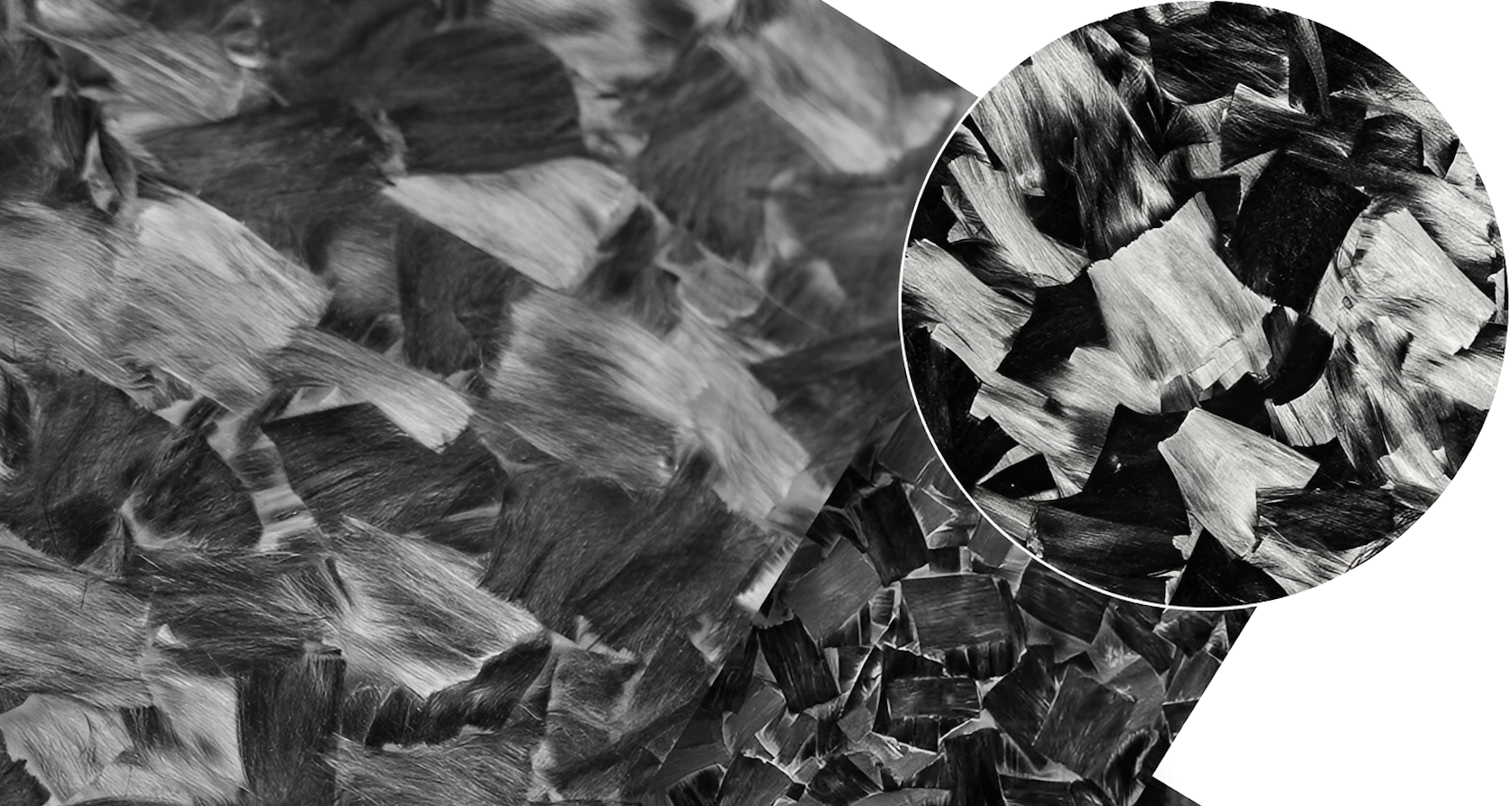
Sheet pricing is where the rubber meets the road — and where most buyers get their first real shock.
Carbon fiber sheet pricing isn’t a single number. Four variables shape the final price: thickness, weave orientation, panel dimensions, and order quantity. Miss one in your budget estimate and the invoice will look nothing like what you expected.
Here’s what the actual market looks like in 2026.
Standard Twill Weave Sheet Pricing
For standard 3k 2×2 twill weave sheets, price ranges by panel size break down like this:
|
Thickness |
12″×12″ |
24″×24″ |
48″×48″ |
|---|---|---|---|
|
0.030″ |
$46.99 |
— |
— |
|
0.090″ |
$90.99 |
— |
$448.99 |
|
0.115″ |
$66.99 |
$287.99 |
— |
|
0.210″ |
$139.99 |
$458.99 |
— |
|
0.240″ |
$159.99 |
$532.99 |
$1,776.99 |
The per-square-foot rate is where the volume savings show up clearly:
-
Small sheets (6″×12″ to 12″×12″): $5.83–$6.45/sq ft
-
Medium sheets (12″×24″): $5.86–$11.83/sq ft — note the wide spread, which reflects thickness variation
-
Large sheets (24″×24″ to 48″×48″): $5.47–$6.35/sq ft
Larger panels — 48″×48″ in particular — run 5–15% cheaper per square foot than smaller cuts. Your project can use larger stock sheets? That difference adds up fast.
Uni-Directional Sheet Pricing
Uni-directional (0°) sheets follow a similar volume curve but come with different base rates:
|
Thickness |
6″×6″ |
12″×12″ |
24″×24″ |
|---|---|---|---|
|
1/16″ |
$29.03 |
$90.79 |
$313.54 |
|
1/8″ |
$40.32 |
$132.72 |
$473.72 |
|
1/4″ |
$69.89 |
$248.59 |
$902.75 |
At 1/16″ thickness, cost per square foot lands at $5.47–$6.45/sq ft depending on panel size. That’s right in line with twill weave prices at the same thickness.
What This Means for Your Budget
Two clear rules come out of this data:
-
Buy larger, cut down. The per-square-foot premium on small sheets is real. Buy a larger panel and cut it to size — you save 10–15% compared to ordering a pre-sized small sheet.
-
Thickness drives cost more than size. A 0.240″ sheet runs 3–4× more than a 0.090″ sheet of the same footprint. Lock in your thickness spec before you price anything else.
Forged Carbon Fiber Automotive Parts Price List (2026)
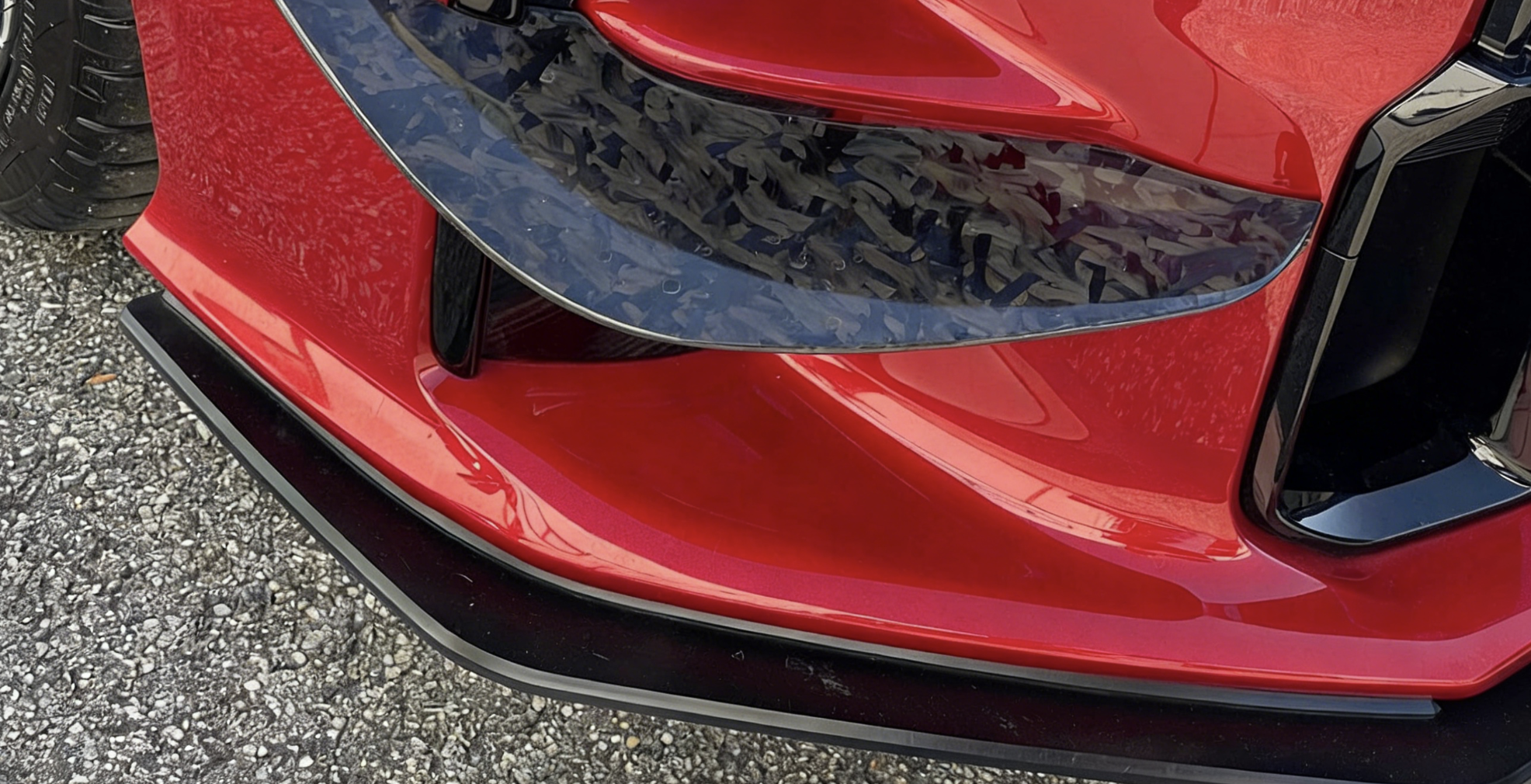
Forged carbon fiber pricing covers a huge range in automotive parts. A mirror cap costs $155. A monocoque chassis runs $150,000+. Both use forged carbon fiber. Knowing what drives that gap keeps your parts budget smart — not painful.
By 2026, the aftermarket has grown enough that solid benchmark data exists across every major part category. Here’s the full picture.
Price by Part Category
|
Part Category |
Example Parts |
Price Range (USD) |
|---|---|---|
|
Small Exterior / Interior |
Mirror caps, door handles, shifter bezels |
$149 – $349 |
|
Medium Components |
Armrest covers, console panels, engine covers, canards |
$249 – $899 |
|
Large Exterior |
Rear diffusers, side skirts, heat extractor hoods |
$849 – $2,999 |
|
High-End / Full Assemblies |
Wishbone sets, monocoque chassis |
$1,999 – $150,000+ |
Small trim pieces — mirror caps for a Subaru Ascent or Toyota GR Yaris, a Mustang coin tray, a MINI door handle — sit in the $149–$349 range. These parts have simple shapes and sell in high volumes. Tooling costs spread across many units fast. That keeps the unit price low.
Medium components cost more. A Tesla Model Y seat back cover runs $599. A C8 Z06 engine cover lands at $499. Challenger center console side panels come in at $429. The price jump comes from more complex shapes and tighter fitment tolerances — not padding the margins.
Large exterior pieces are where the numbers get serious. Trufiber’s C8 Z06 rear diffuser is priced at $1,978.90. Their Mustang heat extractor hood hits $2,999. Side skirts and rear hatch vents for the C8 run $1,199–$1,999.
Brand Reference Points (2026 Aftermarket)
-
Trufiber: Rear diffuser $1,978 / Spoiler $1,999 / Hood $2,999
-
Compressive Tuning: Mirror caps $155 / Intake manifold cover $399
-
RSI c6 (EUR-listed): Mirror caps €242 / Bonnet extractor €439 / Strut bar €390
-
APR / Seibon / HyperXCarbon: Aftermarket hoods benchmark at $2,000–$4,000, versus OEM equivalents at $5,000+ — about a 50% forged premium over standard composite
The OEM vs. Aftermarket Gap
Here’s a number that catches most first-time buyers off guard. Bulk OEM hoods sourced through Alibaba run $150–$180 per piece at minimum order quantities. Compare that to a Trufiber forged CF heat extractor hood at $2,999. Both are carbon fiber hoods. The gap comes down to material quality, tooling investment, fitment precision, and surface finish — not inflated markups.
No 2026 retail listings exist for custom OEM-level monocoque chassis work. Industry estimates put the figure at $150,000 and above. That’s not a consumer purchase. It’s a program-level engineering decision.
Bottom line: Budget $150–$500 for trim-level upgrades. Set aside $500–$3,000 for functional exterior components. Plan for $2,000–$5,000+ if you’re targeting structural or high-visibility show pieces. Full assemblies or monocoque-level fabrication push straight into six-figure territory.
What Drives Forged Carbon Fiber Cost: The 6 Key Pricing Factors
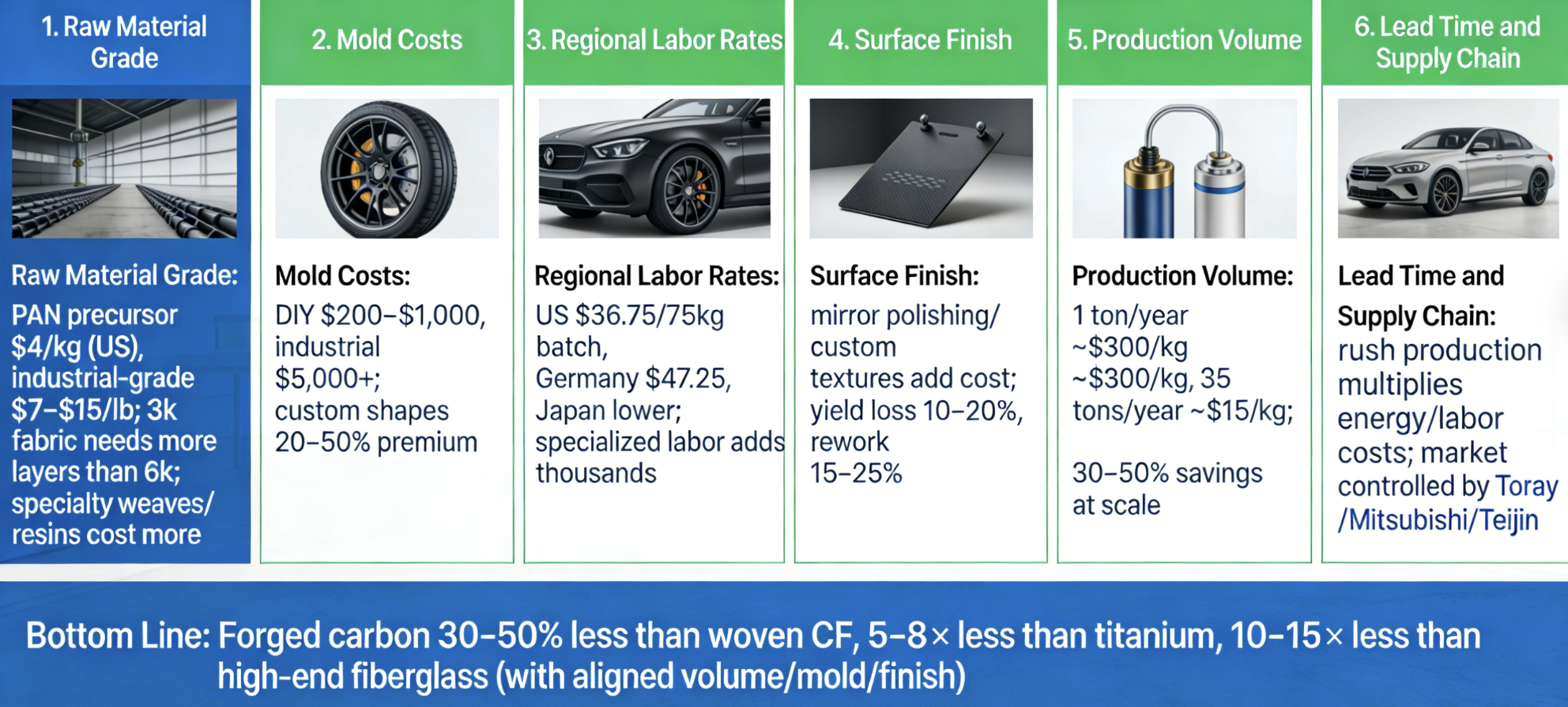
Six variables determine your final price. Not brand reputation. Not supplier location. Not your project spec complexity. Those things matter — but they’re secondary effects. Learn these six drivers and you’ll see why one quote lands at $300/kg and another comes in at $15/kg for what looks like the same material.
1. Raw Material Grade
Cost starts with the fiber itself. PAN precursor runs around $4/kg in the US. Industrial-grade carbon fiber sits between $7–$15/lb depending on grade and supplier. Most buyers don’t need aerospace-grade fiber. For automotive or consumer applications, the performance difference doesn’t justify the higher price.
Fabric weight affects your layer count. That directly affects your cost. A 3k fabric needs more layers than 6k to hit the same finished thickness. More layers means more material, more labor, more time. Specialty unidirectional weaves cost more than standard twill. High-temperature resins cost more than standard epoxy. Every spec choice carries a price tag.
2. Mold Costs
Mold investment is the most misunderstood cost in forged carbon fiber pricing. A DIY mold runs $200–$1,000. An industrial-grade mold for a complex automotive part pushes past $5,000 — and that’s before any design changes. Custom shapes don’t spread tooling costs across volume the way standard parts do. That’s why custom orders carry a 20–50% premium over catalog parts.
3. Regional Labor Rates
Labor costs less than most buyers expect — but it adds up fast on complex builds. For a 75kg batch, hourly labor breaks down to $36.75 in the US ($7.25/hr), $47.25 in Germany ($9.35/hr), and lower in Japan ($6.30/hr). The per-kilogram impact stays small — $0.001–$0.005/kg — but specialized technicians and advanced compression molding machines add thousands per unit on high-tolerance work.
4. Surface Finish
Finish spec is a hidden cost driver. Mirror polishing and custom textures add to the base price. The bigger issue is yield loss. Poor gloss uniformity pushes scrap rates up by 10–20% — a common problem across composite production. Rework and waste add another 15–25% to the finished part cost. Choose a flawless Class-A surface finish and that number climbs with it.
5. Production Volume
This is the single biggest lever in forged carbon fiber pricing.
|
Annual Volume |
Price per kg |
|---|---|
|
1 ton/year |
~$300/kg |
|
35 tons/year |
~$15/kg |
That’s a 20× difference — all driven by scale. Large-volume orders deliver 30–50% savings compared to equivalent woven carbon fiber parts. Low-volume custom batches lose all of that advantage. At small quantities, forged composite runs 2–3× the cost of aluminum. At scale, the numbers flip in your favor.
6. Lead Time and Supply Chain
Rush production pushes every cost higher. Tighter delivery windows drive up both energy use and labor at the same time. Energy is already the biggest cost factor in fiber carbonization. A faster timeline doesn’t reduce that — it multiplies it.
The supply side makes this worse. Three companies — Toray, Mitsubishi, and Teijin — control most of the high-grade carbon fiber market worldwide. That concentration of power limits your pricing leverage, especially if you can’t commit to steady volume. Lead time pressure shrinks your negotiating position fast.
The bottom line across all six factors: Forged carbon fiber costs 30–50% less than woven CF for comparable finished parts, 5–8× less than titanium, and 10–15× less than fiberglass at the high end of the performance range. None of those numbers hold unless your volume, mold investment, and finish spec line up. Get one of the six wrong and the math shifts fast.
Custom Forged Carbon Fiber Project Cost Breakdown: What to Expect
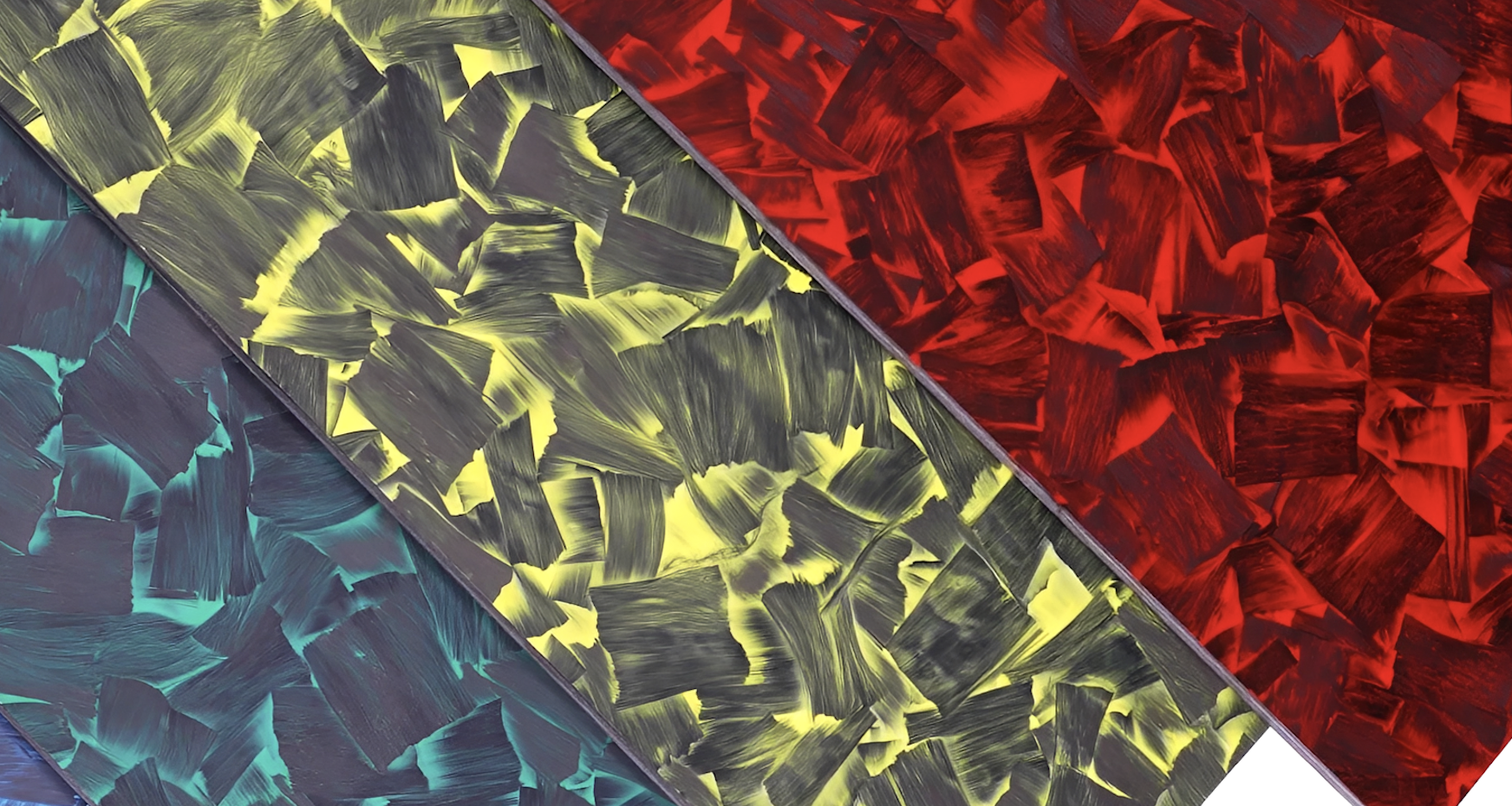
Custom work doesn’t come with a price tag. It comes with a conversation — and that conversation goes better when you already know the numbers.
Here’s the cost range for custom forged carbon fiber projects in 2026:
|
Project Type |
Typical Cost Range |
|---|---|
|
Small decorative parts |
$50 – $300 |
|
Medium automotive components |
$500 – $2,000 |
|
High-performance sporting equipment |
$1,000 – $5,000 |
|
Aerospace / industrial components |
$5,000+ |
The spread within each tier isn’t random. Three things drive it:
-
Material selection
-
Process method
-
How much of the tooling cost your order absorbs alone
Take an engine cover as an example. Raw material costs $63. The retail price hits $800. That gap isn’t margin padding. It covers tooling, labor, equipment, and ~50% material waste built into the manufacturing process. Manufacturers lose close to half their raw input before a finished part comes out. That loss gets priced into every unit.
Process choice pushes costs higher too. Here’s how the three main methods stack up:
-
Hand layup — the lowest cost option
-
Vacuum bagging — sits in the middle
-
Autoclave curing — the most expensive, but it produces aerospace-grade results with clear performance gains
The numbers tell a clear story. Variable production costs make up 55% of the final sales price. Add a 30% reseller markup on top. Suddenly, that $800 engine cover makes complete sense.
One number worth protecting: keep scrap rates below 8%. Go above that threshold and gross margins drop fast.
Forged Carbon Fiber Price by Product Category: Watches, Rings, Knife Handles & More
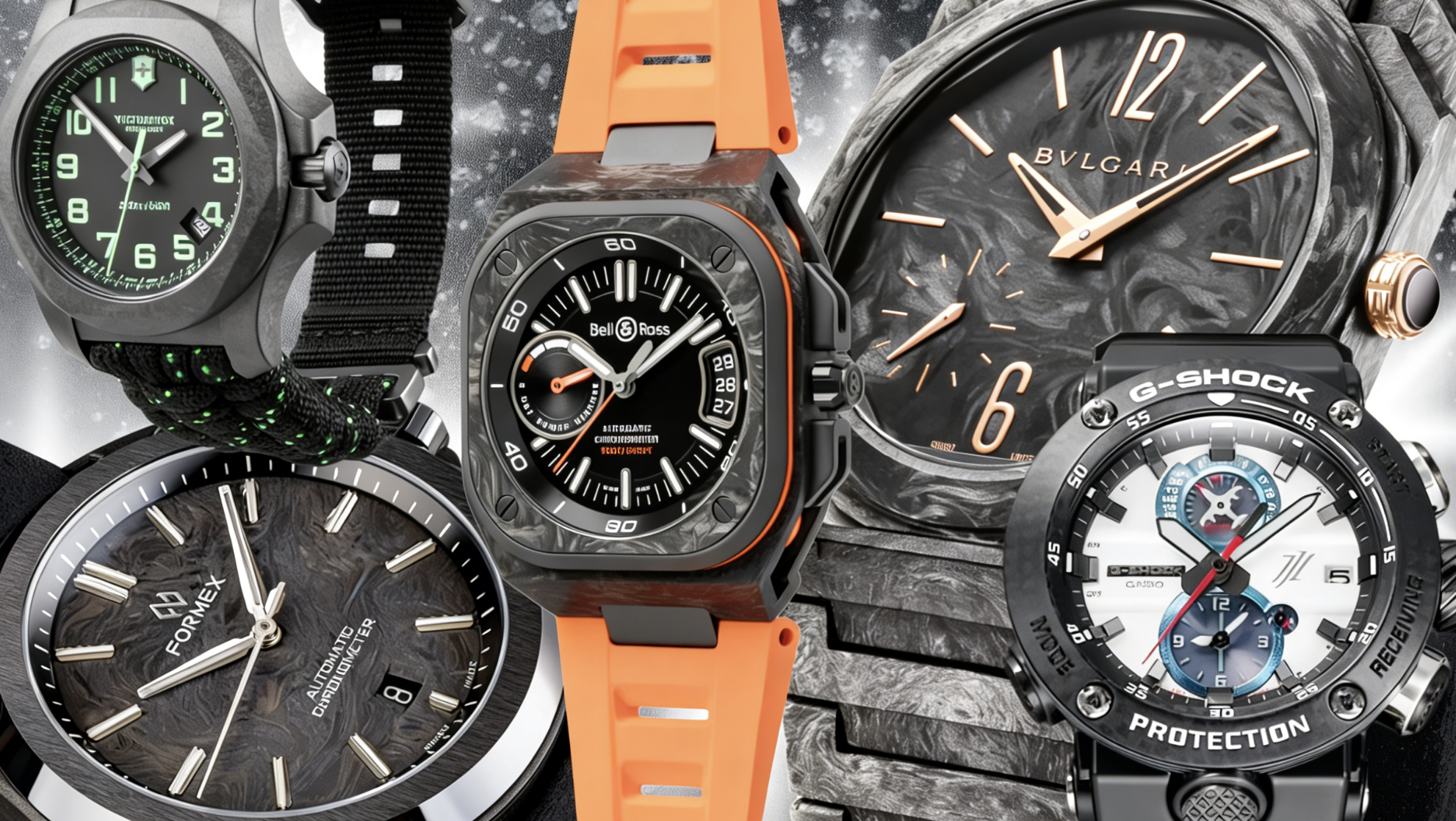
Forged carbon fiber goes far beyond automotive. The same material used in Lamborghini door panels now shows up in wedding rings, pocket knives, and luxury watches. Each category has its own pricing logic — and its own reasons for costing what it does.
Here’s the full breakdown by category.
Rings: $240 to $2,850+
Pure forged CF rings start at $240. That’s the Shogun ring from carbonfibergear.com — handmade in Salt Lake City, lifetime warranty, waterproof. Step up to a Damascus steel exterior with a forged CF interior and you’re at $730 (the Samurai). Add 14k gold and a diamond inset, and Carbon6’s Brooklyn-made ring lands at ~$2,850.
|
Ring Type |
Price (USD) |
|---|---|
|
Pure forged CF |
~$240 |
|
Forged CF + Damascus steel |
~$730 |
|
Forged CF + gold + diamond |
~$2,850 |
For context: titanium rings retail at $50–$200. A forged CF entry ring runs 3–5× that. Add precious metals and you’re in full luxury jewelry territory.
Watches: $500 to $100,000+
Microbrand watches with forged CF cases start around $500–$2,000. Hublot and Richard Mille — the names that put forged CF on the map in watchmaking — start at $10,000 and climb past $100,000. Even within the same brand lineup, a forged CF case adds a 30–100% price premium over the matching stainless steel model.
Knife Handles: $40 to $2,500+
Replacement forged CF scales for production knives run $40–$150 per set. A production folder with a custom forged CF handle sits at $200–$600 retail. High-end custom builds — one-off pieces from independent makers — push past $800–$2,500.
Pen Barrels: $150 to $600
Forged CF pens sit in the executive accessory tier. Brands like Monteverde price limited-edition forged CF barrels between $150–$600. That puts them alongside premium metal pens — not office supply aisle pens.
Why Consumer Forged CF Costs More Per Unit Than Automotive Parts
Most buyers find this surprising. Automotive parts spread tooling costs across large production runs. A knife handle or ring does not get that advantage. Low production volumes mean each unit carries the full cost of press tooling, cycle time, and finishing labor. Retail markup on handmade forged CF goods runs 4–8× material cost.
The other factor is uniqueness. Every forged CF piece has a distinct marbled pattern. No two look the same. That’s not a marketing claim — it’s a direct result of the compression molding process. In consumer markets, it works as a real scarcity signal.
|
Category |
Steel |
Titanium |
Forged CF |
Premium vs. Ti |
|---|---|---|---|---|
|
Rings |
$20–$80 |
$50–$200 |
$240–$2,850 |
3–14× |
|
Knife handles |
$15–$40 |
$60–$120 |
$150–$600 |
2.5–5× |
|
Watch cases |
$300–$800 |
$500–$1,500 |
$800–$100,000+ |
1.5–70×+ |
|
Pen barrels |
$30–$100 |
$80–$200 |
$150–$600 |
1.9–3× |
The same logic that justifies the price on a Performante body panel applies to a ring. Buyers in both markets pay for aerospace-grade origins, skilled handwork, and a product that loses its value the moment you try to mass-produce it.
How to Get an Accurate Forged Carbon Fiber Quote: 5 Questions to Ask Your Supplier
Bad quotes happen because buyers don’t ask the right questions. Suppliers fill in the gaps with assumptions — and those assumptions cost you money.
Contact any forged carbon fiber manufacturer with these five questions ready. They separate serious suppliers from ones who’ll waste your time.
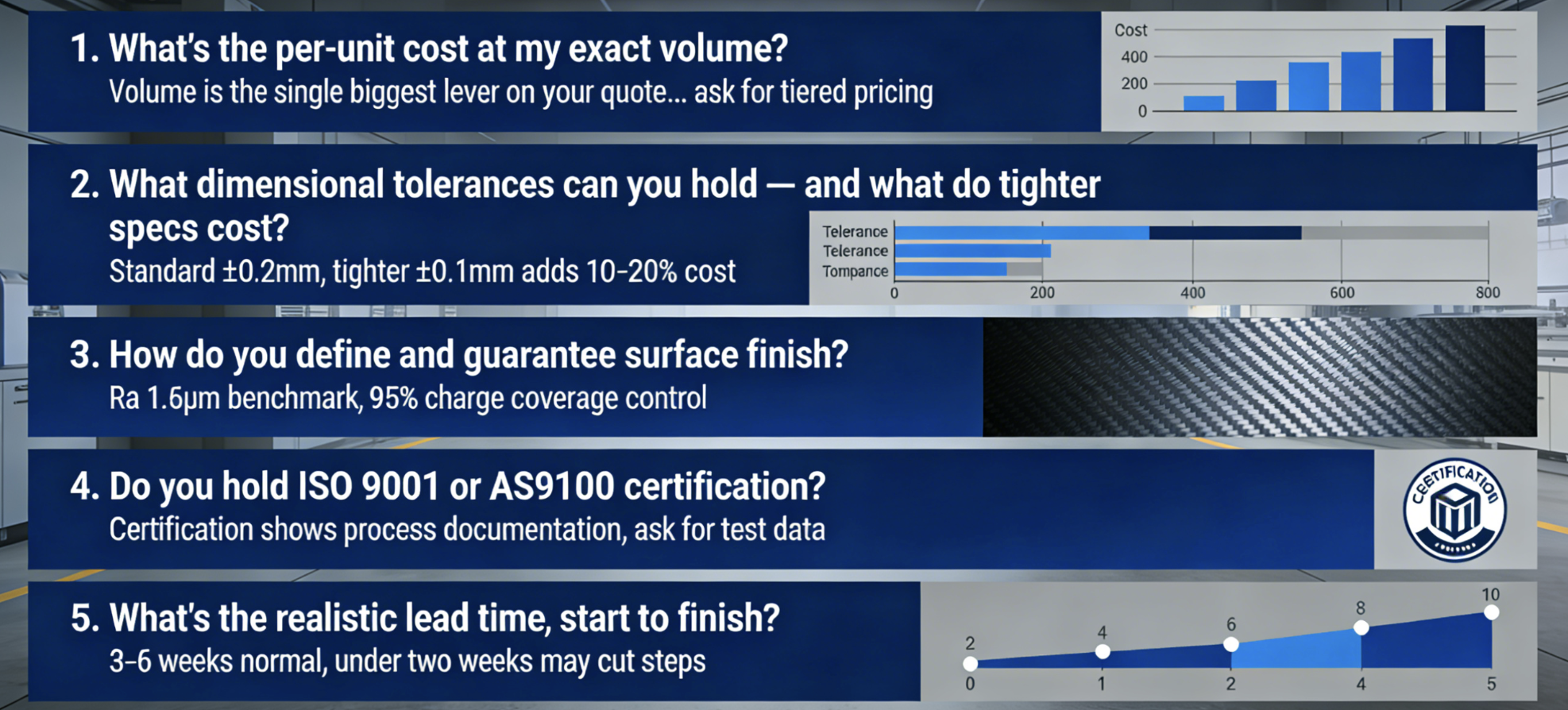
1. What’s the per-unit cost at my exact volume?
Volume is the single biggest lever on your quote. Orders under 500 units carry a 30–50% per-unit premium because setup costs don’t spread far enough. State your target quantity upfront — 100 pieces or 10,000 — and ask for tiered pricing. The gap between tiers shows you exactly how much room you have to negotiate.
2. What dimensional tolerances can you hold — and what do tighter specs cost?
Standard forged CF production holds ±0.2mm. Tighter specs — down to ±0.1mm — need extra post-processing: trimming, sanding, secondary inspection. That work adds 10–20% to your quoted price. Know your tolerance requirement before the call. Don’t pay for precision you don’t need.
3. How do you define and guarantee surface finish?
“Good finish” means nothing. Ask for a specific roughness value — Ra 1.6μm is the benchmark for Class-A surfaces. Forged CF’s marbled pattern comes from random fiber placement during compression. Consistent results need 95% charge coverage inside the mold. Ask your supplier how they control that. No clear answer means inconsistent finish on your parts.
4. Do you hold ISO 9001 or AS9100 certification?
Certification isn’t just paperwork. It separates a supplier who documents their process from one who guesses. For structural or high-performance parts, material benchmarks matter: tensile strength 300–500 MPa, modulus 20–40 GPa. Ask for actual test data. A certificate number alone tells you nothing.
5. What’s the realistic lead time, start to finish?
A standard compression mold cycle runs 3 minutes at 140°C and 10 MPa. Full cure with vacuum bagging takes 48 hours. Total production — tooling, molding, finishing, QC — runs 3–6 weeks under normal conditions. Any supplier quoting under two weeks for a custom part? Ask them directly what step they’re cutting out.
Regional Pricing Benchmarks
Your supplier’s location shapes your quote before a single spec gets discussed.
|
Region |
Price Range (USD/kg) |
Key Tradeoff |
|---|---|---|
|
China |
$15–$35 |
Lower cost; watch for void rates >5% and inconsistent fiber length (10–50mm) |
|
Europe |
$40–$70 |
High consistency (tensile ~400 MPa); certifications add 20–30% premium |
|
North America |
$50–$90 |
Superior surface finish (Ra <1.6μm); expect 6–8 week lead times |
The cheapest quote isn’t always the cheapest outcome. A Chinese supplier at $20/kg with an 8% void rate produces scrap. A North American shop at $75/kg with documented tensile data and Ra <1.6μm delivers parts that pass — and stay passed.
Need specs-matched pricing within 24 hours? Reach HyperXCarbon at [email protected].
Frequently Asked Questions About Forged Carbon Fiber Pricing
Buyers ask the same questions once they get serious about forged carbon fiber. Here are straight answers — no hedging, no sales language.
How much does forged carbon fiber cost per pound?
Industrial-grade material runs $10–24/lb. Aerospace-grade goes up to $35–100/lb. Most automotive and consumer buyers land in that $10–24 range. Forged carbon fiber carries the same raw material cost as standard woven fiber. The chopped fiber format doesn’t raise that cost. What it adds is more flexibility in manufacturing.
Is forged carbon fiber worth the premium?
For complex, non-flat shapes — yes. The forged composite market reached $128M in 2024 and is on track for $163M by 2030. That kind of growth only happens when buyers keep seeing real value.
Why do prices vary so much between suppliers?
Three things drive the gap: grade, precursor type, and where the material is made.
-
China’s carbon fiber prices fell 45% between 2022 and 2023 — dropping from $33/kg to $18/kg
-
That drop came from excess production capacity, which hit 47.7% of global supply
-
North American and European suppliers kept their prices steady
The spread you see in quotes is real. It comes down to actual differences in cost structure.
Is forged carbon fiber more expensive than regular carbon fiber?
At the raw material level, no. Both sit in the $10–24/lb industrial range. The price difference shows up in tooling, mold complexity, and surface finish — not in the fiber itself.
Conclusion
Forged carbon fiber isn’t cheap — and now you know why it shouldn’t be.
Every dollar in the forged carbon fiber price tells a story. It starts with raw chopped fiber. It runs through high-pressure tooling, post-cure finishing, and quality inspection. Standard weave can’t match that process — full stop.
Your cost variables aren’t a mystery either. Four things move your quote up or down:
-
Thickness
-
Geometry
-
Volume
-
Surface finish
Budgeting one automotive trim piece or sourcing sheets for a full production run — these four factors drive the number either way.
Smart buyers don’t chase the lowest price. They look at cost-per-outcome. Forged composite, spec’d to your application, wins that calculation more often than not.
Contact HyperX Carbon – Your Trusted Chinese Carbon Fiber Partner
Ready to source high-performance carbon fiber materials or custom forged carbon fiber parts from China?
HyperX Carbon is a leading manufacturer with 20+ years of expertise, specializing in aerospace-grade forged carbon fiber, prepreg, tubes, sheets, and lightweight automotive/drone/medical components. We offer:
-
Stable supply chain with premium raw materials (Toray, Mitsubishi, Hengshen)
-
AS9100D certified production for aerospace & UAV applications
-
Rapid prototyping (5-8 weeks) and monthly capacity exceeding 180,000 parts
-
Competitive pricing with 15-18% cost savings on forged carbon solutions
-
Full customization: from T700/T1100G to ultra-high modulus grades
Whether you’re an eVTOL developer, automotive OEM, drone manufacturer, or medical device engineer, HyperX delivers consistent quality, batch-to-batch reliability, and reliable delivery.
Get in touch today for a free consultation, custom quote, or material sample.
📧 Email: [email protected]
🌐 Website: https://www.hyperxcarbon.com/
📞 Phone/WhatsApp: +86 15623270276 (English support available)
Let’s build your next lightweight innovation together – contact HyperX Carbon now and stay ahead in the low-altitude and advanced composites market.




