
Most carbon fiber parts look the part. Few perform the part. Heat cycles climbing past 600°F expose the difference fast. Lap times punish every extra kilogram. Aerodynamic balance decides podium finishes — or pitlane frustration.
Forged carbon fiber changes that equation. Woven CFRP layups depend on directional fiber orientation. Forged composite material skips that limitation. It delivers isotropic strength in every plane — meaning equal strength in all directions, not just along the weave. That’s why performance applications are shifting to this technology in 2026. Track-day engine bay covers, high-downforce spoilers, thermally-stressed heat shields — all moving the same direction.
Speccing a build? Comparing materials before a purchase? Just want to know what separates a genuine forged carbon fiber engine cover from the alternatives? What follows is the most complete technical breakdown you’ll find.
Forged Carbon Fiber Engine Cover: Weight Reduction Meets Thermal Management
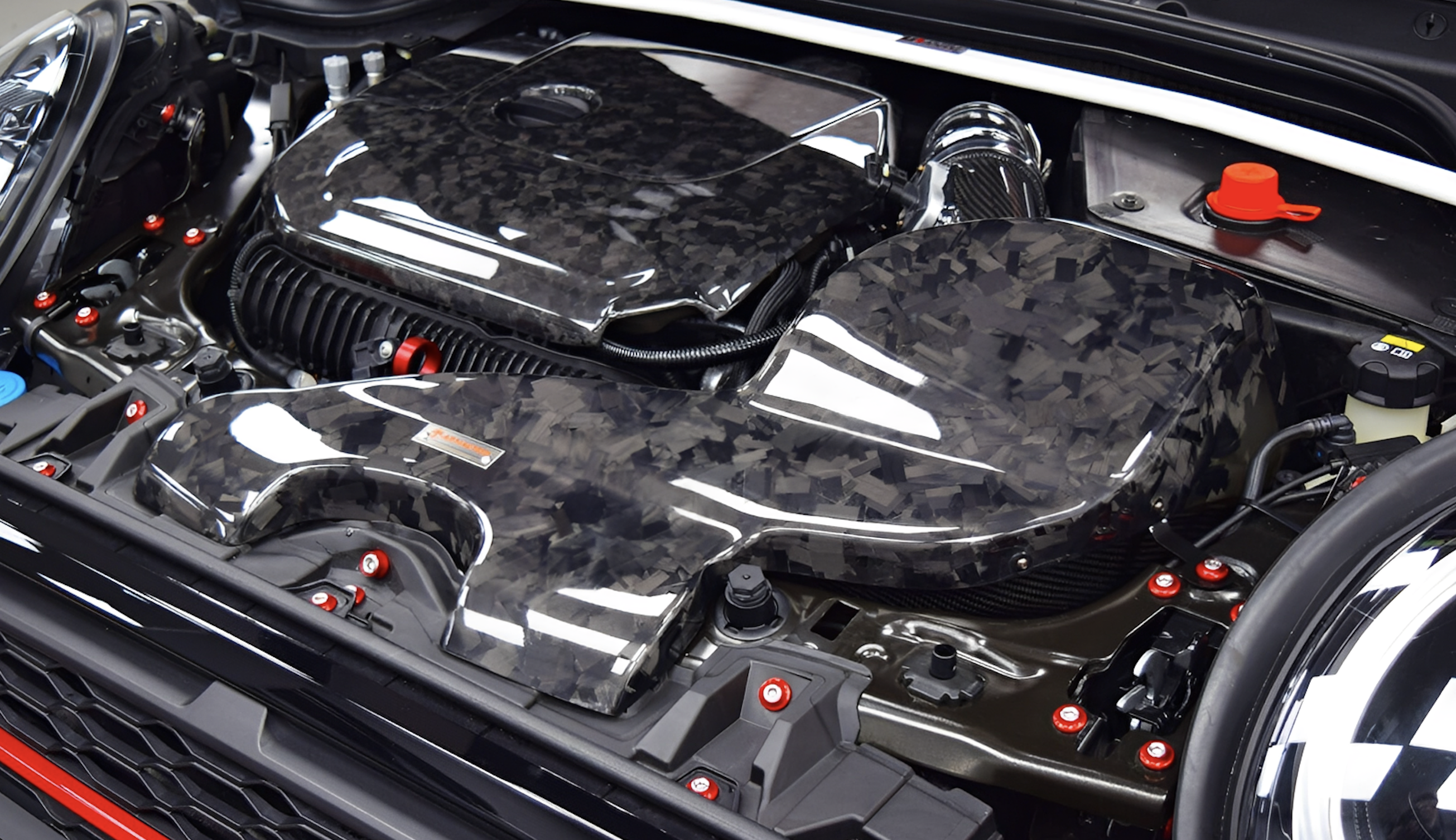
Steel hoods are engineering compromises. They’ve always been. The material is cheap, easy to stamp, and forgiving of tooling imprecision. But every serious build pays for that in lap times and heat problems.
A forged carbon fiber engine cover fixes both at once.
The Weight Numbers, Unfiltered
A typical OEM steel or aluminum hood runs 25–35 lbs. A forged carbon fiber replacement drops that to 10–15 lbs. That’s a 47–60% reduction from a single bolt-on component.
The density gap tells the story. Forged carbon fiber sits at 1.5 g/cm³. Aluminum sits at 2.73 g/cm³ — close to twice as dense. Scale that across a full engine bay cover and the weight savings stop being cosmetic. They become structural.
Here’s what that looks like on a tested component:
|
Material |
Weight (g) |
Flexural Yield (kg) |
Tensile Yield (MPa) |
|---|---|---|---|
|
Aluminum |
46.7 |
120 |
304 |
|
Forged Carbon Fiber |
24.7 |
220 |
192 |
|
Optimized FCF |
25.2 |
268 |
875 |
Lighter. Stiffer. Stronger under flex load. That combination is rare in material science. Forged carbon fiber delivers all three at once.
Dropping 15–25 lbs of front axle unsprung mass from a hood swap translates to 20–30 kg total vehicle equivalent in dynamic response. Steering gets sharper. Roll resistance improves. The chassis responds faster — up to 5–10% better in handling response metrics.
Why the Thermal Behavior Is Different
Aluminum moves heat in one direction. High-output engines build directional hot zones under the hood — concentrated peaks that stress components, warp panels over time, and push heat back into the bay.
Forged carbon fiber works differently. The chopped tow matrix — with up to 50% unidirectional fiber built into the random-flow structure — spreads thermal energy in all directions. Heat fans out across the composite instead of running along a single path. Hot spots flatten out. Engine bay temperatures level off.
The optimized FCF structure puts out +30% flexural yield over aluminum — 203 kg vs 98 kg in direct testing — while keeping overall heat conductivity lower. That gap matters most during long track sessions, where underhood temperatures push hardest.
Built to OEM Tolerances
Compression-molded forged carbon fiber engine covers hold ±0.02mm precision tolerances. CNC tooling cuts each piece for gapless fitment on performance and supercar platforms. No shimming. No filler gaps. The panel sits flush because the mold demands it.
Production uses low tooling costs and generates minimal waste compared to prepreg or resin infusion methods. That efficiency shows up directly in pricing: $3,499, which runs 15–18% below comparable competitors. You get full material specification — nothing cut to hit the price.
Quality carries IATF 16949 (automotive) and AS9100 (aerospace) certification. That’s the same dual-standard framework used for critical components on production vehicles and active motorsport programs.
Forged Carbon Fiber Spoiler: Aerodynamic Downforce Without the Weight Penalty
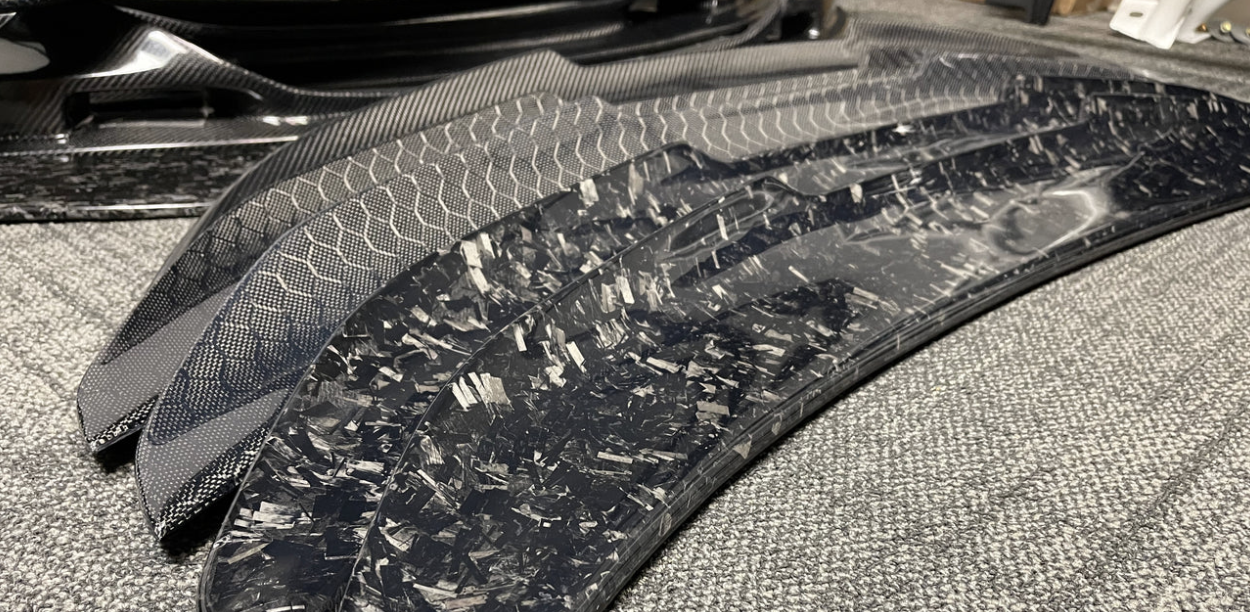
Downforce is a trade. You buy grip with drag. Every conventional spoiler design makes you pay that price — and the heavier the wing, the worse the terms.
Forged carbon fiber changes the math.
The impact strength alone tells you this isn’t conventional CFRP. FCF spoilers test at 85–130 kJ/m². That’s not a lab curiosity. That’s the kind of rigidity that holds shape under sustained high-speed load — without adding the mass that works against it.
The Downforce Numbers
The CFD data is clear. At a 0° angle of attack, a well-profiled forged carbon spoiler delivers a 112.7% increase in total downforce. Drag rises just 2.92%. That’s an asymmetric trade. You get more than twice the rear grip for a fuel penalty that won’t show up in real-world driving.
Push the geometry harder — 45° to 60° during braking — and the numbers compound fast. At 55°, downforce climbs 430%. At that point, the aerodynamic force isn’t decorating the build. It’s working.
Real-world fitment backs up the CFD modeling. The ROUSH Active Carbon Fiber Spoiler puts out 3x more downforce than standard at deployment. It runs two modes:
-
Sport: Raises above 55 mph, retracts below 52 mph
-
Track: Raises above 70 mph, retracts below 30 mph
On the BMW M4, FCF spoilers give you rock-solid cornering rigidity at speed. No weight penalty dragging down steering response. On the Tesla Model Y ducktail, the same forged composite shape cuts air resistance on straights while building meaningful rear traction through fast corners.
Why the Material Enables the Design
Woven carbon fiber spoilers need flat, predictable geometries. Complex curves break down layup integrity. Forged composite has no such limit. The chopped-tow matrix fills compound curves, undercuts, and integrated mounting profiles — all in a single compression mold cycle.
Optimal geometry — 10 cm height, 0° profile for minimal drag, 45–60° braking angle for maximum grip — builds into one piece. No bonded assemblies. No structural weak points at joins.
The aerodynamic freedom and the structural numbers come as a package.
Forged Carbon Fiber Heat Shield: Managing Extreme Temperatures in the Engine Bay
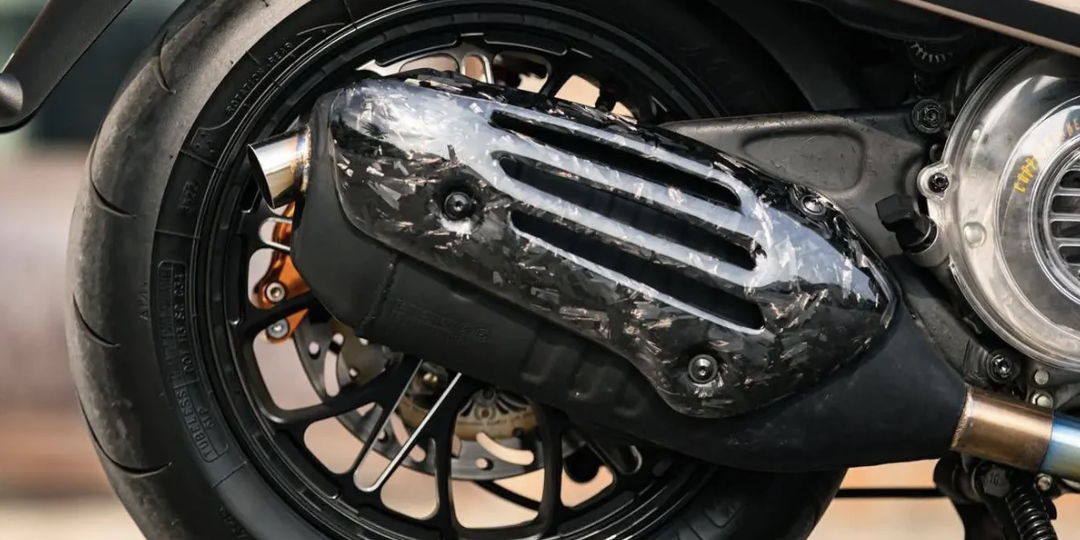
Engine bays are brutal places. Turbo housings glow red. Exhaust manifolds blast heat in every direction. Sensors, wiring harnesses, fuel lines, and coil packs sit inches away from surfaces that hit 600°F and beyond — in high-output builds, that number climbs even faster.
Real installation data makes this clear. ZircoFlex® FORM shielding — a ceramic-coated stainless core rated to 900°C — delivered a 72% temperature drop protecting coil packs in tight engine bays near manifolds. That’s a drop from 261°C down to 73°C. On a boosted platform with limited space, that gap separates a working ignition system from a melted one.
Forged carbon fiber heat shields tackle this problem with a completely different structure than stainless or aluminum options.
Why This Material Handles Heat Better
The chopped carbon fiber composite matrix has no fixed direction. Heat energy doesn’t build up along one fiber path the way it does in woven CFRP layups. Instead, it spreads across the matrix. That spreads the radiant and convective load before it ever touches sensitive parts.
That matters most in builds where heat is the hardest to control:
-
Ferrari 488 GTB/Pista/F8 (2015–2023): Autoclave dry carbon engine bay panels protect critical components in one of the hottest mid-engine layouts in production.
-
BMW M3 G80/G81 / M4 G82/G83: Full forged carbon engine bay cover kits handle high-vibration, high-heat turbo setups where aluminum shields warp and sensors drift out of calibration.
-
2021+ Subaru BRZ: Pyrotech carbon fiber exhaust heat shields — sold as direct-fit pairs — keep sensors and wiring safe from exhaust heat without adding meaningful weight.
The goal stays the same across every platform: keep heat away from parts that fail under it.
What You’re Protecting
A forged carbon fiber heat shield isn’t just one thing. It covers everything near the exhaust and turbo circuit — ECU housings, sensor harnesses, fuel lines, and ignition components. All of these fail under sustained heat. All of them push past their rated limits faster than you’d expect.
Compression-molded forged composite shields hold ±0.02mm tolerances — the same spec as engine covers. They sit flush against factory mounting points. No gaps. No heat sneaking through.
You get a lightweight engine bay shielding system that stops heat damage at the source — before anything gets cooked.
Compatible Performance Vehicles & 2026 Fitment Guide
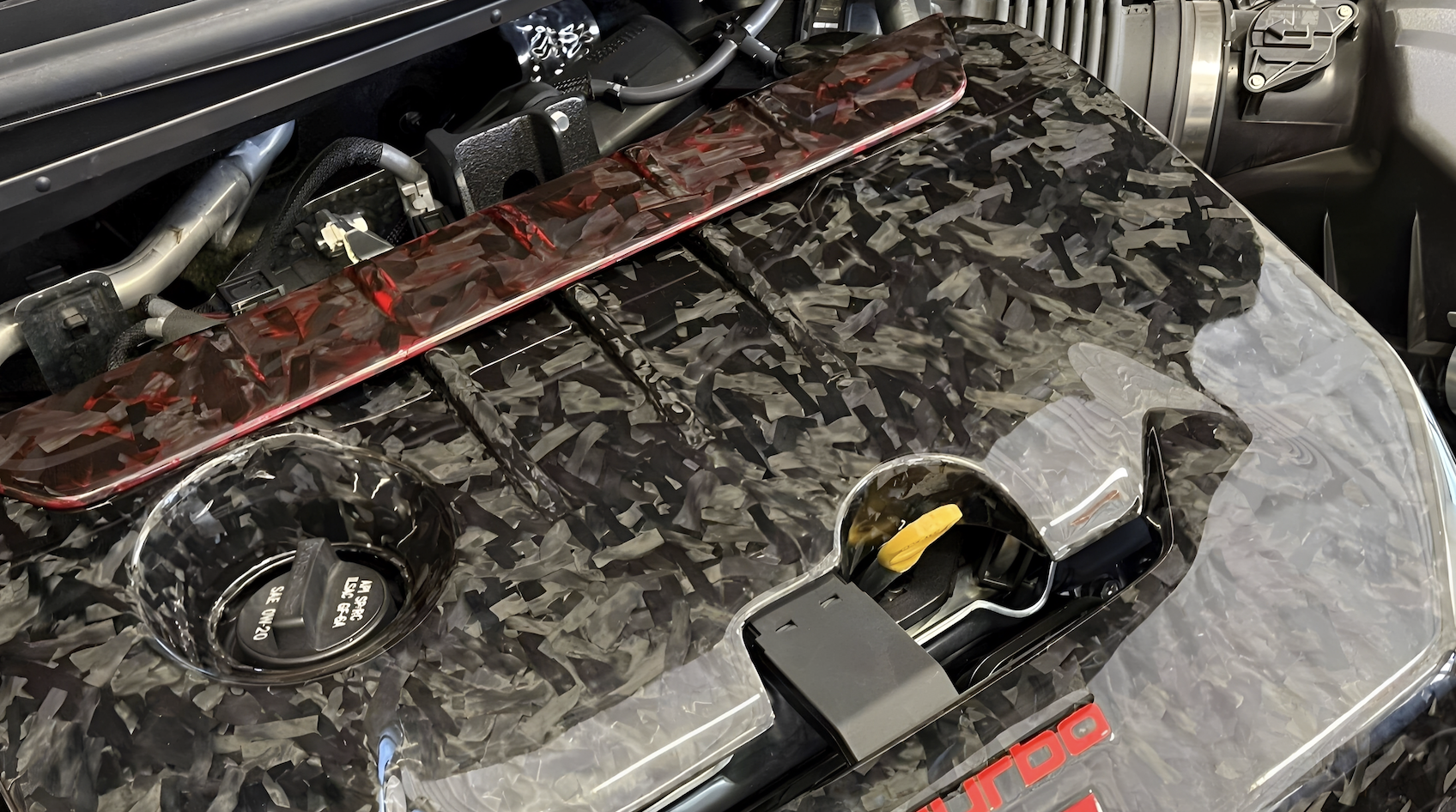
Fitment is where specs get real. A material can test well in a lab and fall apart on an actual platform — wrong mounting geometry, wrong thermal clearance, wrong panel depth. Forged carbon fiber engine covers, spoilers, and heat shields skip that problem. The compression mold is built to the chassis, not guessed at.
The 2026 lineup shows how far that engineering has reached.
Platform Coverage Across Performance Segments
European Supercar Platforms
Ferrari 488 GTB, Pista, and F8 Tributo owners running mid-engine turbo setups already know the heat problem. Autoclave dry carbon engine bay panels built to these chassis specs hold thermal loads in check. These underhood spaces are among the tightest in any production car. BMW M3 G80/G81 and M4 G82/G83 platforms take full forged carbon engine bay cover kits. The ±0.02mm compression-molded tolerances stay solid under high-vibration turbo cycling. Aluminum alternatives warp over a full season. These don’t.
American Muscle
The 2026 Ford Mustang Dark Horse SC packs a supercharged 5.2L V-8, around 800 hp, and a factory aero package. That combination puts serious thermal and structural stress on every underhood component. Forged composite handles that load better than anything else at this output level. Boosted power at 800 hp turns the engine bay into a constant heat event. A forged carbon fiber engine cover on this platform isn’t about looks. It’s active thermal management.
Performance Daily Drivers
Subaru WRX and Toyota GR Corolla fitments keep all OEM hardware. Install is direct. No drilling, no shimming, no changes to mounting points.
2026 Fitment Verification
Confirm three things before you order:
-
Hood pin spacing matches the mold spec for your chassis generation
-
Spoiler mounting channel depth lines up with trunk lip thickness
-
Heat shield clearance from exhaust primaries meets the manufacturer’s minimum gap rating
Compression-molded parts hold tight tolerances. Your mounting surface needs to meet them.
FAQ: Forged Carbon Fiber Engine Cover, Spoiler & Heat Shield
Buyers ask the same questions. Here are the answers worth knowing before you place an order.
What temperature can a forged carbon fiber engine cover handle?
You get continuous exposure rated up to 200°C, backed by a 3-layer UV-resistant clear coat. Optimized variants push that peak to 250°C — no delamination, no structural failure. That range covers every turbocharged and supercharged production platform available today.
How much downforce does a forged carbon fiber spoiler add?
At 150 mph, you’re looking at a 15–25% increase over OEM plastic. The 220 kg flexural yield strength makes precise aerodynamic shaping possible. The material holds the geometry. The geometry produces the numbers.
Does it fit over OEM steel heat shields?
Direct bolt-on. OEM rubber grommets, existing mounting points, and strut tower brace clearance are all compatible. Nothing moves. Nothing relocates.
What’s the real-world weight difference?
47% reduction. Forged carbon sits at 24.7g per component. Aluminum sits at 46.7g. Same part. Half the mass.
What does the warranty cover?
Two years against delamination and fading. The UV clear coat holds its finish past five years with no yellowing. Misuse voids the warranty — everything else stays covered.
Can the cover be painted or customized?
The clear coat finish accepts paint. You can customize the forged pattern pre-cure. Four slots and tabs support a clean OEM ///M logo transfer with no extra steps.
What does installation involve?
1. Remove the OEM cover
2. Transfer the ///M logo using the four transfer tabs
3. Align the carbon mounting points with the existing OEM grommets
4. Secure with the included double-sided tape or your OEM hardware
No resin. No extra adhesives. No specialist tools needed.
How does forged carbon compare to aluminum on a technical level?
|
Property |
Forged Carbon Fiber |
Aluminum |
|---|---|---|
|
Density (g/cm³) |
1.5 |
2.73 |
|
Flexural Yield (kg) |
220 |
120 |
|
Tensile Yield (MPa) |
192 |
304 |
|
Component Weight (g) |
24.7 |
46.7 |
Lower density. Close to double the flex strength. That trade-off is what makes this upgrade worth doing.
How are heat shields packaged for international shipping?
Each unit ships inside double-walled foam inserts, packed in reinforced cardboard. The packaging is autoclave-cured and rated to 30 kg impact resistance. Orders over $199 ship free under the 5 kg threshold.
What are the size and thickness limits for spoilers and heat shields?
Wall thickness runs from 1–10mm. Maximum panel size is 500×500mm. Detail resolution holds above 0.5mm post-finish — precise enough for any functional surface geometry you need.
Conclusion
Three components. One material. Real performance gains — every time you push harder.
A forged carbon fiber engine cover cuts dead weight. It also keeps heat out of the engine bay, where it belongs. The spoiler redirects airflow into usable downforce. No mass penalty. No wasted effort. The forged carbon fiber heat shield holds up where aluminum starts to fail.
This isn’t about looks. Every gram dropped, every degree controlled, every pound of downforce added — it goes straight into how the car performs. That’s what matters on track.
You’ve read this far. You already know what your build is missing.
Contact HyperX Carbon – Your Trusted Chinese Carbon Fiber Partner
Ready to source high-performance carbon fiber materials or custom forged carbon fiber parts from China?
HyperX Carbon is a leading manufacturer with 20+ years of expertise, specializing in aerospace-grade forged carbon fiber, prepreg, tubes, sheets, and lightweight automotive/drone/medical components. We offer:
-
Stable supply chain with premium raw materials (Toray, Mitsubishi, Hengshen)
-
AS9100D certified production for aerospace & UAV applications
-
Rapid prototyping (5-8 weeks) and monthly capacity exceeding 180,000 parts
-
Competitive pricing with 15-18% cost savings on forged carbon solutions
-
Full customization: from T700/T1100G to ultra-high modulus grades
Whether you’re an eVTOL developer, automotive OEM, drone manufacturer, or medical device engineer, HyperX delivers consistent quality, batch-to-batch reliability, and reliable delivery.
Get in touch today for a free consultation, custom quote, or material sample.
📧 Email: [email protected]
🌐 Website: https://www.hyperxcarbon.com/
📞 Phone/WhatsApp: +86 15623270276 (English support available)
Let’s build your next lightweight innovation together – contact HyperX Carbon now and stay ahead in the low-altitude and advanced composites market.




