
Shaving 1.5 kilograms off each corner of your car sounds minor. But brake late into Turn 1, and the front end responds the way you meant it to. That difference is real.
That’s the core debate behind carbon fiber wheels vs. forged alloy. It’s not just grams on a scale. It’s what those grams do at 150 mph, with your suspension fighting to track broken pavement.
The performance wheel market in 2026 looks nothing like it did five years ago. The gap between these two materials — weight, stiffness, real-world durability, and price — is worth a hard, data-driven look. That’s what you’ll find here.
Carbon Fiber Wheels Vs Forged Alloy 2026
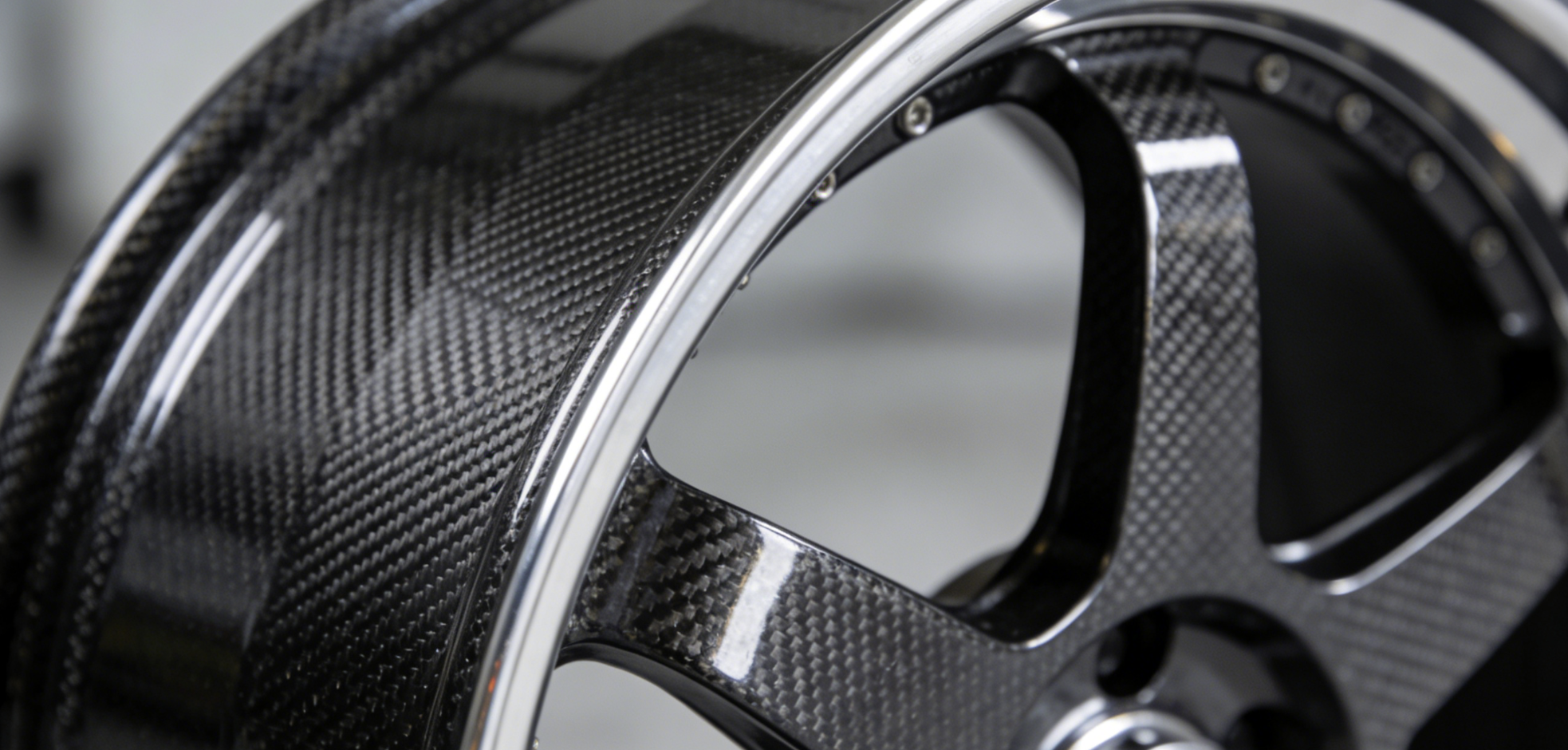
Two materials. Two philosophies. One decision that shapes how your car performs at the limit.
This guide brings you hard data, engineering insight, and real-world analysis. It covers everything that matters for a 2026 performance wheel upgrade:
-
Weight & unsprung mass reduction — actual figures, not marketing claims
-
Stiffness, rotational inertia, and what they mean at speed
-
Strength vs. brittleness — where each material wins and where it fails
-
Cost comparison — from forged aluminum’s $1,500–$3,000 range to carbon fiber’s $20,000 benchmark
-
Track vs. street suitability — matched to how you drive, not how you plan to drive
-
Maintenance realities — repairability, inspection cycles, and long-term value
Chasing lap times? Building the sharpest road car on your block? The right wheel material isn’t a clear-cut answer. The data, though, makes it a lot easier to decide.
What Are Carbon Fiber Wheels and Forged Alloy Wheels? (Material Science & Manufacturing)
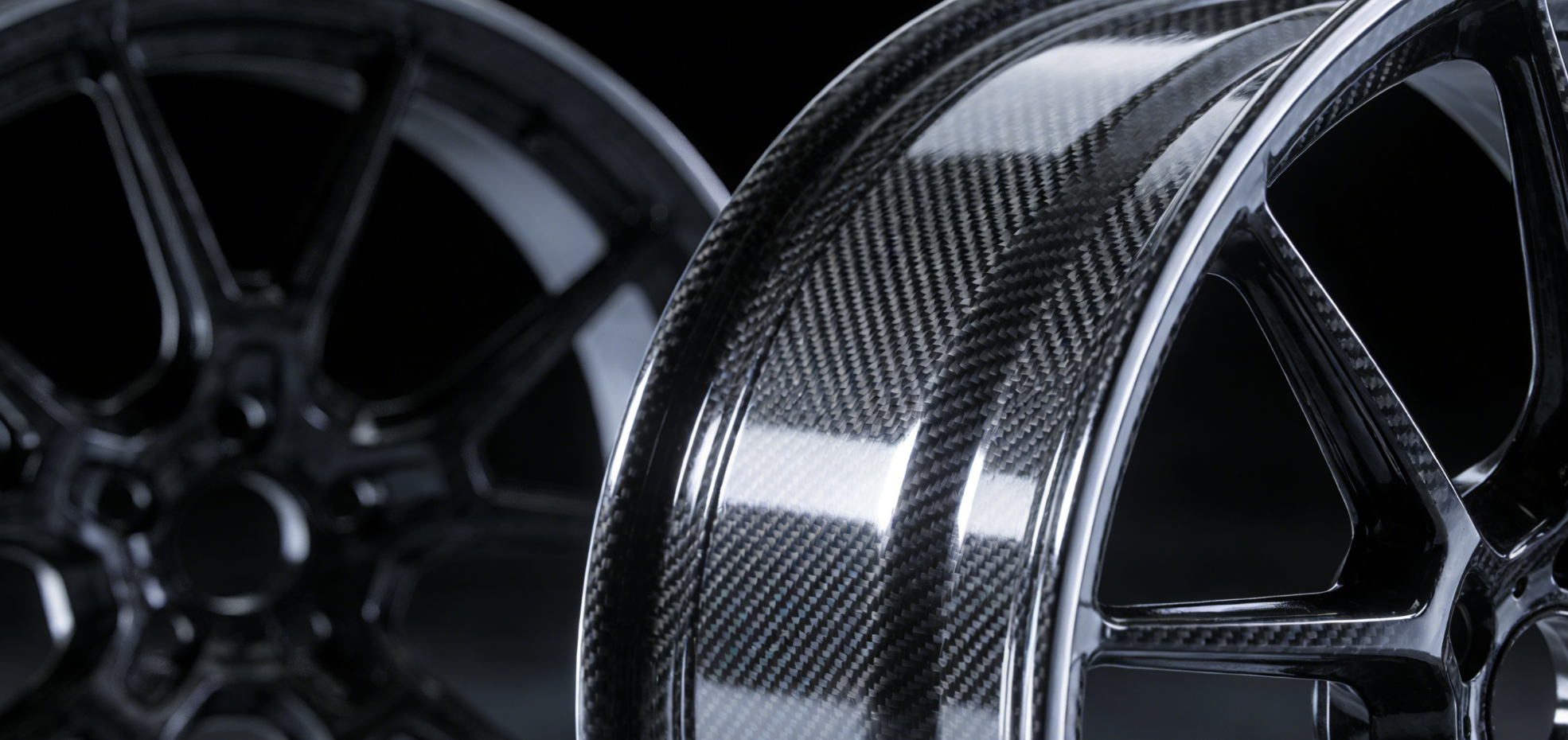
Every wheel starts as one of two things: a spool of woven fiber or a chunk of aluminum billet. That starting point shapes how the wheel handles stress, heat, and impact on the road.
Carbon Fiber Wheels: Built in Layers, Cured Under Pressure
Carbon fiber wheels start with woven carbon strands soaked in resin. Manufacturers stack those layers in exact orientations — each ply sits at a specific angle to handle a defined load pattern. Then they seal the whole thing into molds and cure it inside an autoclave using controlled heat and pressure.
That layering direction is deliberate. Engineers angle each fiber layer to handle tensile stress, fatigue cycles, and lateral cornering loads — all at once. You get a wheel with an outstanding stiffness-to-weight ratio. It stays rigid where it needs to be, without adding mass where it doesn’t.
There’s another advantage worth knowing: carbon fiber’s low thermal conductivity. It blocks brake heat from moving into the tire. During long track sessions, that matters a lot. Heat builds lap after lap, and less transfer means less tire degradation over time.
Forged Alloy Wheels: Pressure-Shaped Grain Structure
Forged aluminum takes a different path. Manufacturers press a heated billet under 2,000 to 10,000 tons of hydraulic pressure. That force compresses the internal grain structure into a denser, more uniform material with almost no porosity. Many producers then apply flow-forming — a rotational stretching step that adjusts wall thickness in targeted zones, trimming material where stress is low and adding it where stress is high.
The result is a wheel with strong ductility and impact resistance. It bends before it breaks. Hit a pothole with enough force, and a forged aluminum wheel deforms rather than shatters. That’s a practical advantage — you can often repair a bent alloy wheel. A cracked carbon fiber wheel is a different story.
How the Materials Stack Up
|
Property |
Carbon Fiber Wheels |
Forged Alloy Wheels |
|---|---|---|
|
Weight Savings |
40–50% vs. cast aluminum |
20–30% vs. cast aluminum |
|
Stiffness-to-Weight |
Superior |
Strong, but lower ratio |
|
Fatigue Resistance |
Excellent — built for endurance cycles |
Good, not optimized for extreme repetition |
|
Impact Resistance |
Brittle — cracks under sharp impact |
Ductile — absorbs energy, often repairable |
|
Thermal Conductivity |
Low — insulates brake heat from tires |
Higher — conducts heat more readily |
|
Price Range (set) |
$3,000–$5,000+ |
$1,500–$3,000 |
Both materials sit at the top of wheel engineering. They just reach that level from opposite directions. Carbon fiber goes after radical lightness and precision-built stiffness. Forged alloy goes after toughness and real-world durability. Which one fits depends on what you ask your wheels to do.
Carbon Fiber vs Forged Alloy: 2026 Weight Savings by the Numbers
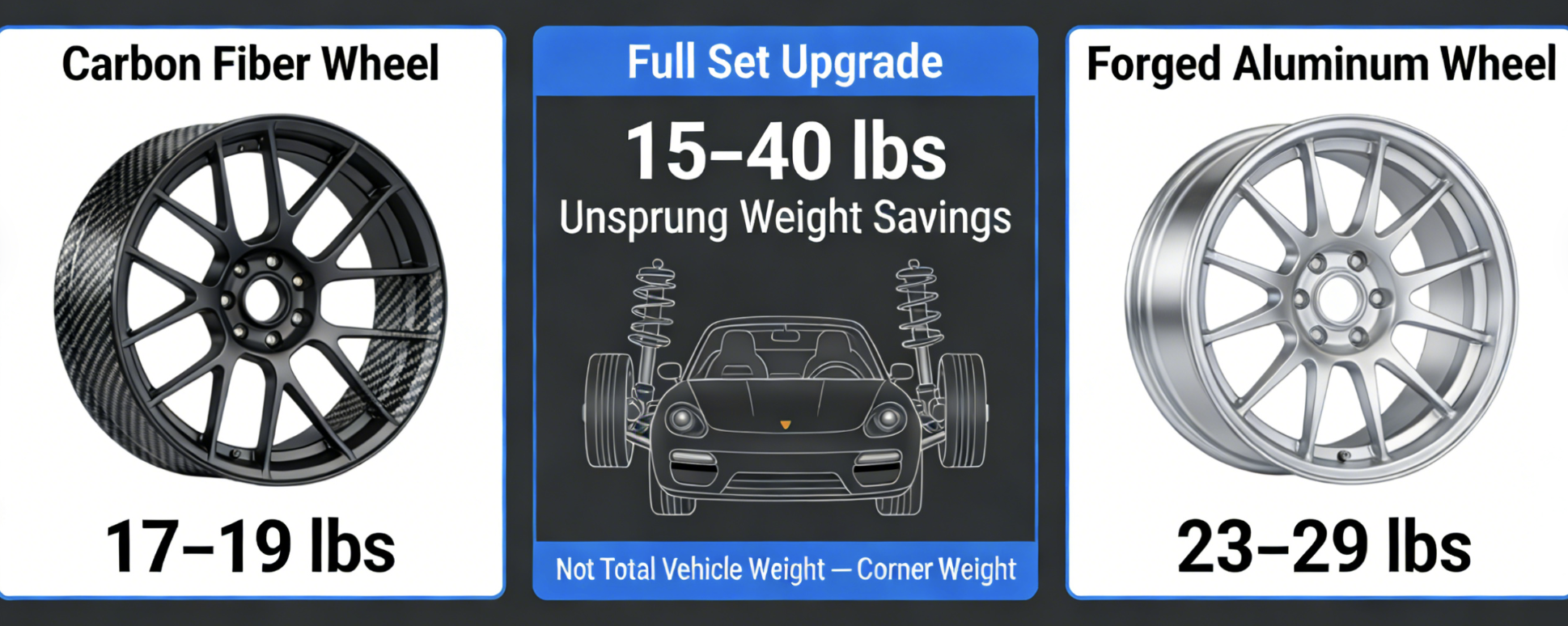
The numbers tell a story most marketing sheets won’t.
A carbon fiber wheel tips the scale at 17–19 lbs. A forged aluminum wheel — even a good one — runs 23–29 lbs. Upgrade a full set, and you’ve pulled 15–40 lbs of unsprung weight off your car. Not total vehicle weight. Corner weight. This is the weight that moves your suspension, loads your tires, and decides how fast your brakes can scrub speed.
That difference matters more than most people think.
The Real-World Stack-Up
Here’s what the weight gap looks like across materials:
|
Material |
Weight Per Wheel |
vs. Cast Aluminum |
|---|---|---|
|
Carbon Fiber |
17–19 lbs |
40–50% lighter |
|
Flow-Formed Forged Alloy |
~23 lbs |
~20–25% lighter |
|
Standard Forged Alloy |
~29 lbs |
Baseline forged |
|
Cast Aluminum |
26+ lbs |
Baseline |
The Ford Mustang Shelby GT350R puts this into real numbers. Ford’s carbon fiber wheels came in at 18 lbs each — 72 lbs for the set. The standard aluminum wheels? 29 lbs each, 116 lbs total. That’s a 44 lb reduction, all of it at the corners where it counts most.
Where Forged Magnesium Fits In
There’s a third material worth looking at: forged magnesium. At 15 lbs per wheel, it edges out carbon fiber by about 2 lbs. Magnesium is the lightest structural metal available. Its strength-to-weight ratio beats aluminum outright.
The catch is cost and complexity. Magnesium wheels need X-ray grain inspection and precision CNC machining. They also produce far more material waste than aluminum. A set runs around $12,500, compared to $20,000 for carbon fiber and $6,250 for quality forged aluminum. You pay for every gram you remove.
What Reduced Rotational Mass Does
Weight saved at the wheel is not the same as weight saved from the roof. Lighter wheel rotational mass takes less energy to spin up. It also creates less resistance under braking.
Here’s the simple version:
– Less rotational inertia means faster acceleration response
– Braking gets sharper
– Your suspension tracks surface changes more quickly
Harley-Davidson’s carbon fiber wheels — front at 13.2 lbs, rear at 18.7 lbs — came in 19% lighter than their own forged aluminum H-D Forged Alloys. BMW M Carbon motorcycle wheels show the same trend. The front dropped from a forged 2.8 kg to a carbon 2.3 kg, with matching reductions at the rear.
The pattern holds across the board. Carbon fiber wheels save 15–25% over equivalent forged aluminum in direct comparisons. The per-wheel number looks modest on its own. Multiply it across four corners, thousands of suspension cycles, and every braking zone — and the total impact is anything but modest.
How Unsprung Weight Reduction Transforms Real-World Performance
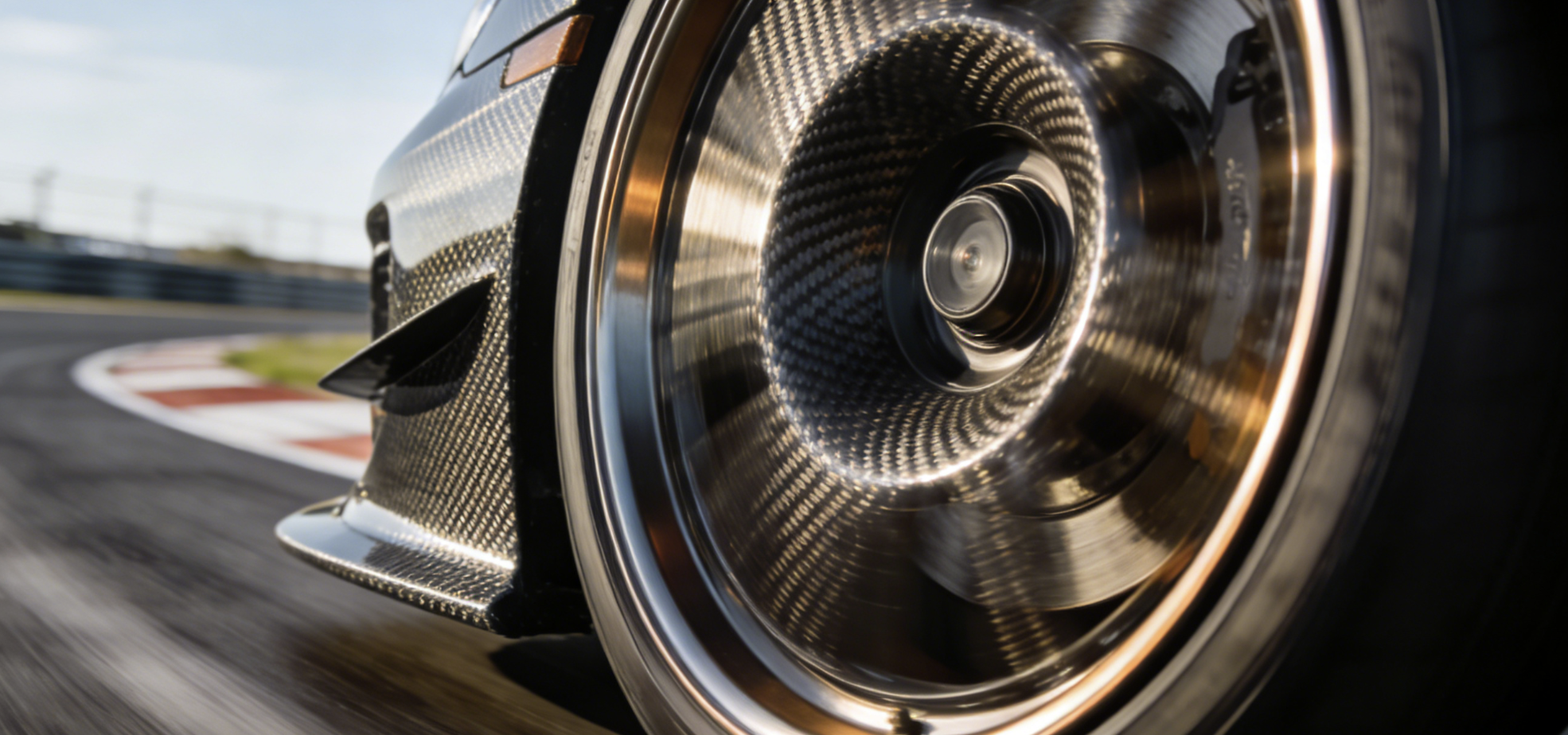
Physics doesn’t care about marketing copy. It cares about mass, momentum, and the milliseconds between your steering input and the tire’s response.
Here’s the number that changes how you think about wheel weight: 1 lb of unsprung mass equals 40–50 lbs of sprung weight at each corner. That’s not a rough estimate. That’s how suspension dynamics work. Unsprung mass — your wheels, brakes, everything sitting below the springs — resists rapid vertical movement. A heavier wheel fights the suspension instead of moving with it. The tire skips instead of tracks. The contact patch loses ground.
Lighten the wheel, and the suspension wins that fight faster.
The Acceleration and Braking Numbers
Rotational inertia doesn’t show up on a spec sheet, but it shows up on every stopwatch.
Cut 12 lbs per corner from wheel rotational mass, and the data moves in ways that are hard to dismiss:
-
0–60 mph improves by 0.29 seconds
-
Quarter-mile drops 0.11 seconds
-
Trap speed increases 1.12 mph
That’s not the result of pulling 48 lbs off the roof. That’s 48 lbs removed from four spinning corners. The impact is real and measurable. A standard aluminum wheel carries a moment of inertia of 53. A comparable steel wheel sits at 123. That’s 57% less power needed just to spin the wheel itself.
Braking tells the same story from the other direction. Add 10 lbs per wheel, and braking effectiveness drops by 1%. Take that weight away, and the reverse holds true. Cutting unsprung weight alone has shortened 60 mph stopping distances by 5–7 feet in controlled tests.
What It Does to Lap Times
On track, lighter unsprung weight adds up across every corner of every lap. Real-world testing shows 0.5 seconds per lap gained from wheel weight reduction alone. Slalom performance jumps by 2–3 mph with meaningful total unsprung cuts.
That’s the case for carbon fiber wheels, put straight: less rotational mass means your car accelerates harder, brakes shorter, and changes direction with more precision — every time you ask it to.
Track Performance vs Street Use: Which Wheel Material Wins Your Scenario?
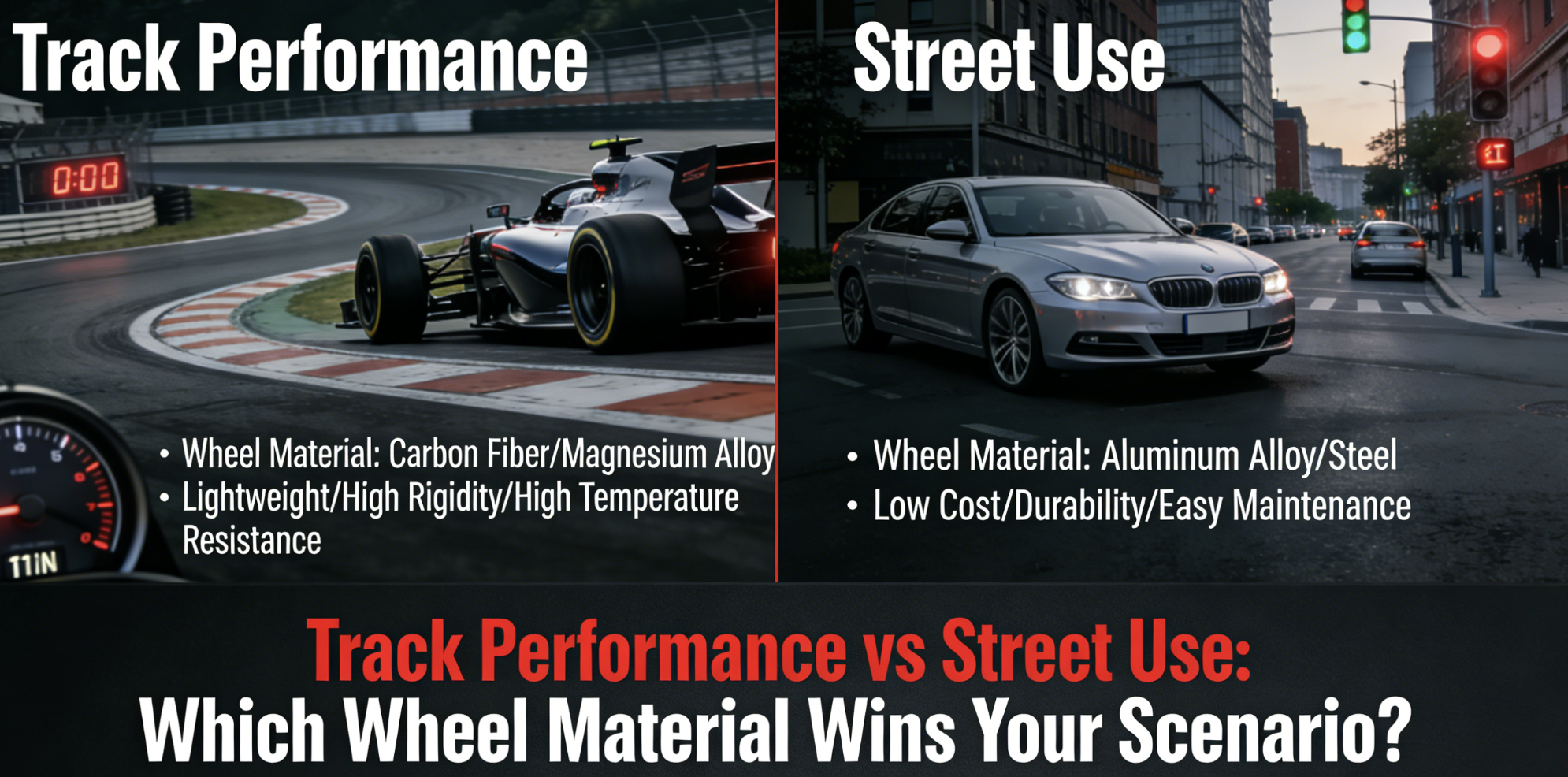
The track and the street ask very different questions of your wheels. No single material wins both.
Where you drive determines which material serves you best. Not which one looks best on paper.
On Track: The Case for Carbon Fiber and Forged Alloy
A track session is a stress test that repeats itself. Heavy braking creates heat cycles. High-speed corners push hard lateral loads. Curb strikes happen. Cast aluminum fails under these conditions — not in a dramatic way, but it fails often. It cracks. It distorts. It loses alignment under the kind of stress that flow-formed and forged construction absorbs without issue.
Carbon fiber wheels are the top pick for drivers chasing lap times. Less unsprung weight means faster direction changes, shorter braking zones, and sharper steering response. That edge builds across long sessions.
But here’s what the data shows: flow-formed forged aluminum delivers close to 90% of those performance benefits at about half the price. That’s not a weak compromise. For most track-day drivers — even serious ones — the gap between the two is mostly theoretical. Real-world testing with flow-formed wheels like the MR145 TrakLite confirmed real handling improvements. Reduced unsprung weight and strong heat resistance held up across multiple sessions. The wheels came in under the advertised 20.5 lbs.
For the track, the priority order looks like this:
-
Carbon fiber — for maximum lap time gains, professional competition, or drivers where price isn’t the concern
-
Flow-formed forged alloy — for regular track use where value and performance both matter
-
Forged alloy — worth the premium price for custom specs or extreme durability needs
-
Cast aluminum — not a good fit for repeated track sessions under load
Optimal track sizing runs 17×9 or 18×9.5, paired with 245–275 width tires. Smaller diameters hold mechanical grip and tire compliance where it counts most.
On the Street: Where the Priorities Shift
Street driving puts different demands on your wheels. Comfort, ride quality, and durability over unpredictable road surfaces matter far more than rotational inertia. That’s where carbon fiber’s case gets complicated.
Lightweight performance wheels feed more road noise and vibration back through the car than stock wheels do. One driver running 18″ TrakLites reported a harsher daily ride compared to the heavier factory wheels — not a dealbreaker, but a real trade-off. Carbon fiber makes that worse. Its stiffness is an asset at speed, but it becomes a liability over rough pavement.
For street use, flow-formed aluminum hits the sweet spot. It runs about 15% lighter than cast wheels, holds up stronger, and stays comfortable enough for daily miles. Cast aluminum still works fine for pure street duty, starting around $150 per wheel, without asking for any track-level sacrifices.
The scenario breakdown:
|
Scenario |
Best Material |
Why |
|---|---|---|
|
Regular track / performance driving |
Flow-formed or forged alloy |
Heat resistance, durability, value |
|
Professional competition / lap time focus |
Carbon fiber |
Maximum weight reduction, stiffness |
|
Daily street driving |
Flow-formed alloy or cast |
Ride quality, cost, repairability |
|
Mixed use (track days + street) |
Flow-formed forged alloy |
Best overall balance |
One more practical note: fitment matters as much as material choice. Caliper clearance, hub compatibility, and verified size specs can silently ruin an upgrade that looks perfect on paper. Check fitment against your actual brake setup before you commit.
The right wheel isn’t the lightest one available. It’s the lightest one that survives — and improves — the way you drive.
Carbon Fiber Wheel Strength & Durability: Debunking the Fragility Myth
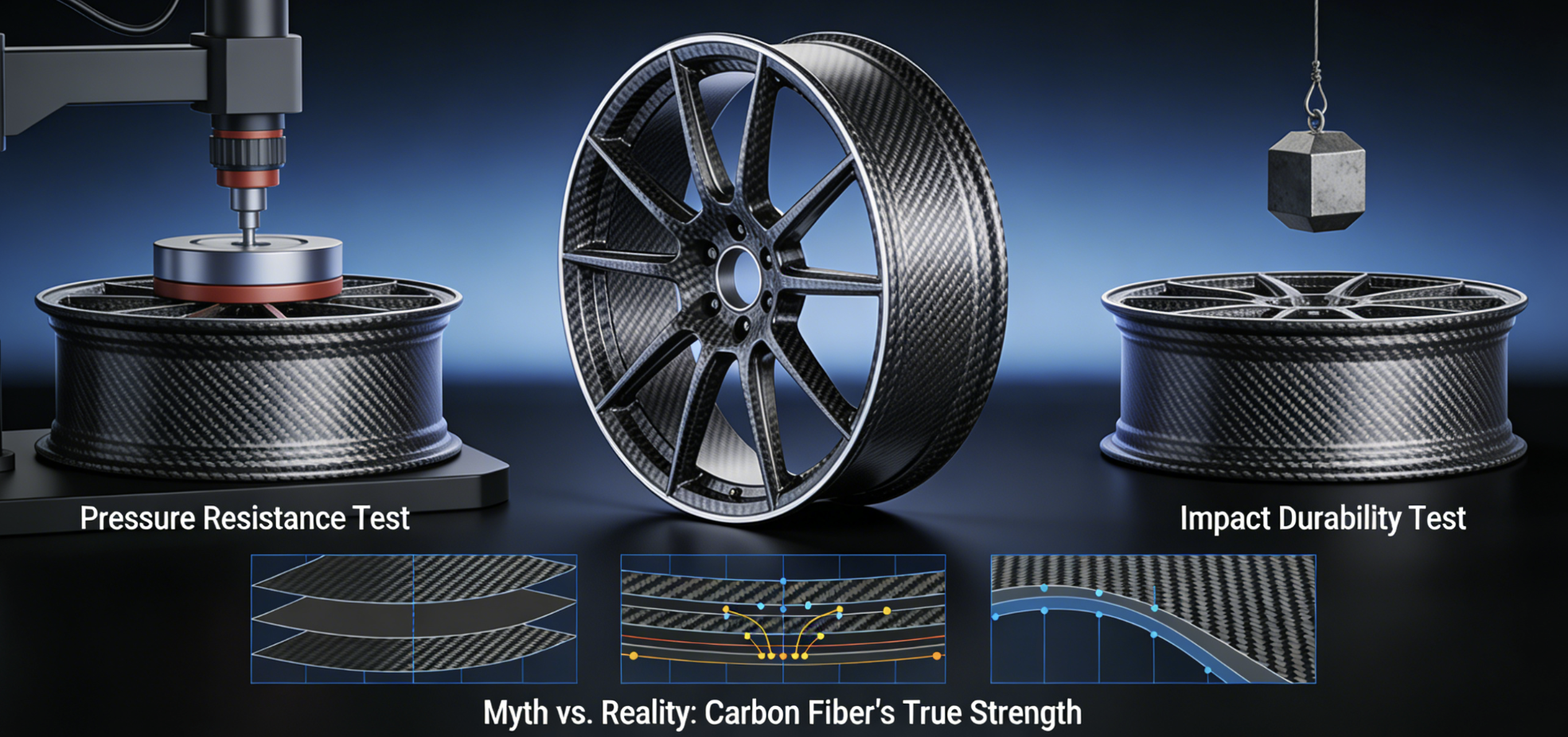
The fragility reputation is wrong. Not a little wrong — dead wrong.
Carbon fiber carries three times the tensile strength of aluminum. It doesn’t build up fatigue memory the way metals do. Stress cycles that slowly break down an aluminum wheel leave carbon fiber intact. A well-built carbon wheel doesn’t collect damage the same way. In theory, it holds up forever — as long as it never takes a hit hard enough to break the resin-fiber bond.
That bond is the real story. Carbon wheels don’t fail from general brittleness. They fail through delamination — a specific failure where impact pulls resin away from fiber. That’s a different problem than fragility. It’s a localized failure with a clear cause. Aluminum bends and you can straighten it. Carbon delaminates and needs replacement. Neither is “stronger.” They just fail in different ways.
Where the Stiffness Advantage Shows Up
Carbon Revolution’s CR-9 wheel proved something aluminum couldn’t match: zero tire blistering across extended track sessions. Comparable OEM aluminum wheels showed outer-edge blistering from flex under load. Stiffer wheels hold tire geometry closer to design intent. That consistency adds up — better wear, more predictable grip, faster laps.
Stiffness also changes how engineers set static camber. Carbon’s rigidity cuts the amount of correction needed at the wheel. You get sharper braking bite and stronger acceleration traction at the same time.
What Affects How Long They Last
Build quality drives durability more than material does. Manufacturing inconsistency — not built-in weakness — is why some carbon wheels fail early while others outlast aluminum by years. Under controlled conditions with proper maintenance, carbon fiber wheels last four to seven years of regular use. That ceiling climbs with consistent inspection and clean riding conditions.
The fragility myth sticks around because the failure mode looks dramatic. But dramatic doesn’t mean common.
Head-to-Head Comparison: Carbon Fiber Wheels vs Forged Alloy (Full Specification Table)

Eight dimensions. Two materials. The table below gives you the straight numbers.
|
Dimension |
Carbon Fiber Wheels |
Forged Alloy Wheels |
|---|---|---|
|
Weight |
40–50% lighter than cast alloy; 15–25% lighter than forged |
20–30% lighter than cast alloy |
|
Tensile Strength |
Superior — directional fiber layout built for track loads |
Excellent strength in all directions; handles bending and compression |
|
Impact Resistance |
Lower — cracks under sharp strikes, hard to repair |
High ductility — absorbs energy, bends before it breaks |
|
Repairability |
Limited to impossible for impact damage |
Minor curb rash and bends often fixable |
|
Heat Management |
Low thermal conductivity — keeps brake heat away from tires |
Higher conductivity — pushes more heat into the tire |
|
Design Flexibility |
Limited by mold shape and layup constraints |
High freedom — variable wall thickness, complex spoke profiles |
|
OEM Fitment |
Track and specialist use; rare in street OEM |
Standard across performance street and track OEM builds |
|
Price (set) |
~$20,000 benchmark |
~$6,250–$12,500 depending on spec |
What the Scores Say
Raw specs only go so far. Match the numbers to how you drive, and the picture gets clearer fast.
Each dimension was scored against race, street, and mixed-use profiles. Carbon fiber and forged alloy don’t perform the same across all three:
|
User Profile |
Carbon Fiber |
Forged Alloy |
Winner |
|---|---|---|---|
|
Race / Track |
90 / 100 |
82 / 100 |
Carbon Fiber |
|
Street Daily |
68 / 100 |
87 / 100 |
Forged Alloy |
|
Mixed Use |
79 / 100 |
85 / 100 |
Forged Alloy |
Carbon wins one profile. That profile also happens to be the one where winning costs the most.
The Numbers Most Buyers Miss
Two factors almost never show up in wheel reviews. Both affect what you’ll spend over time.
Insurance premiums. Carbon fiber wheels carry 20–50% higher rates in performance vehicle policies. High replacement value and repair complexity push insurers toward caution. Forged alloy stays at standard rates.
Resale value. Carbon fiber wheels drop 10–20% of retained value in the used market. Niche demand and buyer concern about hidden damage pull prices down. In pure racing circles, retention can hold near 80% after two years. Forged alloy holds steadier: 70–85% across a broader buyer pool.
Certification standards tell the same story from a different angle. Forged alloy clears TÜV, JWL, and VIA compliance through proven impact testing methods. Carbon fiber hits those standards through hybrid construction designs and longer fatigue cycle validation. Harder to certify. Harder to replace. Harder to insure.
The engineering gap is clear in the core numbers. Carbon fiber cuts rotational inertia 15–25% versus equivalent forged aluminum. It also reduces unsprung mass by 5–15 lbs per set. On top of that, directional fiber construction delivers higher lateral stiffness. Forged alloy closes that gap in every practical area that doesn’t involve a lap timer.
FAQ: Carbon Fiber Wheels vs Forged Alloy — Your Top Questions Answered
Buyers have questions. Good ones. Here are the answers that move the needle.
Can I run carbon fiber wheels on my daily driver?
Yes — on paper. In practice, not a good idea. Carbon fiber cracks on impact. Aluminum bends. Repairs on carbon are either very costly or not possible at all. For everyday road use — potholes, curbs, gravel — forged alloy takes the abuse without draining your wallet.
What’s the real weight difference between the two?
Carbon fiber cuts 15–25% over forged aluminum and 40–50% over cast aluminum. Swap a full set from forged to carbon, and you drop 5–15 lbs of unsprung weight from the car. That’s a meaningful gain. Forged magnesium is about 2 lbs lighter per wheel than carbon — but that opens a whole different price conversation.
Which material is stronger?
It depends on the stress type. Carbon fiber leads in tensile strength and fatigue resistance. Forged aluminum wins on impact resistance. It absorbs energy and bends rather than shatters. On the street, that ability to flex under impact matters more than tensile ratings on a spec sheet.
Why do carbon fiber wheels cost so much?
The process drives the price. Autoclave curing, compression molding, precision machining, labor-intensive layup — none of it comes cheap. A full set runs around $20,000. Forged aluminum lands at $6,250–$12,500. The cost gap is real, and the reason behind it is just as real.
Are forged aluminum wheels enough for a performance build?
For most drivers — including serious track enthusiasts — yes, without question. Forged alloy gives you the stiffness, heat resistance, and weight reduction that improve lap times. You skip the fragility risk. You also skip the five-figure replacement bill.
Conclusion
The data doesn’t lie. After looking at every key metric, the verdict is clear: carbon fiber wheels aren’t a luxury upgrade — they’re a performance multiplier.
Shaving 4–6 kg of unsprung weight per axle isn’t just a spec sheet number. You get faster steering response on entry. Braking stays composed under hard threshold loads. Your suspension can do its actual job — instead of fighting rotational inertia it was never built to handle.
Forged alloy is still a solid, proven choice. Nobody’s disputing that. But you’re reading this article for a reason — and “good enough” isn’t what you’re after.
The gap between what carbon fiber wheels cost and what they deliver is the smallest it’s ever been in 2026.
Contact HyperX Carbon – Your Trusted Chinese Carbon Fiber Partner
Ready to source high-performance carbon fiber materials or custom forged carbon fiber parts from China?
HyperX Carbon is a leading manufacturer with 20+ years of expertise, specializing in aerospace-grade forged carbon fiber, prepreg, carbon fiber tube, carbon fiber sheet, and lightweight carbon fiber automotive parts/carbon fiber drone components/carbon fiber medical components. We offer:
-
Stable supply chain with premium raw materials (Toray, Mitsubishi, Hengshen)
-
AS9100D certified production for aerospace & UAV applications
-
Rapid prototyping (5-8 weeks) and monthly capacity exceeding 180,000 parts
-
Competitive pricing with 15-18% cost savings on forged carbon solutions
-
Full customization: from T700/T1100G to ultra-high modulus grades
Whether you’re an eVTOL developer, automotive OEM, drone manufacturer, or medical device engineer, HyperX delivers consistent quality, batch-to-batch reliability, and reliable delivery.
Get in touch today for a free consultation, custom quote, or material sample.
📧 Email: [email protected]
🌐 Website: https://www.hyperxcarbon.com/
📞 Phone/WhatsApp: +86 15623270276 (English support available)
Let’s build your next lightweight innovation together – contact HyperX Carbon now and stay ahead in the low-altitude and advanced composites market.




