
Swapping your factory hood for a carbon fiber hood is one of the biggest upgrades you can make to a 350Z, 370Z, G35, or G37. You cut real weight up front. The car’s whole presence changes too.
But there’s a real problem. The market is packed with options — from show-quality dry carbon to cheap knock-offs that warp within six months. Pick the wrong one and you’re out serious money with a fitment headache to match.
That’s why this guide exists. We ranked the best carbon fiber hood replacements for 2026 by build quality, weight reduction, style, and real-world value. So you can skip the guesswork and shop with confidence.
2026 Best Carbon Fiber Hood for Nissan 350Z / 370Z / G35 / G37
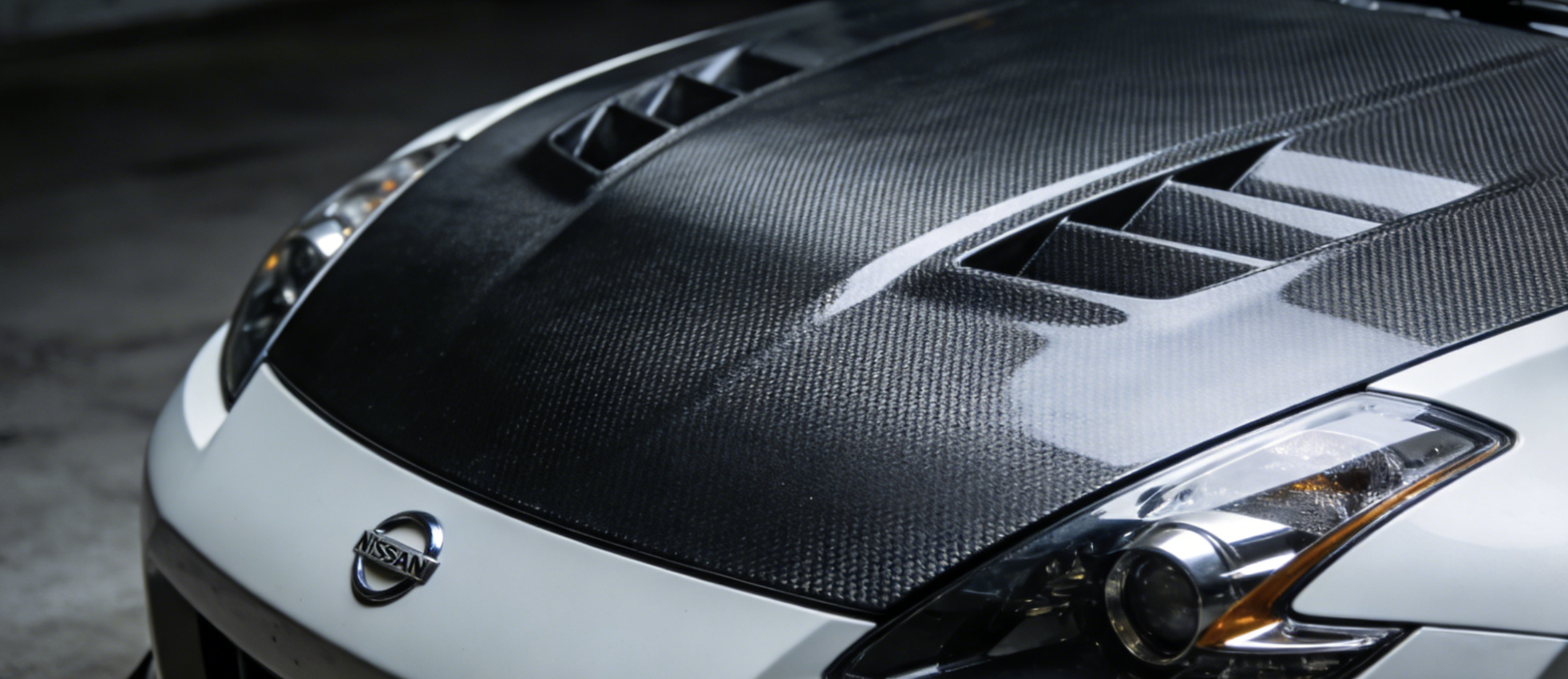
Here’s what most buying guides skip: not all carbon fiber is created equal — and the gap between a $400 hood and a $1,000+ hood has nothing to do with branding.
It comes down to manufacturing science.
What Separates a Great Hood from a Cheap One
The numbers say it all. A standard OEM steel hood weighs 45–50 lbs. A quality vacuum-infused carbon fiber hood brings that down to 20–22 lbs. Go with autoclave prepreg construction — the same process used in motorsport — and you’re at 18–20 lbs with tensile strength reaching 800–900 MPa. That’s close to triple the strength of factory steel at less than half the weight.
Three variables decide whether a carbon fiber hood is worth your money:
-
Ply count — A 4-layer 3K twill layup hits the sweet spot at 18–19 lbs with 650–700 MPa tensile strength. Drop below that and you lose rigidity. Go higher and you’re adding weight back for no real gain.
-
Resin content — The target range is 38–42% resin by weight. That window delivers peak tensile strength (800–880 MPa) and the best impact resistance. Push past it and the numbers drop — not climb.
-
Weave pattern — 2×2 twill is the top choice for 350Z and 370Z owners. It balances structural strength with that clean woven look. Spread tow weaves look aggressive and cut more weight, but you’ll pay a lot more for them.
The Manufacturing Process Matters More Than the Price Tag
Most budget hoods use compression molding. It’s faster to produce, but void content runs higher and tensile strength caps out around 600–700 MPa. Mid-tier options step up to vacuum infusion. The top-tier hoods — built for serious track use — use autoclave prepreg. That process produces close to zero void content and delivers consistent fiber saturation across every panel.
Take the 370Z (Z34) as an example. Brands like Seibon offer multiple validated styles — OEM, GT, BD, GTR, TS, and VSII — all built on 3K 2×2 twill with a gloss finish and a fiberglass skeleton underside. You reuse OEM hardware, skip any drilling, and get confirmed fitment for 2009–2020 370Z and 2023–2025 Nissan Z Sport/Performance trims.
One thing to sort out before you buy: lighter hoods will not support factory struts. Pick up a set of hood pins — they’re the right call here. Also, run a heat shield if your setup includes a performance exhaust or a modified engine bay.
🏆 #1 Seibon TS Carbon Fiber Hood — Best Overall for Nissan 350Z (2003–2008)
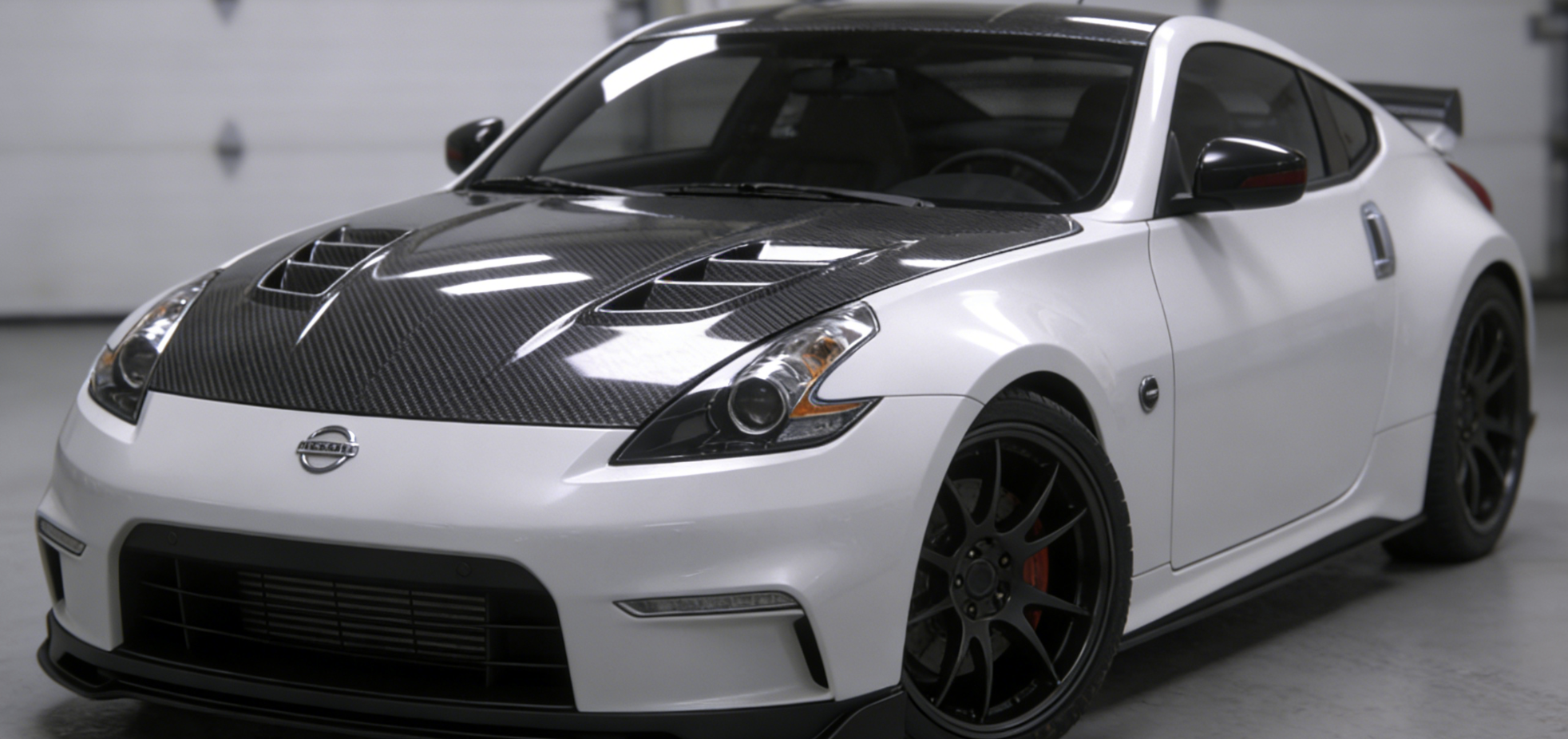
Seibon has been hand-crafting carbon fiber body panels for over 20 years. That experience shows in every detail of the TS hood — and it’s the reason this piece earns the top spot on this list.
The TS-style design isn’t just visual. Those vents pull heat straight out of the engine bay. That matters the moment you push the car hard on a track day. This hood is built for drivers who use their cars, not just show them.
Fitment: Zero Guesswork for the Entire Z33 Lineup
The TS hood fits every 350Z trim — Base, Enthusiast, Grand Touring, Nismo, Touring, Track, 35th Anniversary, and Performance. It covers both the DE (2003–2006) and HR (2007–2008) engine generations. Both 2-door coupe and roadster bodies fit. One SKU covers the full Z33 chassis range. No compatibility headaches. No need to cross-reference engine bay differences between model years.
Installation is a direct bolt-on. You reuse your OEM hardware. No drilling, no modifications.
Build Quality That Justifies the Price
The hood uses 3K 2×2 twill weave carbon fiber — the same spec referenced throughout this guide. It pairs with an optimized carbon-to-resin ratio. The panel stays stiff without extra weight. The underside has a bonded fiberglass skeleton finished in matte black enamel. The topside comes in a show-ready gloss finish. No painting required.
Shipping weight is 35 lbs for the packaged unit. A factory steel hood runs 50–60 lbs. That’s a real weight drop — one that shifts the nose balance of the car in a noticeable way.
What You Need Before Installation
Three requirements — non-negotiable:
-
Hood pins — the lighter panel will not hold with OEM struts. This is a safety requirement, not optional.
-
Heat shield — required with the vented TS design, particularly on modified engine bays
-
No stock dampers — factory struts risk cracking the hood or stopping it from closing right
Price & Value
At $1,200–$1,500, the Seibon TS sits in premium territory. What you’re buying is 20+ years of quality control, multi-step inspection on every unit, confirmed fitment across the full 350Z range, and a track-proven vented design. Weight reduction, fitment, finish quality, real-world durability — this 350z carbon fiber hood delivers on all of it. Everything else on this list gets measured against it.
#2 Seibon GTR-Style Carbon Fiber Hood — Best Aggressive Style for Nissan 370Z
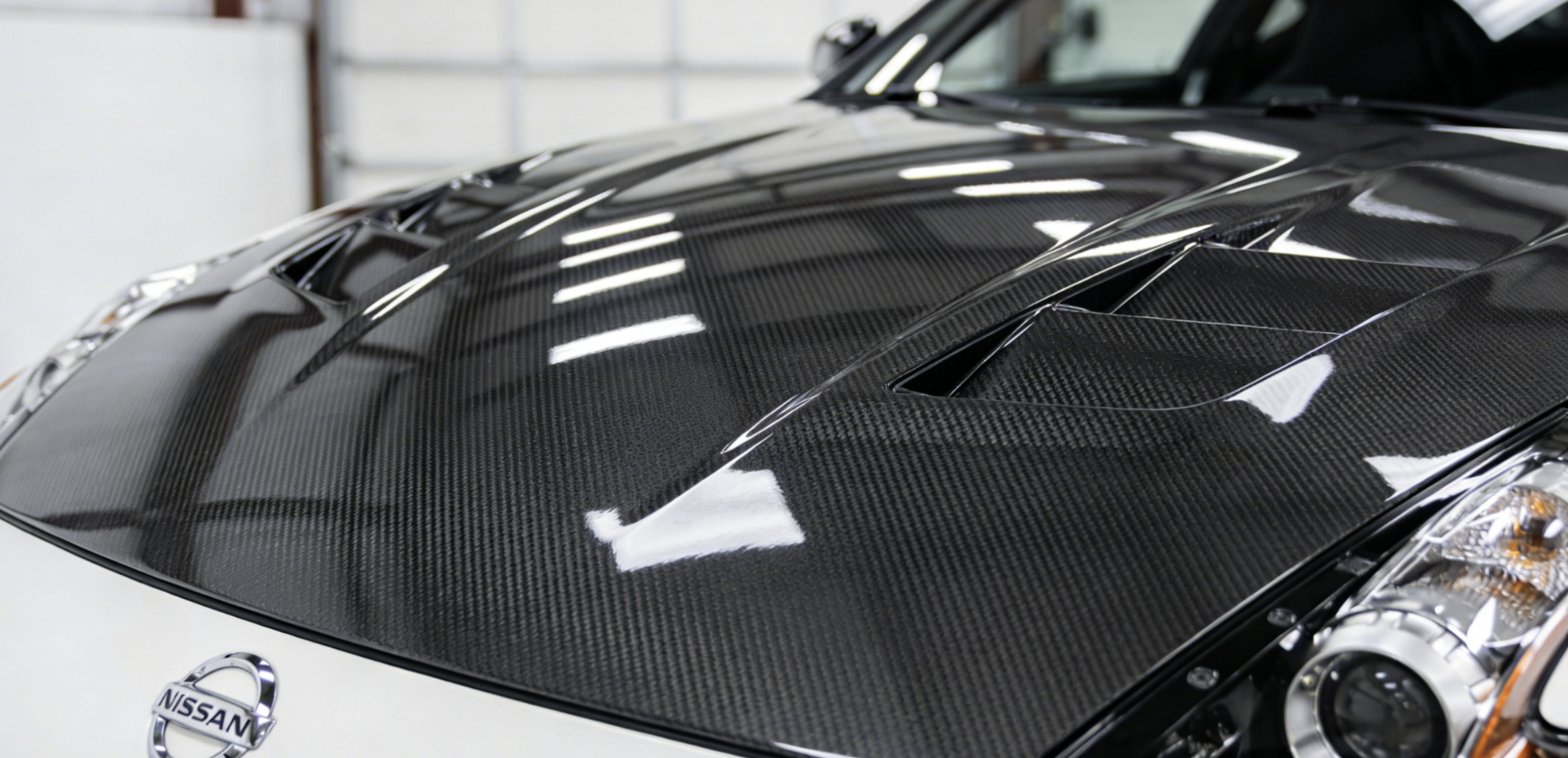
The GTR-style hood does what the OEM-style version can’t. It transforms the whole character of the 370Z the moment you shut the engine bay.
Those raised vents aren’t just for looks. They pull heat out of the engine bay during hard driving. That’s real function, not styling fluff. Plus, they give the Z34 a raw, aggressive presence that’s tough to beat at this price point. Building a 370Z that turns heads at the track and in the parking lot? This hood handles both without cutting corners.
What You’re Getting
The build follows the same 3K 2×2 twill weave standard as the TS hood — one-piece carbon fiber with a balanced carbon-to-resin ratio. You get high stiffness without extra bulk. The underside has a bonded fiberglass skeleton finished in matte black enamel. The topside comes in gloss clear coat with UV protection built in. No painting. No prep work. Mount it and drive.
Weight savings reach up to 50% lighter than your OEM steel hood. That’s a real difference at the front axle — you’ll feel it.
Fitment Covers the Full 370Z Run
Every 2009–2020 Nissan 370Z trim fits — Base, Sport, Touring, Nismo, coupe, liftback, and convertible. You reuse OEM mounting hardware. No drilling. No modification.
Two things you must do before installation: ditch the factory hood struts (they’ll crack the panel or block proper closure) and run hood pins. Seibon backs the clear coat with a 6-month limited warranty.
GTR-Style vs. OEM-Style — Which One’s Right for You?
|
Feature |
GTR-Style |
OEM-Style |
|---|---|---|
|
Visual Impact |
Aggressive, race-derived vents |
Clean, factory-match look |
|
Heat Venting |
Yes — active airflow |
None |
|
Weight Savings |
Up to 50% |
Lighter (varies) |
|
Fitment |
2009–2020 370Z |
2009–2020 370Z |
The GTR-style wins on presence. Want something subtle? The OEM replacement makes more sense. But for most 370Z carbon fiber hood buyers, the GTR vents are the upgrade they came here for.
#3 Seibon VSII Carbon Fiber Hood — Best Vented Option for Track-Focused 370Z Builds
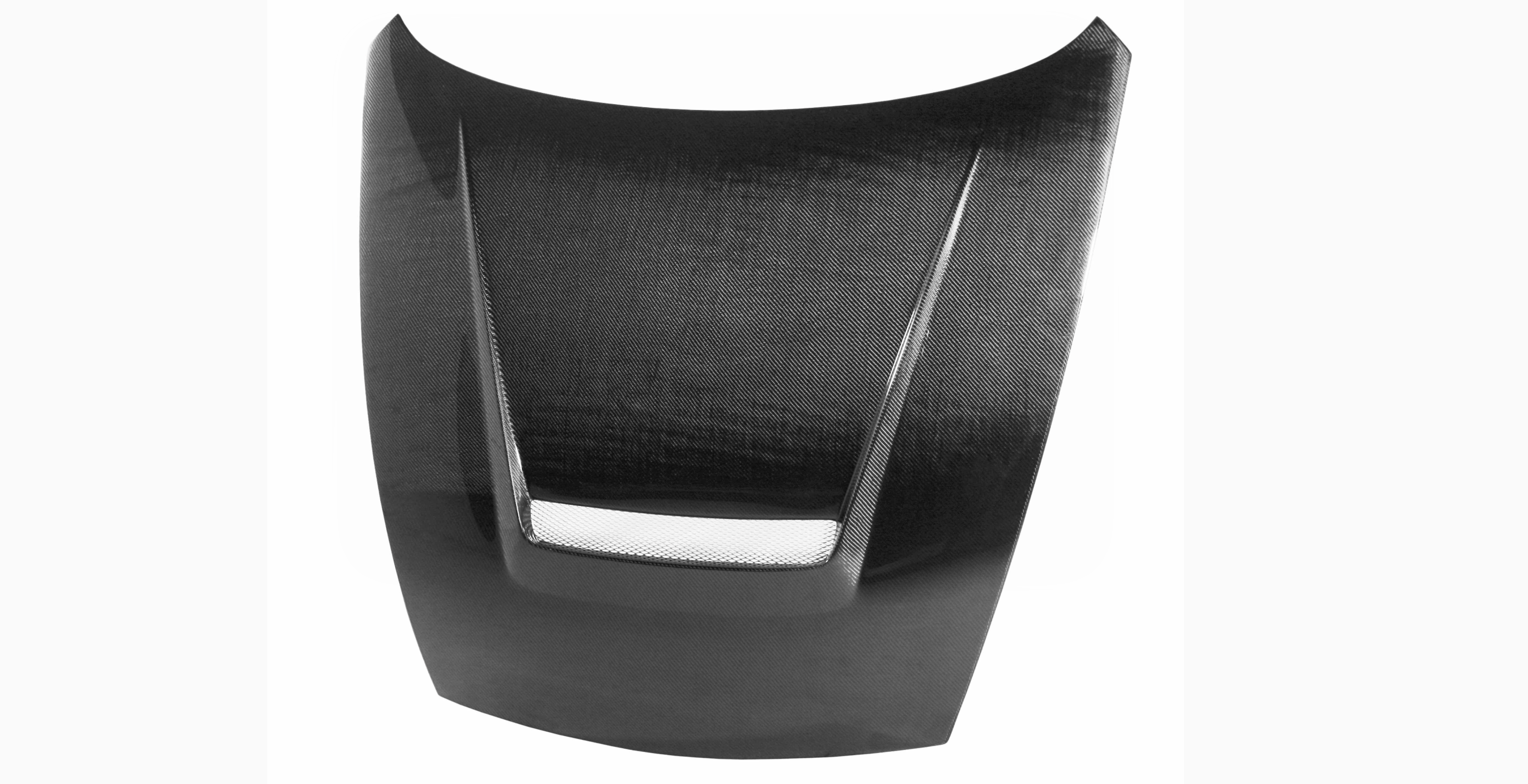
Track days expose every weakness in your build. Heat soaks the engine bay. Lap times suffer. The VSII is built to fix that.
The GTR-style hood uses raised dual vents to make a statement. The VSII goes a different route — one large, centered slot vent running across the hood. It’s a cleaner line. More surgical. That opening does one job: pulling trapped heat straight out of the engine bay while you push the Z34 hard through corners.
The Build Behind the Vent
The construction matches Seibon’s flagship pieces. 3K 2×2 twill weave carbon fiber, one-piece sheet construction. The carbon-to-resin ratio is dialed in to keep the panel stiff without adding extra bulk. Underneath, you get a bonded fiberglass skeleton finished in matte black enamel. Topside ships in gloss clear coat — show-ready straight out of the box. No prep, no painting needed.
Weight savings land at up to 50% lighter than your OEM steel hood. That’s real mass cut from the nose of the car, and you’ll feel it.
Fitment & Track Requirements
This hood fits the full 2009–2020 Nissan 370Z lineup — Base, Sport, Touring, Nismo, liftback, and convertible. OEM hardware bolts right back on. No drilling required.
Two track-specific rules apply before you head out:
-
Hood pins are mandatory — not a suggestion
-
Pull the factory struts out — the lighter panel can crack or close wrong if you leave them in
A heat shield is also required on modified engine bays.
Seibon backs the clear coat with a 6-month limited warranty.
#4 Seibon OEM-Style Carbon Fiber Hood — Best Sleeper Upgrade for 370Z / G37

Not every 370Z or G37 owner wants to announce their upgrades to the world. Some of the best builds are the ones nobody sees coming.
That’s what the Seibon OEM-style hood delivers. Factory lines. Zero visual giveaways. Up to 50% less weight than your steel hood — all without a single vent, scoop, or crease that screams “modified.” It’s a sleeper upgrade in the purest sense.
The Case for Going Non-Vented
Here’s something the vented-hood crowd won’t tell you: open vents are a liability on a street car.
Rain gets in. Dust builds up inside the channels. After every wet commute, you’re pulling debris out of vent cavities. The VSII and GTR-style hoods are purpose-built for track use — and they perform well there. But regular street miles make those vents a maintenance burden you didn’t ask for.
The OEM-style hood is sealed tight. Wipe it down and move on.
|
Feature |
OEM-Style |
Vented (TS/VSII/GTR) |
|---|---|---|
|
Rain Protection |
Sealed, no water entry |
Open vents allow water entry |
|
Daily Maintenance |
Minimal |
Vent cleaning required |
|
Best Use Case |
Street driving / street builds |
Track / heat extraction |
|
Weight Savings |
Up to 50% |
Up to 50% |
Build Quality & Fitment
The construction matches Seibon’s flagship pieces. You get 3K 2×2 twill weave carbon fiber, gloss clear coat on top, and a bonded fiberglass skeleton underneath finished in matte black enamel. No painting needed. No prep work. It ships show-ready straight out of the box.
Fitment covers the full 2009–2020 Nissan 370Z (Z34 chassis) — every trim, both liftback and convertible. Compatibility extends to the Infiniti G37 2-door coupe (V36 chassis) as well. The Z34 and V36 share identical hood geometry. One SKU covers both platforms without any fitment issues.
Weight savings land at 20–30 lbs over your factory steel hood. You’ll feel the difference in how the nose responds.
Before You Install
Four requirements — same rules as every carbon hood on this list:
-
Hood pins — mandatory, non-negotiable
-
Remove factory gas struts — stock pressure risks cracking the lighter panel
-
Heat shield — required on any modified engine bay
-
Professional installation recommended — OEM hardware transfers over, but proper alignment is critical to getting it right
Price & Who It’s For
At an estimated $1,500–$2,000, the OEM-style hood sits in the mid-premium range. You’re paying for Seibon’s build consistency, confirmed dual-platform fitment, and a sealed, weather-proof panel that cuts serious weight without touching the car’s visual identity.
Street-driven G37 or 370Z? Want the carbon fiber hood weight reduction without track-only tradeoffs? This is the one to get.
#5 ZetaComposites S-Style Vented Hood — Best Value Handmade Option for Nissan 350Z
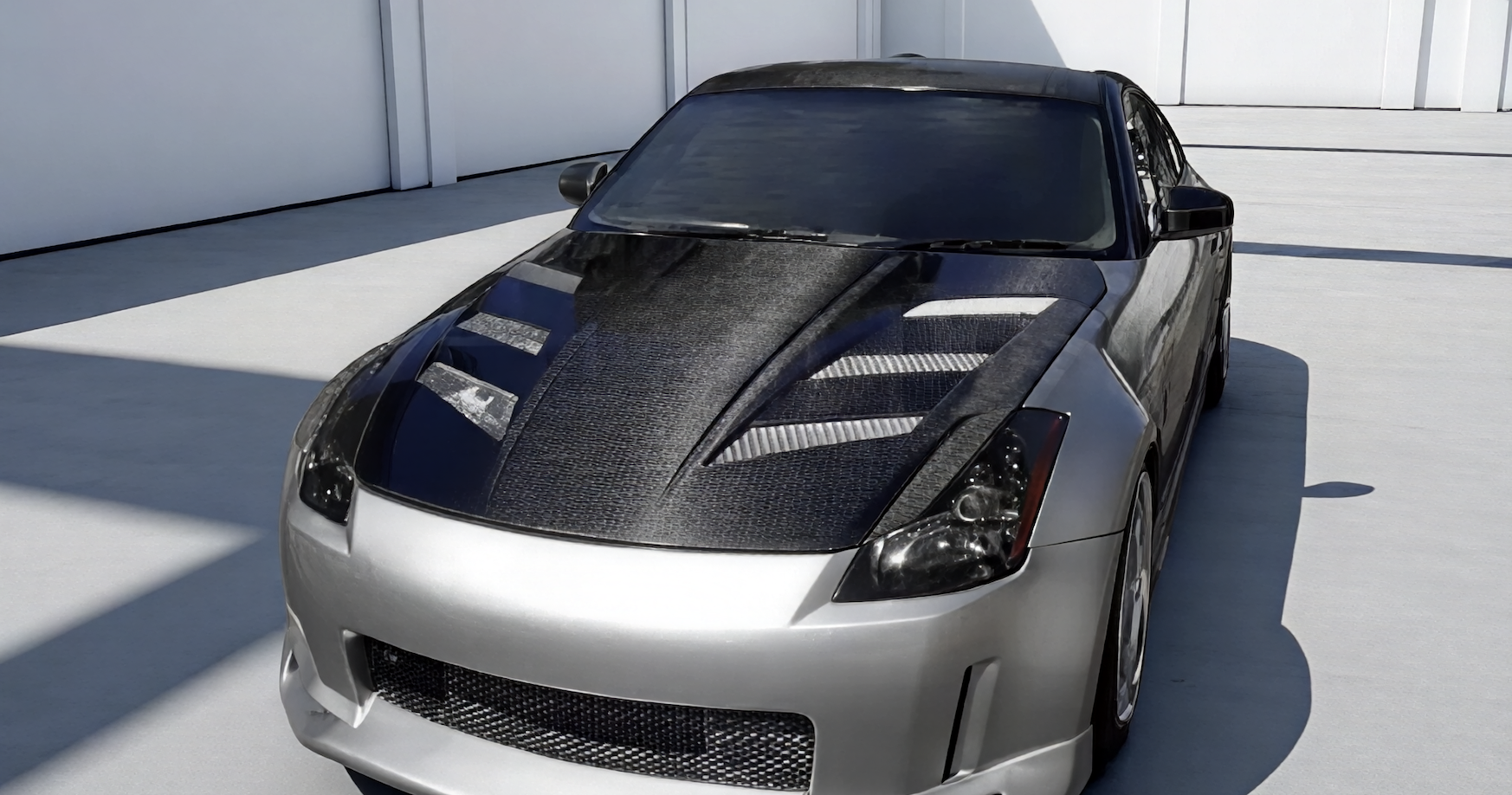
Every hood on this list came off a standardized production line. ZetaComposites does something different — each S-Style hood is handmade to your specs.
That matters if you want something built for your car. Not just bolted on because it fits.
What “Handmade” Means Here
ZetaComposites builds each hood one at a time. Real carbon fiber. Custom specs per order. You’re not grabbing a unit off a warehouse shelf — you’re getting a panel made to your exact requirements.
The trade-off? Brands like Seibon run standardized 3K 2×2 twill layups. They use documented resin ratios and multi-step inspection on every unit. Handmade production brings more variability. That’s the honest reality of going custom.
Fitment & Price
This hood fits the full Z33 chassis — Nissan 350Z (2003–2008, both DE and HR) and the Infiniti G35 Coupe. Both share the same hood geometry. One hood. Two platforms. No fitment headaches.
Price sits at $1,000–$1,400. That puts it in line with mass-produced carbon options — and well above FRP alternatives in the $765–$945 range. You get handmade quality without paying Seibon-tier prices.
Installation Requirements
Same rules as every carbon hood on this list:
-
Hood pins — mandatory
-
Remove factory struts — the panel is lighter, and cracking risk is real
-
Heat shield — required on modified engine bays
Want handmade craftsmanship without crossing into Seibon’s pricing tier? ZetaComposites earns its spot on this list.
Carbon Fiber Hood Buying Guide: 5 Key Factors
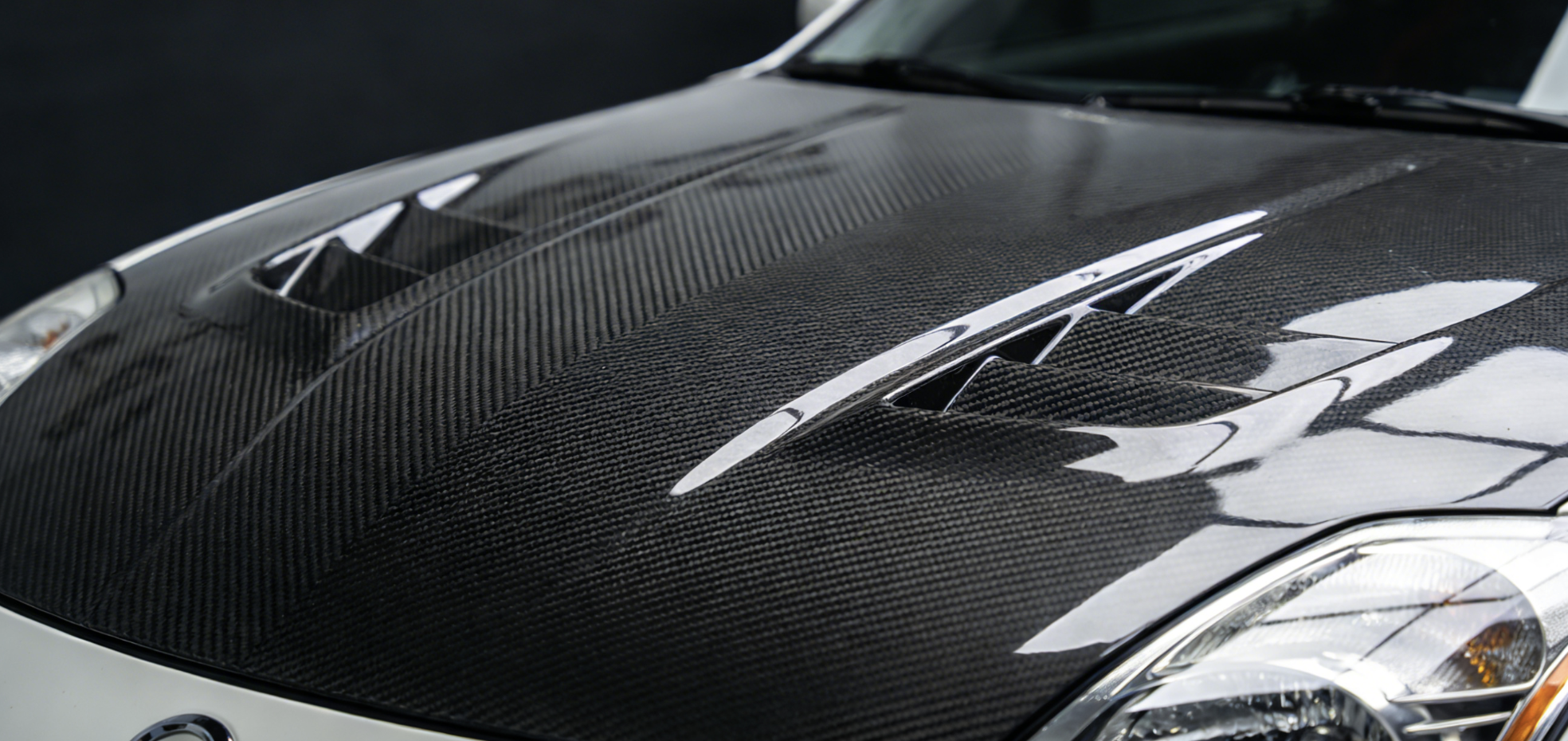
Five decisions will make or break your carbon fiber hood purchase. Get them right and you’ll have a panel that fits clean, holds strong, and looks sharp for years. Get them wrong and you’re stuck with misaligned gaps, cracked fiber, and a return shipment you didn’t plan for.
Here’s what to check before you buy.
1. Fitment: The Z33 and Z34 Are Not Interchangeable
This mistake costs people the most money. The Z33 (350Z / G35) and Z34 (370Z / G37) use different hinge mounting points and different hood curvature profiles. These two platforms do not share hoods.
The difference goes further than most people expect. The Z34’s engine bay runs 20–30mm wider than the Z33 DE, with a different firewall contour. Put a Z33 hood on a Z34 chassis and you get 5–10mm hinge misalignment and latch offset. The panel won’t close flush. Gaps will be uneven. No amount of shimming fixes this — it’s simply the wrong hood for that chassis.
One more detail to check: G35 and G37 sedans (4-door) have different hood geometry than their coupe versions. Verify sedan vs. coupe before placing your order.
2. Weave Pattern and Material Construction
|
Type |
Strength |
Weight Savings |
Best For |
|---|---|---|---|
|
2×2 Twill |
High stiffness, optimal carbon/resin ratio |
20–30% lighter than OEM steel |
Balanced street/track builds |
|
Plain Weave |
Similar to twill, consistent pattern |
Comparable to twill |
OEM-style daily drivers |
|
Dry Carbon (Prepreg) |
Maximum stiffness and tensile strength |
Up to 30–40% reduction |
Race and weight-critical builds |
For most 350Z and 370Z carbon fiber hood buyers, 2×2 twill is the right call — strong, show-ready, and reasonably priced. Dry carbon carries a higher cost. It’s worth it for serious track builds where every pound counts. For street use, it’s more than you need.
3. Vented vs. Non-Vented — Function Drives the Choice
Vented hoods aren’t just a style choice. A well-designed vent system — like the TS or VSII style — can boost engine bay heat extraction by 15–25% under hard driving. That’s a real advantage on track days.
There’s a trade-off most buyers overlook: excess venting cuts downforce integrity by 10–15% at speeds above 100 mph. More holes does not mean better performance.
For street-driven G37 coupes or daily-use 370Z builds, the OEM-style non-vented hood is the smarter pick. The sealed design keeps debris out. There are no open vent channels to maintain or clean. The rule is straightforward — vented for track and performance builds, non-vented for street and show.
4. New vs. Used: The Risk Math Doesn’t Favor Used
|
Option |
Price |
Risk Level |
|---|---|---|
|
New |
$1,000–$1,600 |
Low — ISO-grade carbon, inspected, warranty included |
|
Used |
~$600 |
High — 20–30% delamination failure rate, no warranty |
A used carbon fiber hood at $600 looks like a deal on the surface. Look closer and you’ll find surface delamination, hidden micro-cracks, or signs of a previous impact. On top of that, damaged carbon fiber composites can release styrene (a carcinogen) and Bisphenol A (a reproductive toxin) — both flagged under California Prop 65. Skip used panels unless you can confirm their full history.
5. Hood Pins Are Not Optional
Every lightweight carbon fiber hood — no matter the brand or price — needs hood pins. Stock gas struts produce pressure built for a 45–50 lb steel panel. Your new carbon hood weighs about half that. The struts then over-pressurize the panel, which can crack it or keep it from closing right.
Install 2–4 Quick-Release hood pins at the hinge and latch points before you drive the car. This is a safety requirement, not an optional upgrade. Skip it and you risk hood flutter at speed — or worse.
FAQ: Carbon Fiber Hood for Nissan 350Z / 370Z / G35 / G37
Here are the answers to the questions we get asked most — straight, no filler.
Q: Can I use a G35 hood on my 350Z?
No. The G35 (V35 chassis) and 350Z (Z33 chassis) have different hinge mounting points and engine bay sizes. These two hoods do not swap over. Not sure which chassis you have? Check your VIN. Characters 4–8 tell you the platform. Character 10 confirms the model year. Then pull up the Nissan parts catalog and search by hood part number — the 350Z OEM reference is F2310-CD00A. Do that before you order anything.
Q: Does a 370Z carbon fiber hood fit a G37?
It depends on the body style.
-
G37 Coupe (CV36): The Z34 (370Z) and G37 coupe share some front-end geometry. Fitment is possible, but you still need to verify by model before ordering.
-
G37 Sedan: The hinge setup is different. A 4-door sedan does not share hood geometry with the Z34 liftback.
Confirm coupe vs. sedan first. That one detail decides everything.
Q: How long will a carbon fiber hood last before it yellows?
Skip UV protection and the resin starts breaking down in 2–5 years. A quality 3K 2×2 twill hood with basic upkeep holds up for 10+ years. The routine is straightforward:
-
Wash with pH-neutral soap every two weeks
-
Wax every three months
-
Reapply a 2K urethane UV-protectant clear coat every 12–18 months
Also, try to limit direct sun exposure past 6 hours a day. That alone adds years to the finish.
Q: Is a carbon fiber hood street legal in the US?
Legal in 49 states, as long as the hood is DOT/SAE-compliant. A few states have extra requirements:
-
California: A referee inspection is required for modifications that exceed 5% weight reduction.
-
New York / New Jersey: Emissions testing can flag visible hood modifications.
Notify your insurance carrier before installation. Carriers like Geico and State Farm offer mod endorsements — expect a 10–25% premium increase. Skip the disclosure and the hood gets involved in a claim? Coverage gets denied. It’s not worth the risk.
Q: Will a 350Z HR hood fit a DE engine bay?
Not without some work. The HR engine sits 1.5–2 inches higher than the DE. That height difference creates clearance gaps at the firewall and radiator support. Here’s the split:
-
80% of installs bolt on with no problems
-
20% of installs need alignment shims and minor hinge adjustment — usually +0.5 to 1 inch
Always do a test-fit before you torque anything down.
Conclusion
Picking the right carbon fiber hood for your Nissan 350Z, 370Z, G35, or G37 goes beyond looks. It’s a smart, lasting investment in your build.
Here’s the bottom line:
-
Want zero-compromise quality? Seibon leads the pack for a reason.
-
Budget-conscious but won’t cut corners on craft? ZetaComposites delivers real value.
-
Track-focused? A vented hood isn’t a nice-to-have — it’s a must.
The gap between a great upgrade and a frustrating one comes down to three things: fitment, weave quality, and knowing what your build needs. That’s what this guide is for. No hard lessons required.
Contact HyperX Carbon – Your Trusted Chinese Carbon Fiber Partner
Ready to source high-performance carbon fiber materials or custom forged carbon fiber parts from China?
HyperX Carbon is a leading manufacturer with 20+ years of expertise, specializing in aerospace-grade forged carbon fiber, prepreg, carbon fiber tube, carbon fiber sheet, and lightweight carbon fiber automotive parts/carbon fiber drone components/carbon fiber medical components. We offer:
-
Stable supply chain with premium raw materials (Toray, Mitsubishi, Hengshen)
-
AS9100D certified production for aerospace & UAV applications
-
Rapid prototyping (5-8 weeks) and monthly capacity exceeding 180,000 parts
-
Competitive pricing with 15-18% cost savings on forged carbon solutions
-
Full customization: from T700/T1100G to ultra-high modulus grades
Whether you’re an eVTOL developer, automotive OEM, drone manufacturer, or medical device engineer, HyperX delivers consistent quality, batch-to-batch reliability, and reliable delivery.
Get in touch today for a free consultation, custom quote, or material sample.
📧 Email: [email protected]
🌐 Website: https://www.hyperxcarbon.com/
📞 Phone/WhatsApp: +86 15623270276 (English support available)
Let’s build your next lightweight innovation together – contact HyperX Carbon now and stay ahead in the low-altitude and advanced composites market.




