
Choosing the wrong carbon fiber tube connector doesn’t just cost you money — it can bring an entire structure down. Building a precision drone frame, a lightweight robotics arm, or high-performance sports equipment? The connector holding your carbon fiber tubes together is doing the most critical job in the whole system. Most buyers spend hours buried in spec sheets, still unsure whether they need a clamp, a coupler, a threaded insert, or something else. This guide cuts through that confusion.
You’ll leave knowing which carbon fiber tube connectors fit your application. You’ll know what materials and tolerances matter most. And you’ll know how to install them without weakening the structure you paid to build.
What Are Carbon Fiber Tube Connectors? (Types Overview)
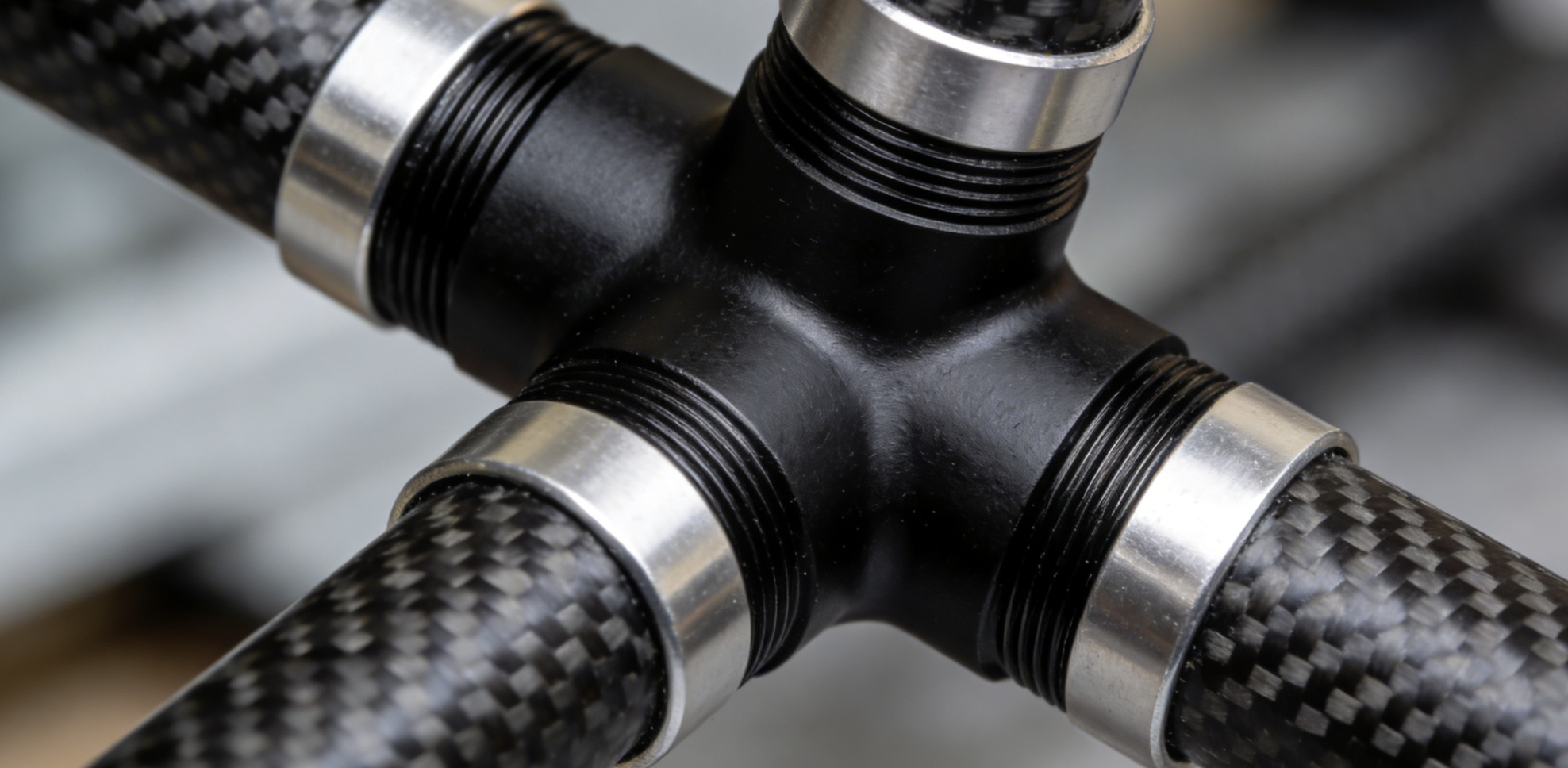
Carbon fiber tubes don’t connect themselves. Every joint in a drone frame, robotics arm, or aerospace truss needs a specialized fastening system. That system decides whether your structure holds or falls apart.
Carbon fiber tube connectors are components that join CF tubes into load-bearing frameworks. They come in four main categories:
-
Mechanical connectors — clamps, couplings, and bolted systems that grip tubes without adhesives. This includes telescopic clamps for builds with adjustable lengths.
-
Adhesive connectors — epoxy-based permanent bonds cured at room temperature or higher heat.
-
Composite connectors — overlapped tube ends secured with more than one bonding method combined.
-
Hybrid connectors — mechanical fasteners combined with adhesive for the highest load capacity.
Connection method is just one variable. Carbon fiber tube connectors also differ by joint geometry. Modular systems cover end connections, in-line splices, angled joints, flat-surface mounts, and multi-tube hub setups. You get full coverage across 2D and 3D structural layouts.
Standard round tube compatibility runs from 0.5″ to 1″ outer diameter. Square and rectangular tubing options are also available for high-load applications.
Internal Sleeve Connectors & Tube Inserts: Best for Hidden, Clean Joints
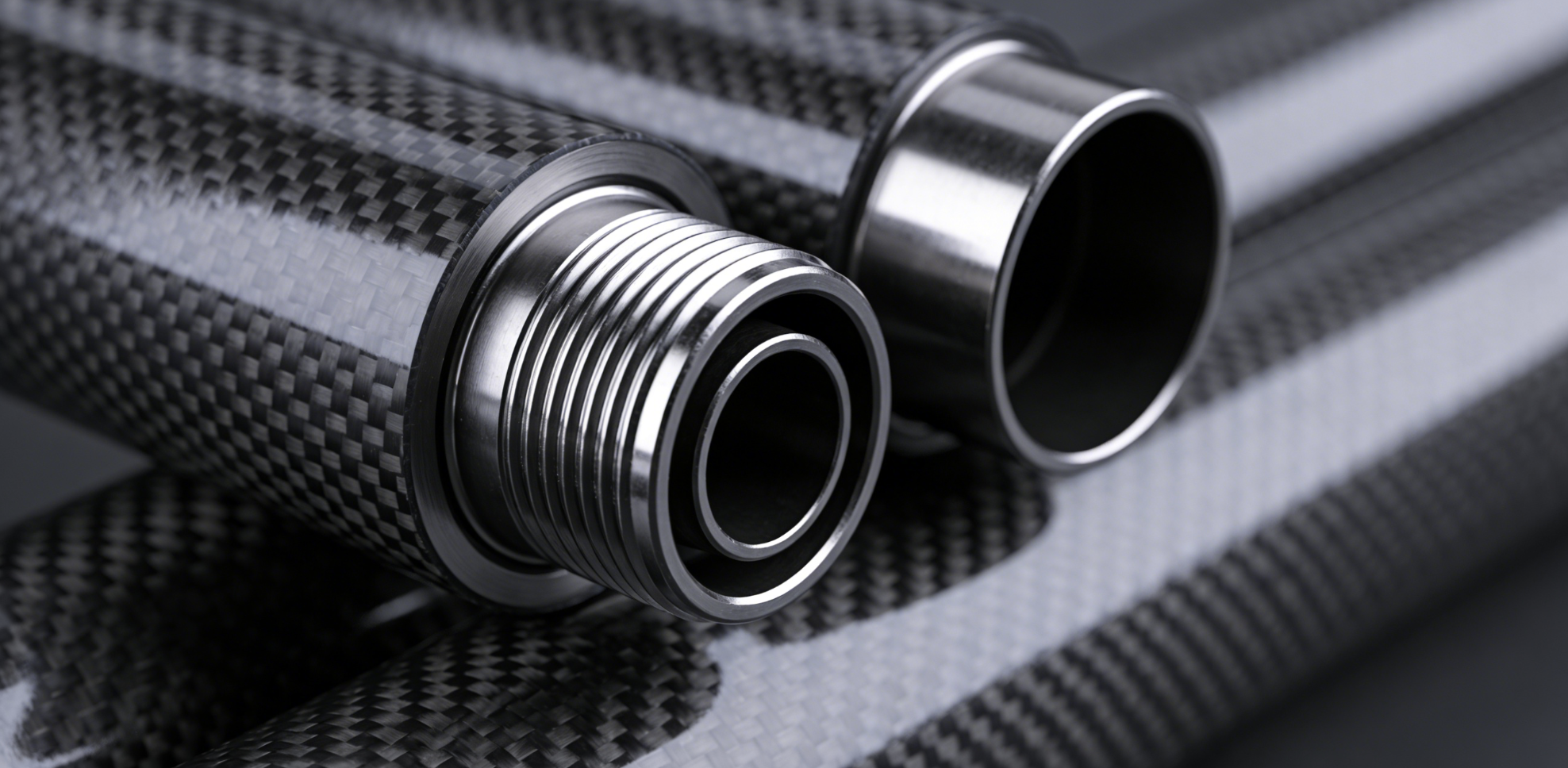
Some joints are meant to disappear. Internal sleeve connectors slide inside the carbon fiber tube itself — no external clamps, no protruding hardware, no visual noise. You get a flush, seamless connection that looks like the tube was always one piece.
That clean profile isn’t just aesthetic. On drone arms, removing external bulges cuts aerodynamic drag and turbulence. In robotics frames, hidden joints clear up visual clutter without sacrificing structural integrity. In aerospace assemblies, internal placement means zero protrusion and built-in corrosion protection — critical in high-vibration environments.
Material determines performance here:
-
6061-T6 aluminum — cost-effective, corrosion-resistant, solid choice for general frames
-
7075-T6 aluminum — ~73 ksi yield strength, about 1.8× stronger than 6061, the right pick for high-load robotics and aerospace
Fit precision is non-negotiable. These inserts need ±0.05mm tolerance to lock in place without damaging the tube’s internal surface. Loose fit means movement. Movement means failure.
Installation is simple. Measure your tube ID, cut the sleeve to match, apply epoxy, and push it in until snug. The sleeve self-aligns and sets the joint gap on its own — no guesswork needed.
External Carbon Fiber Tube Clamps: Reusable & Tool-Free Options
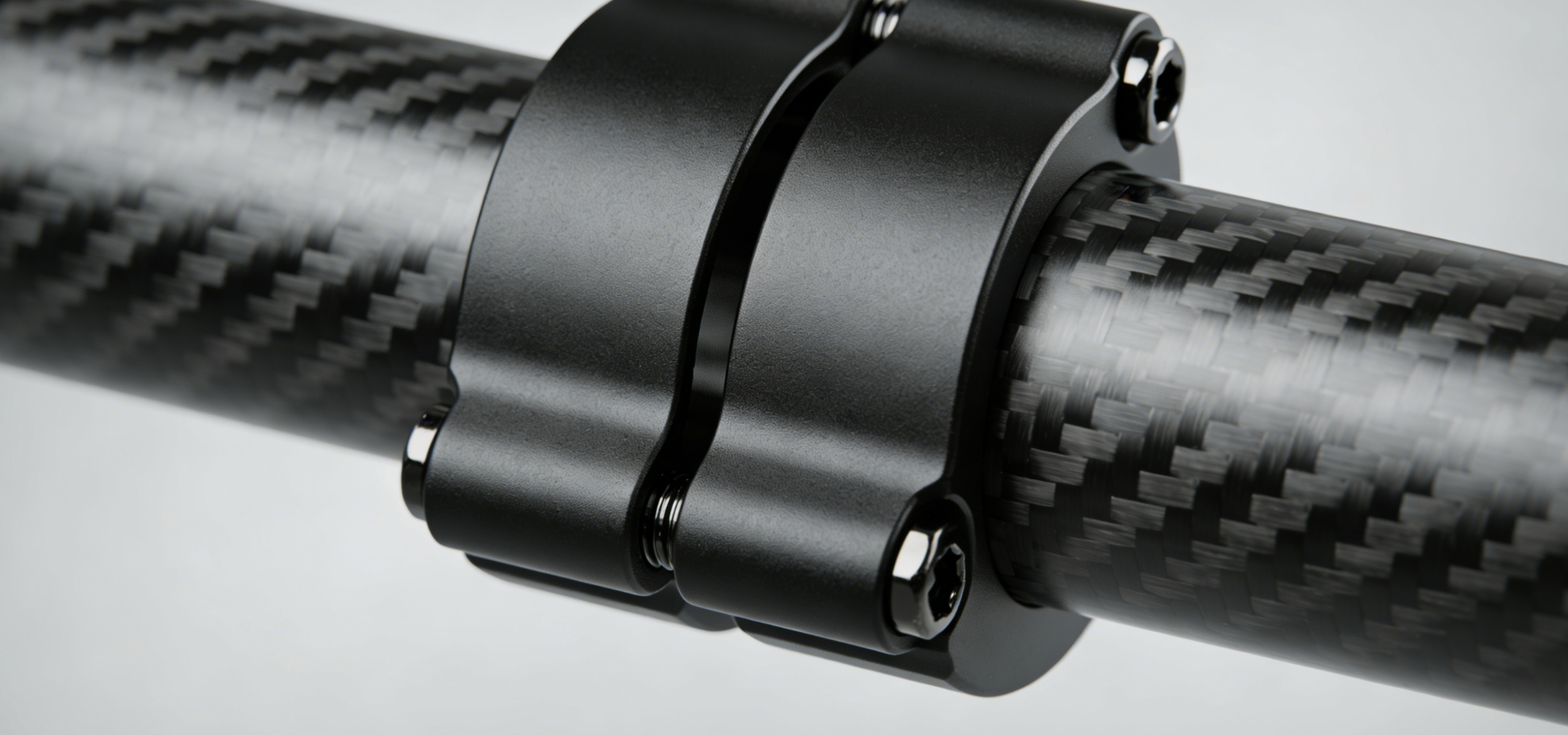
External clamps are the go-to choice for field-adjustable builds. They’re grippy, repeatable, and easy to work with as your design changes.
Unlike internal sleeves, these mount outside the tube wall and grip by compression. No epoxy. No permanent commitment. Your prototype dimensions shift next week? Just loosen the lever and reposition in under a minute.
Diameter coverage is broad:
-
Standard sizes: 12, 16, 20, 22, 25, 30mm
-
Extended range: 19.25mm up to 50.8mm (with nylon adapters bridging the 44.5–47mm gap)
-
Reducing sleeves bring 30mm clamps down to fit 25mm or 20mm tubes
Crushing is the real risk with external clamps. Better designs spread clamping force across nylon adapter liners and wide-base aluminum bodies. The ClipCarbono block measures 40×36.5×5mm. That wide footprint matters — it keeps load from concentrating at just two contact points, which is where carbon tubes fail.
The RJX 25mm clamp weighs just 20.3g and runs on M3 hardware. The 67 Designs Gen2 uses a lever system that needs no tools at all — and it covers six diameter sizes. Both use CNC-machined anodized 6061-T6 aluminum. You get standard M3 screws included, and the clamps hold up to repeated use without wearing out.
Carbon Fiber Tube Couplers: End-to-End Joining for Maximum Axial Strength
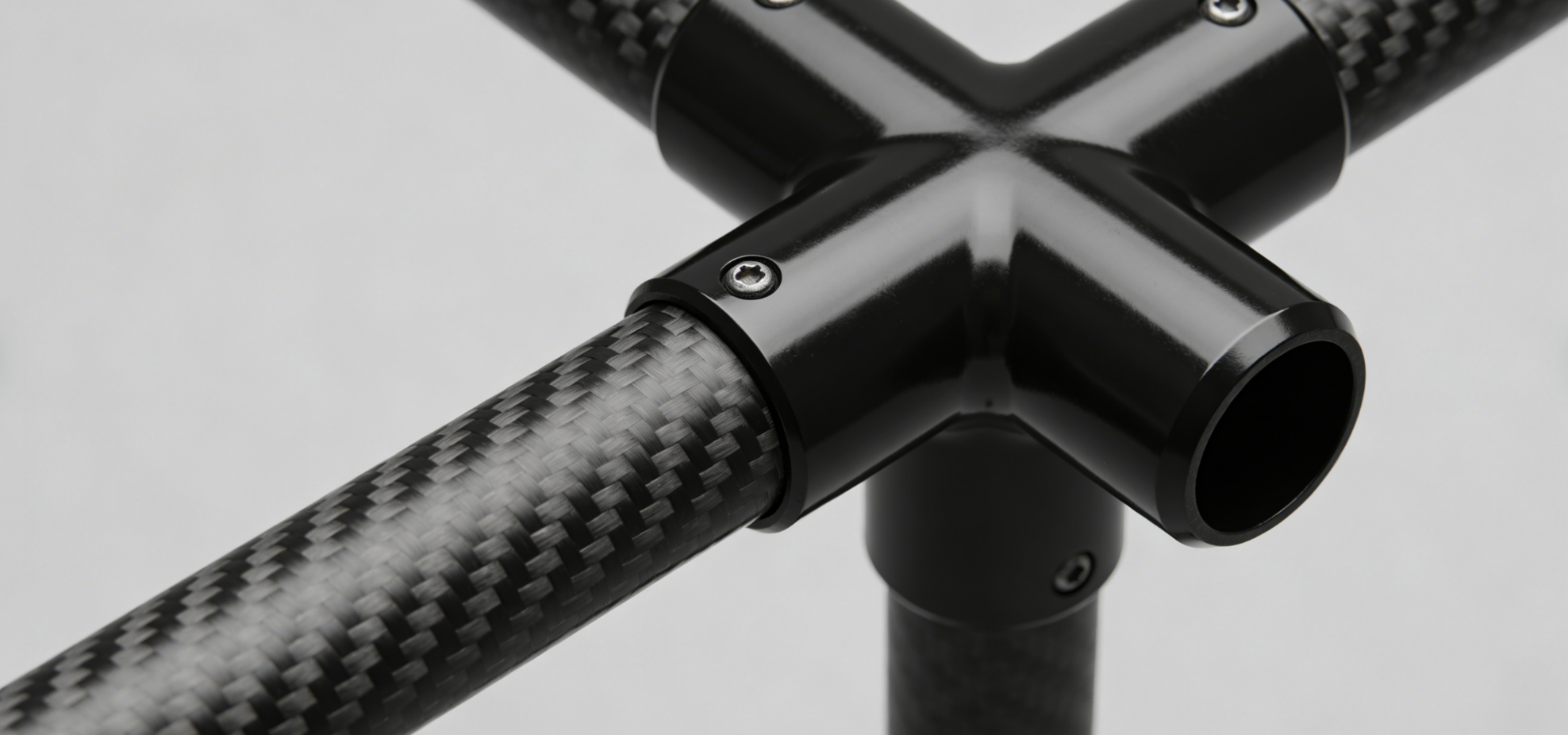
Axial load is where couplers prove their worth — or fail without warning, with damage you won’t notice until the structure gives out.
End-to-end tube joining is a different engineering problem than clamping or sleeving. You’re moving tension and compression straight along the tube’s longitudinal axis. Fiber orientation matters. Bond quality matters. Fit precision matters more than most buyers expect.
Carbon fiber tubes test out at 240–250 ksi tensile strength (1.65–1.72 GPa). A 10mm² cross-section can carry over 10,000N along the axis. The coupler is the weakest link in that chain — unless you spec it right.
Two coupling strategies dominate:
-
Permanent adhesive bonding — full axial tensile transfer, zero play, built for drone arms and tension members that need ≥600N continuous load
-
Removable mechanical collars — inspectable, reusable, better for structural beams or poles where you need to take things apart later
For permanent joints, surface prep and glue layer consistency decide the outcome. Flat, square-cut tube ends spread the load evenly across the bond face. Uneven gaps concentrate stress and cause early delamination.
Pick based on what your structure needs:
|
Application |
Recommended Method |
Why |
|---|---|---|
|
Drone arms, aerospace |
Permanent adhesive |
Max tensile, no slip |
|
Field equipment, poles |
Mechanical collar |
Reusable, inspectable |
|
High-vibration frames |
Hybrid (adhesive + collar) |
Redundant load path |
Threaded Inserts for Carbon Fiber Tubes: Reliable Bolted Connections
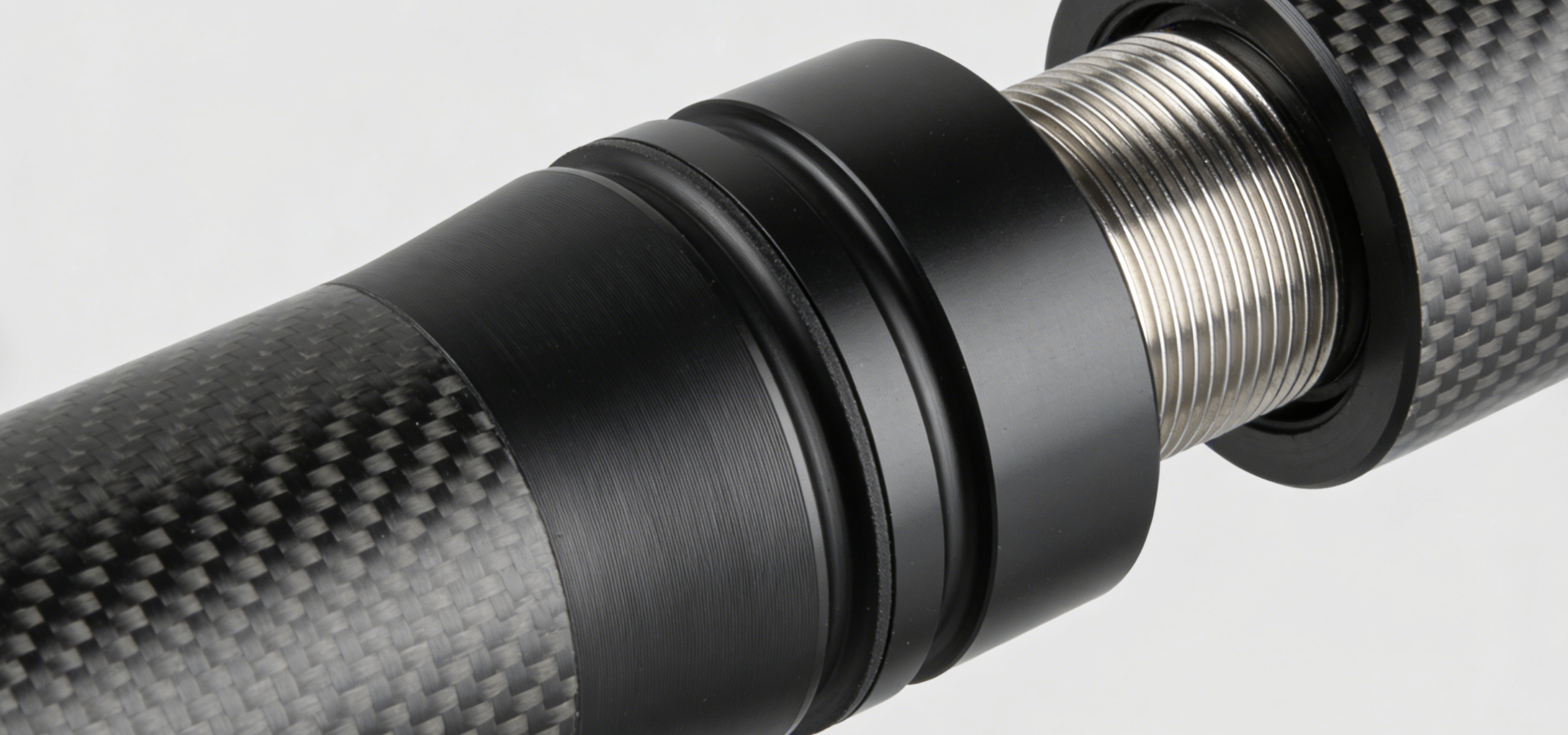
Never tap straight into a carbon fiber tube. The drill cuts through resin and severs load-bearing fibers. What’s left is a joint that fails without warning — right at the load you built it for.
Threaded inserts fix this. A metal insert bonds inside the tube end. You get a strong female thread that never touches the composite structure. Bolt loads spread through the bonded interface into the tube wall — distributed across the surface, not focused at one point.
How it works in practice:
-
Insert OD matches your tube’s inner diameter for a tight interference fit
-
Cross-hatch or 45° knurl profiles give epoxy maximum grip against the inner wall
-
After curing, the insert handles tension, compression, and repeated bolt cycling without loosening
The DragonPlate 0.5″ insert uses a standard 1/4-20 thread. That makes it compatible with most mounting plates, end effectors, and fixtures. Install it once. Then bolt hardware on and off as many times as the job needs.
The tube itself is no weak link. 3K carbon fiber delivers 512 ksi tensile strength. In most setups, the insert bond is your limiting factor — not the tube. Pick your epoxy with that in mind.
Best-fit applications: truss end attachments, optics rigs, pool cue assemblies, and any carbon tube joint that needs clean, removable bolted access.
Modular Carbon Fiber Joints & Structural Connectors: Multi-Angle Assembly Systems

Fixed-angle connectors are a design compromise dressed up as a solution. Your structure needs a 37° joint instead of 45°? You’re either hacking a workaround or starting over.
Modular structural connectors remove that constraint. They bond to tube ends and connect at any angle. Engineers get real freedom to build complex 3D frameworks — no fixturing headaches, no custom machining required.
The system works across a wide size range:
-
Standard IDs: 0.5″ through 1″ for pultruded CF tubes
-
Extended range: 6mm to 100mm ID, held to ±0.05mm tolerance
-
Weight: 20g to 300g per connector, depending on size and material
For permanent joints, use 3M 2216 epoxy with a glue line of 0.010–0.020″. Clean both surfaces, spread epoxy on each face, clamp it down, and wipe off the squeeze-out. That’s it.
Mechanical versions — set screw, snap-lock, or multi-screw designs — handle beyond 10,000 connection cycles. They also run from −40°C to +120°C. No adhesive needed. No hidden bond failures.
Each connector is CNC-machined from anodized 6061-T6 or 7075-T6 aluminum. All parts meet ISO 9001 and ASTM standards. Multi-connector hubs and angle joints push the system even further — great for truss builds, drone frames, and camera rigs.
Telescopic Carbon Fiber Tube Connectors: Adjustable Length Solutions

Adjustable length changes everything about how you build.
Telescopic carbon fiber tube connectors let you extend, retract, and lock a structure. No epoxy. No swapping components. That freedom makes a real difference — fishing poles reaching 5.6m, robotic arms shifting reach between tasks, tripod systems folding down for transport.
Five locking mechanisms cover this category — and they’re not interchangeable:
|
Mechanism |
Holding Force |
Slip Risk at >500N |
Best Use |
|---|---|---|---|
|
Twist Lock |
~800–1,200N |
Very low (0.5–2%) |
Robotics poles, 2m sections |
|
Clamp Collar |
~900N |
Low (1–3%) |
Fishing stands, 1mm-wall tubes |
|
Set Screw |
1,000N+ |
Under 1% |
Industrial trusses, permanent |
|
Push Button |
~400–700N |
Medium (5–10%) |
Tripods, light loads only |
|
Tapered End |
~600–900N |
Low-medium (2–5%) |
Streamlined poles, no hardware |
For dynamic loads — robotics, field equipment, repeated stress — Twist Lock and Clamp Collar give you the lowest slip rates. Need to hold above 1kN with zero deformation tolerance? Set Screw is your pick.
Temperature range holds steady across −40°C to +120°C. Carbon fiber expands less than 0.1% across that full span. Aluminum clamp collars do carry a small nylon expansion risk at extremes. Retighten them in high-heat environments to stay safe.
Tubes in this category are 100% 3K carbon, 1mm wall, 2,000mm sections. They extend to 5.6m at full deployment.
How to Choose Carbon Fiber Tube Connectors: Application-Based Selection Guide
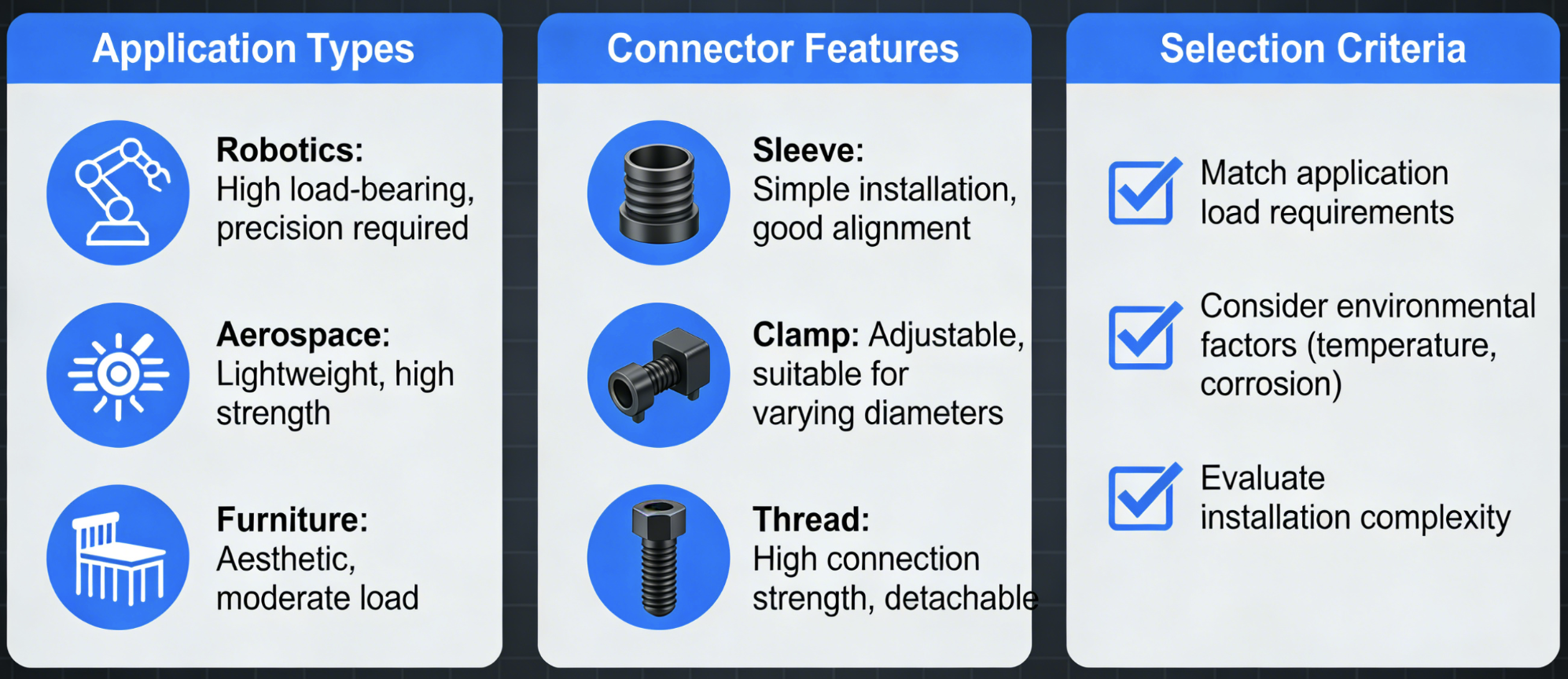
Four applications dominate the carbon fiber tube connector market. Pick the wrong connector and you’ll pay for it — a drone drops, a robotic arm deflects, a fishing pole slips at full extension, or a DIY truss creaks under a load it should hold. Start with your application. Everything else falls into place.
Drones & Robotics: Weight and Quick-Disassembly
Every gram counts on UAV frames and robotic arms. More weight means less flight time or lower payload. Target tubes in the 4–6mm OD, 0.3–0.8mm wall range — that’s 8–18g/m.
Here’s what works well for this category:
-
Modular anodized aluminum connectors with ±0.05mm tolerance (P1 class) keep precision tight without adding bulk
-
Twist locks and spine-button systems let you pull apart the frame with no drilling needed
-
Hub connectors join up to six tubes at one node — useful for compact multi-arm builds
-
Run a 1.3× safety factor on all dynamic UAV loads
Aerospace & Industrial: Load Capacity and Corrosion Resistance
This category needs heavier tubes — 25–30mm OD, 1.5–3.0mm wall. These carry the real structural load. Allowable stress reaches 600MPa for T300 fiber and 800MPa for T800.
Go with hybrid connectors that combine mechanical fasteners and epoxy bonding. You get two load paths instead of one — critical in harsh or high-stress environments. A few other things to lock in:
-
Use corrosion-resistant alloys throughout
-
Hold P2 tolerance at ±0.10mm
-
Safety factors step up to 1.5× for dynamic loads and 2.0× for impact loads
Sports Equipment: Adjustability Over Permanence
Mid-range tubes — 15–20mm OD, 1.0–2.0mm wall — cover poles, stands, and adjustable-length gear well.
Two connector types dominate here:
-
Twist locks — faster to reposition, great for quick field adjustments
-
Telescopic clamps — better for precision length control
Don’t over-engineer this section. A permanent epoxy bond on a fishing pole creates a maintenance problem. Stick with adjustable connections that can be reset or replaced.
DIY Structures: Flexibility Across Complex Geometry
Patented modular systems give you real design freedom. Angle connectors, star joints, and multi-hub combinations let you build in three dimensions — no custom machining required.
Installation is straightforward:
-
Sand the tube ID to clean the surface
-
Put adhesive on the connector
-
Insert and let it set — no fixturing needed
For non-standard sizes like 0.725″ (~18.4mm OD), order custom anodized aluminum with tapered ends. Always check the final fit with a go/no-go gauge before committing to the build.
Quick Reference:
|
Application |
Tube Wall |
Key Connector Type |
Tolerance Class |
|---|---|---|---|
|
Drone / Robotics |
0.3–0.8mm |
Modular twist lock / hub |
P1 ±0.05mm |
|
Aerospace / Industrial |
1.5–3.0mm |
Hybrid mechanical + epoxy |
P2 ±0.10mm |
|
Sports Equipment |
1.0–2.0mm |
Telescopic clamp / twist lock |
P2 ±0.10mm |
|
DIY Structures |
0.8–1.5mm |
Modular angle / star / hub |
P2 ±0.10mm |
Key Specifications to Compare: Materials, Load Capacity & Tolerances
Three numbers decide whether your connector holds or fails: material strength, rated load, and dimensional tolerance. Get all three right and the joint disappears into the structure. Miss one and you’ll find the weak point fast.
Material costs scale with performance — and the gap is significant:
|
Material |
Yield Strength |
Density |
Cost/kg |
Best For |
|---|---|---|---|---|
|
6061-T6 Al |
276 MPa |
2.7 g/cm³ |
~$3–5 |
Structural frames, general builds |
|
7075-T6 Al |
503 MPa |
2.8 g/cm³ |
~$8–12 |
Aerospace, high-fatigue joints |
|
Stainless 304/316 |
215–310 MPa |
8.0 g/cm³ |
~$4–8 |
Marine, corrosive environments |
|
Carbon Fiber |
1,500–3,500 MPa |
1.6 g/cm³ |
~$20–50 |
Ultra-light drone frames |
Load capacity isn’t just a spec — it’s a calculation. 600N equals 61.2kg of force. A 2.5× safety margin means your connector needs a minimum 150kg rating. Start from your real-world peak load. Don’t use your average.
Most buyers underestimate tolerance risk. A ±0.05mm fit cuts installation force by 70% compared to ±0.10mm. On 32mm OD carbon tubes, that precision gap cuts delamination risk in half. In aerospace assemblies, it also removes rework from the process.
For torque-sensitive fittings under 5Nm, hold to ±0.03mm or tighter. ISO IT6–IT7 standards cover CNC-machined connectors in the 10–18mm diameter range.
Step-by-Step Installation Guide: Mechanical, Adhesive & Hybrid Methods
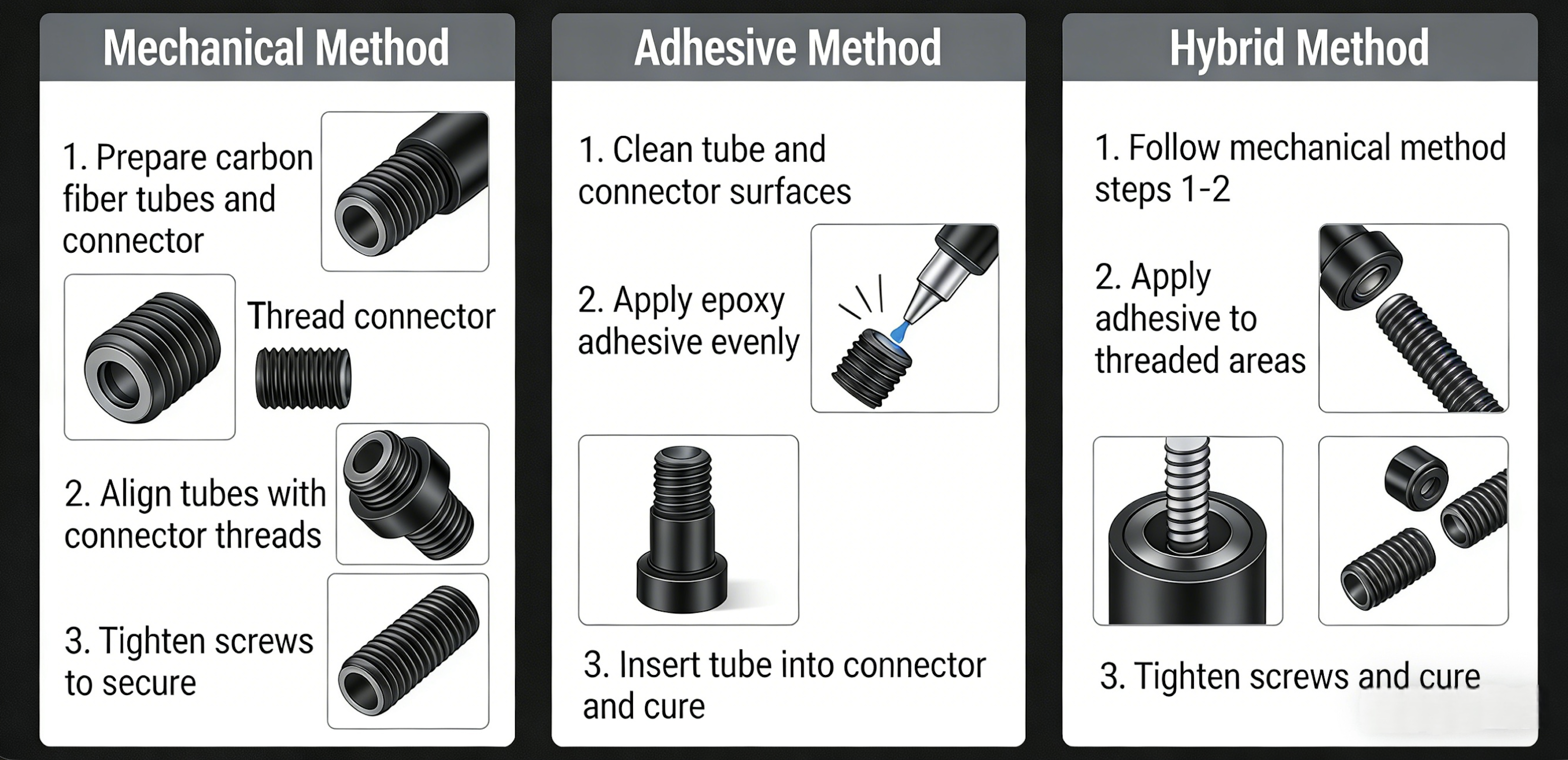
Most structural failures start with the installation method — not the connector, not the tube. They start the moment someone picks speed over process.
Three methods cover carbon fiber tube assembly. Each has a specific role. None of them works best in every situation.
Mechanical Fastening
Fast to install. No cure time. Bolts reach handling strength the moment you torque them down.
The catch: drilling into carbon fiber cuts through load-bearing fibers. That single hole can reduce fatigue life by up to 60% compared to adhesive bonding. Water gets into those holes. Corrosion follows. Add a fixing plate to spread the load across a wider area. Skip that step, and frames will develop cracks under repeated stress cycles.
Adhesive Bonding
No holes. No stress concentration points. Load spreads across the full bond surface instead of focusing at two fastener points.
Adhesive bonds also create a watertight seal — critical anywhere moisture is a concern. The tradeoff is cure time. Hybrid adhesives can fixture in as little as 20 seconds on prepared surfaces, but full structural cure takes longer. In production settings, that delay creates a bottleneck.
Surface prep is non-negotiable. Clean, grit-blasted surfaces and consistent glue line thickness determine the joint’s true strength. Cut corners here, and the bond fails — not the adhesive, but the prep.
Hybrid Method: Best of Both
A pre-tensioned mechanical connection combined with adhesive bonding gives you immediate handling strength plus long-term durability. You get two load paths instead of one.
Hybrid joints deliver:
– Higher stiffness
– Better fatigue resistance
– Improved peel strength
– Broader service temperature range
All of that beats either method on its own. For carbon fiber — where drilling creates delamination risk — the hybrid approach makes up for the structural damage that mechanical fastening causes, while keeping the stress spread that adhesive bonding provides.
Bottom line: Use mechanical for field-adjustable builds. Use adhesive for permanent, high-load joints. Use hybrid when failure isn’t an option.
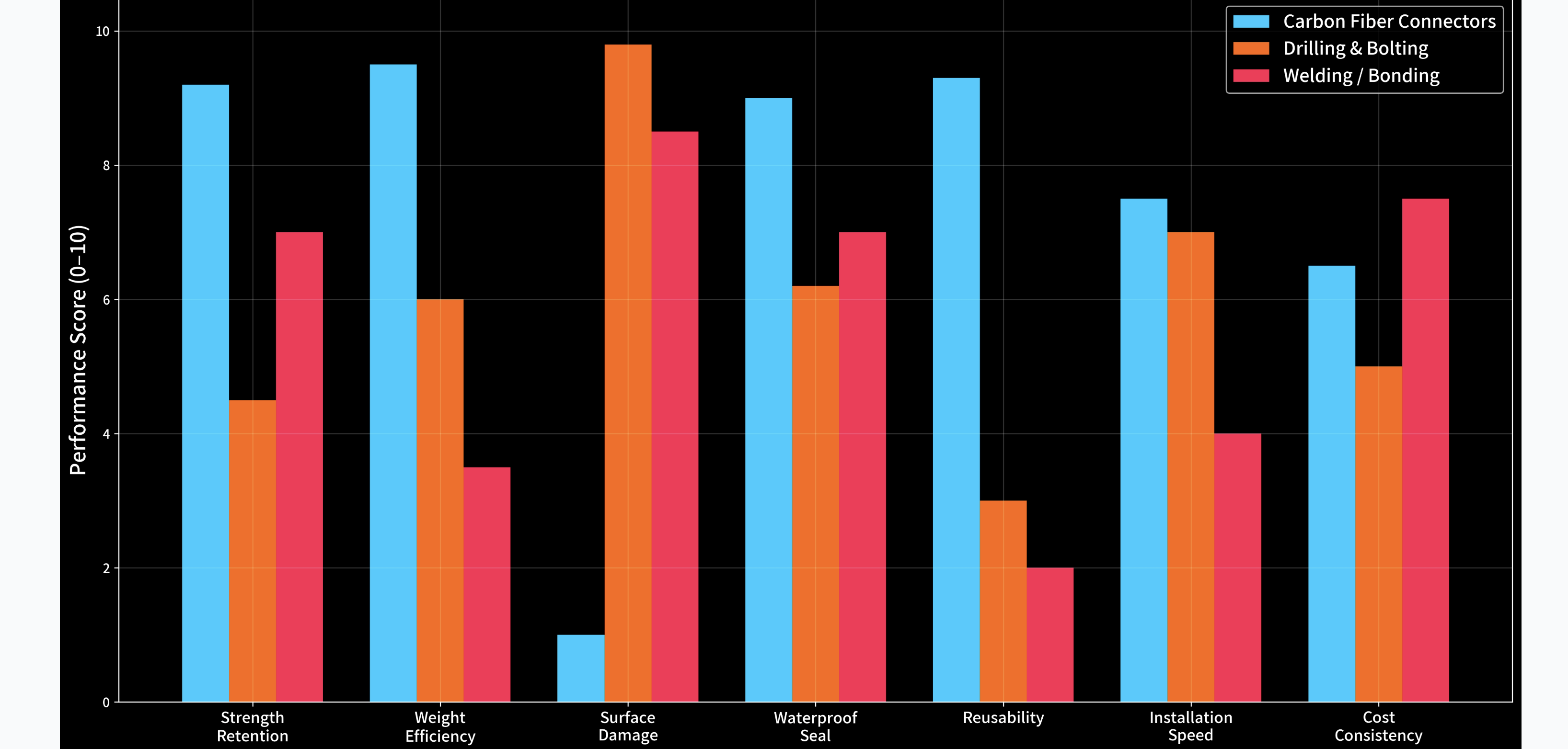
Carbon Fiber Connectors vs. Alternatives: Why Not Just Drill or Weld?
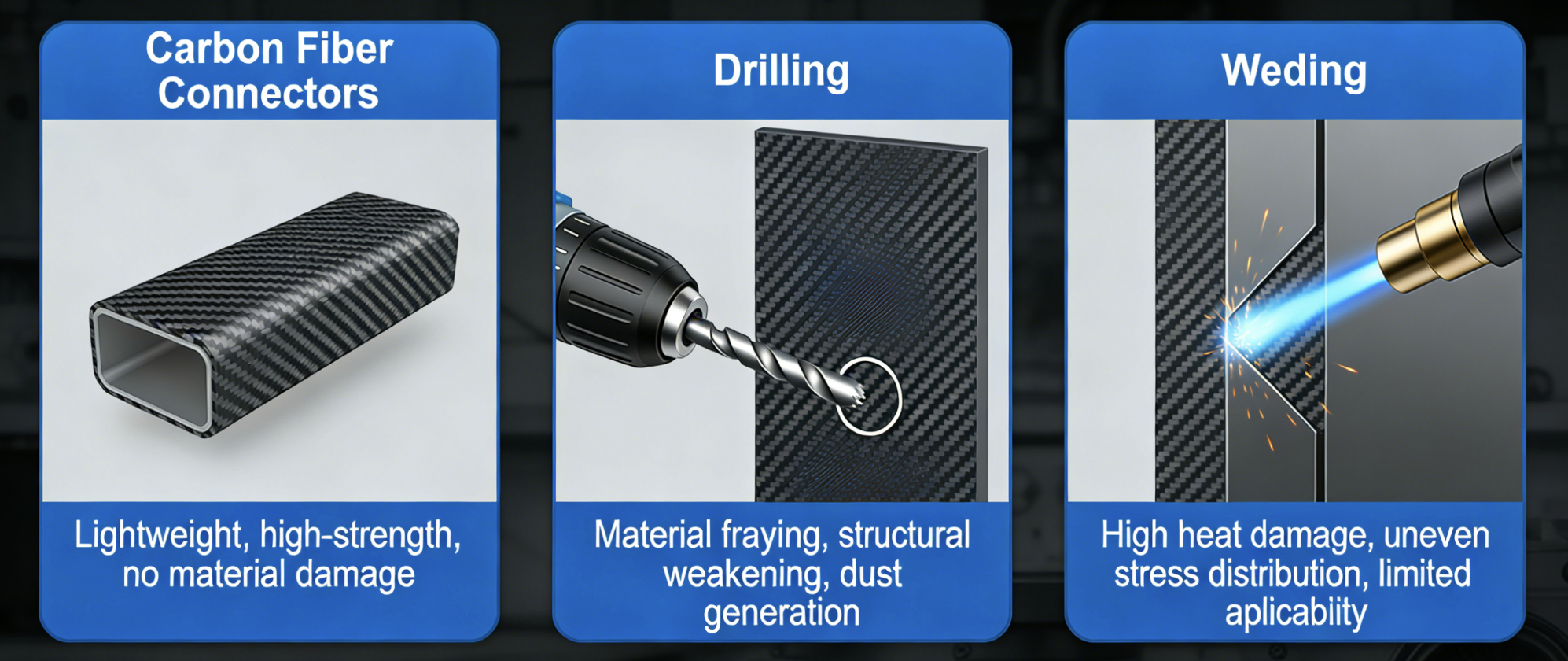
Here’s a hard truth that protects your expensive tubes: carbon fiber cannot be welded, and drilling it costs more than most people expect.
CFRP simply cannot be welded. Full stop. Add heat, and the resin matrix breaks down. The fiber structure collapses with it. Your real options are adhesive bonding, mechanical fasteners, or dedicated connectors — nothing else.
Drilling is possible, but it damages the material. Standard HSS bits go dull after just 5–10 holes. Carbide bits are better, but they can still shatter the laminate without a rigid drill press running at 3,000–5,000 RPM. Each hole cuts through load-bearing fibers. Stress builds at the edge. Moisture gets in and starts delamination from the inside out.
The structural numbers are clear:
|
Method |
Strength Outcome |
Reliability |
|---|---|---|
|
Dedicated connectors |
Full laminate integrity preserved |
Millions of cycles |
|
Drill + fasten |
Fiber fraying, brittle failure risk |
Unpredictable crack propagation |
There’s also a galvanic corrosion problem worth knowing. Aluminum fasteners touching carbon fiber directly will trigger a dissimilar-metal reaction in wet conditions. The fix is simple — use non-conductive sleeves, anodized aluminum, or epoxy barrier coatings. Most DIY builds skip this step and pay for it later.
Dedicated connectors keep carbon fiber’s 20× strength-to-weight advantage over steel intact. Drilling chips away at that advantage, hole by hole, until the structure fails.
Recommended Carbon Fiber Tube Connectors: Top Picks by Use Case
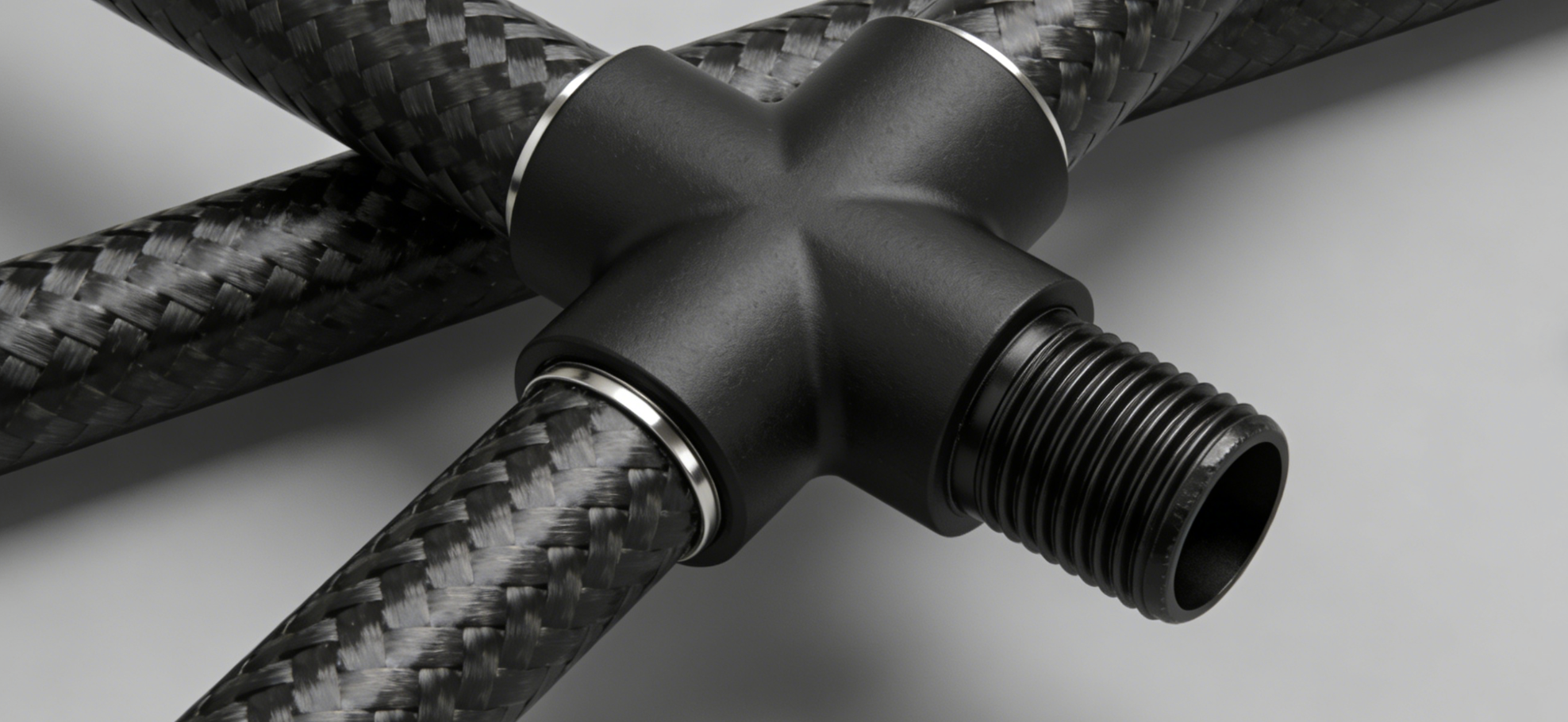
Three connector types handle most real-world builds. Here’s what works — matched to what you’re building.
For Complex 3D Structures & Trusses: DragonPlate Modular Connectors
Fits 0.5″–1″ round CF tubes. You get end joints, in-line splices, star hubs, and angle fittings — all in one system. The aluminum body is anodized and patented. No custom machining needed. Builds come apart and go back together without hassle. This is the right pick for frames you need to disassemble and multi-angle truss systems.
For Adjustable & Telescopic Builds: CNC Aluminum External Clamps
Twist-lock, push-button, or screw-tighten — your choice. No adhesive. No permanent fix. You can reposition any time the design shifts. The strength-to-weight ratio is hard to beat for sliding or end-to-end holds on variable-diameter tubes.
For Permanent Inline Extensions: Internal Sleeves
Epoxy-bonded or hybrid — both work well. Tapered ends sit flush with the tube. No external hardware at all. The axial load moves straight through the bond. No stress concentration. No added bulk. These are built for fixed-length aerospace and automotive assemblies.
Budget Quick-Reference:
|
Level |
Best Pick |
Price Range |
|---|---|---|
|
Entry |
Standard internal sleeves |
Under $50/unit |
|
Professional |
DragonPlate modular (0.5″–1″) |
$50–$200/unit |
|
Custom |
CNC clamps + Refiflex® |
$200+/unit |
Match the connector to the job. That’s the whole decision.
FAQ: Carbon Fiber Tube Connectors — Most Asked Questions
Engineers ask the same questions over and over — because the stakes are real and the wrong answer costs them a build.
Q: What’s the best carbon fiber tube connector for drones?
Modular anodized aluminum connectors in the 0.5″–1″ ID range are the standard pick. They reach tensile strength ≥600 MPa. They hold up under vibration without loosening. No drilling needed for assembly. Sand the tube interior, apply epoxy, insert the connector — done.
Q: Can carbon fiber tube connectors handle vibration environments?
Yes. Carbon fiber stays dimensionally stable and expands very little with heat. That makes it a solid fit for high-vibration applications. Hybrid connectors combine adhesive with mechanical fastening. This creates a second load path. So the joint stays intact even if one method starts to fail.
Q: Are custom non-standard sizes available?
Yes. Standard sizes run 0.5″ through 1″ ID. Need something outside that range? Custom machining covers non-standard dimensions — including 30×27mm tubing, which is common in European markets. Before you commit, verify the fit with a go/no-go gauge.
Q: How do I verify a connector is holding?
Pull-test assembled joints to 2× the operational load. Check epoxy bond lines by eye — look for full coverage and zero voids. The tensile threshold you’re aiming for is ≥600 MPa.
Q: Can I buy carbon fiber tube connectors for EU delivery?
Yes. Refiflex® 30R connectors ship within Europe. They’re rustproof, chemical-resistant, and rated to 100°C. They fit 30×27mm tubes with no modification needed.
Conclusion
Picking the right carbon fiber tube connectors isn’t just a purchasing call — it’s an engineering one. The connector you choose determines whether your structure holds up under load or gives out.
Think about it this way: a drone either flies or it doesn’t. A frame either holds or it buckles. That difference often comes down to one part — the connector.
By now, you know the types, the specs, the trade-offs, and the installation methods. You know why drilling blind into carbon fiber is a gamble. The right clamp, coupler, or threaded insert is the smarter path — every time.
So what’s next? Three steps:
-
Match your application
-
Confirm your tube OD
-
Choose a connector built for the forces your project faces
Check out HyperX Carbon’s full range of precision-machined carbon fiber tube fittings. These fittings are built for weight-critical applications where failure is not acceptable.
Get the right connector the first time. Your project depends on it.
Contact HyperX Carbon – Your Trusted Chinese Carbon Fiber Partner
Ready to source high-performance carbon fiber materials or custom forged carbon fiber parts from China?
HyperX Carbon is a leading manufacturer with 20+ years of expertise, specializing in aerospace-grade forged carbon fiber, prepreg, tubes, sheets, and lightweight automotive/drone/medical components. We offer:
-
Stable supply chain with premium raw materials (Toray, Mitsubishi, Hengshen)
-
AS9100D certified production for aerospace & UAV applications
-
Rapid prototyping (5-8 weeks) and monthly capacity exceeding 180,000 parts
-
Competitive pricing with 15-18% cost savings on forged carbon solutions
-
Full customization: from T700/T1100G to ultra-high modulus grades
Whether you’re an eVTOL developer, automotive OEM, drone manufacturer, or medical device engineer, HyperX delivers consistent quality, batch-to-batch reliability, and reliable delivery.
Get in touch today for a free consultation, custom quote, or material sample.
📧 Email: [email protected]
🌐 Website: https://www.hyperxcarbon.com/
📞 Phone/WhatsApp: +86 15623270276 (English support available)
Let’s build your next lightweight innovation together – contact HyperX Carbon now and stay ahead in the low-altitude and advanced composites market.




