
Choosing the wrong tube profile costs more than money. You’re looking at a full redesign, a delayed build, and sometimes a structure that fails completely.
Building a lightweight drone frame? A precision robotic arm? An aerospace-grade structural member? The tube geometry matters just as much as the material you pick.
Carbon fiber square tubes, rectangular tubing, and oval profiles are not interchangeable:
-
Each one carries load in its own way
-
Each responds to bending stress at different points
-
Each fits into real-world assemblies in a unique way
This guide gives you hard specs to work with — wall thickness tables, tensile strength comparisons, weight-per-meter data, and side-by-side profile breakdowns. You get everything you need to make a solid selection call the first time.
What Are Carbon Fiber Square, Rectangular & Oval Tubes — And Why Shape Matters
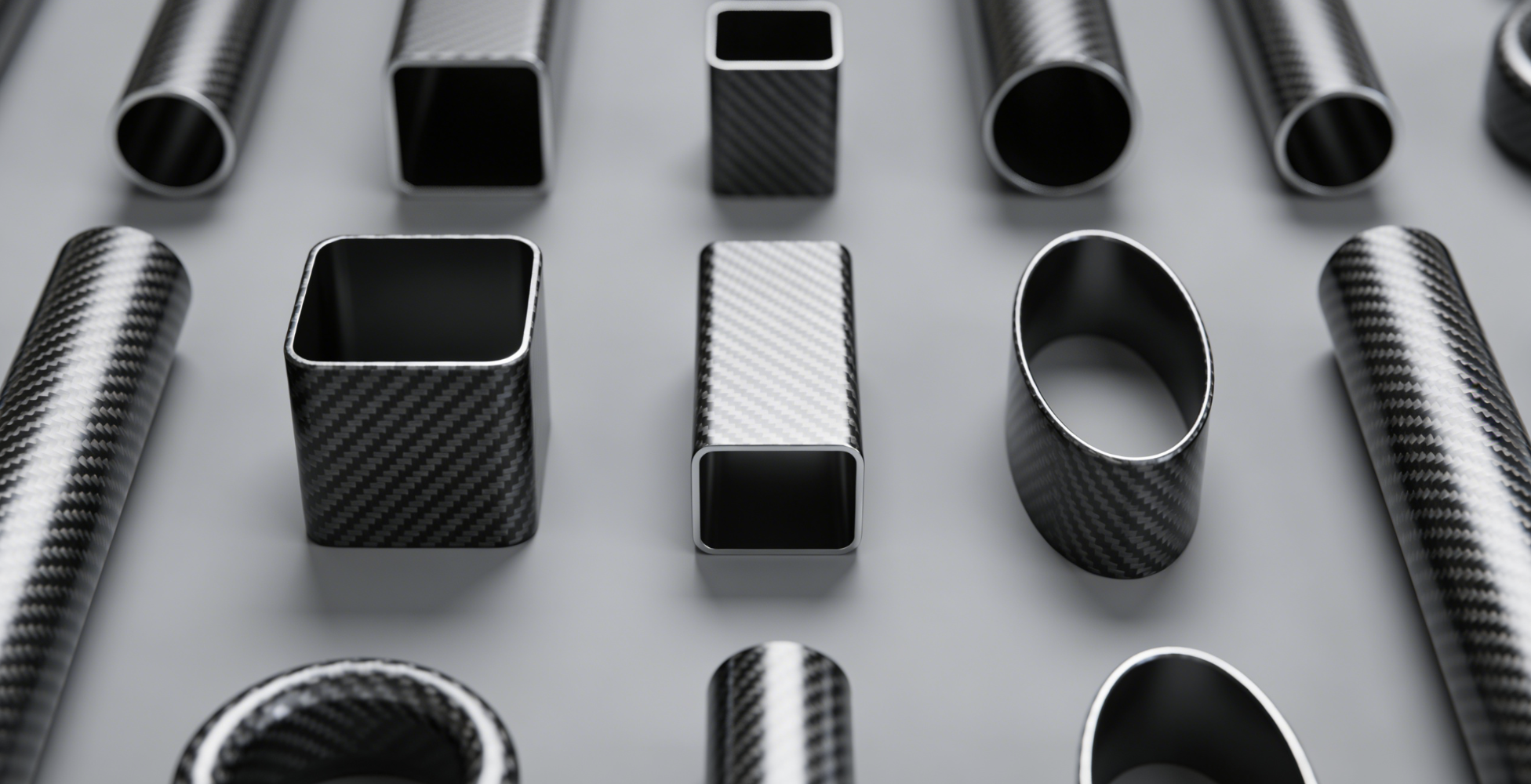
Carbon fiber is one material. The shape you cut it into is a separate decision — and it changes everything.
Square, rectangular, and oval profiles each solve a different structural problem. Each one distributes load in its own way. They resist bending on different axes. And they fit into assemblies in ways the other shapes cannot.
Here’s the short version:
-
Square tubes deliver balanced stiffness on all four sides — ideal for structures that take load from multiple directions
-
Rectangular tubes trade symmetry for directional strength — dominant on one bending axis, which is what certain frames and arms need
-
Oval tubes add aerodynamic efficiency — their tapered profile cuts through airflow while still carrying real structural load
One more thing worth knowing: tube exterior composition changes performance too. A unidirectional (UD) exterior gives you better bending stiffness. A twill fabric exterior gives you stronger hoop resistance. It also handles drilling without splintering — a real advantage when your structure needs holes.
All three profiles share one thing: carbon fiber still outperforms every metal on strength-to-weight ratio — including titanium. The shape just determines how that strength gets put to work.
Carbon Fiber Square Tube Sizes, Wall Thickness & Weight Specifications
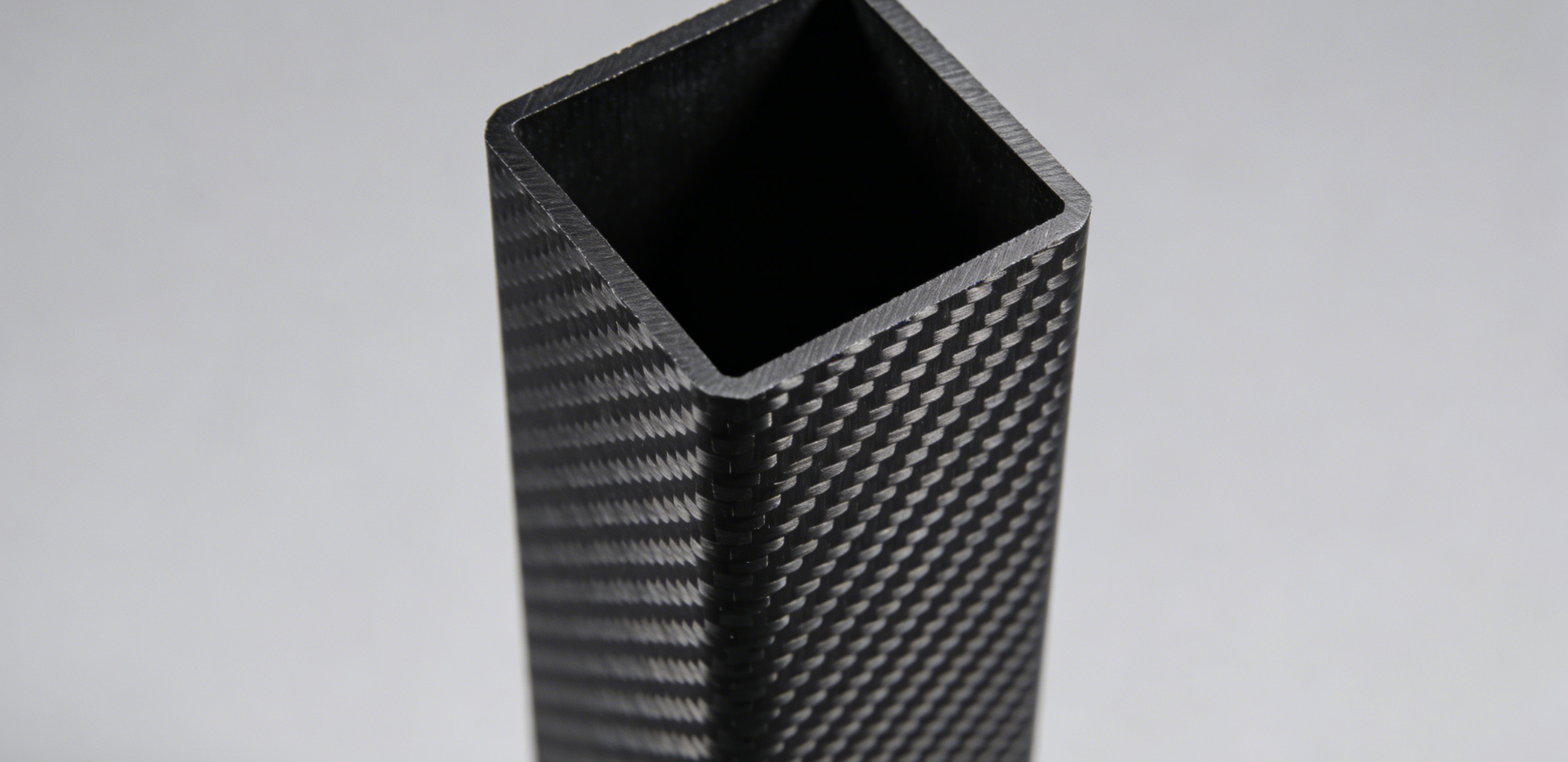
Standard carbon fiber square tubes start at 2mm miniatures and go up to 30×30mm structural sections. Wall thickness runs from 0.5mm on the thin end to 2.5mm on the heavy-duty end. The right size depends on what your application needs.
That range matters more than you’d think. A 2×2mm tube with a 0.5mm wall weighs almost nothing. A 30×30mm pultruded section with a 2.5mm wall carries a tensile load of 677 kN. Same shape. Two very different structural tools.
Size & Weight Reference Table
Here are common carbon fiber square tube dimensions at 1000mm length:
|
Outer Size (mm) |
Inner Size (mm) |
Wall Thickness (mm) |
Weight per 1000mm (g) |
|---|---|---|---|
|
10 × 10 |
8 × 8 |
1.0 |
62 |
|
15 × 15 |
13 × 13 |
1.0 |
90 |
|
15 × 15 |
12.5 × 12.5 |
1.25 |
120 |
|
15 × 15 |
12 × 12 |
1.5 |
133 |
|
18 × 18 |
15 × 15 |
1.5 |
153 |
|
20 × 20 |
18 × 18 |
1.0 |
126 |
|
20 × 20 |
17 × 17 |
1.5 |
181 |
|
30 × 30 |
25 × 25 |
2.5 |
— |
Wall thickness controls stiffness and load capacity — not just weight. A 1.0mm wall at 20×20mm saves 55g per meter compared to the 1.5mm version. Across a multi-member frame, that difference adds up fast.
What the Numbers Tell You
The 30×30mm pultruded carbon fiber square tube makes the case for this material clearly. You get 677 kN tensile strength at just 2.5mm wall thickness. Roll-wrapped square tubes take it further — modulus values reach 33 MSI, and ultimate tensile strength hits 700 KSI, measured at a Tg of 250°F.
Smaller profiles start at 2mm outer dimension. These suit precision instrument housings and micro-robotics builds where every fraction of a gram counts.
Carbon Fiber Rectangular Tube Sizes, Aspect Ratios & Custom Configurations
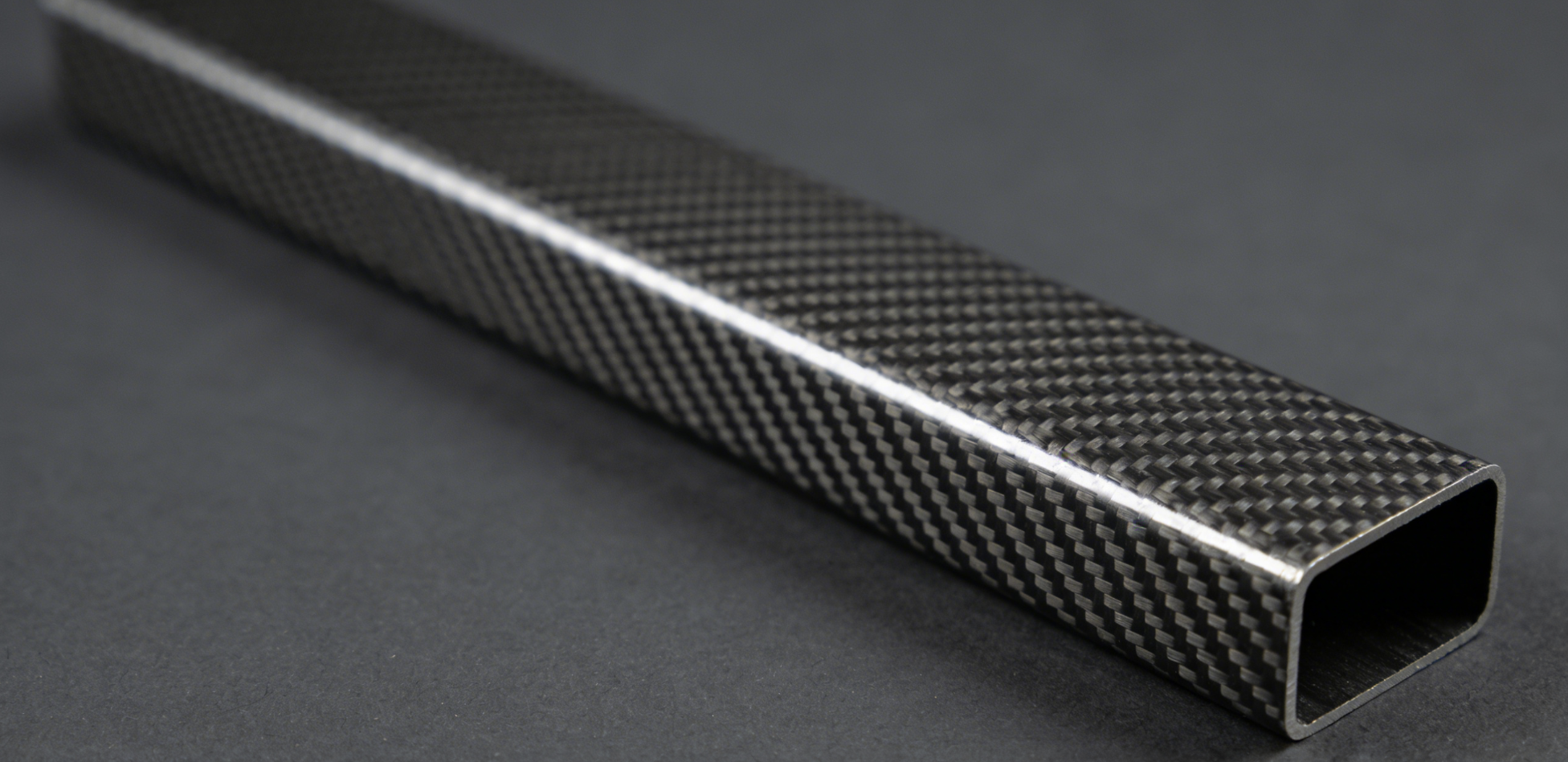
Rectangular carbon fiber tubes keep pointing engineers back to the same ratio: 1:2. It solves more structural problems than any other proportion.
The data backs this up. The 6.3×13.2mm section hits a 1:2.1 ratio. The 60.3×119.6mm structural profile lands at 1:2.0. Imperial sizes follow the same pattern: 1.0″×2.0″ ID, 0.625″×1.25″ ID. That ratio is no accident. It pushes bending stiffness to its peak on the primary load axis. At the same time, it keeps cross-sectional area — and total weight — in check.
Standard Sizes & Stiffness Data
Standard carbon fiber rectangular tubes come with wall thickness from 1.4mm to 6.0mm. Custom builds can go thinner — down to 0.5mm — or heavier, up to 6.0mm for high-load applications.
Here are the stiffness numbers:
|
Size (mm) |
Wall (mm) |
Stiffness (I×E, kNm²) |
Weight (kg/m) |
|---|---|---|---|
|
30 × 30 |
1.0 |
2.05 |
0.18 |
|
40 × 40 |
1.0 |
4.74 |
0.24 |
Going from 30mm to 40mm gives you 2.3× more stiffness. You only add 33% more weight to get there. That’s a trade-off structural engineers can actually use.
Custom Configurations
Standard catalog sizes cover most builds. For everything else, custom fabrication gives you far more range:
-
Dimensions: outer profiles up to 500mm, lengths up to 5 meters
-
Laminate options: unidirectional axial plies with 90° hoop layers, or braided fabric over a UD core for stronger torsion and side-load resistance
-
Finishes: 200+ shape, size, and surface combinations — matte, glossy, or twill weave exterior
-
Cut tolerance: precision cut-to-length on request
There’s one key process difference worth knowing. Braided rectangular tubes outperform pultruded sections under torsional and off-axis loads. Pultrusion lines up fibers along one axis. That works well for straight tension and compression. It struggles once loads hit from unexpected angles. Your assembly twists or takes side impacts — braided construction handles that. Pultruded sections do not.
Minimum order starts at $400. For structural-grade or aerospace-spec configurations, lead time and laminate schedules are set at inquiry.
Carbon Fiber Oval Tube Specifications, Aerodynamic Profile & Custom Design
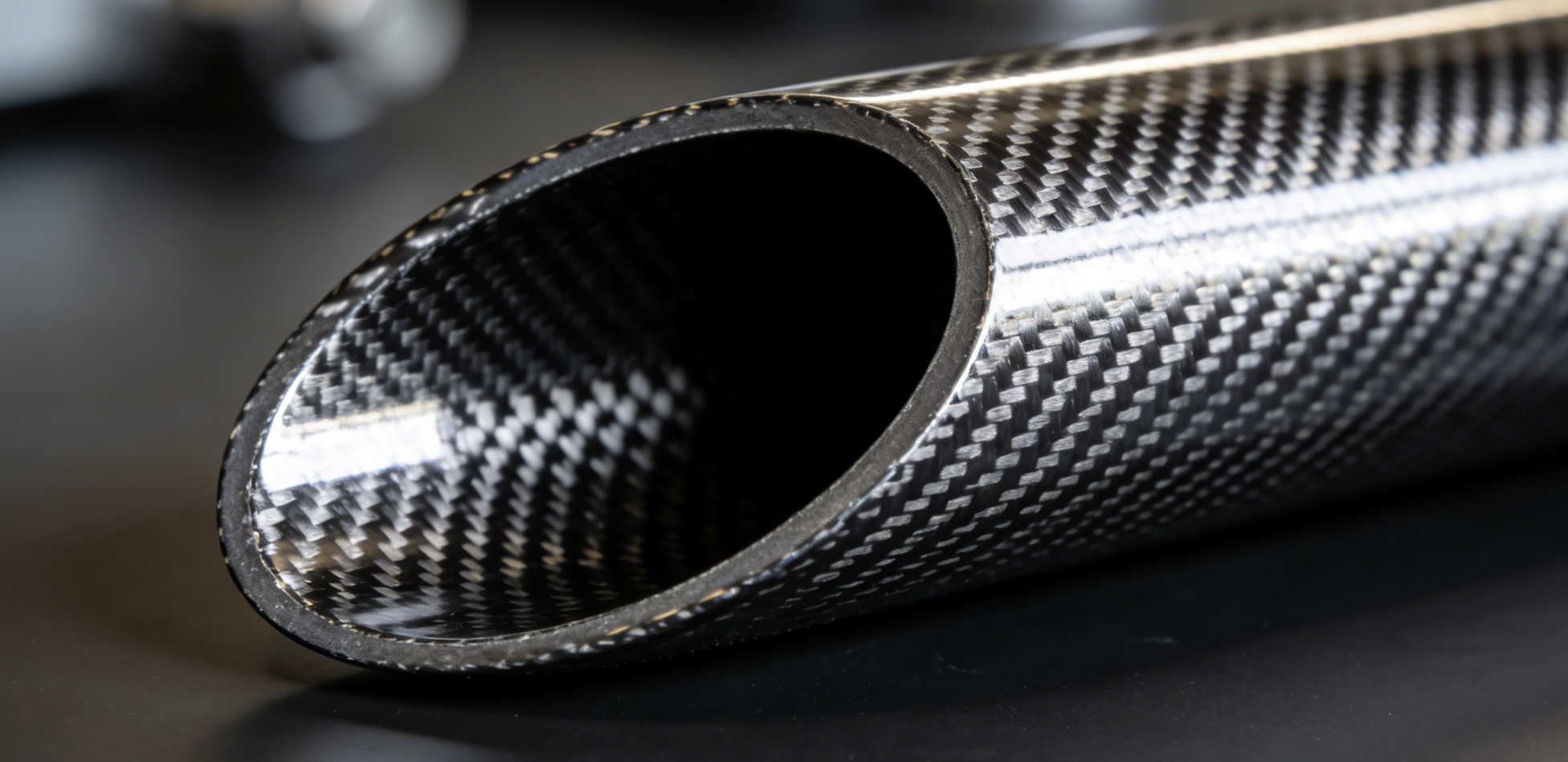
Oval tubes solve a problem that square and rectangular profiles cannot: they cut through air. Round and flat profiles create drag. Oval tubes don’t.
The asymmetric cross-section is structural, not decorative. A major-to-minor axis ratio of 3:1 — like Rock West’s 97mm × 25.4mm profile — reduces drag without sacrificing load capacity along the main bending axis. That’s why aerospace struts, racing bike frames, and UAV booms use oval tubing. Aerodynamic drag isn’t an afterthought in those builds. It’s part of the structural math.
Dimensional Specifications & Engineering Properties
Oval tubes come in a wider range of proportions than most engineers expect:
|
Profile |
OD (mm) |
Wall (mm) |
Weight (kg/m) |
Torsion Stiffness (kNm²) |
|---|---|---|---|---|
|
C-Tech 12.7mm equiv. |
12.7 |
— |
0.06 |
0.05 |
|
C-Tech 16mm equiv. |
16.0 |
— |
0.08 |
0.10 |
|
C-Tech 17.5mm equiv. |
17.5 |
— |
— |
0.12 |
|
ClipCarbono 57×35mm |
57 × 35 |
1.0 |
— |
— |
|
Rock West 97×25.4mm |
97 × 25.4 |
~1.5 |
0.50 |
— |
Rock West’s structural-grade oval comes with verified mechanical data. Young’s modulus on the primary axis hits 1.165×10⁷ psi. Tensile yield strength reaches 70,340 psi along the tube’s length. Compressive yield goes higher at 74,970 psi — the tube handles compression better than tension, which matters under column loading. Shear strength sits at 16,360 psi. These are not catalog estimates. They come from a 9–10 layer laminate built on a defined ply sequence: 0°, 0°, 45°, -45°, 45°, -45°, 0°, 0°, 0/90°.
That layup is worth understanding. The outer 0° plies carry axial bending loads. The ±45° core handles torsion and shear. The 0/90° innermost ply closes out the structure. Each layer is 0.006 inches thick, built from 3K 2×2 twill pre-preg using Tenax UTS50 fiber and Eporite EHM32 resin.
Custom Design Parameters
Standard oval profiles cover most common applications. Custom fabrication gives you more control:
-
Lengths: up to 3m, 4m, or 5m depending on tooling
-
Fiber orientation: variable per layer — you can tune stiffness, torsion resistance, or weight as separate priorities
-
Surface finish: matte or glossy; twill weave exterior available
-
Tolerance: ±0.2mm on OD as standard (ClipCarbono spec)
-
Temperature compatibility: high-temp resin systems available on request
One constraint applies across all oval profiles. Wall thickness below 1.0mm raises delamination risk at the curved minor-axis corners during drilling or fastening. Sort out your attachment method before you lock in the wall spec.
Square vs Rectangular vs Oval Carbon Fiber Tube: Head-to-Head Comparison
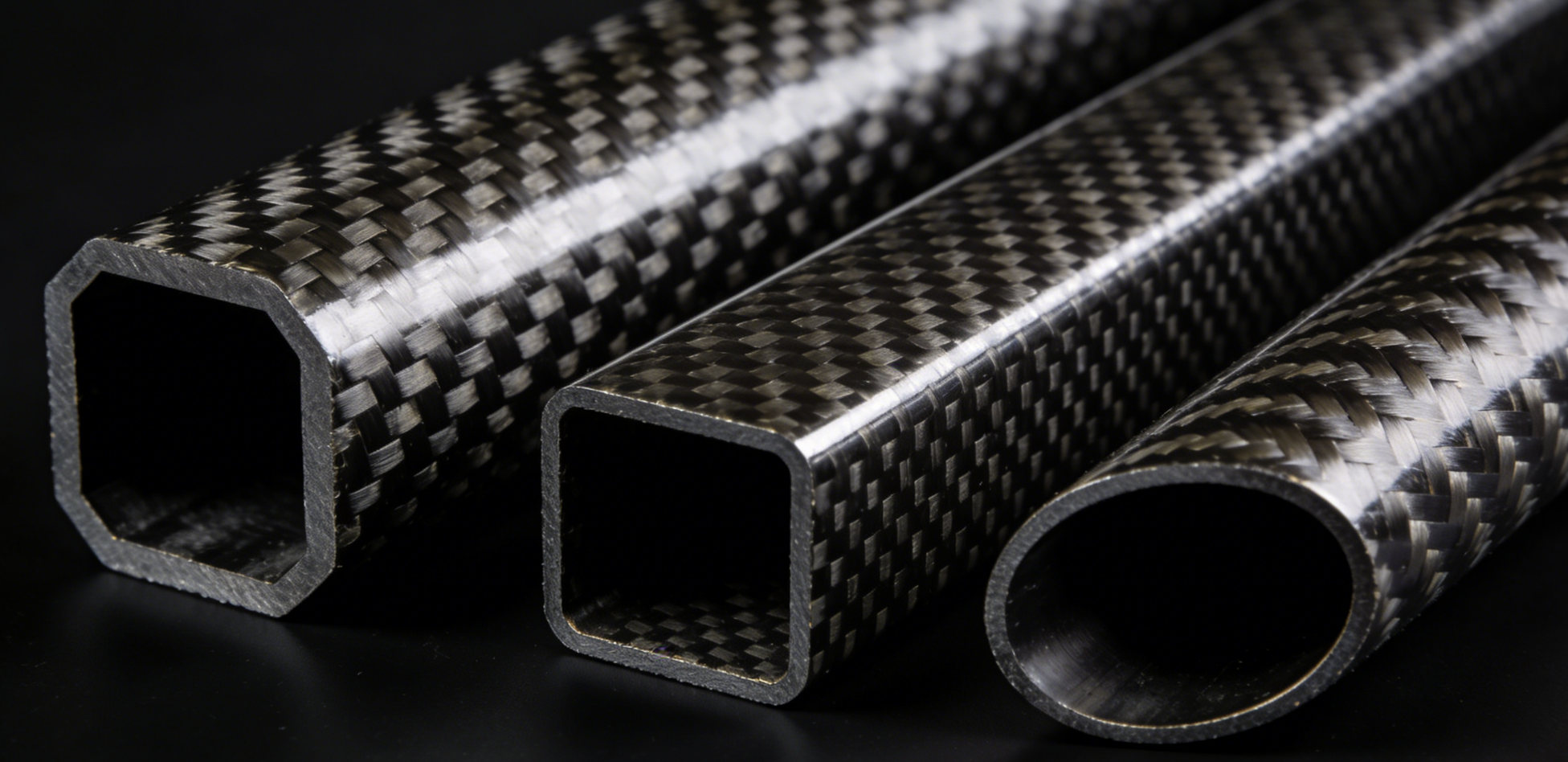
Three profiles. One material. Structural behavior that differs in every way.
Your shape choice controls how load moves through the structure. It sets where stress builds up. Get it wrong, and your build fails at the worst possible moment. Here’s how each profile compares.
Stiffness & Bending Behavior
Square tubes give you balanced bending stiffness across every in-frame axis. That symmetry is the whole point. CNC gantries, UAV arms, rigid support brackets — all of these take load from multiple directions. Square geometry handles every direction without a weak axis.
Rectangular tubes concentrate stiffness along one primary axis. That’s a deliberate trade-off. Your load is predictable and directional. So rectangular geometry gives you the highest bending resistance for the least cross-sectional material. The math backs it up: flexural stiffness scales with h³, so a taller section gains stiffness fast.
Oval tubes work differently. Their asymmetric profile cuts aerodynamic drag and keeps primary-axis load capacity intact. Aerospace struts and racing bike stays use oval geometry because drag is part of the structural equation — not an afterthought.
Torsion, Assembly & Practical Trade-offs
|
Property |
Square |
Rectangular |
Oval |
|---|---|---|---|
|
Torsional resistance |
Moderate — corner stress under high torque |
Lower — off-axis loads need braided layup |
Good along major axis |
|
Mounting |
Direct bolt-through, self-aligning |
Direct bolt-through |
Requires custom clamps |
|
Positioning accuracy |
High — flat faces eliminate rotation |
High on primary axis |
Moderate |
Square tubes are the easiest to assemble. Flat faces bolt straight through without collars. They self-align, which cuts adjustment time. Field data from drone frame builds shows a 26% improvement in positioning accuracy and 15% reduction in end-effector vibration after switching from round to square profiles.
Oval and rectangular tubes cost less to produce in standard pultruded runs. But the extra tooling complexity for square profiles pays off through integration savings later in the build.
Which Profile Fits Your Build
-
Square tube: modular frames, gantries, robotic arms, sensor brackets — any build where precision and multi-axis rigidity matter more than aerodynamics
-
Rectangular tube: directional beams, primary structural members, builds with a single dominant load axis
-
Oval tube: UAV booms, aerodynamic struts, racing structures where airflow resistance is a real, measurable performance factor
Industry Applications: Real Use Cases by Sector
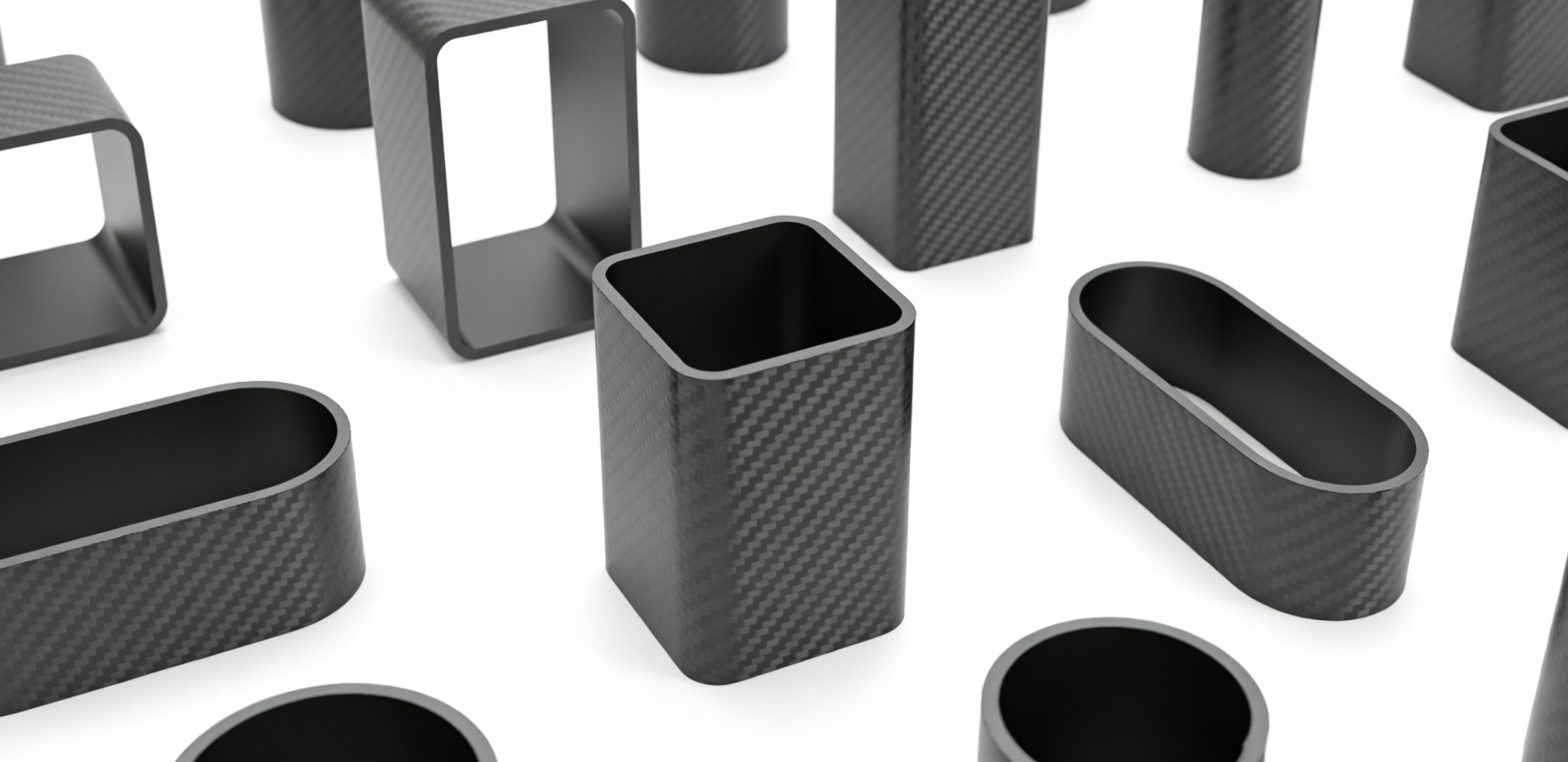
Carbon fiber square tubes, rectangular tubing, and oval profiles don’t stay in a lab. You find them in the most demanding corners of modern engineering. The sectors pushing these materials hardest all face the same pressure: every extra gram is a design failure.
Drones & UAV Frames
Drone manufacturers switched to carbon fiber square tube frames because round profiles couldn’t fix the alignment problem. Flat faces bolt clean. Arms self-locate. Vibration at the end-effector drops. Round tubing can’t do that structural work — the geometry just isn’t there.
For UAV booms where airflow matters, oval profiles take over. The asymmetric cross-section cuts drag without giving up axial load capacity. That’s what long-range fixed-wing platforms and racing UAVs need.
Robotics & Automation
Robotic arms need stiffness on every axis at once. A small deflection at the joint turns into positional error at the tool. Square carbon fiber tubes fix this head-on. Balanced bending stiffness means no weak axis — no matter where the load comes from.
Aerospace & Motorsport
Aerospace struts and racing chassis members use rectangular and oval profiles where the load direction is known and fixed. Directional strength beats symmetric geometry here. Weight gets cut on axes that carry nothing, and that’s the point.
Industrial & Structural Builds
CNC gantries, precision fixtures, and structural frames rely on square pultruded sections for a specific reason. You get dimensional accuracy, high tensile strength, and consistent wall tolerances — all in one profile. Aluminum extrusions can’t match that at the same weight.
How to Select the Right Carbon Fiber Tube: A Practical Sizing Guide
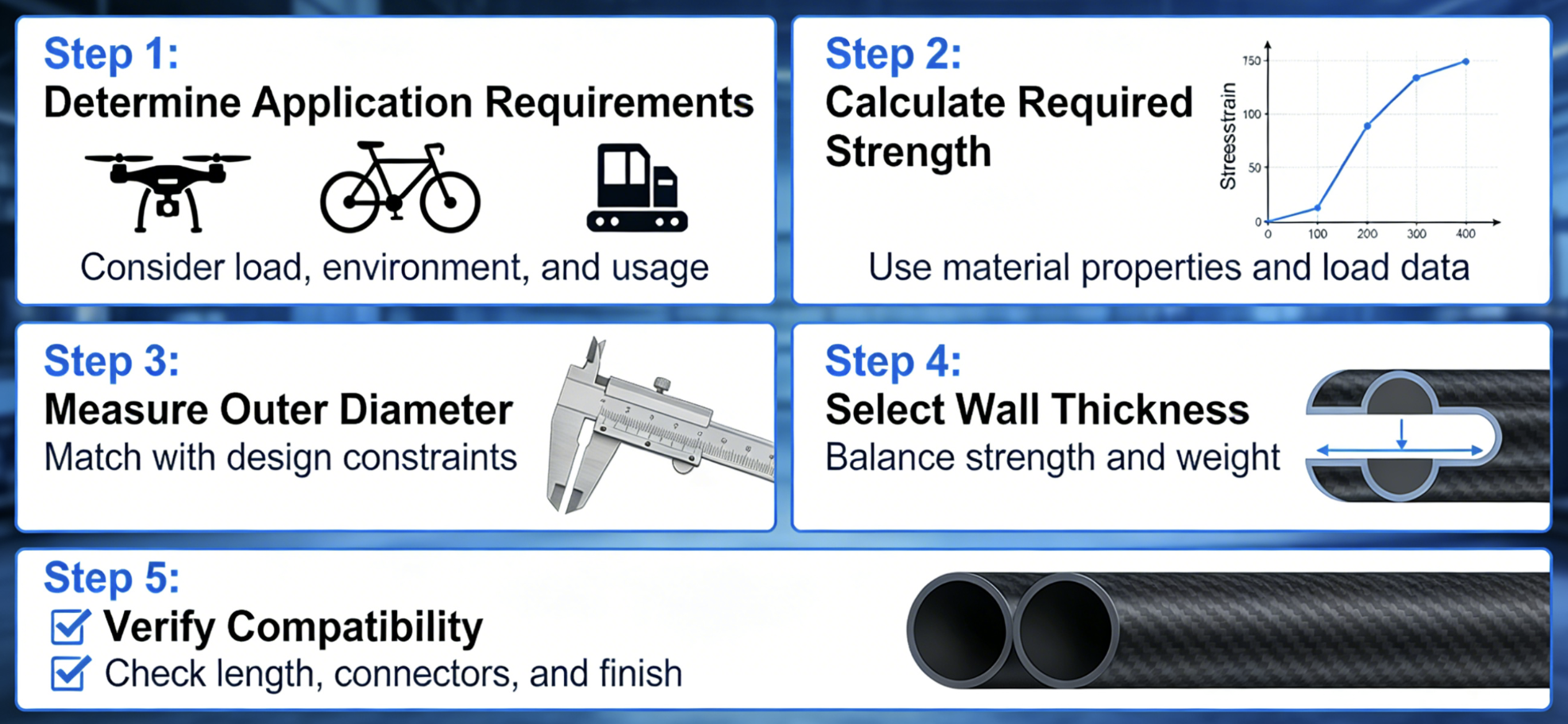
Five variables decide whether your tube selection works or fails. Go through each one in order — load path, outer dimension, wall thickness, fiber layup, and tolerance class. Do that, and you cut out most selection errors before you order a single part.
The Four-Step Selection Process
Step 1 — Identify your dominant load type. Your tube faces axial tension, compression, bending, torsion, or a mix of these. One load type tends to take the lead. Pin that down before you open a spec sheet.
Step 2 — Set the outer dimension. A larger OD boosts bending stiffness and buckling resistance without much weight added. A smaller OD fits compact or weight-sensitive builds. Use this size-to-application map as your starting point:
|
Outer Size Range |
Recommended Wall |
Typical Use |
|---|---|---|
|
4–6 mm |
0.3–0.8 mm |
FPV drone arms, medical guide tubes |
|
8–12 mm |
0.8–1.5 mm |
Camera gimbals, robotic linkages |
|
15–20 mm |
1.0–2.0 mm |
Sprayer booms, automotive structures |
|
25–30 mm |
1.5–3.0 mm |
Industrial rollers, surveying spars |
|
35–60 mm |
2.0–5.0 mm |
Wind-turbine webs, heavy-duty arms |
Step 3 — Calculate wall thickness against actual loads. Use σ_allow = 600 MPa for T300 fiber and 800 MPa for T800. Thicker walls give you more buckling resistance. Thinner walls need a well-planned layup to make up for it.
Step 4 — Select fiber orientation to match your load. This is where most engineers lose performance by not making a deliberate choice:
– 0° plies: axial strength and stiffness
– ±45° plies: torsion and shear resistance
– 90° plies: hoop strength and crush resistance
Minimum bend radius ties directly to wall thickness — a 1mm wall needs a 50mm radius; a 3mm wall needs 250mm. Push past those limits and delamination starts at the inner radius. Standard diameter and wall tolerance stays at ±0.1mm across the full range. Custom profiles go up to 500mm outer diameter and 5 meters in length.
FAQ: Carbon Fiber Square, Rectangular & Oval Tube Buying Questions Answered
Engineers ask the same questions before every order. Here are straight answers.
What tolerances should I expect on carbon fiber square and rectangular tubes?
Standard dimensional tolerance is ±0.1mm on OD, ID, and wall thickness. Length tolerance runs ±0.010–0.015 inches, depending on profile. Got a tight fit? Check with calipers or a micrometer before assembly.
How many plies make up a typical wall?
Each prepreg layer adds 0.006 inches. A 1/16-inch wall equals 9–10 plies. A 0.088-inch wall on a 1.0×1.176-inch rectangular tube follows the same math. Ply count drives stiffness and torsional resistance. It also affects how clean a drilled hole comes out — fewer plies, rougher result.
What’s the lightest carbon fiber square tube available?
A 10mm OD × 8mm ID section with a 1mm wall weighs 0.04 kg/m. Scale up to 50mm OD and that rises to 0.34 kg/m. Density stays at 1.5–1.6 g/cm³ across all profiles — square, rectangular, and oval alike.
Can I get custom lengths and oversized profiles?
Yes. Rectangular and oval profiles go up to 500mm diameter and 5 meters in length. Thin-wall options are available across both square and rectangular series. Minimum order starts at $400 for structural or custom builds. Contact hyperxcarbon.com to confirm lead time and laminate schedule.
Which fiber and resin systems are standard?
Most structural profiles use Tenax UTS50 fiber with Eporite EHM32 resin. Layup patterns include 3K 2×2 twill and spread-tow. Every batch goes through inspection — we check fiber tensile strength, modulus, and resin viscosity before anything ships.
Conclusion
Picking between a carbon fiber square tube, rectangular profile, or oval section goes beyond personal preference. It’s an engineering decision that shapes weight savings, structural rigidity, and long-term field performance.
The right shape cuts out overengineering. The right wall thickness keeps you within your weight budget. The right supplier keeps your project on schedule.
At HyperX Carbon, every profile we manufacture is backed by verified mechanical data — not marketing estimates. That covers everything from tight-tolerance pultruded square sections to oval tubes shaped for low aerodynamic drag.
You’ve found the spec you need. Don’t let that stop here.
Request a quote, submit your custom dimensions, or talk to our engineering team. Most inquiries come back within 24 hours. The people building serious things don’t have time to wait — and neither do we.
Your next build deserves material that performs as hard as you do.
Contact HyperX Carbon – Your Trusted Chinese Carbon Fiber Partner
Ready to source high-performance carbon fiber materials or custom forged carbon fiber parts from China?
HyperX Carbon is a leading manufacturer with 20+ years of expertise, specializing in aerospace-grade forged carbon fiber, prepreg, tubes, sheets, and lightweight automotive/drone/medical components. We offer:
-
Stable supply chain with premium raw materials (Toray, Mitsubishi, Hengshen)
-
AS9100D certified production for aerospace & UAV applications
-
Rapid prototyping (5-8 weeks) and monthly capacity exceeding 180,000 parts
-
Competitive pricing with 15-18% cost savings on forged carbon solutions
-
Full customization: from T700/T1100G to ultra-high modulus grades
Whether you’re an eVTOL developer, automotive OEM, drone manufacturer, or medical device engineer, HyperX delivers consistent quality, batch-to-batch reliability, and reliable delivery.
Get in touch today for a free consultation, custom quote, or material sample.
📧 Email: [email protected]
🌐 Website: https://www.hyperxcarbon.com/
📞 Phone/WhatsApp: +86 15623270276 (English support available)
Let’s build your next lightweight innovation together – contact HyperX Carbon now and stay ahead in the low-altitude and advanced composites market.




