
Choosing the wrong carbon fiber rod wastes money. Worse, it can compromise an entire build.
Building a lightweight UAV frame? Reinforcing a structural panel? Sourcing carbon fiber bars for a precision manufacturing run? The rod type you pick makes a real difference. A pultruded round rod and a hollow square section are not interchangeable. One performs. The other fails.
This guide gives you a full breakdown of every rod type. You’ll get a head-to-head technical comparison of key mechanical properties. Plus, there’s a practical sizing framework matched to real-world applications. By the end, you’ll know what to order — and why.
Solid vs Hollow vs Square vs Round vs Pultruded: Complete Type Breakdown
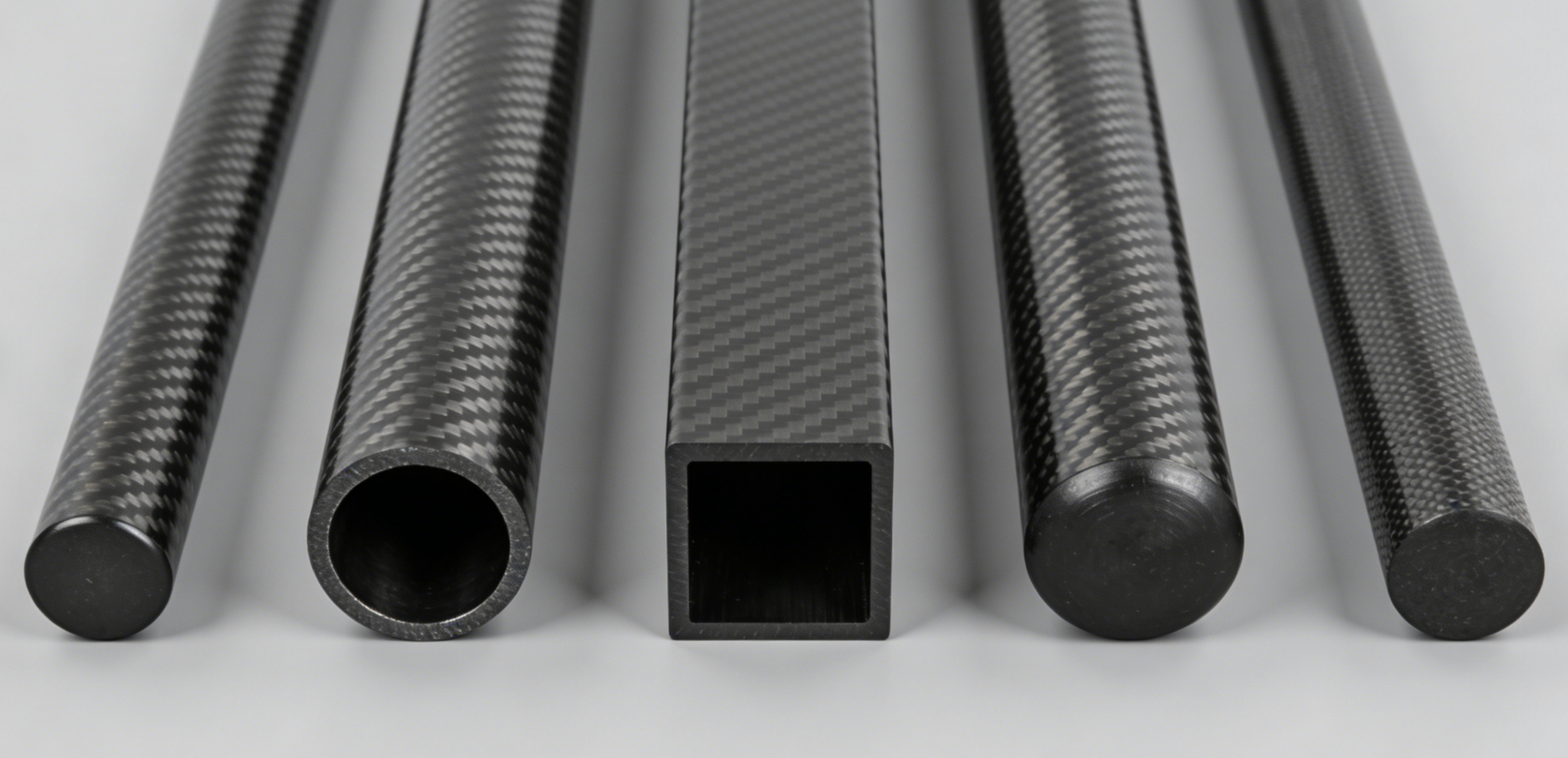
Five rod types. Each one built for a different set of demands. Pick the wrong one and you’re not just leaving performance behind — you’re breaking things.
Here’s how each type behaves under load.
Solid Carbon Fiber Rods: Maximum Stiffness, Maximum Weight
A solid rod gives you a uniform cross-section from surface to center. Every fiber is working. That gives you maximum crush resistance and the highest axial stiffness of any rod shape.
The tradeoff is weight. Solid rods run 40–50% heavier than a hollow rod of the same outer diameter. Your design has a strict mass budget? That gap adds up fast.
Solid rods belong in:
– Applications where compressive load is constant and weight is secondary
– Structural pins
– Press-fit dowels
– High-load robotic linkages
– Any spot where a hollow wall would buckle before the job is done
Hollow Carbon Fiber Rods: The Weight-Efficiency Workhorse
Hollow rods cut material from the core — the zone where stress is lowest. The result is dramatic. A 10mm OD hollow rod with a 1mm wall keeps 85% of the solid rod’s strength while taking 350–400 lbs (160–180 kg) in compression.
The weight savings are real:
– Hollow rods use 40% less material
– They come in 40–50% lighter than solid
– For drone and RC aircraft builds, that’s 40%+ less weight versus solid — and 75% lighter than comparable steel sections
– Tensile strength holds at 120,000–175,000 psi — about 2.5 times that of aluminum
Standard wall thickness runs 0.5–3mm. Outer diameters span 3–20mm. The roll-wrapped process lines up fibers to maximize tensile strength along the axis. It also builds in useful vibration damping as a bonus.
One weakness to know: hollow rods give up some crush resistance. Point loads at the wall are a problem. Plan around it — use proper end fittings or reinforced contact zones.
Square Carbon Fiber Bars: Built for Torsion
Geometry matters more than most buyers expect. A square carbon fiber bar is 170% stiffer in torsion than a round rod of the same cross-sectional size. To match that torsional stiffness with a round rod, you’d have to increase its diameter by 114%.
A 0.200″ × 0.240″ rectangular section is a good example. It blocks rotation in ways a round rod can’t match. Structural frames, flat-sided linkages, precision alignment channels — those are square bar jobs.
Round Carbon Fiber Rods & Dowels: Clean Joints, Known Limits
Round profiles — including standard 4mm and 8mm carbon fiber dowels — are the go-to where joint alignment matters. Circular cross-sections drop straight into drilled holes, bushings, and clevis fittings. No angular indexing error to worry about.
The weak point is side loading. Round rods don’t handle lateral force well without extra support. Fix that with hoop-wrapped reinforcement at load points, or brace the assembly from the outside. A bare round rod in a cantilevered side-load setup will not hold — don’t expect it to.
Pultruded Carbon Fiber Rods: Axial Champions With Real Brittleness
Pultrusion pulls fibers through resin and a heated die in one continuous pass. You get a rod with maximum longitudinal tensile strength — fiber alignment along the axis is near-perfect.
That directional strength comes with a clear downside. In a 3-point bend test, a pultruded rod fails at 140 kg. A roll-wrapped hollow rod of the same diameter survives 200 kg. The gap comes from interlaminar shear resistance — pultruded rods have almost none in the hoop direction.
Impact loads are the real problem. Pultruded rods split and shatter under sudden lateral force. People using them in high-impact environments report breaks often. That’s not a defect — it’s physics. These rods are built for push-pull loading, not shock or impact.
Best uses:
– UAV frames
– Kite spars
– Robotics push rods
– Tent poles
– Arrow shafts
– Instrument necks
These are all axial, predictable, controlled loads — exactly what pultruded rods handle well.
One fitment note: OD/ID tolerances on pultruded rods are often tight. Light sanding is common for telescoping assemblies. Don’t count on press-fit straight out of the box.
On a tighter budget? Carbon/glass hybrid pultruded rods are worth a look. A [C/G/G/C] layup mixes carbon’s stiffness with glass fiber’s toughness. Brittleness drops. So does cost. There’s impact risk but full carbon performance isn’t a must? The hybrid is a solid pick.
Quick-Reference Comparison
|
Type |
Weight vs Solid |
Retained Strength |
Key Weakness |
Best Use |
|---|---|---|---|---|
|
Solid |
100% (baseline) |
Maximum |
Heaviest option |
Compression, structural pins |
|
Hollow |
50–60% |
~85% |
Crush at wall |
Drones, RC frames, spars |
|
Square |
Similar to round |
170% torsional vs round |
Limited profile options |
Torsional frames, alignment rails |
|
Round |
Similar to square |
Strong axial/joint |
Side load weakness |
Dowels, linkages, shafts |
|
Pultruded |
Light (small OD) |
Max axial; ~140kg bend |
Brittle under impact |
Push-pull rods, kites, robotics |
Each type has a job it was built for. Match the rod to the load — not the other way around.
Carbon Fiber Rod Technical Specifications: Full Parameter Comparison Table
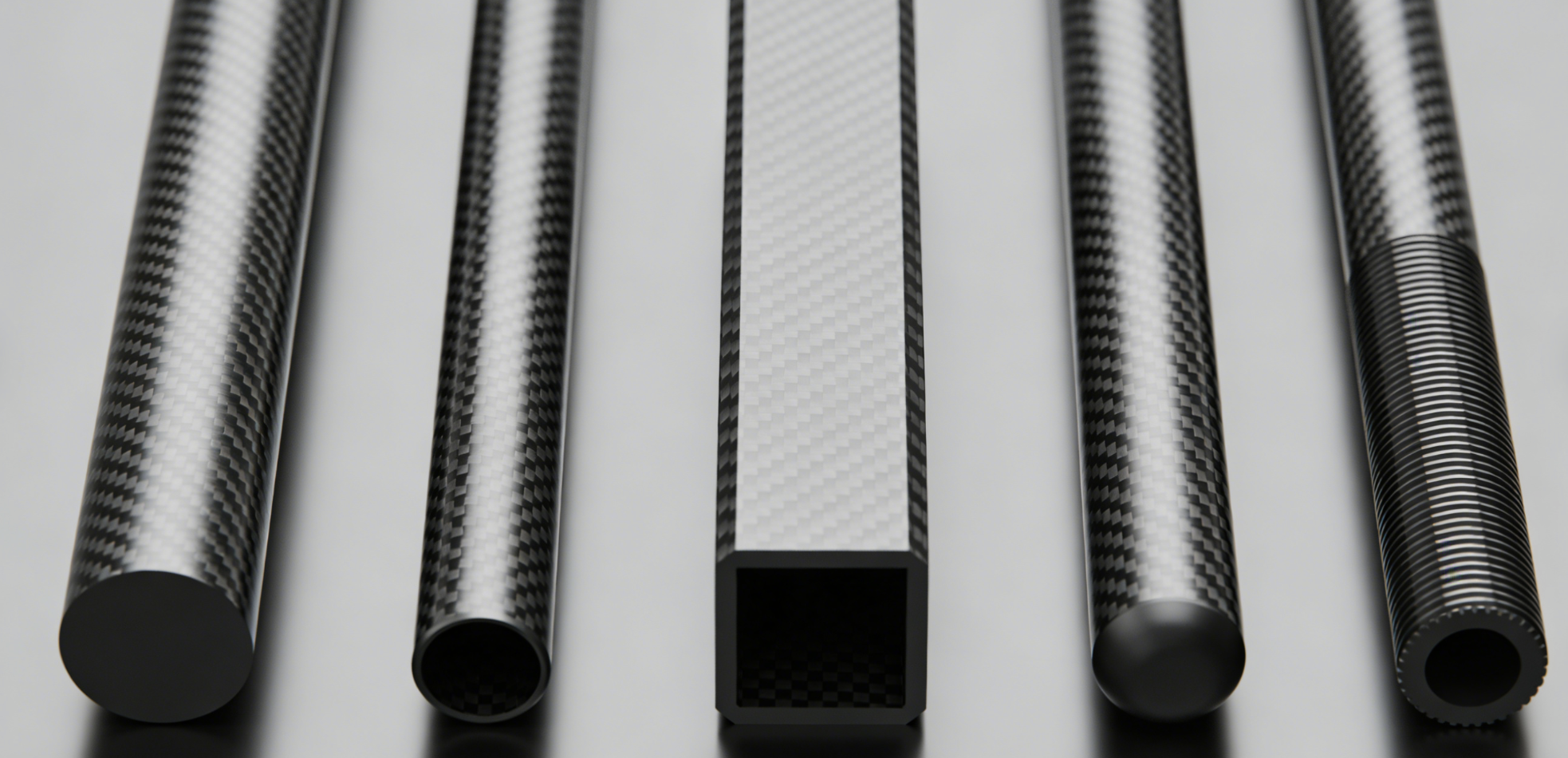
Numbers separate the right rod from the wrong one. Here’s every parameter that matters, laid out clearly.
Core Mechanical Properties by Rod Type
|
Parameter |
Standard Rod (>3.96mm) |
Small Rod (<3.96mm) |
Pultruded HT Rod |
High Modulus CF |
|---|---|---|---|---|
|
Density (g/cm³) |
1.54–1.65 |
1.54–1.65 |
~1.6 |
~1.6 |
|
Tensile Strength (MPa) |
1,720–1,830 |
2,340–3,447 |
2,500–4,900 |
2,400–4,500 |
|
Flexural Modulus (GPa) |
131–138 |
131–134 |
230 |
430 |
|
Fiber Volume |
62% |
67% |
63% |
63% |
|
Diameter Range |
6–10mm |
3–8mm |
6–10mm |
6–10mm |
|
Straightness Tolerance |
— |
±5% dia. |
2mm/1000mm |
2mm/1000mm |
How Carbon Fiber Stacks Against Steel, Aluminum, and Glass Fiber
The density gap alone justifies the switch. Carbon fiber rods run 1.54–1.65 g/cm³. Steel sits at 7.85 g/cm³. That’s a 51% weight reduction in real structural applications.
The performance gaps go well beyond weight:
-
Tensile strength: CFRP delivers 1,720–3,447 MPa. Aluminum manages 300–500 MPa.
-
Flexural modulus: CFRP reaches 124–152 GPa. Glass fiber tops out at 30–50 GPa.
-
Deflection: Carbon rods produce 67% less deflection than glass fiber sections of the same size. This is measured under the same column loading conditions — 200×200×300mm specimens at fck=20 N/mm².
Long-Term Parameters Worth Knowing
Two specs stand out over a product’s life:
-
Thermal expansion coefficient: The axial CTE stays near zero — under 5×10⁻⁶/°C. Steel’s CTE hits 12×10⁻⁶/°C. So your assemblies hold tight tolerances across temperature swings for 15+ years.
-
Corrosion resistance: The epoxy matrix does not corrode. You get zero maintenance cost over that same 15-year period. That’s a real edge over steel rebar in structural use.
Glass transition temperature sits at 100°C. That’s the upper service limit for standard resin systems.
Carbon Fiber Rod Applications by Industry: Which Type Do You Need?
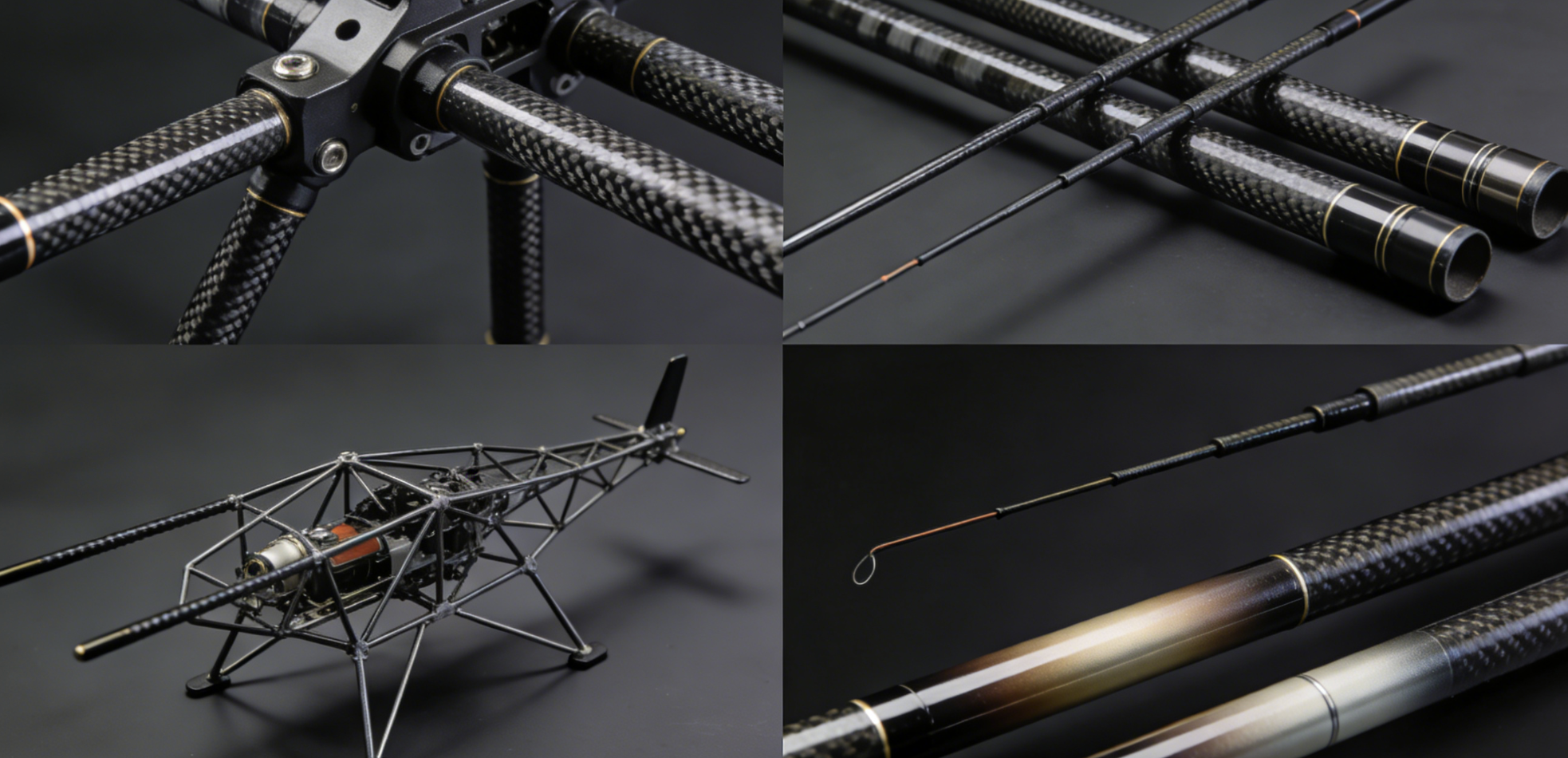
Different industries don’t just use different sizes of carbon fiber rods — they use completely different types, for completely different reasons. A construction engineer and a drone builder might both order “carbon fiber rods.” What lands on their bench should look nothing alike.
Here’s the breakdown by industry, with the specs that matter most.
Aerospace & UAV Frames
Weight is the currency of flight. Every gram you cut is a gram your payload gains.
Drone frames and aerospace structural components call for 8–12mm hollow carbon fiber rods. That’s the standard. A hollow rod with an 8mm ID and 10mm OD gives an airframe the stiffness it needs. It also cuts weight by 43% compared to aluminum sections of the same size. On manned aircraft, those savings add up fast. Fuselage and wing elements built around carbon rod structures shed 20–30% of total structural weight. That translates to a 20% boost in fuel efficiency and a 4-year ROI on material cost.
Spec target: 8mm ID / 10mm OD hollow rod, standard modulus, T700 fiber.
Civil Engineering & Structural Reinforcement
Pultruded rods now do the job steel rebar used to own.
For concrete truss and reinforcement work, 10–25mm pultruded carbon fiber rods meet ACI 440 standards. Tensile strength runs 2,000–3,500 MPa. The corrosion numbers settle most procurement debates on their own. Steel rebar costs around $2.50/m over a 20-year lifecycle. Carbon fiber rods run just $0.50/m over the same span — zero corrosion, zero maintenance, and 70–80% lower long-term cost.
Spec target: 10–25mm pultruded rod, high-tensile grade, corrosion-proof resin system.
Sports Equipment & Road Cycling
Road cyclists feel everything through the frame. Stiffness isn’t a luxury — it’s the product.
Integrated carbon rod kits for performance bikes use 8–10mm solid round rods through frame junctions. A full kit weighs around 1,050g. Lateral stiffness comes in at 200–300 N/mm — about 30% higher than aluminum equivalents. You feel that difference on the road. Vibration damping improves by 25%, so road feedback sharpens without the harshness.
Spec target: Full solid 10mm round rod, high stiffness grade, OD matched to 25.4mm seat tube / 31.8mm head tube.
RC Models, DIY Builds & RC Planes
Budget matters. So does getting the joint right.
For RC aircraft with 1–2m wingspans and DIY frame builds, 4–8mm round carbon fiber pins are the practical pick. Standard builds use tapered sets — 4mm + 6mm + 8mm — bonded with a 1:1 epoxy mix and a 24-hour cure. That gives you joint shear strength of around 500 psi. Compare that to wood: you get a 90% rigidity gain at a fraction of the weight.
Spec target: 4mm round carbon fiber dowel for small joints, stepping up to 6–8mm for primary spar connections.
Musical Instruments
Humidity ruins necks. Carbon fiber doesn’t care about humidity.
0.200″ × 0.240″ square carbon fiber bars embedded in guitar necks have a solid track record spanning a decade. Deflection stays under 0.5mm across 10 years of humidity cycling. Standard epoxy bonding locks them in place. Wood moves; carbon holds. The result is a 95% drop in warp probability compared to unbraced wood necks.
Spec target: Square bar, 0.200″ × 0.240″ profile, bonded with structural epoxy.
Quick Industry Selector
|
Industry |
Rod Type |
Size |
Key Win |
|---|---|---|---|
|
Aerospace / UAV |
Hollow round |
8–12mm |
43% weight cut vs. aluminum |
|
Construction |
Pultruded |
10–25mm |
75% lower corrosion cost vs. steel |
|
Sports / Bikes |
Solid round |
8–10mm |
30% stiffer, 25% better vibration damp |
|
RC Models / DIY |
Round dowel |
4–8mm |
500 psi joint shear, 90% rigidity gain |
|
Instruments |
Square bar |
0.200×0.240″ |
<0.5mm warp over 10 years |
Match the load type first. Match the industry standard second. The right rod is the one built for the forces your application puts on it — not the one that looks close enough on a spec sheet.
Carbon Fiber Rod Sizes Guide: Diameter Selection From 3mm to 50mm
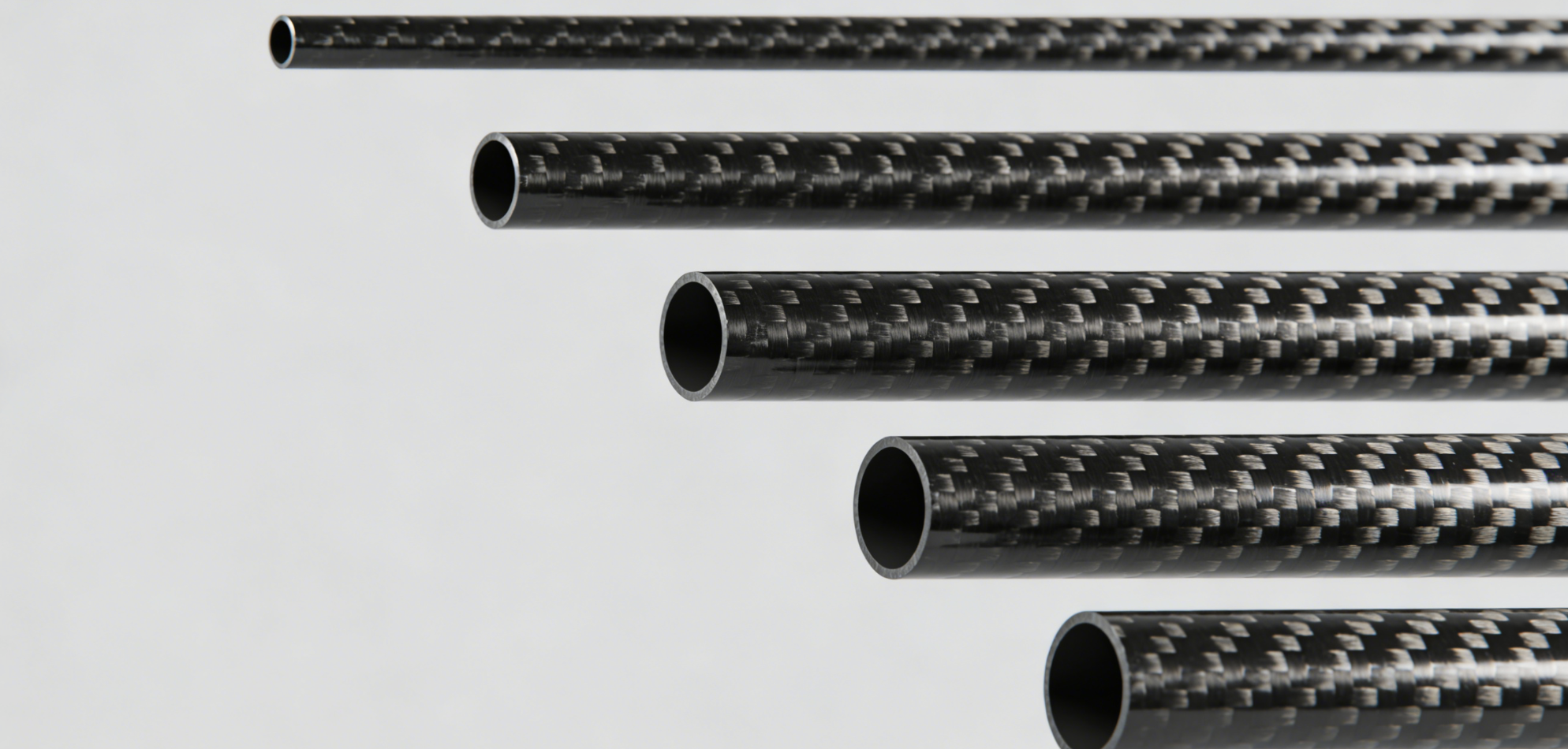
Diameter is where most purchasing decisions go wrong.
Not because buyers don’t know the application — they do. The size chart looks simple until you’re holding a 3mm rod that flexes under load, or a 12mm rod that blew the weight budget on a drone arm you’ve already machined.
The full range runs 1mm to 50mm. Standard increments cover 1, 2, 3, 4, 5, 6, 8, 10, 12, 15, 20, and up to 50mm. Custom cuts are available across the board.
3mm–6mm: Precision and RC Builds
Small diameters are for builds where every gram counts.
A 3mm × 500mm pultruded rod weighs 1–2g. RC hobbyists and instrument makers reach for this size when they need serious strength in a near-weightless form. Tensile strength holds up well here — the epoxy matrix keeps fiber alignment tight even at this scale.
Step up to 6mm and you hit a real crossover point. A 6mm pultruded rod delivers tensile strength above 3,500 MPa at just 1.5 g/cm³. That weight-to-strength ratio makes this range the go-to for precision applications. Smaller rods in this band flex under lateral force. That’s useful in some builds and a problem in others. Know which one applies to your design.
Pricing: $0.60–$2.50 per piece at 50-piece minimums. Most sizes ship in stock.
8mm–12mm: The High-Traffic Zone
This is where the workhorse diameters live.
8mm, 10mm, and 12mm make up the largest share of procurement orders. Drone arm tubes, sports equipment spars, robotics linkages — they all land in this range. The stiffness-to-weight balance hits a sweet spot here. Smaller rods can’t match it. Larger rods don’t need to.
Standard lengths run 1,000mm (39.37″). Reputable manufacturers carry these in stock, with typical delivery in 1–3 days on orders starting at 50 pieces.
20mm–50mm: Industrial Load Carriers
At this scale, you’re not building a drone. You’re building infrastructure.
20mm to 50mm diameter rods handle structural reinforcement, heavy industrial fixtures, and load-bearing mechanical components. Custom lengths and precision cuts are standard here — no off-the-shelf guessing. Minimum orders run 50–100 pieces. Lead times extend to 2–4 weeks for custom specifications.
Size Selection at a Glance
|
Diameter |
Typical Use |
Flex Profile |
Lead Time |
Min Order |
|---|---|---|---|---|
|
3–6mm |
RC models, precision instruments |
High flex, low weight |
Immediate |
1 pc |
|
8–12mm |
Drones, sports gear, robotics |
Balanced |
1–3 days |
50 pcs |
|
20–50mm |
Industrial structures, reinforcement |
High rigidity |
2–4 weeks |
50–100 pcs |
Square bar sizes follow a similar pattern. Edge lengths of 5, 6, 8, 10, 12, 15, 20, and 25mm cover most structural and torsional applications. You can machine non-standard profiles with a high-speed cutoff wheel. It’s straightforward on smaller sections. Anything above 15mm takes more effort.
One note on length: 500mm (19.68″) and 1,000mm (39.37″) are the two standard cuts. Everything else is custom. Your design needs non-standard lengths at volume? Confirm lead time before you commit.
FAQ: Carbon Fiber Rods & Bars Most Asked Questions
These questions come up all the time. Here are straight answers.
What are carbon fiber rods made of?
Carbon fibers are each 5–10 micrometers thick. They’re made up of carbon atoms and get mixed with epoxy resin. Then the mix gets pulled through a heated die. That process is called pultrusion. Think of it like aluminum extrusion — but the result is lighter, stiffer, and won’t corrode.
Can you cut carbon fiber rods?
Yes. A circular saw, bandsaw, Dremel, or CNC waterjet all work. Wear PPE. Carbon dust is not something you want in your lungs.
How much lighter are they than aluminum?
About one-third the weight at comparable or better strength. That’s not a rounding error — that’s a redesign opportunity.
What are the weak spots?
High torque and crushing loads. Carbon fiber handles bending, tension, and compression well. Put it under sustained twisting or point-crush pressure and it will show the damage fast.
What adhesive works for bonding?
Structural epoxy is the standard. Use a two-part system with a 1:1 mix ratio and a 24-hour cure time. That’s the go-to combination across drone builds, instrument necks, and RC assemblies covered in this guide.
Do carbon fiber rods spring back when bent?
Yes — all pultruded rods have shape memory. Release the bend and they return to straight. In flex-dependent applications, that’s a useful feature. In rigid structures, it just confirms the rod is doing its job.
Are carbon fiber rods fragile?
No. Light weight does not mean delicate. For their core loads — axial tension, compression, and controlled bending — they outperform steel and aluminum at a fraction of the mass.
Conclusion
Picking the right carbon fiber rod isn’t complicated. Once you know what separates a precision pultruded shaft from a hollow structural tube, the choice becomes clear.
Carbon fiber doesn’t forgive poor decisions — and that’s a good thing. Match the right geometry and modulus to the job, and the material rewards you. Get it wrong, and the mismatch shows fast. Here’s what each form does:
-
Solid rods carry loads
-
Hollow rods save weight
-
Square bars resist torque
-
Pultruded profiles scale to production
None of these is the single “best” option. The right one is the one that fits your specific application — full stop.
You now have the specs, the comparisons, and the selection logic. Making a confident call is within reach.
The next move is yours. Browse the full carbon fiber rods catalog at HyperX Carbon. Filter by diameter, form factor, or modulus grade. Get the exact profile your project deserves — not just the closest approximation.
Precision doesn’t tolerate “close enough.” Neither should you.
Contact HyperX Carbon – Your Trusted Chinese Carbon Fiber Partner
Ready to source high-performance carbon fiber materials or custom forged carbon fiber parts from China?
HyperX Carbon is a leading manufacturer with 20+ years of expertise, specializing in aerospace-grade forged carbon fiber, prepreg, tubes, sheets, and lightweight automotive/drone/medical components. We offer:
-
Stable supply chain with premium raw materials (Toray, Mitsubishi, Hengshen)
-
AS9100D certified production for aerospace & UAV applications
-
Rapid prototyping (5-8 weeks) and monthly capacity exceeding 180,000 parts
-
Competitive pricing with 15-18% cost savings on forged carbon solutions
-
Full customization: from T700/T1100G to ultra-high modulus grades
Whether you’re an eVTOL developer, automotive OEM, drone manufacturer, or medical device engineer, HyperX delivers consistent quality, batch-to-batch reliability, and reliable delivery.
Get in touch today for a free consultation, custom quote, or material sample.
📧 Email: [email protected]
🌐 Website: https://www.hyperxcarbon.com/
📞 Phone/WhatsApp: +86 15623270276 (English support available)
Let’s build your next lightweight innovation together – contact HyperX Carbon now and stay ahead in the low-altitude and advanced composites market.




