
Buying carbon fiber tubes sounds simple. It’s not. Pultruded vs roll wrapped construction, stock dimensions vs custom specs, wall thickness tolerances, connectors included or not — these details trip up most engineers fast. After an hour of searching, you’re often more lost than when you started.
This guide cuts through that noise.
Sourcing carbon fiber tube stock for a drone frame prototype? We cover that. Evaluating a carbon fiber tube manufacturer for a high-volume production run? That’s here too. Want to know why two tubes with the same outer diameter can perform so differently under load? You’ll get a clear, direct answer.
No filler. No fluff.
What You Need to Know Before Buying Carbon Fiber Tubes
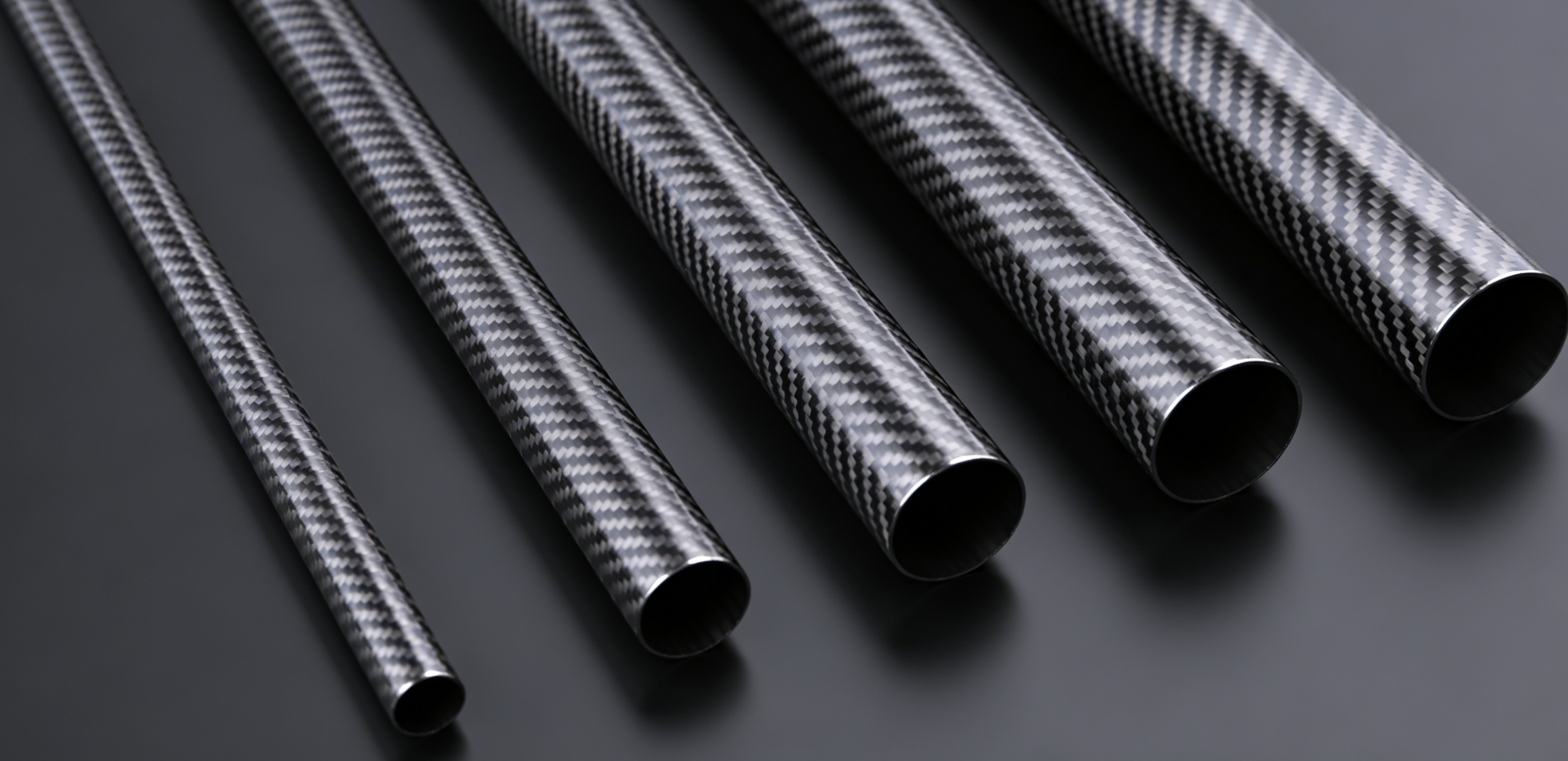
Three variables drive most carbon fiber tube purchases. Get them right, and the rest of the process takes care of itself.
Load type comes first. Axial, longitudinal loads — think compression columns or drone arms — work best with pultruded tubes. All fibers run lengthwise, giving you maximum stiffness. Crush loads, torsion, or multi-directional stress? You need roll-wrapped construction instead. Alternating fiber layers give it real hoop strength.
Lead time comes second. Stock tubes ship fast. Custom specs are a different story. Specific OD/ID combinations, non-standard wall thickness, tight ±0.1mm tolerances — these need full production cycles. That can stretch into weeks. Know your timeline before you lock in specs.
Budget comes third. Carbon fiber’s strength-to-weight ratio is about five times that of steel, at one-fifth the mass. That kind of performance costs more upfront. But look at the full picture:
-
Zero corrosion
-
Near-zero thermal expansion (CTE as low as −0.1 ppm/°C)
-
Fatigue resistance that outlasts metals across repeated load cycles
Add those up, and the long-term cost math often tips in carbon’s favor.
One trap catches first-time buyers more than any other: connectors are almost never included. Fittings, inserts, and joining hardware all ship as separate items. Check OD tolerance compatibility before placing your order — this step saves you from costly mismatches.
Stock Carbon Fiber Tubes: Speed and Budget First
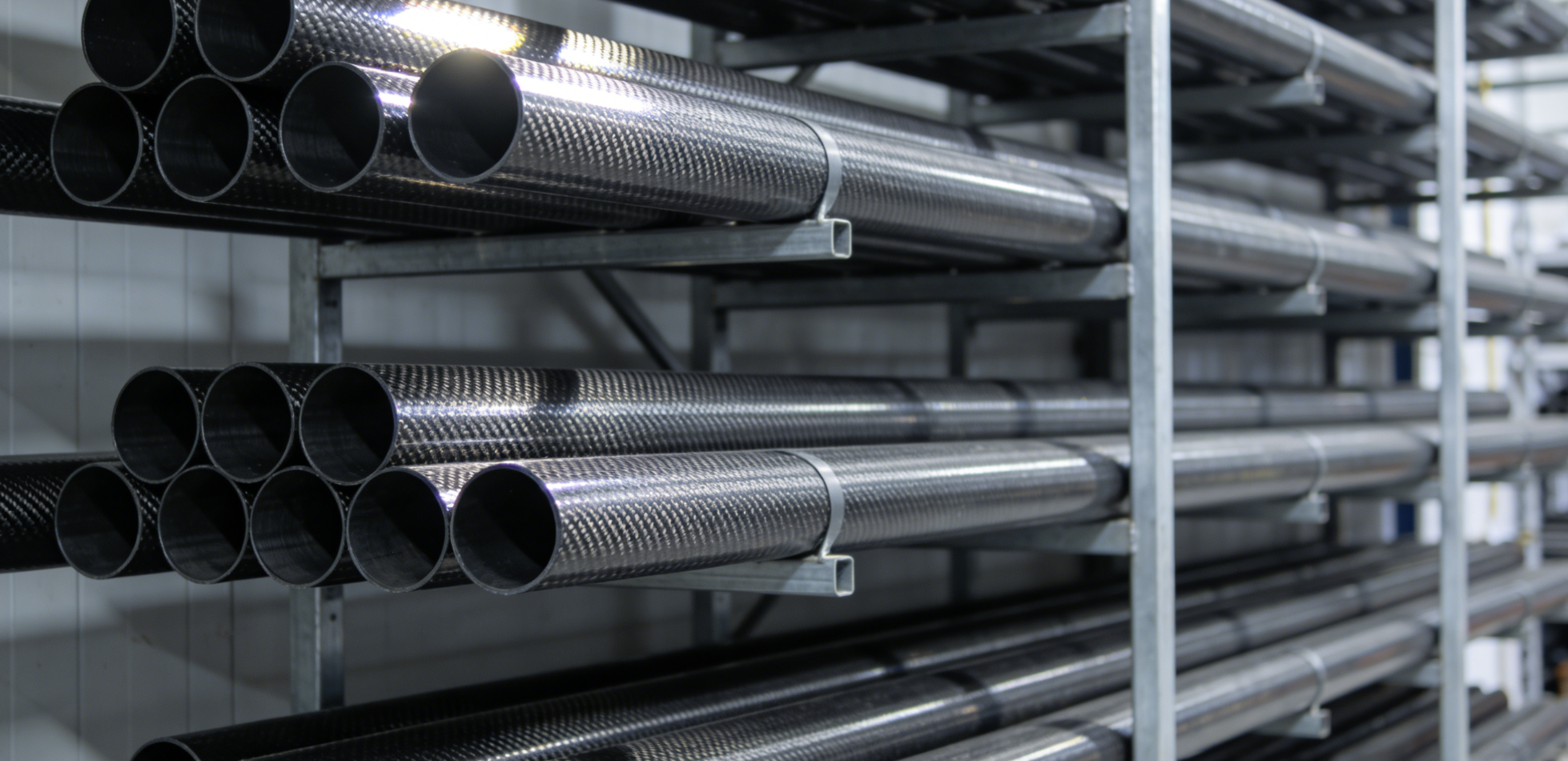
Stock tubes exist for one reason: your project can’t wait four weeks.
Most suppliers carry ready inventory across standard OD ranges — 6mm to 100mm — in lengths from 1m to 3m. The construction is 3K twill roll-wrapped. Rock West Composites ships within one business day on most sizes. McMaster-Carr offers same-day or next-day delivery. Easy Composites carries both roll-wrapped and pultruded options. An 8mm OD tube at 1m length runs €12.40–€12.65. That’s solid pricing for prototyping or small-batch production.
The structural numbers hold up too. Tensile strength sits between 125,000–175,000 psi. Modulus falls in the 230–600 GPa range. Standard fiber stiffness runs 33–36 msi. Drone frames, robotic arms, structural prototypes — stock carbon handles all of them without issue.
Here’s the comparison that matters most:
|
Stock |
Custom |
|
|---|---|---|
|
MOQ |
None |
High |
|
Tooling cost |
$0 |
Significant |
|
Lead time |
24–72 hours |
4–8 weeks |
|
Best for |
Prototypes, replacements |
Volume production |
The tradeoffs are real, though. Stock won’t cover every situation. You won’t find non-standard OD/ID combinations, specialized wall tolerances, or high-modulus variants beyond 33–36 msi in ready inventory. Aerospace and motorsport applications need engineered fiber layups and higher thermal performance. Stock tubes don’t meet those specs. Max service temperature caps at 180°F, and long-term outdoor rating is limited.
For everything else? Stock ships tomorrow.
Custom Carbon Fiber Tubes: Performance Specs That Don’t Compromise
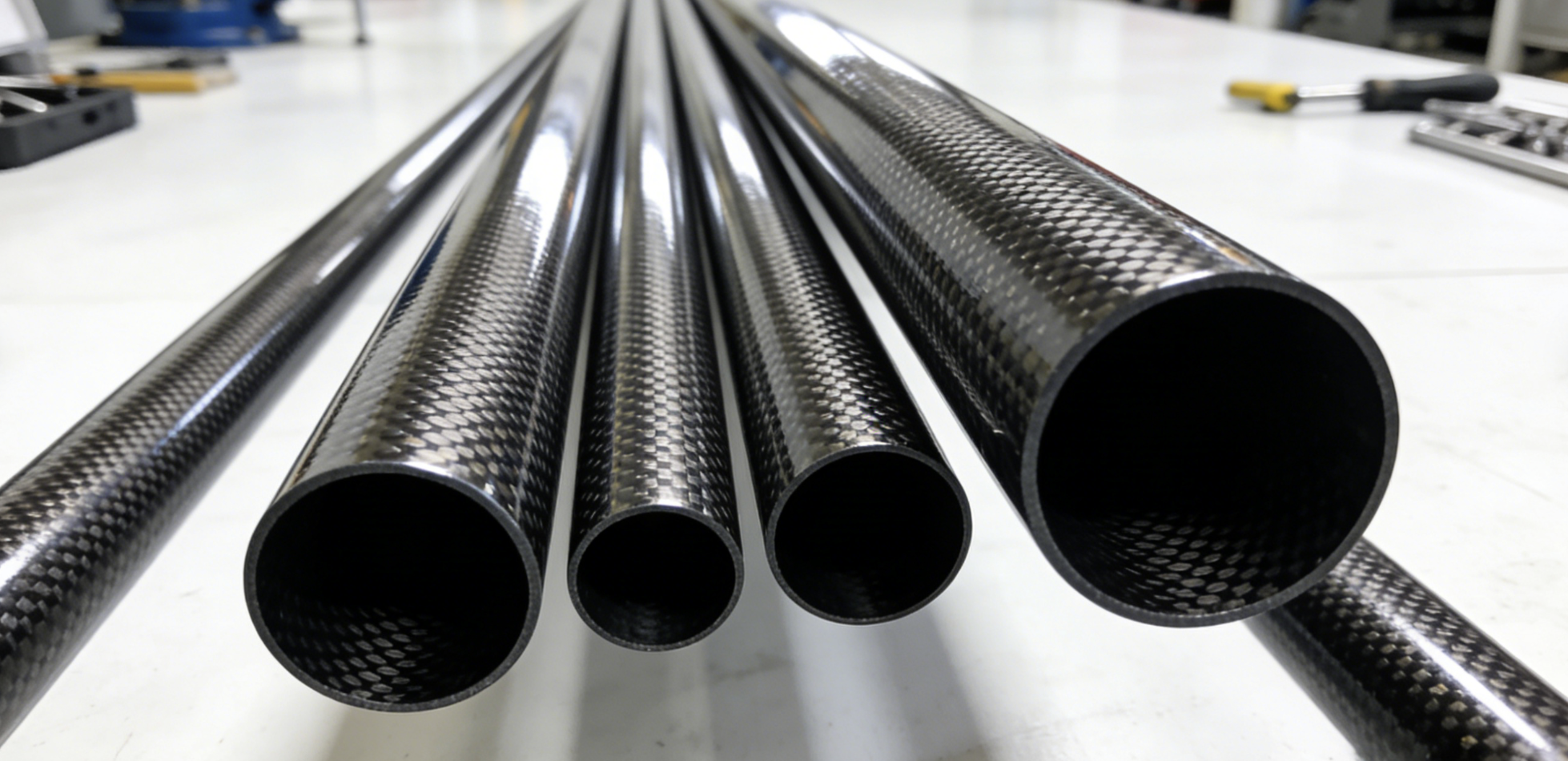
Every gram you cut from an aerospace structure saves $2,000 in lifetime fuel costs. At that math, the 20–50% price premium on custom carbon fiber tubes stops looking like a cost. It starts looking like an investment.
Custom tubes exist for one reason: stock dimensions leave performance on the table.
The parameters you control with a custom order go well beyond diameter. Here’s what you can specify:
-
Wall thickness builds layer by layer. Each ply adds 0.006″, so a 0.060″ wall uses 9–10 stacked plies.
-
Fiber angles match your load case directly: 0° for axial tensile loads, ±45° for torsion and shear, 90° for hoop and crush resistance.
-
Modulus grades range from standard 230 GPa up to ultra-high 600 GPa using Tenax UTS50 fiber.
-
Lengths reach up to 6 meters for continuous structural runs.
The performance gap is real and measurable. Custom roll-wrapped tubes handle 200 kg in three-point bending. Pultruded tubes max out at 140 kg. Steel tops out at 175 kg. Fatigue strength holds at 60–70% of ultimate tensile strength — steel only manages 40–50%. A robotic arm built with custom ±45° layups carries the same load at one-fifth the mass. That cuts rotational inertia and energy consumption at the same time.
The cost model needs honest math:
|
Factor |
Reality |
|---|---|
|
MOQ |
50–100 units minimum |
|
Tooling & engineering fees |
Non-refundable; amortized at 100+ units |
|
Break-even point |
Viable when stock specs cause failure or rework |
Below 50 units, stock wins. Above that threshold, the math shifts. And for aerospace, motorsport, or high-cycle robotics, custom isn’t just the better option — it’s the only one that holds up.
Carbon Fiber Tube Dimensions Explained: OD, ID, Wall Thickness & Length
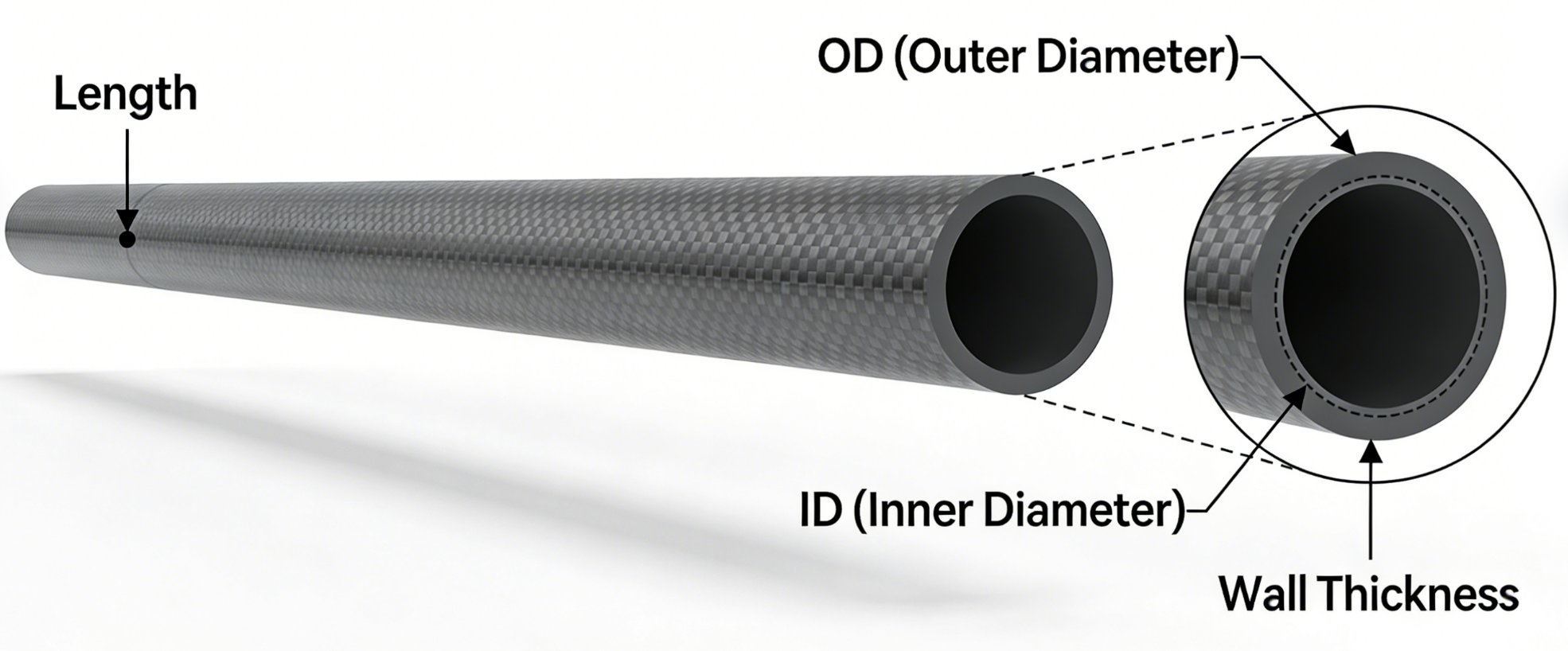
Four numbers define every carbon fiber tube: OD, ID, wall thickness, and length. Miss one, and the part either doesn’t fit or doesn’t hold.
The math is simple. Wall thickness = (OD − ID) ÷ 2. Take a tube with 1.875″ OD and 1.750″ ID. That gives you a 0.0625″ wall. That’s 9–10 plies of carbon fiber, each ply adding 0.006″ of thickness. Not an estimate — that’s the actual build spec for roll-wrapped tubes, layer by layer.
Here’s what real-world specs look like across common sizes:
|
OD (in) |
ID (in) |
Wall (in) |
Length (in) |
Notes |
|---|---|---|---|---|
|
1.875 |
1.750 |
0.0625 |
12 |
0.245 lb/ft, standard modulus |
|
0.625 |
0.625 |
0.0625 |
96 |
Kevlar core, 1/16″ wall |
|
0.394 |
0.354 |
0.0197 |
39–79 |
Thin wall, glossy weave |
|
0.236 |
0.177 |
0.0295 |
39–79 |
Metric thin wall |
|
0.1875 |
0.125 |
0.03125 |
48 |
Unidirectional, 275 ksi tensile |
Wall Thickness: Light Has a Hard Limit
Thin walls are tempting. A 0.019″ wall tube weighs under 0.1 lb/ft. Compare that to 0.245 lb/ft at a 1/16″ wall with the same OD. That’s a 50–70% weight reduction.
The tradeoff is real. Walls under 0.020″ bring buckling risk that climbs more than 3x. Max load capacity also falls to 40–60% of a thick-wall tube. Thin walls handle torsion and light bending well. For compression columns or anything facing axial crush, they fall short.
Modulus Grade Changes Everything
Same dimensions. Totally different behavior under load.
-
Standard modulus (~70 GPa): Balanced stiffness and toughness. Tested flexure averages 148.6 GPa.
-
High modulus (240–300 GPa): 3–4× stiffer, but 20–30% more brittle. Shear modulus reaches 4–5M psi.
-
Ultra-high modulus (~400 GPa): Maximum stiffness — 5.7× standard in flexure. Strain-to-failure drops 40–60%. One impact load in the wrong direction and it fractures.
Match modulus to your application. Precision robotics and optical mounts do well with ultra-high modulus. CTE drops to near zero — 0 to 1.7×10⁻⁷/°C — so tolerances hold under 0.001″ across a 100°C temperature swing. For anything with dynamic impact, standard or high modulus is the safer pick.
Length: Where the Cost Jumps
Stock lengths run 1–3m (39–118″). Most suppliers cap continuous lengths at 96″ for standard IDs.
Go custom beyond 96″, and cost rises 20–50%. Material waste and handling complexity drive that increase. Push past 3 meters, and freight doubles — oversize surcharges kick in. Cut-to-length ordering saves you 30% over buying full stock and cutting it yourself.
Custom runs can reach 6 meters (236″) for structural applications. Just price out the logistics before the quote lands on your desk.
Carbon Fiber Tube Connectors and Fittings: What’s Included and What You’ll Need
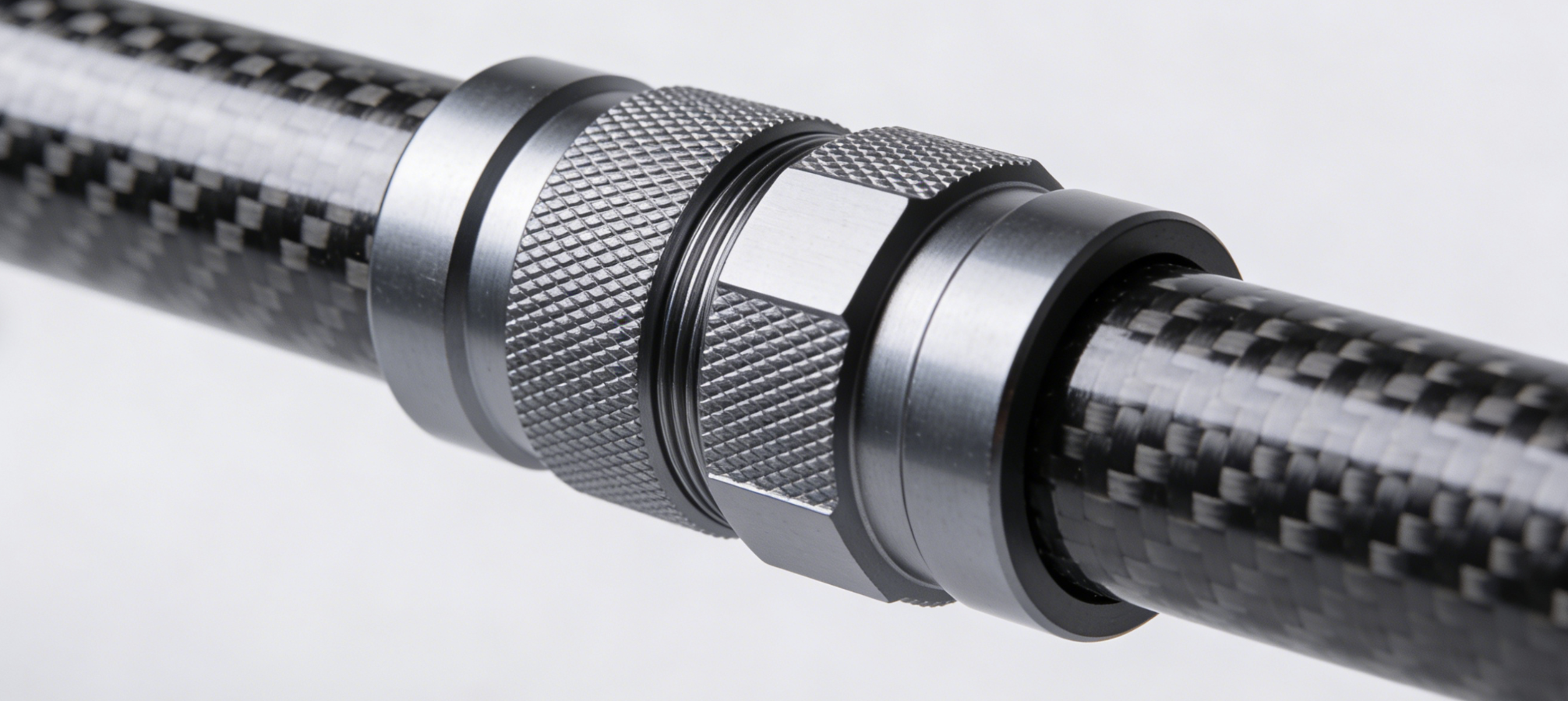
The tubes arrive. The connectors don’t. That’s the default — and it catches more buyers off guard than any spec mismatch ever does.
Carbon fiber tube suppliers ship tubes. Fittings, inserts, and joining hardware are separate line items. Budget for them from day one.
Connector Types: Match the Joint to the Load
Not all connectors work the same way. The load type determines which one fits your build.
-
Anodized aluminum modular connectors (DragonPlate): Fit tubes from 0.5″ to 1″ OD. Support end-to-end and 3D joints — no drilling, no screws punching through the wall.
-
Telescopic clamps: Slide-fit, adjustable. A tightening mechanism locks position. No adhesive needed.
-
Twist locks: Quarter-turn engagement for adjustable builds. Fast to set up. Holds firm under light torsion.
-
Spine buttons: Push-button release. Built for setups that need repeated breakdown and reassembly.
-
Tapered ends: No hardware at all. A precision-matched taper creates a tight friction fit — best for heavy axial loads.
-
Epoxy adhesive joints: Overlap the tube ends, then cure at room temperature or elevated heat. The bond is permanent. It handles axial loading and fatigue cycles better than any mechanical option.
-
Hybrid (bond + fasteners): Maximum durability. Use this where multi-directional loads and long service life both matter.
|
Type |
Best Load Scenario |
|---|---|
|
Adhesive (epoxy) |
Axial loads, fatigue-critical joints |
|
Mechanical (clamp/bolt) |
Shear loads, quick-release requirements |
|
Hybrid |
Heavy multi-directional loading |
|
Tapered |
Axial loads, streamlined profile |
ID/OD Tolerance: The Number That Makes or Breaks the Fit
Connector fit lives or dies on one spec: ID/OD matching within ±0.05mm. Outside that window, you get slip, rocking, or outright failure at the joint.
A 0.725″ ID tube is a real-world example of this problem — no off-the-shelf connector covers that size. Custom machining is the fix. There’s no shortcut around it.
Rock West Composites stocks 91 connector variants for composite tubes. Sizes are specified by OD and ID. Tubes aren’t bundled in. DragonPlate works differently — tubes and patented aluminum connectors come as a modular kit. You can take joints apart and put them back together without harming the tube.
Assembly: Simpler Than It Looks
No complex tooling required. Light sanding inside the tube end improves epoxy adhesion. Apply adhesive, insert the connector, let it cure. Twist locks and clamp mechanisms secure themselves. The one rule worth repeating: don’t drill through the tube wall. Drilling cuts through fibers and weakens the structure at the exact point where you need it strongest.
Source connectors from the same supplier as your tubes. You get a single shipment. Tolerances are pre-matched. No chasing down mismatches after the package arrives.
Buying Decision Tree: Match Your Application to the Right Carbon Fiber Tube
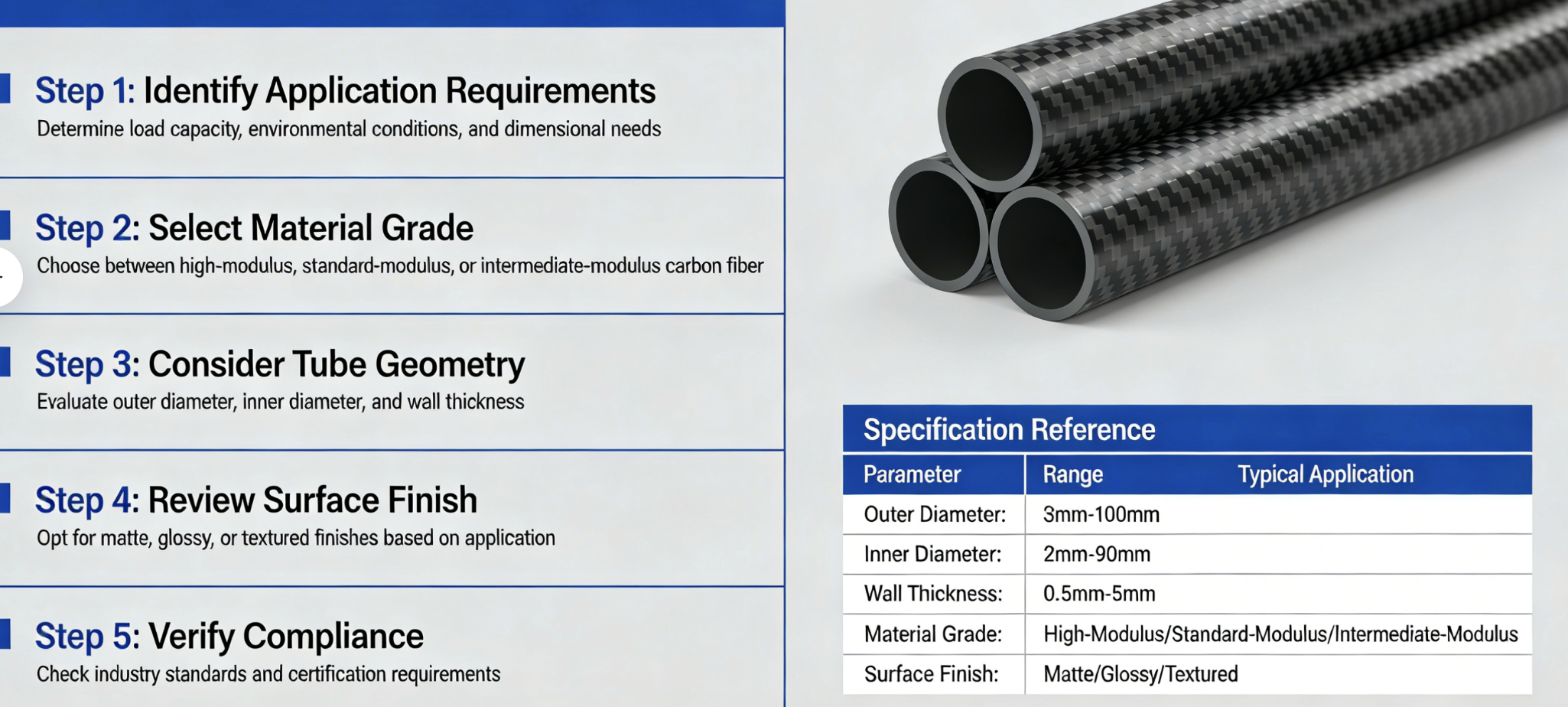
Five questions. That’s all it takes to find the right tube for your application.
Work through them in order. Skip one and you risk the wrong process, the wrong wall thickness, or a connector that won’t fit.
Step 1 — Define your load direction.
Single-axis force? Go pultruded. Multi-directional stress — torsion, bending, side impact — go roll-wrapped. This one decision cuts half the catalog right away.
Step 2 — Match the process to your budget.
Pultruded costs less and scales well. Roll-wrapped handles extreme conditions and mixed loads. Drone frame, robot arm, or anything that takes vibration from multiple angles? Roll-wrapped is the answer. No exceptions.
Step 3 — Stock or custom?
Stock covers OD 4–30mm with standard walls from 0.3–3.0mm. Go custom if any of these apply:
– Your safety factor drops below 1.5 on a standard wall
– You need a non-0/90° fiber angle for torsion
– Your tolerance is tighter than ±0.1mm
– Your batch exceeds 100 units
At 100+ units, custom saves 20–30% per unit versus ordering stock in multiple rounds.
Step 4 — Pin down your specs using application benchmarks.
|
OD (mm) |
Wall (mm) |
Mass (g/m) |
Typical Application |
|---|---|---|---|
|
4–6 |
0.3–0.8 |
8–18 |
FPV drone arms |
|
8–12 |
0.8–1.5 |
25–55 |
Camera gimbals, robot links |
|
15–20 |
1.0–2.0 |
55–110 |
Sprayer booms |
|
25–30 |
1.5–3.0 |
120–220 |
Industrial rollers, aerospace spars |
Need a quick size reference? 6mm OD keeps weight at a minimum. 10–12mm handles balanced medium loads well. 25–30mm is the range for heavy loads where rigidity cannot be compromised.
Step 5 — Plan your connectors before checkout.
Aluminum alloy inserts are a solid choice for drone arms. An OD 16mm roll-wrapped tube fits a matched aluminum plug with no gap or slop. Source connectors from the same supplier. The tolerances are already matched — so you won’t spend a week chasing fit issues after delivery.
Quick reference by industry:
-
FPV Drone: Roll-wrapped stock, OD 16mm, wall 0.8–1.5mm + aluminum plug
-
Robot Linkage: Roll-wrapped, OD 8–12mm, 25–55 g/m
-
Aerospace Spar: Roll-wrapped custom, OD 25–30mm, high modulus layup
-
Bike Frame: Roll-wrapped OD 10–12mm; pultruded if budget is the hard constraint
How to Evaluate a Carbon Fiber Tube Supplier or Manufacturer
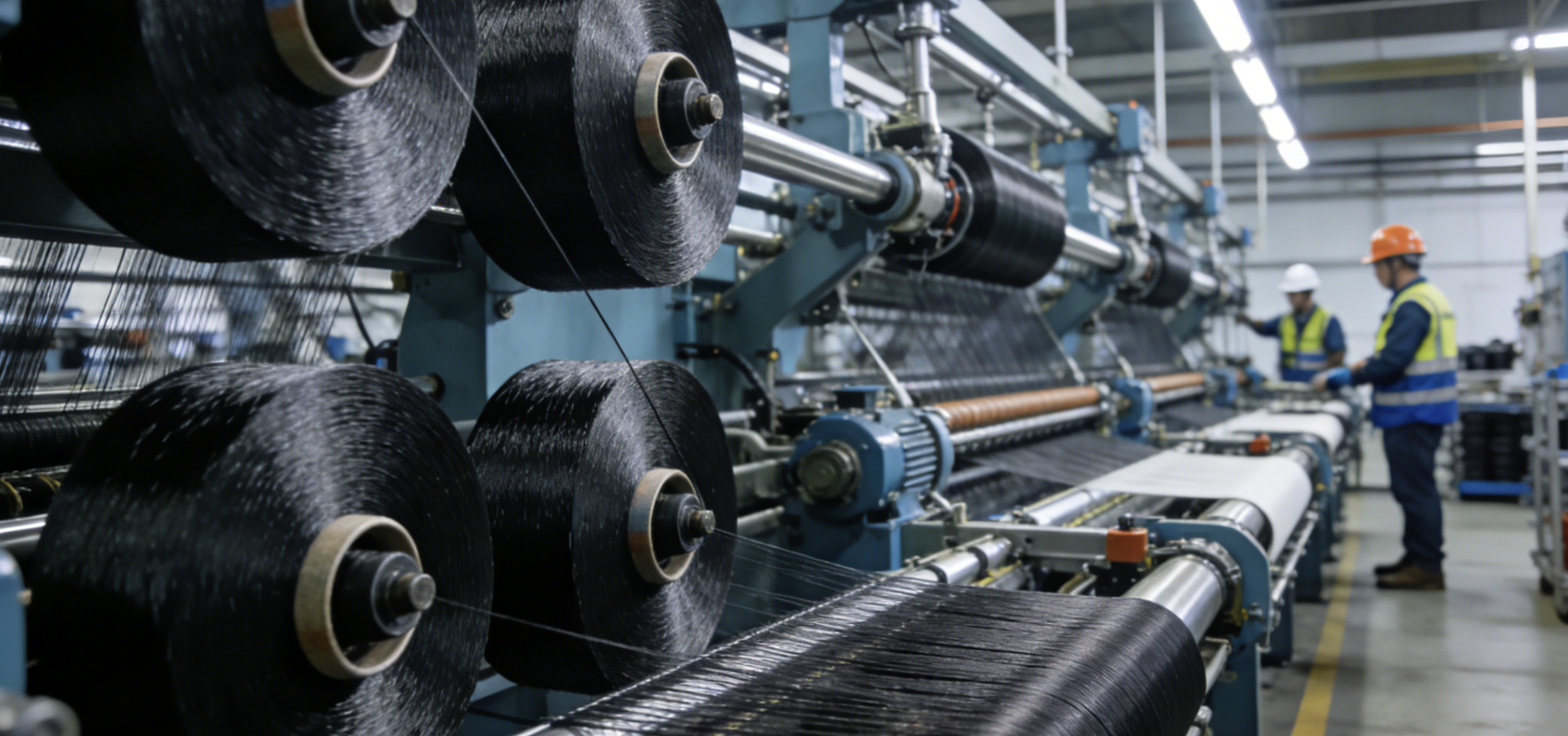
Most carbon fiber tube suppliers look identical on paper. The differences show up after you’ve committed to a purchase order.
Here’s how to separate real manufacturers from repackagers before that point.
Certifications and Test Data First
Ask for documentation before you ask for a quote. A legitimate carbon fiber tube manufacturer holds ISO 9001 at minimum. Aerospace-grade suppliers carry AS9100. That’s the quality management standard covering material handling, traceability, and final inspection — all under one audit framework. NADCAP certification adds another layer for defense and aviation work.
Certifications alone aren’t enough. Ask for third-party mechanical test reports too. The numbers that matter:
-
3-point bend: Roll-wrapped tubes should clear 200 kg. Pultruded holds around 140 kg. Numbers below that point to a bad fiber layup or a weak resin system.
-
Compressive strength: Target ~1 ton for a 10mm OD/8mm ID carbon tube. Steel benchmarks at 1.5 tons. Aluminum caps at 0.5 tons.
-
Fiber sourcing: Ask for documentation proving Toray or Hexcel fiber. “T700-equivalent” claims without paperwork are a red flag. Don’t accept verbal assurances.
Capability Beyond the Catalog
A supplier’s SKU count tells you something. Stock availability rate tells you more. That’s the percentage of standard sizes that ship from inventory on demand. Check data on common profiles like 10mm OD/8mm ID. Don’t assume anything is in stock.
For custom work, find out whether they offer layup design support. Any supplier can quote a tube. Far fewer can tell you whether ±45° fiber orientation suits your torsion load. Even fewer will help you choose between roll-wrapping and continuous compression molding based on your part geometry. That engineering input is what separates a manufacturer from a catalog reseller.
The Pricing Conversation
Tiered pricing breaks at 50, 100, and 500 units. Know those thresholds before you start negotiating. Mold and tooling fees are standard practice. The real leverage point is getting them waived or spread across the 500-unit level. Also, standardizing your specs across projects — consistent OD, wall tolerance, surface finish — builds up savings over time. Small decisions early compound into real cost differences later.
A Six-Step Vetting Sequence
Run every prospective carbon fiber tube supplier through this before you commit:
-
Request certifications and third-party test reports. Look for tensile data past yield point and bend results above 175 kg equivalent.
-
Audit inventory. Check SKU count and target an 80%+ stock availability rate on standard sizes.
-
Order samples. Test compressive strength (~1 ton target), torsion, and three-point bend in-house.
-
Get fiber sourcing documentation straight from the supplier. Confirm the fiber brand, not just the grade claim.
-
Get tiered quotes at 50/100/500 units. Negotiate mold fee waivers at the 500-unit threshold.
-
Confirm layup engineering support. Check that lead times fit your project schedule — not just their standard production window.
The supplier who pushes back on any of these steps is telling you something worth hearing.
Frequently Asked Questions About Buying Carbon Fiber Tubes
Real questions. Straight answers. No padding.
Is carbon fiber worth the price over aluminum?
Density: carbon fiber at 1.6 g/cm³, aluminum at 2.7 g/cm³. Tensile strength: 3,500 MPa versus 300 MPa. Stiffness-to-weight ratio: five times better. You get 40–60% less mass at equal stiffness — at 3–5× the per-foot cost. Weight-critical applications? That math works out fast. For a static bracket on a budget build, aluminum wins.
What’s the smallest diameter you can order?
Pultruded tubes start at 3–5mm OD. Roll-wrapped starts at 6mm. Both hold tolerances of ±0.1mm on diameter and wall thickness at those minimums.
How does it hold up outdoors?
Epoxy resin loses 10–20% of its strength after 1,000 hours of UV exposure. A UV-stable coating or clear gelcoat adds $1/ft to your cost. It pushes outdoor service life past five years. Skip the coating, and degradation starts sooner than you’d expect.
What does carbon fiber tube cost per foot?
|
Type |
Diameter / Wall |
Price Range (per ft) |
|---|---|---|
|
Pultruded |
6–25mm / 1–2mm |
$2–8 |
|
Roll-wrapped |
10–50mm / 1–3mm |
$5–20 |
|
Custom |
5–200mm / 0.5–5mm |
$15–100 |
Volume moves the price. Orders above 100 pieces drop unit cost by 20–30%. Custom layup angles add around 50% to the price. Third-party testing certs add $100–500 per lot.
Can you drill or cut carbon fiber tube yourself?
Yes — with the right tooling.
-
Use diamond-coated bits. Standard HSS bits cause delamination.
-
Feed rate: 0.05–0.1mm per revolution.
-
Coolant is mandatory.
-
For cutting, a diamond saw at 2,000 RPM keeps kerf to 0.5mm.
-
Waterjet holds ±0.2mm tolerance with zero heat damage.
After any cut, sand the edge with 400–800 grit. Twill exterior resists splintering about 20% better than UD at the cut face.
How long does carbon fiber tube last under repeated loading?
Fatigue life reaches 10⁶ cycles at 50% of ultimate tensile strength. Aluminum manages 10⁵ cycles at comparable loads. Torsion fatigue runs more than twice that of metal at equal weight. For high-cycle robotics or aerospace, that gap matters.
How do I know if a tube is genuine carbon fiber?
Run three tests.
-
Flame: Real carbon fiber glows without melting or producing smoke. Fakes bubble and burn.
-
Visual: Authentic fiber shows three-dimensional weave depth with aligned fiber strands. Printed carbon-look finishes look flat.
-
Documentation: Ask for the batch number, density spec (1.5–1.6 g/cm³), and tensile test data. No paperwork means no confidence.
Do connectors come with the tubes?
No. They never do. Budget separately for aluminum inserts — sized at ID + 0.1mm clearance — plus epoxy adhesive. Epoxy bond shear strength runs around 20 MPa with proper application. Also, avoid direct metal-to-carbon contact. Galvanic corrosion is real. Put a fiberglass sleeve between the insert and tube wall. That eliminates the risk.
Conclusion
Buying carbon fiber tubes isn’t complicated — but buying the wrong ones is expensive.
Pulling from stock to hit a tight deadline? That’s one scenario. Speccing a custom pultruded carbon fiber tube for a structural application with zero margin for error? That’s another. Either way, the decision comes back to three things: your load requirements, your timeline, and your tolerance for compromise.
Now you have the framework to make that call with confidence.
Browse our carbon fiber tube stock for same-week availability across the most common OD/ID configurations. Need something the shelf can’t cover? Reach out to our engineering team. You’re not guessing — you’re deciding.
The best carbon fiber tube isn’t the lightest one, or the cheapest one. It’s the one built for what you’re asking it to do.
Start there. Everything else falls into place.
Contact HyperX Carbon – Your Trusted Chinese Carbon Fiber Partner
Ready to source high-performance carbon fiber materials or custom forged carbon fiber parts from China?
HyperX Carbon is a leading manufacturer with 20+ years of expertise, specializing in aerospace-grade forged carbon fiber, prepreg, tubes, sheets, and lightweight automotive/drone/medical components. We offer:
-
Stable supply chain with premium raw materials (Toray, Mitsubishi, Hengshen)
-
AS9100D certified production for aerospace & UAV applications
-
Rapid prototyping (5-8 weeks) and monthly capacity exceeding 180,000 parts
-
Competitive pricing with 15-18% cost savings on forged carbon solutions
-
Full customization: from T700/T1100G to ultra-high modulus grades
Whether you’re an eVTOL developer, automotive OEM, drone manufacturer, or medical device engineer, HyperX delivers consistent quality, batch-to-batch reliability, and reliable delivery.
Get in touch today for a free consultation, custom quote, or material sample.
📧 Email: [email protected]
🌐 Website: https://www.hyperxcarbon.com/
📞 Phone/WhatsApp: +86 15623270276 (English support available)
Let’s build your next lightweight innovation together – contact HyperX Carbon now and stay ahead in the low-altitude and advanced composites market.




