Choosing between T300, T700, T800, T1000, and T1100 carbon fiber shouldn’t feel like reading aerospace documents — but for most engineers, designers, and sourcing managers, it does. The grade numbers suggest a hierarchy, yet the real differences go deeper than a single tensile strength figure on a datasheet.
Pick the wrong grade and you’re either leaving performance on the table or paying a steep premium for strength your application will never need. This guide cuts through the spec-sheet noise. You’ll see what these Toray carbon fiber grades mean, where each one fits best, and how to make the right call — without second-guessing yourself later.
Carbon Fiber Grades T300 vs T700 vs T800 vs T1000 vs T1100
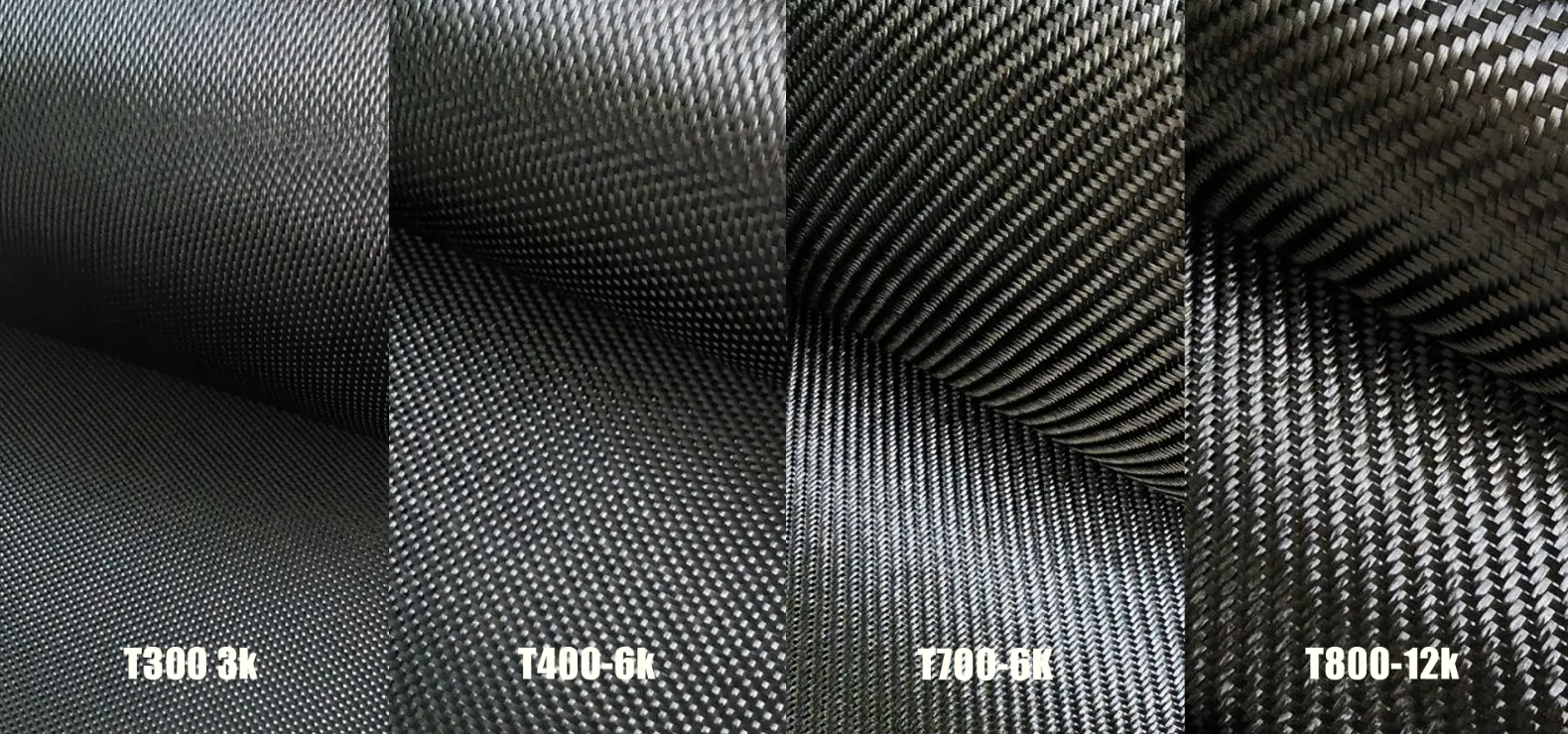
Five grades. One material. The numbers look very different — and the gap between them matters more than most buyers expect.
Here’s the core data, straight and clean:
|
Grade |
Tensile Strength (MPa) |
Tensile Modulus (GPa) |
Filament Diameter (μm) |
Carbon Content (%) |
|---|---|---|---|---|
|
T300 |
3,530 |
230 |
7 |
92.5% |
|
T700S |
4,900 |
230 |
7 |
>93% |
|
T800S |
5,880 |
294 |
5 |
>96% |
|
T1000G |
6,370 |
294 |
— |
— |
|
T1100S |
7,000 |
324 |
— |
— |
A few numbers worth keeping in mind:
-
T700 hits 38.8% higher tensile strength than T300 — same modulus, same filament diameter, just a lot stronger
-
T800 beats T700 by 11% on tensile strength. It also jumps to a 294 GPa modulus. That’s a stiffness leap, not just a strength bump
-
T1000 adds another 16% over T800 on strength, but shares T800’s modulus. You get more pull resistance, not more rigidity
-
T1100 pushes both numbers up: 7,000 MPa strength, 324 GPa modulus. That’s the current ceiling for standard-modulus intermediate fiber
One practical caveat: T800 can be brittle on its own. Many high-performance rim makers blend T700 and T800 together. The reason is simple — pairing them balances stiffness with impact tolerance. Neither grade alone gives you the full picture.
What Do Carbon Fiber Grade Numbers Actually Mean?
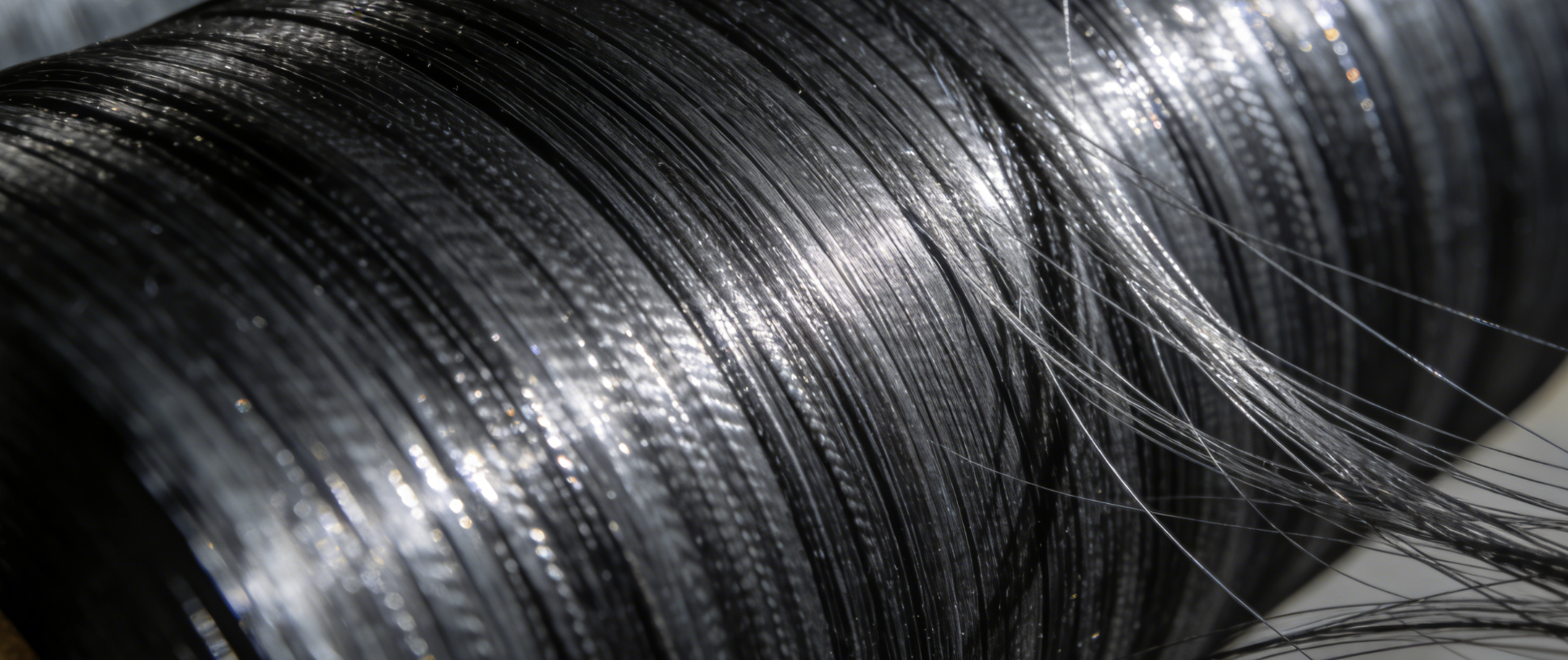
Here’s what most product pages skip: the grade number on carbon fiber does not measure strength. It measures stiffness — called tensile modulus.
This is the most common misconception in carbon fiber sourcing. Engineers assume T1000 is “stronger” than T300 in every meaningful way. That’s only half right.
The Modulus vs. Strength Distinction
Tensile modulus measures how much a material resists deformation under load. In short, it tells you how little it bends before it gives. Tensile strength measures how much load it takes to break the fiber. These are two different properties. They don’t always move in the same direction.
In fact, they often move in opposite directions:
-
Higher modulus = stiffer fiber, but more brittle
-
Lower modulus = more flexible, with higher strain tolerance
-
Ultra-high modulus grades (450–900 GPa) have the lowest tensile strength of all
The four main grade categories lay this out clearly:
|
Category |
Modulus Range |
Behavior |
|---|---|---|
|
Standard Modulus (SM) |
~230 GPa |
Flexible, tough, cost-effective |
|
Intermediate Modulus (IM) |
~290 GPa |
Balanced performance |
|
High Modulus (HM) |
380–450 GPa |
Stiff, grows more brittle |
|
Ultra-High Modulus (UHM) |
450–900 GPa |
Maximum rigidity, lowest strength |
What the “T” in T300, T700, T800 Signals
The “T” prefix in Toray’s naming system stands for tensile strength-oriented fiber. That’s why T-series grades show up so often in structural and sports applications. They push for strength within each modulus tier — not for the highest modulus possible.
Two other factors shape performance behind the grade label — and most buyers miss them:
-
Fiber diameter: Smaller filaments (~5 μm) reach higher modulus through a more intensive purification process. T800S sits at 5 μm. T300 and T700 both run at 7 μm.
-
Carbon content: Higher-grade fibers remove more non-carbon material during pyrolysis. T300 sits at 92.5% carbon content. T800S exceeds 96%. Ultra-high modulus pitch-based fibers can reach 99%+.
So the grade number is a shorthand for a set of tradeoffs — not a straight ranking from worse to better.
T300: The Industrial Workhorse
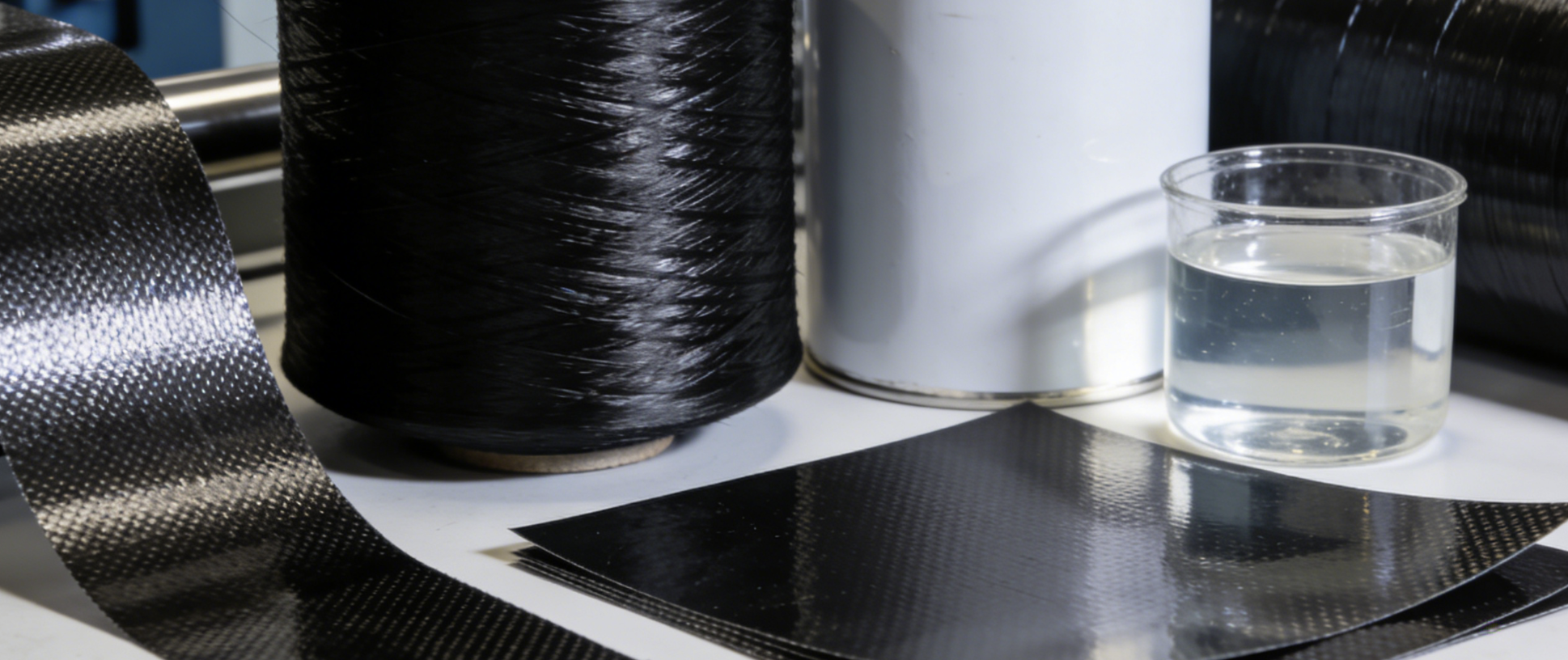
T300 carbon fiber built the modern composites industry — and it still runs most of it.
T300 starts at 3,530 MPa tensile strength, 230 GPa modulus, and a 7 μm filament diameter. That puts it at the entry point of the Toray carbon fiber grades lineup. Carbon content sits at 92.5% — the lowest of the five grades covered here. Elongation at break is 1.3%. Nothing fancy. Just reliable, repeatable, and easy to source in bulk.
Where it gets used:
– General industrial components
– Structural reinforcement in construction
– Non-load-bearing structural parts where overbuilding just burns budget
That last point matters. T300 follows a clear logic: good enough, not overbuilt. Safety margins are modest. Volume is high. It fits that job well.
The cost case is real. T300 runs 20–30% cheaper than T700 — a gap that adds up fast at scale. For procurement teams handling high-volume sourcing, that price difference hits the bottom line hard. You’re not paying for performance you don’t need.
T300 comes in 1K, 3K, 6K, and 12K tow sizes. Some post-carbonization batches have shown performance close to T700 levels. That tells you the real ceiling on T300 isn’t always what the datasheet shows.
T700: The Sweet Spot for Most Applications

T700 didn’t become the industry’s default choice by accident. It earned that position by solving a core engineering problem: how do you get more performance without blowing up your material budget?
The numbers tell the story. 4,900 MPa tensile strength. 230 GPa modulus. Carbon content above 93%. Elongation at break of 2.1%. That last figure carries more weight than it seems. A 2.1% elongation gives you the widest processing window of any grade in this range. You get fewer voids, fewer rejects, and lower scrap rates on the production floor.
Same Modulus, A Different Beast
T700 shares T300’s 230 GPa modulus. Same stiffness tier. But it delivers 38.8% more tensile strength — 4,900 MPa versus T300’s 3,530 MPa. That gap opens up real structural design freedom. You can use thinner cross-sections. Less material per part. Actual weight savings — without touching the modulus equation.
That’s why T700 shows up across so many demanding applications:
-
Bicycle frames and rims — a T700 aerospace-grade frame in sandwich construction with epoxy resin handles an ultimate load of 200 kg at just 8.9 kg total weight
-
Carbon running shoe plates — a strong benchmark choice for full-length plate structures where rigidity drives energy return
-
Automotive body panels, chassis components, battery enclosures — T700 sits right at the performance-to-cost sweet spot for these parts
T700 uses the dry-jet wet spinning process. That method gives it surface quality and tensile consistency that wet-spun T300 can’t reach.
One thing worth knowing on the production side: large-tow formats (24K and above) struggle to hit T700-level performance. Your application needs genuine T700 properties? Stick with standard tow counts.
T800: The Aerospace Standard

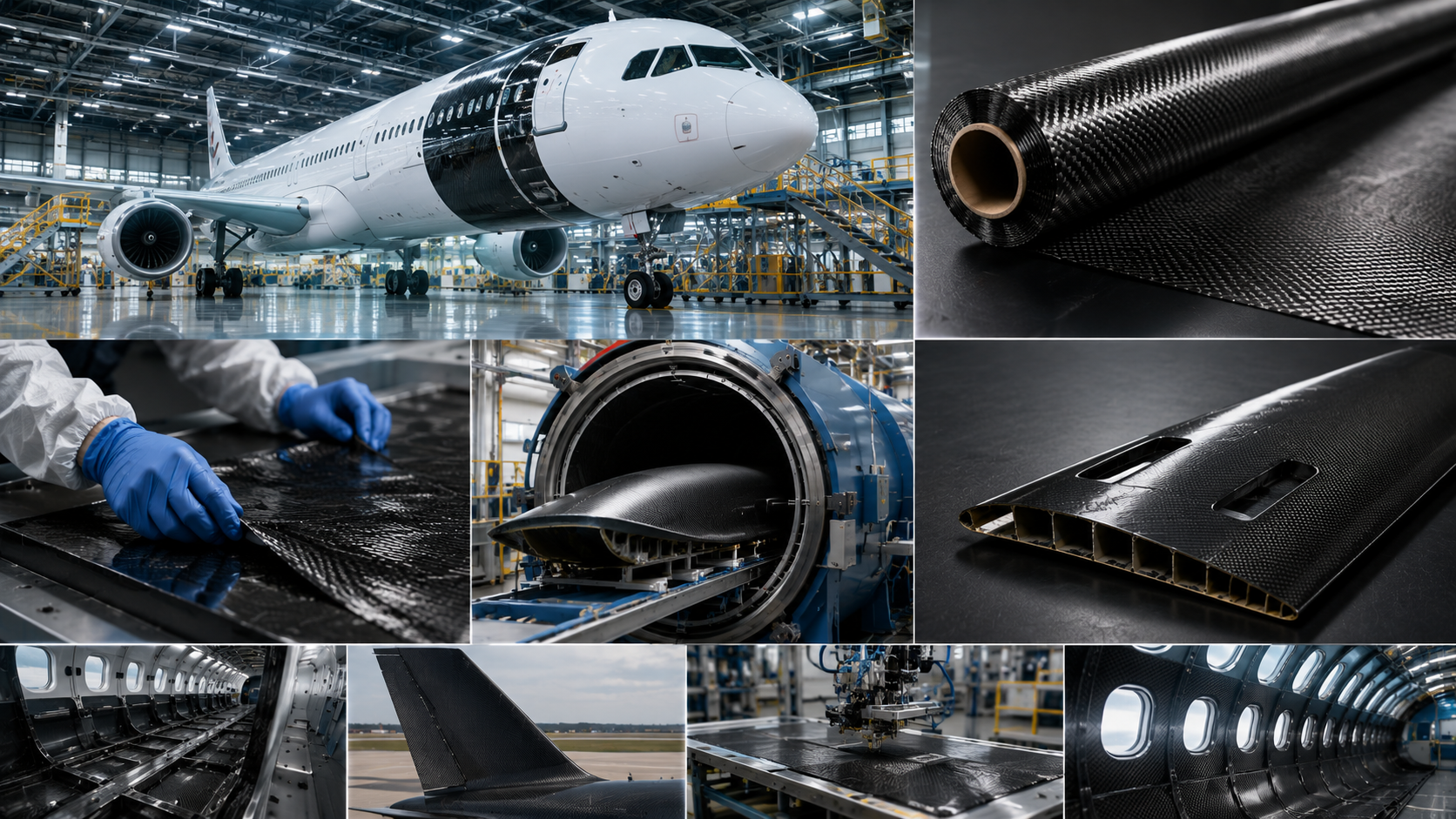
Boeing’s engineers didn’t choose T800 for the 787 because it topped a spec sheet. They chose it because it works — 35 tons per aircraft, across fuselage skins, frames, stringers, and wing spars. Failure is never an option in those parts.
That decision reshaped the composites industry. Toray became Boeing 787’s exclusive supplier for primary structure composites. Airbus followed the same logic on the A350. T800 is now the de facto engineering standard for commercial aviation primary structures — not T1000, not T1100.
Why T800 Hits the Sweet Spot
The numbers make the case. T800H delivers ≥5,490 MPa tensile strength and a 294 GPa modulus — a 68% strength gain and 28% stiffness improvement over T300. That 5 μm fiber diameter (vs. 7 μm in T300/T700) isn’t cosmetic. It drives the modulus jump through tighter molecular alignment during carbonization.
Here’s the part most people miss: T800’s intermediate modulus positioning is a deliberate advantage, not a compromise. Higher-grade fibers get more brittle. In a crash, aerospace structures need to absorb energy — not shatter. T800’s balance of rigidity and toughness beats T1000 in those real conditions.
The Strategic Supply Picture
T800 wasn’t always available outside Japan. For decades, Toray held near-total control. That changed in 2013. China’s Shanxi Taigang launched its own T800H production line. By 2016, their TG800 series earned designation as a national aerospace research material. Guangwei Composites then came in with its ZT8 series.
The international monopoly is broken. That said, Toray’s process maturity and Boeing’s long qualification history still give Toray a solid edge in commercial aviation sourcing.
T1000: Maximum Tensile Strength
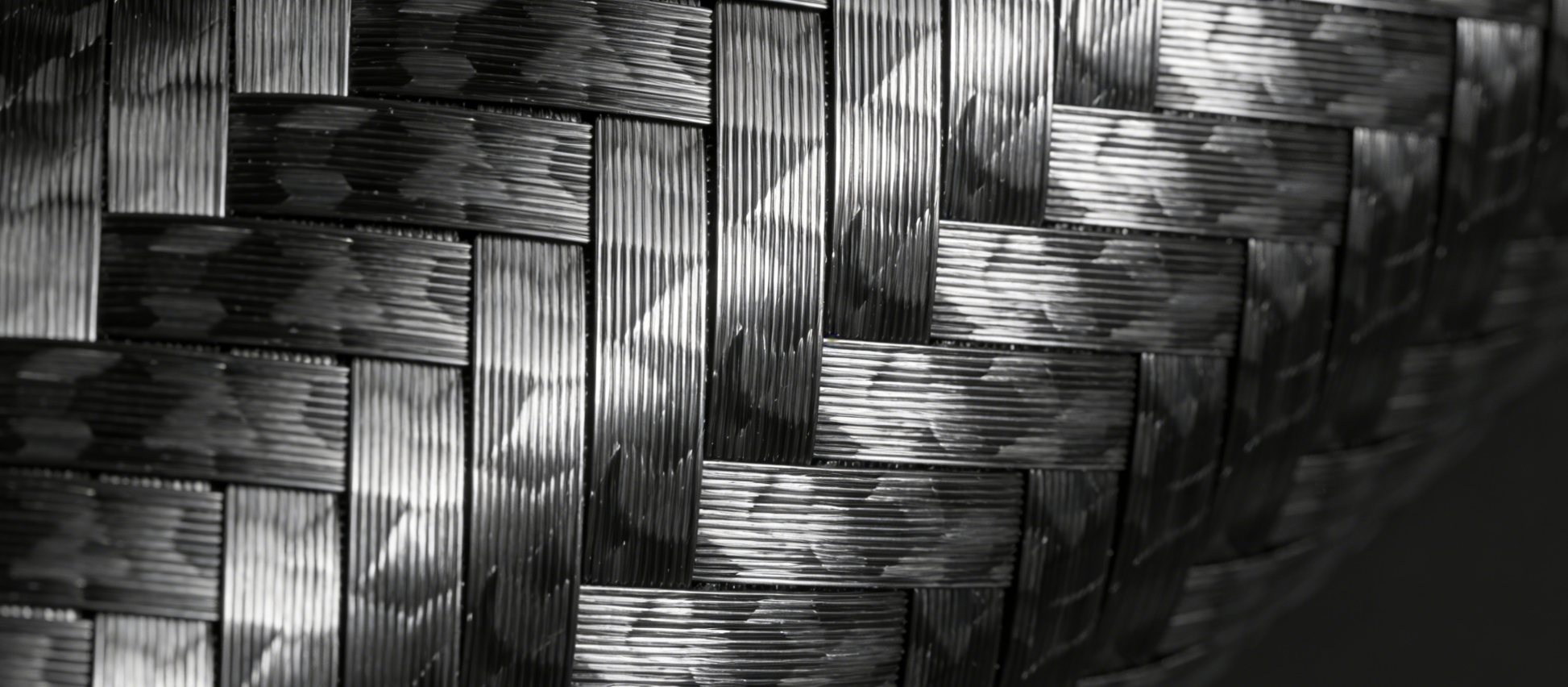
6,370 megapascals. That number sits at the top of standard-grade carbon fiber — and it belongs to T1000.
T1000 is 16% stronger than T800. But the modulus? The same. Both grades hold at 294 GPa. This is the point most buyers miss: T1000 doesn’t make your part stiffer. It pushes the load ceiling higher before fracture occurs.
Here’s what that means in practice:
– Stiffness-limited structure? T1000 adds nothing.
– Strength-limited structure — under peak tensile stress? T1000 is exactly what you need.
The fiber specs back this up. T1000 runs at 5 μm diameter, 12K tow, 1.80 g/cm³ density, and 2.2–2.4% elongation at break. Build it into a laminate at 60% fiber volume, and you get 3,040 MPa composite tensile strength with a 160–165 GPa tensile modulus.
Where T1000 Belongs
Smart designers don’t build entire frames from T1000. They place it at specific high-stress points:
-
Down tubes on ultra-lightweight bike frames
-
Pressure vessels
-
High-load racing components
Peak stress zones. That’s it. Everywhere else, T1000 is just extra cost.
That focused placement is where the numbers work in your favor. A 16% strength advantage lets you reduce layup thickness in tensile-critical zones. That translates to 10–16% potential mass savings — with zero change to your modulus.
T1100: Next-Generation Hybrid Performance
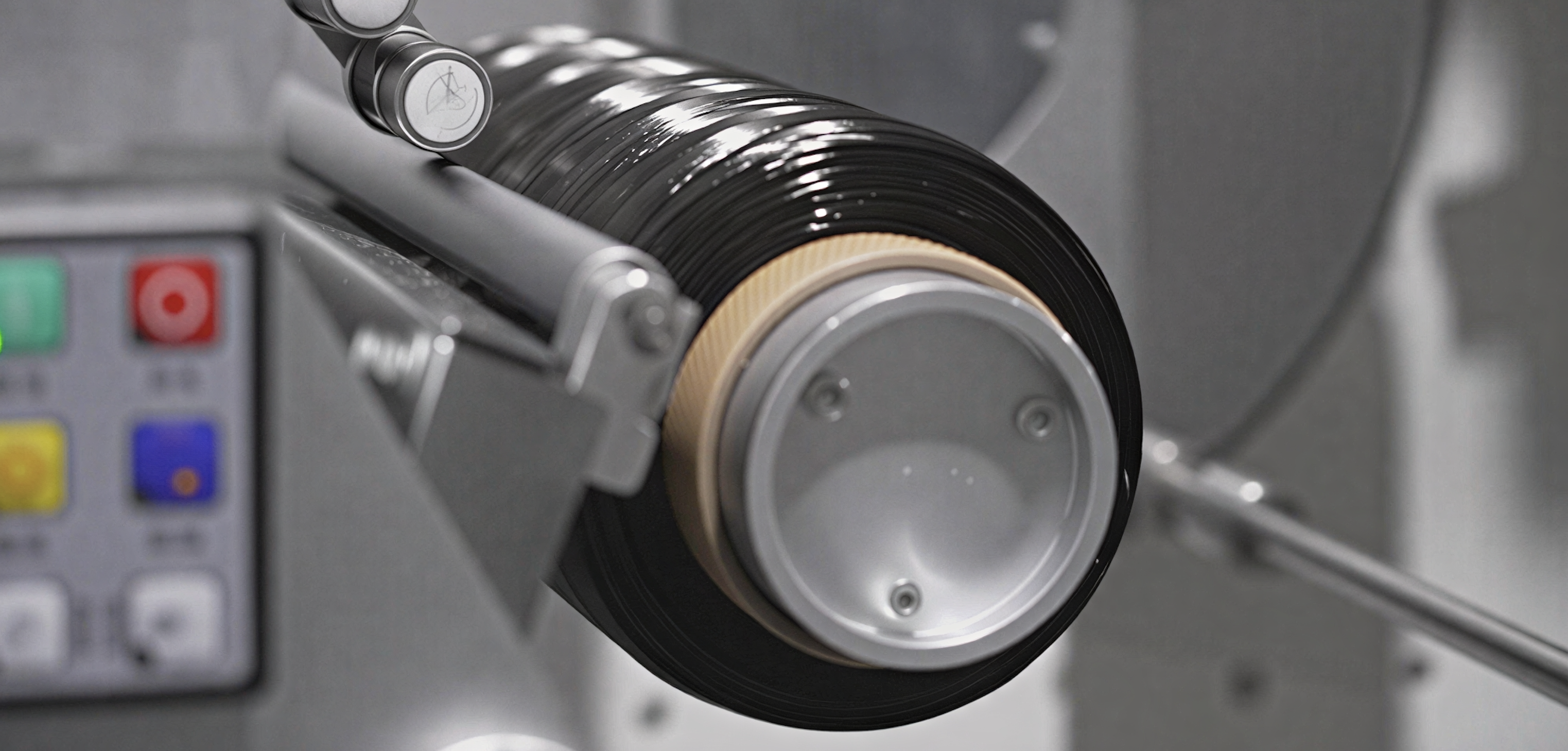
T1100 does something no previous grade could: it pushes strength and modulus up at the same time.
That sounds simple. It isn’t. T1000 maxed out tensile strength at 6,370 MPa — but its modulus stayed at 294 GPa, the same as T800. T1100 breaks both limits. 7,000 MPa tensile strength. 324 GPa modulus. That’s a 10% strength gain over T1000 and a 10% modulus jump — the stiffness upgrade T1000 never delivered.
Against T800, the gap is sharper: ~19% more strength, ~10% more modulus.
Why the Modulus Number Is the Real Story
For rim and fork builds, modulus drives everything. More stiffness per fiber means thinner layups for the same deflection resistance. A T1100 fork crown and blade can drop 15–20% wall thickness compared to an equivalent T800 layup — with no loss in stiffness. That’s real, measurable handling precision. Not a marketing claim.
Low-modulus carbon in a race rim creates micro-deflection under sprint load. Composite engineering data puts that at 3–8W loss in high-torque situations. T1100’s 324 GPa modulus cuts that loss at the source.
The GC suffix matters here. T1100GC uses vapor deposition surface treatment. It’s the version built for structural composites, where getting full modulus transfer into laminate stiffness is critical. T1100S focuses on surface smoothness and tensile strength. For rim beds and spoke interface zones, GC is the right call.
The Procurement Reality
T1100 is not a high-volume material. Toray’s output goes to aerospace and defense first. Cycling brands get allocation-based supply — no guaranteed volume. Price runs 40–80% higher per kg of prepreg versus T800. Add another 20–40% over T1000.
Chinese domestic option ZT9H (Zhongjian Technology) hit stable mass production qualification in 2023. That took eight years from first development. The timeline tells you exactly how high the manufacturing bar sits. ZT9H matches T1100-class performance: +18% strength, +24% modulus versus T800-class fiber.
For procurement teams, a dual-source strategy is the answer — Toray T1100GC plus qualified ZT9H. That’s the path to production continuity. Budget a 6–12 month prepreg inventory buffer at -18°C storage. Just-in-time planning won’t hold up here.
T1100 belongs on flagship SKUs, not base product. The performance gap justifies premium retail positioning in stiffness-critical applications. Anywhere else, you’re paying for a ceiling your design will never hit.
Side-by-Side Specification Comparison
Six numbers define every carbon fiber grade. Miss one and you’ll misread the material.
|
Grade |
Tensile Strength (GPa) |
Tensile Modulus (GPa) |
Filament Diameter (μm) |
Density (g/cm³) |
Carbon Content (%) |
Elongation (%) |
|---|---|---|---|---|---|---|
|
T300 |
3.53 |
230 |
7.0 |
1.76 |
93% |
1.5 |
|
T700 |
4.90 |
230 |
7.0 |
1.80 |
93% |
2.1 |
|
T800 |
5.49 |
294 |
5.0 |
1.80 |
94% |
2.0 |
|
T1000 |
7.06 |
294 |
5.0 |
1.80 |
95% |
1.0 |
|
T1100 |
7.25 |
320 |
5.0 |
1.81 |
96% |
0.9 |
The modulus jumps in three clear steps. Each step changes what the material can do:
-
230 GPa (T300/T700) — Elongation stays above 2.0%. Toughness is strong. Cost is the lowest of all grades. These work well in large-load structures where stiffness isn’t the main concern.
-
294 GPa (T800/T1000) — Stiffness jumps 28%. Strength climbs 40%. This tier fits aerospace pressure vessels and UAV frames well. Stiffness-to-weight ratios improve by 15–20%.
-
320+ GPa (T1100) — 39% stiffer than the 230 GPa tier. Stiffness gain reaches 25%. But elongation drops below 1%. Brittleness risk goes up fast. Fatigue life falls 10–15%. Cost doubles.
Value-for-money drops as grades climb. Using T700 as the baseline (index 1.0), T300 delivers a cost-efficiency index of 1.2 at 0.85× the price. T800 drops to 0.85 at 1.2× cost. T1000 falls to 0.70 at 1.8×. T1100 bottoms out at 0.60 — you’re paying 2.2× T700’s price per kilogram.
The right grade isn’t the strongest one. It’s the one where your design meets the performance ceiling — nothing beyond it.
How Layup Design Matters More Than Grade Alone

Grade selection gets all the attention. Layup design does most of the work.
Here’s the number that changes everything: same-grade parts built with different layup schedules show 20–30% variance in fracture toughness. That gap isn’t a rounding error. It’s the difference between a component that survives impact loading and one that deaminates at the worst moment. Fiber direction, ply count, and resin system all interact. The final part performance comes from that combination — not from carbon fiber grade alone.
What Ply Angle Does to Your Part
The data is blunt:
|
Layup Scheme |
Bottom Y-Axis Deformation |
Top Z-Axis Deformation |
Best Used For |
|---|---|---|---|
|
[0/90]s |
~0.0066mm (near zero) |
Low (baseline) |
High top-end stability |
|
[0/90/±45] balanced |
<0.1mm (excellent) |
+0.1mm vs baseline |
Precision, deformation-critical applications |
|
[+45/-45]s |
High deformation |
Unbalanced |
Avoid where bottom stability matters |
A [+45/-45] single-direction layup on T800 fiber will underperform a balanced [0/90/±45] schedule on T700 — by a clear, measurable margin. T700 with an optimized layup gains 25% stiffness. T800 with a unidirectional-dominant schedule loses 30% delamination toughness. The fiber grade on the spec sheet tells you nothing about either outcome.
This is the sourcing mistake that costs real money. Buyers compare grade numbers, sign purchase orders, and never ask for the layup schedule.
What to Demand From Your Supplier
Before you approve any CFRP component — whether it’s built on T300, T700, or T800 carbon fiber — request these documents:
-
Ply sequence table: fiber direction per layer (0°/90°/±45°), total ply count, thickness per ply in μm
-
Resin system parameters: volume ratio (target 35–40%), cure temperature profile (180°C peak is standard)
-
Deposition quality metrics: deposition fraction >95%, coverage rate >98%
-
Deformation control spec: balanced layup with deformation tolerance <0.1mm; reject any single [+45/-45] dominant schedule
The grade printed on the material certificate is one variable. The layup schedule decides whether that variable shows up in your finished part at all.
Decision Framework: Which Grade Should You Choose?
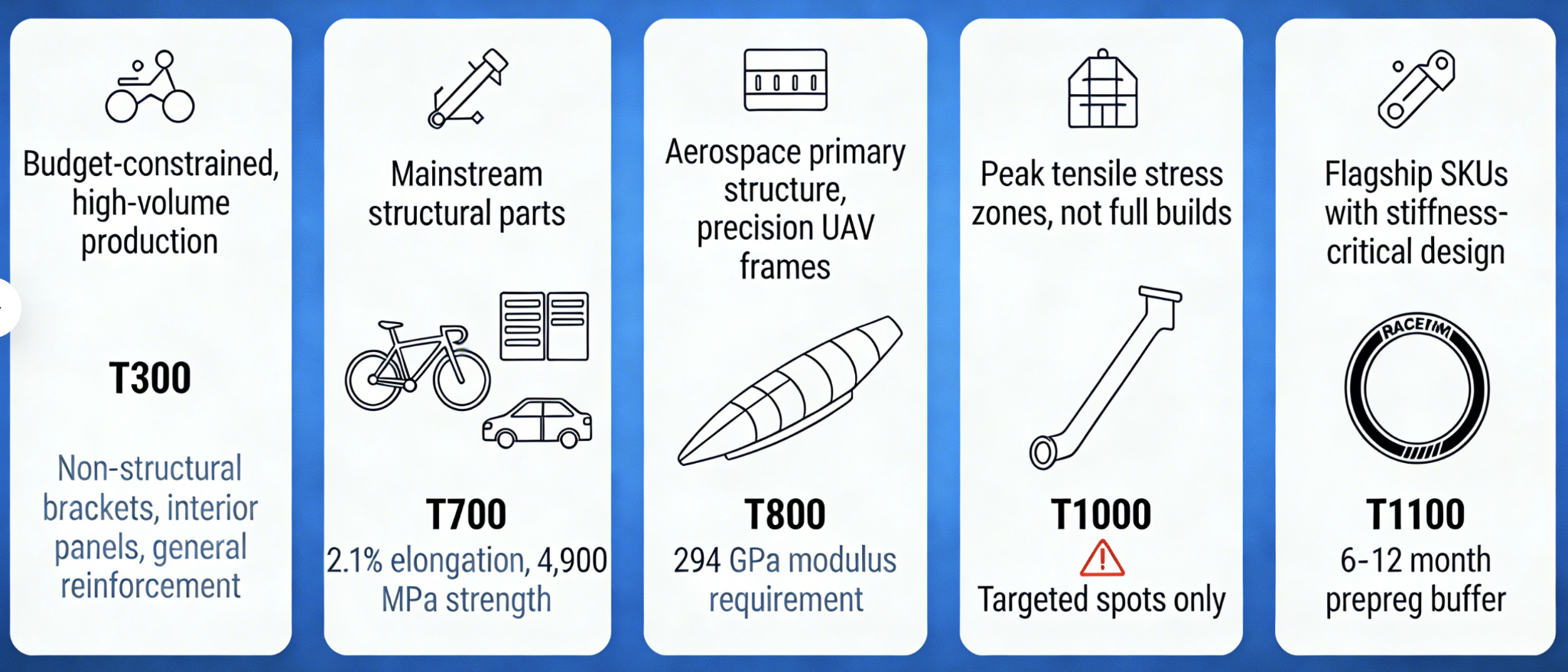
The spec comparison is done. Now comes the part that costs or saves money.
Grade selection comes down to three variables: what stress the part sees, what the budget allows, and what the supply chain can deliver. Get all three right and you’re done. Miss any one of them and you’ll be redesigning or re-sourcing within a product cycle.
Here’s the decision broken down by application type:
Budget-constrained, high-volume production → T300
Non-structural brackets, interior panels, general reinforcement. You’re buying performance-per-dollar, not raw performance. T300 wins that metric by a wide margin.
Mainstream structural parts → T700
Bike frames, automotive panels, running shoe plates, drone airframes. This is where 90% of applications land in practice. T700 offers 2.1% elongation and 4,900 MPa strength. That covers the vast majority of load cases. No need for the sourcing headaches that come with higher grades.
Aerospace primary structure, precision UAV frames → T800
Fuselage skins, wing spars, pressure vessels. The 294 GPa modulus is the requirement, not a bonus feature. Your qualification paperwork points here? There’s no substitute.
Peak tensile stress zones, not full builds → T1000
Down tubes, high-load joints, pressure vessel overwrap. Place it with precision — targeted spots only. A T1000 full-frame build looks like an engineering decision. It’s a budget decision in disguise.
Flagship SKUs with stiffness-critical design → T1100
Race rims, elite fork crowns, competition-grade panels. Budget a 6–12 month prepreg buffer. Allocation-based supply is a real operational constraint. It’s not a footnote — plan around it.
One rule covers every scenario: choose the grade where your design requirement meets the performance ceiling — nothing above it. The next grade up doesn’t make your part better. It makes your invoice larger.
Conclusion
Picking between T300, T700, T800, T1000, and T1100 carbon fiber isn’t about choosing the highest number you can afford. It’s about matching the right material to the right job.
The grade sets the ceiling. Your layup design decides whether you ever reach it.
For most structural applications, T700 carbon fiber sits at the sweet spot. It balances cost, processability, and real-world performance well. Step up to T800 when aerospace tolerances require it. Save T1000 and T1100 for rare cases where the weight savings justify the premium — and where your engineering team can put that difference to real use.
Here’s something most people won’t tell you: a poor laminate in T1000 will lose to a well-engineered T700 layup. Every time.
So get your design fundamentals right before you focus on grade numbers.
→ Need help picking the right carbon fiber grade for your specific application? Talk to a materials engineer — not just a supplier catalog.
Contact HyperX Carbon – Your Trusted Chinese Carbon Fiber Customization Partner
Ready to develop high-performance carbon fiber materials or custom forged carbon fiber parts tailored specifically for your project?
HyperX Carbon is your long-term strategic partner with over 20 years of expertise in advanced composites. We specialize in delivering aerospace-grade forged carbon fiber custom solutions, along with fully personalized prepreg, tubes, sheets, and lightweight carbon fiber structural components for automotive, drone, eVTOL, and medical applications.
We don’t just supply materials — we provide end-to-end customization support:
-
Stable premium supply chain using Toray, Mitsubishi, and Hengshen raw materials
-
AS9100D certified production tailored for aerospace and UAV requirements
-
Rapid prototyping carbon fiber component in just 5-8 weeks, with monthly capacity over 180,000 parts
-
Competitive pricing with 15-18% cost savings on forged carbon solutions
-
Full customization flexibility: from T700 and T1100G to ultra-high modulus grades, with tailored layups, finishes, and performance specifications
Whether you’re an eVTOL developer, automotive OEM, drone manufacturer, or medical device engineer, HyperX Carbon delivers bespoke material selection, structural optimization, and manufacturing solutions that match your exact technical and performance needs — with consistent batch-to-batch quality and reliable delivery.
Get in touch today for a free technical consultation, personalized quote, or custom material samples.
📧 Email: [email protected] 🌐 Website: https://www.hyperxcarbon.com/ 📞 Phone/WhatsApp: +86 15623270276 (English support available)
Let’s co-create your next lightweight innovation together. Contact HyperX Carbon now and stay ahead in the low-altitude economy and advanced composites market.
HyperX Carbon – Not just a supplier, but your dedicated carbon fiber customization expert.