Thickness isn’t just a number — it’s the difference between a drone frame that survives a crash landing and one that doesn’t.
Pick up a 3mm carbon fiber sheet and you’re holding something stiff well beyond what its weight suggests. Grab a 6mm carbon fiber sheet and you can feel why structural engineers trust it for load-bearing assemblies. That middle ground — 4mm — is where most builders end up after one too many misjudgments on earlier projects.
Staring at a spec sheet and not sure which thickness fits your project? This guide breaks down the real mechanical differences between each option. It maps every thickness to the applications where it performs best. You also get a clear decision framework — so you can stop guessing and start building.
3mm vs 4mm vs 6mm Carbon Fiber Sheets
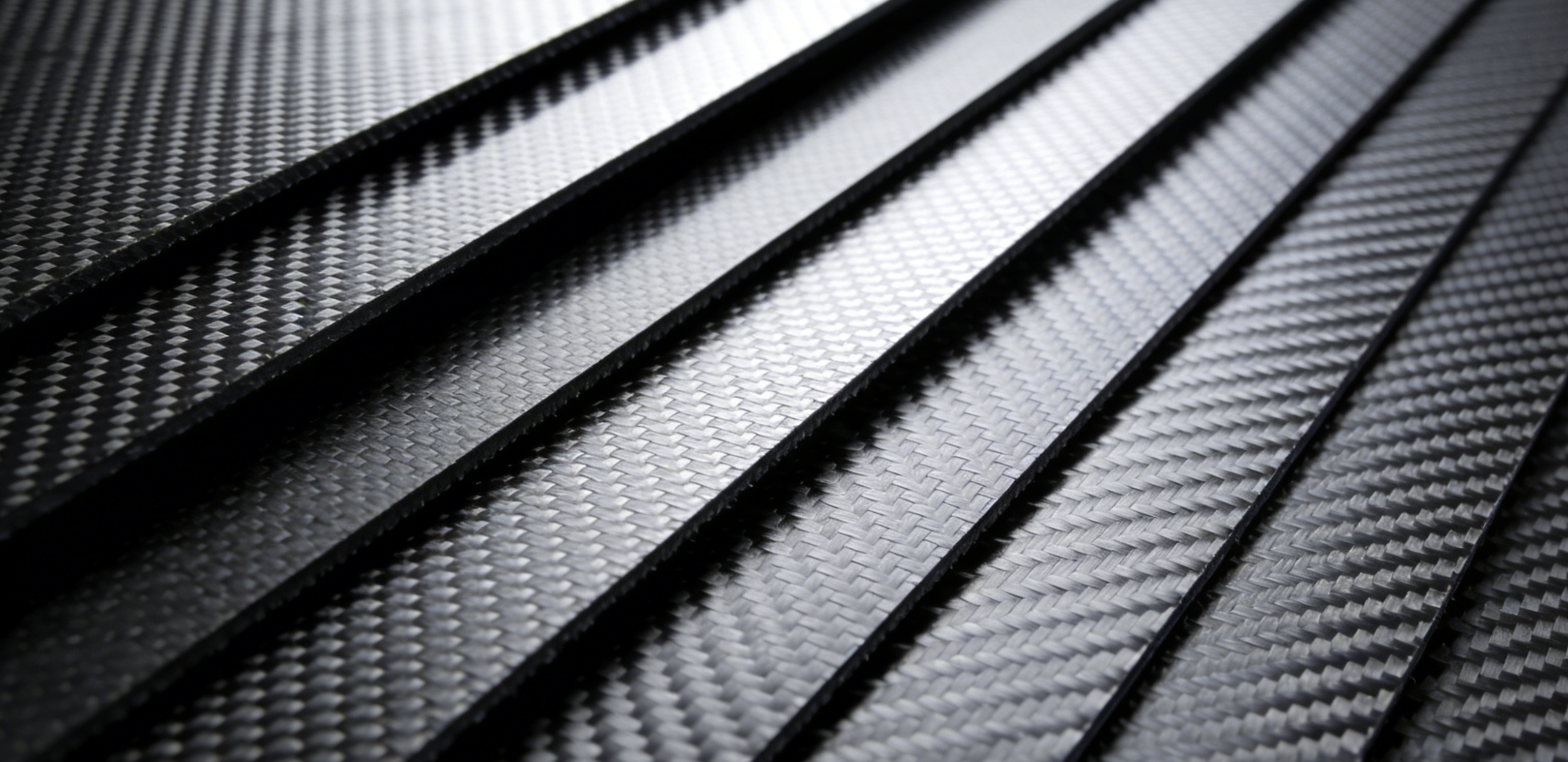
Three thicknesses. Three different performance profiles. Here’s how they compare.
|
Thickness |
Stiffness |
Flexibility |
Weight |
Best For |
|---|---|---|---|---|
|
3mm |
High |
Minimal flex |
Light |
Drones, robotics, structural brackets |
|
4mm |
Higher |
Very low |
Moderate |
Heavy automotive, aerospace reinforcement |
|
6mm |
Maximum |
Near zero |
Heaviest of three |
Industrial load-bearing, bridges, max-rigidity builds |
A few things the table doesn’t show:
-
Stiffness scales fast. Even one millimeter of added thickness changes how the sheet handles load. A 6mm sheet is far more rigid than a 3mm sheet across the same span.
-
All three weigh less than steel or aluminum at the same size. You keep the strength-to-weight advantage no matter which thickness you choose.
-
Machinability trades off with rigidity. 4mm hits the sweet spot for detailed CNC work. 6mm needs strong tooling and careful planning before you cut.
-
Every sheet uses 100% carbon fiber and epoxy resin — no fillers — with quasi-isotropic 0°/90° layering. This gives you uniform strength in all directions.
Pick your thickness based on what the structure truly needs. Don’t go by what looks right on paper.
What Does Carbon Fiber Sheet Thickness Actually Change? (The Physics Behind the Numbers)
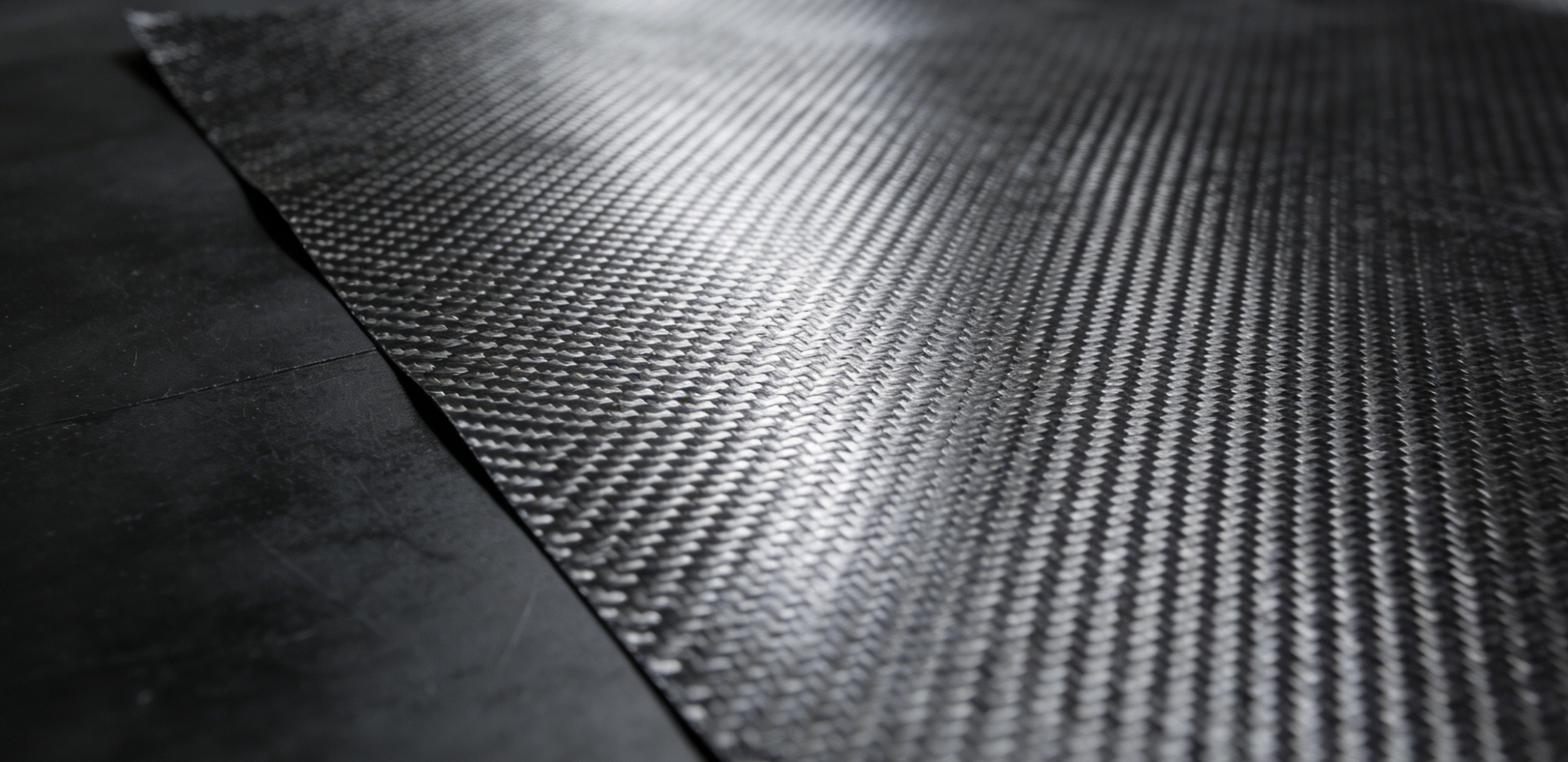
One millimeter. That’s often the gap between a panel that holds and one that fails. Most spec sheets skip the physics. Here’s what they don’t tell you.
Stiffness doesn’t scale in a straight line with thickness. It scales with the cube of thickness. That one fact changes how you should think about these materials entirely.
Double the thickness and you don’t double the stiffness. You multiply it by eight. Stiffness is proportional to h³. So a 6mm carbon fiber sheet is 8× stiffer than a 3mm carbon fiber sheet across the same span. A 3mm sheet is 27× stiffer than a 1mm sheet. That’s not a gradual climb — it’s a cliff.
Weight Stays Manageable Across All Three
Here’s the real trade-off that makes carbon fiber stand out: thickness goes up, but the weight penalty stays small compared to metal.
A 3mm carbon fiber sheet has an areal density of 4.5–5.4 g/cm². That’s 37% of the weight of an equal aluminum sheet — and just 13% of steel. You get more rigidity without the extra mass that hurts performance in weight-sensitive builds.
Weave Pattern Interacts With Thickness
Few people talk about this, but it matters a lot at 3mm and above.
-
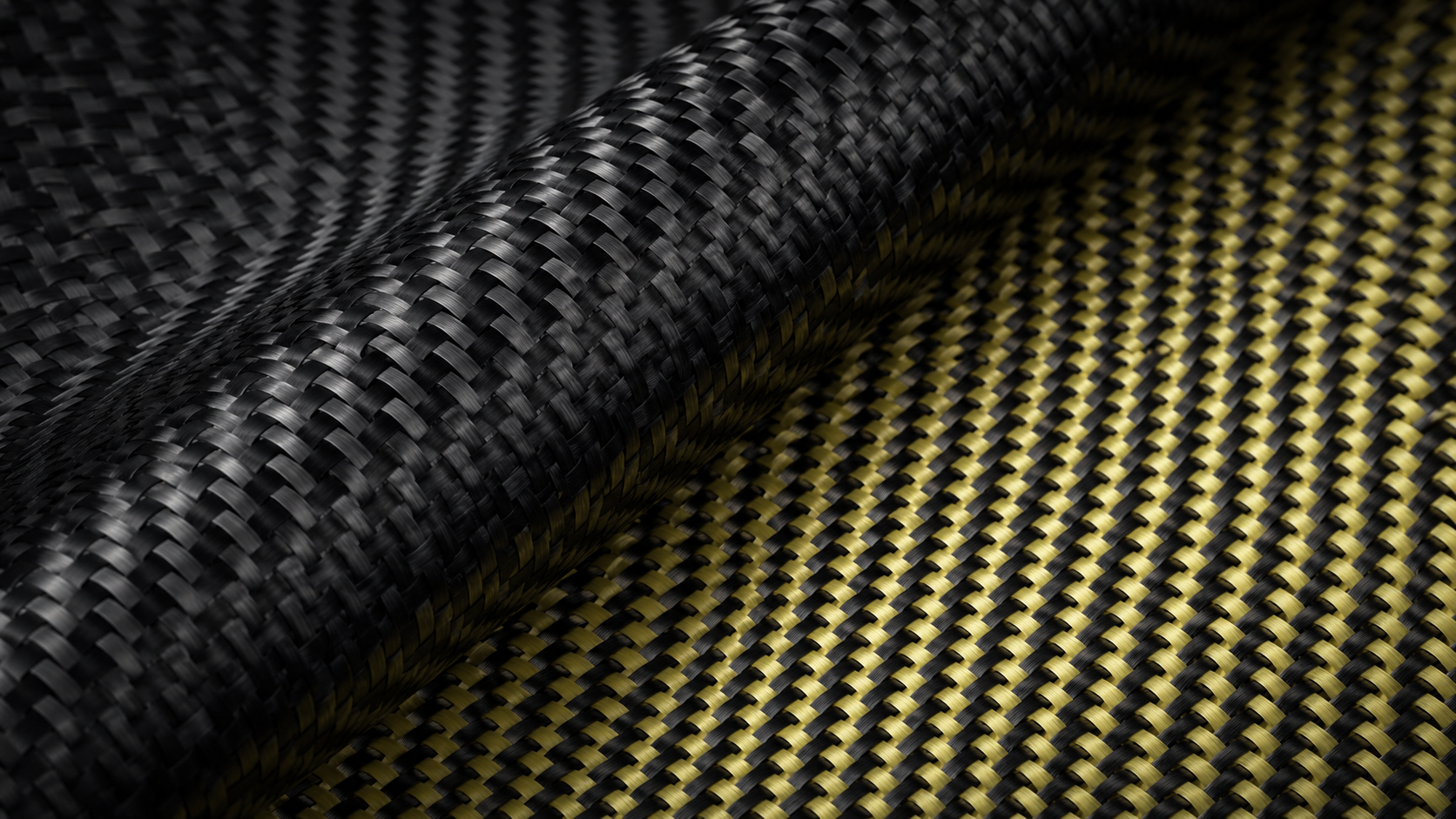
Twill weave handles thick stacks better. At 2–3mm, it gives ~10–15% higher interlaminar shear strength than plain weave. The reason: the interlacing geometry cuts down internal crimp stress.
-
Plain weave raises flexural modulus by 8–12% in thicker laminates — but there’s a real cost. Fatigue life drops by 20%, and delamination risk climbs past 3mm.
Pick the wrong weave at the wrong thickness and you don’t just hurt performance. You speed up failure.
3mm Carbon Fiber Sheet: Lightweight Performance for Precision Applications

At 3mm, carbon fiber stops being a material choice and becomes a precision instrument.
The numbers back this up. A 3mm carbon fiber sheet carries a tensile strength of 503 MPa in the 0/90° direction — and jumps to 557 MPa at 45°. That puts it well ahead of structural aluminum at a fraction of the mass. Density sits at 1,152 kg/m³. You’re working with something that refuses to be heavy.
The modulus figures tell the same story. Young’s modulus lands at 31.6 GPa in tension and 32.4 GPa in compression. Tensile modulus hits 37.2 GPa along the primary fiber axis. These aren’t marketing numbers. They’re why aerospace and robotics engineers keep choosing this thickness. Structural performance and tight weight budgets both get what they need.
Where 3mm Carbon Fiber Sheet Earns Its Keep
The elongation at break — 2.27% at 0/90°, 3.13% at 45° — is the detail most buyers miss. The sheet absorbs deflection before it fails. Drone frames survive rough landings. Robotic linkages bend under dynamic load without cracking. Precision brackets hold their shape under vibration. This isn’t flexibility for its own sake. It’s controlled compliance built into the laminate itself.
Compared to 4mm and 6mm sheets, the 3mm sheet is much easier to machine. CNC routing, drilling, and edge finishing all need less tool force. Less heat builds up too. You get lower scrap rates and cleaner cuts — a clear edge on tight-tolerance parts.
Key Mechanical Specs at a Glance
|
Property |
3mm Carbon Fiber Sheet |
|---|---|
|
Tensile Strength (0/90°) |
503 MPa |
|
Tensile Strength (45°) |
557 MPa |
|
Tensile Modulus (0/90°) |
37.2 GPa |
|
Density |
1,152 kg/m³ |
|
Elongation at Break (0/90°) |
2.27% |
|
Glass Transition Temp |
80°C |
One more spec worth noting: the 80°C glass transition temperature. Automotive interiors, outdoor drone use, industrial fixtures — none of these push the material into heat degradation under normal use. It holds up where you need it to.
For most precision builds, 3mm is the thickness you keep coming back to. You’ll run out of reasons to avoid it long before you find a better option.
4mm Carbon Fiber Sheet: The Engineering Sweet Spot for High-Stress Builds
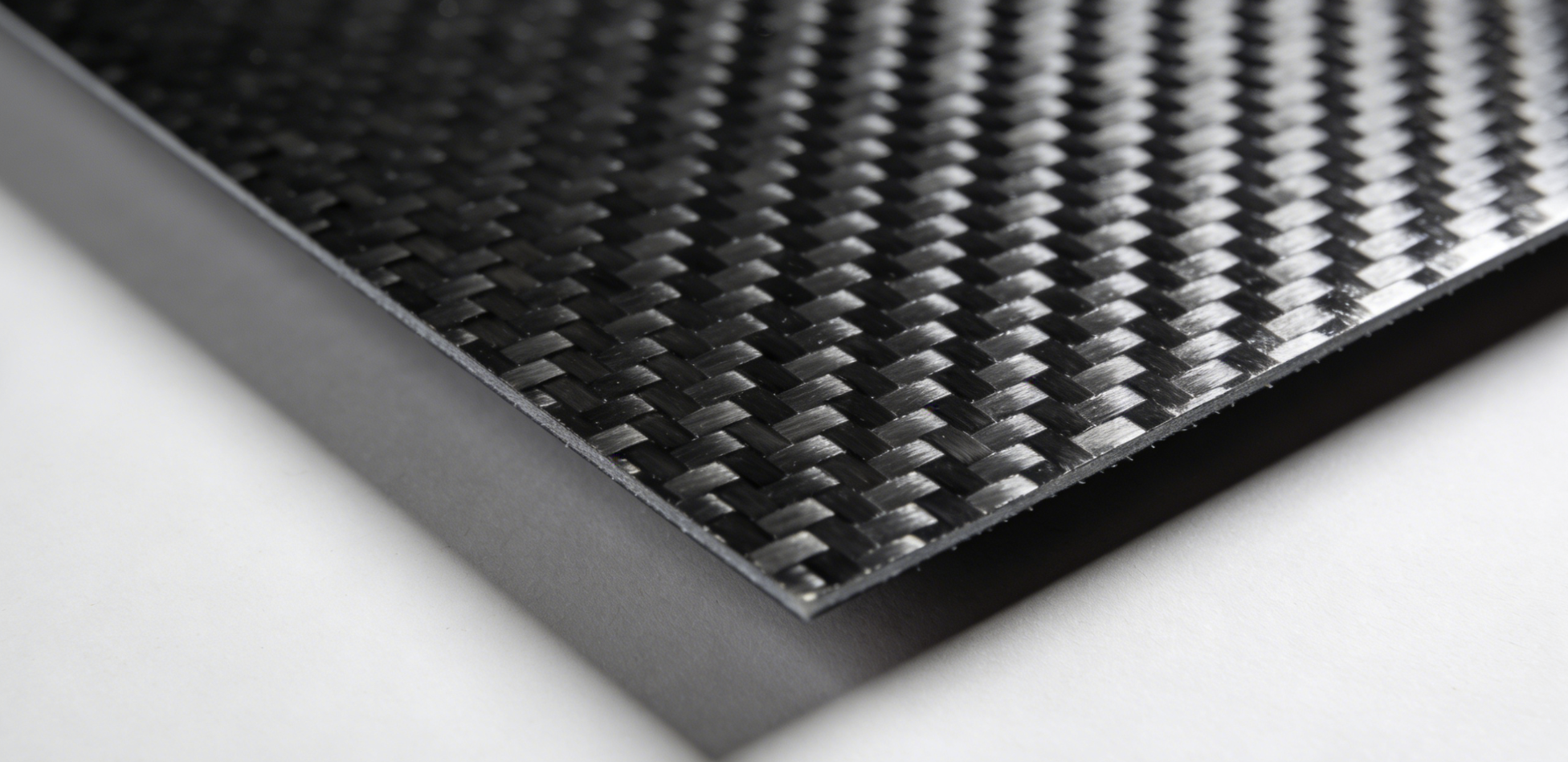
One millimeter separates the 4mm sheet from its lighter sibling. That single millimeter changes everything under load.
Stiffness scales with the cube of thickness. Going from 3mm to 4mm doesn’t give you 33% more rigidity. It gives you 78% more. The math: (4/3)³ ≈ 2.37. That’s close to double the bending resistance for a weight increase of just one-third more mass. In high-stress builds, that ratio decides whether a component holds — or buckles at 300 kg.
What the Numbers Mean in the Field
A 4mm carbon fiber sheet matches the 3mm in raw material quality. Same 503 MPa tensile strength at 0/90°. Same 557 MPa at ±45°. Same 37.2 GPa tensile modulus. What changes is how that strength performs under real-world loading.
The quasi-isotropic 0°/90°/±45° layup lets the sheet handle torsion and bending from every direction at once. Automotive chassis braces at this thickness take 500+ kg dynamic loads and vibration spikes up to 10g without any flex. UAV frames built at 4mm absorb 20g impact shocks — the kind of hit that cracks a 3mm frame right at the mounting points.
Industrial machine mounts show the same results: static loads from 1 to 5 tons, outdoor UV exposure, zero dimensional drift.
The Cost Argument Is Straightforward
A 4mm carbon fiber sheet costs 25–33% more than its 3mm version. For builds where one failed part forces a full redesign, that extra cost buys 2–5x savings in avoided rework. You’re not paying for thickness. You’re paying for the margin that keeps your project from starting over.
Tight CNC tolerances (±0.1mm), hot-press curing, and zero-filler construction mean the sheet cuts clean and holds its shape under load. Demanding applications get full performance from 4mm — no trade-offs required.
6mm Carbon Fiber Sheet: Maximum Rigidity for Structural and Heavy-Load Demands
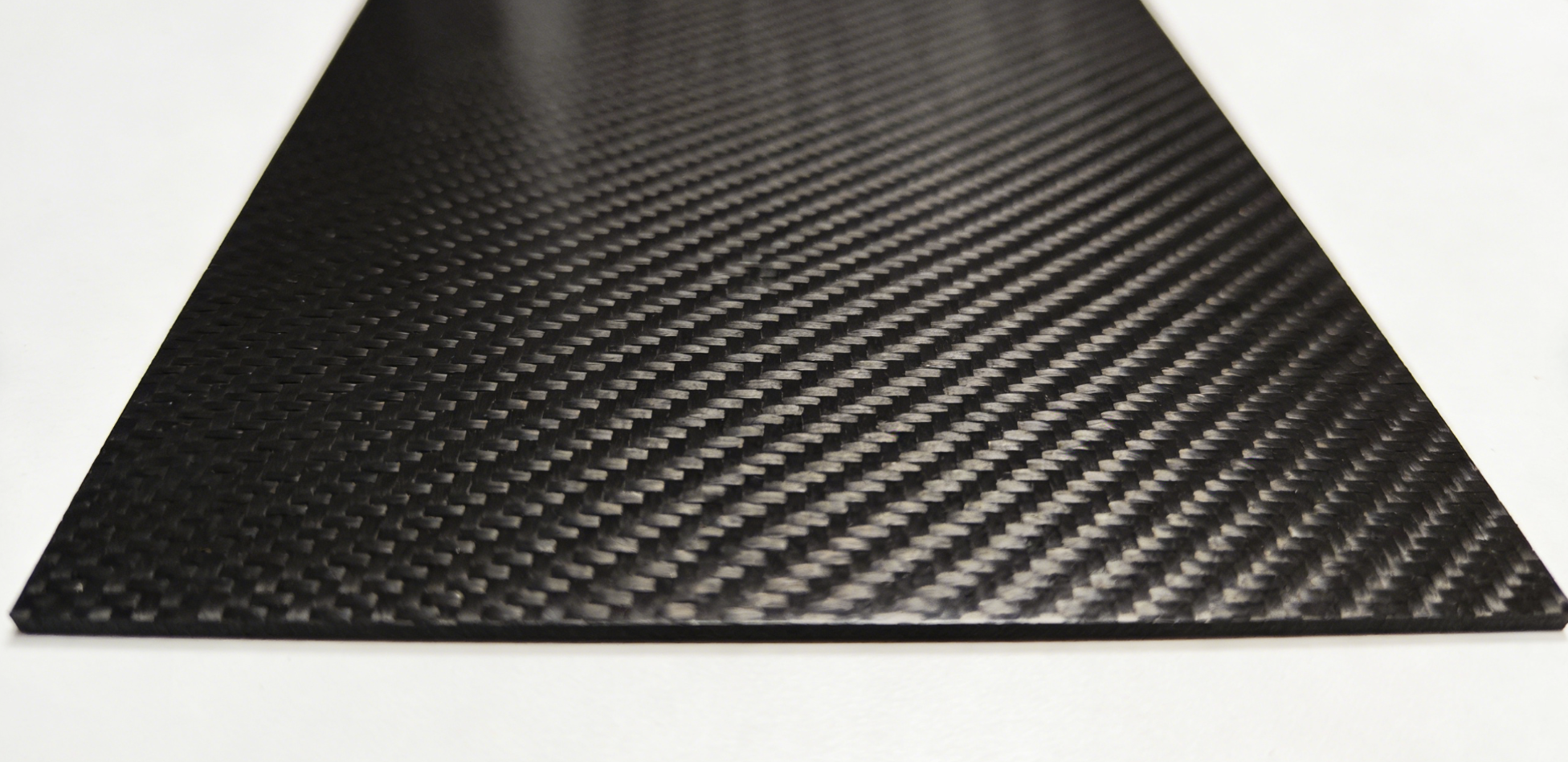
At 6mm, carbon fiber crosses a line. It’s no longer just a lightweight alternative — it becomes a structural solution.
The physics are clear. Stiffness scales with the cube of thickness. So compared to a 3mm carbon fiber sheet, a 6mm sheet delivers 8× the bending rigidity. Stack it against 4mm, and you get 3.4× the stiffness. That’s not a small step up. That’s a different class of material entirely.
Built for Loads That Punish Everything Else
The build specs back up the numbers. Every 6mm carbon fiber sheet uses 100% carbon fiber and epoxy resin — no fillers, no shortcuts. The quasi-isotropic layup with +45°/−45° plies spreads torsional loads and off-axis forces across the full structure. No weak spots. Infusion manufacturing pushes stiffness 30% higher than hand-laminated sheets at the same thickness. High-pressure, high-temperature curing locks in flatness and rigidity. Both hold under sustained load without creeping.
A 50×50cm sheet weighs 2.17 kg. That single number tells the whole story — peak structural rigidity, but still a fraction of the weight of steel or aluminum at the same size.
What You Get at This Thickness
-
Tolerance: ±0.1mm, or +0.2mm via infusion process (6–6.2mm actual)
-
Max sheet size: Up to 1000×1000mm available
-
Surface: One-side gloss with UV protection; matte reverse optimized for bonding
The gloss face does real work. UV protection slows surface wear on outdoor structural builds, where surface damage speeds up fatigue failure. The matte reverse side bonds well after light sanding. No special prep chemicals needed.
Thick carbon fiber sheets at 6mm fit applications where rigidity is non-negotiable. Think structural frames under torsional stress, construction assemblies that need high bending strength, and load-bearing setups where thinner options have already failed the numbers test. Your load case calls for 4mm? That’s fine — 4mm handles most jobs. But check your safety margins before you step down from 6mm. Overkill and adequate are two very different things when the structure is under load.
Side-by-Side Comparison: 3mm vs 4mm vs 6mm Carbon Fiber Sheet Key Specs
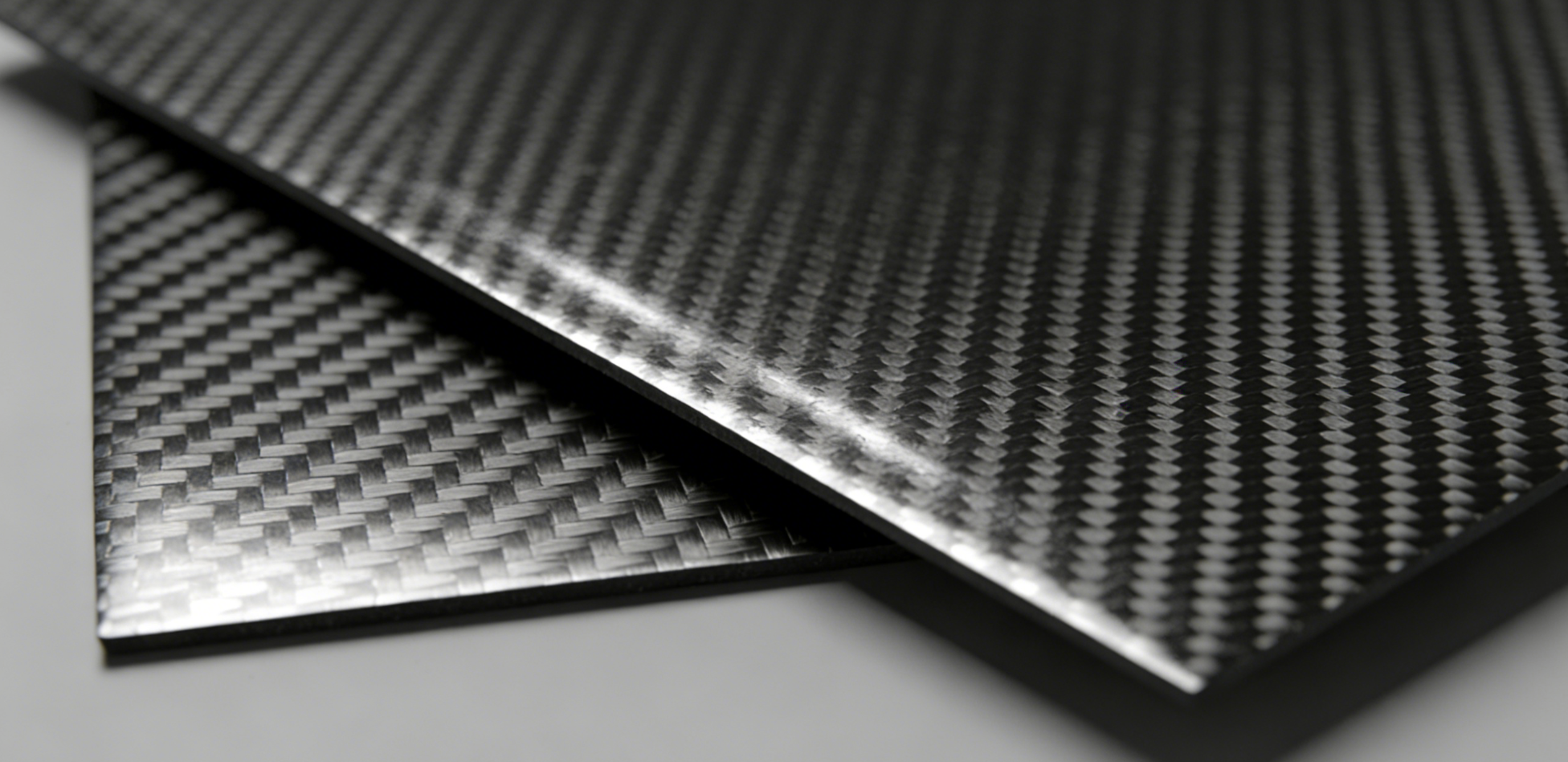
These specs are decision tools. Use them to match your load case to the right thickness before you order.
|
Property |
3mm |
4mm |
6mm |
|---|---|---|---|
|
Rigidity Level |
High |
Very High |
Exceptional |
|
Load Capacity |
Moderate–High |
High |
Very High |
|
Flexibility |
Low |
Minimal |
Minimal |
|
Typical Applications |
Drone chassis, robotics, RC frames |
Heavy automotive, high-torque components |
Industrial machinery, max load-bearing |
|
Machining Difficulty |
Moderate |
Moderate |
Demanding |
Three things worth knowing before you read further:
-
Material composition stays the same across all three. Each sheet runs 68% carbon fiber and 32% epoxy resin — sourced from Japan Toray carbon fiber fabric. The thickness changes. The material quality does not.
-
Layup options vary. All three come in 3K+UD+3K, full UD, full 3K, and hybrid fiberglass configurations. Your layup choice shifts stiffness and fatigue performance on its own — separate from thickness.
-
Standard sheet sizes cover the full range — from 4×8 inches up to 150×370 cm. Thickness does not limit your format options.
The 3mm sits at 150–180 g/sqm areal weight. The 6mm reaches 320–360 g/sqm. Both are much lighter than equivalent aluminum. That weight advantage holds at every thickness in this range.
How to Choose the Right Carbon Fiber Sheet Thickness: A Decision Framework
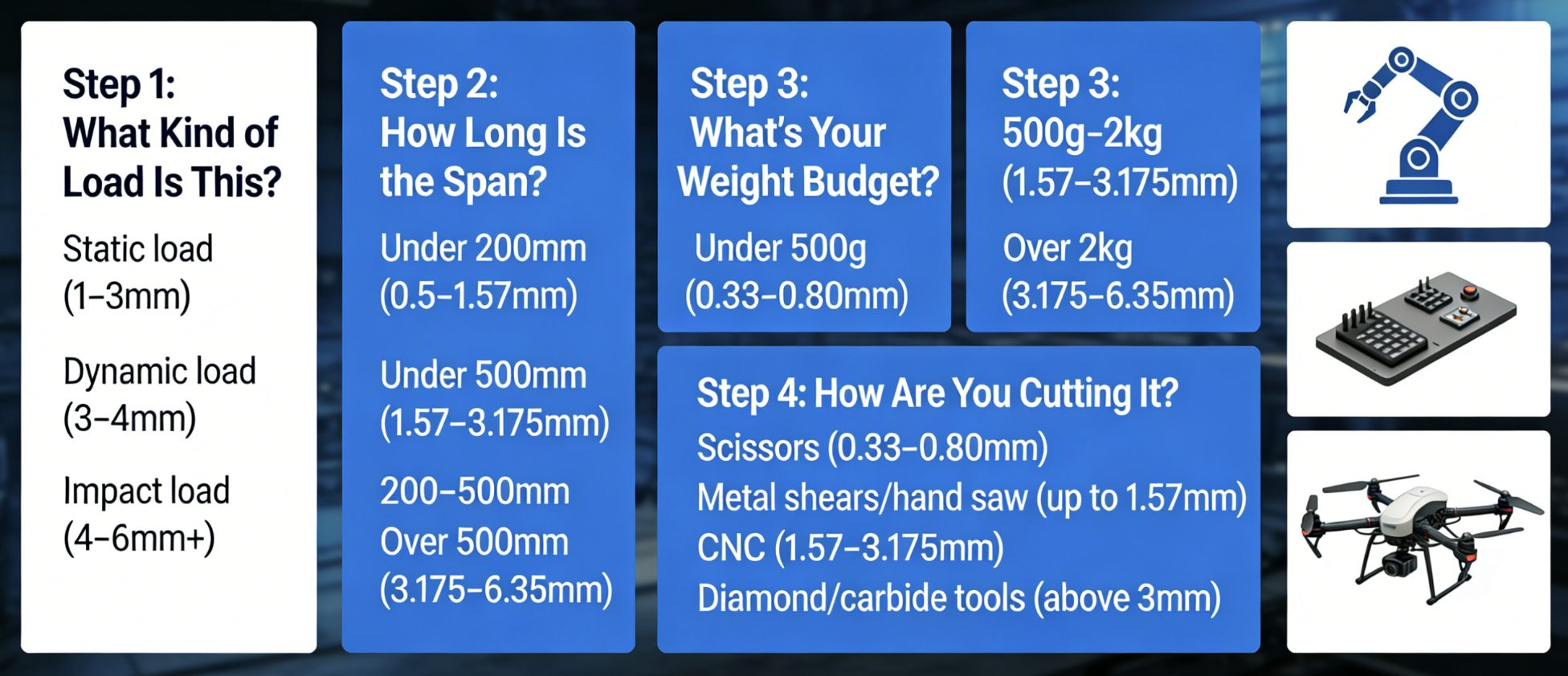
Wrong thickness choices don’t show up right away. You see the damage later — a buckled robot arm, a cracked chassis plate, or a drone that loses 20% flight time because someone added 300g of extra material. These four steps help you avoid that.
Work through each question in order. Each one cuts down your options.
Step 1: What Kind of Load Is This?
-
Static load (constant, predictable force): 1–3mm works well — low flex, high stability.
-
Dynamic load (vibration, oscillation, repeated stress): 3–4mm handles the repeated cycling without wearing out fast.
-
Impact load (sudden shock, crash force): 4–6mm+. Anything under 4mm on a high-impact build isn’t a calculated tradeoff — it’s a failure waiting to happen.
Step 2: How Long Is the Span?
Span length forces the real thickness decision. Under 200mm? You can use 0.5–1.57mm with no serious deflection. From 200–500mm, stay in the 1.57–3.175mm range. Past 500mm — cantilever setups in particular — you need 3.175–6.35mm. A 3mm sheet on a 700mm industrial span buckles at 200N static load. That’s not a design flaw. That’s the wrong thickness.
Step 3: What’s Your Weight Budget?
|
Total Weight Budget |
Thickness Range |
|---|---|
|
Under 500g |
0.33–0.80mm |
|
500g–2kg |
1.57–3.175mm |
|
Over 2kg |
3.175–6.35mm |
A 6mm sheet on a 200mm drone arm adds 300g of dead weight. Flight time drops 20%. The carbide tooling needed to machine it costs 50% more. Neither outcome was in the original project spec.
Step 4: How Are You Cutting It?
-
Scissors: 0.33–0.80mm
-
Metal shears or hand saw: up to 1.57mm
-
CNC with alloy tooling: 1.57–3.175mm
-
Diamond or carbide tools: required above 3mm
Skip this step and budget overruns follow. The material cost is almost never the surprise — the tooling cost is.
Quick-Reference by Industry
|
Application |
Recommended Thickness |
|---|---|
|
Drone / RC frames |
3mm |
|
Robotics / automation |
3–4mm |
|
Automotive modifications |
4mm |
|
Industrial structural builds |
6mm |
Run all four steps. Check your result against the industry table. Two steps pointing the same way? You have your answer.
Frequently Asked Questions About Carbon Fiber Sheet Thickness
Real questions from real builds — answered straight.
Should I use 3mm or 4mm for my drone frame?
Stick with 3mm. It’s the standard for UAV bulkheads and robot base plates. The specs back it up: 20–24 plies, 1,800 g/m² areal weight, and a bending stiffness of 675 N·m²/m. That handles the vast majority of drone frame requirements. Need more rigidity? Jump to 5mm — 34–40 plies, 3,120 N·m²/m. A 4mm sheet isn’t a standard production size. Chasing it wastes sourcing time you don’t have.
How much weight can a 6mm sheet hold?
No single published load number exists. Span length and support conditions change everything. Here’s what we know: 6mm sits in the heavy-duty structural class — machine beds, industrial frames, load-bearing assemblies. Sheets up to 120×280cm are available at this thickness. Custom orders go up to 50mm. Run a 3-point deflection test against your actual load case. That gives you a verified answer. Guessing doesn’t.
Can carbon fiber sheets be bent or formed?
Yes — but thickness sets a hard limit on how far.
|
Thickness |
Minimum Bend Radius |
Practical Use |
|---|---|---|
|
0.33mm |
Very tight |
Decorative, scissors-cut |
|
0.50mm |
~4″ cylinder |
Cosmetic overlays |
|
0.80mm |
10–12″ cylinder |
Light structural |
|
1.6mm |
~24″ cylinder |
Rigid, impact-resistant |
|
3.2mm+ |
Minimal |
Structural only, saw-cut required |
Past 3mm, forming is off the table. Design for flat.
How does ply count relate to thickness?
Each millimeter of thickness is a stack of cured plies. Here’s the breakdown:
|
Thickness |
Ply Count |
Areal Weight |
|---|---|---|
|
1.0mm |
7–8 plies |
600 g/m² |
|
2.0mm |
14–16 plies |
1,200 g/m² |
|
3.0mm |
20–24 plies |
1,800 g/m² |
|
5.0mm |
34–40 plies |
3,000 g/m² |
More plies means more material. Stiffness climbs with the cube of thickness — not at a steady rate. So doubling thickness does far more than double the stiffness.
What tolerances should I expect from custom-cut sheets?
Three precision classes cover most projects:
|
Class |
Thickness Tolerance |
Length/Width |
Flatness |
|---|---|---|---|
|
P0 |
±0.05mm |
±0.1mm |
0.2mm/m |
|
P1 |
±0.10mm |
±0.2mm |
0.5mm/m |
|
P2 |
±0.20mm |
±0.5mm |
1.0mm/m |
UAV components need P1 or better. Industrial fixtures can usually work with P2. Standard orders carry a cutting tolerance of ±3.175mm. Got tight mating surfaces? Specify P0 upfront. Adding precision after the fact costs more time and money.
What’s the largest sheet size available?
Standard single panels go up to 2,000×1,200mm. Sheets thicker than 5mm max out at 1,180×1,100mm. Need something bigger? Sandwich construction or custom fabrication gets you larger formats. Lead time and pricing will shift, so plan for that early.
Conclusion
Thickness isn’t just a number on a spec sheet. It’s the difference between a drone frame that survives a hard landing and one that doesn’t. It separates a robot chassis that holds tolerance under load from one that flexes at the worst moment.
Here’s the quick breakdown:
-
3mm carbon fiber sheet — go here for weight savings and competitive builds
-
4mm — solid structural confidence without adding unnecessary bulk
-
6mm — the choice where failure is not an option
The right pick comes down to three things: your load requirements, your weight budget, and how much safety margin you need. Work through the decision framework in this guide. Match your specs to the comparison table. You’ll have your answer before you hit the order button.
Ready to build something that holds? Browse our full range of carbon fiber sheets — every thickness, cut to your specs, shipped fast.
Contact HyperX Carbon – Your Trusted Chinese Carbon Fiber Partner
Ready to source high-performance carbon fiber materials or custom forged carbon fiber parts from China?
HyperX Carbon is a leading manufacturer with 20+ years of expertise, specializing in aerospace-grade forged carbon fiber, prepreg, tubes, sheets, and lightweight automotive/drone/medical components. We offer:
-
Stable supply chain with premium raw materials (Toray, Mitsubishi, Hengshen)
-
AS9100D certified production for aerospace & UAV applications
-
Rapid prototyping (5-8 weeks) and monthly capacity exceeding 180,000 parts
-
Competitive pricing with 15-18% cost savings on forged carbon solutions
-
Full customization: from T700/T1100G to ultra-high modulus grades
Whether you’re an eVTOL developer, automotive OEM, drone manufacturer, or medical device engineer, HyperX delivers consistent quality, batch-to-batch reliability, and reliable delivery.
Get in touch today for a free consultation, custom quote, or material sample.
📧 Email: [email protected]
🌐 Website: https://www.hyperxcarbon.com/
📞 Phone/WhatsApp: +86 15623270276 (English support available)
Let’s build your next lightweight innovation together – contact HyperX Carbon now and stay ahead in the low-altitude and advanced composites market.