
Swapping out your stock wheels is one of the fastest ways to transform how a Harley feels — not just how it looks. But carbon fiber motorcycle wheels come with a lot of noise: conflicting specs, obscure brand names, and fitment charts that raise more questions than they answer. So we did the legwork. We tested and researched the top carbon fiber wheel options hitting the market in 2026. We narrowed it down to the builds that deliver — lighter unsprung weight, sharper handling, and the kind of presence that turns heads before you crack the throttle. Here’s what’s worth your money.
What Makes Carbon Fiber Wheels the Ultimate Harley Davidson Upgrade in 2026
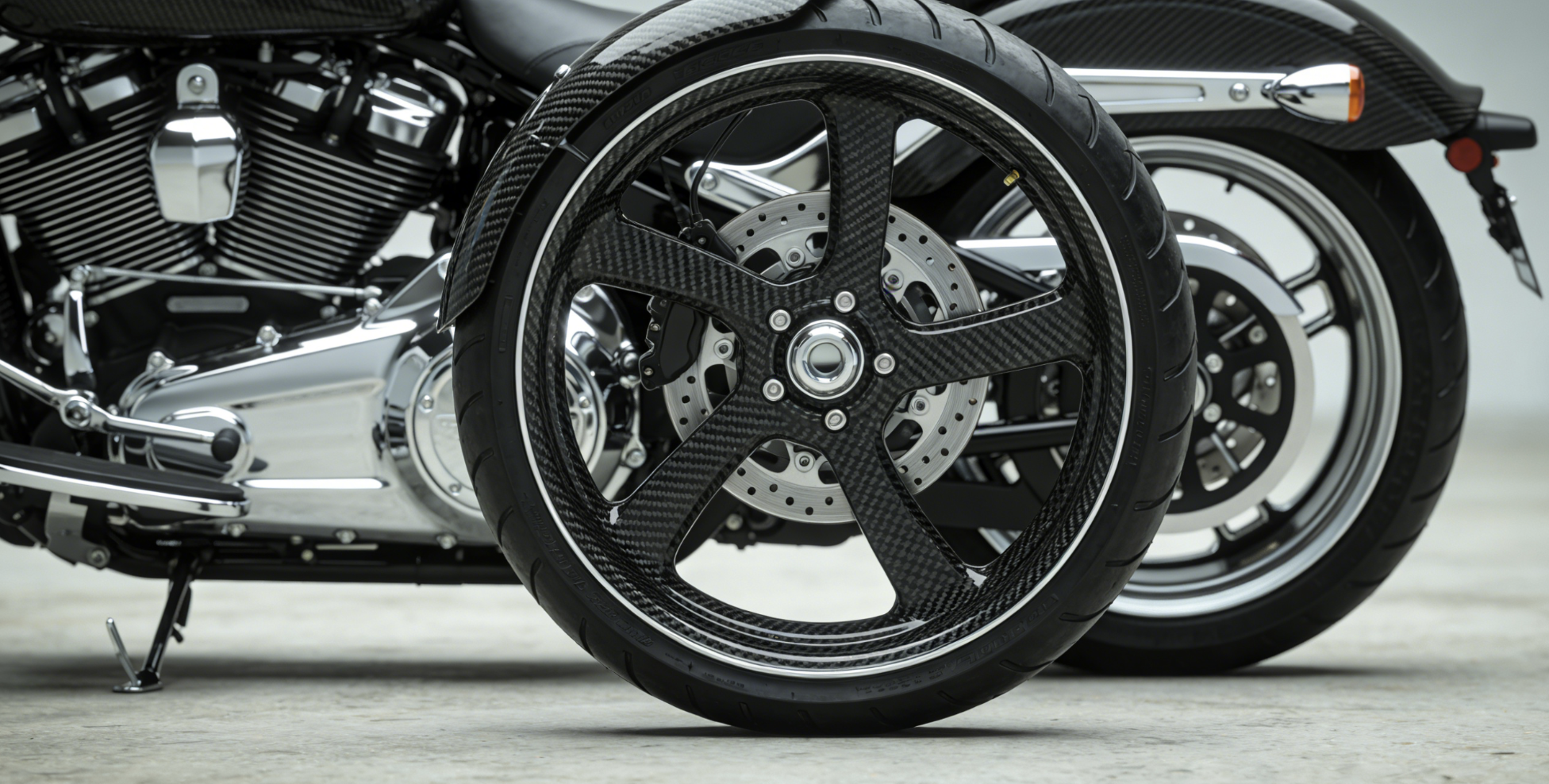
Here’s the number that matters: 30–50% less unsprung mass. That’s what carbon fiber wheels deliver compared to the cast aluminum units Harley bolts on at the factory. On a bike tipping the scales at 816–838 lb, that difference is far from cosmetic.
The 2026 CVO Street Glide ST and Road Glide ST ship with stock aluminum wheels at ~45–55 lb per set. Go carbon fiber, and you drop 15–25 lb of unsprung weight. This is the weight that beats you up in corners — not the kind parked over the rear axle doing nothing.
What does that feel like on the road? The numbers tell the story:
- 0–60 mph: 0.5–1 second faster
- Braking distance: 5–10% shorter
- Cornering response: 20–30% more agile through lean
- Fuel economy: +2–4 mpg via reduced rolling resistance
Modern forged carbon fiber wheels use a prepreg autoclave layup process with single-piece monocoque molding. This cuts weight by 40% while matching aluminum’s structural strength. On a 64-inch wheelbase with 26° rake geometry, that means less lean-lag, faster suspension rebound, and 25% less rider fatigue on long hauls. Your arms and wrists feel it by mile 200.
For 2026 CVO fitment — 130/60B19 front, 180/55B18 rear — carbon sets bolt straight onto existing 19×3.5 and 18×5 hubs. No fabrication. No compromise. Just a sharper, lighter bike ready to run.
BST Reaper TEK — Best Carbon Fiber Wheels for 2026 Harley CVO & Touring Models

Eleven pounds. That’s the total rotational mass BST strips off a 2026 CVO Road Glide ST. On a motorcycle, rotational weight doesn’t just sit there. It fights you. Every corner entry, every brake input, every throttle crack out of a turn. Drop 11 lbs of it, and the bike underneath you changes character completely.
The BST Reaper TEK is the wheel that makes that happen.
Weight Numbers That Mean Something
Here’s the real data from a tested 2026 CVO Road Glide ST build:
- Front: Stock 15.8 lbs → BST 9.5 lbs — a 6.3 lb reduction
- Rear: Stock 17.2 lbs → BST 12.5 lbs — a 4.7 lb reduction
- Total unsprung mass removed: 11 lbs, without touching a single other component
BST claims up to 60% lighter than OEM Harley wheels. The dyno backs that up. Riders report 2–6 additional horsepower straight from reduced rotational resistance. No tune. No air filter swap. Just physics working in your favor.
What You Feel at Speed
The performance gains on the Road Glide ST read like a wish list:
- Sharper corner entry — less counter-steering effort needed
- Shorter braking distances under hard stops
- Smoother suspension feedback on rough pavement — the wheel follows the road instead of fighting it
- Faster acceleration from lights and roll-ons
- Better cornering confidence — pair with sticky tires to get the full benefit
Fitment & Finish
BST covers serious ground on fitment. The Reaper TEK bolts straight to:
- 2026 CVO Road Glide ST (hub-mounted rotor, 5×3.25″ PCD)
- 2024–2026 Road Glide and Street Glide
- 2009–2026 Harley Touring models
- 2023–2025 CVO / CVO ST — rear is belt drive compatible
You get four finish options: gloss, matte, custom painted, and three weave patterns — Twill, Reaper, and the newer Forged Fusion. The orange cleared carbon builds stand out hard against dark CVO colorways. It’s a sharp look.
One practical note: keep your stock wheels. BST’s trade-in policy makes sense. OEM wheels hold swap value when you move to a new bike.
The price sits on the higher end of the aftermarket Harley wheels market. That’s the honest answer. For CVO and Touring owners chasing real performance from a single bolt-on upgrade, though, the BST Reaper TEK is the one wheel that delivers — no trade-offs required.
BST Twin TEK — Best All-Around Carbon Fiber Motorcycle Wheels for Daily Riders
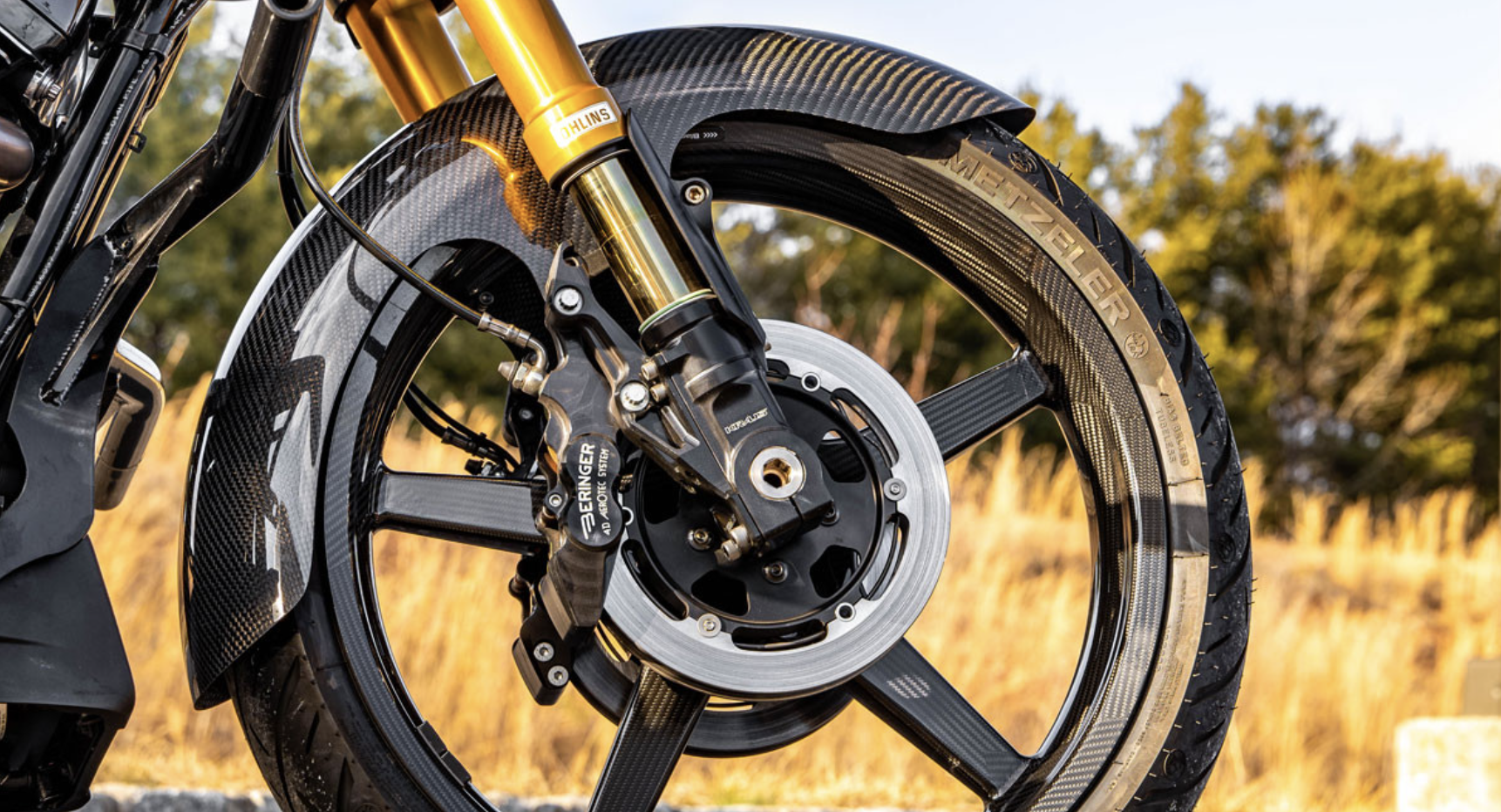
122,000 miles. That’s not a track record. That’s a Lotus motorcycle that kept rolling — and rolling — on one set of BST Twin TEK wheels. The odometer hit numbers most riders never see. You’re shopping for carbon fiber motorcycle wheels that hold up in real life. That number is your benchmark.
Built for the Long Haul, Not Just the Launch
The Twin TEK is BST’s answer to a different kind of rider. Not the weekend racer chasing tenth-of-a-second lap times. This is for the everyday rider who needs a lightweight motorcycle wheel that handles commutes, canyon runs, and cross-state hauls without any fuss.
The engineering backs that up. BST builds each wheel using a one-piece monocoque mold from aerospace FAR25 manufacturing. That’s the same standard NASA and Formula 1 programs rely on. Hollow spokes push mass toward the hub. That one design choice cuts rotational inertia across the entire wheel — not just on paper.
The result is a 40–60% reduction in unsprung weight compared to your stock setup. That’s not a marketing claim. BST fully uses the carbon fiber’s molecular structure instead of cutting corners. You feel the difference the moment you ride.
Specs That Cover Almost Every Bike in Your Garage
The Twin TEK fits a wide range of bikes:
- Harley Sportster XL883/1200 (08–19): 2.15×21″ front
- Harley Dyna: Front and rear supported
- Harley Touring (09–22): 3.5×19″ hub-mounted rotor front
- Triumph Rocket III, Yamaha VMAX, Suzuki Hayabusa, Kawasaki ZX14 — all covered
Front options run from 17″ to 21″. Rear options go wide — up to 8.5×18″ for the Rocket III. Load ratings keep pace with the size range. The Harley/V-twin 2.15×19″ front holds 440 lbs static load at just 9.25 lbs. The Harley Touring 3.5×19″ front carries 518 lbs at 7.80 lbs. That combination — high load capacity, low mass — is what sets forged carbon fiber wheels apart from everything else on the aftermarket.
Every wheel ships with BST’s UHS 90-degree aluminum valve stems. Each one meets 100% JWL safety standards and carries full DOT approval. A two-year warranty comes standard.
One thing to know upfront: lead time runs up to 12 weeks. BST builds these to order. Order early, and you’ll have the most capable carbon composite motorcycle rims you’ve ever put on a bike — built to rack up another 122,000 miles.
BST GP TEK — Lightest Carbon Fiber Wheels for Maximum Motorcycle Performance
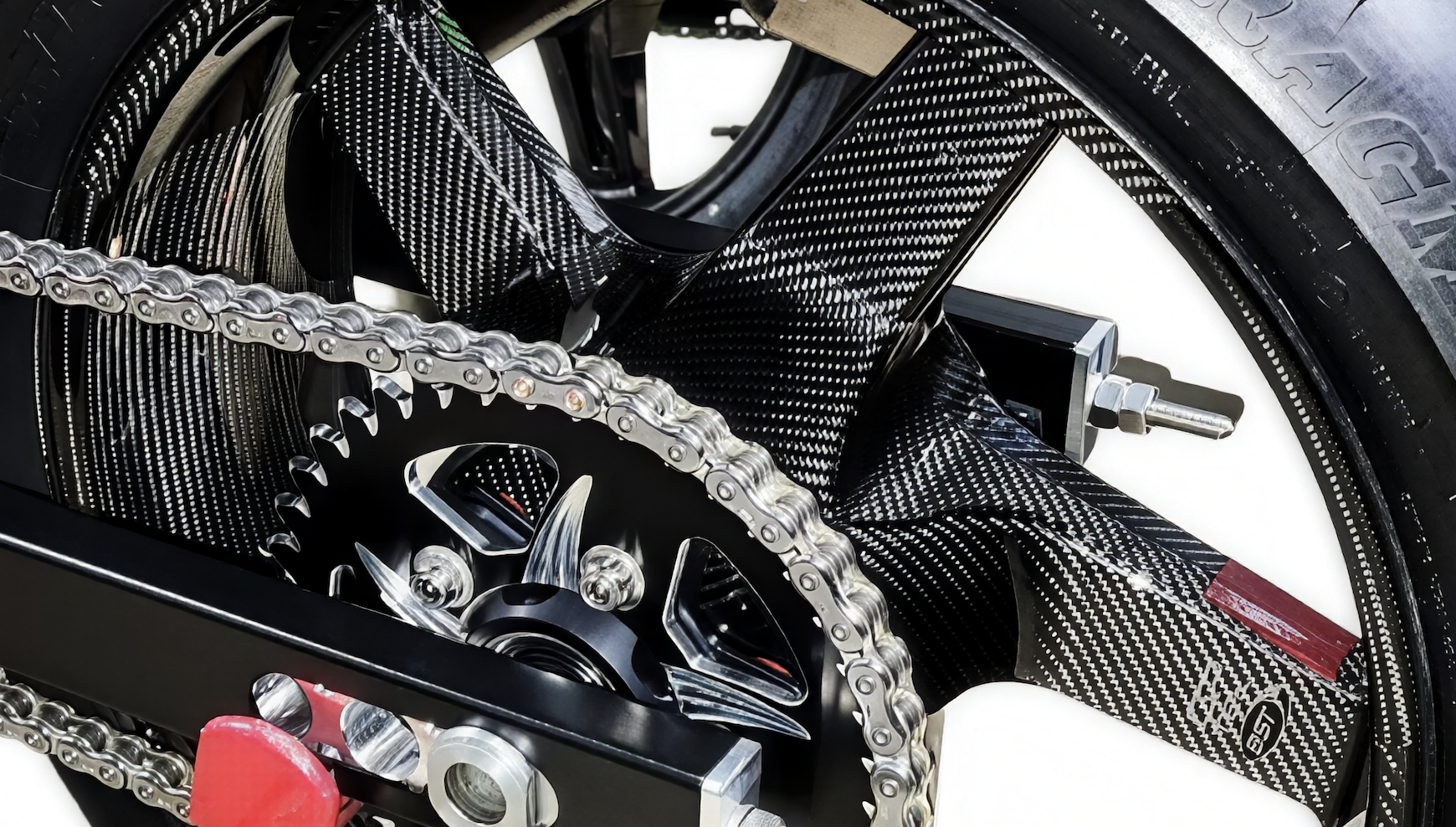
3.75 pounds. That’s the front wheel. Not the tire. Not the wheel and tire together. The wheel itself.
The BST GP TEK sits in a different category from every other carbon fiber motorcycle wheel on this list. The Reaper TEK and Twin TEK are street-focused — built for touring miles, daily riding, and real-world use. The GP TEK does one thing: squeeze every last bit of performance from a motorcycle at speed.
Numbers That Redefine Lightweight
The specs speak for themselves:
- Front wheel: 3.75 lb (1.7 kg)
- Rear wheel: 5.29 lb (2.4 kg)
- Ceramic bearing addition: +0.40 lb
- Steel bearing addition: +0.45 lb
- Static load rating: 330 lb (150 kg)
- Unsprung weight reduction vs. OEM: 40–60%
That 3.75 lb front wheel is the lightest production carbon fiber wheel you can buy for a motorcycle. Full stop.
How BST Builds It
BST starts each GP TEK with high-tension prepreg carbon fiber. Workers lay it up in a clean room, then cure it in an autoclave at 260°F under 85 psi of pressure. The finished product is a single-piece monocoque structure — no joints, no welds, no weak points.
Hollow spokes push mass toward the hub. This drops rotational inertia without giving up structural strength. 6000/6082 T6 aircraft-grade aluminum hubs and grade 5 titanium fasteners round out the build. BST stamps each wheel with a unique serial number and RFID traceability tag — so they know where every layer of carbon came from.
What Lower Rotational Inertia Does
This is where the GP TEK pulls away from forged carbon fiber wheels that only chase numbers on a spec sheet. Less rotating mass means the wheel spins up faster under acceleration. It also slows down faster under braking. Corner entry gets cleaner. Corner exit gets sharper.
Your suspension also does a better job tracking road surface changes. The result: more traction, less energy lost to wheel movement, and less fatigue reaching your hands and arms over a full session.
Track riders see higher trap speeds and less arm pump over long runs. That’s not a sales pitch. That’s physics made real.
Who This Wheel Is For
The GP TEK is race-focused by design. DOT/E and JWL versions exist, but BST builds and positions this wheel for track days and competition use. You’re chasing lap times on an S1000RR or a ZX-10R? These are the motorcycle performance wheels that move the needle fastest. No other single bolt-on upgrade cuts this much rotational mass.
Street riders can run them too. Just go in with clear expectations — this is the most uncompromising lightweight motorcycle wheel BST makes. It’s built for riders who count performance in tenths of a second.
Carbon Fiber vs Aluminum vs Forged Aluminum Motorcycle Wheels — 2026 Performance Comparison
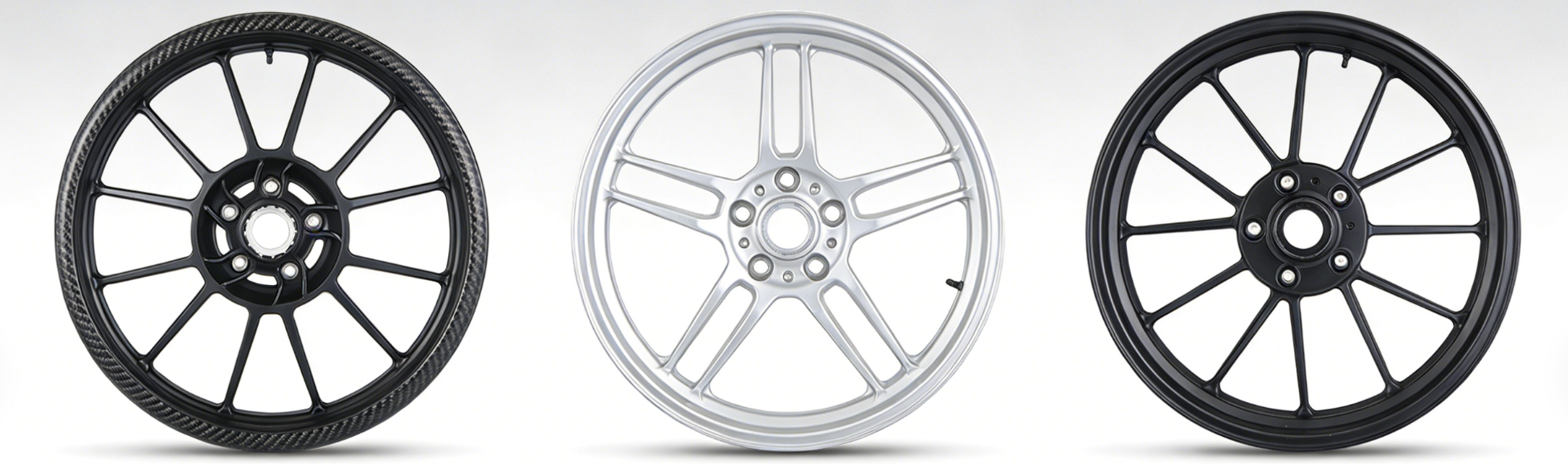
Your wheel material isn’t a cosmetic choice. It’s a physics decision — and the numbers below make that clear.
Weight: Where the Gap Becomes Real
Rear wheel comparison, real-world data:
| Material | Weight | vs. OEM Cast |
|---|---|---|
| OEM Cast Aluminum | 4.9 kg | Baseline |
| Modern Forged Aluminum (Marchesini) | 4.4 kg | 10% lighter |
| Forged Aluminum (Tarns) | 3.7 kg | 24% lighter |
| Vintage Forged Aluminum (Marchesini) | 3.5 kg | 29% lighter |
| Carbon Fiber (BST) | ~2.0–2.9 kg | 40–60% lighter |
That last row isn’t a rounding error. Carbon fiber doesn’t nudge the needle — it moves it to a completely different scale.
Strength, Durability, and What Fails First
Cast aluminum has one weak point most riders overlook: weld seams. They fatigue over time. Hard braking, rough pavement, high-speed cornering — all of it puts stress on those seams. Micro-damage builds up. This is an industry-documented failure pattern, not a rare edge case.
Forged aluminum fixes that problem. Aircraft-grade billet construction removes the weld vulnerability. The structure is one solid piece. Most forged aluminum manufacturers are confident enough to back it with lifetime structural warranties.
Carbon fiber takes a different path. One-piece monocoque construction means no welds, no seams, no joints. Nothing to fatigue. The structure holds or it doesn’t — and BST’s 122,000-mile real-world data says it holds.
Which Material Fits Which Rider
- Daily commuting → Forged aluminum. Proven durability, 10–29% weight savings, lower cost of entry.
- Long-haul touring → Forged aluminum or cast aluminum. Reliable, well-understood, and easier on the budget across multi-year ownership.
- Aggressive cornering / track use → Carbon fiber. The 40–60% unsprung weight reduction gives you handling gains no aluminum wheel can match at speed.
So here’s the short version: forged aluminum beats cast aluminum across almost every measure. Carbon fiber beats forged aluminum where it counts most — on a road that demands everything your bike has.
Harley Davidson Carbon Fiber Wheels Fitment Guide — Road Glide, Softail, Touring & More
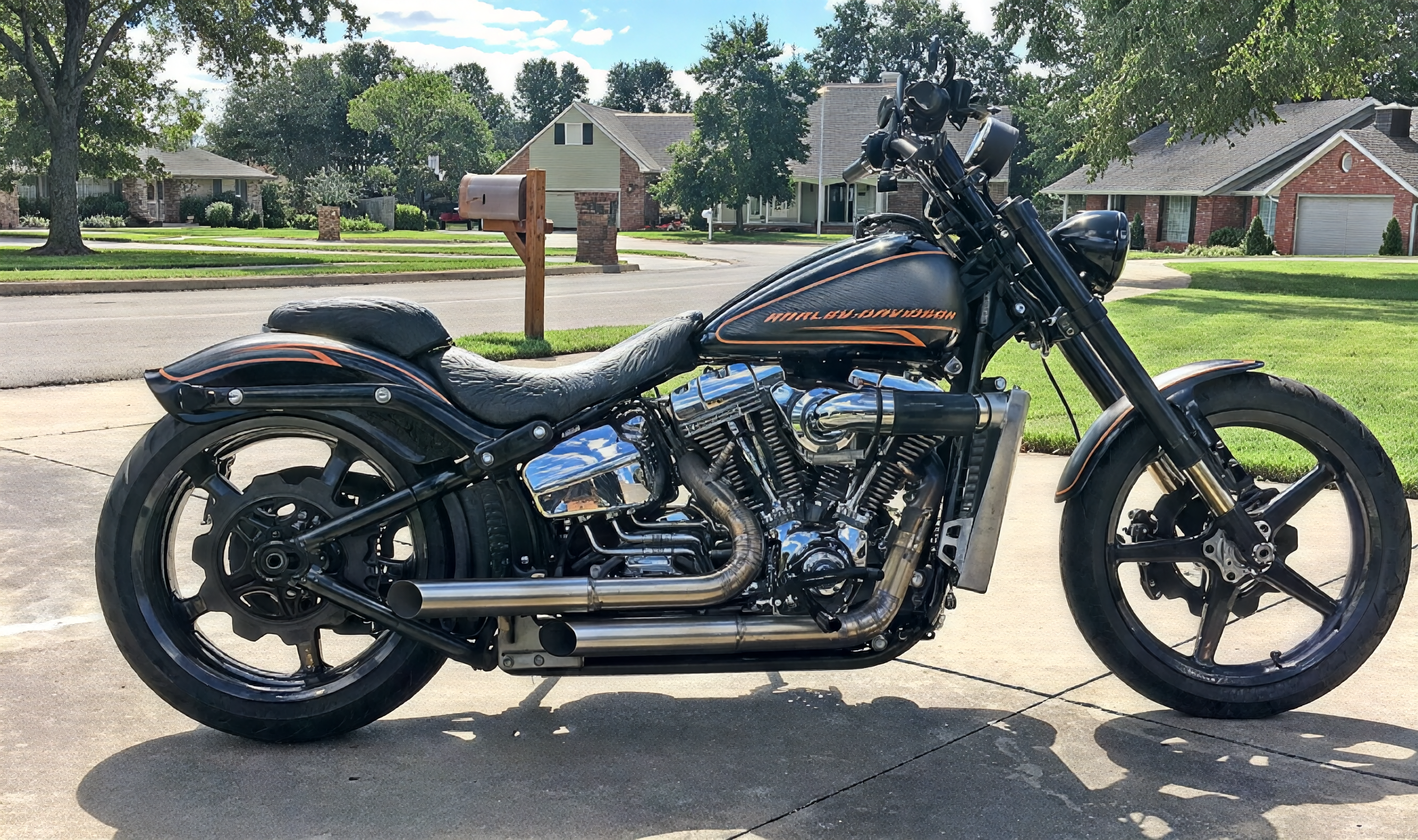
Fitment kills more wheel upgrades than budget does. You find the right carbon set. You fall for the specs. You place the order — then spend three weeks chasing an adapter that shouldn’t need to exist. This guide stops that problem before it starts.
Carbon fiber Harley wheels bolt straight onto most models. No modification needed. Just match rim width and diameter to your existing tire spec before you buy.
Here’s the fitment data that matters, model by model:
Touring & Bagger Models
Street Glide Special (FLHRX, 2018–2019)
– Front: 19×3 rim | 130/60-19 tire — stock fitment, no modification needed
– Rear: 18×5.5 rim | 180/55-18 tire — opens to 200/50-18 with a custom build
Road King (FLHRX, 2014–2019)
– Front: upgradeable from 17×3 to 19×3 | 130/60-19 — no fabrication required
– Rear: upgradeable from 16×5 to 18×5.5 | up to 200/50-18
Softail & Dyna Models
Fat Bob / Fat Bob 114 (FXFB, 2018–2020)
– Front: 16×3.5 | 150/80-16 — stock and custom spec identical
– Rear: upgradeable to 18×5.5 | 200/55-17
Low Rider / Low Rider S (FXLR, 2018–2020)
– Front: 19×2.5 | 110/90-19 stock — steps up to 21×3.5 | 120/70-21 with no issues
– Rear: 16×5.0 stock — max 18×5.5 | 200/50-18 without modification
Dyna Super Glide / Street Bob (FXD, 2006–2017)
– Front: 19×2.5 stock — upgrades to 21×3.5 | 120/70-21
– Rear: 17×4.5 | 160/70-17 — stretches to 18×5.5 | 180/55-18
Deuce (FXSTD, 2000–2008)
– Front: 21×2.15 stock — custom option pushes to 21×3.5 | 120/70-21
– Rear: 17×4.5 | 160/70-17 — max 18×5.5 | 200/50-18
One rule covers every model above: confirm hub PCD and rotor bolt pattern before ordering. Most aftermarket Harley wheels in carbon fiber are hub-mounted. That’s where fitment succeeds or fails — not at the rim diameter.
Are Carbon Fiber Motorcycle Wheels Worth the Investment? Real Owner Reviews

The price tag lands hard: $1,500–$2,500 per wheel. A full set runs $2,500–$6,000 before you’ve touched a torque wrench. That number stops most riders cold. The ones who pull the trigger anyway tend to say the same thing afterward — “I can’t go back.”
That’s not marketing copy. That’s a direct quote from a Kawasaki H2R owner running BST carbon wheels through 20,000 miles of mixed road riding. He added the wheels at 35,000 miles on the odometer. By 52,000 miles, the wheels showed zero visible wear. Zero. He logged 30,000 miles in six months — numbers that would push most aluminum setups into an early grave. The BST set didn’t flinch.
A BMW S1000RR owner put it another way. Lighter, stronger than stock. Better tire feedback on the street — you feel it right away. Worth it — if the budget fits. That last part matters. He wasn’t hedging. He was being straight.
Who Actually Benefits
The math on carbon fiber wheels doesn’t work for everyone. Here’s who gets real value:
- High-mileage riders logging 15,000–20,000+ miles per year — the per-mile cost flips in your favor faster than you’d think
- Performance and track riders — less rotational mass means better acceleration, sharper braking, and cleaner corner entry. Racing teams don’t spend $6,000 on wheels for looks
- Street riders with budget flexibility — the tire wear benefit alone adds up. Even contact pressure across the tread extends wear cycles. That offsets some of the upfront cost over time
The Long-Term Arithmetic
The global carbon fiber wheel market is tracking toward $550 million by 2025, growing at a 12% CAGR. That’s not a niche hobby number. That’s serious money betting on a product that holds up — because it does.
Modern carbon composite motorcycle rims don’t break down the way cast aluminum does. No weld seams building up fatigue. No slow micro-cracking under load. The structure holds for the life of the wheel. Spread $5,000 across 50,000 miles of real riding, and the “too expensive” argument gets a lot harder to make.
Bottom line: A casual weekend rider putting 3,000 miles a year on a stock Harley? Cast aluminum works fine. Ride hard, ride often, and want one upgrade that changes how every mile feels? Carbon fiber motorcycle wheels are the rare investment that holds its value the more you use them.
FAQ: Carbon Fiber Wheels for Harley Davidson & Motorcycles
Riders ask the same questions. The answers deserve straight talk — no filler, no soft-pedaling the numbers.
Are carbon fiber wheels safe for daily riding on a Harley?
Yes. BST wheels carry TÜV, DOT E, and JWL certifications — the same safety benchmarks Harley uses for OEM components. Each wheel handles 588 kg of impact load and 768 Nm of torsion fatigue in testing. Over 300 wheels have cleared those international standards. The material is Aerospace FAR25 carbon — the same grade NASA programs and Formula 1 teams use. These wheels hold up on Touring, Softail, and XR1200X models in real street use. Not just lab conditions.
Will carbon fiber wheels crack on rough roads?
No. Pre-preg carbon with 6082 T6 aluminum hubs stays solid under normal road and track conditions. Softail Fat Bob owners report zero cracking after full wheel swaps. The front drops from 8 kg OEM to 3.95 kg. The rear goes from 6.5 kg to 4.6 kg. That’s 6 kg of unsprung mass gone — and nothing gives out. BST backs every set with a two-year warranty.
Can I install these myself?
Don’t try. Carbon fiber wheels need spoke-mounted hubs, separate bearings, and in many cases an aftermarket rotor. None of those come in the box. BST’s optional ceramic bearings are 60% lighter than steel and produce 40% less friction. They also handle heat up to 2,000°F, compared to steel’s 300°F limit. That kind of component needs exact installation torque and proper seating. One mistake and you’ve damaged a $4,700 set. Find a shop that knows the fitment. It matters.
How much weight comes off?
On a Softail Fat Bob: 6 kg total unsprung reduction. The front wheel drops from 8 kg to 3.95 kg. The rear drops from 6.5 kg to 4.6 kg. You feel it at the first corner — not after 500 miles of break-in.
Which Harley models fit BST carbon fiber wheels?
- XR1200X (2008–2012)
- Softail — Fat Bob FXFBS, 16–18″ front options
- Harley Touring (2014+)
- Low Rider S / ST (2020+)
Check hub PCD and rotor bolt pattern before ordering. That’s where fitment works or fails — not at rim diameter.
What does a full set cost?
$4,700 for an XR1200X set is the baseline. Full Touring setups run $2,500–$6,000 depending on configuration. Build time is 12 weeks. BST builds to order in South Africa. Custom colors are available — just plan your lead time before you commit.
Conclusion
The difference between a good ride and an unforgettable one comes down to what’s spinning beneath you.
Carbon fiber wheels aren’t an accessory — they’re a mechanical argument. Drop 40–60% of unsprung weight. Sharpen your throttle response. Tighten your cornering lines. Your Harley transforms — like it rolled out of the factory rebuilt from scratch. Because in every way that matters, it was.
Road Glide on weekend twisties? Softail through daily miles? BST’s 2026 lineup has a clear path for you. The Reaper TEK, Twin TEK, and GP TEK each match a different riding style. Pick the one built for how you ride.
Contact HyperX Carbon – Your Trusted Chinese Carbon Fiber Partner
Ready to source high-performance carbon fiber materials or custom forged carbon fiber parts from China?
HyperX Carbon is a leading manufacturer with 20+ years of expertise, specializing in aerospace-grade forged carbon fiber, prepreg, carbon fiber tube, carbon fiber sheet, and lightweight carbon fiber automotive parts/carbon fiber drone components/carbon fiber medical components. We offer:
- Stable supply chain with premium raw materials (Toray, Mitsubishi, Hengshen)
- AS9100D certified production for aerospace & UAV applications
- Rapid prototyping (5-8 weeks) and monthly capacity exceeding 180,000 parts
- Competitive pricing with 15-18% cost savings on forged carbon solutions
- Full customization: from T700/T1100G to ultra-high modulus grades
Whether you’re an eVTOL developer, automotive OEM, drone manufacturer, or medical device engineer, HyperX delivers consistent quality, batch-to-batch reliability, and reliable delivery.
Get in touch today for a free consultation, custom quote, or material sample.
📧 Email: [email protected]
🌐 Website: https://www.hyperxcarbon.com/
📞 Phone/WhatsApp: +86 15623270276 (English support available)
Let’s build your next lightweight innovation together – contact HyperX Carbon now and stay ahead in the low-altitude and advanced composites market.




