
Swapping your Tesla’s factory hood isn’t just about looks. It’s one of the biggest impact mods you can make. You shave real weight from the front axle and change the entire face of the car at the same time.
The problem? Carbon fiber hood options flooded the market in 2026. Pick the wrong one, and you’re dealing with poor fitment, a fading clear coat, or a panel never built for your specific Model 3 or Model Y variant.
This guide cuts through the noise. We looked at five of the best carbon fiber hoods available right now — from dry carbon race-spec panels to forged carbon street builds. Each one is ranked by fitment precision, material quality, and real-world value. Whether you own a Highland or a Juniper, there’s a clear option for you here.
2026 Model Y Juniper vs Model 3 Highland: Fitment Compatibility Guide Before You Buy
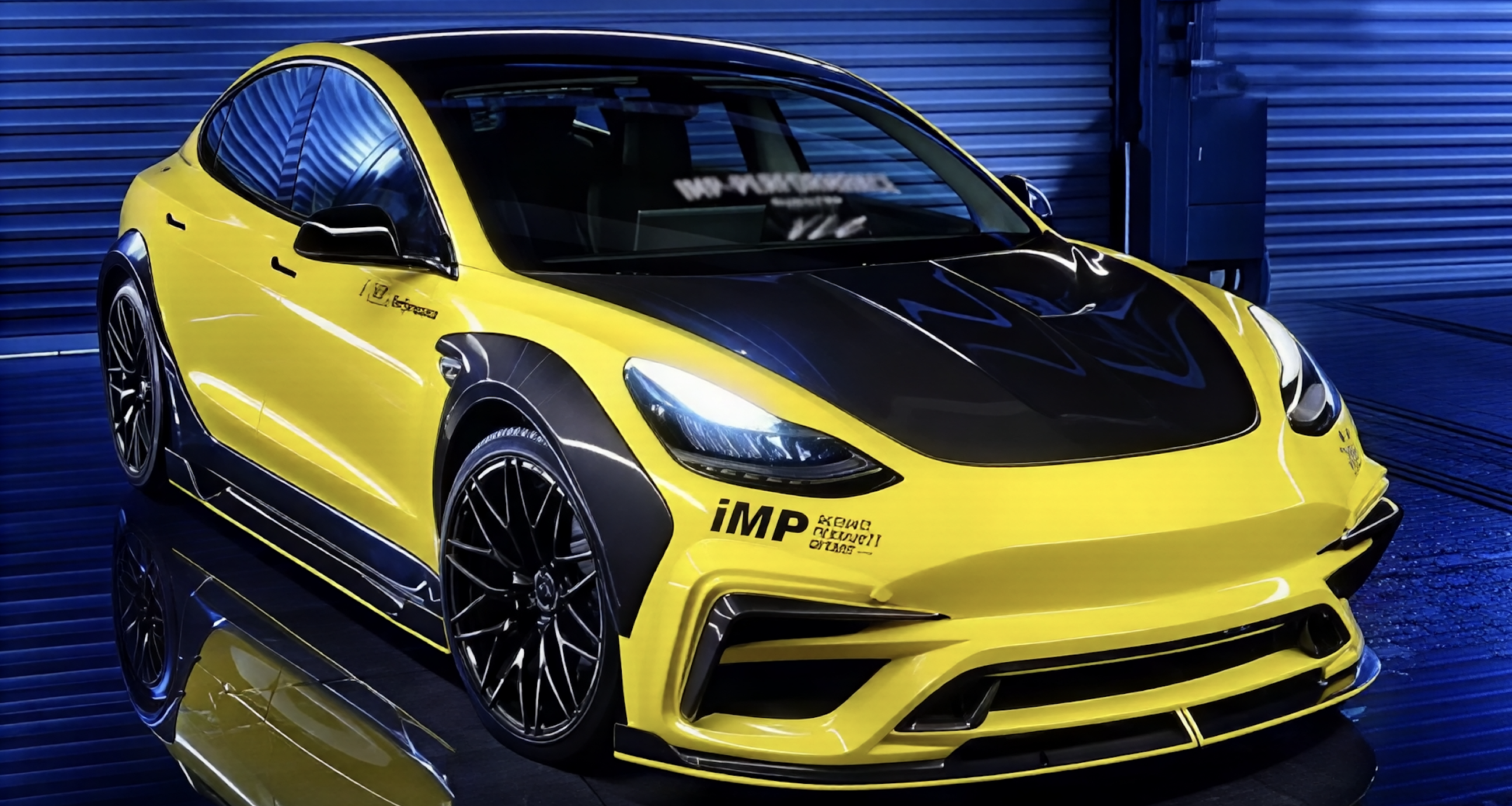
Tesla’s 2024–2026 refresh cycle produced two distinct vehicle generations. The differences go far deeper than cosmetics. Before you order any carbon fiber hood, confirm which generation you’re buying for.
Here’s the core problem: cross-compatibility between Highland and Juniper accessories sits at 20% across the board. For Model Y Juniper, that number drops to 16% — just 22 out of 134 tracked products carry over without issues. Carbon panels are generation-specific. Hoods are no exception.
How to Identify Your Generation Fast
Two quick checks before anything else:
-
Model Y Juniper (2025–2026): Split headlights in a Cybertruck-inspired LED bar layout. Physical turn signal stalk retained. Headlight position sits lower overall.
-
Model 3 Highland (2024–2026): Different headlight shape — no split design. No turn signal stalk. Center console architecture matches Juniper (within 0.2mm on 3D scans).
Still unsure? Open the Tesla app → Vehicle Info → check your build date.
Why Hood Fitment Is Non-Negotiable
The Juniper’s redesigned front fascia — that lower, wider LED bar — changes the hood geometry at the leading edge. Tesla also redesigned the trunk latch mechanism on the Juniper from scratch. Legacy hardware doesn’t work with it. Hood hinge and latch behavior follows the same pattern.
Fitting a Highland-spec hood to a Juniper isn’t a “minor adjustment.” It’s a misfit panel. It won’t close flush. It won’t seal at the cowl. You’ll get wind noise at highway speeds — and no amount of adjustment fixes that.
Bottom line: Confirm the SKU matches your build year before purchasing. Carbon fiber quality means nothing if the panel doesn’t sit right.
#1 CMST Tuning V1/V2 Carbon Fiber Hood — Best for Model Y Juniper 2026+
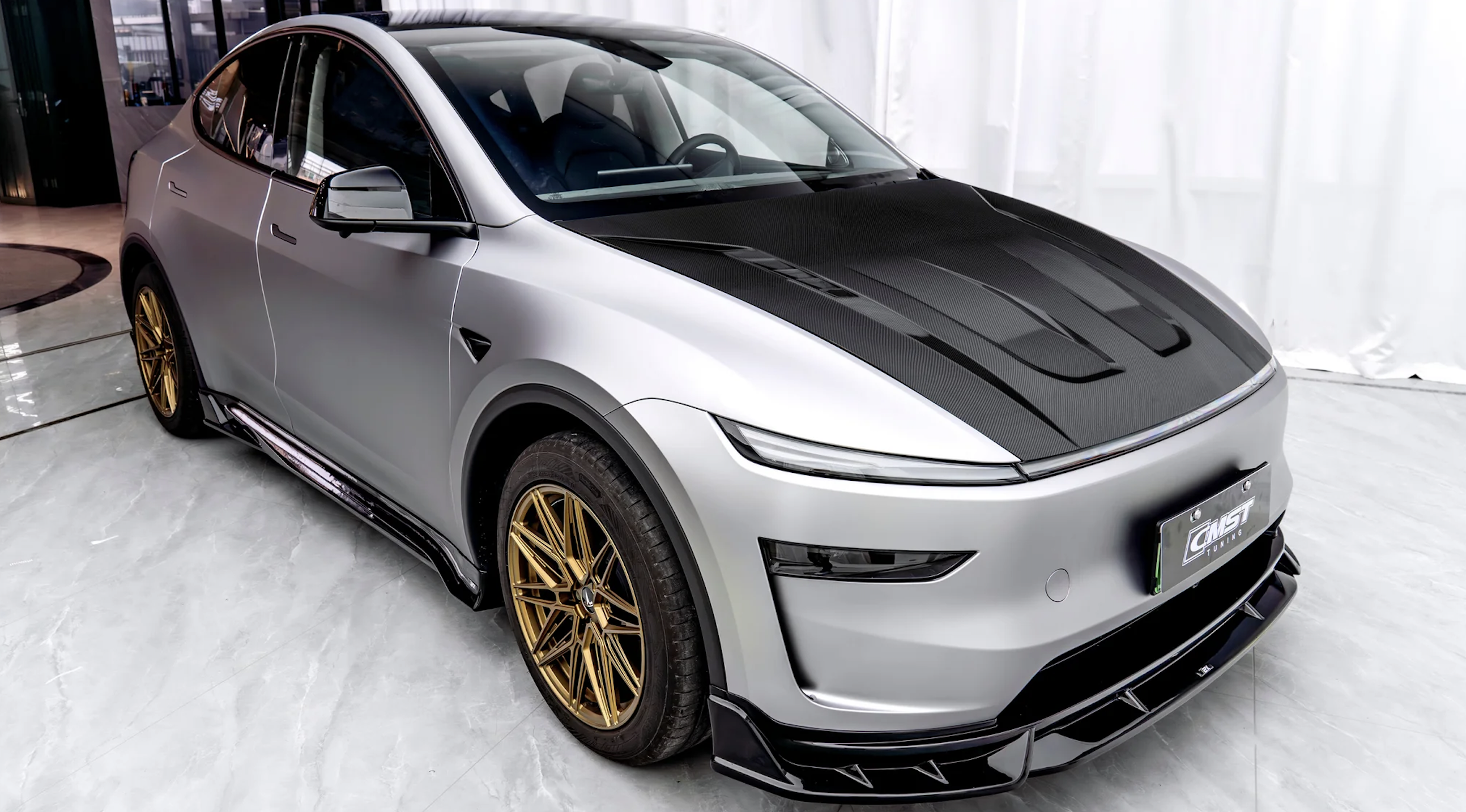
CMST built this hood for the Juniper body. That focus is why it leads this list.
Most carbon hoods on the market target the pre-facelift Model Y. The Juniper got a redesigned front end — a lower LED bar, a wider fascia. Those older panels simply don’t fit. CMST’s V1 is one of the few hoods built from scratch for the 2026+ platform. Own a Juniper? That matters more than any finish choice.
What You’re Getting
The V1 comes in three genuine carbon patterns:
-
3K Woven — The standard option. Bundles of 3,000 filaments in a 2×2 twill weave. UV clearcoated on top, FRP-backed underneath. Clean and proven.
-
Forged Carbon (+20%) — Short strands, compression-molded into a marbled texture. No directional weak points. Handles impact better than woven. Made to order.
-
Honeycomb (+20%) — 3K woven layers over a honeycomb sandwich core. The stiffest choice. Top-tier thermal insulation. Also made to order.
Every variant uses one-piece sheet construction. No seam breaks in the weave pattern. That’s what sets CMST’s build quality apart from cheaper multi-piece hoods.
Pricing — Juniper V1
|
Variant |
Price |
|---|---|
|
FRP / Paintable |
$1,013 |
|
Single-sided / Woven / Gloss |
$1,350 |
|
Single-sided / Woven / Matte |
$1,486 |
|
Single-sided / Forged / Gloss |
$1,620 |
|
Single-sided / Honeycomb / Gloss |
$1,620 |
|
Double-sided / Woven / Gloss |
$1,890 |
|
Double-sided / Forged / Gloss |
$2,268 |
|
Double-sided / Honeycomb / Gloss |
$2,268 |
The single-sided woven gloss at $1,350 is the smart starting point for most buyers. Double-sided honeycomb at $2,268 sits at the top — that’s for builds where the underside finish needs to look just as good as the top.
One thing to watch on the paintable tier: at $1,013, CMST doesn’t guarantee carbon fiber content. You might receive FRP instead. Visible weave matters to you? Step up to the woven gloss.
Installation
Direct bolt-on to OEM mounting points. No drilling, no fabrication needed. Set aside two hours. Go with a professional installer — CMST doesn’t offer a downloadable guide, so call their support line before you start.
One gap worth knowing: CMST publishes no weight data for any variant. You’re buying based on material quality and construction, not a confirmed weight-savings number. At this price point, that’s a real omission worth factoring in.
#2 ZetaComposites Canard Style Hood — Best Custom Option for Model 3 / Model Y
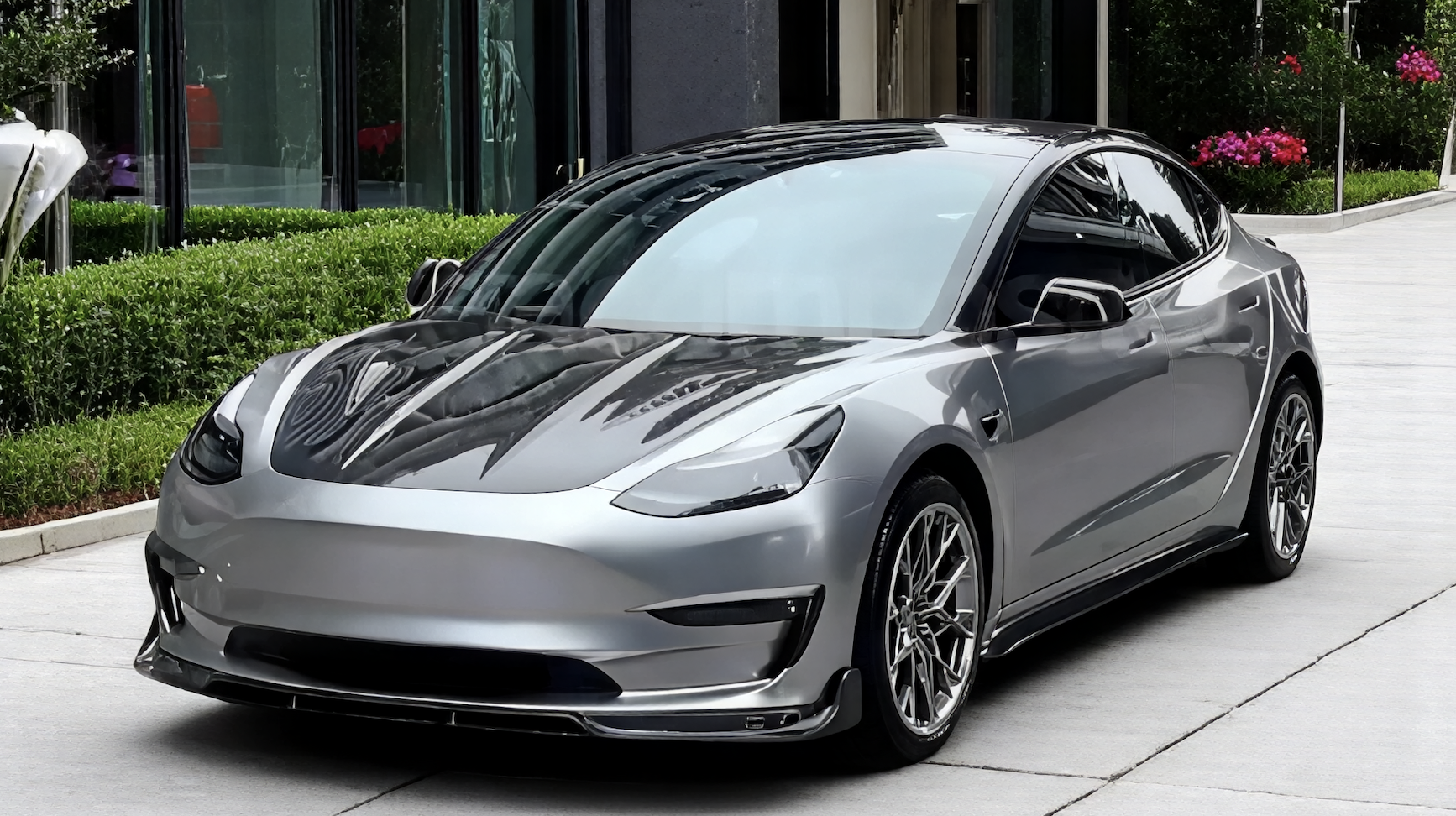
ZetaComposites doesn’t do off-the-shelf. Every hood that leaves their shop gets built for one specific customer, to one specific spec. That’s not a marketing line. It’s a production model that runs 8 to 10 weeks from order to delivery. Real handmade carbon fiber doesn’t rush for anyone.
That timeline is a dealbreaker for some buyers. This hood isn’t for someone in a hurry. But you want a carbon panel built to your exact fitment needs — adjustable latches, hinges, radiator support, cowl clearances — ZetaComposites is the one option on this list that works at that level of customization.
What Makes It Different
The build process breaks down like this:
-
Weeks 1–2: Order scheduling and preparation
-
Weeks 2–5: Active manufacturing and curing
-
Weeks 6–7: Quality inspection and handling
-
Weeks 8–10: Freight and delivery
You get top-grade carbon fabrics and resins at every stage. No shortcuts in the laminate stack. ZetaComposites carries over 600 products across vehicle lines ranging from Cadillacs to S2000s. They know panel geometry well.
Hood Pins Are Not Optional
ZetaComposites is clear on this: hood pins are mandatory. A lightweight carbon panel at highway speeds creates real lift. No pins means you’re gambling on a latch failure at speed. Budget for them. Build them into your install plan before you order.
Get a pro to handle the install. Latching positions and clearances differ across Model 3 and Model Y trims. Self-install takes real hands-on body work experience. Be straight with yourself about your skill level before attempting it.
Also add adhesive heat shields to the underside during install. It’s optional, but it adds real life to the hood over time.
Who This Is For
|
ZetaComposites |
Plug-and-Play Alternatives |
|
|---|---|---|
|
Lead time |
8–10 weeks |
Days |
|
Material |
Real carbon fiber |
ABS or carbon-print |
|
Fitment |
Per-spec, modular |
Fixed |
|
Install |
Pro body shop advised |
DIY tape-on |
You want a carbon hood matched to your exact trim with no cut corners on material quality — ZetaComposites earns that price tag. Need it next week? Look elsewhere.
#3 BCTXE Tuning Carbon Fiber Hood — Best Direct-Fit for Model 3 Highland 2024–2026

Highland owners face a specific problem. Most carbon hoods on the market were designed before the 2024 refresh existed. BCTXE built this one after.
That difference isn’t just cosmetic. The Highland’s updated front geometry has tighter cowl tolerances and repositioned latch points. Pre-2024 tooling produces panels that don’t sit right. BCTXE retooled for the updated platform. You get a direct OEM replacement that drops onto factory mounting hardware — no modification needed.
What the Build Looks Like
The panel uses 3K woven carbon fiber — 3,000 filaments per bundle, laid in a 2×2 twill pattern. That’s the same weave grade found across serious performance composites. UV protective clearcoat goes on top. That clearcoat does real work: it stops the fiber from yellowing under long sun exposure. On budget CF panels, that yellowing is usually the first thing to go wrong.
Finish options are gloss or matte. You can also choose between single-sided and double-sided vacuumed builds. Pick based on how much the underside matters to your setup.
Installation
Four hinge bolts. Two hood latch bolts. All stock hardware. BCTXE puts the install at two hours — longer than RPM’s 10-minute benchmark for similar direct-fit hoods, but still a solid afternoon job. For first-time panel swaps on Highland geometry, professional installation is the safer call.
The One Real Gap
No published weight figure exists for this hood. The closest reference is RPM’s Serpent — a dual-layer no-FRP panel that comes in at 14 lbs total, cutting 6 lbs from OEM. BCTXE’s 3K woven build should land in a similar range. But until they publish a number, that’s a reasonable guess, not a confirmed spec.
Pricing isn’t listed publicly. Comparable CMST FRP/CF units run $880–$950. You can find the BCTXE hood through performancespeedshop.com, carbonshowroom.com, and pimpmyev.com.
For Highland-specific fitment at an accessible price, BCTXE earns third place. The material is solid. The fitment is built for your generation of Model 3. The install skips fabrication entirely. What it’s missing in published data, it covers with platform-specific precision.
#4 Robot Craftsman V1 Forged Carbon Hood — Best Impact Resistance for Model Y Juniper
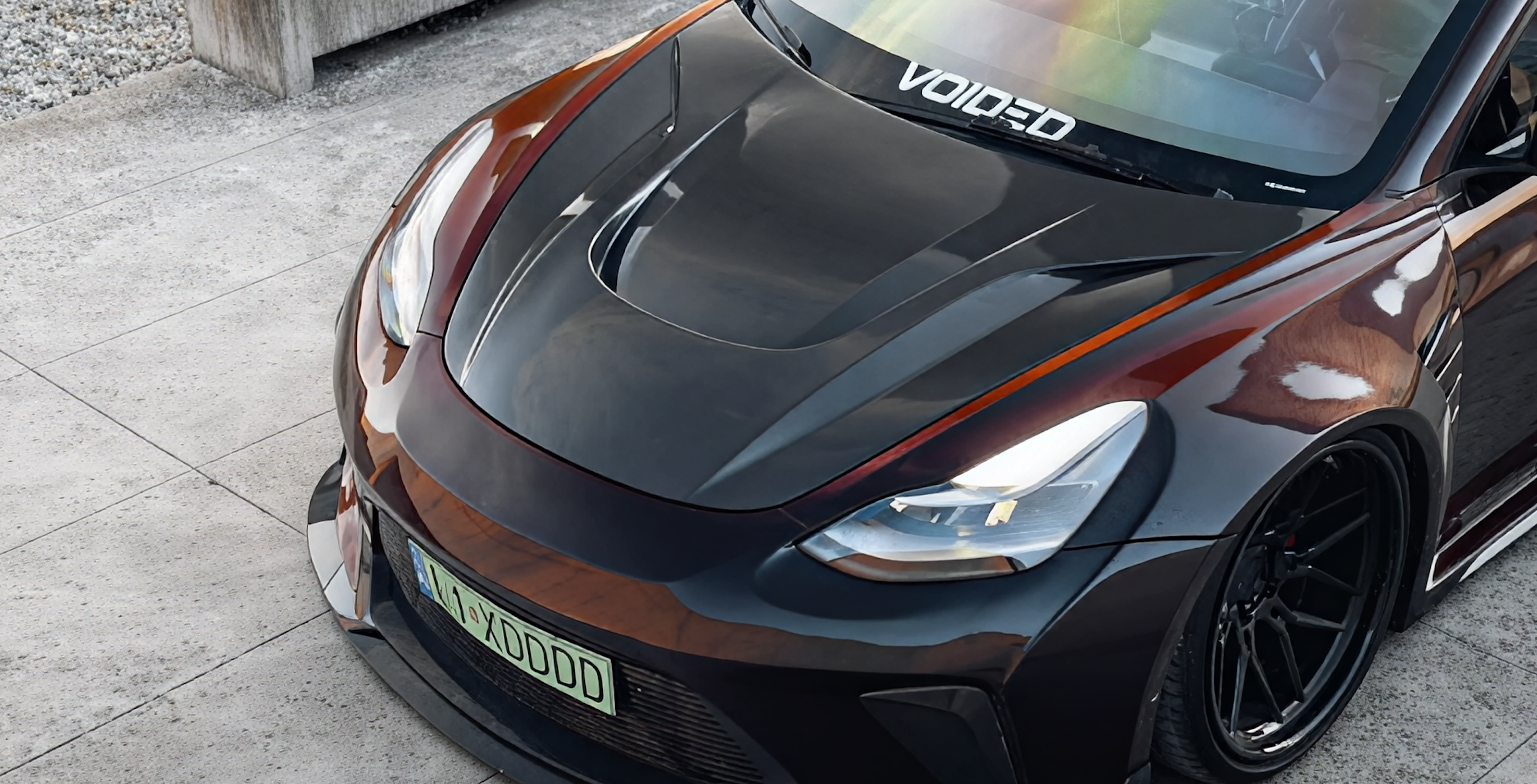
Forged carbon exists for a reason. Woven fiber locks you into a directional weave pattern. Forged carbon works differently — it’s compression-molded from chopped strands. No grain. No weak axis. On a hood built around the Juniper’s sharp leading edge curves, that difference is real.
Robot Craftsman built the V1 for the 2026+ Juniper platform. It uses OEM mounting points. No modification needed. The panel drops right in where your factory hood came out.
Material Options
Four build variants are available:
-
FRP / Unpainted — Base tier. Heavier with lower rigidity. Lowest entry cost.
-
Aluminum / Paintable — Matched to OEM paint. You’ll need a paint booth to finish it right.
-
3K Woven Carbon — Standard carbon choice. Gloss by default; matte available at +10%.
-
Forged Carbon — Made-to-order at +20% over woven. No directional weave to fight the Juniper’s complex curves. Impact resistance is strong. This is the variant that earns the section title.
The forged option’s advantage is real — not just marketing. Short-strand compression molding spreads stress across the whole panel, so compound curves don’t create weak points. Tight curves that cause surface distortion on woven panels sit flat and clean on forged.
Pricing and Lead Time
Base pricing starts around $680 on comparable Robot Craftsman models. Forged carbon adds 20%. Matte finish adds another 10%. Made-to-order means 2–3 weeks production before shipping starts.
Installation
Go with a professional install here. Budget two hours. You’ll need a torque wrench to align the OEM hinge points — target 10–20 Nm on the hinge bolts. Getting the gaps even across the cowl and fenders takes time and patience. Call Robot Craftsman support before you start. No downloadable guide ships with the panel.
One honest gap: no published weight figure exists for this hood. The forged build will be lighter than aluminum. How much lighter than the factory panel is not confirmed anywhere in writing.
#5 Tesery Carbon Fiber Hood — Best Multi-Model Compatibility (Model 3/Y/S/X)
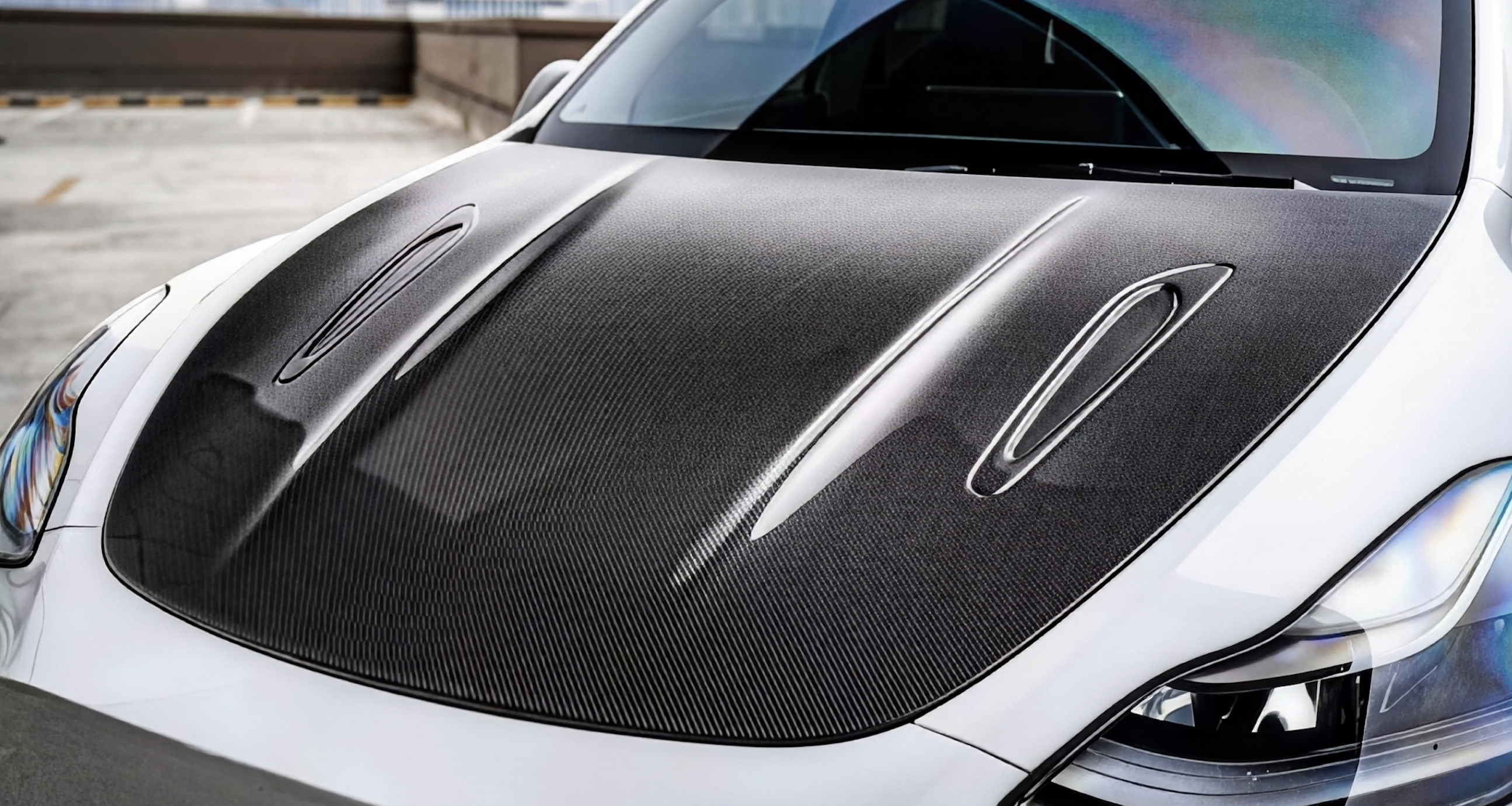
Tesery built this hood for breadth, not depth. Every other panel on this list targets a single platform — Juniper, Highland, pre-facelift Y. Tesery covers the full Tesla lineup: Model 3, Model Y, Model S, and Model X under one product family. Run multiple Teslas? That range matters. Not sure which generation-specific SKU fits your build? That range matters even more.
The top surface uses vacuum-laid carbon fiber with a UV protective clearcoat. You get that clearcoat on every variant, standard. It’s not an upsell — it’s the baseline. Cheaper hoods skip it and yellow within two seasons of sun exposure. Tesery builds it in from the start, so you don’t pay extra to avoid that problem.
Single-Sided vs. Double-Sided
Two build tiers are available:
-
Single-sided — Carbon fiber top, matte black primed FRP underside. This is the lower-cost production option. It’s a solid pick when the underside stays out of sight.
-
Double-sided — Full carbon matte black on both faces. This is the cleaner build for open-hood displays or track setups where finish quality matters on every surface.
Pricing and Purchase Terms
The Model Y hood lists at $1,480. Free shipping applies on orders over $149. Delivery takes about four days from order — faster than any made-to-order option on this list.
The return window is 30 days from receipt. Non-defective returns carry a 15% restocking fee plus return shipping costs on your end. Defective or damaged units? No restocking fee. Reach out to [email protected] and they’ll handle it.
The Honest Trade-Off
Tesery publishes no weight reduction figures. No cross-model fitment data exists in writing either. Comparing a Highland-specific hood against this multi-model option? That gap in published specs is real, and worth knowing before you buy. What you do get is broad compatibility and a clean, UV-protected finish at a competitive price. Platform-specific precision is your priority? Look higher on this list.
FAQ: Carbon Fiber Hood for Tesla Model 3 / Model Y
These questions come up all the time. Here are straight answers.
Does a carbon fiber hood void my Tesla warranty?
There’s no blanket warranty void. Tesla doesn’t have a policy that wipes out your coverage the moment you put on an aftermarket panel. The real risk is narrower. A front-end issue comes up, Tesla decides the hood played a role — that specific claim can get denied. Talk to your Tesla service center before you install anything. Take photos. Keep records. Document every step.
Can I install a carbon fiber hood myself?
Yes, you can. But no, you probably shouldn’t — not unless you’ve done panel work before.
The steps aren’t hard to list:
-
Disconnect the frunk wiring harness
-
Remove the stock hood
-
Align the new panel
-
Torque the hinge bolts to OEM spec (20–30 Nm)
-
Seal the edges
The alignment phase is where DIY installs fall apart. Carbon fiber panels have zero flex. A 2mm gap at the cowl stays 2mm off — forever. No amount of adjustment fixes it after the fact. Save yourself the headache and pay a shop.
How much weight does a carbon fiber hood save?
The Model 3 Viento Robot hood is 100% molded carbon fiber, dual-layer, with no fiberglass backing. It weighs 14 lbs total and drops 6 lbs from stock.
Model Y numbers shift by manufacturer. But the front-axle weight reduction is real. You’ll feel it in handling response — it’s not subtle.
Which hood fits the 2024 Model 3 Highland?
Fitment options for the Highland are limited right now. BCTXE has retooled for the 2024+ platform — that’s your safest bet.
Pre-2024 options like CMST Ver.2 and Zeta GTS-style hoods need individual fit verification before you order. Don’t assume they carry over. Check with the seller directly.
Is the CMST V2 compatible with a 2025 Model Y?
Yes. CMST V2 covers Model Y 2020 through 2026, and that includes 2025. It uses vacuum-formed carbon fiber with a UV clearcoat finish. Multiple owners have confirmed clean fitment on the Juniper platform — no surprises there.
Carbon fiber vs. aluminum vs. fiberglass — what matters?
|
Material |
Weight |
Durability |
Verdict |
|---|---|---|---|
|
Carbon Fiber |
~14 lbs |
High strength-to-weight, UV-coated |
Best overall |
|
Aluminum |
Heavier |
Corrosion-resistant |
OEM standard |
|
Fiberglass |
Moderate |
Lower impact resistance |
Budget option, not recommended |
Carbon fiber wins on every axis that counts for performance. Fiberglass costs less upfront — and more later. Aluminum is what Tesla already gave you.
Conclusion
A carbon fiber hood upgrade isn’t just about looks. It’s a real choice to own something lighter, sharper, and built with purpose.
Go with the CMST Tuning V1/V2 for clean OEM lines on your Juniper. Or pick ZetaComposites’ canard style for a full track-ready look. Either way, every option on this list earns its price. Fitment is solid, materials are legit, and the weight savings are real.
So here’s the one question left: which Tesla Model 3 carbon fiber hood fits your build, your budget, and the exact version of your car?
Stop overthinking it. Scroll back up, match your year and trim, and grab the upgrade your Tesla deserves.
The hood you pick today is the first thing people notice tomorrow.
Contact HyperX Carbon – Your Trusted Chinese Carbon Fiber Partner
Ready to source high-performance carbon fiber materials or custom forged carbon fiber parts from China?
HyperX Carbon is a leading manufacturer with 20+ years of expertise, specializing in aerospace-grade forged carbon fiber, prepreg, carbon fiber tube, carbon fiber sheet, and lightweight carbon fiber automotive parts/carbon fiber drone components/carbon fiber medical components. We offer:
-
Stable supply chain with premium raw materials (Toray, Mitsubishi, Hengshen)
-
AS9100D certified production for aerospace & UAV applications
-
Rapid prototyping (5-8 weeks) and monthly capacity exceeding 180,000 parts
-
Competitive pricing with 15-18% cost savings on forged carbon solutions
-
Full customization: from T700/T1100G to ultra-high modulus grades
Whether you’re an eVTOL developer, automotive OEM, drone manufacturer, or medical device engineer, HyperX delivers consistent quality, batch-to-batch reliability, and reliable delivery.
Get in touch today for a free consultation, custom quote, or material sample.
📧 Email: [email protected]
🌐 Website: https://www.hyperxcarbon.com/
📞 Phone/WhatsApp: +86 15623270276 (English support available)
Let’s build your next lightweight innovation together – contact HyperX Carbon now and stay ahead in the low-altitude and advanced composites market.




