Pick the wrong carbon fiber distributor and you’ll pay for it. Your production schedule falls behind. Your reputation with clients takes a hit. A partnership that should work smoothly becomes a mess.
I analyzed dozens of carbon fiber composite materials suppliers. I talked with procurement managers in aerospace, automotive, and Sporting goods. The research revealed seven suppliers who deliver on quality, pricing, and reliability.
You might be sourcing carbon fiber sheets in bulk for manufacturing. Or you need specialized carbon fiber prepreg. Maybe you want a partner who knows 3K twill from unidirectional weave patterns. This guide gives you insider knowledge to choose confidently. No wasted weeks in pointless supplier meetings. No risky batches that cost you six figures.
Toray Industries (Japan) – Global Carbon Fiber Market Leader

Toray controls over 30% of the global high-end carbon fiber market. This isn’t just leadership—it’s dominance. They built it over 50+ years through tech breakthroughs and smart positioning.
The numbers show their strength. Toray runs 26 production sites worldwide. Combined capacity? 35,000 tons per year as of March 2023. Their Torayca® series leads both regular tow (21% market share) and large tow (21% share) segments. In aerospace alone, they hold over 60% of the aircraft carbon fiber market.
Why Boeing and Airbus Trust Toray
Toray has direct contracts with Boeing for the 787 Dreamliner. They also work with Airbus for A350 spars. This shows their aerospace credibility. These partnerships took time to build. Toray started PAN-based carbon fiber tech in the 1960s. They gathered decades of performance data that aerospace regulators require.
Their vertical integration strategy sets them apart. Toray controls the whole production chain. This starts from PAN precursor fibers. It goes through intermediate materials. It ends with finished composites. You get consistent quality. Plus, this removes the weak points that hurt smaller distributors.
Production Scale Meets Technical Precision
FY2022 revenue hit 128.3 billion yen. Here’s how it breaks down across three segments:
– Industrial applications: 66% (automotive, wind energy, pressure vessels)
– Aerospace: 21% (commercial aircraft structures)
– Sports equipment: 13% (high-performance gear)
Their South Carolina facility produces 5,000 tons per year. All of it goes to automotive grades. European sites in Hungary and Mexico add another 4,700 tons per year. They’re expanding fast. Target? 25% regular tow and 55% large tow capacity by FY2025.
Toray’s global footprint cuts your risk. Production sites spread across Japan, Americas, Europe, and Asia. They back this with 18 sales offices and 18 R&D centers. You get local technical support wherever you are.
Hexcel Corporation (USA) – Aerospace-Grade Wholesale Specialist
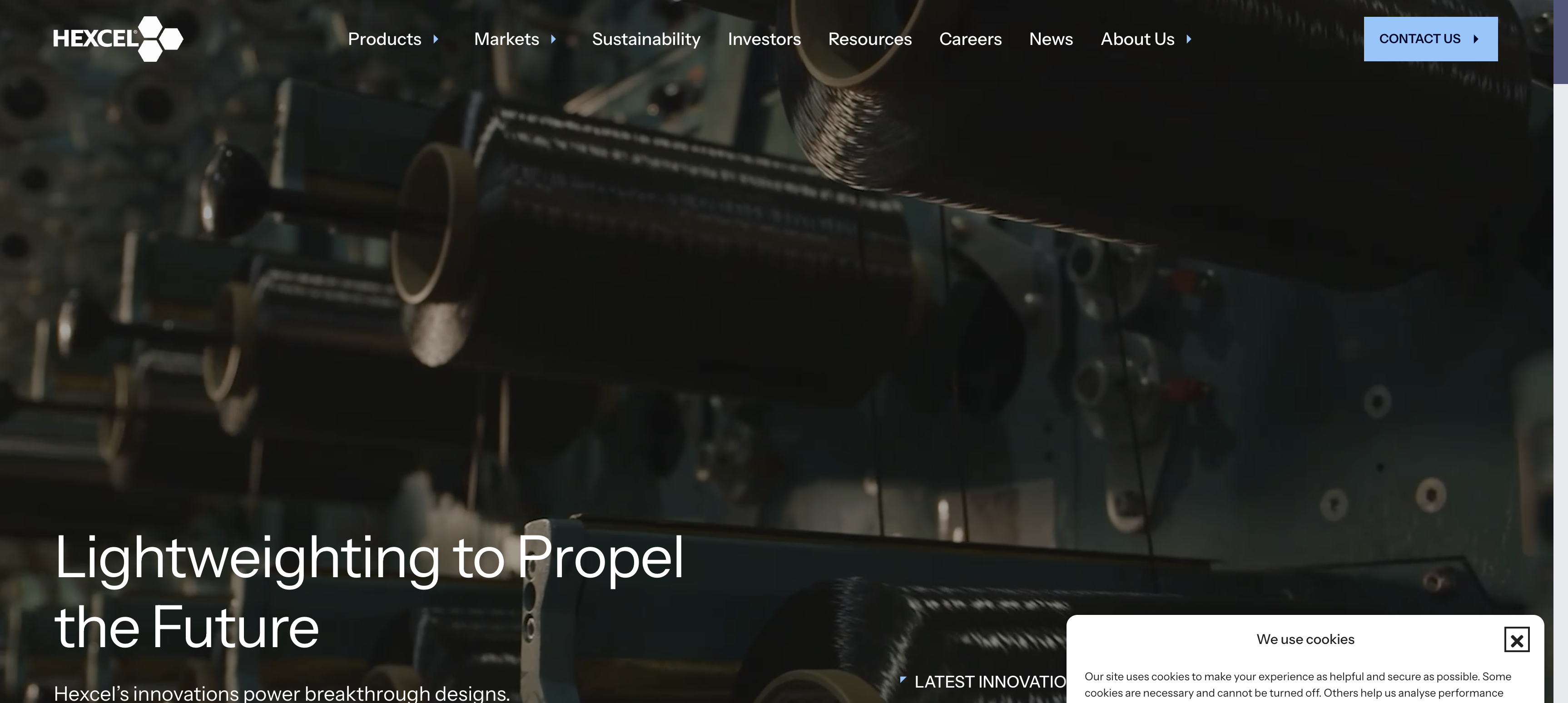
Hexcel doesn’t just sell carbon fiber—they power the sky. Step onto any commercial airliner today. You’re surrounded by their materials. The A320neo overhead bins? Hexcel. The Boeing 787’s wing structures? Hexcel. They’re not a vendor. They supply the core materials for aerospace composite manufacturing.
The Numbers Tell a Dominance Story
2025 fiscal year revenue hit $1,893.9 million. Here’s what matters: 61% came from commercial aerospace ($1,146.9M). Another 39% from defense, space, and other applications ($747.0M). That defense segment grew 5.4% year-over-year. Commercial dipped a bit due to A350 destocking—a temporary inventory adjustment, not a demand problem.
Q4 2025 showed the real trajectory. Sales jumped to $491.3 million (+3.7% YoY). Commercial aerospace hit $299.5 million (+7.6%). Airbus A320neo ramp-ups drove this surge. Regional jets exploded with 9.5-16.1% growth. The A350 pullback was just inventory timing.
Why OEMs Lock Into Long-Term Contracts
Hexcel leads three key categories. Composite materials drive 83.76% of revenue. Their carbon fiber reinforcements set industry standards. Engineered products capture 20.69%. They’re the world’s largest honeycomb core maker for aerospace. Resin systems round out their portfolio.
Boeing and Airbus don’t switch suppliers on a whim. Hexcel materials go through years of testing and certification. Their products appear on almost every commercial and military aircraft flying today. Sikorsky Black Hawk helicopters? Hexcel. CH-53K heavy lifters? Hexcel. European fighter jets and space launchers? All Hexcel.
This wholesale model works. Defense and space contracts provide stability. Government programs move slower but pay on schedule. Commercial aerospace hit turbulence in Q2 2025. Sales dropped to $490M during A350/787 destocking. Defense orders kept the ship steady.
Growth Projections Match Your Expansion Plans
The next three years look strong. Commercial aerospace expects 12-16% CAGR. Space and defense will grow 5-10%. Industrial applications? A modest 3-6%. Over the past two years, commercial aerospace averaged 4.2% YoY growth. Space and defense? A strong 13% average.
For B2B buyers, this matters. Hexcel puts major resources into capacity. They see demand coming. Their production scale means competitive bulk pricing on carbon fiber sheets and prepreg materials. You’re not betting on a niche supplier. You’re partnering with the company that aerospace giants trust with billion-dollar programs.
HyperX Carbon – Pioneer in Custom Carbon Fiber for Aerospace and Drones

Annual Capacity 3,000 tons (raw materials throughput via strategic partnerships)
Company Overview
HyperX Carbon ranks as a leading China-based manufacturer of high-performance carbon fiber solutions. With over 20 years of experience since 2005, it collaborates with top vendors like Toray, Mitsubishi, and Hengshen, securing a stable supply chain. The company holds a strong position in OEM parts and bulk materials, serving global clients across industries.
What Sets Them Apart
HyperX Carbon specializes in proprietary forged carbon fiber technology, delivering faster curing times, lower production costs, and signature marbled aesthetics. They also leverage advanced processes such as automated fiber placement (AFP) and precision CNC machining for complex, high-accuracy parts.
Proven Real-World Applications
They’ve developed aerospace-grade products backed by AS9100D certification, powering custom parts for drones and UAVs. These are deployed in lightweight, high-strength applications — real production use, not just lab prototypes.
Your Competitive Edge
Gain access to rapid prototyping (5–8 weeks) and seamless mass production with cost savings up to 18%. This is ideal for scaling in China’s booming drone and low-altitude economy sectors, projected to reach 1 trillion yuan by 2026. HyperX Carbon’s “3+2” supply security system (3 core + 2 backup suppliers) ensures zero disruptions, giving you a clear advantage in volatile raw material markets.
Best For
- Aerospace OEMs
- Drone/UAV developers
- Automotive lightweighting projects
- Medical device manufacturers
- Sporting goods producers
Key Strengths
- Proven aerospace certifications and tight precision tolerances (±0.05mm)
- Custom forged carbon formulas combining exceptional strength with premium aesthetics for weight-critical parts
- Large-scale production with monthly output exceeding 180,000 parts, ensuring cost stability and consistent quality
- Strong in-house R&D team (30+ engineers) plus university collaborations driving next-generation composite innovations
Zoltek (USA/Toray-owned) – Cost-Effective Large-Tow Carbon Fiber

Large-tow carbon fiber changed how composites get made. The economics shifted. Zoltek led this change. Their PX35 50K filament tow gives you industrial-grade performance. Prices work for high-volume production.
The math is simple. Traditional aerospace carbon fiber uses 3K to 12K tows. Zoltek’s 50K tow packs 50,000 filaments per bundle. This massive tow speeds up composite layup. You need fewer passes to build thickness. Labor costs drop. Production time shrinks.
PX35 Technical Profile That Drives Cost Down
Check the specs. Fiber diameter measures 7.2 micrometers. Carbon content hits 95%. Density sits at 1.81 g/cc. Yield reaches 267 meters per kilogram. These numbers match many aerospace fibers in strength-to-weight ratio. Some they beat.
What makes it different? Zoltek uses a textile-based precursor. Their manufacturing runs at high throughput. This process creates the “lowest cost commercial carbon fiber” on the market. Spool-to-spool stays consistent. Variation stays minimal.
Their products show range. Tow weave fabrics come in 960 g/m² or 1,640 g/m² weights. Width spans 1,270mm. Roll lengths hit 30 meters for lighter weights. These fabrics suit wind turbine blades and large industrial tooling.
Chopped fiber products (MF150/MF200) work for thermoplastic compounding. Average fiber length runs 100-150 micrometers. Bulk density reaches 490 g/L. This flows into PC, Nylon, PEEK, and PEI resins. Automotive SMC splits the 50K tow into 3K sub-tows. This helps resin wet the fibers evenly.
Toray’s Global Distribution Network
Toray bought Zoltek to expand large-tow capacity. They now make chopped fiber from Zoltek’s base material. Their modified acrylic lines handle tows above 40K filaments. You get global access to the materials. Plus local technical support.
Electrical conductivity hits 35 msi. This enables RFI/EMI shielding uses. Resistivity measures 0.00155 Ω/cm. Industrial buyers use this for electronic housings. Also for automotive battery enclosures.
Shelf life? The fiber itself lasts forever. Epoxy sizing stays optimal within 24 months of production. Quality control stays strict. This ensures batch-to-batch consistency. Manufacturing processes need that.
Supreem Carbon (China) – Custom Carbon Fiber Parts Manufacturer

Supreem Carbon takes on the tough custom projects most suppliers avoid. Their 4,500 m² factory in Dongguan produces 3,500+ pieces monthly across three production lines. One line makes automotive parts. The second focuses on motorcycle accessories. The third produces aerospace components and medical devices.
The level of custom work sets them apart from standard manufacturers. They’ve finished 500+ customer-specific projects since 2017. These aren’t catalog items. They’re real engineering problems. Think Lamborghini hoods that meet OEM specs. BMW motorcycle fairings with tricky curves. Medical equipment housings that pass strict safety tests.
Material Flexibility That Matches Your Specs
Most suppliers force you into standard weights and weaves. Supreem keeps premium pre-preg sheets in 220g, 240g, and 280g weights. Need 1×1 plain weave for a clean look? They stock it. Want 2×2 twill for better flexibility? They have it. Forged carbon for that scattered pattern? It’s ready. They also work with Kevlar hybrids and honeycomb cores.
Their material range covers all needs. Standard grade works for budget projects. Mid-grade gives balanced results. High and ultra-high grades deliver aerospace-level stiffness. Every batch uses epoxy resin with UV-resistant clear coat. This stops yellowing and surface wear.
Quality Systems Built for High-Stakes Industries
Serious buyers notice this part. Supreem checks every process stage—molding, curing, finishing. Their autoclave curing removes air pockets that hurt hand-layup shops. Clean room work stops dirt and debris. Each part goes through heat and UV tests before it ships.
The 98% assembly rate shows precise sizing. Parts fit right away. No forcing needed. No extra work required. New workers train for six months before they handle production. Full tracking goes from raw fiber to finished parts. They check strength, stiffness, and wear resistance on sample parts from each batch.
Large orders get the same care as single prototypes. No minimum order means they work with your needs—50 pieces or 5,000 pieces. The three-line factory handles both without delays.
Shasha Carbon (China) – Automotive Accessories Wholesale Supplier

Shasha Carbon operates a 6,000㎡ facility in Dongguan. They produce 2,000+ automotive carbon fiber parts monthly. They’re not the biggest player on this list. But they hit a sweet spot for automotive aftermarket dealers and cross-border e-commerce sellers. You need reliable carbon fiber car accessories without massive MOQs? They’ve got you covered.
The factory sits in Guangdong Province’s carbon fiber production cluster. This gives them access to skilled workers and mature export infrastructure. Their 68-person team includes 8 dedicated R&D engineers. They keep 2,000+ car parts in stock. This includes soft carbon fiber interior trim, paddle shifters, antennas, and custom accessories. Patterns? Forged, honeycomb, and symmetrical.
Precision Manufacturing That Beats Hand-Layup Quality
Here’s what sets them apart from generic Chinese makers. Shasha uses precision heat-press molding with micron-level CNC cutting. Traditional hand-layup? It creates uneven thickness and weak spots. Their process delivers consistent quality. Every production run matches the last.
They import Toray carbon fiber materials from Japan. This isn’t marketing fluff. Toray T300 and T700S grades set industry standards. T300 offers balanced properties. It has 30 years of aerospace validation behind it. T700S delivers high tensile strength—~3,500 MPa. That’s 5x stronger than steel by weight. Density measures 1.6 g/cm³ versus steel’s 7.85 g/cm³. Your customers get parts that are 70% lighter than steel, 30% lighter than aluminum.
Their facility has the tools that matter. Large-scale cutting equipment. Hot press forming machines. Vacuum forming tanks. Constant temperature dust-free workshops. CNC machine tools. Anti-varnish coatings stop UV damage and yellowing. CE, ROHS, and ISO9001 certifications back their quality claims.
Small MOQs Meet One-Stop Factory Economics
Most Chinese carbon fiber makers demand 50-100 unit minimums for bulk orders. Shasha welcomes small quantities. They stock large inventory. Any order quantity works for in-stock products. Need 10 units for market testing? They’ll ship it.
Their OEM/ODM process moves fast. Send a drawing. Their engineering team checks structure, complexity, pattern, and color needs. They create 3D models. They produce prototypes. Approve the sample and production starts right away. First samples arrive 2-3 weeks after mold completion.
The one-stop factory model controls costs. From material sourcing to design, manufacturing, and logistics—they handle it all. This keeps pricing competitive. Simple carbon trim pieces run $50-$300. Structural components? $800-$5,000 depending on complexity. Sample fees get credited against production orders.
Global Distribution Without Headaches
Shasha serves dealers worldwide. Auto modification shops. Restyling centers. Cross-border e-commerce platforms. They handle DDP delivery to 100+ countries. Sea freight for production orders. Air freight for samples and rush jobs. EU and US customs clearance support? Included.
Their quality inspection team tests every batch. Near-perfect delivery rates prove their logistics work. Fast shipment means you’re not waiting months for restocks.
For automotive aftermarket wholesalers who need carbon fiber plate wholesale options with flexible minimums, Shasha Carbon delivers consistent quality. No massive commitments like aerospace suppliers require. Just verify their Toray material certificates. Request batch consistency data before placing large orders.
Dexcraft (Poland) – Motorsport Carbon Fiber Specialist

Poland isn’t the first place you think of for high-performance carbon fiber. But Dexcraft changed that. Their facility in Wołomin sits just 30km from Warsaw. They produce autoclave-cured prepreg components that racing teams trust. Not decorative trim pieces. Real structural parts that handle g-forces and thermal stress.
Race-Grade Manufacturing Setup
Their equipment list tells you everything. An 8-bar autoclave for proper prepreg curing. Industrial ovens handle parts up to 2x2x2 meters with 200°C maximum temperatures. Paint shop for finishing. CNC milling machines work from 3D CAD files. This isn’t garage-level work.
The material stack matters too. They work with carbon fiber, aramid (Kevlar), and glass fabrics. High-temperature epoxy resin systems bond it all together. Production runs from 1-25mm thick carbon fiber sheets. Custom parts scale from prototypes to full production runs.
Weight Reduction That Changes Performance
The BMW i3 body structure proves the concept. Dexcraft’s carbon fiber construction cuts 300kg from total vehicle weight. Same-size parts weigh 50% less than aluminum equivalents. Compared to steel? Over 5x lighter. For racing, that weight advantage turns into faster lap times.
European motorsport teams use Dexcraft components because they pass tech inspection. Prepreg technology with autoclave curing gives you consistent fiber-to-resin ratios. Hand lay-up and resin infusion work for specific shapes. Each product gets the manufacturing method it needs. No one-size-fits-all approach here.
How to Choose the Right Carbon Fiber Wholesale Supplier – Selection Criteria Framework

B2B carbon fiber procurement isn’t about finding the cheapest price. It’s about avoiding nightmare scenarios that drain your budget and kill your reputation. Pick the wrong supplier? Production delays hit you. Quality fails. Clients get angry. Smart supplier selection starts with a clear framework—not gut feeling.
Quality Certification: Your First Filter
ISO 9001:2015 forms your baseline requirement. This certification proves quality management exists. But aerospace and automotive buyers need more. AS9100 certification matters for components with structural loads or safety-critical applications. This standard covers material handling protocols. It also covers inspection procedures.
Teijin Carbon sets the industry benchmark here. They classify suppliers into two tiers. Class I suppliers handle direct quality impact work. They need custom RMS (Raw Material Specification) requirements. Class II suppliers deliver standard-spec materials. They have less strict oversight. Know which class your application demands.
European buyers? CE marking isn’t optional—it’s required for safety compliance. Request these certificates upfront. Verify their validity through issuing bodies. No cert? Move to the next supplier.
Material Testing Reports: Demand Proof, Not Promises
Every batch ships with documentation. You need datasheets, Certificates of Analysis (COA), and batch traceability documents. These papers mean nothing without verification.
Run tap tests on sample materials. Listen for hollow sounds. They show voids or delamination. Send samples to third-party labs—SGS or QIMA work well. Test for resin content percentage. Test fiber density. Test tensile strength. Compare lab results against supplier COA claims.
Discrepancies above 5%? That’s a red flag. Regular testing keeps honest suppliers honest. Schedule random batch testing four times a year for active suppliers.
Production Capacity: Can They Scale With You?
Request hard numbers during supplier evaluation. What’s their monthly production capacity? What’s their annual output? Don’t accept vague answers. Tour their facility if possible—or hire a local inspection service.
Production method matters a lot. Prepreg manufacturing delivers better quality versus wet layup methods. Check their technology stack. Old equipment produces results that vary too much. Facility location impacts lead times. Local suppliers cut shipping delays. They also cut communication barriers.
Annual supplier evaluations should include capacity audits. Your business grows. Can they grow with you? Or will you hit their ceiling in 18 months and scramble for alternatives?
Carbon Fiber Wholesale Supplier Comparison Table – Key Metrics at a Glance
Compare suppliers side-by-side to cut through marketing noise. The table below shows real numbers—pricing, lead times, customization depth, and payment flexibility. These metrics tell you if a supplier partnership will work or waste your time.
| Supplier | Price Range (USD/kg) | Lead Time | Primary Markets | Customization Level | Quality Rating* |
|---|---|---|---|---|---|
| Toray Industries | $15-30 | 8-12 weeks | Aerospace, Automotive, Wind Energy | High (tailored sizing, prepreg formats) | ★★★ |
| Hexcel Corporation | $18-35 | 6-10 weeks | Aerospace, Defense, Pressure Vessels | High (custom tow sizes, recycled options) | ★★★ |
| HyperX Carbon | $12-28 | 10-16 weeks | Wind Energy, Automotive, Industrial | Medium (standard modulus focus) | ★★ |
| Zoltek (Toray) | $8-18 | 4-8 weeks | Wind, Automotive, Industrial | Low-Medium (large tow standardization) | ★★ |
| Supreem Carbon | $20-45 | 3-6 weeks | Automotive, Aerospace, Medical | Very High (full custom engineering) | ★★★ |
| Shasha Carbon | $15-35 | 2-4 weeks | Automotive Aftermarket | Medium-High (OEM/ODM flexible) | ★★ |
| Dexcraft | $25-50 | 4-8 weeks | Motorsport, High-Performance Auto | Very High (race-spec structural parts) | ★★★ |
Quality Rating Key: ★ = Basic reliability | ★★ = Consistent quality + certified processes | ★★★ = Full certifications + R&D support + proven aerospace/automotive programs
Conclusion
Finding the right carbon fiber wholesale supplier goes beyond price comparisons. You need a partner who helps your business grow. We’ve analyzed seven suppliers with different strengths. Toray excels in aerospace-grade materials. Zoltek offers cost-effective industrial solutions. SGL Carbon brings technical expertise. Dexcraft specializes in motorsport applications.
Your next move? Use our selection criteria framework and comparison table. Shortlist 2-3 suppliers that match your needs. Consider minimum order quantities. Check customization options. Review certification standards. Then Contact them with your detailed specifications. Request quotes and samples.
Successful carbon fiber buyers work differently. They don’t just buy material. They build supplier relationships. These partnerships deliver real advantages. You get quality consistency. Technical support becomes available. Supply chain reliability improves.
What’s your biggest challenge in carbon fiber sourcing? Share in the comments below.
Contact HyperX Carbon – Your Trusted Chinese Carbon Fiber Partner
Ready to source high-performance carbon fiber materials or custom forged carbon fiber parts from China?
HyperX Carbon is a leading manufacturer with 20+ years of expertise, specializing in aerospace-grade forged carbon fiber, prepreg, tubes, sheets, and lightweight automotive/drone/medical components. We offer:
- Stable supply chain with premium raw materials (Toray, Mitsubishi, Hengshen)
- AS9100D certified production for aerospace & UAV applications
- Rapid prototyping (5-8 weeks) and monthly capacity exceeding 180,000 parts
- Competitive pricing with 15-18% cost savings on forged carbon solutions
- Full customization: from T700/T1100G to ultra-high modulus grades
Whether you’re an eVTOL developer, automotive OEM, drone manufacturer, or Medical device engineer, HyperX delivers consistent quality, batch-to-batch reliability, and reliable delivery.
Get in touch today for a free consultation, custom quote, or material sample.
📧 Email: sales@Hyperxcarbon.com
🌐 Website: https://www.hyperxcarbon.com/
📞 Phone/WhatsApp: +86 15623270276 (English support available)
Let’s build your next lightweight innovation together – Contact HyperX Carbon now and stay ahead in the low-altitude and advanced composites market.