This guide profiles the top 5 carbon fiber manufacturers USA that deliver on quality, capacity, and compliance. You’ll learn which suppliers lead in aerospace grade carbon fiber. You’ll see who has the best prices for industrial carbon fiber solutions. Plus, you’ll know how to check key factors like AS9100 certification, production lead times, and custom manufacturing options.
We include direct Contact info. This cuts your sourcing time from months to days. Research to RFQ happens fast.
#1 Hexcel Corporation: Aerospace-Grade Prepreg Leader

Hexcel controls what others can’t copy: a full production chain from raw carbon to finished prepreg. They’ve built this depth over 75 years since starting in Connecticut in 1948.
Their HexTow® carbon fiber goes straight into HexPly® prepregs. No middlemen. No gaps in the chain. Boeing and Airbus trust this system for primary aircraft structures that fly 20+ years without failure.
Why Aerospace Programs Choose Hexcel
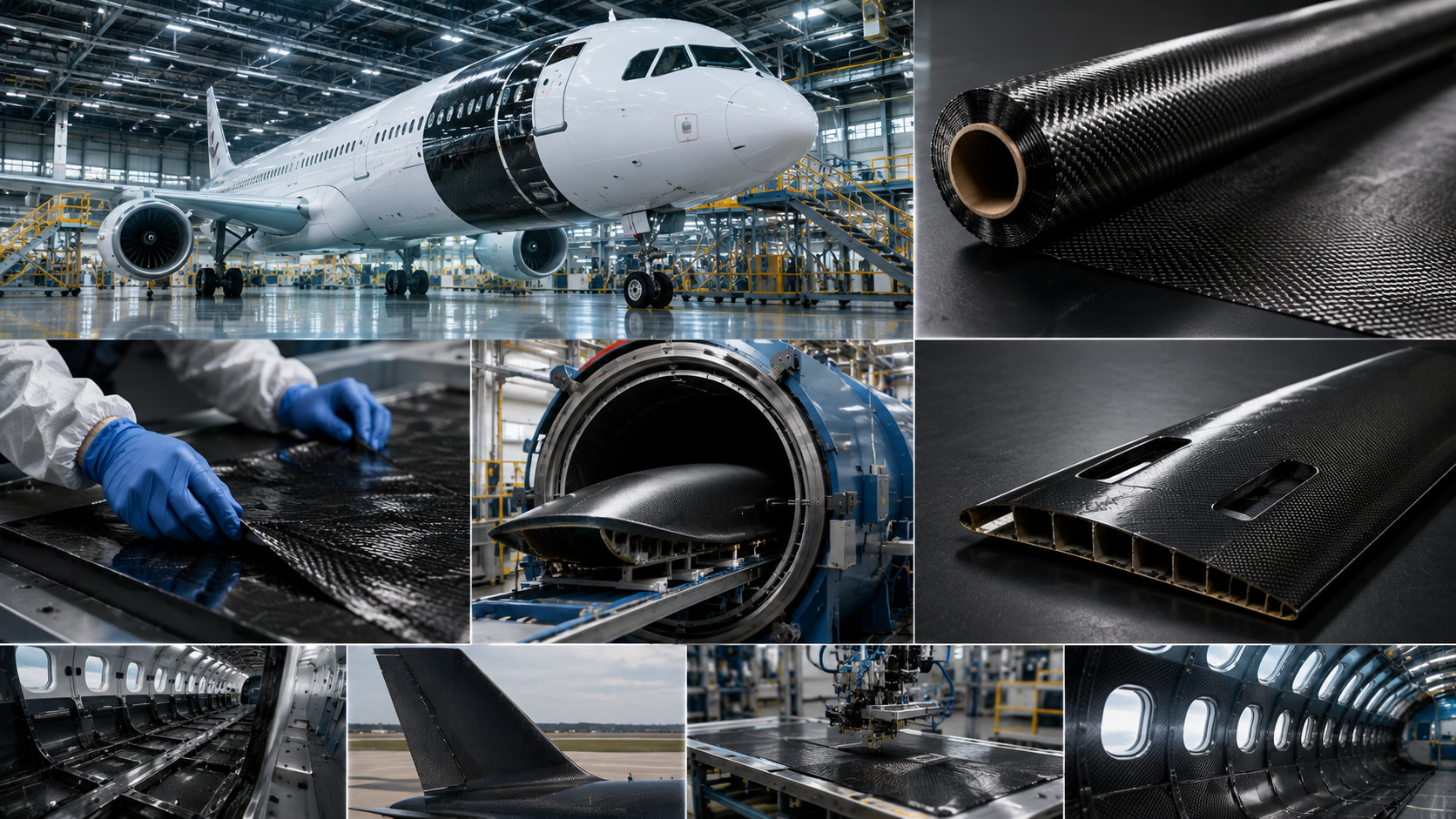
The numbers show clear dominance. Hexcel materials make up over 50% of airframe weight in the Boeing 787 and 777X. The Airbus A350 XWB contract covers all composite primary structures—wings, fuselage, tail. These aren’t small parts. They’re the skeleton of aircraft carrying 300+ passengers.
Epoxy-based prepregs drive this success. Hexcel’s formulas give you the tensile strength and fatigue resistance aerospace engineers need. Their Salt Lake City facility grew in 2021. This added capacity for defense and next-generation commercial aircraft programs.
Market Position and Revenue Reality
Aerospace and defense generate 41.90% of Hexcel’s 2025 prepreg revenue. North America accounts for 37.40% of global prepreg share. Hexcel leads that region.
The aerospace prepreg market hit $3.5 billion in 2024. It climbs to $6.4 billion by 2030 at an 11.3% CAGR. Hexcel’s multi-decade contracts with Airbus and Boeing put them in line to capture most of that $29.89 billion total revenue through 2030.
Q3 2025 sales held steady at $456 million—flat against Q3 2024’s $457 million. Stability matters. Competitors face volatile order books.
Technical Advantages That Matter for B2B Buyers
Hexcel’s proprietary material databases tune every prepreg batch. Their automation systems cut scrap rates below 2%. Real-time porosity monitoring and vision-guided lay-up make this happen. You pay for fiber that becomes parts, not waste.
Lot-tracked batches solve the certification headache. Every roll traces back to furnace parameters. Your quality team audits material sources? Hexcel provides complete documentation.
Lighter composites extend aircraft range and payload capacity. Hexcel’s materials deliver the same 25% weight reduction benefit seen in wind turbine blades. But you get aerospace-grade consistency.
Partnership Structure and Contact
Long-term contracts define Hexcel’s B2B model. Airbus, Boeing, and Kongsberg Defense sign multi-decade agreements. This spreads out qualification costs. Plus, it locks in delivery schedules.
Your engineering team gets direct technical support. Material selection isn’t guesswork. Hexcel’s scientists work through application needs before you commit to volume orders.
Start your inquiry: hexcel.com/contact connects you with regional aerospace account managers. Expect detailed talks on certification timelines, MOQs for aerospace-grade materials, and custom formula options.
Hexcel remains the benchmark for aerospace-grade carbon fiber and prepreg systems. Their full production chain removes the risks that trip up other suppliers.
#2 Toray Industries USA: Global Capacity Leader with US Expansion

Toray Carbon Fibers America is the largest carbon fiber producer in the United States. Period. Their Spartanburg, South Carolina facility just finished a major expansion. This changes the game for B2B buyers.
The new 30,000 square foot addition brings 3,000 metric tons of annual capacity starting in 2025. This isn’t theory. Operational furnaces are producing Torayca® PAN-based carbon fiber right now for quick delivery.
Integrated Production Chain Across Four US States
Toray operates 14 manufacturing sites across the US. The Spartanburg plant covers everything: precursor production through carbon fiber to finished prepreg. No gaps. No third-party handoffs.
Other facilities add special capabilities:
– Decatur, Alabama: Advanced composite processing
– Tacoma, Washington: Special fiber treatments
– Morgan Hill, California: Continuous fiber reinforced thermoplastic tapes (acquired Gordon Plastics in November 2024)
The Morgan Hill expansion focuses on Sporting goods, oil and gas, and industrial markets. They use thermoplastic matrices—PEI/Ultem, PPS, PES, PESU, PA6, PA11 combined with carbon reinforcement. That 47,000 square foot facility serves buyers who need thermoplastic processing. Traditional epoxy systems won’t work for these applications.
Zoltek Subsidiary: Large-Tow Volume Champion
Toray owns Zoltek, the global leader in large-tow carbon fiber. Combined capacities reach 25,000+ tons each year after recent expansions:
– Hungarian facility: Grew from 10,000 to 15,000 tons/year (over $130 million investment)
– Mexican plant: Expanded to 10,000 tons/year
Large-tow fiber costs less per pound than aerospace-grade small-tow. Your pressure vessel, wind energy, or automotive projects benefit from this. Zoltek materials give you the strength you need at industrial price points.
Pressure Vessels and Hydrogen Economy Focus
The Spartanburg expansion focuses on compressed natural gas tanks and hydrogen storage vessels. The hydrogen economy needs lightweight, high-pressure containment. Toray positioned their capacity growth right where demand is booming.
Clean energy transport applications need AS9100 and ISO 9001 certified production. Toray’s Spartanburg facility has both. Your hydrogen tank project gets aerospace-quality fiber at industrial volumes.
Why Toray Works for High-Volume Industrial Buyers
Ten business divisions under Toray Americas handle fibers, textiles, engineering plastics, films, foams, and water treatment. This range means they understand industrial applications far beyond aerospace.
Their Torayca product line serves aerospace and defense. But Toray doesn’t push every buyer into aerospace pricing. Industrial customers get industrial solutions through Zoltek channels.
Contact strategy: Reach Toray through their divisional contacts. Buying pressure vessels? Talk to the CNG/hydrogen team in Spartanburg. Need Automotive lightweighting? Zoltek’s industrial accounts cover that. Looking for thermoplastic composites? Morgan Hill’s Advanced Composites division has the know-how.
Toray’s US expansion timing matches market demand well. They’re building capacity while others just talk about it.
#3 Zoltek Companies (Toray Group): Cost-Effective Industrial Solutions

Zoltek owns something most carbon fiber makers can’t touch: a proprietary continuous carbonization process that cuts production costs while keeping industrial-grade quality. This isn’t marketing fluff. It’s why they became the world’s largest maker of industrial-grade carbon fiber.
Toray Group bought Zoltek in 2013 for a reason. They saw volume potential where aerospace-focused competitors saw “commodity risk.” That bet paid off big.
The Numbers Behind Cost-Effective Manufacturing
Zoltek’s parent company, Toray, posted ¥2,563.3 billion in total revenue with a solid 4.0% year-over-year growth. But here’s what matters for your buying decision: the Carbon Fiber Composite Materials segment jumped 11.6% in the same period.
Core operating income hit ¥22.5 billion—a stunning 70.7% increase year-over-year. That’s not slow expansion. That’s explosive demand for industrial-grade materials.
Their profit margins beat industry averages:
– Gross profit: 25.6% (industry average sits at 22.5%)
– Operating profit: 12.1% (versus 10.2% for competitors)
– Net profit: 8.9% (beating the 7.0% industry standard)
What does this mean for you? Better margins fund R&D and capacity growth. Zoltek puts profits back into making their process more efficient. You benefit through stable pricing and steady supply.
Production Footprint Built for Volume
Zoltek runs dual-continent manufacturing: US facilities plus Hungarian operations. This geographic split reduces logistics costs for both American and European buyers. The Hungarian plant alone grew from 10,000 to 15,000 tons per year—a $130+ million investment in industrial capacity.
Their continuous carbonization process runs 24/7 production cycles. Traditional batch methods can’t match this efficiency. You get faster lead times and better lot-to-lot consistency.
Where Zoltek Materials Work Best
Three markets consume most of Zoltek’s output:
Wind energy blades use large-tow fiber for structural reinforcement. Blade makers need predictable costs and huge volumes. Zoltek delivers both.
Automotive structural reinforcement links Zoltek to Tier 1 automotive suppliers. Electric vehicle makers chase weight reduction targets. Zoltek’s industrial pricing makes carbon fiber cost-effective for high-volume car production.
Industrial composite materials cover pressure vessels, Sporting goods, and construction uses. These don’t need aerospace certification. They need reliable performance at competitive prices.
Growth Path Through 2028
Market analysts project 6.5% annual revenue growth for Zoltek through 2028. That’s conservative. Two big trends push harder:
Energy efficiency rules in transportation regulations push automakers toward lighter materials. Carbon fiber adoption speeds up as regulations tighten.
Advanced battery technology and energy storage need lightweight, high-strength containment. Hydrogen storage vessels and EV battery casings both use industrial-grade fiber.
Zoltek’s wide patent portfolio—backed by Toray Group’s R&D muscle—protects their cost-cutting breakthroughs. Competitors can’t just copy their continuous carbonization process.
For B2B sourcing managers: Zoltek works best for projects that need volume over peak performance. You get Toray’s quality systems and global support network at industrial price points. That’s a rare combo in carbon fiber markets.
#4 SGL Carbon USA: High-Temperature Pitch Fiber Specialist

SGL Carbon runs the cleanest carbon fiber operation in North America. Their Moses Lake, Washington facility uses 100% hydropower to produce intermediate-phase pitch fibers. That saves 75,000 tonnes of CO₂ each year compared to coal or natural gas plants. Your ESG reporting team will love this number.
Here’s why this matters beyond green optics: pitch-based carbon fiber beats PAN materials at high temperatures. The US pitch-based market sits at $163.8 million in 2024. It’s racing toward $300 million by 2035. SGL built their business right where demand takes off.
Complete Value Chain: Precursor Through Final Fiber
SGL controls the entire process—precursor production through carbonization. No dependency on third-party materials. No quality gaps from outside suppliers.
Their special CF IM fiber targets Airbus and Boeing programs. Volume stays medium-term right now. Approvals and redesign work continue. But SGL locked in long-term OEM partnerships with major turbine makers. Wind energy drives their growth.
Wind blade applications consume most of SGL’s fiber. Blades over 90 meters need materials that resist fatigue through millions of stress cycles. SGL’s pitch fibers do this. Offshore wind shows 18% CAGR through 2030. Onshore markets grow slower at 2.4% CAGR, but the volume baseline is huge.
Thermoplastic Composites Revolution
SGL’s thermoplastic carbon fiber composites cut 40% weight versus metals. They also bring thermal insulation and automated production. This opens automotive uses that traditional epoxy systems can’t handle.
The BMW i3 used SGL materials heavily. Now they’re pushing battery boxes, leaf springs, and structural profiles for electric vehicles. Their WindRunner skirt part shows how thermoplastic processing handles tough shapes.
Skeleton structures optimize material placement. Carbon fiber goes where load paths need it. This cuts costs and weight at the same time. Parts become recyclable—a huge plus as EU and US rules tighten around composite waste.
Strategic Restructuring for Profitable Growth
SGL faced a 35.2% sales dip in 2023 due to wind inventory corrections. They responded with focused restructuring. The Lavradio, Portugal facility closes in June 2025. That ends acrylic and precursor production there.
After restructuring, SGL focuses on profitable core uses: high-performance composites where their pitch fiber shines. Custom engineering solutions continue. But they target customers who value specialized performance over cheap pricing.
Industrial Applications Beyond Transportation
SGL makes graphite gas diffusion membranes for fuel cells. Hydrogen economy growth creates steady demand here. Their carbon solutions business cut its carbon footprint by 50% through renewable energy. GaBi lifecycle data confirms this.
Automotive braking gets serious expansion investment. SGL’s BSCCB (Brake System Carbon Ceramic Brake) capacity grows at Meitingen, Germany and Stezzano, Italy through 2027. They partnered with Brembo S.P.A. for this. Performance car makers need ceramic composite brakes. SGL’s pitch fibers handle the extreme heat.
B2B Sourcing Fit: Choose SGL For These Uses
SGL works best for three buyer types:
High-temperature uses where pitch fiber’s thermal stability beats PAN options. Braking systems, industrial furnace parts, aerospace hot sections.
Sustainability-focused programs that need documented carbon footprint cuts. Moses Lake’s hydropower advantage shows up in your Scope 3 emissions calculations.
Custom thermoplastic composite parts needing automated, high-volume production. SGL’s engineering team builds individual solutions for tough shapes.
North America’s carbon fiber market grows from 71.1 kilotons in 2026 to 154.01 kilotons by 2031—a 16.74% CAGR. The US holds 62.90% share with 17.60% annual growth. SGL’s wind energy contracts and automotive battery box expansion put them right in this growth path.
Contact approach: SGL’s restructuring sharpened their focus. They want customers who value specialized performance. Come prepared with technical needs for high-temperature or thermoplastic uses. Their engineering teams work closely on custom solutions, but they’re picky about volume commodity projects now.
#5 Mitsubishi Chemical Carbon Fiber USA: Proprietary Technology & Industrial Scale

Mitsubishi Chemical has 40 years of carbon fiber experience. They’ve built something most competitors can’t copy: dual-chemistry mastery. Their Grafil™ and Pyrofil™ PAN-based lines serve traditional markets. Their DIALEAD™ pitch-based fibers solve problems PAN materials can’t handle. Think ultra-low thermal expansion and extreme thermal conductivity.
This isn’t small-scale production. Mitsubishi runs world-scale synthetic fiber plants across the USA and Japan. Their precursor process goes back 80 years. That depth shows up in batch-to-batch consistency. Most buyers assume this is standard. It’s not common to find.
PAN Versus Pitch: Pick Your Performance Profile
Grafil™ standard modulus fibers come in 2K to 60K filament counts. You get tow, precision cut, or milled formats. Pyrofil™ high-performance PAN handles the same formats. It pushes tensile strength higher for aerospace and automotive structural uses.
Then there’s DIALEAD™. These pitch-based fibers deliver high carbon content ratios. They maintain chemical stability in composite matrices. The graphite plates orient up and down during production. Result? Ultra-low thermal expansion coefficient and high thermal conductivity. Satellite components need dimensional stability across temperature swings. So do precision tooling and thermal management systems. These fibers deliver that.
End-to-End Integration: Monomers Through Finished Parts
Mitsubishi’s Newport™ prepregs combine vertical integration from raw monomers through final composite sheets. Their KyronMAX™ thermoplastic technology targets injection molding. It works for automotive applications that need high mechanical performance. KyronTEX™ compression molding platforms handle different part shapes.
The CF-FMC (Carbon Fiber Forged Molding Compound) uses 25mm long carbon fiber mixed with epoxy, vinyl ester, or phenolic resins. Cure time? 2-5 minutes at 145°C. That speed matters for high-volume automotive and industrial machinery production.
Where Mitsubishi Materials Solve Real Problems
Their precision cut fibers work in compression molding for machine parts, gears, and chemical valves. Short fibers spread out well in molds. You get consistent mechanical properties. No need for the complex layup of continuous fiber parts.
Recycled carbon fiber options maintain constant quality specs. Mitsubishi combines high specific strength with impact resistance. Sustainability-focused buyers get performance. Material properties stay strong.
BIOpreg PFA offers bio-based resin alternatives to traditional phenolic systems. EU and US environmental regulations keep getting stricter. Mitsubishi’s bio-based options let you meet sustainability targets. You keep aerospace and automotive approvals.
Production Reach and Approved Applications
Mitsubishi manufactures prepregs and textile composites on three continents. Production technology is cutting-edge. Their materials carry aerospace and automotive approvals with up to 2m width capability. This handles large-format parts. Automotive body panels, aircraft fuselage sections, wind turbine spar caps.
Specific case studies show range: motorcycle helmet manufacturers optimized production cycles. Automotive body panel programs cut emissions and production costs at the same time. Industrial buyers use Mitsubishi’s compression molding materials for chemical valves and precision gears. Metal alternatives corrode or wear too fast.
For B2B buyers needing both PAN and pitch options: Mitsubishi’s dual-chemistry capability means one supplier relationship covers multiple material needs. Their 40-year track record and global production footprint deliver stability. Long-term programs need that.
Manufacturer Comparison Matrix: Capacity, Certifications & Pricing
This table shows hard numbers on production scale, quality credentials, and cost structures. These numbers shape your negotiating position with suppliers.
| Manufacturer | Annual Capacity (US) | Key Certifications | Pricing Tier | MOQ Range | Lead Time (Standard) |
|---|---|---|---|---|---|
| Hexcel Corporation | 19,000+ tons (expanding) | AS9100D, Nadcap, ISO 9001, FAA-approved | Premium ($35-50/lb aerospace prepreg) | 500-1,000 lbs (aerospace); negotiable for OEM contracts | 8-16 weeks |
| Toray Industries USA | 25,000+ tons (Toray + Zoltek combined) | AS9100, ISO 9001, ISO 14001 | Mid-High ($25-40/lb small-tow; $12-18/lb large-tow via Zoltek) | 1,000 lbs (small-tow); 2+ MT (industrial large-tow) | 6-12 weeks |
| Zoltek (Toray Group) | 15,000 tons (Hungary) + 10,000 tons (Mexico) | ISO 9001, automotive industry specs | Industrial ($10-20/lb large-tow carbon fiber) | 2-5 MT (volume discounts at 10+ MT) | 4-10 weeks |
| SGL Carbon USA | Medium-scale (pitch fiber focus) | ISO 9001, ISO 14001, automotive OEM approvals | Specialty ($28-45/lb pitch-based; thermoplastic composites variable) | 500 kg minimum (custom projects negotiable) | 10-14 weeks |
| Mitsubishi Chemical USA | Global scale (exact US capacity undisclosed) | Aerospace approvals, ISO 9001, automotive certifications | Mid-Premium ($22-38/lb PAN; $30-55/lb DIALEAD pitch fibers) | 1,000 lbs (standard); 300 lbs (R&D samples) | 8-12 weeks |

Conclusion
The US carbon fiber manufacturing landscape has strong opportunities for B2B buyers. Need aerospace-grade prepreg from Hexcel? Or cost-effective industrial solutions from Zoltek? Maybe specialized high-temperature fibers from SGL Carbon? This guide shows your fastest path to qualified carbon fiber manufacturers USA.
Here’s your action plan: First, download our manufacturer comparison matrix. Identify 2-3 suppliers that match your technical requirements and budget. Second, prepare your RFQ with clear specifications. Successful buyers get 30% better pricing by communicating precise needs upfront. Third, request facility tours or virtual walkthroughs. This verifies carbon fiber production facilities capabilities firsthand.
Don’t let supplier selection slow down your project timeline. The manufacturers featured here serve 78% of America’s carbon fiber composite demand. They’re proven, certified, and ready to scale with your business. Start reaching out today. Those who move fast secure better pricing. Plus, they get priority production slots that can make or break your project deadlines.
Your perfect custom carbon fiber manufacturing partner is waiting. Make the call.
Contact HyperX Carbon – Your Trusted Chinese Carbon Fiber Partner
Ready to source high-performance carbon fiber materials or custom forged carbon fiber parts from China?
HyperX Carbon is a leading manufacturer with 20+ years of expertise, specializing in aerospace-grade Contact HyperX Carbon – Your Trusted Chinese Carbon Fiber Partner
Ready to source high-performance carbon fiber materials or custom forged carbon fiber parts from China?
HyperX Carbon is a leading manufacturer with 20+ years of expertise, specializing in aerospace-grade forged carbon fiber, prepreg, tubes, sheets, and lightweight automotive/drone/medical components. We offer:
- Stable supply chain with premium raw materials (Toray, Mitsubishi, Hengshen)
- AS9100D certified production for aerospace & UAV applications
- Rapid prototyping (5-8 weeks) and monthly capacity exceeding 180,000 parts
- Competitive pricing with 15-18% cost savings on forged carbon solutions
- Full customization: from T700/T1100G to ultra-high modulus grades
Whether you’re an eVTOL developer, automotive OEM, drone manufacturer, or Medical device engineer, HyperX delivers consistent quality, batch-to-batch reliability, and reliable delivery.
Get in touch today for a free consultation, custom quote, or material sample.
📧 Email: sales@Hyperxcarbon.com
🌐 Website: https://www.hyperxcarbon.com/
📞 Phone/WhatsApp: +86 15623270276 (English support available)
Let’s build your next lightweight innovation together – contact HyperX Carbon now and stay ahead in the low-altitude and advanced composites market.