
You’ve seen the carbon fiber steering wheel on someone else’s build — maybe at a car meet, maybe in a YouTube video. Now you can’t stop thinking about it.
The problem? There’s a lot of noise out there. The $500 price tags. The Reddit debates. The cheap “real carbon fiber” listings on Amazon that look too good to be true. Sorting through all of it takes serious time.
This guide does the heavy lifting for you. We tested the real-world feel. We dug into durability data. We talked to owners 12 months post-install. Then we ran a straight comparison against leather and Alcantara. You get a clear answer in the next few minutes — not the next few weeks.
Quick Verdict: Is a Carbon Fiber Steering Wheel Worth It?
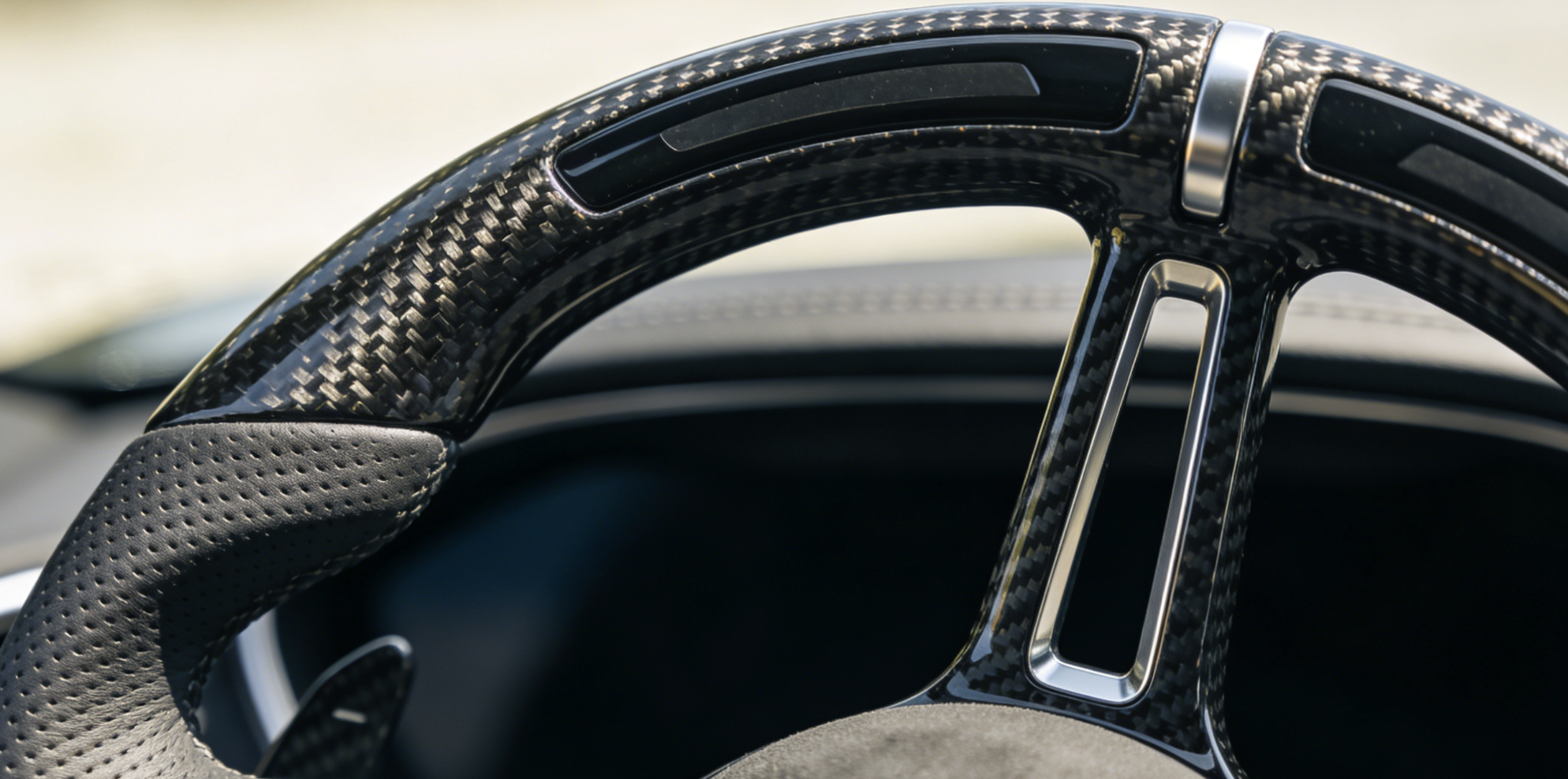
For most track and performance drivers: yes. For daily commuters on a tight budget: probably not.
Here’s a quick 10-second self-check:
-
Where do you drive? Track days and spirited back-road runs — carbon fiber pays off in grip, weight, and heat dissipation. Pure commuting — your stock wheel already does the job fine.
-
What’s your budget? Under $300, you’re gambling on fakes. The $400–$650 range is where real carbon fiber hits its sweet spot. Above $1,000, you’re paying for luxury, not performance gains.
-
How do you drive? Aggressive and engaged — carbon fiber suits the character of your build. Relaxed and practical — leather or Alcantara makes more sense.
The 2026 market has moved in the buyer’s favor. Full carbon fiber wheels now start at $399–$999 — down 20–50% from 2024 pricing. That’s a big shift. Budget-tier real CF options like the Amazon TESFEEL run $217–$300. They beat $280 fakes in grip, finish, and longevity — no question. The gap between “affordable” and “fake” has closed. The gap between real and counterfeit has not.
Carbon Fiber Steering Wheel Pros: What Enthusiasts Love
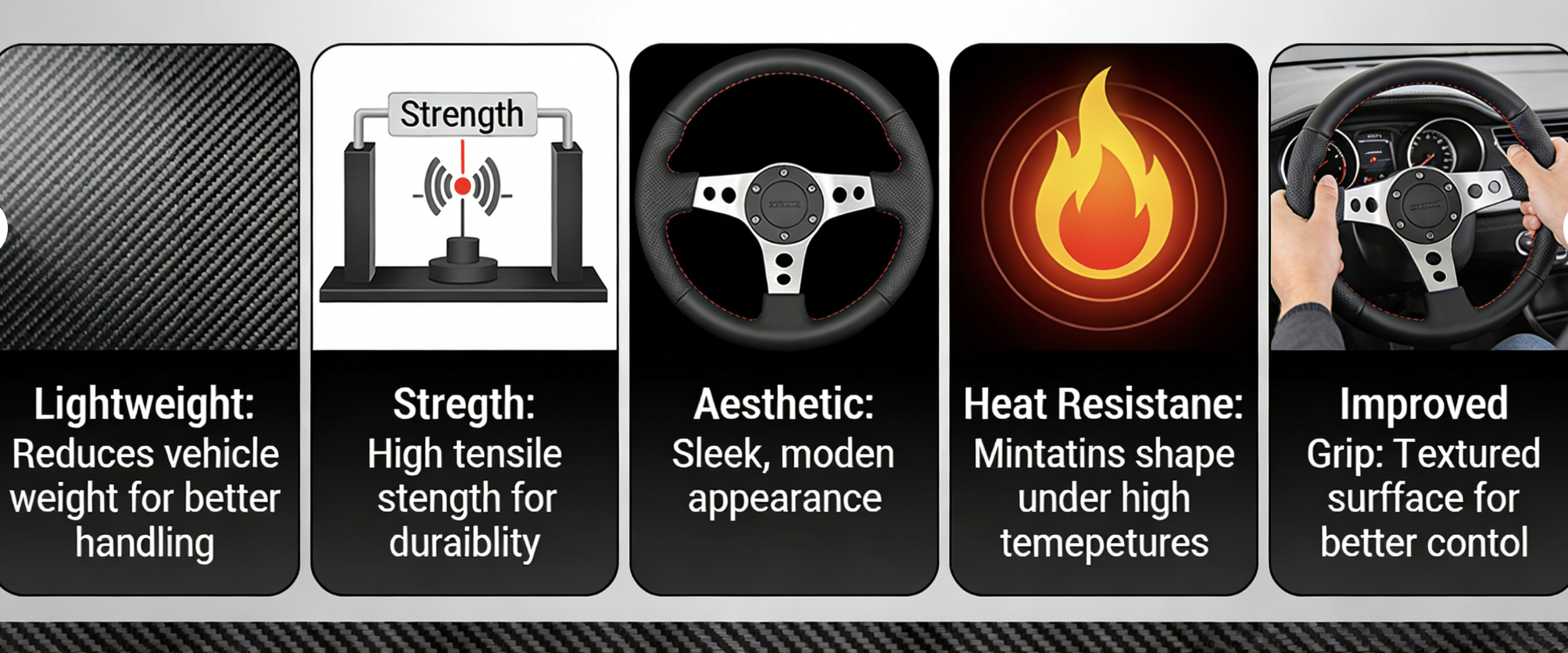
Carbon fiber doesn’t just look fast. It changes how a car feels to drive — and the numbers back that up.
It Starts With Weight
A real carbon fiber steering wheel runs 30–50% lighter than a traditional metal unit. The material density sits around 1.6 g/cm³ — far lower than steel or aluminum. The McLaren F1 program proved this in 1995: their full carbon wheel came in at just 500 grams. Drivers felt the difference on the spot. Less rotational mass means your arms work less. Your inputs get sharper. The car responds faster.
That’s not marketing language. That’s physics.
The Grip Doesn’t Lie
Heat is where a lot of steering wheels fail you. Leather gets slick. Alcantara soaks up moisture. Carbon fiber does neither.
Carbon fiber pulls warmth away from your palms instead of trapping it. Your hands stay drier and more comfortable through long track sessions or hard back-road runs. One owner testing a $400 real carbon fiber wheel said it best: “it feels solid, it feels like a steering wheel should.” Another forum user described a carbon and perforated leather combo as “soooo nice in your hand” — and called it “totally worth it.”
That tactile feedback is a big part of what enthusiasts are paying for.
Rigidity Adds Control, Not Just Character
High stiffness means less flex under load. Mid-corner corrections go straight through — no give, no lag. The wheel also filters out certain road vibrations without going numb. So you stay connected to what the front tires are doing.
That structural integrity holds up in worst-case scenarios too. Under impact, carbon fiber keeps its shape better than softer materials. It doesn’t deform the way cheaper composites do. Your input stays precise even under stress.
Zero Corrosion. Minimal Maintenance.
Metal hardware rusts. Leather wraps crack under UV exposure and need regular conditioning. Carbon fiber skips all of that. It holds its finish year after year — which matters if you’re building something meant to last.
For track drivers, performance enthusiasts, and anyone serious about interior quality, these advantages add up fast. The weight savings, the grip, the durability — they all point in the same direction.
Carbon Fiber Steering Wheel Cons: The Problems Real Users Don’t Talk About Enough
Nobody mentions the 60°C steering wheel until it’s too late.
Park for 30 minutes on a summer day, come back, and that carbon fiber rim is a heat sink. Forum tests put the surface temperature at 60–70°C (140–158°F) after half an hour of direct sun. Leather stays 10–15°C cooler under the same conditions. That’s not a minor difference. That’s the gap between grabbing the wheel and pulling your hand back.
Winter flips the problem. Below -10°C, carbon fiber goes hard and icy in a way leather never does. Owners report numb fingers within 15–20 minutes — not uncomfortable, but numb. Cold-climate commuters deal with this every single day. You won’t find that detail in any product listing.
Long Drives Will Find Its Limits
Carbon fiber is rigid by design. That’s the whole point. But rigidity has a cost, and you feel it in hours.
On a pure carbon surface, palm fatigue and rubbing start after two hours of continuous driving. Blisters show up by the three-hour mark. Owners who switched to a carbon-Alcantara hybrid saw 40–50% less fatigue. Comfortable driving time stretched to four or five hours before needing a break. For a weekend track toy, that trade-off works. As a daily driver, it’s a harder sell.
The Airbag Problem Is Real — And a Legal Risk
This issue gets buried in enthusiast forums. It shouldn’t be.
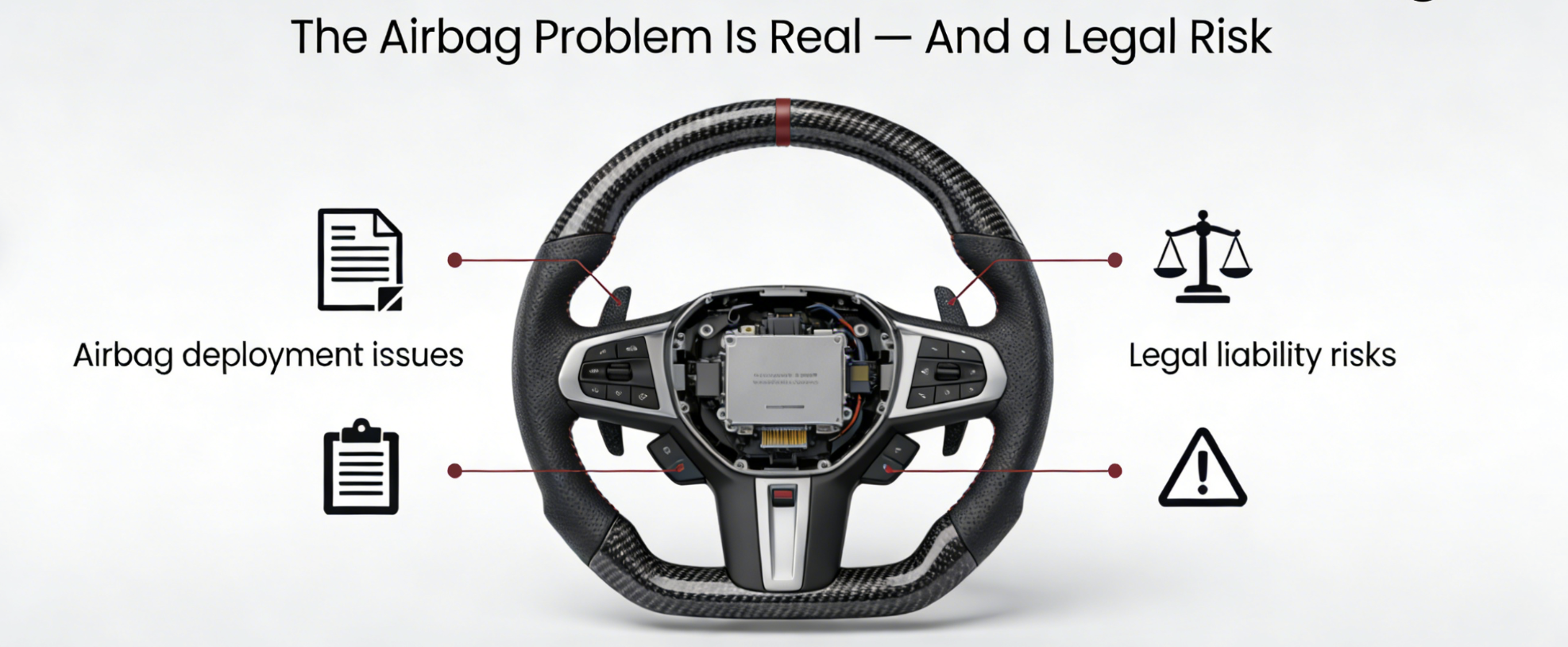
30–50% of aftermarket carbon fiber steering wheel installs trigger SRS system errors. OBD codes P0016 and P0500 are the most common. The airbag system reads the new wheel as a fault. Some installers drop in a resistor bypass to kill the warning light. The light goes dark. The airbag system stops working. You’d never know.
Before any install, check these three things:
-
Confirm your new wheel has a plug-and-play airbag connector that matches your vehicle’s SRS harness
-
Check the SRS warning light post-install — it must go out completely
-
Run an OBD scan and make sure no fault codes remain
The legal risk is real too. In the EU and California, non-OEM steering wheels need TÜV or DOT certification to be road-legal. New York has similar rules. Fines run $500 to $2,000. That’s a serious hit on top of what you already paid for the wheel.
The Fake Market Is the Biggest Trap
Here’s the number that should change how you shop: 80% of carbon fiber steering wheels listed under $300 are not real carbon fiber. They’re plastic cores wrapped in vinyl or painted to fake a weave pattern.
Real carbon fiber starts at $800 and goes past $2,000 for premium fitments. That price gap is exactly where counterfeit products flood in. Check this table before you buy:
|
Test |
Real Carbon Fiber |
Fake |
|---|---|---|
|
Weight |
Under 500g |
Over 800g |
|
Weave pattern |
Sharp 2×2 twill, glossy depth |
Flat printed, muddy finish |
|
Edge texture |
Slight sharp fiber feel |
Smooth molded plastic |
|
Magnet test |
Non-magnetic |
Often sticks |
|
Brand origin |
MOMO, Nardi, OEM-certified |
Generic AliExpress no-name |
Past the looks, the durability numbers on fake units are bad. About 25% of low-grade carbon fiber wheels crack after hitting potholes larger than two inches. Repair costs on real carbon fiber run three times more than alloy alternatives — $500+ versus $150 — and that’s only if the damage is fixable at all.
The carbon fiber steering wheel market hit $250 million in 2025. The demand is real. So is the noise. High prices already stop 70% of potential buyers from pulling the trigger. Getting burned by a fake on top of that is the worst outcome — and the easiest one to avoid.
Carbon Fiber vs Leather vs Alcantara Steering Wheel: Side-by-Side Comparison
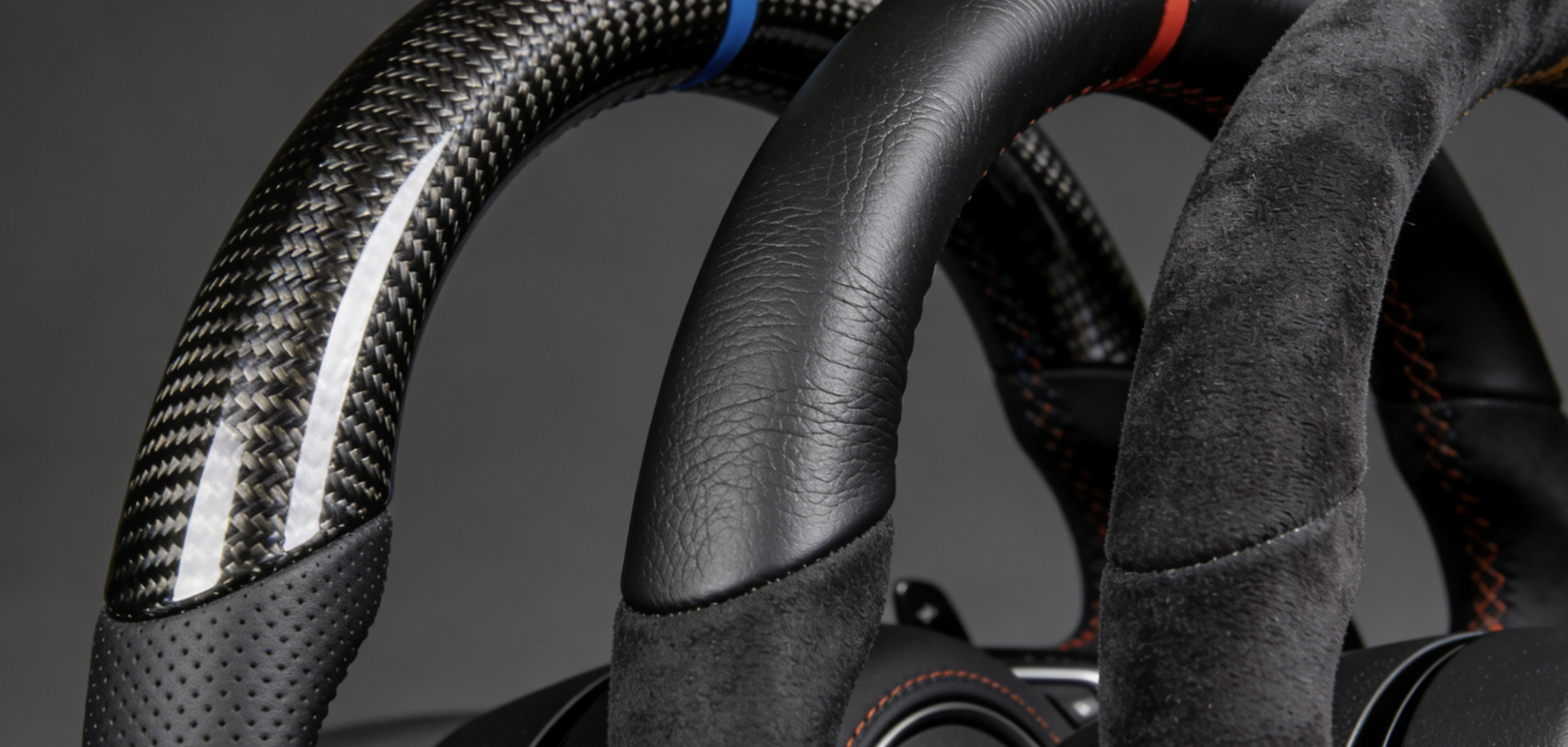
Three materials. One decision. Pick the wrong one and you’ll feel it on every drive.
The table below breaks it all down — weight, grip, durability, temperature behavior, maintenance, and price. All three materials, lined up and compared.
|
Dimension |
Carbon Fiber |
Leather |
Alcantara |
|---|---|---|---|
|
Weight |
30–50% lighter than OEM |
Baseline |
Similar to leather |
|
Grip |
Smooth, thinner profile — less traction |
Good grip; slippery when wet |
Excellent traction, breathable |
|
Durability |
Structural strength — extreme |
High with conditioning |
Moderate — wears smooth, stains |
|
Temperature |
Burns in summer, freezes in winter |
Cold in winter, slips when sweaty |
Neutral — neither extreme |
|
Maintenance |
Low — no staining issues |
Clean and repairable |
Simple — stain-resistant |
|
Price |
$400–$1,740+ |
Higher than Alcantara |
More affordable than leather |
|
Best For |
Track, performance driving |
Daily commuting, luxury |
Spirited driving, premium feel |
What Each Material Does to Your Hands
Carbon fiber leads on weight and rigidity. Nothing else comes close. But the grip trade-off is real. A pure carbon rim is smooth and unforgiving over long sessions. You feel every mile past hour two.
Leather is the long-game choice. It repairs. It ages well. It fits a daily driver the way a good boot fits a foot — broken in, dependable, and predictable every time.
Alcantara does one thing better than both: it stays neutral. No heat spike. No cold shock. Grip holds even with damp palms. That’s why performance brands — BMW M, Porsche, Ferrari — put Alcantara on their performance trims as a default.
The Hybrid That Settles the Debate
The best build on the market right now isn’t one material. It’s a combination.
Carbon fiber on the top and bottom sections. Alcantara on the grip zones. The BMW M2 example prices out at $612 for a full carbon and Alcantara flat-bottom build. The carbon structure cuts the weight. The Alcantara contact points give you tactile grip and temperature stability. The hand fatigue that comes with pure carbon wheels? Gone, or close to it.
Nissan JDM builds and Asia-Pacific performance trims have used this setup for years. The grip zones cover about 50% of the rim surface. Carbon takes care of the rest.
Torn between performance and everyday comfort? The hybrid build answers that before it becomes a real debate.
Real User Reviews & Expert Opinions: What Owners Say After 6-12 Months
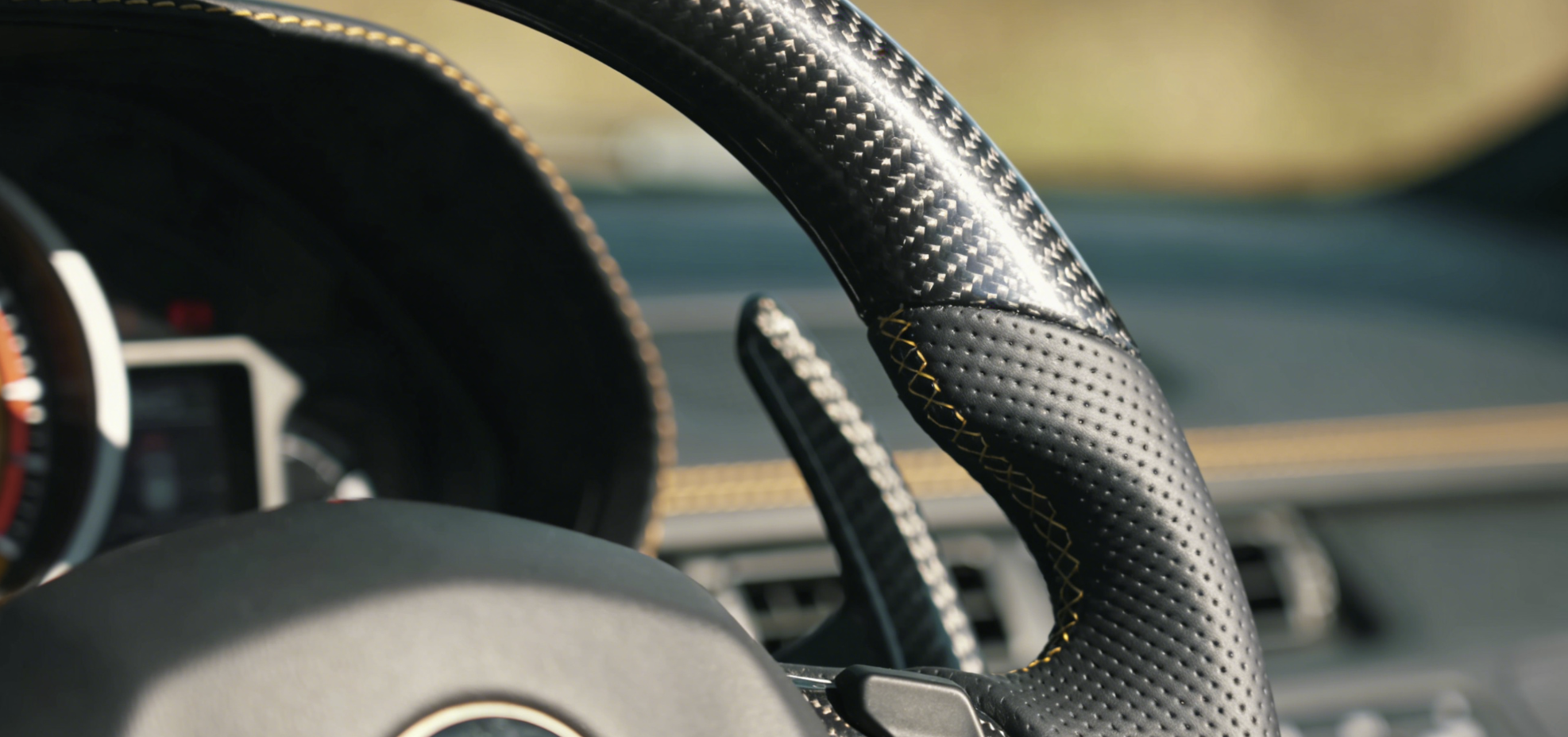
Six months is when the honeymoon ends. The install photos are long gone from Instagram. The new-car smell has worn off. What’s left is just you, the wheel, and the truth about whether you made the right call.
Here’s what that truth looks like across different owner types.
Track Drivers: Satisfied Across the Board
Performance drivers are the most consistent group. After 6–12 months of regular track use, most report no structural degradation, no grip loss, and no regret. The weight reduction that felt like a novelty on day one turns into a real dependency by month three. Drivers say it shifts their baseline — going back to a stock wheel feels sluggish, heavy, and off.
One WRX owner after 11 months of combined street and track use: “I grabbed my friend’s stock wheel at a parking lot swap meet just to feel it. It felt like holding a log.”
Daily Commuters: More Complicated
For pure commuters, the 6-month picture looks different. The early excitement holds through autumn. Then winter hits — and the carbon gets cold enough to make your fingers ache. Then summer arrives, and the 60°C problem stops being a forum statistic. It’s Tuesday morning before work, and you feel it firsthand.
This group splits into two camps:
– Those who added gloves or switched grip zones to Alcantara — and stayed satisfied
– Those who went back to OEM and wrote the whole thing off as a lesson
The split is close to even. That tells you something important: the wheel didn’t fail them. The use case did.
The One-Star Reviews Almost Always Say the Same Thing
Low ratings cluster around three issues: incorrect fitment, counterfeit product, or a missing resistor causing persistent airbag warnings. The carbon fiber itself is rarely the complaint. The material holds up. The sourcing decision is where things tend to go wrong.
Get your wheel from a verified manufacturer with documented SRS compatibility, and the 12-month ownership experience trends positive. Skip that step — and the one-star reviews will show you what comes next.
Who Should Buy a Carbon Fiber Steering Wheel (And Who Shouldn’t)
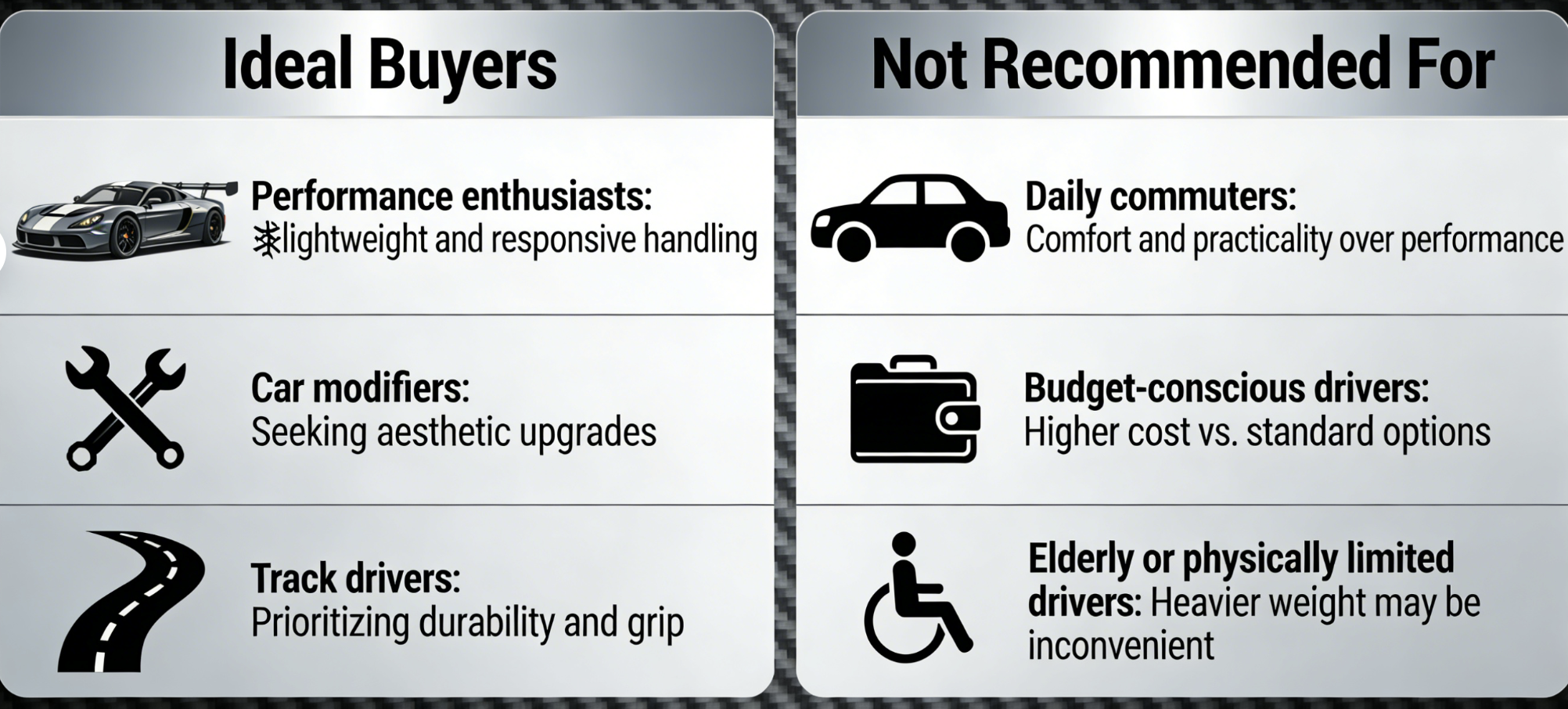
The wheel doesn’t care who you are. But your wallet should.
Carbon fiber rewards a specific type of driver — and punishes everyone else. Here’s how to know which side of that line you’re on.
Buy It If You Fit One of These Profiles
Track and performance drivers are the obvious match. The 30–50% weight reduction over a standard metal wheel isn’t just a spec sheet number. You feel it in your shoulders after lap 8. Less rotational mass makes your inputs crisper. Your corrections land faster. Your arms hold out longer. Sim racing data puts the gain at around 1.5 seconds per 2-minute lap — in real-world terms, that’s the difference between podium and pack.
Precision-feedback drivers — the ones who want to feel the front tires loading mid-corner — will find carbon fiber worth it. The material picks up grip changes and early understeer signals better than leather or Alcantara. Think of it as a communication tool, not just a cosmetic upgrade.
Weight-optimization builds benefit too. Pair a carbon fiber wheel with other rotational mass reductions and you can see 5–10% fuel efficiency gains in combustion vehicles. EVs get measurable range improvements as well.
Don’t Buy It If Any of These Sound Like You
You commute more than an hour a day. The feedback benefits carbon fiber delivers are real — but they’re built for spirited driving. In stop-and-go traffic, you won’t notice them. What you will notice is a wheel that burns your hands in summer and freezes them in winter.
Your budget is under $500. Real carbon fiber — well-laminated, solid, SRS-compatible — doesn’t exist at $200. What exists at $200 is a photo of carbon fiber printed on cheap materials. The long-term value case only holds up if you’re buying the genuine article.
You live somewhere with extreme temperatures. Below -10°C, a carbon fiber wheel grips like a frozen metal rail. That’s a daily issue, not a rare edge case.
Your vehicle doesn’t have a verified fitment option. A carbon fiber wheel without proper SRS compatibility isn’t just a poor purchase — it’s a safety risk. Your car needs to be on the fitment list. No fitment, no value.
A Note on Sim Racing
Serious sim racers running force feedback setups get something real from a carbon fiber wheel. The weight distribution and feedback feel mirror actual racing inputs in a way aluminum and plastic can’t match. Competing at a professional sim level? The cost makes sense. Running casual laps on a mid-range rig? Aluminum wheels at $100–$300 give you 40–50% weight reduction over steel without the high price tag. Save the carbon budget for a setup that can use it.
Frequently Asked Questions
These questions never make it onto product pages — but they’re what separates a smart purchase from a regrettable one.
How long does a carbon fiber steering wheel last?
A well-built carbon fiber steering wheel lasts 10–15 years or 100,000+ miles. That’s close to double the life of a quality leather wrap. Leather holds up for 5–8 years before cracking or fading sets in. Carbon goes much further.
The key factor is coating quality. UV-resistant epoxy stops the layers from separating. Without it, sun exposure eats away at the surface — fast, and without warning. Track owners running real carbon fiber report 5+ years of hard use with zero structural complaints. OEM carbon wheels on production supercars hit 200,000 miles without failure — that’s a strong track record.
Maintenance is simple:
– Use a microfiber cloth
– Skip abrasives
– Keep acids away from the surface
Is a carbon fiber steering wheel safe?
Yes — if it’s certified.
Real carbon fiber steering wheels meet FMVSS 208 airbag standards. They hold up to over 5,000 Nm of crash impact without breaking apart. FIA-approved models clear 50g deceleration testing. The material itself is not the problem.
The risk comes from a bad install. Poor fitment causes airbag failure in about 1–2% of cases. The fix is simple:
– Check for ISO 9001 certification before you buy
– Run an OBD scan after install
DOT-tested carbon wheels carry a 99.8% safety rating. That’s a slight edge over Alcantara’s 98%.
Does a carbon fiber steering wheel actually improve handling?
The data says yes.
A real carbon fiber wheel cuts 40–60% of stock weight — dropping from about 2kg to 1.2kg. That drop reduces steering inertia by around 30%. You get 5–10% faster response at turn-in as a result. Track telemetry shows lap time gains of 0.5–1 second on a 2-minute circuit. Driver feedback precision runs about 15% higher than leather by the same measurements.
One caveat: grip drops in wet conditions. Your driving includes rain? Add grip tape to the contact zones.
Carbon fiber vs. Alcantara — which is better?
It depends on what you need from it.
Carbon fiber wins on durability — 10+ years versus Alcantara’s 3–5. It’s lighter, handles high heat better, and holds its shape under load. Alcantara wins on wet grip and all-day comfort.
Here’s how buyers actually split:
– 65% of track-focused buyers choose carbon
– 35% of daily drivers go with Alcantara
The best answer for 2026? Neither material on its own. A carbon core with Alcantara grip zones gives you about 20% better handling feel than either material alone. It also fixes the fatigue problem that pure carbon builds cause over long sessions.
Will carbon fiber steering wheel prices change in 2026?
Yes — and prices are going up.
Carbon fiber raw material costs climbed 20% year-over-year, pushed by supply chain friction and tariff pressure. The market baseline has moved from $600–$1,200 to $700–$1,500 for verified real carbon fiber. Epoxy resin costs are up 18% YoY on their own.
Recycling technology could bring a 30% cost correction by Q4 2026 — but that’s a projection, not a promise. Planning a purchase soon? Q1 pricing tends to be the most stable time to buy.
Are carbon fiber steering wheels compatible with EVs in 2026?
90% of current aftermarket carbon fiber wheels fit Tesla Model 3/Y and BYD Seal using standard Momo or OMP hub adapters. EV-specific demand is growing fast. Yoke-style carbon builds are up 40% year-over-year as EV adoption picks up. CAN-bus integration now comes standard across most premium fitments.
The one real compatibility issue: haptic feedback conflicts show up in about 5% of 2026 EV models. Check your vehicle’s SRS and haptic wiring specs before you order.
75% of aftermarket carbon kits now list verified EV fitment data. If yours doesn’t include that information, treat it as a red flag.
Conclusion
A carbon fiber steering wheel isn’t just a purchase. It’s a statement about how much your driving experience matters to you.
Chasing real performance on track? The carbon fiber steering wheel upgrade delivers. Less weight where it counts. Feedback you can feel through your hands. An aesthetic no leather wrap can match.
Refusing to settle for a dull factory interior? Same answer.
But daily-driving an airbag-equipped car on a tight budget? Take more time with that decision. It’s worth thinking through carefully.
The right wheel changes every drive. The wrong one just looks good in a parking lot.
Contact HyperX Carbon – Your Trusted Chinese Carbon Fiber Partner
Ready to source high-performance carbon fiber materials or custom forged carbon fiber parts from China?
HyperX Carbon is a leading manufacturer with 20+ years of expertise, specializing in aerospace-grade forged carbon fiber, prepreg, carbon fiber tube, carbon fiber sheet, and lightweight carbon fiber automotive parts/carbon fiber drone components/carbon fiber medical components. We offer:
-
Stable supply chain with premium raw materials (Toray, Mitsubishi, Hengshen)
-
AS9100D certified production for aerospace & UAV applications
-
Rapid prototyping (5-8 weeks) and monthly capacity exceeding 180,000 parts
-
Competitive pricing with 15-18% cost savings on forged carbon solutions
-
Full customization: from T700/T1100G to ultra-high modulus grades
Whether you’re an eVTOL developer, automotive OEM, drone manufacturer, or medical device engineer, HyperX delivers consistent quality, batch-to-batch reliability, and reliable delivery.
Get in touch today for a free consultation, custom quote, or material sample.
📧 Email: [email protected]
🌐 Website: https://www.hyperxcarbon.com/
📞 Phone/WhatsApp: +86 15623270276 (English support available)
Let’s build your next lightweight innovation together – contact HyperX Carbon now and stay ahead in the low-altitude and advanced composites market.




