Carbon fiber stands out as one of the most remarkable materials ever made — stronger than steel, lighter than aluminum. You’ll find it in Formula 1 chassis, road bike frames, and more products every year.
But one question keeps coming up: what happens to it when it’s done?
The honest answer? Carbon fiber recycling is real. It’s moving fast. And it’s far more complex than a simple yes or no.
So whether you’re picking materials for a next-generation product, checking the environmental impact of a purchase, or just want to know where this industry is going — this is the most complete breakdown of carbon fiber’s end-of-life story you’ll find.
The Short Answer: Yes — But It’s Complicated

Yes. But what “recycling” means here changes everything.
Carbon fiber reinforced polymer recycling isn’t like tossing an aluminum can into a blue bin. The material doesn’t melt down in a clean, simple way. The fiber and resin bond at a molecular level. Pulling them apart takes real engineering, real energy, and real trade-offs.
Here’s the core tension: the fiber can be recovered, but the composite can’t be fully restored.
-
Reclaimed carbon fiber holds 70–90% of its original tensile strength, depending on the process
-
That’s still strong — seriously strong
-
But it’s no longer virgin material
-
Certain high-stress applications will always need the original spec
So “recyclable” is accurate. “Perfectly recyclable” is not.
The real question isn’t just can it be recycled. It’s which method gets used, what you actually recover, and where that material goes next. That’s where the real story begins.
Why Carbon Fiber Is So Hard to Recycle in the First Place
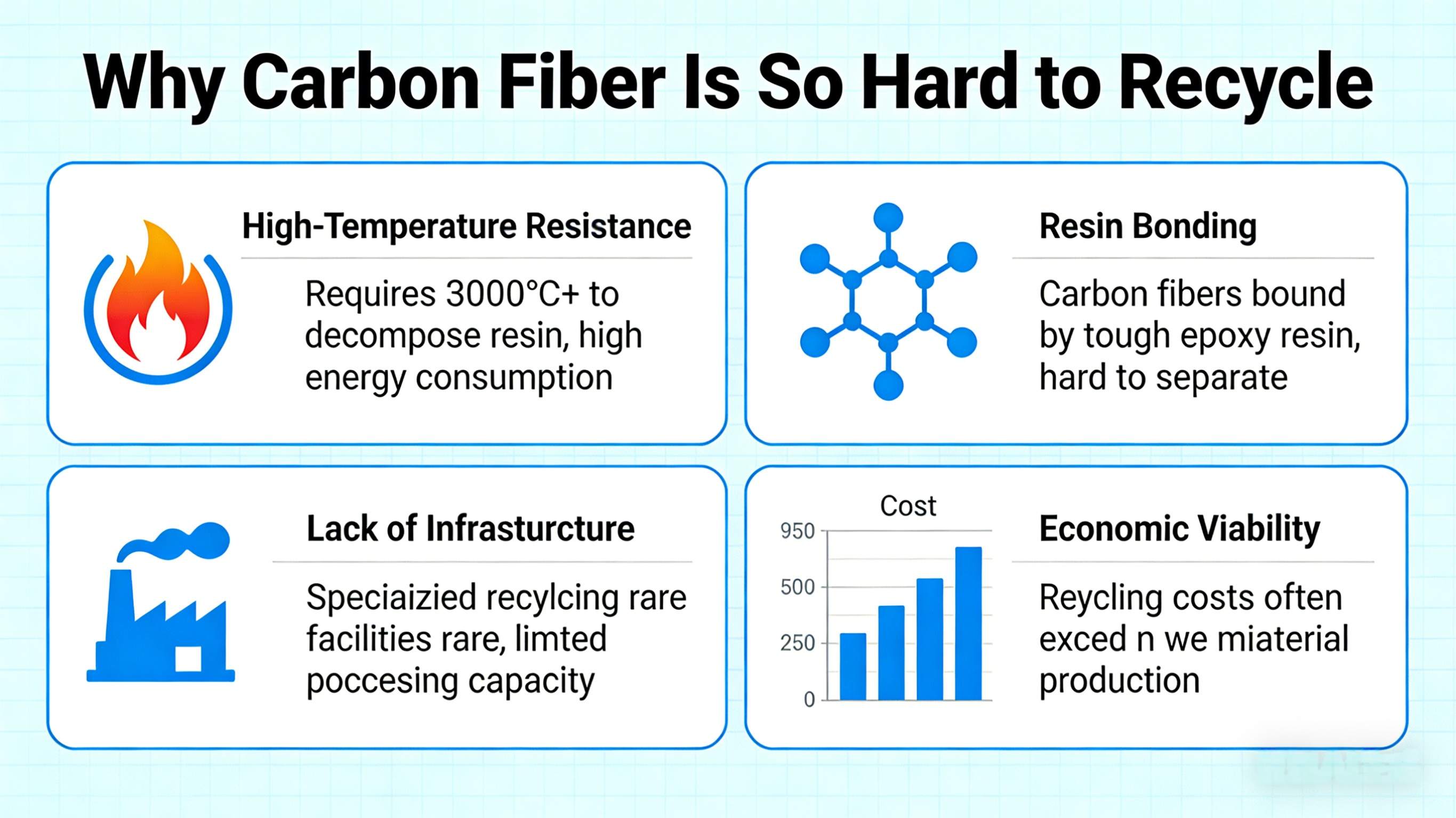
The numbers tell the story fast: 97% of carbon fiber waste ends up in a landfill or an incinerator. Not because the industry doesn’t care. Because the material itself fights back.
Here’s the core problem.
Most carbon fiber products come from thermoset composites — carbon fibers locked inside epoxy resin through chemical cross-links that can’t be undone. That bond is what makes CFRP so strong. It’s also what makes it so hard to break apart.
Aluminum melts. You apply heat, it liquefies, you pour it into something new. The recycling loop runs close to 100% material recovery with low energy input.
Carbon fiber doesn’t work that way. You can’t melt it back. The epoxy matrix won’t reverse. To pull fiber from resin, you have to attack the material — with heat, chemicals, or mechanical force. Every method costs something.
Every Recycling Method Makes a Trade-Off
|
Method |
Energy Required |
What You Recover |
|---|---|---|
|
Mechanical grinding |
0.27–2.03 MJ/kg |
Short, damaged fibers; ~75% tensile strength |
|
Pyrolysis (thermal) |
3–30 MJ/kg |
50–75% tensile strength; some fiber damage |
|
Chemical solvolysis |
19.2–91 MJ/kg |
Higher quality possible — but toxic byproducts, high cost |
Compare that to virgin carbon fiber production: 183–594 MJ/kg, costing around $33/kg. Recycled fiber comes in at $15–20/kg — a real cost advantage. But fiber quality varies too much for the most demanding aerospace applications.
The scale problem makes everything worse. In 2024, the industry produced around 50 kilotons of CFRP waste. Global recycling capacity covers about half of that. After 2029, annual waste is on track to hit 100 kilotons — driven by manufacturing scrap, with end-of-life aircraft and wind blades adding more pressure for decades.
The infrastructure hasn’t caught up to the volume. That’s the real bottleneck. Not a lack of effort. Not technology alone. The gap is between how fast carbon fiber waste piles up and how fast recovery systems can actually scale.
The 5 Main Carbon Fiber Recycling Methods Explained

Five methods exist today. They range from industrial furnaces to laboratory fungi. Each one attacks the problem in a different way — and each one makes a different set of promises about what you get back.
Here’s what happens inside each process.
1. Pyrolysis — Burning Away the Resin
Pyrolysis is the most established method on the market. You heat CFRP in an oxygen-free atmosphere, between 450–700°C. The resin burns off. The fiber survives.
What you recover is clean carbon fiber with up to 97% strength retention — the highest of any thermal approach. The environmental numbers are striking. Fluidized bed pyrolysis delivers a net energy saving of 494.5 MJ per kilogram of waste processed. It also cuts greenhouse gas output by 19 to 27 kg CO₂ equivalent per kilogram. Stack that against virgin fiber production, and you’re looking at an emission reduction of 90–95% and 98% less energy consumed.
The catch is surface degradation. Thermal stress roughens fiber surfaces. That weakens how well they bond to new resin matrices. Most pyrolysis-recovered fiber ends up in lower-grade applications — strong, but downgraded. VOC emissions during processing are another real concern. Facilities need solid management systems in place to handle them.
2. Solvolysis — Dissolving the Problem
Pyrolysis attacks with heat. Solvolysis attacks with chemistry. Solvents — hot acetic acid, ethylene glycol with potassium hydroxide, or fluorinated solvents like HFIP — break down the resin matrix at a chemical level. The fiber comes out intact.
The fiber quality is exceptional. Solvolysis preserves 93–99% of tensile strength, 93% of Young’s modulus, and 95% of strain-to-failure compared to virgin fiber. In lifecycle terms, the best-performing batch reactor scenario hits an environmental impact score of 3.31 × 10⁻¹ — the lowest across all recycling methods, with a 43% reduction in climate change impact. The same process outputs 1 kg of reclaimed carbon fiber alongside 5.74 kg of recovered, reusable solvent.
The obstacles are commercial, not scientific. Reaction times are slow. Solvent recovery adds complexity and cost. Scaling a controlled chemical process from lab to industrial volume is expensive. Plasma-enhanced variants using nitric acid show promise in boosting recovery rates, but they’re still in early development.
3. Mechanical Recycling — Simple, Blunt, Effective Enough
No chemistry. No heat. Just cutting and grinding.
Mechanical recycling shreds CFRP composites into small particles and short fiber fragments. It’s the fastest, cheapest, and most direct method available. For manufacturers dealing with production scrap, it offers an immediate, low-cost exit route.
The trade-off is fiber quality. Grinding destroys fiber length and damages structure. What you get back works as a filler — in consumer products, non-structural panels, or reinforced compounds — but not in load-bearing components. The greenhouse gas benefit is still real: −378 kg CO₂ equivalent per tonne of waste processed (assuming residuals are landfilled rather than incinerated). But displacing virgin carbon fiber in the supply chain? That needs near-100% material recovery with structural properties that don’t survive the shredder.
It’s a practical tool. Not a complete answer.
4. Laser Degradation — Precision at a Cost
Fraunhofer researchers developed a laser-based approach that does something no other method can match: it removes resin while preserving continuous long fibers.
That distinction matters a lot. Most recycling methods break fiber into shorter segments, which limits where the reclaimed material can go. Laser ablation targets the resin matrix and leaves fiber geometry intact. The output is viable for structural reuse — something short-fiber methods can’t offer.
The process is still at demonstration scale. High energy requirements, expensive equipment, and low throughput make commercial scaling a serious challenge. The output quality, though, positions laser recycling as a future contender for aerospace and high-performance applications that won’t accept downgraded fiber alternatives.
5. Biological Recycling — The Longest Shot With the Strangest Promise
Researchers at the University of Southern California are using engineered black Aspergillus fungi to biodegrade epoxy resin byproducts. It reads more like biotechnology than materials processing.
The fungi break down chemical residues that other methods leave behind. In doing so, they convert composite waste into high-value pharmaceutical compounds. That’s a complete reframe of the problem: carbon fiber recycling not as material recovery, but as a source of medicinal chemistry.
Right now, it exists in laboratory conditions. No commercial data. No throughput metrics. No deployment timeline. The core idea, though, challenges the whole industry framing — the “waste” in carbon fiber waste might carry more value than the fiber itself.
How the Methods Stack Up
|
Method |
Fiber Quality |
Energy Demand |
Best Use Case |
CO₂ Benefit |
|---|---|---|---|---|
|
Pyrolysis |
High (up to 97% strength) |
High |
Semi-structural, automotive |
−19 to −27 kg CO₂/kg |
|
Solvolysis |
Highest (93–99% strength) |
Moderate |
High-performance structural parts |
Lowest LCA score (0.331) |
|
Mechanical |
Low (short, damaged) |
Low |
Fillers, consumer products |
−378 kg CO₂/tonne |
|
Laser |
Very high (continuous fiber) |
Very high |
Aerospace, structural reuse |
Not yet quantified |
|
Biological |
Unknown |
Unknown |
Lab-stage only |
Not yet quantified |
No single method wins across every dimension. The right choice depends on what the waste looks like, what quality the end application demands, and what infrastructure is available. The industry is moving toward hybrid approaches — mechanical pre-processing followed by thermal or chemical treatment — to balance cost, throughput, and output quality at scale.
How Recycled Carbon Fiber (rCF) Compares to Virgin Fiber

The gap between reclaimed and virgin carbon fiber is real — but it’s narrower than most people think, and it keeps shrinking.
Here’s what the data shows.
Tensile strength retention lands between 60–90%, depending on the recycling process. Mechanical recycling sits at the low end — grinding cuts fiber length and adds contamination. Steam-based pyrolysis sits at the top. It produces cleaner fiber surfaces and bonds better with new resin.
One result stands out. Superheated steam-recycled carbon fiber (SHS-RCF) placed inside polyethylene composites reached 106.88% impact strength compared to T700 virgin carbon fiber — plus 106% of its thermal conductivity. That’s not a downgrade. That’s a match, or better.
Where rCF Falls Short
Fiber length is the real limiting factor. Recycling shortens fibers. Shorter fibers carry load less well. That’s a problem in high-stress, safety-critical applications — aerospace primary structures, for example — where you need the full geometry of virgin fiber. There’s no substitute there.
For non-structural and semi-structural uses — automotive interiors, consumer electronics, sporting goods — rCF gives you strong performance at a much lower cost and carbon footprint.
The Economics and Environmental Case
|
Metric |
rCF |
Virgin CF |
|---|---|---|
|
Tensile Strength |
60–90% retention |
100% baseline |
|
Cost Savings |
20–40% cheaper |
Full market price |
|
CO₂e per kg |
5–10 kg |
25–30 kg |
|
Energy Use |
Up to 90% less |
Baseline |
|
Fiber Recovery Rate |
Up to 95% |
N/A |
The cost advantage is well-documented and consistent. ELG Carbon Fibre puts savings at 30–40%. CFK Valley puts them at 20–30%. Either way, reclaimed fiber costs less — and the market is moving fast, with rCF growing at 12% CAGR through 2028, ahead of virgin fiber growth.
The environmental case is even stronger. Virgin carbon fiber production puts out 25–30 kg CO₂e per kilogram. Reclaimed fiber drops that to 5–10 kg — a 60–80% reduction. Energy use falls by up to 90%. Water use drops by two to three times.
Your team evaluating carbon fiber’s full lifecycle — for ESG reporting, green procurement, or real environmental concern — those numbers change the decision. They’re not minor. They’re the difference between a defensible choice and a costly one.
Where Recycled Carbon Fiber Is Being Used Today

Reclaimed carbon fiber has left the laboratory. It’s in production lines, on roads, and inside the devices people use every day.
Automotive is the biggest adopter right now. Semi-structural parts, under-hood components, compression-molded panels — rCF slots cleanly into processes where fiber length matters less than cost and weight. EV manufacturers in Asia-Pacific are pushing that demand harder. A fast-growing two-wheeler market is doing the same, with buyers focused on both performance and price.
Aerospace is moving slower, but it’s moving. MRO networks and secondary structures are taking in reclaimed fiber where full virgin-spec isn’t needed. Defense and space programs are approving higher-grade rCF for specific uses. Aerospace production scrap is some of the cleanest feedstock available, so downstream processing is far more straightforward than with other sources.
Wind energy is where end-of-life volume gets serious. Blade owners in Europe and North America face landfill bans. So they’re sending decommissioned blades into hybrid mechanical-thermal processing. That recovery produces rCF mats, pellets, and infrastructure components — all backed by recycled-content procurement policy.
Electronics and sporting goods round out the picture. Housings, brackets, and consumer frames now carry real brand value tied to environmental credentials. Manufacturers are paying attention to that shift.
What’s driving adoption at scale isn’t the fiber itself — it’s the intermediate formats. Think:
– Pelletized rCF/PA and rCF/PP compounds
– Needle-punched nonwovens
– Hybrid GMT tapes
These tool-ready materials cut validation timelines. Manufacturers can integrate reclaimed fiber without rebuilding their entire production process from the ground up.
The market reflects it: $205.7 million in 2025, projected to reach $443 million by 2034. That growth isn’t speculative. Procurement decisions happening right now are already locking it in.
The Real Barriers Slowing Down Carbon Fiber Recycling at Scale

The technology works. The demand exists. So why does only 15% of carbon fiber waste get recycled?
It’s not one problem. It’s five problems hitting the industry at once.
The money problem comes first. Building a commercial-scale recycling facility costs $10–20 million before a single kilogram of fiber moves through it. That’s a steep entry barrier. Then the economics bite again once you’re running. Recycled carbon fiber sells at 40–60% of virgin fiber prices, yet delivers 70–80% of the mechanical performance. Recyclers face a tight margin squeeze. That squeezes out serious capital commitment before it even starts.
The quality problem makes it worse. Waste streams aren’t clean or consistent. CFRPs come in mixed combinations — different resins, additives, and fiber grades — and no two batches behave the same way. Residual carbon on fiber surfaces, surface damage, and leftover resin all drag down the final output. The recycled material can’t match virgin-spec fiber in structural applications. That cuts the potential market significantly.
The infrastructure problem locks it in. Collection systems stay fragmented across the supply chain. No unified digital tracking links waste generators, recyclers, and end-users. Sorting and processing facilities are scarce globally. Centralizing operations boosts throughput — but raises transportation emissions at the same time. Neither path is clean.
The regulatory problem adds more friction. The EU enforces strict end-of-life requirements. North America and Asia don’t follow the same rules. No universal standards exist for recycled carbon fiber certification, so high-performance buyers stay cautious. That uncertainty keeps rCF locked out of the applications where it would make the biggest difference.
The volume problem is outpacing everything else. Carbon fiber waste sits at 20,000–30,000 tonnes per year today. About 30% of all production becomes scrap before a product ever ships. That number is growing faster than recovery infrastructure can keep up. The gap between waste generated and waste recovered isn’t shrinking — it’s getting wider.
None of these barriers are permanent. But capital, quality consistency, logistics, policy, and processing capacity all need to move in the same direction at the same time. Until that happens, large-scale recycling stays out of reach.
Breakthroughs That Could Change the Game
Two research teams dropped major results in 2025. Both findings shift how we think about recycling carbon fiber entirely.
The first came from the NREL/BOTTLE Consortium, published in Nature in June. Their process — acetolysis — uses acetic acid, a compound found in vinegar, to break down epoxy thermosets in CFRPs. Two hours. Clean fiber extraction. They tested it on a real mountain bike frame at 80g scale.
The numbers speak for themselves:
-
Reclaimed fiber minimum selling price: $1.50/kg
-
Virgin carbon fiber runs $110+/kg
-
That’s a 98% cost reduction
-
GHG emissions drop ~99% compared to virgin production
Plus, the fibers held up through three full recycling cycles with zero strength degradation. Composites made from the recovered fiber exceeded 2× the strength-to-weight ratio of steel.
The second breakthrough is the “SaLSO” protocol, published in Communications Materials in October. It achieves true closed-loop recycling using a seawater-derived medium and citric acid. No toxic chemistry involved. The recovered material keeps its full quality — nothing gets downgraded. Refabricated laminates showed +44% flexural strength and +41% interlaminar shear strength compared to standard baselines.
These two findings aren’t small steps forward. They break from what the industry long assumed was impossible to change.
How to Dispose of Carbon Fiber Waste the Right Way (Practical Guide)

Carbon fiber doesn’t disappear. It isn’t biodegradable. Toss it in a landfill and it sits there — for good.
That fact alone should change how you think about disposal.
Three routes to avoid:
-
Landfilling — wastes a recoverable material and takes up land with no end date
-
Incineration — burns through 2,011 kg of CO₂ per ton of CFRP waste. It also releases uncontrolled fiber particles at up to a 4% release rate. The carbon output far exceeds any energy you get back.
-
DIY grinding — creates hazardous fiber dust with a documented carcinogenic risk
The right move is professional recycling — thermal recycling, to be exact. It’s the most established method in commercial use. It runs below 500°C in fluidized bed systems and pulls out around 600 kg of usable carbon fiber per ton of waste.
Can’t track down a recycler on your own? Start with your composite material supplier. You can also contact an aerospace or automotive manufacturer. Or reach out to the ACMA — they provide certified referrals. Before you commit, confirm they offer thermal processing capability.
The infrastructure gap is real. Today, combined global recycling capacity still leaves ~50% of CFRP waste unprocessed. But the option exists. Use it.
Carbon Fiber vs. Fiberglass vs. Aluminum: Recyclability Compared
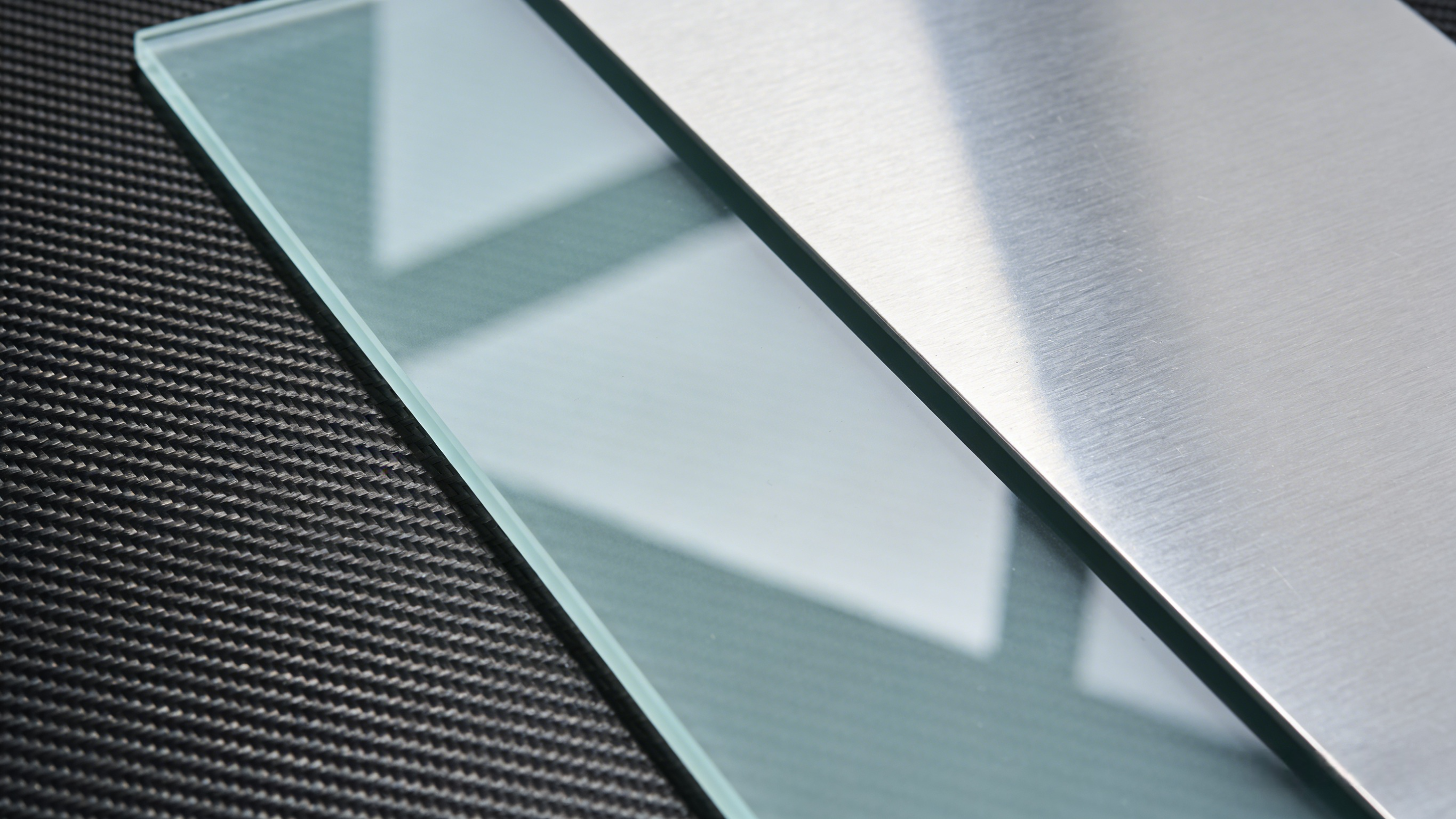
Three materials. Three very different outcomes.
Compare them on recyclability alone. The gap is wide enough to shift how you approach material selection entirely.
|
Material |
Recyclability Rate |
Energy Savings vs. Primary Production |
CO₂ per Ton |
|---|---|---|---|
|
Aluminum |
90% |
95% |
8.6 tons |
|
Carbon Fiber (CFRP) |
30% |
~50% cost recovery |
14 tons |
|
Fiberglass |
Marginal |
Not established |
Lower than CFRP |
Aluminum wins this comparison. It isn’t even close. Seventy-five percent of all aluminum ever produced is still in active use today. Recycling it consumes just 5 GJ per ton and recovers 95% of the energy compared to primary production. No meaningful property loss. No exotic chemistry. Drop it in, melt it down, use it again. The infrastructure is global, mature, and cheap.
Carbon fiber sits at 30% recyclability. The technology exists — that’s not the issue. The problem is that thermal recycling burns 40% more energy than aluminum smelting. On top of that, separating fiber from matrix is hard to do at scale. Most CFRP waste still ends up in landfills.
Fiberglass is stuck in a similar trap — and the case for it is weaker. Production emissions run lower than carbon fiber. That’s a point in its favor. But recycling infrastructure? There isn’t one. Most used fiberglass goes straight to landfill. Research is still chasing solutions that haven’t hit commercial scale yet.
Carbon fiber does earn back ground in the operational phase. CFRP components in aircraft cut engine thrust requirements by 15%. That trims annual CO₂ emissions by 12,000 tons per aircraft. This is a lifecycle argument, not a recyclability argument. But it carries real weight in a full environmental accounting.
So here’s the straight summary:
-
Recyclability is your top priority? Aluminum is the clear, defensible choice.
-
Weight efficiency and long-term performance drive the decision? Carbon fiber’s environmental cost can be justified — but advanced recycling must be part of the end-of-life plan. That means pyrolysis, solvolysis, or chemical methods built into the process from the start. Skip that step, and the numbers fall apart.
FAQ: Common Questions About Carbon Fiber Recycling
Most people ask the same handful of questions. Here are the straight answers.
Can carbon fiber be recycled?
Yes. The global market for reclaimed carbon fiber is worth over $200 million. That’s not a pilot program — it’s a functioning industry.
How does the recycling process work?
Two methods dominate.
-
Pyrolysis burns off resin in a controlled atmosphere. It holds 70% of the market and recovers fiber at around $7.20/kg.
-
Solvolysis uses chemistry instead of heat. It preserves better surface quality.
After recovery, the fiber gets cleaned and re-sized. Then it converts into pellets or nonwovens, ready for manufacturing.
How much strength does recycled fiber lose?
– Pyrolysis: about 10% reduction
– Fluidized bed methods: up to 50%, due to mechanical agitation
Most applications don’t need that missing margin anyway. The strength loss rarely affects real-world performance.
Who’s buying it?
Demand comes from a wide range of industries:
-
Automotive OEMs
-
Aerospace MRO networks
-
Wind energy operators
-
Consumer electronics brands
North America leads the market. Europe is growing fastest.
What if there’s no recycler nearby?
You have a few options. Contact your material supplier first. You can also reach out to an ACMA-certified facility or aerospace manufacturers with established take-back programs.
One more tip: placing disposal close to your manufacturing site cuts logistics costs fast. The savings add up quickly over time.
Conclusion
Carbon fiber isn’t the environmental villain people make it out to be — but it isn’t a solved problem either. The recycling infrastructure exists. The technology is maturing. Reclaimed carbon fiber is already showing up in real products across aerospace, automotive, and sport industries. What’s missing isn’t possibility. It’s scale, standardization, and pressure to act.
Sourcing materials for a product line? Evaluating your company’s end-of-life obligations? Trying to make smarter purchasing decisions? Understanding carbon fiber’s recyclability puts you ahead of most people in the room.
The next step is clear: ask harder questions about where your carbon fiber comes from — and where it goes.
Contact HyperX Carbon – Your Trusted Chinese Carbon Fiber Partner
Ready to source high-performance carbon fiber materials or custom forged carbon fiber parts from China?
HyperX Carbon is a leading manufacturer with 20+ years of expertise, specializing in aerospace-grade forged carbon fiber, prepreg, tubes, sheets, and lightweight automotive/drone/medical components. We offer:
-
Stable supply chain with premium raw materials (Toray, Mitsubishi, Hengshen)
-
AS9100D certified production for aerospace & UAV applications
-
Rapid prototyping (5-8 weeks) and monthly capacity exceeding 180,000 parts
-
Competitive pricing with 15-18% cost savings on forged carbon solutions
-
Full customization: from T700/T1100G to ultra-high modulus grades
Whether you’re an eVTOL developer, automotive OEM, drone manufacturer, or medical device engineer, HyperX delivers consistent quality, batch-to-batch reliability, and reliable delivery.
Get in touch today for a free consultation, custom quote, or material sample.
📧 Email: [email protected]
🌐 Website: https://www.hyperxcarbon.com/
📞 Phone/WhatsApp: +86 15623270276 (English support available)
Let’s build your next lightweight innovation together – contact HyperX Carbon now and stay ahead in the low-altitude and advanced composites market.