
Picking between a forged carbon fiber steering wheel and a traditional woven carbon unit goes beyond a materials debate. This choice shapes how your car feels, performs, and draws attention every time you get behind the wheel.
The differences go deeper than surface texture. We’re talking manufacturing philosophy, structural integrity, weight distribution, and a visual identity that either blends in or stops people cold.
Chasing lap times? Building a show-worthy interior? Or just want a solid upgrade you can trust? Getting this choice right matters.
What follows is a complete, no-fluff breakdown. It covers strength data, real-world drivability, aesthetic trade-offs, and the best forged carbon fiber steering wheels worth your money in 2026.
Forged vs Traditional Carbon Fiber Steering Wheel: Strength & Structural Performance Breakdown
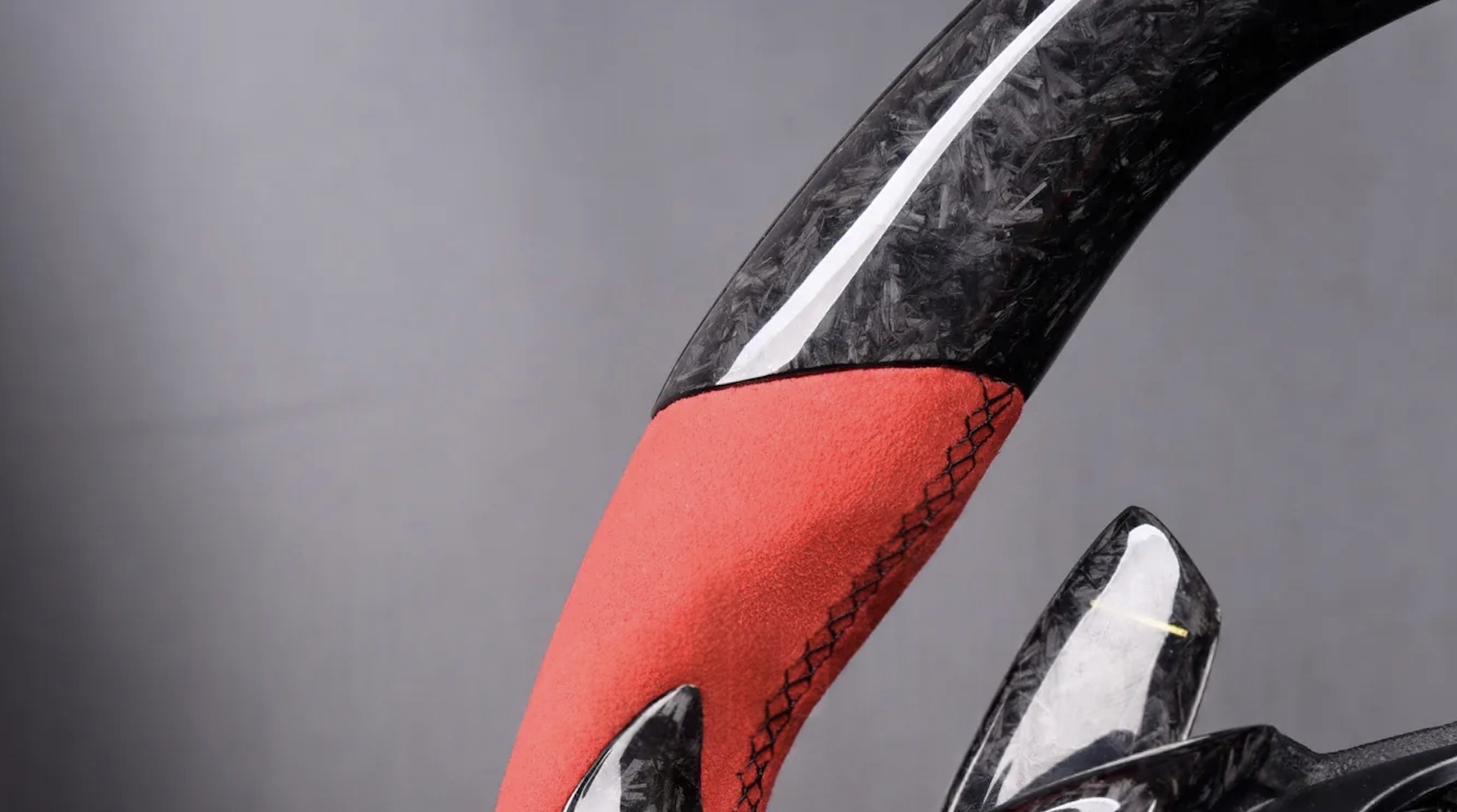
Spec sheets skip the most important detail: these two materials fail in different ways. That difference determines which one belongs in your hands.
Forged carbon fiber gets made by compressing short carbon strands — oriented at random — into a resin matrix. The pressure runs between 1,000 and 2,000 psi, at temperatures above 150°C. That random fiber orientation isn’t a flaw. It’s the whole point. The result is a material that behaves the same across every axis. Engineers call this near-isotropic behavior. Pull it, twist it, hit it from a sharp angle — the structural response stays consistent.
Traditional woven carbon works differently. A 2×2 twill weave is built for tensile strength along the fiber direction. In that axis, it’s exceptional — unidirectional carbon can reach three times the tensile strength of steel. But a steering wheel doesn’t just experience tension. It absorbs road shocks, handles sustained torsion, and takes impact loads from directions nobody plans for. That’s where woven carbon’s anisotropic nature becomes a problem. Compress it. Bend it across the grain. Strength drops fast, and the failure mode shifts from gradual deformation to cracking and delamination.
What This Means in Numbers
|
Property |
Forged Carbon Fiber |
Traditional Woven Carbon Fiber |
|---|---|---|
|
Tensile Strength |
Competitive with aluminum in practice |
Higher (peak unidirectional); prepreg matches steel |
|
Rigidity / Modulus |
Consistent across all axes; superior vibration damping |
Directional; weaker in bending and compression |
|
Density |
~1.6 g/cm³; 30–50% lighter than equivalent metal |
Comparable low density; resin-heavy builds add weight |
|
Impact Toughness |
Superior; disperses force, resists catastrophic failure |
Lower; prone to shattering under non-tensile loads |
|
Fatigue Resistance |
Higher allowable stress under sustained load |
Good in tension direction; limited elsewhere |
Why Shape Complexity Changes the Equation
Steering wheels aren’t flat panels. Hubs, spokes, and rim profiles need material that flows into irregular shapes without creating structural weak spots. Forged carbon handles this well. The random fiber distribution fills complex molds with no gaps and no geometry restrictions from weave patterns.
Traditional prepreg layups fight that same geometry. Curved spokes need multi-axis ply orientations, extra mold splits, and precise manual alignment. Get it wrong, and you’ve built delamination risk straight into the structure from day one.
Real-World Driving Performance
These structural differences show up in measurable ways behind the wheel.
Forged carbon’s isotropic damping absorbs road shocks from multiple directions. Less vibration travels through the rim and into your palms over a long drive. Traditional woven carbon is stiffer in its primary tension axis. So it transmits more energy to your hands when forces hit from side angles.
Above 20 mph, the reduced gyroscopic effect from forged carbon’s tighter weight distribution gives you cleaner steering feel and less deflection under load. For track use or hard daily driving, forged carbon also absorbs crash energy in a more controlled way — it deforms under sudden impact rather than fracturing.
Traditional woven carbon isn’t weak. In pure tensile conditions, it performs well. But a steering wheel sees unpredictable load directions, complex geometry, and serious consequences if it fails. For that application, isotropic strength consistency beats peak unidirectional numbers every time.
Visual Identity: The Aesthetic Difference Between Forged and Traditional Carbon Fiber
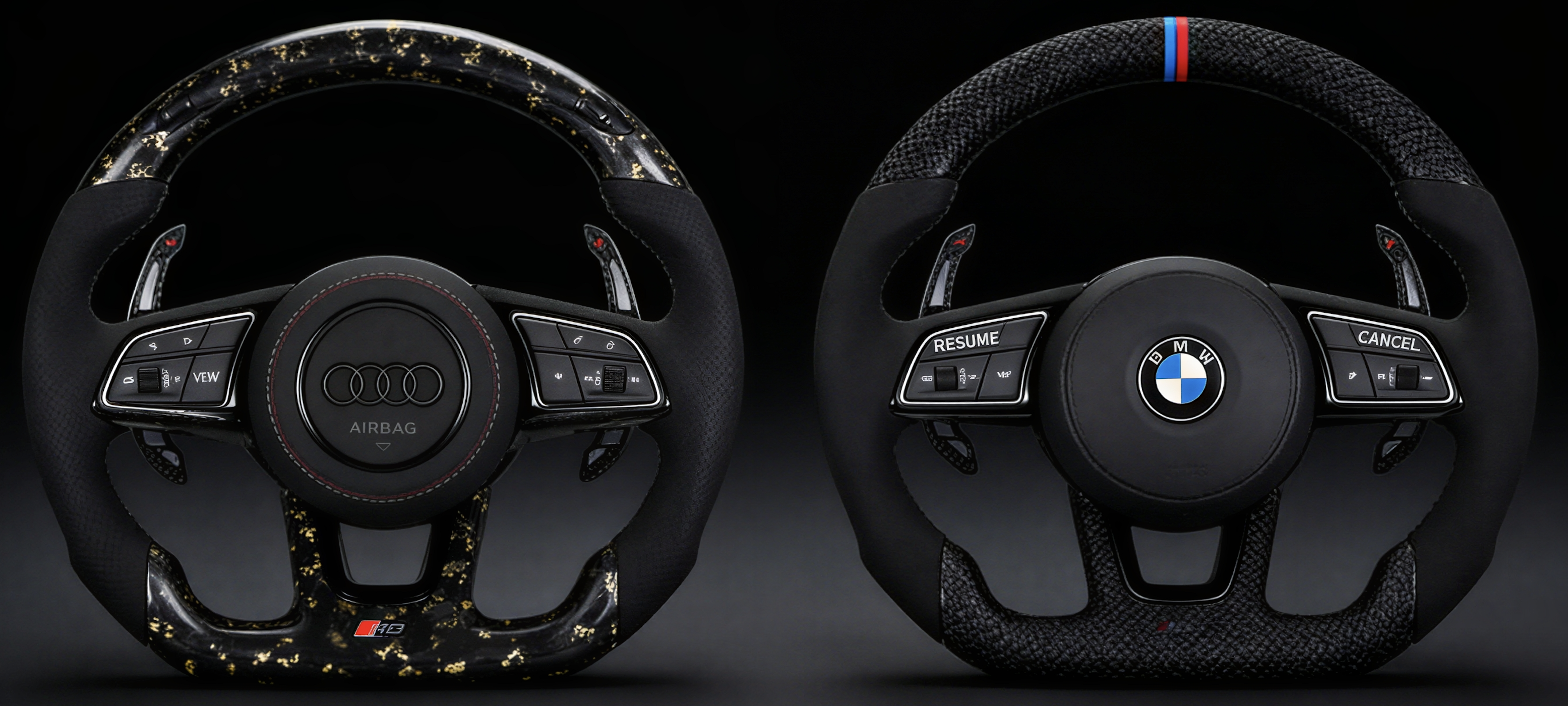
Two steering wheels sit side by side. Same diameter. Same weight class. But look at them — they tell two different stories.
That visual gap isn’t just surface-level. It comes from how each material is made. And it matters, because that wheel sits dead-center in your field of vision every single drive.
Traditional Carbon: The Language of Motorsport
Traditional woven carbon fiber is all about geometry. The 2×2 twill weave gives you that familiar “racing grid” pattern — precise, repeating, directional. Each ply sits at a controlled angle: 0°, 45°, 90°. The surface reads clean, intentional, technical. It signals performance before the engine even starts.
That uniformity is the whole appeal. JDM builds lean into it hard. Track-focused setups do too — the visual restraint matches the mechanical purpose. Nothing distracts. Everything reinforces.
Gloss or matte — both finishes work well with the weave’s tight structure. No extra prep work needed. The surface delivers what it promises.
Forged Carbon: The Marble Nobody Expected
Forged carbon fiber has no repeating pattern. The chopped fibers sit at random angles inside the resin. Every part comes out looking different from the last. Irregular. Flowing. Unpredictable in the best way.
That marble-like texture is the point. It looks less like a race car part and more like a Lamborghini interior trim piece — high-end, exclusive, and impossible to copy. That’s not by accident. Forged carbon keeps gaining ground in luxury and custom builds because traditional weave flat-out can’t offer this kind of surface variation.
One trade-off worth knowing: a high-gloss finish on forged carbon takes extra polishing and coating. The resin-heavy surface needs more prep to reach that depth. Matte finishes are more common straight out of production. Build that into your custom timeline.
Matching Material to Aesthetic Direction
|
Build Style |
Better Match |
Why |
|---|---|---|
|
JDM / Track |
Traditional weave |
Clean, uniform, performance-coded |
|
Supercar / Euro Elite |
Forged carbon |
Marble exclusivity, luxury cue |
|
Street / Show |
Forged carbon |
No two pieces identical — conversation starter |
|
Aero-forward builds |
Traditional weave |
Structural visual language |
This choice is as much about personality as preference. Traditional carbon says precision. Forged carbon says one-of-one. Neither is wrong — but only one of them is yours.
Weight, Daily Drivability & Real-World Performance: Which Feels Better Behind the Wheel
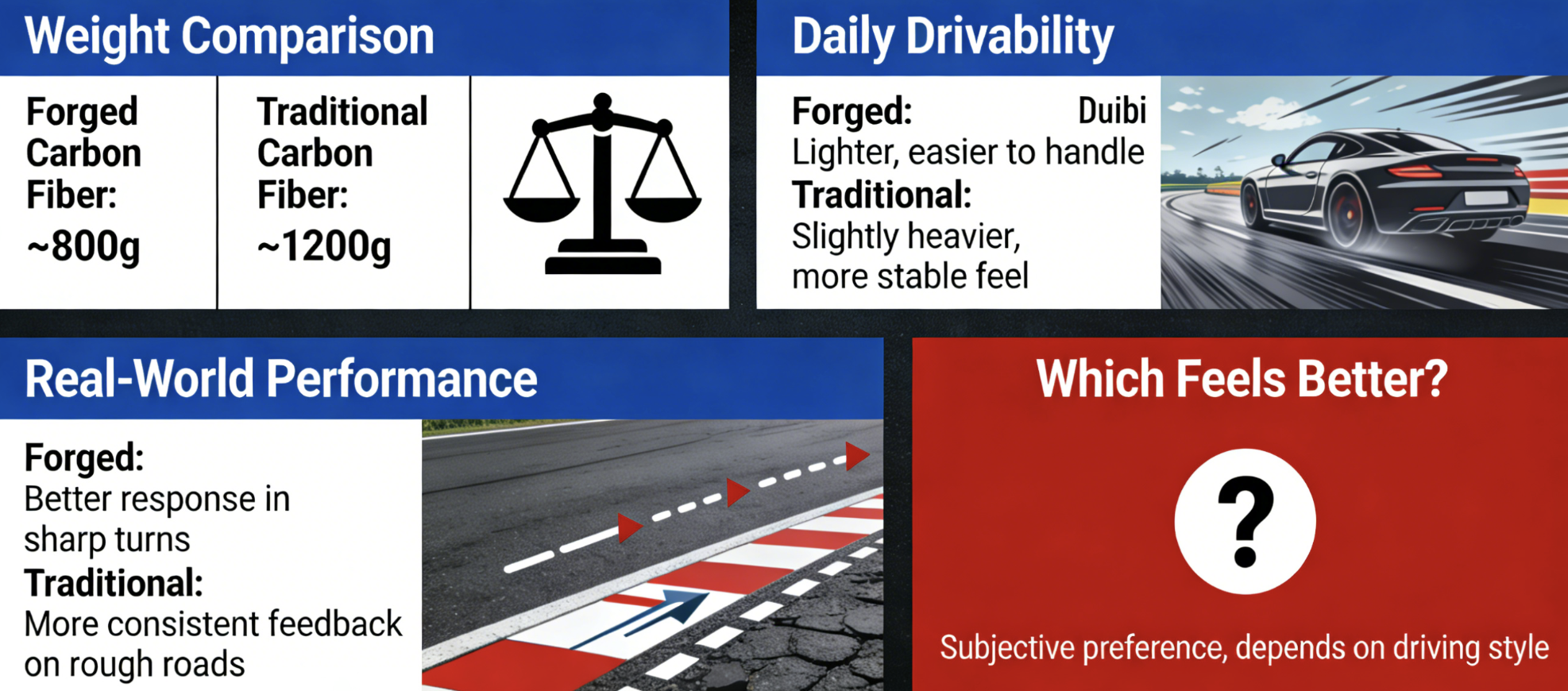
Grams matter more than most people admit. Not because a steering wheel saves your life in a crash. It’s because the weight you hold for a straight hour changes how your arms feel, how clean your inputs read, and whether you’re still sharp on lap 12 or just grinding through it.
Here’s the baseline. A traditional woven carbon fiber steering wheel lands between 1.2 and 1.6 kg. That range depends on hub design, spoke count, and resin saturation. A well-built forged carbon fiber steering wheel runs closer to 0.9 to 1.3 kg. That gap — 200 to 400 grams — sounds small. Do repeated direction changes at speed, and it becomes the only number on your mind.
What Lighter Does Behind the Wheel
Less rotational mass means less resistance as the wheel spins. You initiate a turn, and the wheel follows your input. It doesn’t push back with its own momentum. That’s not a feeling you imagine. It shows up in steering response time and hand fatigue across long drives. Both are measurable.
Forged carbon’s tighter weight distribution cuts down on flex under load. Traditional woven carbon is stiffer along its tension axis. That means it sends more vibration sideways — straight into your palms and up your wrists. Across a long commute or an extended track session, that adds up fast.
Forged carbon absorbs road noise from multiple directions. Its internal structure handles vibration more evenly. Woven carbon passes more of that energy straight through to your hands.
Daily Drivability: The Honest Assessment
For everyday driving, both materials perform well past the point where you’d notice any structural issue. The real difference isn’t about strength — it’s about feel.
|
Experience Factor |
Forged Carbon Fiber |
Traditional Woven Carbon |
|---|---|---|
|
Vibration Damping |
Superior — absorbs from multiple directions |
Directional — sends lateral energy through |
|
Hand Fatigue (1+ hour) |
Lower — lighter rotational feel |
Higher on sustained inputs |
|
Steering Response |
Crisp — less lag |
Precise — excellent along tensile load direction |
|
Thermal Comfort |
Neutral — resin surface stays cooler |
Similar — gloss finishes heat up faster in direct sun |
|
Wet Grip Feel |
Consistent — texture variation helps grip |
Smooth weave can feel slippery without grip wrap |
The Real-World Call
Drive more than an hour a day? You want a wheel that stays out of the way. One that doesn’t push back, doesn’t relay every bump in the road, and doesn’t leave your wrists aching by hour three. Forged carbon fiber is the practical pick — not just the premium one.
Traditional woven carbon is still excellent. It suits shorter, focused sessions where peak stiffness and sharp feedback matter more than managing fatigue.
The wheel you stop noticing is the one doing its job best. Forged carbon earns that.
2026 Best Forged Carbon Fiber Steering Wheels: Top Picks & What Sets Them Apart
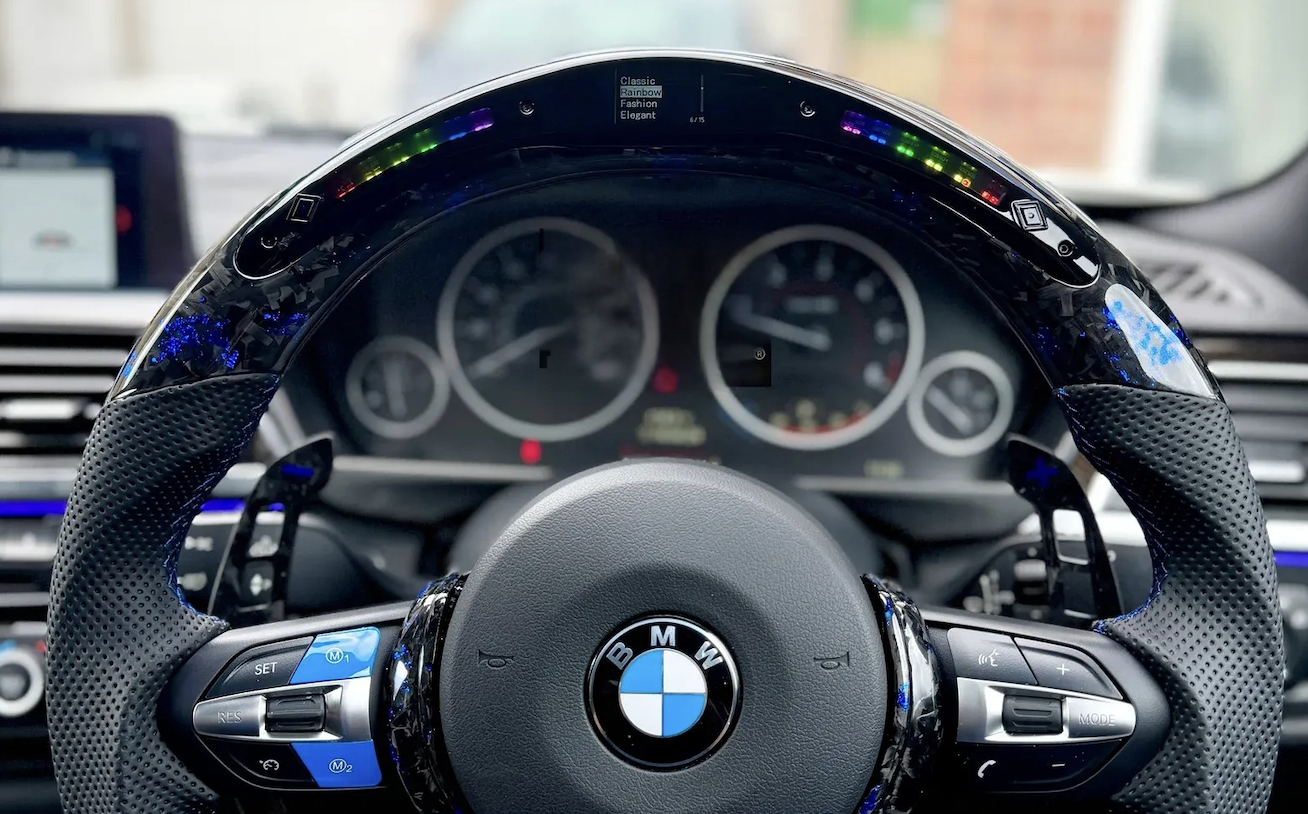
Six products. Six platforms. One material philosophy that puts them ahead of every traditional woven wheel out there.
The 2026 forged carbon fiber steering wheel market has grown up fast. What used to be a generic aftermarket swap is now platform-specific fitment, plug-and-play OEM integration, and customization depth that woven carbon can’t touch. These are the builds worth your attention this year.
The 2026 Field, Broken Down by Platform
AmericanMuscle Forged Carbon Fiber — 2024–2026 Ford Mustang
$619.99 | Non-heated trim only
This one has a confirmed price and a one-hour install window. You get glossy black forged carbon with a red racing stripe and perforated leather grips. It drops in as a direct replacement — no adapter, no coding session, no surprises. Running a non-heated Mustang and want the fastest path to a forged carbon upgrade? This is it.
FFP Custom Carbon Fiber — 2024–2026 Mustang S650 (GT, EcoBoost, Dark Horse)
Custom build | 20+ hours handcraft
The deeper Mustang option. FFP starts from an OEM base and rebuilds around it. You get a flattened bottom, extra-thick padding, leather or Alcantara wrap, and hand-sewn stitching. Your factory buttons transfer over. The airbag stays. No dash errors. Stitching color, accent trim, and logo placement are all yours to choose. It takes longer. It costs more. And it shows.
SubieFlow Genuine Carbon Fiber D-Shape — 2017–2026 Toyota BRZ / Subaru FRS
Price unlisted | 365mm diameter
Flat-bottom racing geometry with hand-stitched grip zones and a thicker rim built for feel. The D-shape works well. On a BRZ or FRS, it sharpens the cabin’s driver-focused character without clashing with the platform’s JDM visual identity.
StreetDriven Custom Carbon Fiber — 2014–2026 BMW 4 Series / M4
Handmade-to-order | 2–8 week lead time
The most configurable option on this list. StreetDriven covers the full F-chassis and G-chassis range — F32 through G83, 320i to M4. Carbon styles come with a painted 12 o’clock stripe. Grip zones run in perforated leather or Alcantara across black, red, blue, and tan. Optional upgrades include larger carbon fiber paddles, CF thumb areas, a custom airbag cover, and an LED shift light with live RPM display. BMW owners who want something built with purpose — not pulled off a shelf — will find the lead time worth it.
TTD Craft Carbon Fiber — 2022–2026 Honda Civic / Accord
Price unlisted | Optional LED RPM display
Honda platform coverage with one standout feature: an optional round-top LED display pulling OBD-II wireless data — RPM, speed, engine load, coolant temp. No hardwiring needed. For a Civic or Accord that sees track day use, that’s the right data in the right place.
AutoLEDTech Custom Carbon Fiber — 2020–2026+ GMC Sierra 1500 / 2500 HD
Price unlisted | Built to your specs
Truck-platform forged carbon is hard to find. AutoLEDTech fills that gap for Sierra owners who want the material without giving up the solid, substantial feel a full-size truck rim needs. Built to your exact specification.
How Forged Carbon Pulls Ahead of Traditional Woven — By the Numbers
|
Feature |
Forged CF |
Traditional Woven CF |
|---|---|---|
|
Weight |
Ultra-light molded compression |
200–400g heavier on average |
|
Impact Resistance |
~30–50% higher |
Brittle under flex and off-axis load |
|
Rim Profile |
1–2mm thin shell possible |
3–5mm minimum due to layup structure |
|
Vibration Damping |
~20% better across all axes |
Directional — weaker lateral damping |
|
Finish |
Seamless matte or gloss |
Visible weave texture throughout |
|
Customization |
Stripes, grips, LED, airbag cover |
Colors and stitching, limited beyond that |
|
Install |
OEM plug-and-play (most builds) |
Often requires adapters |
|
Price Range |
$600+ |
$400–800 standard |
The profile difference alone changes how the cabin feels. A 1–2mm forged shell sits closer to your hands without adding grip bulk. Traditional layup construction can’t reach that without giving up structural strength.
Before You Buy: The Short Checklist
Three things that cost people money when they skip them:
-
Verify your exact trim. The AmericanMuscle fitment excludes heated-wheel Mustangs. The FFP build covers GT, EcoBoost, and Dark Horse — not the same list. Get your trim code before ordering.
-
Check regional road-legal status. Some builds require airbag deletion. That’s not street-legal in every region. California Prop 65 applies to several carbon fiber products, no matter where you buy them.
-
Confirm button and airbag transfer. Plug-and-play claims vary between sellers. The best builds — FFP, StreetDriven — are clear about what transfers and what doesn’t. Ask before you assume.
The wrong wheel for the right car is still the wrong call.
FAQ: Forged Carbon Fiber Steering Wheel — Straight Answers to Real Buyer Questions
Buyers ask the same questions. They deserve straight answers — not marketing copy dressed up as information.
Is a forged carbon fiber steering wheel legal for street use?
Yes — but with conditions. Builds that keep the OEM core preserve all original wiring, buttons, and paddle functions. The airbag and horn systems need to stay untouched and compliant. Do that, and you’re in legal territory in most places. Trouble starts with airbag delete kits. Strip the airbag out, and street legality turns into a regional issue with real consequences. Check your local vehicle code before you buy. California buyers: Prop 65 warnings cover several carbon fiber products, no matter where they ship from.
How durable is forged carbon compared to traditional weave — long term?
Forged carbon handles impact and off-axis stress better than traditional weave. Standard 2×2 twill is strong in one direction. Forged carbon holds in all directions. A steering wheel takes road shock from angles you can’t predict. That all-direction strength matters more than raw tensile numbers on a spec sheet.
Surface upkeep is simple. Minor scratches on gloss or satin finishes respond well to carbon fiber polish. Skip the abrasives — they do more harm than good. Wipe it down with a microfiber cloth. Basic care keeps the finish sharp for years.
How does installation work?
Most OEM-core builds are plug-and-play. Button and wiring transfers take five to ten minutes. The core exchange process is straightforward:
-
Order the wheel
-
Send your stock OEM unit back
-
Get a $200 deposit refund
Basic fitment is something most people handle at home. Reshaping or welding? Bring in a professional for that.
Conclusion
The choice was never complicated — you just needed the right information.
Forged carbon fiber isn’t a marketing word. It’s a different material at the core. You get stronger fiber-to-resin distribution, superior impact resistance, and a texture that no two pieces on earth share. Traditional woven carbon has its place. But grip a wheel at speed — or push your interior to its limit — and the engineering gap shows.
What you’ve read here isn’t opinion. There’s a clear difference between buying something that looks like performance and buying something that is performance.
Contact HyperX Carbon – Your Trusted Chinese Carbon Fiber Partner
Ready to source high-performance carbon fiber materials or custom forged carbon fiber parts from China?
HyperX Carbon is a leading manufacturer with 20+ years of expertise, specializing in aerospace-grade forged carbon fiber, prepreg, carbon fiber tube, carbon fiber sheet, and lightweight carbon fiber automotive parts/carbon fiber drone components/carbon fiber medical components. We offer:
-
Stable supply chain with premium raw materials (Toray, Mitsubishi, Hengshen)
-
AS9100D certified production for aerospace & UAV applications
-
Rapid prototyping (5-8 weeks) and monthly capacity exceeding 180,000 parts
-
Competitive pricing with 15-18% cost savings on forged carbon solutions
-
Full customization: from T700/T1100G to ultra-high modulus grades
Whether you’re an eVTOL developer, automotive OEM, drone manufacturer, or medical device engineer, HyperX delivers consistent quality, batch-to-batch reliability, and reliable delivery.
Get in touch today for a free consultation, custom quote, or material sample.
📧 Email: [email protected]
🌐 Website: https://www.hyperxcarbon.com/
📞 Phone/WhatsApp: +86 15623270276 (English support available)
Let’s build your next lightweight innovation together – contact HyperX Carbon now and stay ahead in the low-altitude and advanced composites market.




