Swapping your factory hood for a carbon fiber hood seems simple — until you’re staring at a $300 eBay listing next to a $2,800 OEM-grade panel. The price gap is real, and so is the confusion about what you’re paying for.
Not all carbon fiber hoods are equal. Weight savings, performance gains, and long-term value shift depending on what you buy and why you buy it. A budget hood and a race-spec panel are two different products — even if they look the same in a listing photo.
So what’s this guide for? It covers the real numbers and honest trade-offs. Are you chasing tenths on a road course? Trying to cool a heat-soaked supercharged engine? Or just done with the look of painted steel? This guide addresses all three. By the end, you’ll have a clear answer to the question most buyers come here with: is a carbon fiber hood worth it for your specific situation?
What Is a Carbon Fiber Hood? (Definition + Core Concept)

Carbon fiber has been changing motorsport since F1 engineers first put it on race cars in the 1980s. The street version you’re buying today comes directly from that same technology.
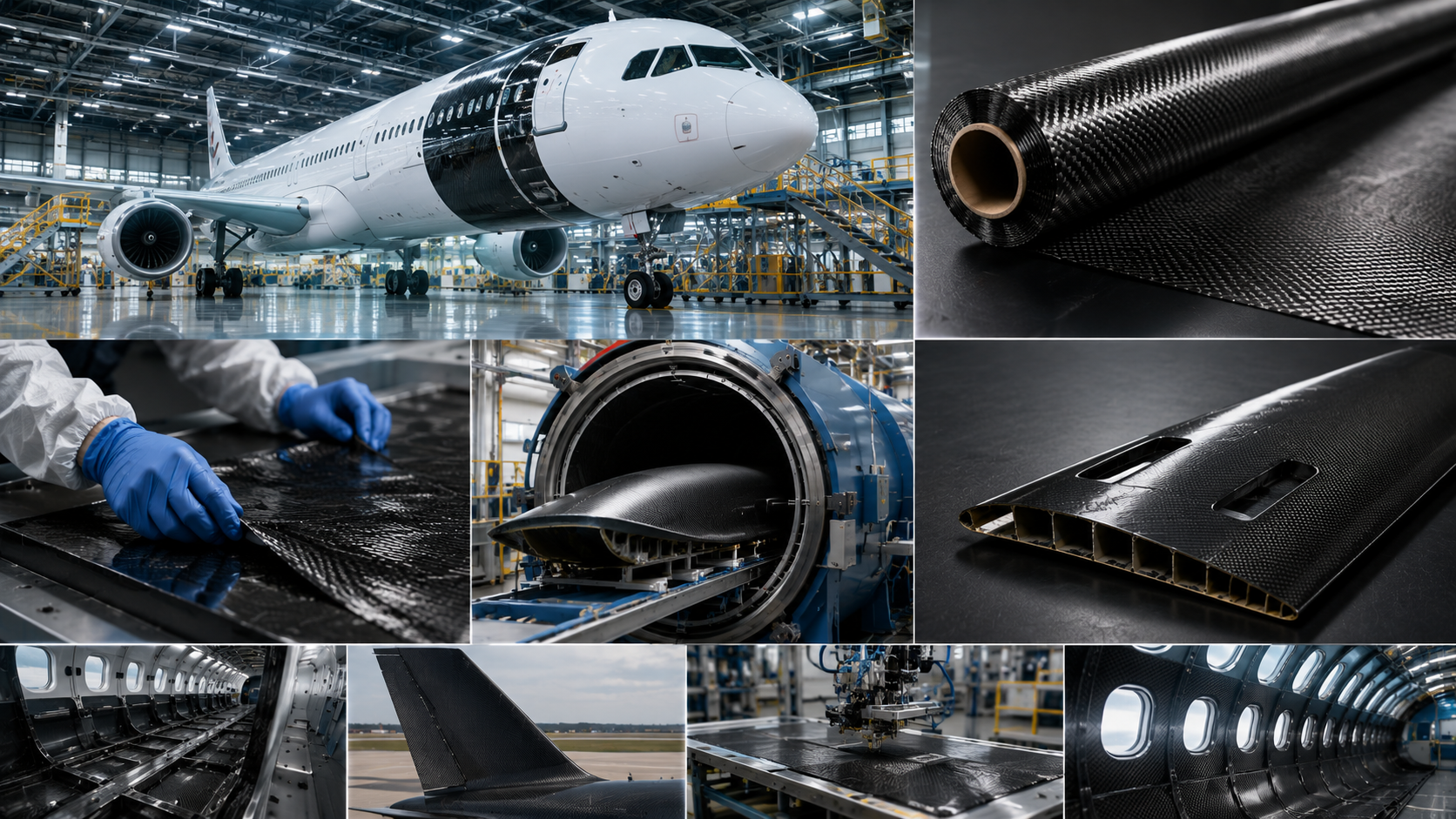
A carbon fiber hood — or carbon fiber car hood — is a structural panel made from carbon fiber-reinforced polymer (CFRP). Thousands of carbon filaments, each just 5–10 micrometers wide, get woven into fabric sheets and bonded with polymer resin. That creates a composite material with tensile strength above 3,500 MPa — about seven times stronger than steel — but far lighter.
That ratio matters. Your factory steel hood puts significant mass right at the front axle. Swap it for CFRP and you cut 30–70% of that weight with no loss in structural strength.
Why the Construction Method Defines Everything
Not every carbon hood gets built the same way. The manufacturing process shapes real-world performance directly:
-
Autoclave (prepreg) — Carbon sheets come pre-soaked with resin, then cure under 50–200 psi at 135°C. You get the highest fiber-to-resin ratio (60–70%) and the tightest consistency. This is race-grade and OEM-spec construction.
-
RTM (Resin Transfer Molding) — Dry fiber goes into a two-part mold, then resin injects under pressure. Production is faster, consistency stays reliable, and you’ll find this method across quality aftermarket panels.
-
Hand layup — Dry fabric goes into an open mold, and workers press the resin in by hand. Cost stays lower, but results vary more. Fine for street use — skip this one for a track build.
The process controls fiber density, layer uniformity, and how much weight you actually cut in the end.
Dry Carbon vs Wet Carbon vs Forged Carbon: Which Type Is Right for You?

Three manufacturing methods. Very different outcomes. The “carbon fiber” label on a product listing tells you almost nothing — the process behind it tells you everything.
Dry Carbon: The Performance Standard
Dry carbon starts with prepreg sheets — fabric already infused with resin — then cures under heat and pressure in an autoclave. No guesswork. No air pockets. You get a fiber-to-resin ratio that hand layup methods can’t match.
The numbers speak clearly. A dry carbon hood weighs around 8 kg. Strength holds at 90% after two million stress cycles. After twelve years of salt exposure, it still keeps 85% of its original strength. Water absorption sits at just 2.2%. Track builds, structural parts, anything that takes real punishment — dry carbon is the serious choice. Plan to spend $2,000 and up.
Wet Carbon: The Entry Point
Wet layup is straightforward. Workers brush or spray liquid resin onto dry fiber inside an open mold. It’s accessible, budget-friendly, and puts hoods in the $500–$1,500 range.
The trade-offs are real and measurable. That same hood weighs 13 kg in wet layup — compared to 8 kg in dry carbon. Salt exposure drops strength retention below 60% over time. Water absorption hits 7.5% — more than three times higher than dry carbon. Surface finish often needs sanding and clear coat to look clean.
For a street car where looks matter more than performance, wet carbon works fine. For structural use or track driving, it falls short.
Forged Carbon: The Shape-Shifter
Forged carbon uses short, chopped fibers compressed inside a resin matrix. The random fiber layout creates that distinctive mottled, marble-like texture — no woven pattern in sight. It handles complex shapes well and fits high-volume production runs.
Strength lands between wet and dry carbon. Weight efficiency trails continuous-fiber dry carbon at the same stiffness level. Cost runs $800–$2,000 depending on the part.
The Fast Decision Framework
|
Dry Carbon |
Wet Carbon |
Forged Carbon |
|
|---|---|---|---|
|
Hood Weight |
~8 kg |
~13 kg |
Varies |
|
Long-term Strength |
90% retention |
<60% retention |
Moderate |
|
Water Absorption |
2.2% |
7.5% |
Moderate |
|
Cost Range |
$2,000+ |
$500–$1,500 |
$800–$2,000 |
|
Best For |
Track/structural |
Street/aesthetic |
Complex shapes |
Four questions cut through the noise:
-
Is the hood load-bearing or structural? → Dry carbon. Full stop.
-
Do you need complex curves and high-volume fitment? → Forged carbon handles this better.
-
Street use, appearance-focused, tighter budget? → Wet carbon gets the job done.
-
Harsh conditions — weather, track stress, long ownership? → Dry carbon holds 85%+ strength after salt and UV exposure. Nothing else comes close for the long run.
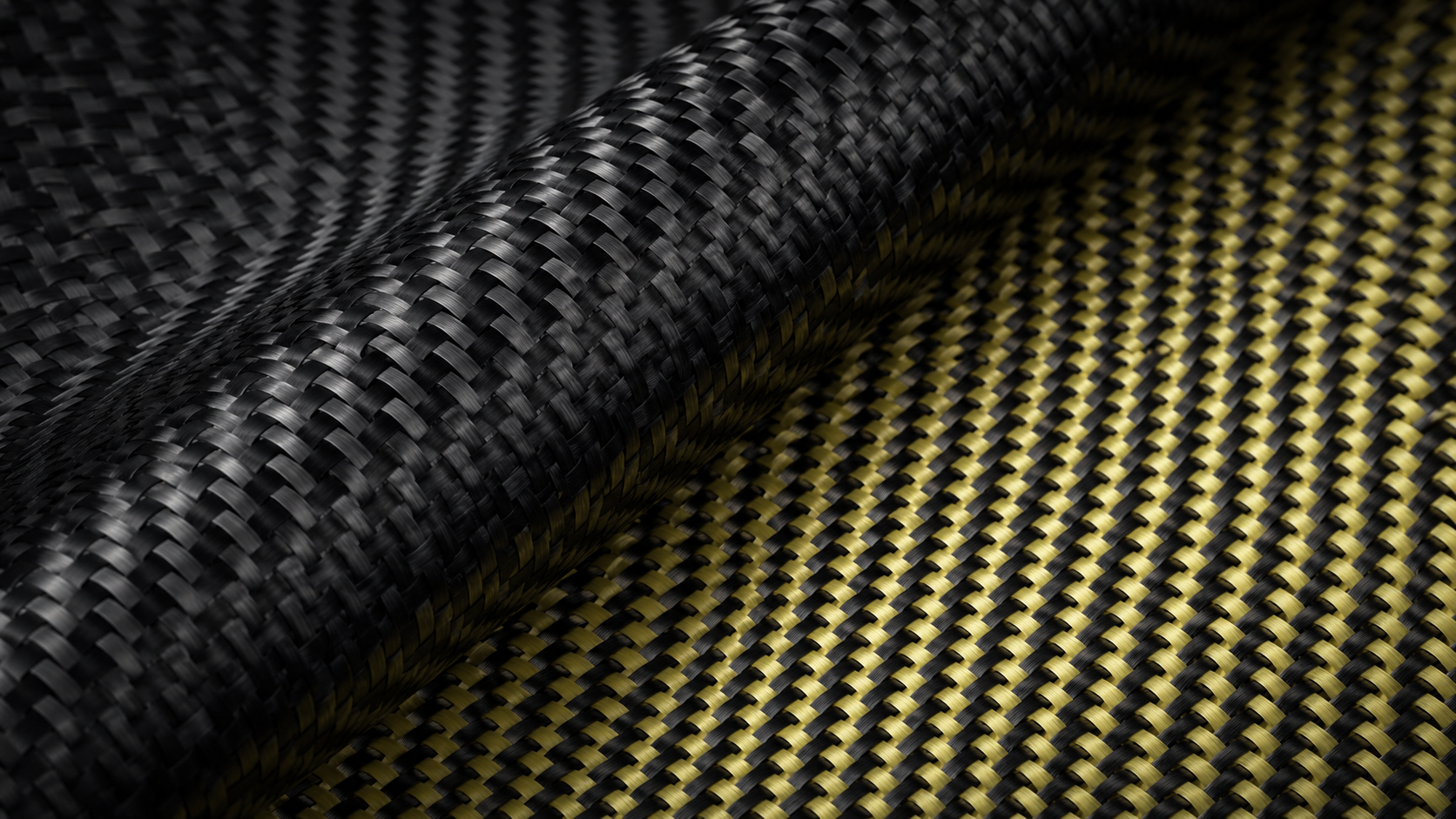
The weave matters too. Dry carbon gives you that clean 3K twill or plain weave pattern — sharp, glossy, and easy to spot. Forged carbon shows a random marble texture instead. Wet carbon can look close to dry on day one. It doesn’t stay that way for long.
Carbon Fiber Hood Weight Savings: Real Numbers by Vehicle Type

How much weight you actually save depends on what hood you’re replacing. The range is wider than most buyers expect.
A DSM 2G GST swap tells the clearest story. Stock hood: 42 lbs. Carbon fiber replacement: 10 lbs. That’s a 32-lb drop from one panel. That weight comes off right above the front axle — the spot where it counts most.
Other platforms save less, but the numbers are still worth knowing:
-
Ford Mustang S550 (2018–19): 5–10 lbs savings over stock
-
BMW M3 (E90/E92): 4 kg (8.8 lbs) lighter than the factory panel
What That Weight Does to Your Car
Pull 30 lbs from the front of a 4,200-lb vehicle. The math gives you real, measurable results:
-
0–60 mph: 0.1–0.2 seconds faster (power-to-weight ratio gain of ~0.7%, assuming 400 hp in a traction-limited scenario)
-
Cornering G: 0.02–0.05 G increase, from reduced rotational inertia and a 1–2% drop in polar moment at the front end
Not huge numbers. But they’re real and repeatable every time.
The Drivetrain Factor Nobody Talks About
50–60% of hood weight savings hits the front axle. That shifts your weight distribution. The effect plays out differently based on your drivetrain:
|
Drivetrain |
Est. Front Bias Shift |
Effect |
|---|---|---|
|
FWD |
+1–2% front heavy |
Understeer increases |
|
RWD |
−1–2% front light |
Better rotation, oversteer tendency rises |
|
AWD |
<1% change |
Balanced, minimal handling risk |
RWD cars get the most out of this change. FWD owners should weigh the handling trade-off before making the switch.
Performance Benefits of a Carbon Fiber Hood: What the Data Shows

The physics are simple and unforgiving. Steel sits at 8.1 g/cc. Carbon fiber sits at 1.78 g/cc. That density gap is why a carbon fiber hood is 72% lighter than steel and 27% lighter than aluminum. You’re not shaving ounces here. You’re pulling 20–30 lbs off the front axle in a single swap.
Those numbers cover the weight side. What they don’t cover is what happens after — through the drivetrain, into the fuel gauge, and around every corner.
Acceleration, Braking, and the Front-End Equation
Less mass at the nose means your engine pushes a lighter car. The power-to-weight ratio goes up. The gain is small in raw numbers — but it’s permanent. It builds on other weight reductions. You feel it every time you accelerate.
Braking sees the same benefit. Less front-end weight means less unsprung mass. Tires stay planted harder through deceleration. The contact patch holds more consistent pressure. Stopping distances get shorter.
On RWD platforms, this stands out the most. The front end bites into corners instead of floating through them.
The Fuel Economy Math Nobody Runs
Here’s a number most buyers ignore: every 10% of vehicle mass reduction produces a 6–8% fuel economy gain. A carbon fiber hood alone won’t reach that threshold. But the math still works in your favor.
-
A 25-lb savings on a 3,500-lb vehicle translates to 0.4–0.6% better efficiency
-
Across 15,000 annual miles, that gap adds up to real dollars
-
Not life-changing — but real
Cooling: The Benefit That Requires the Right Hood
Weight savings happen no matter which hood you run. Cooling gains don’t. You need integrated vents that push hot air out of the engine bay. A vented carbon fiber hood moves air better than any sealed panel — regardless of material.
Carbon fiber also resists heat by nature. The hood won’t warp or break down from sustained engine bay temperatures. That’s a durability edge that sealed panels don’t offer.
The honest caveat: peak gains show up on the track. On a daily commute, you’ll notice the weight reduction in steering feedback and sharper turn-in response. On a road course, the braking, cornering, and balance improvements stack up into something you can measure — and feel.
Carbon Fiber Hood Heat Management: Vented vs Non-Vented (Critical for Supercharged Engines)
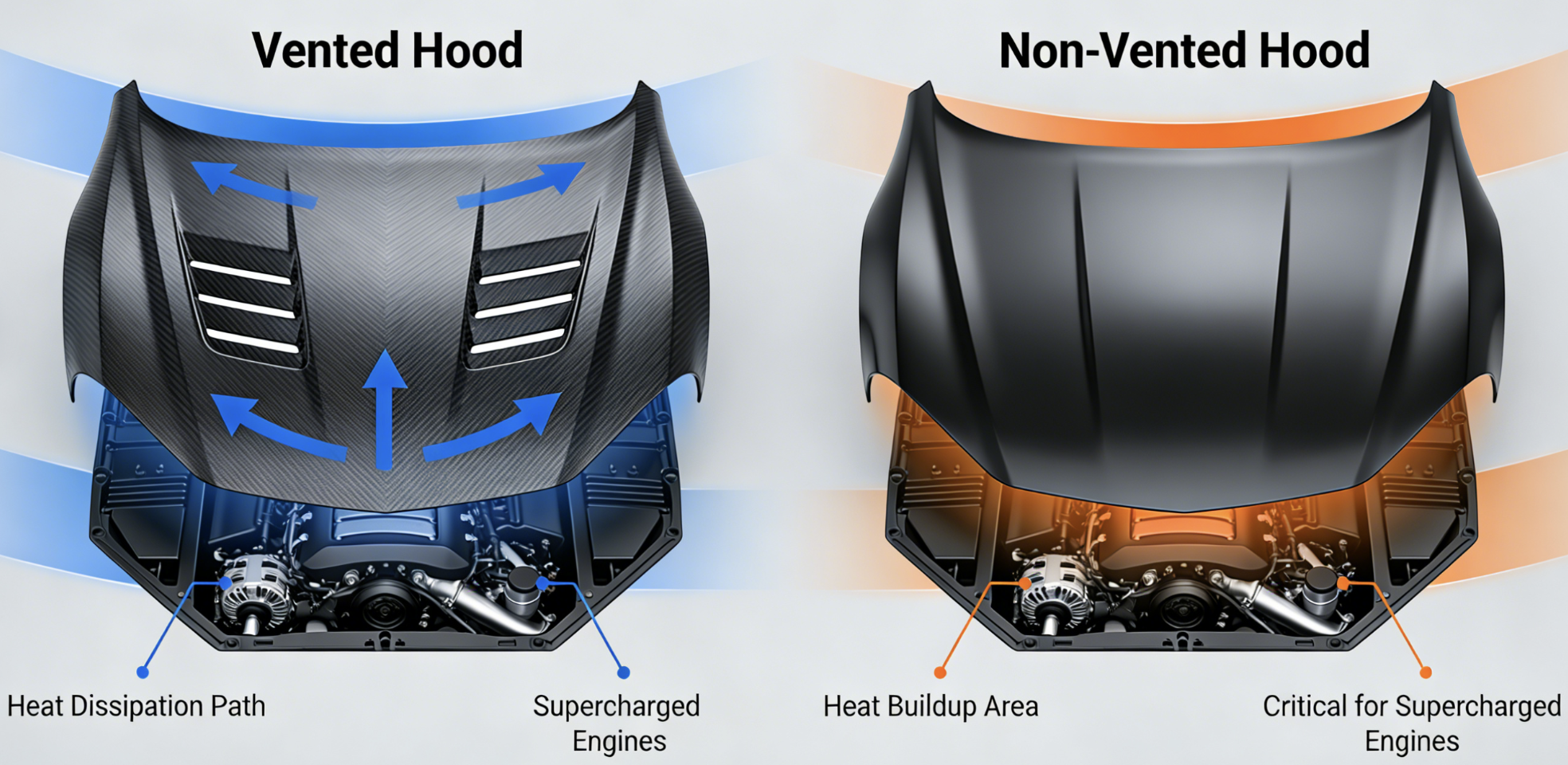
Heat kills power. That’s the short version. Here’s the longer one: inside a forced-induction engine bay, temperatures climb past the point of clean combustion. Efficiency drops. Parts wear faster. The horsepower your dyno sheet promised starts disappearing.
A vented carbon fiber hood tackles that problem head-on. Functional vents give trapped hot air a way out. That drops underhood temps before heat soak can do real damage. The MSP Circuit Style Carbon Fiber Hood packs over 14 functional vents for this exact reason. That’s not a styling choice. That’s engineering.
Vented vs Non-Vented: What Changes
Non-vented carbon fiber hoods still outperform steel and aluminum on heat behavior. Carbon fiber’s low thermal conductivity means it absorbs and transfers heat slower than metal. That’s useful — but it’s not enough on its own for a supercharged or turbocharged build.
Here’s the real gap: carbon fiber’s material properties protect the hood itself. They don’t cool your engine. Airflow does that. No functional vents means you’re relying on passive insulation while your intercooler and turbos keep building heat with nowhere to release it.
Some manufacturers know this risk well enough to put it in writing. Anderson Composites requires heat shields on the backside of non-vented hoods as a warranty condition. That’s a clear admission — the hood alone is not thermal management.
The Forced-Induction Reality
Boost makes heat. More boost makes more heat. Add a larger turbo, upgrade your intercooler, or push power past stock levels — a non-vented hood stops being a compromise. It becomes a liability. High-performance BMW M turbocharged platforms running hard at high RPM can hit underhood temps that cause:
-
Reduced combustion efficiency and power loss
-
Faster wear on seals, hoses, and sensors
-
Brake fade as heat spreads to nearby systems
Run summer driving with a bigger turbo and a sealed hood. You’re setting up a cracked panel and a heat-soaked engine on the side of the road.
Functional Vents vs Decorative Vents
Not every vent on a hood does anything useful. Many aftermarket panels use decorative vents — they look great in photos, they look aggressive in person, and they move zero air. Check the actual functional vent count in the product spec before you buy. Looks alone tell you nothing.
Real functional designs include:
– Multiple open vent channels with direct clearance to the engine bay
– Integrated heat extractors that push airflow upward and out
– Air ducts that pull cooler outside air toward specific components
No airflow confirmation in the spec sheet? Treat it as cosmetic.
The Right Setup for High-Output Builds
For supercharged and turbocharged builds, a vented carbon fiber hood works best as part of a full thermal management system:
-
Vented carbon fiber hood — primary heat extraction from the engine bay
-
Carbon fiber air ducts — route cooler air to intercoolers and intakes
-
Carbon fiber heat shields — block radiant heat from turbochargers and exhaust components
-
Carbon fiber brake cooling ducts — stop brake fade during hard, sustained driving
The hood pulls heat out from under. The rest of the system keeps every critical component inside its safe operating range.
Is a Carbon Fiber Hood Worth It? Honest Verdict by Use Case
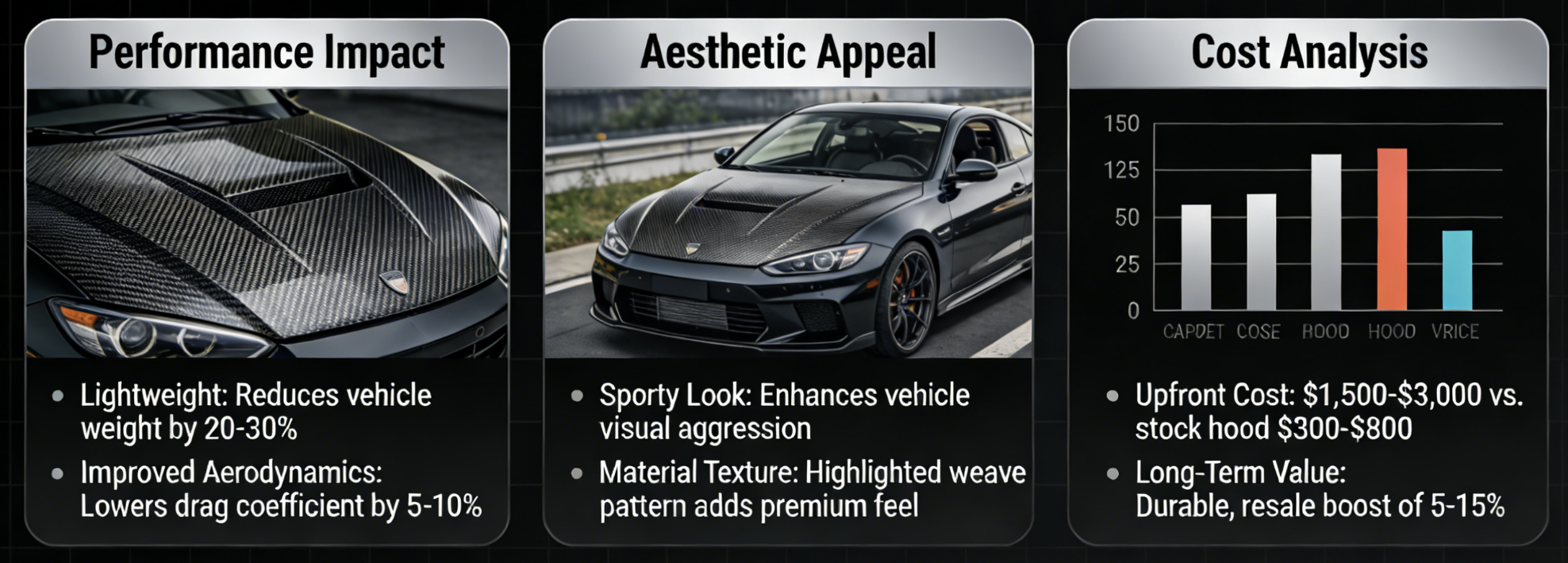
The answer depends on what you need the hood to do.
Track drivers get a real return. A 10–15 kg drop on a 1,500–2,000 kg race car cuts real lap time. You’re looking at 0.1–0.3 seconds per 10 kg removed on a 2–3 minute circuit. That’s not marketing math. That’s rotational inertia leaving the front axle on every corner entry. Add brake and tire upgrades on top, and you can expect 1–2 seconds of total lap gain. For competitive track use, this purchase pays off.
Street drivers need a more direct look at the numbers. A 30 lb reduction on a 4,000 lb daily driver is less than 0.75% of total vehicle mass. The 0–60 difference sits under 0.05 seconds. Fuel economy gains land around 0.1–0.2 mpg. You won’t feel any of that leaving a stoplight.
That doesn’t make it a bad purchase — it makes it a different one. A carbon fiber hood on a street car is an appearance upgrade with a lightweight bonus. Own that framing, and it’s worth every dollar.
The ROI table tells the full story:
|
Mod |
Cost |
Weight Saved |
Performance Gain |
ROI Rank |
|---|---|---|---|---|
|
CF Hood |
$1,500–$3,000 |
12–16 kg |
0.5–1% accel/brake |
#4 |
|
Exhaust |
$1,500–$2,500 |
5–10 kg |
5–10% power |
#1 |
|
Suspension |
$2,000–$3,000 |
5–15 kg |
10–20% handling |
#2 |
|
Brakes |
$1,500–$2,500 |
8–12 kg |
15–25% stopping |
#3 |
Dollar-for-dollar on pure performance, a carbon hood ranks fourth. That said, build a full lightweight system — hood, trunk, roof — and you stack 30–40 kg of total reduction. That hits a 2–2.7% mass cut. At that level, the gains start to add up across the whole car.
Buy it if you’re a track builder chasing lap times, a weight-reduction builder running a full systematic build, or someone who wants the look and isn’t pretending it’s anything else.
Skip it if you commute and expect to feel a difference. Don’t wait on one mod to transform the driving experience. One hood won’t do that. A hundred kilograms might.
Frequently Asked Questions
These eight questions show up on every carbon fiber hood forum thread, every comment section, every DM to a parts supplier. Here are straight answers.
How much lighter is a carbon fiber hood?
Stock steel runs 40–60 lbs. A carbon fiber replacement comes in at 15–30 lbs. On a Mustang GT, that’s a 25-lb drop — about 50–70% of the original panel weight gone. Front-end mass drops, and quarter-mile acceleration gains 0.1–0.2 seconds. That’s from the weight reduction alone.
Does a carbon fiber hood need heat vents?
Not required. That said, 80% of high-performance hoods include functional ram-air or gel-coated vents. Those vents pull underhood temps down 20–40°F. Street builds can run non-vented just fine. Track builds can’t — heat soak will catch up with you.
Carbon fiber vs. fiberglass — what changes?
|
Carbon Fiber |
Fiberglass |
|
|---|---|---|
|
Weight |
15–25 lbs |
20–35 lbs |
|
Cost |
$800–$2,000 |
$400–$900 |
|
Heat Resistance |
Up to 500°F |
Warps above 200°F |
|
Lifespan |
10+ years |
5–7 years |
Carbon is 2x stiffer and handles sustained heat with no issues. Fiberglass costs less but cracks and warps under stress.
Will a carbon fiber hood warp?
No. Carbon fiber holds up to 500–700°F without deforming. Zero warp reports after 5+ years in 120°F desert climates. The epoxy resin matrix takes on thermal stress directly. Fiberglass breaks down under that same heat. Carbon doesn’t.
What about Tesla Model 3?
The OEM aluminum hood weighs 45 lbs. A carbon fiber replacement hits 18–22 lbs. You save ~25 lbs, cut 0–60 time by 0.05–0.1 seconds, and improve front balance. Fits 2017–2026 models. Plan to spend $1,200–$1,800.
Mustang S550 fitment issues?
95% direct bolt-on using OEM hinges and latches. Watch the cowl seal — a 5mm gap is common and needs alignment. Add hood pins for speeds above 150 mph. Stock steel weighs 55 lbs. The carbon replacement drops to 16 lbs. That’s a 71% reduction.
How hard is installation?
Here’s the full process:
– Remove the OEM hood
– Transfer hinges and latches, torqued to 15–20 ft-lbs
– Align panel gaps to under 3mm
– Install struts rated for 100+ lbs
Total time: 2–4 hours with basic hand tools.
Does it affect insurance or emissions?
Zero emissions impact — it’s a structural swap, not a powertrain change. Your insurer will add 5–10% to your premium (~$100–300/year). Declare it upfront. Undeclared mods carry a 0.1% claim denial risk — small odds, but pointless exposure to carry.
Conclusion
A carbon fiber hood isn’t magic — but it’s not marketing fluff either. The weight savings are real (5–15 kg depending on your platform). The thermal and aerodynamic benefits are measurable. For the right driver, the performance difference is real and worth it.
So what are you trying to achieve? That’s the question that matters. Here’s how it breaks down:
-
Daily drivers chasing a cleaner look — there’s a solid case for it
-
Track builds cutting every kilogram — the numbers back you up
-
Supercharged setups fighting heat — carbon gives you real relief
Each scenario has a legitimate reason to upgrade. Now you have the data to make that call with confidence.
You’ve made it this far. That means you know more about carbon fiber car hoods than 95% of the people buying them.
One move left — stop reading and start upgrading.
→ Explore HyperX Carbon Fiber Hoods — real dry carbon, race-proven construction, and fitments built for the way you drive.
Contact HyperX Carbon – Your Trusted Chinese Carbon Fiber Partner
Ready to source high-performance carbon fiber materials or custom forged carbon fiber parts from China?
HyperX Carbon is a leading manufacturer with 20+ years of expertise, specializing in aerospace-grade forged carbon fiber, prepreg, carbon fiber tube, carbon fiber sheet, and lightweight carbon fiber automotive parts/carbon fiber drone components/carbon fiber medical components. We offer:
-
Stable supply chain with premium raw materials (Toray, Mitsubishi, Hengshen)
-
AS9100D certified production for aerospace & UAV applications
-
Rapid prototyping (5-8 weeks) and monthly capacity exceeding 180,000 parts
-
Competitive pricing with 15-18% cost savings on forged carbon solutions
-
Full customization: from T700/T1100G to ultra-high modulus grades
Whether you’re an eVTOL developer, automotive OEM, drone manufacturer, or medical device engineer, HyperX delivers consistent quality, batch-to-batch reliability, and reliable delivery.
Get in touch today for a free consultation, custom quote, or material sample.
📧 Email: [email protected]
🌐 Website: https://www.hyperxcarbon.com/
📞 Phone/WhatsApp: +86 15623270276 (English support available)
Let’s build your next lightweight innovation together – contact HyperX Carbon now and stay ahead in the low-altitude and advanced composites market.