
Most drivers never think twice about their steering wheel. Then they grab one wrapped in real carbon fiber — and everything changes.
The difference isn’t subtle. It’s immediate and tactile. Hard to put into words for someone who hasn’t held one.
So here’s what’s clear: carbon fiber steering wheels have become the top interior upgrade for performance-minded drivers in 2026. This guide explains why — and how to make sure you’re buying the real thing.
Chasing lap times? Building a show car? Or just tired of a factory wheel that feels like it belongs in a rental fleet? This guide cuts through the noise for all of it.
Here’s what you’ll get from reading this:
-
What separates genuine carbon fiber construction from cheap impostors
-
Which specs matter and which ones don’t
-
How to pick a lightweight steering wheel upgrade you’ll be glad you bought
What Makes Carbon Fiber Steering Wheels Different in 2026 (Material Science Explained)
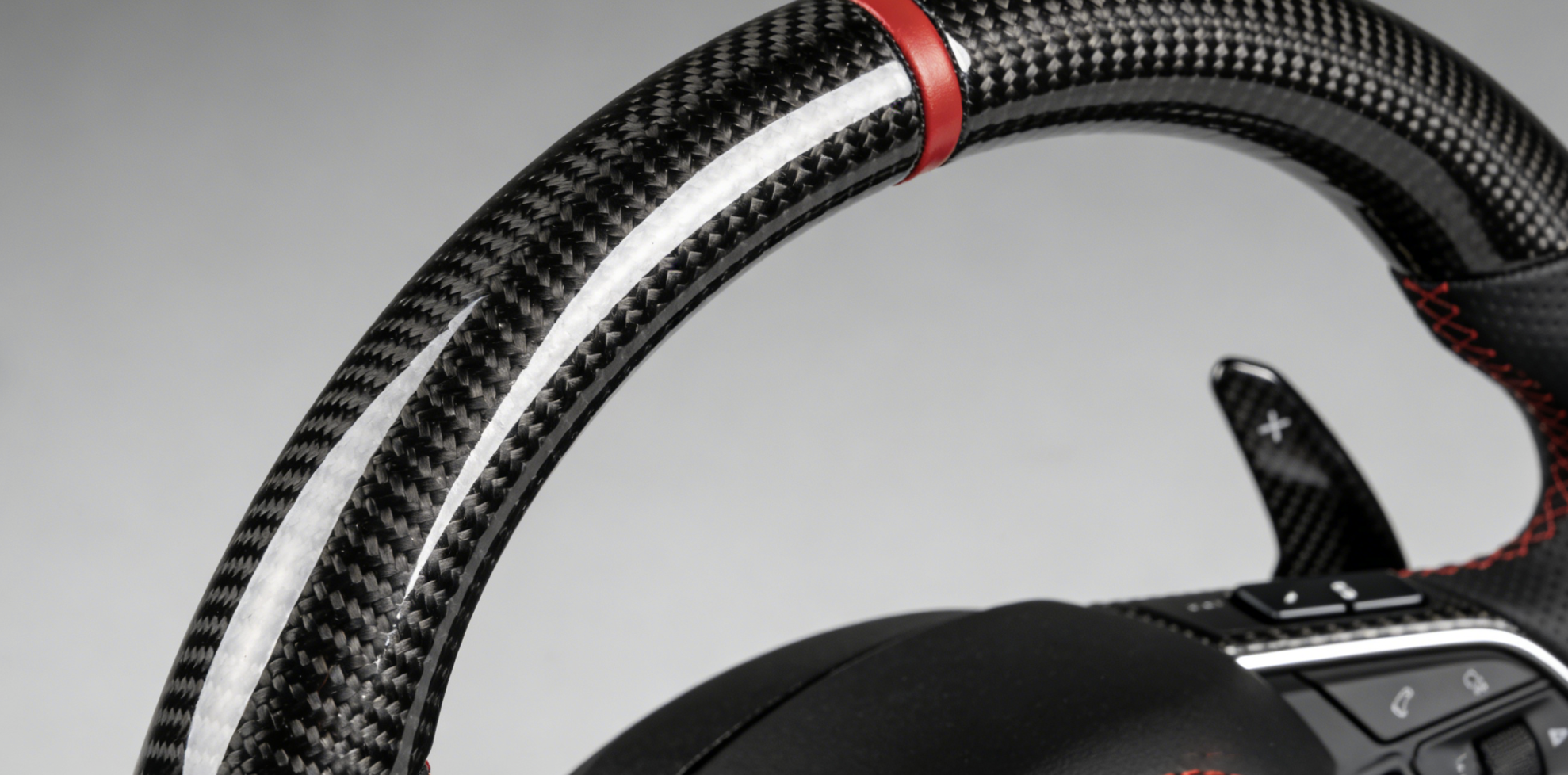
Carbon fiber isn’t a finish. It’s a structural system — and knowing that difference separates smart buyers from costly mistakes.
Every genuine carbon fiber steering wheel is built around thousands of woven filaments, each 0.2–0.3mm thick. The two main fiber grades in 2026 are Toray T700 (tensile strength: 4,900 MPa) and Toray T800 (5,490 MPa — 12% stronger). T700 dominates the market for a simple reason: it costs 20% less and fits 15% better into complex spoke-and-hub molds. For most drivers, T700 gives you everything you’ll ever need.
The resin bonding those fibers together is just as critical. Epoxy vinyl ester beats cheaper polyester resin by a wide margin. It holds 92% flexural strength after 18 months of UV exposure. Polyester? It drops to just 68%, with microcrack densities three times higher under the same conditions.
Then there’s cure process precision. At 120°C and 85psi vacuum, temperature must stay within ±1°C. That tight range pushes fiber volume fractions above 95% and hits an interlaminar shear strength of 85 MPa. Drift 5°C outside that window? Voids form. Strength drops 27% — no recovery.
Get it right, and you end up with a wheel housing that weighs just 250g versus aluminum’s 450g. Same rigidity. Less than half the mass.
Carbon Fiber vs Leather vs Aluminum: Steering Wheel Material Comparison
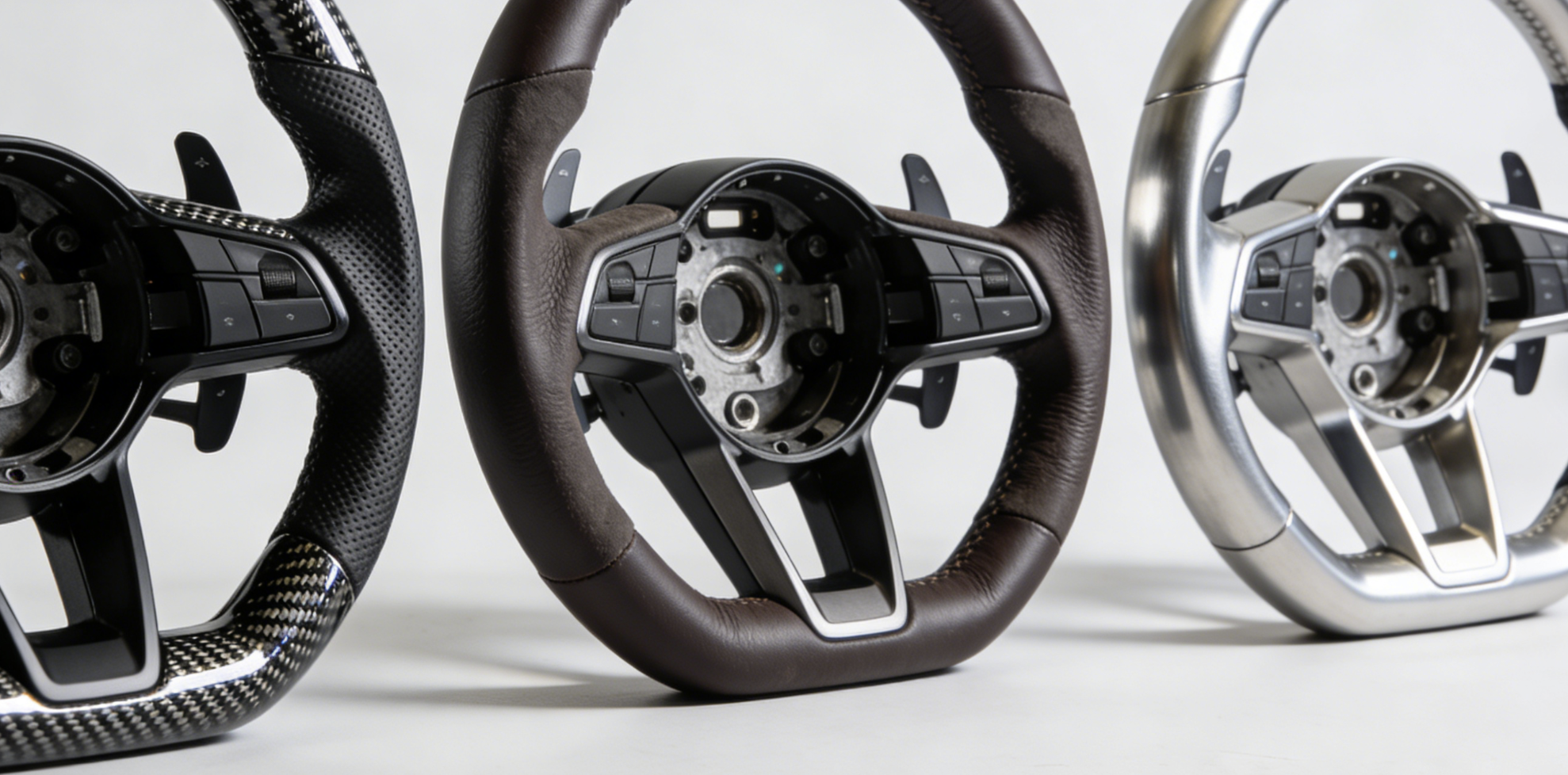
Three materials. Three different driving philosophies. Pick the wrong one and it doesn’t just change how your car looks — it changes how the car talks to you at 80mph.
Here’s the honest breakdown.
Weight & Steering Response
Carbon fiber wins this category, no debate. A carbon fiber steering wheel cuts rotational mass by 30–50% compared to OEM leather-wrapped units. That drop gives you quicker steering response — not on paper, but in your hands, on the road, corner after corner. Track drivers feel it right away. Commuters feel it after a few weeks.
Leather sits at the heavier end. Aluminum lands somewhere in the middle, depending on how it’s built.
Grip & Feel
This one has more layers.
-
Alcantara-wrapped carbon fiber: Dry grip coefficient of 0.72, wet grip of 0.58 — the highest of any common steering wheel material
-
Full-grain leather: Strong grip with a softer, more forgiving feel — built for comfort
-
Bare aluminum: Functional, but the weakest grip of the three. Sweaty palms on a hot day? Aluminum turns into a problem fast.
Carbon fiber on its own gives you moderate, precise feedback. It’s firmer than leather — and that’s the point for performance drivers.
Durability Over Time
Carbon fiber doesn’t crack. It doesn’t peel. UV exposure and temperature swings don’t faze it. To clean it, wipe it down with a microfiber cloth. That’s the full maintenance routine.
Leather is a different story. With regular conditioning, it ages well and stays supple. Skip that routine, and it cracks, stiffens, and gets slippery in summer heat — a real safety concern. It also soaks up sweat over time. That small detail builds into a bigger problem over years of use.
Aluminum holds its shape well. But it doesn’t age better than the other two. You’re not gaining anything from it over time.
The Full Comparison at a Glance
|
Feature |
Carbon Fiber |
Leather |
Aluminum |
|---|---|---|---|
|
Weight |
Lightest (30–50% reduction) |
Moderate/Heavy |
Moderate |
|
Grip |
Precise/Moderate |
Soft/Comfortable |
Low (bare surface) |
|
Temp Stability |
Excellent |
Good (insulated) |
Stable |
|
Durability |
Exceptional |
High (with care) |
High |
|
Comfort |
Firm |
Highest |
Rigid |
|
Maintenance |
Minimal |
Regular conditioning |
Low |
|
Best For |
Track, performance builds |
Daily driving, luxury |
Structural frames |
The Bottom Line
Carbon fiber is the right pick for track use, performance builds, and drivers who put feedback first. Leather is the top choice for daily commuters and luxury builds where softness and ergonomics take priority. Aluminum works best as a structural frame component — not as a grip surface you hold every day.
No material is better across the board. The right choice comes down to what you’re building and how you drive.
The Real Performance Benefits: Data-Backed Driving Improvements
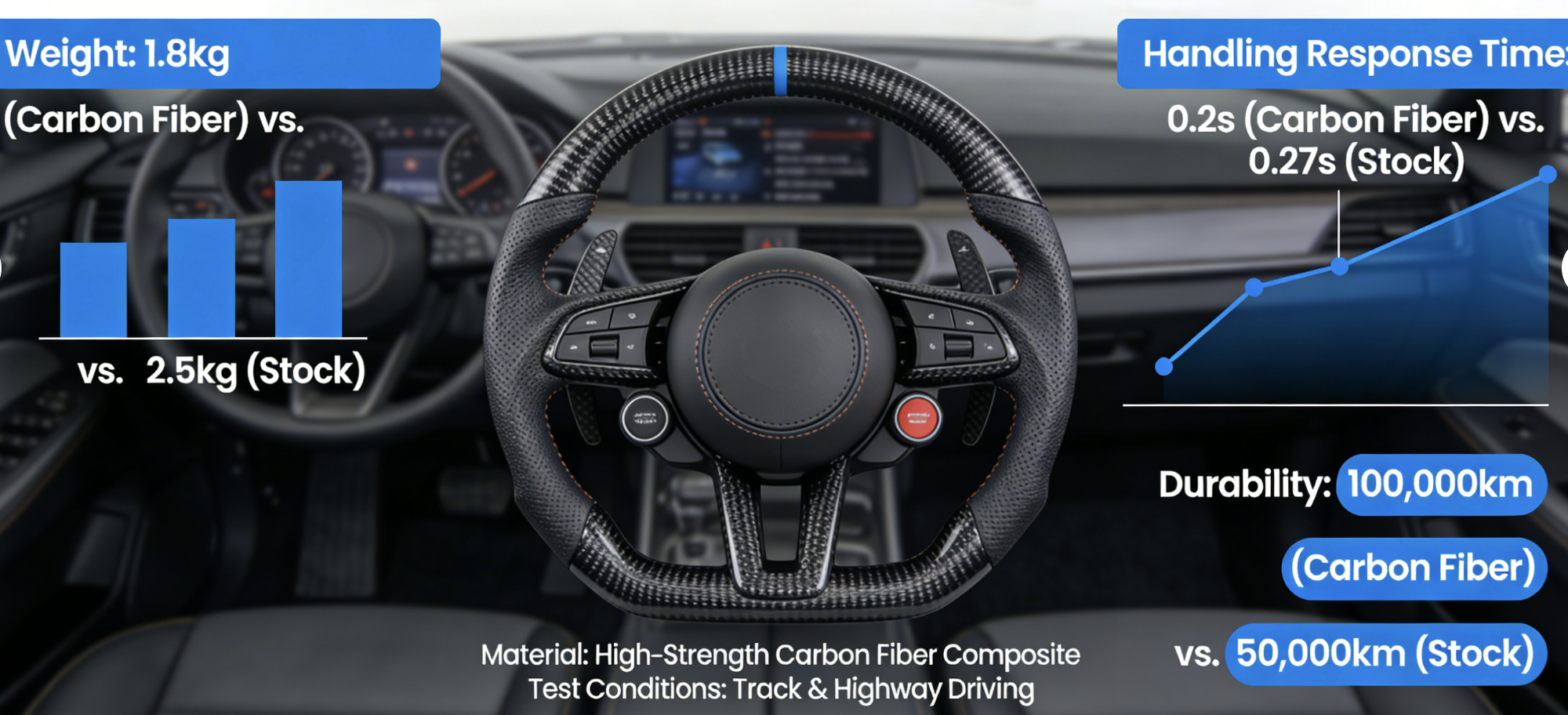
Numbers don’t lie — and the numbers behind carbon fiber steering wheels are worth paying attention to.
Start with weight. A carbon fiber steering wheel housing weighs 250g. A comparable aluminum unit hits 450g. That 200g gap seems small at first. But rotational mass has real costs at speed. A lighter steering column responds faster. You put in less physical effort to start and hold a line through a corner. Track drivers say it feels like the car starts “listening” — your inputs go through clean, with no lag.
Then there’s grip. Alcantara-wrapped carbon fiber delivers a dry grip coefficient of 0.72 and wet grip of 0.58. Those are the highest numbers of any common steering wheel material. Not marketing talk. That gap is what separates a confident corner entry from second-guessing yourself in the rain.
What the Weight Reduction Feels Like
A 30–50% reduction in steering wheel mass compared to OEM leather-wrapped units does three specific things:
-
Quicker directional input — the wheel responds before your brain finishes the thought
-
Reduced driver fatigue — less mass fighting you through long stints or technical sections
-
Sharper feedback loop — the lighter the wheel, the more road information reaches your hands unfiltered
That last point matters most. A heavier wheel absorbs vibration. In some builds, that’s comfort. On a performance car, it’s just lost data — and you want every bit of road feel you can get.
This upgrade is not a theory. It’s mechanical. It’s measurable. You feel it on the first corner.
2026 Vehicle Compatibility: ADAS, SAS & Airbag Integration (Critical for New Models)
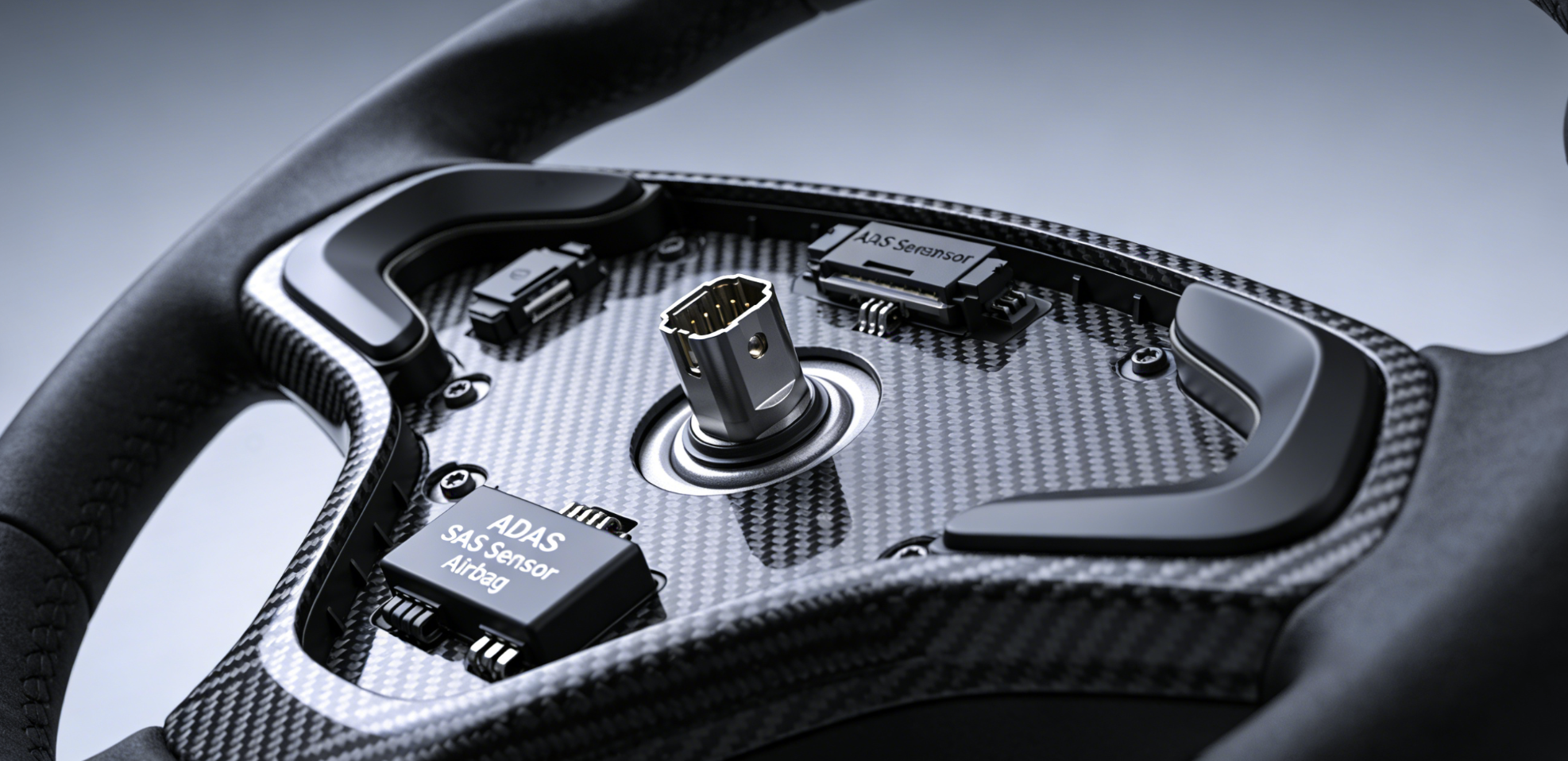
Most sellers skip this part. It’s the part that matters most on any vehicle built after 2024.
Swapping a steering wheel on a modern vehicle is not a simple bolt-on job. It’s a full systems decision. The wrong aftermarket wheel can clash with your car’s Steering Angle Sensor (SAS), knock out your airbag circuit, or trip ADAS faults that need a dealer-level scan tool to clear. Know what’s built into your stock wheel before you buy — and know what you’ll need to replace.
The 2026 ADAS Landscape Has Raised the Stakes
NHTSA’s 2026 NCAP evaluation now requires Blind Spot Warning (BSW), Blind Spot Intervention (BSI), Lane Keeping Assist (LKA), and Pedestrian Automatic Emergency Braking (PAEB) as standard criteria. Manufacturers are pushing these systems deeper into the steering column because of it.
Euro NCAP goes further. Their 2026 protocols include Driver Monitoring Systems (DMS) that detect drowsiness, distraction, and impairment through steering patterns and reaction times. Alter the wheel geometry, grip diameter, or spoke layout — and you shift the baseline data those systems rely on.
AEB becomes mandatory on all new U.S. passenger vehicles by September 2029, pedestrian detection included. That deadline is pushing OEM integration faster right now, across 2026 model builds.
What This Means for Your Aftermarket Upgrade
Federal legislation H.R. 6688 — advanced to committee February 10, 2026 — tells NHTSA to set modification tolerance guidelines by 2028. Until those rules exist, the responsibility falls on you.
Three things to check before installation:
-
SAS recalibration requirement: Most 2022+ vehicles need a SAS reset after any steering wheel swap. Skip it, and your stability control baseline gets corrupted.
-
Airbag clock spring compatibility: Your replacement wheel must keep proper clock spring continuity. A resistance mismatch can shut down the airbag system with no warning light — no safety net at all.
-
ADAS sensor clearance: Follow the 12×12-inch radar projection rule. No modification should block the sensor footprint behind the hub or column housing.
Your vehicle may run LiDAR-radar-camera fusion — this setup now appears in more 2026 production models. Check your OEM documentation before touching the column. These systems share calibration data across every connected part. One misaligned variable throws off the whole chain fast.
Bottom line: A quality carbon fiber steering wheel won’t damage your ADAS system. An incompatible installation will. Check your SAS specs. Confirm airbag circuit continuity. On a 2026 model year vehicle, look up whether your manufacturer has posted modification tolerances under the H.R. 6688 disclosure timeline. Some have. Most haven’t.
How to Identify High-Quality Carbon Fiber Construction (Buyer’s Authentication Guide)
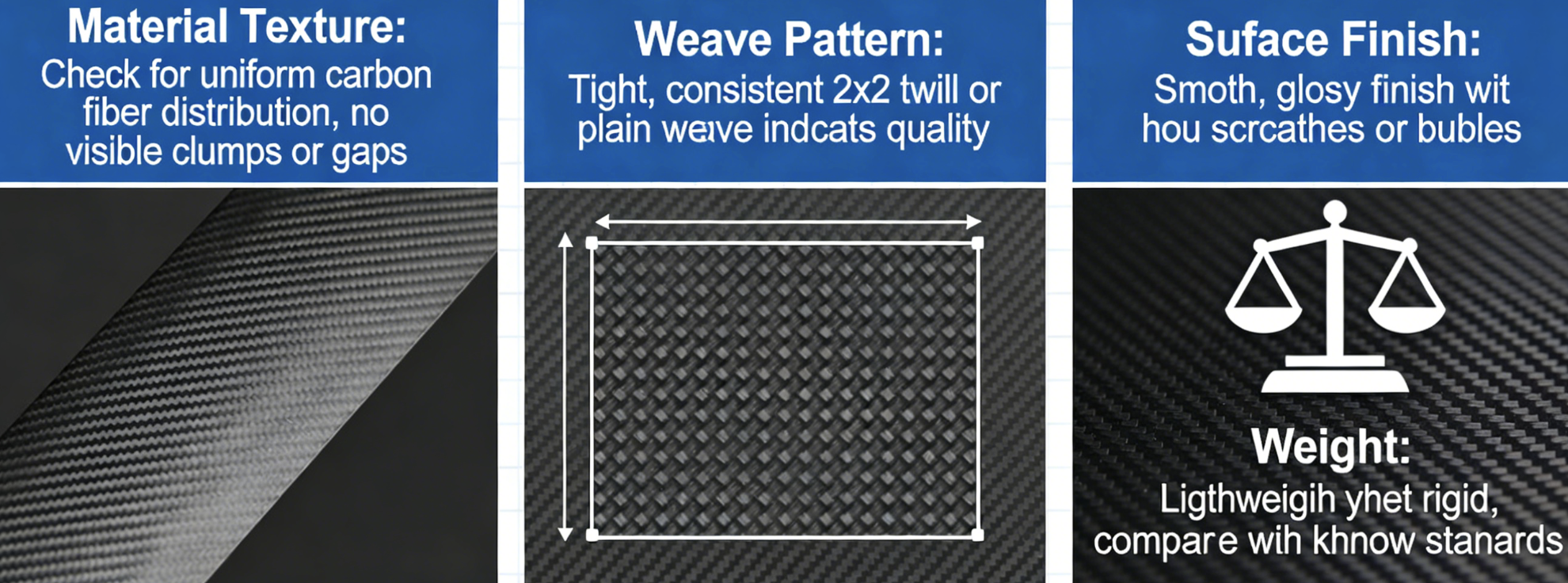
The carbon fiber steering wheel market is packed with products that look the same in photos — but feel completely different in your hands. Telling them apart before you buy is what separates a real upgrade from a costly mistake.
Here’s how to read a wheel like an expert.
Read the Fiber Pattern First
Flip the wheel over and look at the surface under direct light. Two patterns exist in the real market:
-
Unidirectional (UD): Parallel, straight fibers running one direction — no crossover, no weave. This gives you maximum tensile strength along the load path. Clean and linear.
-
Bidirectional (2×2 twill or plain weave): Fiber bundles crossing at regular intervals, perpendicular to each other. This is the classic woven carbon look.
Both are legitimate. What’s not: twisted, misaligned, or inconsistent fiber orientation. That’s a quality control failure — or a surface film wrapped over plastic.
Five Field Tests You Can Do Right Now
No lab needed. Just five minutes and a sharp eye.
-
Knock test — Tap the shell with your knuckle. Real carbon fiber produces a clear, high-pitched ping. Fakes give back a dull thud. That difference is void content you can hear.
-
Edge inspection — Check any cutout or trimmed edge. Genuine laminate shows depth greater than 2mm with an even resin-to-fiber ratio. A fake shows a thin surface film under 0.5mm — pure decoration over a cheap base.
-
Surface gloss check — Roll the wheel under consistent light. A quality cure gives you uniform 60–80° surface reflectance. Dull patches or uneven sheen point to inconsistent resin cure.
-
Weight feel — True carbon fiber lands at 1.5–1.8 g/cm³. Glass-filled plastic and fake CF composites go above 2.2 g/cm³. Feels heavier than it looks? Something’s off inside.
-
UV lamp test — Quality epoxy resin glows blue-violet under UV light. Cheap polyester resin fluoresces yellow-green — or shows nothing at all. That color difference also signals future problems: polyester starts losing structural strength within 1,000 hours of sun exposure.
What the Core Structure Tells You
The outer shell is half the story. The internal core is what determines how the wheel holds up under real load — especially during high-G cornering stress.
|
Core Type |
Flexural Deflection (5G load) |
Peak Load to Failure |
Real-World Result |
|---|---|---|---|
|
Aluminum Honeycomb |
<2 mm |
>15 kN |
High stiffness-to-weight, shear-resistant |
|
CNC Magnesium Alloy |
<1.5 mm |
>20 kN |
Superior rigidity, vibration damping |
|
Hollow Plastic / Foam |
>5 mm |
<8 kN |
Prone to crush and delamination |
A seller who can’t tell you what’s inside the hub structure? Treat it as foam until you see proof otherwise.
The Certifications That Matter
Good manufacturers document every batch — no exceptions. Look for cure logs that track temperature ramp (25°C to 180°C at 2–5°C per minute), vacuum levels below 25 inHg, and a post-cure anneal cycle at 200°C for 4–8 hours. No documentation means no accountability. It also means a 20–40% chance of hidden strength loss from under-cured voids.
Under ASTM standards, a real carbon fiber steering wheel component should reach tensile strength above 3,500 MPa (D3039) and interlaminar shear strength above 70 MPa (D2344). Ask for those numbers directly. A manufacturer who stands behind their product keeps them on file.
Grip Material Selection: Alcantara vs Perforated Leather vs Full Carbon Fiber
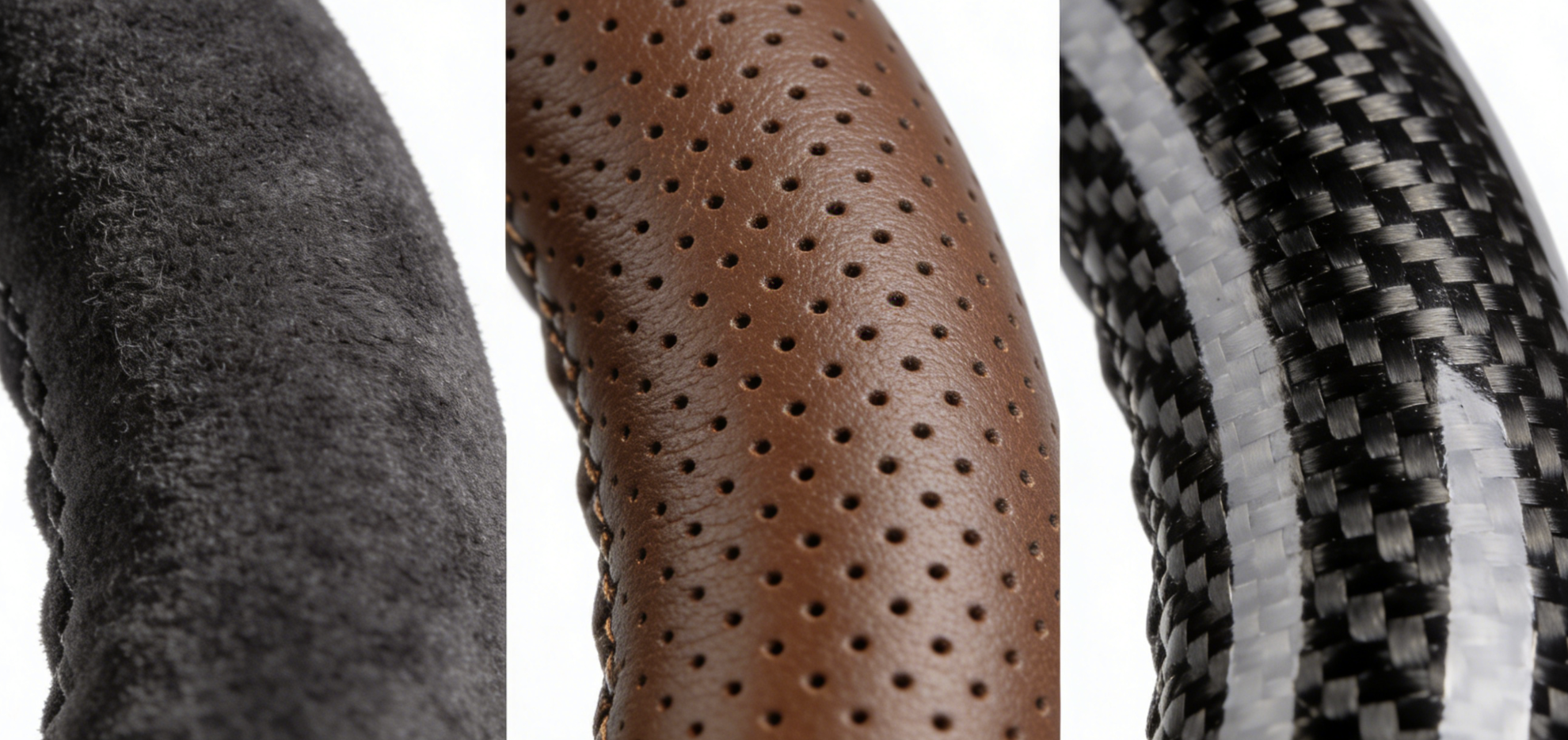
The shell is half the story. What your hands touch — that’s where the driving experience lives or dies.
Three grip materials dominate the carbon fiber steering wheel market in 2026. Each makes a different promise. One will suit your build. The others won’t.
Alcantara: The Racer’s Default
Ferrari uses it. Lotus uses it. There’s a reason.
Alcantara uses a non-woven microfiber structure. This creates a suede-like surface that leather can’t match. In dry conditions, those microfibers generate strong traction — more than smooth leather by a clear margin. In wet or sweaty conditions, the gap grows wider. Alcantara pulls moisture in rather than letting it sit on the surface. That’s what keeps your grip locked when your palms are working hard.
It also stays cooler than bare carbon fiber under direct sun. Most buyers don’t realize how much that matters until their first summer track day.
The tradeoff is maintenance. Sweat and skin oils break down the nap over time. Brush or vacuum the surface every week — that’s not optional. It’s the price of keeping that grip performance intact.
Perforated Leather: The Durable Middle Ground
Perforated leather doesn’t win on peak grip. It wins on longevity.
Simulated testing across 100,000 grip cycles shows leather outlasting Alcantara on wear resistance. It’s also easier to repair when damage shows up. The perforations move air through the surface better than solid leather. That cuts the sticky, heat-trapped feeling on long summer drives. In sustained summer cooling, ventilated leather outperforms Alcantara.
The limitation is straightforward: wet or bare hands on leather is a slip risk. It’s a stronger choice for drivers who run gloves, live in mild climates, or want low maintenance over maximum traction.
Full Carbon Fiber: Looks First, Grip Second
Bare carbon fiber on the grip surface is a visual statement. It’s not a performance tool. The slick surface has no microtexture, no moisture absorption, and no useful friction to speak of. Hold it for a while and it gets hot and sticky.
That’s not a knock — it’s a clarification. Full carbon fiber grips make sense on show cars and aesthetic builds. Gloves handle the grip work; the carbon fiber delivers the look. For street driving or endurance use, carbon fiber belongs on the shell — not the part your hands live on.
The Comparison at a Glance
|
Feature |
Alcantara |
Perforated Leather |
Full Carbon Fiber |
|---|---|---|---|
|
Dry Grip |
Exceptional |
Good |
Poor |
|
Wet/Sweaty Grip |
Superior |
Slippery |
Inferior |
|
Breathability |
High |
Moderate |
None |
|
Summer Heat |
Neutral |
Better than Alcantara |
Hot/sticky |
|
Durability |
Moderate (maintenance-dependent) |
High |
High (structural only) |
|
Best For |
Track, performance street |
Daily driving, mild climates |
Show cars, gloved racing |
One Detail Worth the Premium
Custom stitching — red, blue, yellow — carries real racing heritage. It also commands a 10–20% pricing premium in the aftermarket. A center stripe does more than look good. It adds 5–15% to resale value on performance vehicles. Plan to sell the build down the road? These details pay back.
The practical verdict: Alcantara for grip and feel. Perforated leather for durability and daily use. Full carbon fiber for the build that never leaves the show floor — or pairs with gloves on the track.
2026 Carbon Fiber Steering Wheel Buying Checklist: 8 Non-Negotiable Criteria
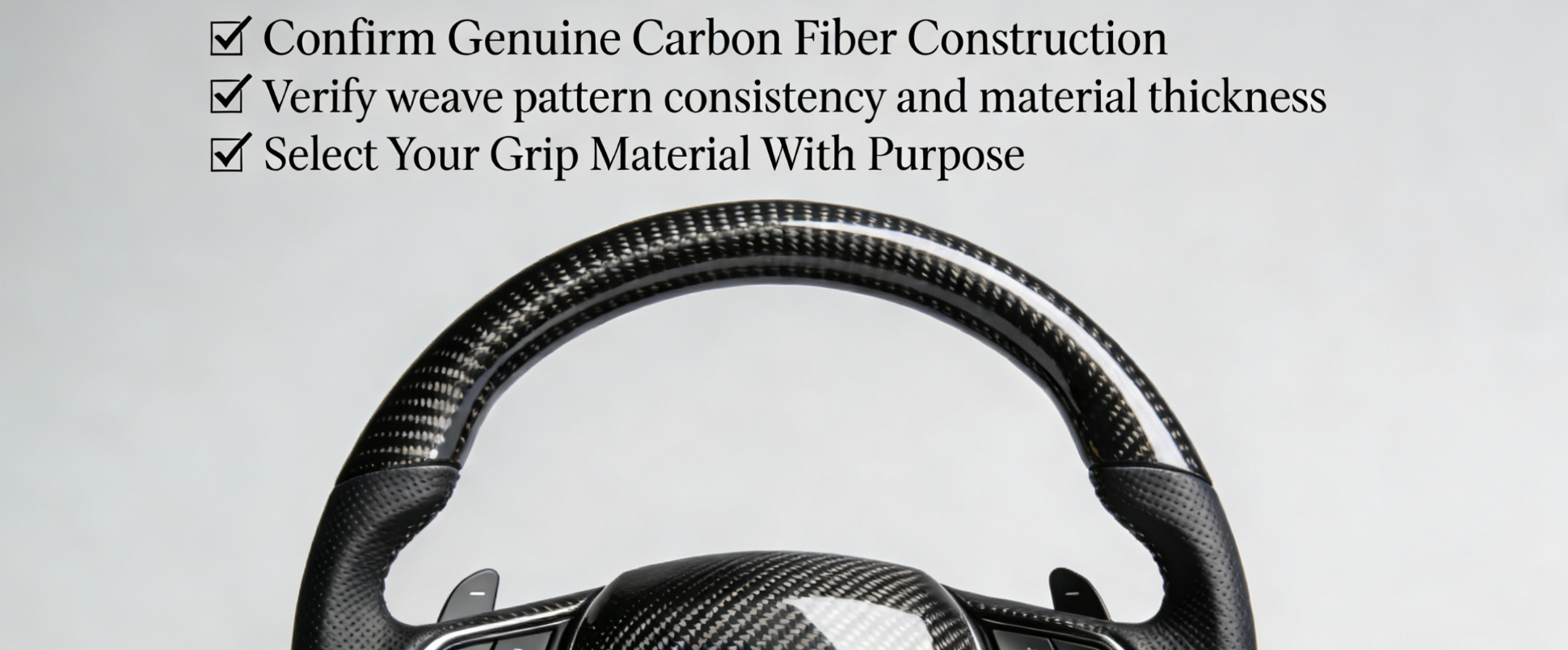
Eight criteria. Every serious buyer needs to go through all of them — not most, not the easy ones. All eight.
1. Confirm Genuine Carbon Fiber Construction
Not a wrap. Not a film. You want structural carbon fiber laminate built into the shell. Ask for cure documentation and ASTM test data before spending a dollar.
2. Verify Your Fitment Specs
Bolt pattern, thread pitch, hub diameter — these vary by model year. The 2026 Acura TLX uses a revised 3-spoke interface with a 72mm bolt pattern, 12mm thread pitch, and 22mm specifications. Get your car’s exact numbers first. A wheel that doesn’t fit is a very expensive paperweight.
3. Choose the Right Dimensions
Diameter, grip thickness, and dish depth all shape how the car feels in your hands. For a 2026 Subaru WRX, the target numbers are: 350–360mm outer diameter, 25–28mm grip thickness, 45–50mm dish depth. These aren’t suggestions. They’re the numbers that separate a wheel that works with your driving style from one that works against it.
4. Select Your Grip Material With Purpose
Alcantara gives you performance grip. Perforated leather holds up for daily use. Full carbon fits show builds. There’s no neutral choice here — pick based on how you actually drive.
5. Understand the Build Timeline
– Simple builds: 4 weeks minimum
– Standard custom builds: 6 weeks typical
– Complex builds — forged carbon, custom logos, heat function, carbon paddles: up to 10 weeks
Set your expectations to match the timeline. Rushing a custom build leads to disappointment.
6. Confirm Clockspring and Airbag Compatibility
The 2026 Mustang S650 runs a dual-stage, torque-sensing clockspring rated for 12,000 N·m rotational force. Your replacement wheel must keep clockspring continuity intact. A resistance mismatch does more than trigger a warning light — it shuts down your airbag system completely.
7. Lock In Your Build Sheet Before Production Starts
Good manufacturers review every order, catch any missing details, and send a complete build sheet for you to confirm. Nothing moves to the build schedule until you sign off. That step protects both sides. Don’t skip it.
8. Understand the Return Policy Before You Order
Custom steering wheels are built to your specs — materials sourced, over 20 hours of skilled labor put in. That’s why the industry standard restocking fee runs 35% on returns. Read the policy before you order. Know what you’re agreeing to. Buyer’s remorse on a custom build is a costly lesson.
Run through this list once before you order. Every item on it reflects a mistake someone else already made.
Carbon Fiber Steering Wheel Care & Longevity: Protecting Your Investment

A quality carbon fiber steering wheel lasts 10–15 years. A neglected one starts failing in three.
The gap isn’t material quality — it’s maintenance. Here’s what the routine looks like:
Weekly cleaning: Use pH-neutral soap, water, and a soft microfiber cloth. Nothing abrasive. No silicone-based products. No strong acids or alkalis — keep pH between 4 and 9. These don’t just scratch the surface. They break down the resin underneath.
Quarterly protection: Apply a carbon-specific sealant. It builds a UV and scratch barrier. This stops the epoxy from yellowing under direct sun. Skip this step and unprotected resin starts discoloring within a season.
For Alcantara grips: Use a foam-based cleaner only, pH 6–8. Apply it to the cloth — never straight onto the surface. Air dry. No heat.
For leather grips: Use a mild water-based leather cleaner, pH 4.5–6.5. Apply conditioner lightly after cleaning. Too much conditioner clogs the perforations.
Three warning signs to watch on the carbon shell:
– Hairline micro-cracks visible under direct light
– White delamination patches where resin has bleached out
– Unusual flex when you press the structure
Spot these signs fast. Carbon cracks don’t stop spreading on their own.
Hand oils and sweat speed up surface wear by 20–30% without regular conditioning. That’s a big deal. Over years of driving every day, it’s the difference between a wheel that holds its value and one that doesn’t.
Frequently Asked Questions (Long-Tail Coverage)
Real questions from real drivers. These come up all the time — and they deserve straight answers.
Is a carbon fiber steering wheel legal for street use?
Yes — in most jurisdictions. The key condition is airbag retention. Your vehicle came with an airbag? Local road regulations require it stays active. A quality aftermarket carbon fiber wheel, paired with a proper hub adapter and clockspring, keeps that system intact. Check your state or country’s vehicle modification laws before installation.
Will swapping the steering wheel disable my airbag?
Not if you install it correctly. The airbag circuit runs through the clockspring. Match the resistance spec and maintain continuity. The system stays live. Get it wrong, and the airbag deactivates — with no warning light and no backup. That’s why clockspring compatibility isn’t a footnote. It’s the first thing to confirm.
Can I install a carbon fiber steering wheel myself?
On the mechanical side, yes. It depends on your vehicle, though. Pre-2020 platforms are simple and straightforward. Vehicles running ADAS, torque-sensing clocksprings, or Driver Monitoring Systems — 2024 models and newer — need SAS recalibration after the swap. That requires a scan tool. Know your platform before you go the DIY route.
How do I know if the carbon fiber is real or just a wrap?
Knock on it. Real carbon fiber rings sharp and clear. Plastic with a carbon film thuds. Check the edge of any cutout — genuine laminate shows depth above 2mm. A surface film shows under 0.5mm. Not sure? Ask the seller for ASTM test data. A manufacturer confident in their product keeps those numbers on file.
Does carbon fiber get hot in the sun?
Less than bare aluminum. More than leather. Alcantara-wrapped carbon fiber handles summer heat better than a bare shell. It also stays far cooler than a dark leather wheel sitting under direct sun. Park outdoors a lot? A steering wheel cover or window shade fixes the problem completely.
What’s the right size for a carbon fiber steering wheel?
For performance driving: 350–360mm diameter, 25–28mm grip thickness. A smaller diameter sharpens steering feel and cuts effort. Go too small, and street driving gets tiring fast. Match the dimensions to how you use the car day-to-day — not just how it looks in photos.
Conclusion
Your steering wheel is the one part of your car that never stops talking to you. Every corner, every correction, every split-second decision passes through it. Upgrading to a genuine carbon fiber steering wheel isn’t about looks. It’s about making that conversation cleaner and sharper.
A real structural carbon fiber wheel and a vinyl-wrapped imitation are worlds apart. The gap isn’t just the material. It’s years of driving experience packed into every gram you didn’t add. Lighter inputs. Faster feedback. A cockpit that feels worthy of the machine beneath you.
Quality matters more than ever in 2026. ADAS calibration requirements are stricter now. Counterfeit carbon products are flooding the market. Buying blind is a risk no serious driver should take.
Do the research. Verify the construction. Demand the documentation.
Contact HyperX Carbon – Your Trusted Chinese Carbon Fiber Partner
Ready to source high-performance carbon fiber materials or custom forged carbon fiber parts from China?
HyperX Carbon is a leading manufacturer with 20+ years of expertise, specializing in aerospace-grade forged carbon fiber, prepreg, carbon fiber tube, carbon fiber sheet, and lightweight carbon fiber automotive parts/carbon fiber drone components/carbon fiber medical components. We offer:
-
Stable supply chain with premium raw materials (Toray, Mitsubishi, Hengshen)
-
AS9100D certified production for aerospace & UAV applications
-
Rapid prototyping (5-8 weeks) and monthly capacity exceeding 180,000 parts
-
Competitive pricing with 15-18% cost savings on forged carbon solutions
-
Full customization: from T700/T1100G to ultra-high modulus grades
Whether you’re an eVTOL developer, automotive OEM, drone manufacturer, or medical device engineer, HyperX delivers consistent quality, batch-to-batch reliability, and reliable delivery.
Get in touch today for a free consultation, custom quote, or material sample.
📧 Email: [email protected]
🌐 Website: https://www.hyperxcarbon.com/
📞 Phone/WhatsApp: +86 15623270276 (English support available)
Let’s build your next lightweight innovation together – contact HyperX Carbon now and stay ahead in the low-altitude and advanced composites market.




